and Segmental Housing Price Change Due to Volatility of the Housing Price in South Korea.
Association Of Korean Economic Studies. 33(4):31- 60.
주현순. 2012. 대도시간 아파트 매매가격 상승 률의 전이 관계 분석. 석사학위논문. 부산대학 교.
Joo, HS. 2012. (An) Empirical Study on the Effect of Apartment Price Change in Area on Those in Metropolitan Area. [master's thesis]. Bu-San University.
한국감정원. 2016. 부동산거래현황통계[인터넷]. [http://
www.kab.co.kr/]. 2016년9월 2일 검색
Korea Appraisal Board. 2016. Status of real estate transaction statistics[Internet]. [http://www .kab.co.kr/]. Last accessed 2 September 2016.
2016년 10월 07일 원고접수(Received) 2016년 10월 28일 1차심사(1st Reviewed) 2016년 11월 24일 2차심사(2st Reviewed) 2016년 12월 07일 게재확정(Accepted)
초 록
본 연구의 목적은 최근 증가하고 있는 우리나라 아파트의 거래원인 가운데 하나인 분양권 전매비 율을 중심으로 지역 간 특성을 파악하는데 있다. 이를 위해 162개 시·군 지역을 중심으로 인구특성, 아파트거래 및 분양특성, 주거특성, 경제적 특성을 살펴보았으며 분양권전매비율을 종속변수로 하는 다중회귀분석을 실시하였다. 그 결과 통계적으로 유의한 변수는 아파트 비율, 인구 증가율, 분양물량 평균 아파트 매매가격 대비 전세가격 비율, 1인 가구 증가율, 청약 경쟁률, 지역 내 매입자 거래호수 등 7개의 변수가 분양권 전매비율에 영향을 미치는 것으로 나타났다. 각 지역특성으로는 주거특성, 인구특성, 아파트거래 및 분양특성 순으로 영향을 미치는 것으로 나타났다. 본 결과로 아파트 시장에 서 실수요자 중심의 거래를 활성화 하기위한 정부의 정책과 제도의 개선에 바탕이 되는 기초자료가 될 것으로 판단된다.
주요어 : 분양권 전매비율, 아파트 매매, 다중회귀분석, 아파트, 지역 특성
지적분야 과정평가모형 구축에 관한 연구
*A Study on the Establishment of Course evaluation model in the Cadastral Field
서용수** · 최승영***
Seo, Yong-Su · Choi, Seung-Young
Abstract
The current government strives to train those supposed to drive the national economy, and bridge the gap between qualification and industrial sites through competency-based qualification systems, not the educational background. In this regards, the government is planning to adopt the course evaluation qualification system.
The course evaluation qualification system, on a basis of the NCS, is a system to qualify certain people completing the education and training fulling a specific requirement for a national technical qualification in case they meet the internally and externally assessed criteria. This can be seen as an attempt to practically link between job training and qualifications.
The NCS model and learning module in the cadastral field are already utilized as the training and eduction in the specialized school and colleges. However, the current national technical qualification system is considered as a main system because the course evaluation qualification system has not been introduced yet.
This study analyzed the process of the course evaluation qualification system, and conducted a survey to solicit feedback on introduction of course evaluation qualification system, Besides, the NCS evaluation model is presented in order for the introduction of course evaluation qualification system in the cadastral fields.
Keywords: NCS(National Competency Standards), Competency unit, Learning module. Course Evaluation Qualification System.
1. 서 론
1.1. 연구의 필요성 및 목적
현 정부는 자격과 교육훈련이 산업현장과 불일치되 는 문제점을 해소하기 위하여 스펙이 아닌 능력중심 의 자격제도로 변화를 요구하고 있으며, 그 일환으로
* This study is an excerpt rewritten by the first author doctoral thesis.
** 한국국토정보공사 공간정보연구원 선임연구원 LX Spatial Information Research Institute (First author: [email protected])
*** 목포대학교 지적학과 교수 Department of Land Administration, Mokpo National University(Corresponding author:
국가직무능력표준(NCS)1) 및 학습모듈 개발을 통하여 산업현장에서 필요한 능력중심의 자격제도로 변모를 꾀하고 있다. 또한 NCS 및 학습모듈을 바탕으로 과정 평가형 자격제도를 도입, 시행하고 있으며 시행종목 을 점차적으로 확대하고 있다.
NCS와 관련하여서는 고용노동부 산하 한국산업인 력공단에서 주축이 되어 개발하고 있으며, NCS를 기 반으로 하는 학습모듈은 교육부 산하 한국직업능력개 발원에서 개발을 하고 있다.
현행 우리나라에서 국가기술자격을 취득할 수 있는 방법은 한국산업인력공단에서 시행하는 국가기술자 격시험을 통과하거나 과정평가형 과정을 이수하고 자 격을 취득하는 방법이 있다. 국가기술자격검정 및 과 정평가형 자격제도 둘 다 한국산업인력공단에서 병행 하여 시행중에 있으나 점진적으로 과정평가형 자격제 도를 확대하고 있는 상황이다.
지적분야의 NCS 및 학습모듈의 경우 특성화고등학 교 및 전문대학에서 교육‧훈련에 활용하고 있으나, 이 에 대한 자격취득방법이 부재하고 과정평가형 자격제 도가 도입되지 않아 지적분야의 자격을 취득하기 위 해서는 NCS와 연관이 없는 국가기술자격시험에 의존 하여야 하는 모순점이 존재한다. 따라서 산업현장에 필요한 인재양성을 목적으로 하고 있는 NCS와 부합 하기 위해서도 지적분야의 과정평가형 자격제도 도입 이 시급한 실정이다.
지적분야 NCS와 관련한 연구동향을 살펴보면 이용 호·서철수(2014)는 NCS의 직무구분과 용어에 대한 명확한 법률적 정의를 통하여 지적의 정체성을 확보 할 것을 주장하였으며, 이러한 법률적 근거에 의하여 NCS 능력단위를 바탕으로 교육 및 국가기술자격을 새로이 설정할 것을 제안하였다.
서용수 외 2인(2015)은 지적분야 NCS 능력단위 및 능력단위요소를 검토하여 세분류 단위로 분류될 내용 들을 추출하고, 최하위 세분류 단계의 지적을 상위단 계의 소분류로 지정하여 분류체계를 개선하여야 한다
는 의견을 제시하였다.
위의 선행연구들을 살펴보면 NCS 개선에 대한 다 양한 의견을 제시하였으나, 지적분야 과정평가형 자 격제도에 대한 종합적인 접근을 수행하지 못하였다고 판단된다. 따라서 본 연구는 문헌조사 및 설문응답 분 석을 통하여 지적분야 과정평가형 자격제도에 대한 시사점을 도출하고자 하였다.
본 연구의 시간적 범위는 지적분야 NCS가 개발된 2014년부터 학습모듈 개발기간인 2015년까지 특정하 고자 하며, 연구의 내용적 범위는 지적분야 과정평가 모형 구축에 한정하고자 한다.
연구의 방법으로는 한국산업인력공단에서 시행중 인 과정평가형 자격제도를 면밀히 분석하고, 과정평 가형 자격제도 도입에 대한 의견을 수렴하기 위하여 지적분야 산업계 종사자 및 NCS 개발전문가, 한국산 업인력공단 실기시험담당자를 대상으로 설문조사를 실시하였으며, 이를 바탕으로 향후 지적분야 과정평 가형 자격제도 도입을 위한 NCS기반의 평가모형을 제시하고자 한다.
2. 과정평가형 자격제도의 개요 및 분석 2.1. 과정평가형 자격제도 개요
과정평가형 자격제도는 국가직무능력표준(NCS)에 기반하여 일정 요건을 충족하는 교육‧훈련과정을 이 수하고 내‧외부 평가를 거쳐 합격기준에 해당하는 경 우, 국가기술자격시험을 거치지 않고 국가기술자격을 부여하는 자격제도로 이미 미국, 호주 등 일부 선진국 에서는 직업교육 및 훈련을 바탕으로 하는 자격제도 를 운용 중에 있다.
과정평가형 자격제도 도입 목적은 일-교육‧훈련- 자격 상호간 연계를 강화하고, 자격취득자의 현장성 향상과 사회적 지위향상에 기여함을 목적으로 한다.
이러한 과정평가형 자격제도는 국가직무능력표준에
Application submission
written test
practical test Application submission
written test
practical test
Certification issued Certification issued
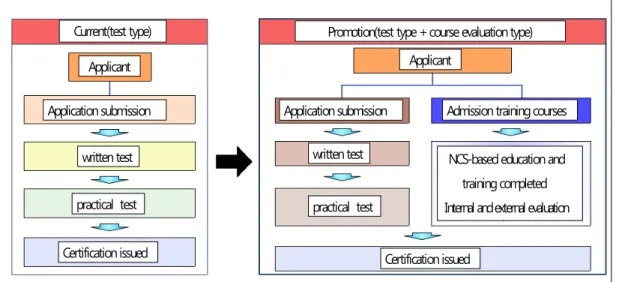
Current(test type) Promotion(test type + course evaluation type) Applicant
Applicant
Admission training courses
NCS-based education and training completed Internal and external evaluation
Figure 1. National technical qualification test method validation Source: NCS 2016 기반하여 교육‧훈련과정 운영 내실화를 통해 국가기
술자격 취득이 가능하도록 하기 위함이다. 즉, 과정평 가형 자격제도는 산업현장에서 요구하는 인재를 육성 하기 위하여 직업교육·훈련과 자격을 본격적으로 연 계하기 위한 시도라고 할 수 있다.
우리나라는 2014년 5월 자격제도 개선의 일환으로 국가기술자격법을 개정하여 과정평가형 자격제도 도 입에 대한 법적 기반2)을 마련하였다. 2016년 현재 총 30개 종목에서 과정평가형 자격제도를 시행하고 있으 며, 시행기관들은 특성화고등학교, 전문대학, 한국폴 리텍대학, 직업전문학교 등 다양한 기관에서 과정평 가형 자격에 따른 교육·훈련을 실시하고 있다.
2.2. 과정평가형 자격제도 분석
현행 우리나라에서 국가기술자격을 취득하고자 할 경우에는 국가기술자격검정에 합격하거나, 정책심의 회의 심의를 거쳐 주무부장관이 지정하는 교육․훈련과 정을 이수하고 대통령령으로 정하는 합격기준을 충족할 경우 자격취득이 가능하다고 법령에 명시하고 있다.3)
과정평가형 자격제도는 직업교육․훈련 및 자격제도 가 산업현장과 불일치된다는 문제점4)이 제기되어 산 업현장을 중심으로 직업교육 및 훈련, 자격이 유기적 으로 연계될 수 있는 방안의 하나로 도입을 추진하게 되었다. 이는 현행 검정형 자격시험의 경우 단순 암기 위주의 자격검정으로 인해 자격을 취득하였어도 산업 현장의 직무를 원활하게 수행하지 못하는 경우가 빈 번히 발생되므로 직업능력개발의 현장성 및 효율성을 제고하고, 현장에서 요구하는 인재를 검증․배출할 수 있도록 하는데 목적이 있다.
과정평가형 자격제도는 「제3차 국가기술자격 제 도발전 기본계획」에 따라 2015년부터 일부 종목에 한하여 시행되고 있다.5)
현행 한국산업인력공단에서 운영하고 있는 국가기 술자격제도는 검정형자격제도와 과정평가형 자격제 도로 병행하여 운영하되, 우선 기능사 및 산업기사 등 급의 일부분야에 도입하고 단계적 확산을 추진하고 있다. 이에 따라 특성화고 대상 기능사 필기시험 면제 제도는 단계적으로 과정평가형 자격제도로 전환할 계 획이다.6)
국가직무능력표준(NCS)1) 및 학습모듈 개발을 통하여 산업현장에서 필요한 능력중심의 자격제도로 변모를 꾀하고 있다. 또한 NCS 및 학습모듈을 바탕으로 과정 평가형 자격제도를 도입, 시행하고 있으며 시행종목 을 점차적으로 확대하고 있다.
NCS와 관련하여서는 고용노동부 산하 한국산업인 력공단에서 주축이 되어 개발하고 있으며, NCS를 기 반으로 하는 학습모듈은 교육부 산하 한국직업능력개 발원에서 개발을 하고 있다.
현행 우리나라에서 국가기술자격을 취득할 수 있는 방법은 한국산업인력공단에서 시행하는 국가기술자 격시험을 통과하거나 과정평가형 과정을 이수하고 자 격을 취득하는 방법이 있다. 국가기술자격검정 및 과 정평가형 자격제도 둘 다 한국산업인력공단에서 병행 하여 시행중에 있으나 점진적으로 과정평가형 자격제 도를 확대하고 있는 상황이다.
지적분야의 NCS 및 학습모듈의 경우 특성화고등학 교 및 전문대학에서 교육‧훈련에 활용하고 있으나, 이 에 대한 자격취득방법이 부재하고 과정평가형 자격제 도가 도입되지 않아 지적분야의 자격을 취득하기 위 해서는 NCS와 연관이 없는 국가기술자격시험에 의존 하여야 하는 모순점이 존재한다. 따라서 산업현장에 필요한 인재양성을 목적으로 하고 있는 NCS와 부합 하기 위해서도 지적분야의 과정평가형 자격제도 도입 이 시급한 실정이다.
지적분야 NCS와 관련한 연구동향을 살펴보면 이용 호·서철수(2014)는 NCS의 직무구분과 용어에 대한 명확한 법률적 정의를 통하여 지적의 정체성을 확보 할 것을 주장하였으며, 이러한 법률적 근거에 의하여 NCS 능력단위를 바탕으로 교육 및 국가기술자격을 새로이 설정할 것을 제안하였다.
서용수 외 2인(2015)은 지적분야 NCS 능력단위 및 능력단위요소를 검토하여 세분류 단위로 분류될 내용 들을 추출하고, 최하위 세분류 단계의 지적을 상위단 계의 소분류로 지정하여 분류체계를 개선하여야 한다
는 의견을 제시하였다.
위의 선행연구들을 살펴보면 NCS 개선에 대한 다 양한 의견을 제시하였으나, 지적분야 과정평가형 자 격제도에 대한 종합적인 접근을 수행하지 못하였다고 판단된다. 따라서 본 연구는 문헌조사 및 설문응답 분 석을 통하여 지적분야 과정평가형 자격제도에 대한 시사점을 도출하고자 하였다.
본 연구의 시간적 범위는 지적분야 NCS가 개발된 2014년부터 학습모듈 개발기간인 2015년까지 특정하 고자 하며, 연구의 내용적 범위는 지적분야 과정평가 모형 구축에 한정하고자 한다.
연구의 방법으로는 한국산업인력공단에서 시행중 인 과정평가형 자격제도를 면밀히 분석하고, 과정평 가형 자격제도 도입에 대한 의견을 수렴하기 위하여 지적분야 산업계 종사자 및 NCS 개발전문가, 한국산 업인력공단 실기시험담당자를 대상으로 설문조사를 실시하였으며, 이를 바탕으로 향후 지적분야 과정평 가형 자격제도 도입을 위한 NCS기반의 평가모형을 제시하고자 한다.
2. 과정평가형 자격제도의 개요 및 분석 2.1. 과정평가형 자격제도 개요
과정평가형 자격제도는 국가직무능력표준(NCS)에 기반하여 일정 요건을 충족하는 교육‧훈련과정을 이 수하고 내‧외부 평가를 거쳐 합격기준에 해당하는 경 우, 국가기술자격시험을 거치지 않고 국가기술자격을 부여하는 자격제도로 이미 미국, 호주 등 일부 선진국 에서는 직업교육 및 훈련을 바탕으로 하는 자격제도 를 운용 중에 있다.
과정평가형 자격제도 도입 목적은 일-교육‧훈련- 자격 상호간 연계를 강화하고, 자격취득자의 현장성 향상과 사회적 지위향상에 기여함을 목적으로 한다.
이러한 과정평가형 자격제도는 국가직무능력표준에
Application submission
written test
practical test Application submission
written test
practical test
Certification issued Certification issued
Current(test type) Promotion(test type + course evaluation type) Applicant
Applicant
Admission training courses
NCS-based education and training completed Internal and external evaluation
Figure 1. National technical qualification test method validation Source: NCS 2016 기반하여 교육‧훈련과정 운영 내실화를 통해 국가기
술자격 취득이 가능하도록 하기 위함이다. 즉, 과정평 가형 자격제도는 산업현장에서 요구하는 인재를 육성 하기 위하여 직업교육·훈련과 자격을 본격적으로 연 계하기 위한 시도라고 할 수 있다.
우리나라는 2014년 5월 자격제도 개선의 일환으로 국가기술자격법을 개정하여 과정평가형 자격제도 도 입에 대한 법적 기반2)을 마련하였다. 2016년 현재 총 30개 종목에서 과정평가형 자격제도를 시행하고 있으 며, 시행기관들은 특성화고등학교, 전문대학, 한국폴 리텍대학, 직업전문학교 등 다양한 기관에서 과정평 가형 자격에 따른 교육·훈련을 실시하고 있다.
2.2. 과정평가형 자격제도 분석
현행 우리나라에서 국가기술자격을 취득하고자 할 경우에는 국가기술자격검정에 합격하거나, 정책심의 회의 심의를 거쳐 주무부장관이 지정하는 교육․훈련과 정을 이수하고 대통령령으로 정하는 합격기준을 충족할 경우 자격취득이 가능하다고 법령에 명시하고 있다.3)
과정평가형 자격제도는 직업교육․훈련 및 자격제도 가 산업현장과 불일치된다는 문제점4)이 제기되어 산 업현장을 중심으로 직업교육 및 훈련, 자격이 유기적 으로 연계될 수 있는 방안의 하나로 도입을 추진하게 되었다. 이는 현행 검정형 자격시험의 경우 단순 암기 위주의 자격검정으로 인해 자격을 취득하였어도 산업 현장의 직무를 원활하게 수행하지 못하는 경우가 빈 번히 발생되므로 직업능력개발의 현장성 및 효율성을 제고하고, 현장에서 요구하는 인재를 검증․배출할 수 있도록 하는데 목적이 있다.
과정평가형 자격제도는 「제3차 국가기술자격 제 도발전 기본계획」에 따라 2015년부터 일부 종목에 한하여 시행되고 있다.5)
현행 한국산업인력공단에서 운영하고 있는 국가기 술자격제도는 검정형자격제도와 과정평가형 자격제 도로 병행하여 운영하되, 우선 기능사 및 산업기사 등 급의 일부분야에 도입하고 단계적 확산을 추진하고 있다. 이에 따라 특성화고 대상 기능사 필기시험 면제 제도는 단계적으로 과정평가형 자격제도로 전환할 계 획이다.6)
이러한 과정평가형 자격제도는 NCS를 기반으로, 교육 및 훈련과정을 개편하므로 과정평가형 자격제도 의 교육 및 훈련과정 기본자료로 NCS 학습모듈이 활
용되며, 교육․훈련 및 내,외부 평가를 1:1 비율로 합산 하여 80점 이상인 교육․훈련생을 합격자로 결정하고 자격증을 발급하고 있다.
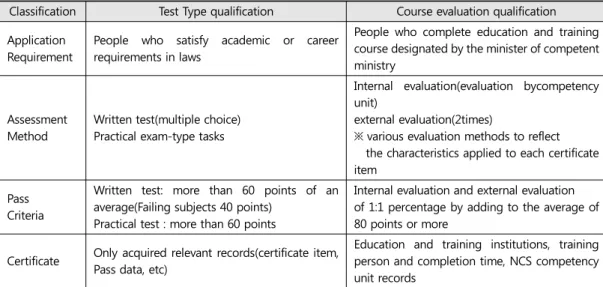
Table 1. Compare to test type qualification and course evaluation qualification
Classification Test Type qualification Course evaluation qualification Application
Requirement
People who satisfy academic or career requirements in laws
People who complete education and training course designated by the minister of competent ministry
Assessment Method
Written test(multiple choice) Practical exam-type tasks
Internal evaluation(evaluation bycompetency unit)
external evaluation(2times)
※ various evaluation methods to reflect the characteristics applied to each certificate item
Pass Criteria
Written test: more than 60 points of an average(Failing subjects 40 points)
Practical test : more than 60 points
Internal evaluation and external evaluation of 1:1 percentage by adding to the average of 80 points or more
Certificate Only acquired relevant records(certificate item, Pass data, etc)
Education and training institutions, training person and completion time, NCS competency unit records
Table 2. Course evaluation qualification execution Field Source: MELR 2014
Classification enforcement item
2015 enforce ment
Industrial Engineer
(7 field)
Industrial engineer computer aided manufacturing, Industrial engineer machine fitting, Industrial engineer machinery design, Industrial engineer jig fixture design, Industrial engineer pricision measuring, Industrial engineer injection mould making, Industrial engineer press die making
Technician (8 field)
Craftsman computer aided lathe, Craftsman computer aided milling, Craftsman machine fitting, Craftsman Grinding, Craftsman hydro-pneumatic, Craftsman computer aided mechanical drawing, Industrial engineer precision measuring, Craftsman metal mold
2016 enforce
ment
Industrial Engineer
(3 field)
Industrial engineer welding, Industrial engineer manufacturing automatization, Industrial engineer precious metal processing
Technician (11 field)
hairdresser, barber, Craftsman chemical analysis, Craftsman inert gas arc welding, Craftsman electronic apparatus, Craftsman electronic CAD, Craftsman production automatic operation, Craftsman precious metal processing, Craftsman overhead travelling crane operator, Craftsman tower crane operating
Service
(1 field) Convention meeting planners 2grade
검정형 자격제도와 과정평가형 자격제도의 가장 큰 차이점은 주무부 장관으로부터 지정받은 교육‧훈련 기관에서 교육‧훈련과정 이수를 통하여 과정평가형 자격을 취득할 수 있다는 점이다. 이는 검정형 자격이 제한된 시간내 한정된 직무내용을 평가하여 자격을 부여하는 제도였다면, 과정평가형 자격제도는 교육‧
훈련과정의 전 기간을 통하여 주어진 내용을 체계적 으로 이수했는지를 NCS능력단위를 중심으로 평가한 다는 점에서 차이가 있다.
3. 지적분야 과정평가형 자격제도 도입에 대한 설문조사 및 분석
3.1. 설문조사 설계
설문조사는 현재 지적분야에서 도입하고 있지 않는 과정평가형 자격제도에 대한 의견수렴을 목적으로 하 였다. 설문분석에 대한 모집단 선정은 현재 지적분야 에 종사하고 있는 산업계 및 NCS 및 학습모듈 개발 전 문가를 대상으로 하였으며, 국가기술자격과 관련된 실기시험 담당자의 의견도 포함하여 분석을 실시하였 다. 이는 지적분야 NCS가 실무능력 검증에 밀접하게 연결되어 있으므로 산업계에 종사하고 있는 의견수렴 이 필요하였으며, NCS 및 학습모듈 개발에 참여하였 던 전문가 그룹의 의견 및 국가기술자격 실기시험 담 당자에 대한 의견을 수렴하여 과정평가모형 설계에 반영하고자 하였다.
지적분야 과정평가형 자격제도 도입여부에 대한 의 견을 5점 척도로 분류하여 조사 하였으며, 지적분야 국가기술자격검정시험을 통과하고 자격을 취득한 경 우에 지적분야 산업현장 직무수행 가능여부를 조사하 였다. 또한 지적분야 NCS 학습모듈 교육훈련을 이수
하고 과정평가형 자격제도를 통하여 자격을 부여받은 경우 국가기술자격검정시험에 합격하여 자격을 취득 한 경우보다 지적분야 산업현장 직무수행이 유리한지 에 대한 조사를 실시하였으며, 현행 특성화고등학교 및 2년제 전문대학에 적용중인 NCS를 4년제 대학 도 입여부에 대한 의견을 수렴하였다.
설문조사는 지적분야에 종사하는 공무원 및 산업체 종사자 155명, NCS 및 학습모듈 개발에 참여한 전문 가 12명, 산업인력공단 실기시험 담당자 8명 등 총 175명을 대상으로 설문조사를 실시하였으며, 수집된 설문응답은 SPSS Statistics 23 통계 패키지를 활용하 여 분석하였다.
3.2. 설문분석
3.2.1. 과정평가형 자격제도 지적분야 도입 여부
현행 한국산업인력공단에서 운용하고 있는 자격 취 득방식은 국가기술자격검정을 통하여 자격을 취득하 는 경우와 과정평가형 자격제도를 통하여 자격을 취 득하는 이원적 형태로 자격 운용이 이루어지고 있으 며, 점진적으로 과정평가형 자격제도를 점차 확대하 고 있다.
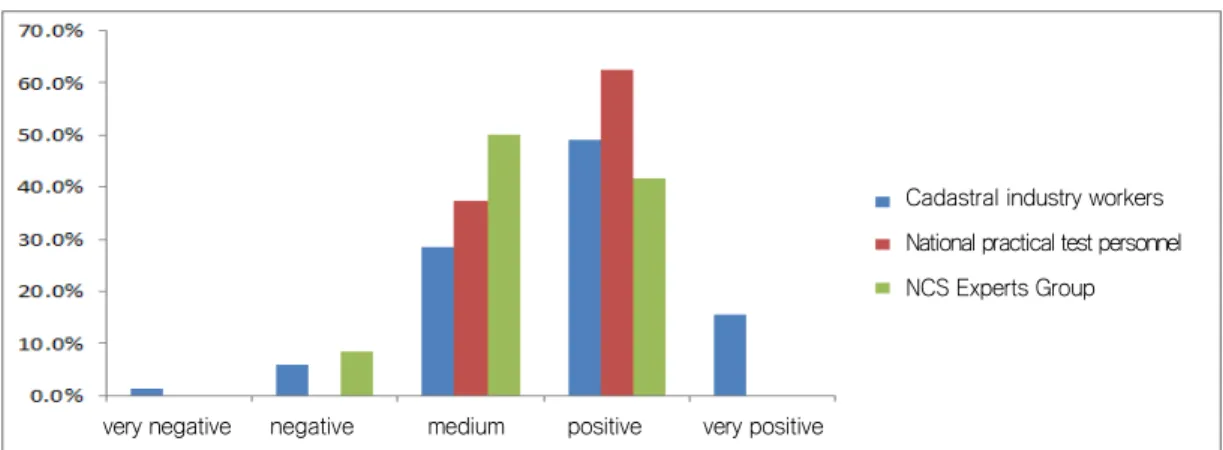
지적분야에서는 아직 과정평가형 자격제도를 시행 하고 있지 않으나, 설문결과 지적분야에도 도입하여 야 한다는 긍정적인 답변(매우 긍정 포함)이 지적분야 산업계에서는 54.5%, 국가기술자격검정 실기시험 담 당자는 62.5%, NCS 전문가그룹에서는 41.7%로 나타 났다. 이는 과정평가형 자격제도가 지적분야 산업계 에서 요구하고 있는 업무수행에 필요한 지식과 기술 을 습득할 수 있기 때문인 것으로 파악된다.
이러한 과정평가형 자격제도는 NCS를 기반으로, 교육 및 훈련과정을 개편하므로 과정평가형 자격제도 의 교육 및 훈련과정 기본자료로 NCS 학습모듈이 활
용되며, 교육․훈련 및 내,외부 평가를 1:1 비율로 합산 하여 80점 이상인 교육․훈련생을 합격자로 결정하고 자격증을 발급하고 있다.
Table 1. Compare to test type qualification and course evaluation qualification
Classification Test Type qualification Course evaluation qualification Application
Requirement
People who satisfy academic or career requirements in laws
People who complete education and training course designated by the minister of competent ministry
Assessment Method
Written test(multiple choice) Practical exam-type tasks
Internal evaluation(evaluation bycompetency unit)
external evaluation(2times)
※ various evaluation methods to reflect the characteristics applied to each certificate item
Pass Criteria
Written test: more than 60 points of an average(Failing subjects 40 points)
Practical test : more than 60 points
Internal evaluation and external evaluation of 1:1 percentage by adding to the average of 80 points or more
Certificate Only acquired relevant records(certificate item, Pass data, etc)
Education and training institutions, training person and completion time, NCS competency unit records
Table 2. Course evaluation qualification execution Field Source: MELR 2014
Classification enforcement item
2015 enforce ment
Industrial Engineer
(7 field)
Industrial engineer computer aided manufacturing, Industrial engineer machine fitting, Industrial engineer machinery design, Industrial engineer jig fixture design, Industrial engineer pricision measuring, Industrial engineer injection mould making, Industrial engineer press die making
Technician (8 field)
Craftsman computer aided lathe, Craftsman computer aided milling, Craftsman machine fitting, Craftsman Grinding, Craftsman hydro-pneumatic, Craftsman computer aided mechanical drawing, Industrial engineer precision measuring, Craftsman metal mold
2016 enforce
ment
Industrial Engineer
(3 field)
Industrial engineer welding, Industrial engineer manufacturing automatization, Industrial engineer precious metal processing
Technician (11 field)
hairdresser, barber, Craftsman chemical analysis, Craftsman inert gas arc welding, Craftsman electronic apparatus, Craftsman electronic CAD, Craftsman production automatic operation, Craftsman precious metal processing, Craftsman overhead travelling crane operator, Craftsman tower crane operating
Service
(1 field) Convention meeting planners 2grade
검정형 자격제도와 과정평가형 자격제도의 가장 큰 차이점은 주무부 장관으로부터 지정받은 교육‧훈련 기관에서 교육‧훈련과정 이수를 통하여 과정평가형 자격을 취득할 수 있다는 점이다. 이는 검정형 자격이 제한된 시간내 한정된 직무내용을 평가하여 자격을 부여하는 제도였다면, 과정평가형 자격제도는 교육‧
훈련과정의 전 기간을 통하여 주어진 내용을 체계적 으로 이수했는지를 NCS능력단위를 중심으로 평가한 다는 점에서 차이가 있다.
3. 지적분야 과정평가형 자격제도 도입에 대한 설문조사 및 분석
3.1. 설문조사 설계
설문조사는 현재 지적분야에서 도입하고 있지 않는 과정평가형 자격제도에 대한 의견수렴을 목적으로 하 였다. 설문분석에 대한 모집단 선정은 현재 지적분야 에 종사하고 있는 산업계 및 NCS 및 학습모듈 개발 전 문가를 대상으로 하였으며, 국가기술자격과 관련된 실기시험 담당자의 의견도 포함하여 분석을 실시하였 다. 이는 지적분야 NCS가 실무능력 검증에 밀접하게 연결되어 있으므로 산업계에 종사하고 있는 의견수렴 이 필요하였으며, NCS 및 학습모듈 개발에 참여하였 던 전문가 그룹의 의견 및 국가기술자격 실기시험 담 당자에 대한 의견을 수렴하여 과정평가모형 설계에 반영하고자 하였다.
지적분야 과정평가형 자격제도 도입여부에 대한 의 견을 5점 척도로 분류하여 조사 하였으며, 지적분야 국가기술자격검정시험을 통과하고 자격을 취득한 경 우에 지적분야 산업현장 직무수행 가능여부를 조사하 였다. 또한 지적분야 NCS 학습모듈 교육훈련을 이수
하고 과정평가형 자격제도를 통하여 자격을 부여받은 경우 국가기술자격검정시험에 합격하여 자격을 취득 한 경우보다 지적분야 산업현장 직무수행이 유리한지 에 대한 조사를 실시하였으며, 현행 특성화고등학교 및 2년제 전문대학에 적용중인 NCS를 4년제 대학 도 입여부에 대한 의견을 수렴하였다.
설문조사는 지적분야에 종사하는 공무원 및 산업체 종사자 155명, NCS 및 학습모듈 개발에 참여한 전문 가 12명, 산업인력공단 실기시험 담당자 8명 등 총 175명을 대상으로 설문조사를 실시하였으며, 수집된 설문응답은 SPSS Statistics 23 통계 패키지를 활용하 여 분석하였다.
3.2. 설문분석
3.2.1. 과정평가형 자격제도 지적분야 도입 여부
현행 한국산업인력공단에서 운용하고 있는 자격 취 득방식은 국가기술자격검정을 통하여 자격을 취득하 는 경우와 과정평가형 자격제도를 통하여 자격을 취 득하는 이원적 형태로 자격 운용이 이루어지고 있으 며, 점진적으로 과정평가형 자격제도를 점차 확대하 고 있다.
지적분야에서는 아직 과정평가형 자격제도를 시행 하고 있지 않으나, 설문결과 지적분야에도 도입하여 야 한다는 긍정적인 답변(매우 긍정 포함)이 지적분야 산업계에서는 54.5%, 국가기술자격검정 실기시험 담 당자는 62.5%, NCS 전문가그룹에서는 41.7%로 나타 났다. 이는 과정평가형 자격제도가 지적분야 산업계 에서 요구하고 있는 업무수행에 필요한 지식과 기술 을 습득할 수 있기 때문인 것으로 파악된다.
very negative negative medium positive very positive
NCS Experts Group National practical test personnel Cadastral industry workers
Figure 3. Opinion survey on job performing availability after acquisition of national technical qualification
very negative negative medium positive very positive
NCS Experts Group National practical test personnel Cadastral industry workers
Figure 2. Opinion survey on introduction of course evaluation qualification System in cadastral industry
3.2.2. 국가기술자격취득 후 직무수행 가능 여부
지적분야 국가기술자격검정시험을 통과하고 자격 을 취득한 경우 지적분야 산업현장의 직무수행 가능 여부에 대한 설문조사 결과, 지적분야 산업계 종사자 의 경우에는 긍정적인 답변(매우긍정 포함)이 42%로 나타났으며, 국가기술 자격검정 실기시험 담당자의 경우 50%, 지적분야 NCS 전문가 그룹은 25%로 조사 되었다. 이는 지적분야 국가기술자격시험을 통과하고
자격을 취득하였어도 산업현장의 직무수행을 원활하 게 수행하기가 용이하지 않을 것으로 파악되어, 자격 증 자체가 그 분야의 업무수행능력을 가지고 있는지 에 대한 여부를 확인하기가 어렵다고 판단된다.
3.2.3. 국가기술자격취득자와 과정평가형 자격취득자의 직무수행 유리 여부 지적분야 과정평가형 자격제도를 도입할 경우, NCS 교육훈련을 이수하고 과정평가형 자격제도를 통
very negative negative medium positive very positive
NCS Experts Group National practical test personnel Cadastral industry workers
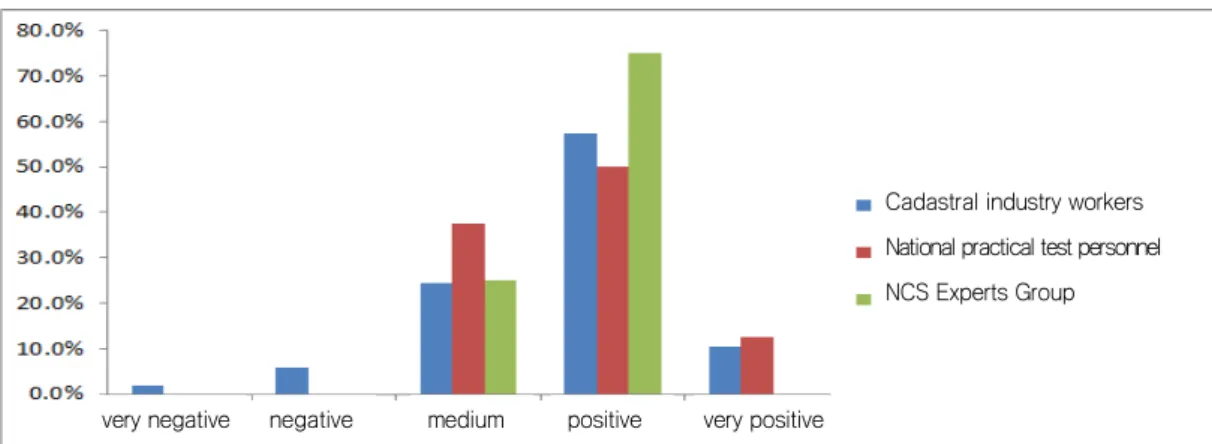
Figure 4. Opinion survey on job performing availability after acquisition of Course evaluation qualification
하여 자격을 부여받은 경우, 국가기술자격검정에 합 격하여 자격을 취득한 경우보다 지적분야 산업현장 직무수행에 유리하다고 생각하느냐에 대한 설문조사 결과, 지적분야 산업계 종사자의 경우에는 긍정적인 답변(매우긍정 포함)이 67.7%로 나타났으며, 국가기 술 자격검정 실기시험 담당자의 경우 62.5%, NCS 전 문가 그룹은 75%의 응답률을 보여 전반적으로 국가 기술 자격검정시험에 의하여 자격을 취득한 경우보다 과정평가형 자격제도를 통하여 자격을 취득한 경우가 지적분야에서 직무수행이 유리할 것으로 조사 되었 다.이는 국가기술자격검정을 통하여 자격을 취득한 경우 지적분야 산업계에서는 실무에 대한 재교육을 실시하여야 하고, 현장 경험을 숙지하여야 하는 등 재
교육에 따른 시간 및 비용이 추가적으로 발생 되므로, 과정평가형 자격제도를 통하여 산업현장에서 필요한 지식 및 기술 등의 실무를 겸비한 인재를 더 선호하기 때문인 것으로 판단된다.
3.2.4. 과정평가형 자격제도 4년제 도입여부 정부에서는 현재 운영중인 국가기술자격검정을 점 진적으로 줄이고, 과정평가형 자격제도 도입을 확대 하려 하고 있으므로, 특성화고등학교 및 전문대학을 중심으로 적용하고 있는 NCS 및 과정평가형 자격제 도를 4년제 대학에도 확대․운영할 필요가 있는지에 대 한 설문분석 결과, 지적분야 산업계종사자의 경우에 는 64.6%가 확대하여야 한다는 의견(매우긍정 포함)을
very negative negative medium positive very positive
NCS Experts Group National practical test personnel Cadastral industry workers
Figure 5. Opinion survey on introduction of university course evaluation qualification System
very negative negative medium positive very positive
NCS Experts Group National practical test personnel Cadastral industry workers
Figure 3. Opinion survey on job performing availability after acquisition of national technical qualification
very negative negative medium positive very positive
NCS Experts Group National practical test personnel Cadastral industry workers
Figure 2. Opinion survey on introduction of course evaluation qualification System in cadastral industry
3.2.2. 국가기술자격취득 후 직무수행 가능 여부
지적분야 국가기술자격검정시험을 통과하고 자격 을 취득한 경우 지적분야 산업현장의 직무수행 가능 여부에 대한 설문조사 결과, 지적분야 산업계 종사자 의 경우에는 긍정적인 답변(매우긍정 포함)이 42%로 나타났으며, 국가기술 자격검정 실기시험 담당자의 경우 50%, 지적분야 NCS 전문가 그룹은 25%로 조사 되었다. 이는 지적분야 국가기술자격시험을 통과하고
자격을 취득하였어도 산업현장의 직무수행을 원활하 게 수행하기가 용이하지 않을 것으로 파악되어, 자격 증 자체가 그 분야의 업무수행능력을 가지고 있는지 에 대한 여부를 확인하기가 어렵다고 판단된다.
3.2.3. 국가기술자격취득자와 과정평가형 자격취득자의 직무수행 유리 여부 지적분야 과정평가형 자격제도를 도입할 경우, NCS 교육훈련을 이수하고 과정평가형 자격제도를 통
very negative negative medium positive very positive
NCS Experts Group National practical test personnel Cadastral industry workers
Figure 4. Opinion survey on job performing availability after acquisition of Course evaluation qualification
하여 자격을 부여받은 경우, 국가기술자격검정에 합 격하여 자격을 취득한 경우보다 지적분야 산업현장 직무수행에 유리하다고 생각하느냐에 대한 설문조사 결과, 지적분야 산업계 종사자의 경우에는 긍정적인 답변(매우긍정 포함)이 67.7%로 나타났으며, 국가기 술 자격검정 실기시험 담당자의 경우 62.5%, NCS 전 문가 그룹은 75%의 응답률을 보여 전반적으로 국가 기술 자격검정시험에 의하여 자격을 취득한 경우보다 과정평가형 자격제도를 통하여 자격을 취득한 경우가 지적분야에서 직무수행이 유리할 것으로 조사 되었 다.이는 국가기술자격검정을 통하여 자격을 취득한 경우 지적분야 산업계에서는 실무에 대한 재교육을 실시하여야 하고, 현장 경험을 숙지하여야 하는 등 재
교육에 따른 시간 및 비용이 추가적으로 발생 되므로, 과정평가형 자격제도를 통하여 산업현장에서 필요한 지식 및 기술 등의 실무를 겸비한 인재를 더 선호하기 때문인 것으로 판단된다.
3.2.4. 과정평가형 자격제도 4년제 도입여부 정부에서는 현재 운영중인 국가기술자격검정을 점 진적으로 줄이고, 과정평가형 자격제도 도입을 확대 하려 하고 있으므로, 특성화고등학교 및 전문대학을 중심으로 적용하고 있는 NCS 및 과정평가형 자격제 도를 4년제 대학에도 확대․운영할 필요가 있는지에 대 한 설문분석 결과, 지적분야 산업계종사자의 경우에 는 64.6%가 확대하여야 한다는 의견(매우긍정 포함)을
very negative negative medium positive very positive
NCS Experts Group National practical test personnel Cadastral industry workers
Figure 5. Opinion survey on introduction of university course evaluation qualification System
보였으며, 국가기술 자격검정 실기시험담당자의 경우 62.5%, 지적분야 NCS 전문가는 무려 83.4%가 4년제 대학에서도 NCS 및 과정평가형 자격제도를 조속히 도입하여야 할 것으로 조사되었다.
이는 현재 NCS를 적용하고 있는 특성화 고등학교 및 전문대학 뿐 만 아니라 4년제 대학에도 NCS를 기 반으로 교과과정을 개편하여, 과정평가형 자격과 연 계하는 필수교과목에 대한 능력단위별 전공분야를 설 계하고, 단순히 자격취득이 아닌 산업계에서 필요로 하는 인재양성을 육성하여야 한다는 의견으로 판단된다.
4. 지적분야 과정평가모형 구축 4.2. 지적분야 과정평가모형 설계
과정평가형 자격제도는 내부평가와 외부평가로 구 분되며, 내부평가는 교육‧훈련과정에서 선택한 필수 능력단위 및 선택능력단위를 포함하여 평가하도록 하 고 있으며, 산업 현장의 직무와 관련된 실기시험을 출 제하도록 하고 있다.
본 연구에서는 지적분야 NCS 및 학습모듈을 기초로
Table 3. Internal evaluation method course evaluation qualification system internal evaluation method Source: HRDKorea 2015c
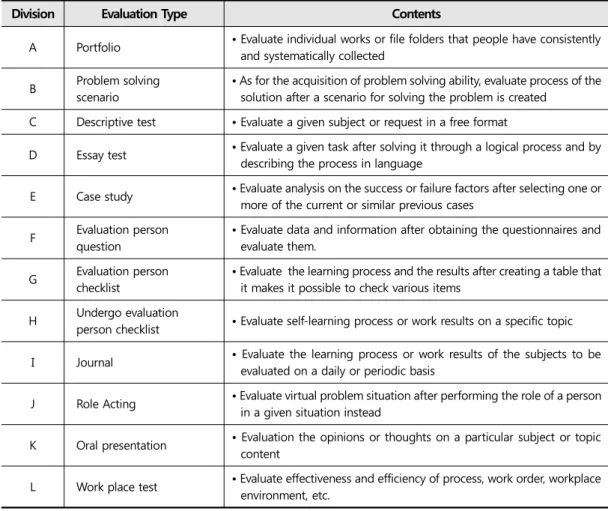
Division Evaluation Type Contents
A Portfolio • Evaluate individual works or file folders that people have consistently and systematically collected
B Problem solving scenario
• As for the acquisition of problem solving ability, evaluate process of the solution after a scenario for solving the problem is created
C Descriptive test • Evaluate a given subject or request in a free format
D Essay test • Evaluate a given task after solving it through a logical process and by describing the process in language
E Case study • Evaluate analysis on the success or failure factors after selecting one or more of the current or similar previous cases
F Evaluation person question
• Evaluate data and information after obtaining the questionnaires and evaluate them.
G Evaluation person checklist
• Evaluate the learning process and the results after creating a table that it makes it possible to check various items
H Undergo evaluation
person checklist • Evaluate self-learning process or work results on a specific topic
I Journal • Evaluate the learning process or work results of the subjects to be evaluated on a daily or periodic basis
J Role Acting • Evaluate virtual problem situation after performing the role of a person in a given situation instead
K Oral presentation • Evaluation the opinions or thoughts on a particular subject or topic content
L Work place test • Evaluate effectiveness and efficiency of process, work order, workplace environment, etc.
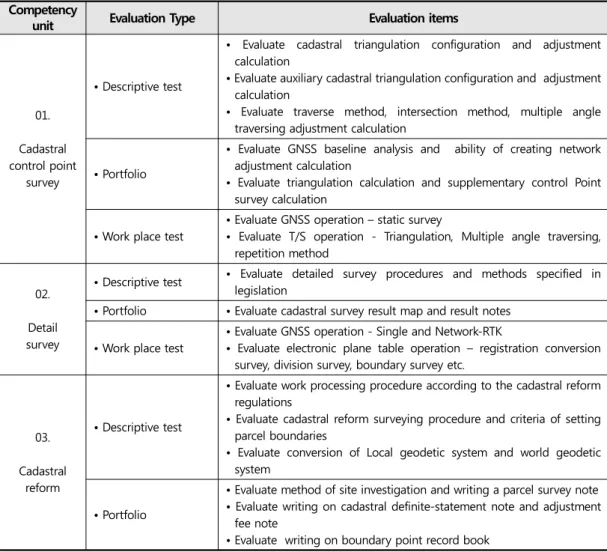
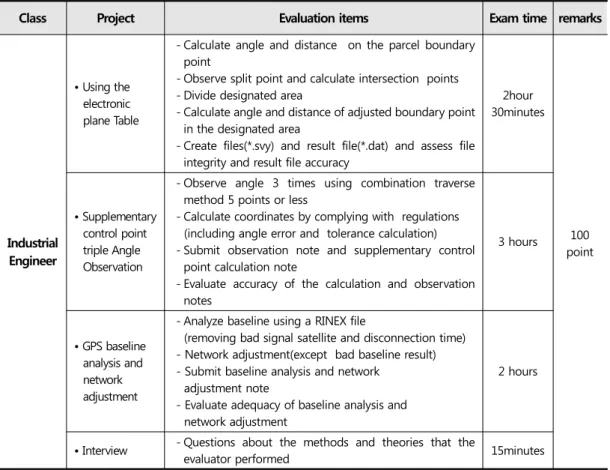
하여 내,외부 평가항목을 설계하였다. 내부평가는 NCS의 능력단위의 이수여부를 판단하기 위해 서술형 평가, 포트폴리오, 작업장평가를 중심으로 설계하였 으며, 외부평가는 현행 과정평가형 자격제도를 시행 하고 있는 타 종목과의 형평에 맞도록 지적분야 산업 계에서 활용하고 있는 작업형 실기시험 위주로 평가 를 실시하도록 설계하였다.
4.2.1. 내부평가 항목 설계
내부평가는 지적분야 NCS 능력단위를 기준으로 실 시하고 각 능력단위별로 교육․훈련에 80%이상을 출 석7)해야 해당 능력단위를 이수한 것으로 간주하고 불 충족 시에는 탈락처리 하는 것을 원칙으로 한다.
내부평가방법으로는 지적분야 NCS 수행준거를 기 초로 하고, 능력단위별 평가방법을 적용하여 평가를 실시하되, NCS 과정평가의 목적에 부합되도록 지적 분야 산업현장의 직무와 관련된 실기항목을 평가하도 록 설계하였다.
Table 4. Design for the internal evaluation method item of NCS Course evaluation model in cadastral industry Source: NCS 2016
Competency
unit Evaluation Type Evaluation items
01.
Cadastral control point
survey
• Descriptive test
• Evaluate cadastral triangulation configuration and adjustment calculation
• Evaluate auxiliary cadastral triangulation configuration and adjustment calculation
• Evaluate traverse method, intersection method, multiple angle traversing adjustment calculation
• Portfolio
• Evaluate GNSS baseline analysis and ability of creating network adjustment calculation
• Evaluate triangulation calculation and supplementary control Point survey calculation
• Work place test
• Evaluate GNSS operation – static survey
• Evaluate T/S operation - Triangulation, Multiple angle traversing, repetition method
02.
Detail survey
• Descriptive test • Evaluate detailed survey procedures and methods specified in legislation
• Portfolio • Evaluate cadastral survey result map and result notes
• Work place test
• Evaluate GNSS operation - Single and Network-RTK
• Evaluate electronic plane table operation – registration conversion survey, division survey, boundary survey etc.
03.
Cadastral reform
• Descriptive test
• Evaluate work processing procedure according to the cadastral reform regulations
• Evaluate cadastral reform surveying procedure and criteria of setting parcel boundaries
• Evaluate conversion of Local geodetic system and world geodetic system
• Portfolio
• Evaluate method of site investigation and writing a parcel survey note
• Evaluate writing on cadastral definite-statement note and adjustment fee note
• Evaluate writing on boundary point record book
보였으며, 국가기술 자격검정 실기시험담당자의 경우 62.5%, 지적분야 NCS 전문가는 무려 83.4%가 4년제 대학에서도 NCS 및 과정평가형 자격제도를 조속히 도입하여야 할 것으로 조사되었다.
이는 현재 NCS를 적용하고 있는 특성화 고등학교 및 전문대학 뿐 만 아니라 4년제 대학에도 NCS를 기 반으로 교과과정을 개편하여, 과정평가형 자격과 연 계하는 필수교과목에 대한 능력단위별 전공분야를 설 계하고, 단순히 자격취득이 아닌 산업계에서 필요로 하는 인재양성을 육성하여야 한다는 의견으로 판단된다.
4. 지적분야 과정평가모형 구축 4.2. 지적분야 과정평가모형 설계
과정평가형 자격제도는 내부평가와 외부평가로 구 분되며, 내부평가는 교육‧훈련과정에서 선택한 필수 능력단위 및 선택능력단위를 포함하여 평가하도록 하 고 있으며, 산업 현장의 직무와 관련된 실기시험을 출 제하도록 하고 있다.
본 연구에서는 지적분야 NCS 및 학습모듈을 기초로
Table 3. Internal evaluation method course evaluation qualification system internal evaluation method Source: HRDKorea 2015c
Division Evaluation Type Contents
A Portfolio • Evaluate individual works or file folders that people have consistently and systematically collected
B Problem solving scenario
• As for the acquisition of problem solving ability, evaluate process of the solution after a scenario for solving the problem is created
C Descriptive test • Evaluate a given subject or request in a free format
D Essay test • Evaluate a given task after solving it through a logical process and by describing the process in language
E Case study • Evaluate analysis on the success or failure factors after selecting one or more of the current or similar previous cases
F Evaluation person question
• Evaluate data and information after obtaining the questionnaires and evaluate them.
G Evaluation person checklist
• Evaluate the learning process and the results after creating a table that it makes it possible to check various items
H Undergo evaluation
person checklist • Evaluate self-learning process or work results on a specific topic
I Journal • Evaluate the learning process or work results of the subjects to be evaluated on a daily or periodic basis
J Role Acting • Evaluate virtual problem situation after performing the role of a person in a given situation instead
K Oral presentation • Evaluation the opinions or thoughts on a particular subject or topic content
L Work place test • Evaluate effectiveness and efficiency of process, work order, workplace environment, etc.
하여 내,외부 평가항목을 설계하였다. 내부평가는 NCS의 능력단위의 이수여부를 판단하기 위해 서술형 평가, 포트폴리오, 작업장평가를 중심으로 설계하였 으며, 외부평가는 현행 과정평가형 자격제도를 시행 하고 있는 타 종목과의 형평에 맞도록 지적분야 산업 계에서 활용하고 있는 작업형 실기시험 위주로 평가 를 실시하도록 설계하였다.
4.2.1. 내부평가 항목 설계
내부평가는 지적분야 NCS 능력단위를 기준으로 실 시하고 각 능력단위별로 교육․훈련에 80%이상을 출 석7)해야 해당 능력단위를 이수한 것으로 간주하고 불 충족 시에는 탈락처리 하는 것을 원칙으로 한다.
내부평가방법으로는 지적분야 NCS 수행준거를 기 초로 하고, 능력단위별 평가방법을 적용하여 평가를 실시하되, NCS 과정평가의 목적에 부합되도록 지적 분야 산업현장의 직무와 관련된 실기항목을 평가하도 록 설계하였다.
Table 4. Design for the internal evaluation method item of NCS Course evaluation model in cadastral industry Source: NCS 2016
Competency
unit Evaluation Type Evaluation items
01.
Cadastral control point
survey
• Descriptive test
• Evaluate cadastral triangulation configuration and adjustment calculation
• Evaluate auxiliary cadastral triangulation configuration and adjustment calculation
• Evaluate traverse method, intersection method, multiple angle traversing adjustment calculation
• Portfolio
• Evaluate GNSS baseline analysis and ability of creating network adjustment calculation
• Evaluate triangulation calculation and supplementary control Point survey calculation
• Work place test
• Evaluate GNSS operation – static survey
• Evaluate T/S operation - Triangulation, Multiple angle traversing, repetition method
02.
Detail survey
• Descriptive test • Evaluate detailed survey procedures and methods specified in legislation
• Portfolio • Evaluate cadastral survey result map and result notes
• Work place test
• Evaluate GNSS operation - Single and Network-RTK
• Evaluate electronic plane table operation – registration conversion survey, division survey, boundary survey etc.
03.
Cadastral reform
• Descriptive test
• Evaluate work processing procedure according to the cadastral reform regulations
• Evaluate cadastral reform surveying procedure and criteria of setting parcel boundaries
• Evaluate conversion of Local geodetic system and world geodetic system
• Portfolio
• Evaluate method of site investigation and writing a parcel survey note
• Evaluate writing on cadastral definite-statement note and adjustment fee note
• Evaluate writing on boundary point record book
Competency
unit Evaluation Type Evaluation items
04.
Cadastral confirmation
• Descriptive test
• Evaluate understanding of the cadastral confirmation relevant laws(Urban Development Act, Law on land use and planning. etc)
• Evaluate calculation of boundary points, central point, parcel point and area
• Evaluate traverse method, intersection method, multiple angle traversing adjustment calculation
• Portfolio • Evaluate writing on result map and note of cadastral confirm survey
• Evaluate delivery documents, and writing on relevant book
• Work place test
• Evaluate GNSS operation - parcel boundary points
• Evaluate T/S operation – multiple angle traversing, parcel boundary pointa
05.
Scale change
• Descriptive test • Evaluate scale change procedure and methods
• Evaluate configuration and roles about scale change Committee
• Portfolio
• Evaluate drawing on cadastral survey result map and cadastral survey result documents
• Evaluate writing on parcel number book
06.
Result inspection
• Descriptive test
• Evaluate inspection and method of control point survey and detail survey
• Evaluate cadastral reform survey procedures and criteria of parcel boundary set
• Evaluate conversion of local geodetic coordinates and world geodetic coordinates
• Portfolio
• Evaluate correspondence with cadastral control point result and parcel boundary line
• Evaluate writing on survey result inspection book
• Work place test
• Evaluate GNSS operation – Static survey, RTK (Single and Network)
• Evaluate T/S operation - triangulation, multiple angle traversing, details survey
07.
Parcel number change
• Descriptive test
• Evaluate approval application of parcel number change specified in legislation
• Evaluate parcel number change method and procedure
• Portfolio
• Evaluate writing on approval application of parcel number change and parcel number specification
• Evaluate result data verification of parcel number change result data verification and arrangement of cadastral data
• Evaluate writing on parcel number change report and administration area change report
08.
Land registration
• Descriptive test
• Evaluate land research, registration, and procedure
• Evaluate setting criteria of ground boundary
• Evaluate instruction of writing on ground boundary points
• Evaluate principle of granting parcel number and land use
• Portfolio
• Evaluate writing on parcel number missing book
• Evaluate writing on land move searching index and land move arrangement decree
• Work place test • Evaluate writing ground boundary point record book specified in legislation
Competency
unit Evaluation Type Evaluation items
9.
Cadastral record management
• Descriptive test
• Evaluate type of cadastral record and registration
• Evaluate recovery data, recovery procedure, and recovery survey of cadastral official book
• Evaluate contents of land owner arrangement configuration
• Portfolio
• Evaluate writing on cadastral record recovery data decree
• Evaluation of write about land owners arrange resolution letter
• Evaluate world geodetic system conversion parameter calculation and writing on conversion procedure
• Work place test • Evaluate conversion of the World Geodetic Coordinate system
10.
Land move arrangement
• Descriptive test
• Evaluate administrative procedures in accordance with the cadastral survey(new registration, registration conversion, division, merger, registration correction. etc)
• Evaluate knowledge about laws of land move
• Portfolio
• Evaluate writing on application form in accordance with the land move(new registration, registration conversion, division, merger, registration correction. etc)
• Evaluate writing on commission of registration in land change
• Work place test • Evaluate editing for continuous cadastral map
• Evaluate writing on survey result map and result book using programs
11.
Cadastral record system management
• Descriptive test
• Evaluate configuration of graphic data and attribute data
• Evaluate concept, management, and operation of land information system
• Portfolio
• Evaluate procedure of land transaction permission
• Evaluate basic knowledge, investigation, and assessment of notified individual land price
• Evaluate basic knowledge about building resource data
• Work place test
• Evaluate editing of continuous cadastral continuous map
• Evaluate editing of continuous cadastral map and extracting SHP file using the object edit program
12.
Land Information
survey
• Descriptive test
• Evaluate analysis method on land information and land information concept
• Evaluate methods and procedures for land information survey object
• Portfolio • Evaluate writing on land information investigation table
• Evaluate writing on land use survey index
• Work place test • Evaluate DXF file conversion and file extraction using the CAD program
Work place test common
Area
[Cadastral reform, Scale change, Parcel number change, Cadastral record management, Land information survey ]
• Evaluate GNSS operation – using a Single and Network-RTK
• Evaluate operation of T/S and Electric plane table- Occupied use Status and Structure Status