62 https://doi.org/10.4285/kjt.2020.34.1.62 INTRODUCTION
Graft-versus-host disease (GVHD) is a multisystem disease that can occur after hematopoietic stem cell or solid organ transplantation [1,2]. It may occur when donor-derived T lymphocytes (graft) recognize recipient (host) as foreign and initiate hostile immune reaction against the recipient [3].
The organs targeted are skin, gastrointestinal tract, liver, and bone marrow, and these activities resulted in fever, skin rash, diarrhea, jaundice, and pancytopenia [4].
GVHD after solid organ transplant is rare because solid organs contain less lymphoid tissue than a hematopoietic stem cell transplant. In fact, only seven cases of GVHD fol- lowing simultaneous pancreas-kidney transplantation (SPK) have been reported to date [1,4-9]. Nevertheless, GVHD after solid organ transplant is frequently lethal. Here, we report a successfully treated case of GVHD in an SPK recipient.
CASE REPORT
The study procedures were in accordance with the Dec- laration of Helsinki. All procedures were performed after obtaining informed consent. A single patient case report does not require Institutional Review Board approval ac- cording to our board policy.
The patient was a 38-year-old female with a 25-year history of type 1 diabetes mellitus who had been on he- modialysis for 7 years prior to SPK. She underwent SPK with organs from an ABO compatible, five (1A, 2B, 2DR) human leukocyte antigen-mismatched female donor. Both donor and recipient were positive for cytomegalovirus im- munoglobulin G antibody. Induction immunosuppression included methylprednisolone and basiliximab followed by maintenance immunosuppression with tacrolimus, prednisone, and mycophenolate mofetil. Her postoper- ative course was complicated by duodenal bleeding, in-
Received November 25, 2019 Revised February 26, 2020 Accepted February 28, 2020 Corresponding author: Soon Il Kim Department of Transplantation Surgery, Severance Hospital, Yonsei University Health System, 50-1 Yonsei-ro, Seodaemun-gu, Seoul 03722, Korea Tel: +82-2-2228-2118
Fax: +82-2-313-8289 E-mail: [email protected]
Graft-versus-host disease after simultaneous pancreas-kidney transplantation
Juhan Lee, Myoung Soo Kim, Kyu Ha Huh, Dong Jin Joo, Jae Geun Lee, Soon Il Kim
Department of Transplantation Surgery, Severance Hospital, Yonsei University Health System, Seoul, Korea Korean J Transplant 2020;34:62-65
https://doi.org/10.4285/kjt.2020.34.1.62
Case Report
Graft-versus-host disease (GVHD) is rare complication after simultaneous pancreas-kid- ney transplantation (SPK). Here, we present a rare case of GVHD that developed in a SPK recipient. A 38-year-old female patient with end-stage renal disease due to type 1 diabe- tes mellitus underwent SPK from a deceased female donor. Four months after transplan- tation, she was readmitted with fever and abdominal pain and computed tomography revealed a retroperitoneal abscess. While being treated for the retroperitoneal abscess by percutaneous drainage and antibiotics, the patient developed skin rash and diarrhea.
A skin biopsy performed at the time showed vacuolization and peri-venular lymphocytic infiltration compatible with GVHD. High-dose steroids resulted in complete remission of GVHD, and the patient was discharged after 2 weeks of treatment. This case demon- strates that early diagnosis of GVHD followed by timely treatment may led to a favorable outcome, and cautions that GVHD can occur in SPK patients.
Keywords: Graft-versus-host disease; Pancreas transplantation; Kidney transplantation
© The Korean Society for Transplantation This is an Open Access article distributed under the terms of the Creative Commons Attribution Non-Commercial License (http://creativecommons.org/licenses/
by-nc/4.0/) which permits unrestricted non-commercial use, distribution, and reproduction in any medium, provided the original work is properly cited.
pISSN 2671-8790
eISSN 2671-8804
63 www.ekjt.org
Lee J et al. Graft-versus-host disease after SPK
tra-abdominal fluid collection, and splenic vein (transplant pancreas) partial thrombus, which was treated with open thrombectomy per exploratory laparotomy.
On postoperative day (POD) 114, she was readmitted with lower abdominal pain and fever. An abdomen and pelvis computed tomography depicted a retroperitoneal abscess in right pelvic area (Fig. 1). She underwent ul- trasound-guided percutaneous catheter drainage and the culture showed extended spectrum β lactamase-pro-
ducing Klebsiella pneumoniae and vancomycin-sensitive Enterococcus faecium. We started antibiotic treatment (imipenem+vancomycin) according to the results of cul- ture and susceptibility tests. Mycophenolate mofetil was placed on hold for infection control. However, despite the above-mentioned treatment, a fistula developed between the retroperitoneal abscess and small bowel.
Six weeks later (POD 156), she developed erythematous macules on her trunk and fever (Fig. 2). Laboratory data showed a white blood cell count of 2,630 cells/mm
3(neu- trophil, 74.2%; eosinophil, 0.7%; and lymphocyte, 16.6%), hemoglobin of 10.5 g/dL, and platelet count of 260,000/
mm
3. Serum creatinine, glucose, and liver function tests remained normal. Blood cytomegalovirus polymerase chain reaction was negative. She maintained tacrolimus at a dose of 0.1 mg/kg/day (blood trough level, 4 to 6 ng/mL) and prednisolone 5 mg/day. All antibiotics were withdrawn to rule out a drug reaction. Four days after the skin lesion presentation, skin biopsy was performed and it showed focal basal vacuolization and superficial peri-venular lym- HIGHLIGHTS
• Graft-versus-host disease (GVHD) is rare but fatal com- plication after simultaneous pancreas-kidney trans- plantation.
• Early diagnosis of GVHD followed by timely treatment with sufficient immunosuppression appears to be the only way of achieving favorable outcomes.
A B
Fig. 1. (A, B) Contrast enhanced computed
tomography showed a retroperitoneal ab- scess (arrows).
A B
Fig. 2. Photographs of patient’s neck (A)
and back (B) showing erythematous mac-
ules.
https://doi.org/10.4285/kjt.2020.34.1.62 64
Korean J Transplant · March 2020 · Volume 34 · Issue 1
phocytic infiltration without hyperkeratosis, hypergranulo- sis, and acantosis, compatible with GVHD grade I. The pa- tient was treated with intravenous methylprednisolone (500 mg) for 5 days, and given concerns of septic complications, was started on broad-spectrum antibiotics (cefepime, ciprofloxacin, and metronidazole). Tacrolimus dose was adjusted for the target blood trough level of 7 to 10 ng/
mL. Mycophenolate mofetil was held given retroperitoneal abscess and neutropenia. The patient responded well to the treatment and was discharged 2 weeks later (POD 179) with stable graft function (creatinine 1.3 mg/dL and nor- moglycemia).
DISCUSSION
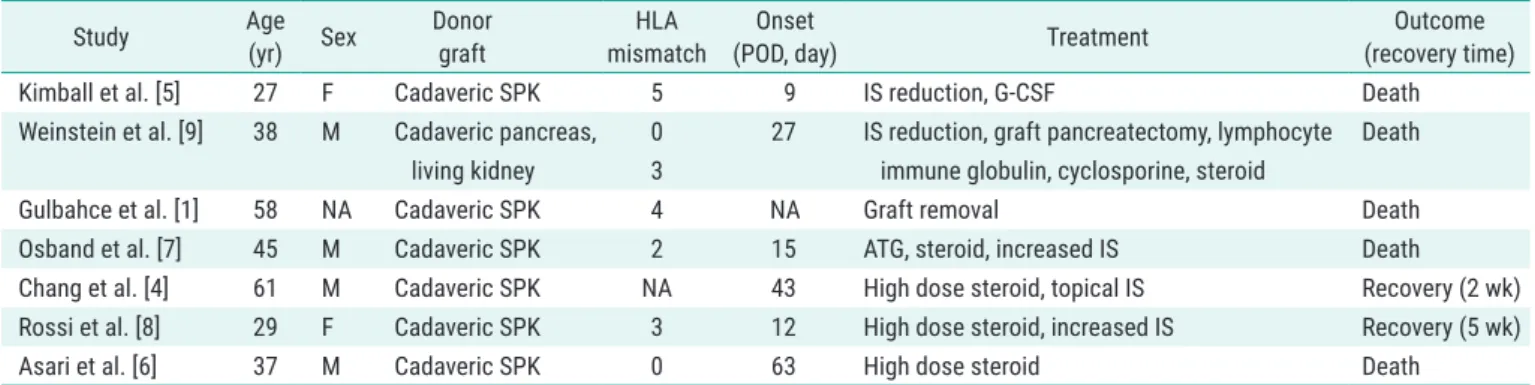
GVHD is rare but frequently fatal complication after solid organ transplantation, and the risk of its development is related to the number of donor lymphocytes transplanted with an organ [2]. Thus, because liver and multi-visceral transplants contain larger numbers of lymphocytes, the incidences of GVHD after these solid organ transplants are corresponding higher [10,11]. However, GVHD following SPK has rarely been reported. A review of the literature revealed GVHD after SPK has only been reported on seven occasions (Table 1), and that only two of the seven pa- tients survived [1,4-9]. Here, we report a successfully treat- ed case of GVHD after SPK.
Clinical manifestations of GVHD vary from skin rash to systemic involvement, including liver, gastrointestinal tract, and bone marrow. The common clinical manifes- tations of diarrhea and rash occur when donor-derived T
lymphocytes are activated by alloantigens presented by host antigen-presenting cells and result in inflammatory response against host organs. Pancytopenia resulting from donor immune-mediated attack on recipient bone marrow is also a common feature [3,4].
Clinical features of GVHD are nonspecific and the di- agnosis is often delayed because of similarities with drug reactions and infectious complications [12]. For example, ambiguous skin rash and fever may resemble a drug re- action or viral infection and diarrhea is also a common consequence of antibiotic treatment. In addition, the rarity of GVHD following SPK leads to delayed diagnosis, which contributes to the high mortality rate of GVHD. Our patient presented with many typical features, but the differential diagnosis was difficult because she was being treated with antibiotics. However, skin rash and diarrhea per- sisted after antibiotic withdrawal, and a skin biopsy per- formed 4 days after antibiotic withdrawal revealed focal basal vacuolization and perivenular lymphocytic infiltra- tion. The patient received anti-GVHD treatment based on typical clinical manifestations and histologic confirmation of GVHD although chimerism study was not conducted.
While fluorescence in situ hybridization can be helpful to detect chimerism in sex-mismatched cases, its use was limited in this sex-matched case.
The optimal treatment of GVHD after solid organ trans plantation remains unclear. Given the mechanism of GVHD, which donor-derived T lymphocytes recognize re- cipient as foreign, inadequate immunosuppression might increase the risk of GVHD. Hence, the literature describes treatments that either enhance and reduce immunosup- pression [2,7]. Some patients were treated by transplant pancreatectomy early in the course of GVHD, but clinical
Table 1. Treatment and outcomes of prior reported cases of GVHD following SPK