J O U R N A L O F
Veterinary Science
J. Vet. Sci. (2006), 7(2), 133–136
Neuropharmacological effects of deltamethrin in rats
S. Manna1,*, D. Bhattacharyya2, T. K. Mandal3, S. Dey4
1Institute of Animal Health and Veterinary Biologicals (R&T), 37-Belgachia Rd, Kolkata-700 037, India
2Department of Pharmacology, University College of Medicine, Calcutta University, 244-B A. J. C. Bose Rd, Kolkata-20, India
3Department of Pharmacology and Toxicology, West Bengal University of Animal and Fishery Sciences, 68, K. B. Sarani, Kolkata- 700 037, India
4Chittaranjan National Cancer Research Institute, Kolkata, India
This study examined the effect of deltamethrin on some of the neuropharmacological paradigms in a rat brain such as the motor co-ordination test using a rotarod, the pentobarbitone-induced sleeping time and pentylenetetrazole (PTZ)-induced convulsion as well as the gamma aminobutyric acid (GABA) level. Albino Wistar rats were used as the experimental animals. Different neuropharmacological paradigms such as the motor co-ordination by the rotarod, pentobarbitone-induced sleeping time and the PTZ- induced convulsion were examined after administering deltamethrin orally at two doses, 150 mg/kg (LD
50) and 15 mg/kg (1/10 LD
50). The GABA level in the rat brain was estimated by HPLC after a single oral dose of 150 mg/
kg deltamethrin. Deltamethrin significantly reduced the motor coordination, decreased the onset time and increased the sleeping time duration induced by pentobarbitone. In addition, it also decreased the onset time and increased the duration of convulsions induced by PTZ at 150 mg/kg (LD
50) and 15 mg/kg (1/10 LD
50), respectively. Further deltamethrin administration decreased the GABA levels in the cerebellum as well as in the whole brain (except the cerebellum) significantly at the LD
50dose level. There was some correlation between the effect of deltamethrin on the central GABA levels and its neuropharmacological effects.
Key words:
convulsion, deltamethrin, GABA, hypnosis, rotarod testIntroduction
Deltamethrin [(s)
α-cyano-3phenoxy benzyl-(R)-cis-3-(2,2- dibromovinyl)-2-2-dimethyl-cyclopropane carboxylate] is a synthetic pyrethrroid with potent insecticidal properties.
Deltamethrin is used extensively not only as an ectoparasiticide
in animals but also in agricultural crop production and in public health programs. The effects of deltamethrin on the biochemical and histopathology of some organs after single LD
50dose level in rats has been reported [12], and synthetic pyrethroids such as cypermethrin act through the gamma aminobutyric acid (GABA) gated chloride channels [8,11,15].
The neuropharmacological effect of pyrethroids such as alfa-cypermethrin in rats has been described previously [13].
However, there are few reports on pharmacological effects and modulation of brain GABA levels after deltamethrin administration. This study examined the pharmacological effects of deltamethrin with relation to its ability to modulate the brain GABA levels.
Materials and Methods
Animals
Albino-Wistar rats of either gender, weighing 200
±10 g, were used in this study. The animals were fasted overnight with water being provided
ad libitum.The experimental protocol met the national guidelines for the care and use of animals in laboratory research. The Institutional Animal Ethics Committee approved the experimental protocol.
Dose of deltamethrin
Deltamethrin was administered orally at the LD
50[12]
(150 mg/kg) and 1/10 LD
50(15 mg/kg).
Motor co-ordination by rotarod test
Dunham and Miya [3] suggested that skeletal muscle relaxation induced by a test compound could be evaluated by testing the ability of either mice or rats to remain on a rotarod (Techno India, India). For this purpose, groups of rats were trained to remain on a rotarod for 1 minute. The animals were excluded and replaced if they failed to do so.
Thirty animals were considered and trained on the rotarod.
The rats were divided into three equal groups I, II and III consisting of 10 animals each. Groups I and II received deltamethrin orally at LD
50(150 mg/kg) and 1/10 LD
50*Corresponding author
Tel: +91-9433119608; Fax :+91-3325565476 E-mail: [email protected]
134 S. Manna et al.
(15 mg/kg) dissolved in dimethylsulfoxide (DMSO; 1 ml), respectively. Group III received only DMSO (1 ml) and was used as the control. One hour after administering the deltamethrin and DMSO, all the groups including the control were placed on the rotarod, and the number of animals falling from the rotarod during the scheduled time were counted. The percentage was transformed into a probit and compared with the control (Table 1).
Pentobarbitone-induced sleeping time: Thirty animals were divided into three equal groups containing 10 animals each. Pentobarbitone (Sigma, USA) was administered (40 mg/kg, ip) 1 h after administering 150 mg/kg and 15 mg/kg deltamethrin to the animals in group I and II, respectively.
The sleeping time was recorded as the period starting with the loss and regaining the righting reflex (Table 2). The control group (group-III) received DMSO and pentobarbitone.
PTZ-induced convulsion
Thirty animals were divided into three equal groups containing 10 animals each. Phenylenetetrazole (PTZ;
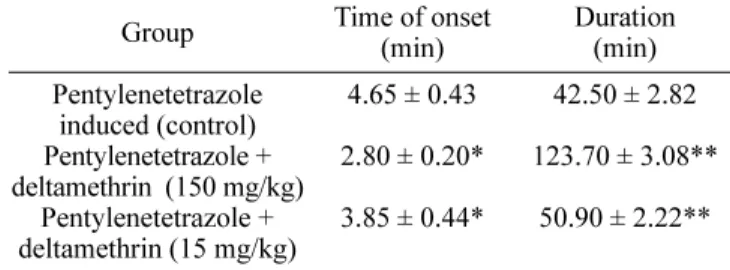
Sigma, USA) was administered (60 mg/kg i.p.) 1 h after administering 150 mg/kg and 15 mg/kg deltamethrin dissolved in DMSO to groups I and II, respectively. The vehicle (DMSO) and PTZ were given to the control group- III. The onset of the induction and duration of the tonic- clonic convulsions were recorded (Table 3).
Determination of GABA level in brain
Twenty rats were divided into two equal groups consisting of 10 animals each. Group I received deltamethrin at LD
50(150 mg/kg) dissolved in DMSO (1 ml). In contrast, group
II received only DMSO (1 ml) and was used as the control.
Six hours after administering deltamethrin, the remaining six (6) rats and control were euthanized The brain was collected immediately and divided into two parts, the cerebellum and the whole brain without the cerebellum.
Both portions were used to estimate the GABA level.
GABA is a major inhibitory neurotransmitter in the central nervous system of all vertebrates, and is found in the mammalian cerebellum, corpus striatum, cerebral cortex and spinal cord. Its role in various neurological and mental disorders has been reported.
Several methods for estimating the GABA levels in a biological sample by high performance liquid chromatograph (HPLC) have been published using fluorimetric [4] or electrochemical detection [10] using pre-column derivatization with O-phthalaldehyde (OPA). These methods are sensitive but are generally unsuitable for automation. In addition, the OPA derivatives are less stable than the OPA-tertiary- butylthiol (TBT) derivatives. In this study, the level of GABA was determined by HPLC-ECD by following its derivatization with OPA and TBT using the method reported by Allison
et al., [1] which was modified by Manna et al [13]. The following is the reaction for this process:
The derivative is a stable time-substituted isoindole.
Condition of HPLC
Separation was achieved on a Novapak RP-C 18 column (3.9
×150 mm). The mobile phase consisted of sodium acetate (pH 5, 0.18 M, 55% v/v), and acetonitrile (45% v/v).
The flow rate was 1.5 ml/min, and the run time was 15 min.
A glassy carbon electrode set to 700 mV against a Ag-AgCl reference electrode was used for electrochemical detection (464-pulsed Electrochemical Detector; Waters, USA). The temperature was 20
oC during analysis. The reagents were
Table 1. Effect of deltamethrin on the motor-coordination by rotarod test in rats after a single oral dose of 150 (LD50) and 15 mg/kg (1/10 LD50)
Group Probit p-value
Vehicle treated Deltamethrin treated
(150 mg/kg) Deltamethrin treated
(15 mg/kg)
± 0.16 2.39 ± 0.60 5.40 ± 0.14
<0.01-
<0.05
Table 2. Effect of deltamethrin on the pentobarbitone (40 mg/kg i.p.) induced sleeping time in rats after a single oral dose of 150 (LD50) and 15 mg/kg (1/10 LD50)
Group Time of onset
(min) Duration
(min) Pentobarbitone treated
Pentobarbitone + deltamethrin (150 mg/kg)
Pentobarbitone + deltamethrin (15 mg/kg)
5.75 ± 0.30 3.40 ± 0.20**
4.70 ± 0.32*
67.10 ± 1.46 182.10 ± 2.38**
76.90 ± 3.50*
Note: Values are mean ± SE, n = 10 in each group; *: p< 0.05, **: p<
0.01 as compared to control.
Table 3. Effect of deltamethrin on pentylenetetrazole (60 mg/kg i.p.) induced convulsion in rats after a single oral dose of 150 (LD50) and 15 mg/kg (1/10 LD50)
Group Time of onset
(min) Duration
(min) Pentylenetetrazole
induced (control) Pentylenetetrazole + deltamethrin (150 mg/kg)
Pentylenetetrazole + deltamethrin (15 mg/kg)
4.65 ± 0.43 2.80 ± 0.20*
3.85 ± 0.44*
42.50 ± 2.82 123.70 ± 3.08**
50.90 ± 2.22**
Note: Values are mean ± SE, n = 10 in each group; *: p< 0.05, **:
p< 0.01 as compared to control.
Effect of deltamethrin on brain GABA levels 135
0.1 M HClO
4, GABA stock (1.2, 0.625, 0.313 and 0.156 mM), 1.0 M carbonate buffer and a working reagent (0.0671 g of OPA dissolved in 50 ml methyl alcohol with 56
µl of TBT added).
Sample preparation
In these experiments, the cerebellum and whole brain without the cerebellum were weighted separately, homogenized in 0.1 M HClO
4and the particulate matter was removed by centrifugation and filtration. The clarified supernatant was diluted with 0.1 M HClO
4to give a total dilution factor of 200 for the original brain samples.
Procedure
Twenty
µl of the AVA (5-amino valeric acid) stock (internal standard) and 40
µl of GABA stock was added to 500
µl of the diluted brain homogenate and mixed thoroughly. Eight hundred
µl of the working reagent and 200
µl of the above mixture were added to the sample and mixed thoroughly (the flask was kept capped to contain the pungent thiol odor). The mixture was allowed to react at room temperature for 6 min and 50
µl of the derivatized sample was injected, run for 15 min. The retention time (RT) of the derivatized and as well as the unknown sample were found to be at 4.915 min and 5.137 min, respectively. The data was recorded and the analysis was carried out using the Millennium package (Waters, USA). The GABA concentration is expressed as mg/g of wet tissue.
Statistical analysis
All the values are expressed as the mean ± SE. Statistical analysis was carried out using SPSS 10.1 software (SPSS, USA). The statistical significance of the differences between the two means was assessed using one-way ANOVA. A probability level at 5% or 1% (
p< 0.05 or
p <0.01) was considered significant.
Results
Pharmacological test
Table 1 shows the percentage of animals present in the rotarod were transformed into a probit following the single oral dose of deltamethrin at either 150 and 15 mg/kg.
Deltamethrin produced significant ataxia at both LD
50(
p< 0.01) and 1/10 LD
50(
p< 0.05). Table 2 shows that deltamethrin significantly increased the duration of the pentobarbitone induced sleeping time (
p< 0.01) while it decreased the onset time at both dose levels. Table 3 shows that deltamethrin significantly increased the duration of the tonic-clonic convulsions induced by PTZ (
p< 0.01) at 150 mg/kg, and significantly decreased the onset time of the convulsions (
p< 0.05) at the LD
50dose and non significantly at the 1/10 LD
50dose.
Brain GABA level
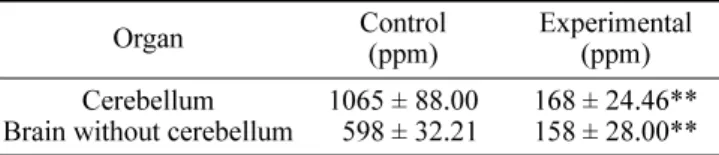
Table 4 shows the GABA concentrations in the cerebellum and whole brain without the cerebellum in the brain of the rats following a single dose of 150 mg/kg deltamethrin. The table shows that the GABA concentration was significantly lower (
p< 0.01) in the cerebellum and the total brain without the cerebellum.
Discussion
The restlessness, respiratory distress and violent convulsions in rats administered deltamethrin suggest CNS stimulation.
After 3-5 hours of oral administration, the animals showed a defined sequence of toxicity such as choreoathetosis, a loss of the righting reflex followed by tonic-clonic convulsions.
The GABA receptor complex is an important target site for type-II pyrethroids such as cypermethrin [14,2,7].
Deltamethrin potentiated the PTZ-induced convulsions in rats. Some GABA antagonists do not interact with the GABA binding site itself but interact with separate sites on or near the chloride channel, such as non competitive antagonists e.g. the PTZ block GABA mediated Cl
−flux, and therefore act as a potent convulsant. The GABA level in the brain was higher in the cerebellum portion than in the remainder of the brain in the both control and experimental rat. Deltamethrin decreased the GABA levels significantly in both the cerebellum portion and in the remaining potion of the whole brain. Cypermethrin, which is a type II pyrethroid, also decreased the GABA level in the brain [13].
The decrease in the GABA level might be due either to the decreased synthesis or increased catabolism of GABA resulting in the inactivation of the Cl
−channel leading to excitation and convulsion. Deltamethrin increased the pentobarbitone induced sleeping time in rats.
On the other hand, pentobarbitone reduced the CNS excitation symptoms caused by deltamethrin, which were corroborated by the findings reported Forshaw
et al. [5], who showed that the voltage dependent chloride channel is a toxicologically significant site of action for deltamethrin, and that chloride channel agonists such as pentobarbitone are effective therapy against type-II pyrethroid poisoning.
The deltamethrin-induced potentiation of the sleeping time after pentobarbitone can be deduced because of the inhibitory action on the hepatic drug metabolizing enzymes
Table 4. Concentration between the GABA in the brain of rats after a single oral dose of 150 mg/kg deltamethrin
Organ Control
(ppm) Experimental (ppm) Cerebellum
Brain without cerebellum 1065 ± 88.00
0598 ± 32.21 168 ± 24.46**
158 ± 28.00**
Note: Values are mean ± SE (n = 6); **p < 0.01 as compared to control.
136 S. Manna et al.
by the pyrethroids type-II [9].
Pentobarbitone potentiates the GABA induced chloride conductance and simultaneously depresses the voltage activated Ca
++currents at the lower concentration. However, at higher concentrations, the chloride conductance was increased in the absence of GABA [6]. One consequence of the inhibition of these Ca
++channels might be a blockade of Ca
++entry into the presynaptic nerve terminals, which would inhibit the release of the excitatory neurotransmitters such as glutamate, resulting in a net reduction of excitatory synaptic transmission.
In conclusion, there was a correlation between the effects of pyrethroid type-II (deltamethrin) on the brain GABA level and its neuropharmacological effects.
Acknowledgments
The authors wish to acknowledge Dr. A. Hazra, a Lecturer of this department, for his help in this study, and Gharda Chemical Ltd., Mumbai, India, for the gift of the analytical grade deltamethrin so the research work and experimental protocol could comply with the current laws of India.
References
1.Allison LA, Mayer GS, Shoup RE. o-Phthalaldehyde derivatives of amines for high-speed liquid chromatography/
electrochemistry. Anal Chem 1984, 56, 1089-1096.
2.Crofton KM, Reiter LW. Pyrethroid insecticides and the GABA receptor complex: motor activity and the acoustic startle response in the rat. J Pharmacol Exp Ther 1987, 243, 946-954.
3.Dunham NW, Miya TS. A note on a simple apparatus for detecting neurological deficit in rats and mice. J Am Pharm Assoc Pharm Assoc (Baltim) 1957, 46, 208-209.
4.Farrant M, Zia Gharib F, Webster RA. Automated pre- column derivatization with o-phthalaldehyde for the determination of neurotransmitter amino acids using reverse d-phase liquid chromatography. J Chromatogr 1987, 417,
385-390.
5.Forshaw PJ, Lister T, Ray DE. The role of voltage gated chloride channels in type II pyrethroid insecticide poisoning.
Toxicol Appl Pharmacol 2000, 163, 1-8.
6.Ffrench-Mullen JM, Barker JL, Rogawski MA. Calcium current block by (-)-pentobarbital, phenobarbital, and CHEB but not (+)-pentobarbital in acutely isolated hippocampal CA1 neurons: comparison with effects on GABA-activated Cl− current. J Neurosci 1993, 13, 3211-3221.
7.Gammon D, Casida JE. Pyrethroids of the most potent class antagonize GABA action at the crayfish neuromuscular junction. Neuro sci Lett 1983, 40, 163-168.
8.Gilbert ME, Mack CM, Crofton KM. Pyrethroids and enhanced inhibition in the hippocampus of the rat. Brain Res 1989, 477, 314-321.
9.Juliet S, Chakraborty AK, Koley KM, Mandal TK, Bhattacharyya A. Toxicokinetics, recovery efficiency and microsomal changes following administration of deltamethrin to black Bengal goats. Pest Manag Sci (London) 2001, 57, 311-19.
10.Lasley SM, Greenland RD, Michaelson IA. Determination of gamma-aminobutyric and glutamic acids in rat brain by liquid chromatography with electrochemical detection. Life Sci 1984, 35, 1921-1930.
11.Lock EA, Berry PN. Biochemical changes in the rat cerebellum following cypermethrin administration. Toxicol Appl Pharmacol 1981, 59, 508-514.
12.Manna S, Bhattacharyya D, Mandal TK. Single oral dose toxicity study of deltamethrin in rats. Indian Vet Med J 2004, 28, 237-241.
13.Manna S, Bhattacharyya D, Mandal TK, Dey S.
Neuropharmacological effects of alfa-cypermethrin in rats.
Indian J Pharmacol 2005, 37, 18-20.
14.Salawu OA, Iyaniwura TT, Adaudi AO. Effects of anticonvulsants on acute cypermethrin poisoning in mice and rats. Vet Hum Toxicol 2000, 42, 303-305.
15.Staatz CG, Bloom AS, Lech JJ. A pharmacological study of pyrethroid neurotoxicity in mice. Pest Biochem Physiol 1982, 17, 287-292.