J O U R N A L O F
Veterinary Science
J. Vet. Sci. (2005), 6(3), 239–241
Ketamine anaesthesia following premedication of rabbits with vitamin C
Abdullahi Elsa*, Stephen Ubandawaki
Department of Veterinary Medicine and Surgery, Usmanu Danfodiyo University, Sokoto, Nigeria
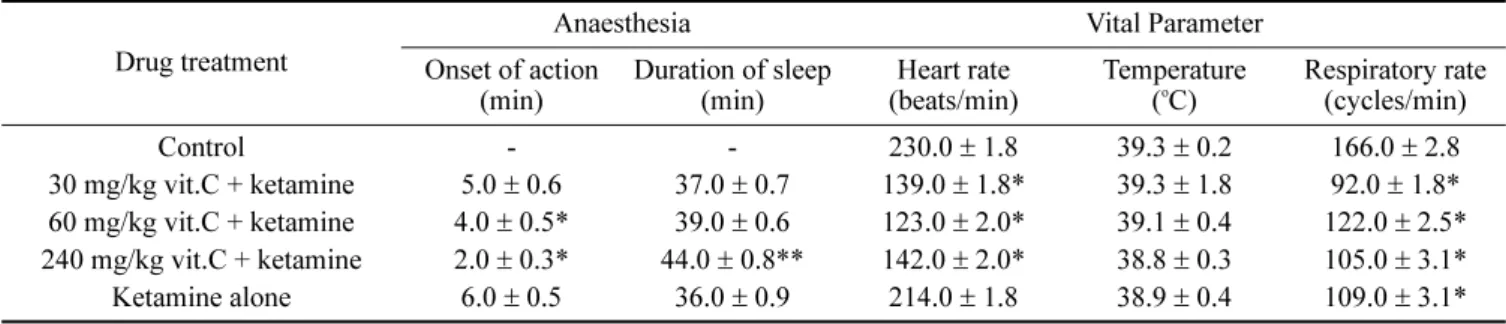
The effects of vitamin C on ketamine anesthesia was studied. In normal rabbits the onset and duration of ketamine induced anesthesia were 6.0 ± 0.5 and 36.0 ± 0.9 min, respectively. Pre-treatment of rabbits with 30, 60 and 240 mg/kg, i.m. of vitamin C followed by ketamine 40 mg/
kg i.m. resulted in significant ( p < 0.05) decrease in the onset and increase in duration of ketamine anesthesia to 5.0 ± 0.06 and 37.0 ± 0.7; 4.0 ± 0.5 and 39.0 ± 0.6; 2.0 ± 0.3 and 44.0 ± 0.8 min, respectively. There was also significant ( p < 0.05) decrease in the heart rates in the animals treated with vitamin C and ketamine combinations.
Serum analysis showed a significant ( p < 0.05) increase in blood glucose. The observed decreased in serum calcium and phosphorous following ketamine injection was prevented by pretreatment with vitamin C. These results suggest that vitamin C at higher doses could potentiate ketamine anesthesia in rabbits.
Key words: ketamine, rabbits, vitamin C
Introduction
Vitamin C possesses properties that exert modulating influence on the central nervous system either physiologically or pharmacologically. It is believed that vitamin C is an important regulator of mood and behaviours from reports of observed symptoms of insomnia and anxiety [11,12]. High amount of vitamin C probably has similar physiological properties as amphetamine in the central nervous system.
Depression and impairment of nervous system functions have been reported due to deficiency of this water-soluble vitamin [10,13]. In spite of several studies, the actual physiological role of vitamin C in the normal function of central nervous systems remains unclear, though it is known to be highly concentrated in the brain [11]. High doses of vitamin C have been reported to induce sleep disturbances, headache and gut upset [4,8].
Combined effects of stress and anesthesia can result in cardio- respiratory arrests. Rabbits are prone to be easily stressed by improper pre-operative handling and/or induction of anesthesia especially with volatile anaesthetics [3]. In rabbits, recovery from anesthesia is often slow particularly following the use of barbiturates. The prolonged inappetance characterized by frequent postoperative complication in rabbits can result in gastro-intestinal disturbances.
Ketamine produces a most useful state of dissociative anesthesia with the patient rapidly entering a trance like state with eyes wide open and nystagmus [7]. A patient is unconscious, amnesic and deeply analgesic. Ketamine has made many operations possible that otherwise wouldn’t have been impossible because of scarcity of trained anaesthetists [6,9]. Based on this background, this study was designed to determine the effects of vitamin C on ketamine anesthesia in rabbits.
Materials and Methods
Experimental animals
Twenty-five adult rabbits (California white breed) of either sex aged between 10 to 19 months and weighing 1.5 to 2.1 kg were used for this study. They were divided into five groups (A, B, C, D and E) of five rabbits each and housed in the animal house of the Faculty of Veterinary Medicine, Usmanu Danfodiyo University. They were fed with rabbit pellets, onions and spinach, and fresh water was provided ad libitum . The rabbits were allowed to acclimatize for two weeks before the experiment commenced.
Experimental procedure
Ketamine (40 mg/kg) was administered intramuscularly into each rabbits in group E. The vital parameters such as body temperature, heart and respiratory rates were taken and recorded after ketamine anesthesia. The onset and duration of sleep were also observed and recorded. Onset of anaesthesia was evident by dropping of ears, recumbency, decrease respiratory rate, loss of pedal and pupillary reflexes and loss of external stimuli. Ketamine anaesthesia in rabbit produces a deep plane of surgical anaesthesia characterized by complete loss of consciousness and good muscle
*Corresponding author
Tel: +234-8035436100
E-mail: [email protected]
240 Elsa Abdullahi, Ubandawaki Stephen
relaxation. Five rabbits each in groups B, C and D received 30, 60 and 240mg/kg of vitamin C by imtramuscular injection, respectively. Five minutes after premedication with vitamin C, the animals were treated with ketamine. The onset and duration of sleep as well as vital parameters were observed and recorded. The animals in groups A as control were neither treated with vitamin C nor ketamine.
Blood samples from the ear vein were collected using clean plain test tubes for each rabbit in groups A, B, C, D, and E after drug administration. The blood samples were allowed to coagulate and serum were harvested and taken to the laboratory for blood glucose, calcium, phosphate and bicarbonate ion assay [14].
Statistical analysis
Mean and standard error were used in analyzing the experimental data. Changes in the control and experimental values were compared for statistical significance using ANOVA and a probability level at 5% as levels of significant.
Results
In normal rabbits the onset and duration of katamine - induced anesthesia was 6.0 ± 0.5 min and 36.0 ± 0.9 min.
respectively. Pretreatment of rabbits with 30, 60 and 240 mg/kg i.m. of vitamin C followed by ketamine 40 mg/kg i.m. resulted in significant ( p < 0.05) decrease in the onset and increase in the duration of ketamine anaesthesia (Table
1). The decrease in onset and increase in the duration of anaesthesia appear to be dose dependent. Administration of vitamin C prior to administration of ketamine also significantly ( p < 0.05) decreased the heart rate and respiratory rates. The decrease in the temperature of rabbits treated with vitamin C prior to ketamine anaesthetic administration was insignificant.
Administration of vitamin C prior to ketmine treatment resulted in significantly ( p < 0.05) increased serum glucose when compared to the control and ketamine treatment alone (Table 2). Vitamin C treatment prior to ketamine administration appear to prevent the reduction in serum calcium ion concentration observed with ketamine treatment alone.
Phosphate ion concentration of the blood decreased significantly ( p < 0.05) with the administration of ketamine alone. However, the administration of vitamin C prior to ketamine resulted in improvement of serum phosphate ion levels in rabbits. Bicarbonate ion levels was not altered by ketamine treatment alone or with its combinations with vitamin C.
Discussion
The results obtained from the experiment showed that vitamin C treatment prior to ketamine administration affected the onset and duration of sleep of ketamine anaesthesia in rabbits. The decrease in the time of onset as well as the increase in the duration of anaesthesia showed
Table 1. Effect of vitamin C on ketamine anesthesia and vital parameters of rabbits pre-treated with different doses of vitamin C
Drug treatment Anaesthesia Vital Parameter
Onset of action
(min) Duration of sleep
(min) Heart rate
(beats/min) Temperature
(
oC) Respiratory rate (cycles/min)
Control - - 230.0 ± 1.8 39.3 ± 0.2 166.0 ± 2.8
30 mg/kg vit.C + ketamine 5.0 ± 0.6 37.0 ± 0.7 139.0 ± 1.8* 39.3 ± 1.8 92.0 ± 1.8*
60 mg/kg vit.C + ketamine 4.0 ± 0.5* 39.0 ± 0.6 123.0 ± 2.0* 39.1 ± 0.4 122.0 ± 2.5*
240 mg/kg vit.C + ketamine 2.0 ± 0.3* 44.0 ± 0.8** 142.0 ± 2.0* 38.8 ± 0.3 105.0 ± 3.1*
Ketamine alone 6.0 ± 0.5 36.0 ± 0.9 214.0 ± 1.8 38.9 ± 0.4 109.0 ± 3.1*
*Significantly decrease (p < 0.05)
**Significantly increase (p < 0.05)
Table 2. Changes in the level of blood glucose, Ca
2+, PO
42−