• 검색 결과가 없습니다.

Veterinary Science

N/A
N/A
Protected

Academic year: 2022

Share "Veterinary Science"

Copied!
4
0
0

로드 중.... (전체 텍스트 보기)

전체 글

(1)

J O U R N A L O F

Veterinary Science

J. Vet. Sci. (2006), 7(2), 189–192

Matricaria chamomilla CH 12 decreases handling stress in Nelore calves Luis Souza Lima de Souza Reis

1,

*, Paulo Eduardo Pardo

1

, Eunice Oba

2

, Sergio do Nascimento Kronka

3

, Neuza Maria Frazatti-Gallina

4

1

Departamento de Pos-graduação, Universidade do Oeste Paulista, UNOESTE, Presidente Prudente, SP, CEP 19067-175, Brazil

2

Departamento de Reprodução Animal e Radiologia, Faculdade de Medicina Veterinaria e Zootecnia, Universidade Estadual Paulista Júlio de Mesquita Filho, UNESP, Botucatu, SP, CEP 19067-175, Brazil

3

Departamento de Pós-graduação em Agronomia, Universidade do Oeste Paulista, UNOESTE, Presidente Prudente, SP, CEP 19067-175, Brazil

4
Seção de Raiva, Instituto Butantan, São Paulo, SP, CEP 05503-900, Brazil

Matricaria chamomilla CH

12

is a phytotherapeutic or homeopathic product, which has been used to reduce stress. Here, we examined its effect on preventing handling stress in bovines. Sixty Nelore calves were randomly distributed into two equal groups. One group was administered Matricaria chamomilla CH

12

in diet and the other the ‘control’ was not. Animals in both groups were maintained unstressed for 30 days to adjust to the feeding system and pasture, and were then stressed by constraint on the 31th, 38th, 45th and 60th experimental days. Blood samples were taken on these days after animals had been immobilization in a trunk contention for 5 min. Stress was followed by analyzing serum cortisol levels. These peaked on the 45th day and then decreased, but not to baseline, on the 60th day. On the 45th day cortisol levels were significantly lower in animals fed Matricaria chamomilla CH

12

, suggesting that this product reduces stress. These effects may be a consequence of its inhibiting cortisol production and its calming and anxiolytic effects.

Key words: bovine, cortisol, handling, Matricaria chamo- milla, Nelore calf, stress

Introduction

Neuroendocrine stress responses are regulated by the hypothalamic-pituitary-adrenal axis (HPA), which promotes plasmatic cortisol release [38,26]. This response is vital to an organism that has to cope with a challenging environment [19].

Bovine stressors may be either physical or psychological. The most referenced stressors are vaccination [30], immobilization

[19], handling in a corral [37], installation [5], fear [28], presence of unfamiliar people [23], transportation [7], food and water deprivation [37], hot or cold environment [5], cirurgical procedures [6], crowding [7], isolation [9], confinement [11] and natural physiological changes (parturition, lactation, weaning) [37].

The effects of stress on bovine economy and production are remarkable. For example, in Argentina it has been estimated to account for losses of 50 million dollars per year [7].

Moreover, the effects of the above stressors are increased when bovines are held in modern regimes, such as, intensive systems that impose severe stress [37] and require higher investments [11]. Under such conditions, stress impairs cattle growth, weight gains, milk production, and meat quality [11,10,26,37].

Phytotherapy or homeopathic products, such as, the chamomile Matricaria chamomilla, have been used to decrease stress. Moreover, apigenin the active principle of chamomile, decreases cortisol plasma concentrations [41]

and has sedative [39], analgesic [3], anxiolytic [39], anti inflammatory [33] and immunomodulatory effects [1].

Although the phytotherapeutic effects of chamomile are well documented, its anti-stress effect on bovines is not as well known. Thus, in the present study, we evaluated whether the chamomile-based product, Matricaria chamomilla CH

12

, prevents or reduces handling stress response in Nelore bovines.

Materials and Methods

Animals

Sixty Nelore calves ( Bos indicus ), about 12 months old, belonging to a farm situated in Lutecia, SP, Brazil, were studied. Animals were fed Brachiaria decumbens from an extensive pasture system and supplemented with commercial mineral salt in an ad libitum manner .

The experiment was carried out during the spring (September

*Corresponding author

Tel: +55-18-97762550

E-mail: [email protected]

(2)

190 L. S. L. S. Reis et al.

to October) of 2003 in a tropical area, which is characterized by a rainy season from October to April and a dry season from May to September, with an annual precipitation of about 1300 mm, a relative humidity of approximately 64%, a mean temperature 25ºC, and an altitude of 602 m. Nelore cattle adapt well to these conditions.

Matricaria chamomilla CH

12

Matricaria chamomilla CH

12

(Fator Estresse; Arenales Fauna & Flora, Brazil) is composed of Matricaria chamomilla CH

12

, milk CH

12

, Bixa orellana (0.75 g) and sucrose (100 g).

Matricaria chamomilla CH

12

administration

The animals were randomly distributed into two groups (30 animals/group): one received feed with mineral salt supplemented with Matricaria chamomilla CH

12

and the other group without this supplement (control). In both groups the animals were maintained unstressed for 30 days to adjust to the feeding system and adaptation to pasture, and were then stressed on the 31th, 38th, 45th, and 60th days of the experiment. Each animal in the Matricaria chamomilla CH

12

group ingested about 2 g of Matricaria chamomilla CH

12

daily. The quantity of this supplement consumed by the animals was estimated by incorporating Matricaria chamomilla CH

12

into mineral salt every day and calculating the mean individual salt consumption (daily difference between salt weight offered and amount left after 24 h divided by the number of animals).

Blood samples were taken on days 31th, 38th, 45th, and 60th after immobilization, which was performed by leading animals to a corral in the morning of the sampling day, and restraining each animal in a trunk contention for 5 min immobilization blood samples were taken (10 ml) from the jugular vein and stored in vacuum tubes not containing anticoagulant. These tubes were kept in an insulated container in ice and soon centrifuged 2,500rpm by 10min.

Serum samples were stored at 20

o

C for subsequent serum cortisol determination.

Stressors imposed on cattle

The stressors imposed on calves are: handling pen, presence of unfamiliar people during handling, immobilization in a trunk contention for 5 min and harvesting blood sampling.

Serum cortisol determination

Serum cortisol levels were determined using a commercial solid-phase radioimmunoassay kit (Diagnostic Products, USA) and counted using an Auto-Gamma Count Cobra II (Packard Bio Sciences, USA).

Statistical analysis

Data were normalized by [(x + 0.5)

1/2

] and significant effects were detected by repeated measures ANOVA and

then compared using the Tukey test. The error probability was set at 5% [4].

Results

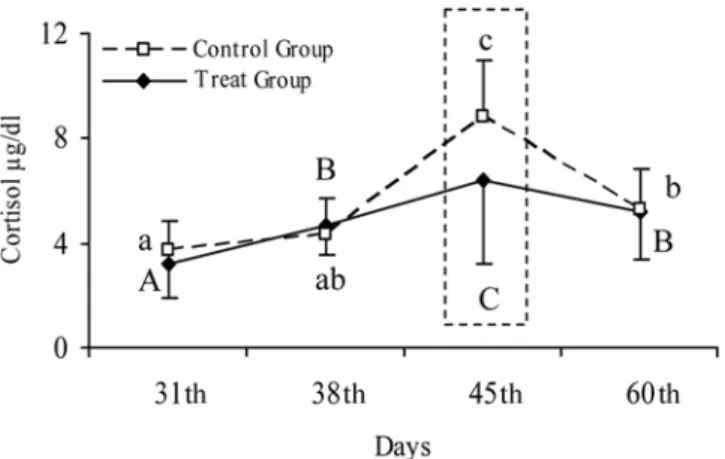
Animals in both groups showed increased serum cortisol from the beginning of the experiment and peak values were reached on the 45th day. Cortisol levels then decreased gradually but did not reach basal values on the 60th day (Fig. 1). Highest serum cortisol levels were observed in both groups on day 45, but this was significantly lower in animals treated with Matricaria chamomilla CH

12

(ANOVA, F = 8.54; p < 0.01).

Discussion

The handling procedures imposed on cattle in holding pens are stressful, and increase serum cortisol levels, although these levels are almost completely reestablished after animals have adjusted. Cattle stress is attenuated by the chamomile-based product Matricaria chamomilla CH

12

, possibly because this material reduces serum levels of adrenocorticotropic hormone (ACTH) and has sedative, anxiolytic, and miorelaxing properties.

On the 31th experiment day after animals had adjusted to the feeding system and before or after applying constraint stress for 1 h, serum cortisol levels were 3.16 µ g/dl in animals fed Matricaria chamomilla CH

12

and 3.68 µ g/dl in controls. These values are close to the basal cortisol levels of 3.29 µ g/dl found in Zebu cattle by Aragón et al. [2] and by Vásquez and Herrera [37].

In this experiment, many factors may have caused the cortisol increase. In fact, handling a primary stressor in farm animals and is known to impair animal welfare [5,9,21,28].

Moreover, leading cattle to a holding pen is a forced physical

Fig. 1. Effect of Matricaria Chamomilla CH

12

on calf serum

cortisol. Mean cortisol levels (±SD) of treated and control groups

(30 animals/group). Means with the dotted box are statistically

different from each other ( p < 0.05). Means with at least common

lower case letter are similar within the given group.

(3)

Matricaria chamomilla CH

12

decreses handling stress in Nelore calves 191

exercise [12,22,34], as is restraint in a ‘Brete’ chute [19,35].

In addition, blood sampling [28] and the presence of unfamiliar people during handling [9,16,17,23] impose additional stress. The handling pen is a novelty for animals [20,29,38], and shouting and physical aggression by handling [16,32], and fear caused by the conditions mentioned above [5,14,28] also acted as stressors in the present study.

Neuroendocrine stress response consists of the activation of the hypothalamic pituitary axis, which results in the secretion of cortisol by the adrenal gland [8,26,38]. This is a possible explanation the results obtained from the 38th day to the end of the experiment in both the control group and the group treated with Matricaria chamomilla CH

12

. Moreover, although no statistical difference was found, serum cortisol levels were higher than the basal concentrations obtained by Aragón et al. [2] and Vásquez and Herrera [37], thus supporting the notion that the animals were slight stressed.

On the 45th day of this experiment, control animals showed cortisol levels 38.4% higher than those of animals treated with chamomile. This response is in agreement with the results reported by Ohno et al. [31], who found that Matricaria chamomilla reduces cortisol production by about 47.5% in human adreno-cortical H295R cells. In other mammals, the flavonoid apigenin contained in Matricaria chamomilla [25,33,40,42] was found to act on the nervous system by diverse and complex mechanisms [27,13].

On the 60th day of the experiment, cortisol levels had dropped off in treated and control animals, and almost reached basal levels. This reduction can be attributed to adjustment to handling procedures [18,28,36]. Adjustments to stressors are caused by changes in the central nervous system at different levels, i.e., effects on hypothalamus and pituitary function; on neurosteroids and neurotransmitters;

on the limbic system (mainly the amygdala and hippocampus) and on the hypothalamic pituitary axis [6], which decrease axis response to stressors [19]. The capacity of bovines to adjust to stress differs among individual animals due to genetic [15,19] and temperament features, i.e., docile animals adjust more easily [15].

The results of the present study provide evidence that Matricaria chamomilla CH

12

decreased stress in bovines.

We hypothesize that the mechanisms involved are the inhibition of cortisol production and the calming and anxiolytic effects of this material.

Acknowledgments

This research was supported by the Homeopathic Laboratory Arenales Fauna & Flora Ltd., Brazil.

References

1. Amirghofran Z, Azadbakht M, Karimi MH. Evaluation of the immunomodulatory effects of five herbal plants. J Ethnopharmacol 2000, 72 , 167-172.

2. Aragón VEF, Graca DS, Norte AL, Santiago GS, Paula OJ. Suplementação com cromo e desempenho reprodutivo de vacas zebu primíparas mantidas a pasto. Arq Bras Med Vet Zootec 2001, 53 , 624-628.

3. Avallone R, Zanoli P, Puia G, Kleinschnitz M, Schreier P, Baraldi M. Pharmacological profile of apigenin, a flavonoid isolated from Matricaria chamomilla . Biochem Pharmacol 2000, 59 , 1387-1394.

4. Banzatto DA, Kronka SN. Experimentação agrícola. 3rd ed.

pp. 247, FUNEP, Jaboticabal, 1995.

5. Borell, EH. The biology of stress and its application to livestock housing and transportation assessment. J Anim Sci 2001, 79 (E. Suppl.) , E260-E267.

6. Cook CJ, Mellor, DJ, Harris, PJ, Ingram JR, Matthews, LR. Hands-on and hands-off measurement of stress. In:

Morberg GP, Mench JA (eds.). The Biology of Animals Stress: Basic Principles And Implications for Animal Welfare. pp.123-146, CABI Publishing, New York, 2000.

7. Coppo JA, Mussart NB, Revidatti MA, Capellari A.

Absence of biochemically demonstrable stress in early weaned half-bred zebu calves. Cien e Inv Agr, 2003, 30 , 97- 8. 105. Dickerson SS, Kemeny ME. Acute stressors and cortisol responses: a theoretical integration and synthesis of laboratory research. Psychol Bull 2004, 130 , 355-391.

9. Eicher SD. Transportation of cattle in the dairy industry:

current research and future directions. J Anim Sci 2001, 84 (E. Suppl.) , E19-E23.

10. Elsasser TH, Klasing, KC, Filipov N, Thompson F. The metabolic consequences of stress: Targets for stress and proprieties of nutrient use. In: Morberg GP, Mench JA (eds.).

The Biology of Animals Stress: Basic Principles And Implications for Animal Welfare. pp.77-110, CABI Publishing, New York, 2000.

11. Encarnação RO. Estresse e produção animal. In: Costa MJRP (ed). 1º Ciclo internacional de palestras sobre bioclimatologia animal. pp. 111-129, FUNEP, Jaboticabal, 1989.

12. Garcia-Belenguer S, Palacio J, Gascón M, Aceña C, Revilla R, Mormède P. Differences in the biological stress responses of two cattle breeds to walking up to mountain pastures in the Pyrenees. Vet Res 1996, 27 , 515-526.

13. Goutman JD, Waxemberg MD, Doñate-Oliver F, Pomata PE, Calvo DJ. Flavonoid modulation of ionic currants mediated by GABA

A

and GABA

C

receptors. Eur J Pharmacol 2003, 461 , 79-87.

14. Grandin T. Evaluación del estrés durante el manejo y transporte. J Anim Sci 1997, 75 , 249-257.

15. Grandin T. Handling methods and facilities to reduce stress on cattle. Vet Clin North Am Food Anim Pract 1998, 14 , 325-342.

16. Hemsworth PH, Coleman GJ, Barnett JL, Borg S.

Relationships between human-animal interactions and productivity of commercial dairy cows. J Anim Sci 2000, 78 , 2821-2831.

17. Hemsworth PH, Coleman GJ, Barnett JL, Borg S,

Dowling S. The effects of cognitive behavioral intervention

on the attitude and behavior of stockpersons and the behavior

(4)

192 L. S. L. S. Reis et al.

and productivity of commercial dairy cows. J Anim Sci 2002, 80 , 68-78.

18. Hickey MC, Drennan M, Earley B. The effect of abrupt weaning of suckler calves on the plasma concentrations of cortisol, catecholamines, leukocytes, acute-phase proteins and in vitro interferon-gamma production. J Anim Sci 2003, 81 , 2847-2855.

19. Hopster H, van der Werf JTN, Erkens JHF, Blokhuis HJ.

Effects of repeated jugular puncture on plasma cortisol concentrations in loose-housed dairy cows. J Anim Sci 1999, 77 , 708-714.

20. Joca SRL, Padovan CM, Guimarães FS. Estresse, depressão e hipocampo. Rev Bras Psiquiatr 2003, 25(Suppl 2) , 46-51.

21. Knowles TG, Warriss PD. Stress physiology during transport.

In: Grandin T (ed.). Livestock Handling and Transport. 2nd ed.

pp. 385-407, CAB International, Wallingford, 2000.

22. Kurosawa M, Nagata S, Takeda F, Mima K, Hiraga A, Kai M, Taya K. Plasma catecholamine, adrenocorticotropin and cortisol responses to exhaustive incremental treadmill exercise of the Thoroughbred horse. J Equi Sci 1998, 9 , 9-18.

23. Lensink BJ, Fernandez X, Boivin X, Pradel P, Le Neindre P, Veissier I. The impact of gentle contacts on ease of handling, welfare, and growth of calves and on quality of veal meat. J Anim Sci 2000, 78 , 1219-1226.

24. Marder M, Paladini AC. GABA(A)-receptor ligands of flavonoid structure. Curr Top Med Chem 2002, 2 , 853-867.

25. Marder M, Viola H, Wasowski C, Fernández S, Medina JH, Paladini AC. 6-methylapigenin and hesperidin: new valeriana flavonoids with activity on the CNS. Pharmacol Biochem Behav 2003, 75 , 537-545.

26. Matteri RL, Carroll JA, Dyer CJ. Neuroendocrine responses to stress. In: Morberg GP, Mench JA (eds.). The Biology of Animals Stress: Basic Principles and Implications for Animal Welfare. pp. 43-76, CABI Publishing, New York, 2000.

27. Medina JH, Viola H, Wolfman C, Marder M, Wasowski C, Calvo D, Paladini AC Neuroactive flavonoids: new ligands for the benzodiazepine receptors. Phytomedicine 1998, 5 , 235-243.

28. Mellor DJ, Stafford KJ, Todd SE, Lowe TE, Gregory NG, Bruce RA, Ward RN. A comparison of catecholamine and cortisol responses of young lambs and calves to painful husbandry procedures. Aust Vet J 2002, 80 , 228-233.

29. Morrow CJ, Kolver ES, Verkerk GA, Matthews LR.

Fecal glucocorticoid metabolites as a measure of adrenal activity in dairy cattle. Gen Comp Endocrinol 2002, 126 , 229-241.

30. Nockels CF, Odde KG, Craig AM. Vitamin E supplementation and stress affect tissue á-tocopherol content of beef heifers. J

Anim Sci 1996, 74 , 672-677.

31. Ohno S, Shinoda S, Toyoshima S, Nakazawa H, Makino T, Nakajin S. Effects of flavonoid phytochemicals on cortisol production and on activities of steroidogenic enzymes in human adrenocortical H295R cells. J Steroid Biochem Mol Biol 2002, 80 , 355-363.

32. Pajor EA, Rushen J, de Passile AMB. Aversion learning techniques to evaluate dairy cattle handling practices. Appl Anim Behav Sci 2000, 69 , 89-102.

33. Paladini AC, Marder M, Viola H, Wolfman C, Wasowski C, Medina JH. Flavonoids and the central nervous system:

from forgotten factors to potent anxiolytic compounds. J Pharm Pharmacol 1999, 51 , 519-526.

34. Paludo GR, McManus C, Melo RQ, Cardoso AG, Mello FPS, Moreira M, Fuck BH. Efeito do estresse térmico e do exercício sobre parâmetros fisiológicos de cavalos do exército brasileiro. R Bras Zootec 2002, 31 , 1130-1142.

35. Sánchez JM, Castro MJ, Alonso ME, Gaudioso VR.

Adaptive metabolic responses in females of the fighting breed submitted to different sequences of stress stimuli.

Physiol Behav 1996, 60 , 1047-1052.

36. Solano J, Galindo F, Qrihuela A, Galina CS. The effect of social rank on the physiological response during repeated stressful handling in Zebu cattle ( Bos indicus ). Physiol Behav 2004, 82 , 679-683.

37. Vásquez EFA, Herrera APN. Concentração plasmática de cortisol, uréia, cálcio e fósforo em vacas de corte mantidas a pasto suplementadas com levedura de cromo durante a estação de monta. Ciência Rural (Santa Maria) 2003, 33 , 743-747.

38. Veissier I, Reenen CG, Andanson S, Leushuis IE.

Adrenocorticotropic hormone and cortisol in calves after corticotropin-releasing hormone. J Anim Sci 1999, 77 , 2047- 2053.

39. Viola H, Wasowski C, Levi de Stein M, Wolfman C, Silveira R, Dajas F, Medina JH, Paladini AC. Apigenin, a component of Matricaria recutita flowers, is a central benzodiazepine receptors-ligand with anxiolytic effects.

Planta Med 1995, 61 , 213-216.

40. Wasowski C, Marder M, Viola H, Medina JH, Paladini AC. Isolation and identification of 6-methylapigenin, a competitive ligand for the brain GABA

A

receptors, from Valeriana wallichii. Planta Med 2002, 68 , 934-936.

41. Yamada K, Miura T, Mimaki Y, Sashida Y. Effect of inhalation of Chamomilla oil vapour on plasma ACTH level in ovariectomized-rat under restriction stress. Biol Pharm Bull 1996, 19 , 1244-1246.

42. Zanoli P, Avaloni R, Baraldi M. Behavioral characterization

of the flavonoids apigenin and chrysin. Fitoterapia 2000,

71(Suppl 1) , S117-S123.

수치

Fig. 1.  Effect of  Matricaria Chamomilla  CH 12  on calf serum cortisol. Mean cortisol levels (±SD) of treated and control groups (30 animals/group)

참조

관련 문서