Risk Assessment of Postoperative Nausea and Vomiting in the Intravenous Patient-Controlled Analgesia Environment:
Predictive Values of the Apfel’s Simplified Risk Score for Identification of High-Risk Patients
Shin Hyung Kim, Yang-Sik Shin, Young Jun Oh, Jeong Rim Lee, Sung Chan Chung, and Yong Seon Choi
Department of Anesthesiology and Pain Medicine, Anesthesia and Pain Research Institute, Yonsei University College of Medicine, Seoul, Korea.
Received: September 14, 2012 Revised: December 4, 2012 Accepted: December 5, 2012
Corresponding author: Dr. Yong Seon Choi, Department of Anesthesiology and Pain Medicine, Anesthesia and Pain Research Institute,
Yonsei University College of Medicine, 50 Yonsei-ro, Seodaemun-gu, Seoul 120-752, Korea.
Tel: 82-2-2227-4576, Fax: 82-2-364-2951 E-mail: [email protected]
∙ The authors have no financial conflicts of interest.
© Copyright:
Yonsei University College of Medicine 2013 This is an Open Access article distributed under the terms of the Creative Commons Attribution Non- Commercial License (http://creativecommons.org/
licenses/by-nc/3.0) which permits unrestricted non- commercial use, distribution, and reproduction in any medium, provided the original work is properly cited.
Purpose: Opioid-based intravenous patient-controlled analgesia (IV PCA) is pop- ular method of postoperative pain control, but many patients suffer from IV PCA- related postoperative nausea and vomiting (PONV). In this retrospective observa- tional study, we have determined independent predictors of IV PCA-related PONV and predictive values of the Apfel’s simplified risk score in pursuance of identify- ing high-risk patients. Materials and Methods: We analyzed 7000 patients who received IV PCA with background infusion after elective surgery. Patients who maintained IV PCA for a postoperative period of 48 hr (completion group, n=6128) were compared with those who have discontinued IV PCA within 48 hr of surgery due to intractable PONV (cessation group, n=872). Patients, anesthetics, and surgi- cal factors known for predicting PONV were evaluated by logistic regression anal- ysis to identify independent predictors of IV PCA related intractable PONV. Re- sults: In a stepwise multivariate analysis, weight, background infusion dose of fentanyl, addition of ketolorac to PCA, duration of anesthesia, general anesthesia, head and neck surgery, and Apfel’s simplified risk score were revealed as indepen- dent risk factors for intractable PONV followed by the cessation of IV PCA. In ad- dition, Apfel’s simplified risk score, which demonstrated the highest odds ratio among the predictors, was strongly correlated with the cessation rate of IV PCA.
Conclusion: Multimodal prophylactic antiemetic strategies and dose reduction of opioids may be considered as strategies for the prevention of PONV with the use of IV PCA, especially in patients with high Apfel’s simplified risk scores.
Key Words: Apfel’s simplified risk score, patient-controlled analgesia, postopera- tive nausea and vomiting
INTRODUCTION
Intravenous patient-controlled analgesia (IV PCA) is a widely used postoperative analgesic strategy for its effectiveness and safety as acute postoperative pain re-
audit and outcome assessment (more than 20000 cases at present). The sample population in this study was defined as elective surgical patients who received fentanyl-based IV PCA for postoperative pain control between September 2010 and September 2011 at Severance Hospital. Patients were excluded for the following: age <18 years, age >80 years, American Society of Anesthesiologists physical status class
≥III, requirement of postoperative ventilator support or in- tensive care, and having received total intravenous anesthe- sia (TIVA). Patients who maintained IV PCA for a postop- erative period of 48 hr (completion group) were compared with those who discontinued IV PCA within 48 hr after sur- gery due to intractable PONV (cessation group).
IV PCA and PONV management
General anesthesia was induced with propofol and opioids (remifentanil or fentanyl), and maintained with volatile an- esthetics (isoflurane, sevoflurane, or desflurane) with/with- out a continuous infusion of remifentanil (0.05-0.2 μg/kg/
min). All patients used the same model of disposable PCA pump (Accufuser plus® P2015M; Woo Young Medical, Chungbuk, Korea), which was programmed to deliver 2 mL/hr as a background infusion and 0.5 mL per demand, with a 15-min lockout during a 48-hr period. The PCA regi- men typically consisted of fentanyl (concentration 10-15 μg/
mL) plus normal saline (total volume of 100 mL). At the discretion of the attending anesthesiologists, 90-120 mg of ketorolac was added as an adjuvant to the PCA regimen ac- cording to age, preoperative renal function, or type of sur- gery. Additionally, a 5-hydroxytryptamine receptor 3 (5- HT3) antagonists (ondansetron 4-8 mg or ramosetron 0.3 mg) were either given at the end of surgery, or dexametha- sone 4 mg was administered intravenously after induction of anesthesia. All IV PCA were started at a post-anesthesia care unit.
The PCA service team, which was comprised of anesthe- siologists and PCA nurse specialists, monitored patients at 1-6, 6-24, and 24-48 hr intervals after surgery to inquire about the occurrence of adverse events, and the need for rescue analgesics and/or antiemetics. Fentanyl-based IV PCA-related adverse events included PONV, sedation, diz- ziness, headache, hypotension, and pruritis. In addition to these parameters, the incidence of PONV, severity of nau- sea, and pain intensity scores were recorded at the afore- mentioned time points. The intensity of nausea was graded on verbal rating scales using an 11-point scale (0=no nau- sea to 10=worst possible nausea). Pain intensity scores were lief.1-3 However, postoperative analgesia using opioids is as-
sociated with a high incidence of postoperative nausea and vomiting (PONV), despite multimodal preventive approach- es.4-7 Clinically, opioid-based IV PCA is occasionally discon- tinued because of patients’ complaints of various opioid-in- duced side effects, such as PONV, dizziness, urinary retention, and pruritis.1,8 In extreme cases, intractable PONV may even be perceived as a failure of IV PCA as a pain management technique. The cessation of IV PCA due to intractable PONV might also be an unreasonable clinical decision made by the surgical team because opioid-based IV PCA was thought to play a larger role in PONV than evidence suggested.9 The re- lationship between opioid usage and PONV is complex, and applying various adjuvants with opioid sparing effects to multimodal analgesic regimens does not necessarily lead to a reduced incidence of PONV.9,10 Numerous studies have in- vestigated the risk factors for predicting the development of PONV, including those related to the patient, the anesthesia, and the surgery.11-19 However, no such comprehensive data exist regarding to the association of risk factors and intracta- ble PONV with the postoperative use of IV PCA with back- ground infusion, which has mainly been based on the site of operation and the age, weight, and gender of the patient.3 Moreover, possible risk factors for IV PCA-related PONV should be identified because the cessation of IV PCA may not only lead to discomfort, but also dissatisfy patients due to poor postoperative pain management and, as a result, in- creasing hospital costs.20,21
We hypothesized that multiple factors affect the cessation of IV PCA caused by intractable PONV. To test our hypoth- esis, we analyzed elective surgical patients who received fentanyl-based IV PCA for their postoperative pain control, using our large observational database. The aim of this study was to investigate perioperative predictive factors for intractable PONV accompanied by the cessation of IV PCA, as well as to evaluate the predictive value of the Ap- fel’s simplified risk score for the cessation of IV PCA due to intractable PONV.
MATERIALS AND METHODS
The Institutional Review Board of Severance Hospital (ref.
4-2011-0475) approved this study and written informed con- sent was waived. Since 2009, the PCA service team has prospectively collected comprehensive clinical data for all postoperative PCA management for the purpose of clinical
Additionally, a receiver operating characteristics (ROC) curve was drawn. The area under the ROC-curve (AUC) was used to estimate the discriminating power of the Apfel risk score for prediction of IV PCA related PONV and the cut-off point for a predictive risk of IV PCA related PONV was calculated. Pearson correlation analysis was used to test the associations between weight and background infusion dose of fentanyl in PCA. Statistical analysis was performed with SAS (version 9.2; SAS Institute, Inc., Cary, NC, USA).
Values of p<0.05 were considered as statistically significant.
RESULTS
A total of 9221 patients were assessed for study eligibility, of which 7073 initially met the study criteria. IV PCA was ceased within 48 hr after surgery due to fentanyl-based IV PCA-related adverse events for 945 patients. After the exclu- sion of patients with other reasons for cessation of IV PCA, including headache and/or dizziness, hypotension, sedation, urinary retention and pruritis, 872 patients were included in the cessation group due to IV PCA-related intractable PONV.
In the cessation group, IV PCA was ceased in 7%, 65%, and 28% of patients 1-6, 6-24, and 24-48 hr after surgery, respec- tively. The final study population included 7000 patients in measured on a visual analog scale (0 mm=no pain to 100
mm=worst pain imaginable). IV PCA related PONV man- agement in a general ward was conducted in regular se- quence by institutional guidelines. 1) Patients are given IV rescue antiemetic (ondansetron 4 mg) if moderate to severe nausea (verbal rating score ≥4) lasting ≥15 min and/or emet- ic symptoms (vomiting, retching) and/or upon the request of the patient; 2) If PONV is persistent 1 hr after rescue an- tiemetic treatment, IV PCA is temporarily stopped for ap- proximately 2 hr to identify the cause of PONV; 3) If PONV is persistent or relieved PONV develop by resumed IV PCA, additional IV antiemetic (ondansetron 4 mg or ramosetron 0.3 mg) is given to patients; 4) The IV PCA was completely discontinued when intractable PONV persisted despite addi- tional IV rescue antiemetic. Thus, IV PCA-related intracta- ble PONV was defined as persistent nausea or emetic symp- toms not relieved by appropriate antiemetic therapy when IV PCA was maintained. All prophylactic and rescue anti- emetics that were administrated during the perioperative period were recorded.
The PCA service team kept tract of the reason for cessa- tion, time of cessation, adverse side effects, and residual vol- ume of IV PCA if it was discontinued within 48 hr of sur- gery. Additional patient data includes age, gender, height, weight, medical history, duration of anesthesia, type of an- esthesia, type of surgery, smoking history, and previous his- tory of motion sickness or PONV.
Statistical analysis
Continuous variables are shown as mean±standard devia- tion, and categorical variables are shown as number (per- centage). The variables used for analysis included demo- graphic data (age, gender, weight) and known risk factors associated with PONV (background infusion dose of fentan- yl in PCA, addition of ketorolac in PCA, type of anesthesia, type of surgery, duration of anesthesia, diabetes mellitus, ad- juvant chemotherapy, Apfel’s simplified risk score). Patient and anesthetic characteristics were analyzed by independent t-test, χ2 test, or Fisher’s exact test, where appropriate. Lo- gistic regression was used to compute crude odds ratios (ORs) with 95% confidence intervals (CIs) for variables as- sociated with the cessation of IV PCA due to IV PCA-relat- ed intractable PONV. Variables that had a p-value <0.05 were included in the multivariate logistic regression analysis estimating adjusted ORs with 95% CIs. The trend of the cessation rate of IV PCA according to Apfel’s simplified risk score was analyzed using the Cochran-Armitage trend test.
6128 patients in the completion group
872 patients in the cessation group 1-6 hr period (n=65, 7%) 2-24 hr period (n=563, 65%) 24-48 hr period (n=224, 28%) 2148 excluded:
<18 or 80> yr (n=1272)
ASA physical status class ≥III (n=342) Requiring intensive unit care (n=483) TIVA (n=48)
Incomplete data (n=3) 9221 patients in database
7073 patients met criteria
Fig. 1. Study profile. TIVA, total intravenous anesthesia; PONV, postoperative nausea and vomiting; IV PCA, intravenous patient-controlled analgesia;
ASA, American Society of Anesthesiologists.
945 patients ceased IV PCA Intractable PONV (n=872) Headache and/or dizziness (n=15) Hypotension (n=36)
Sedation (n=8) Urinary retention (n=7) Pruritis (n=7)
p=0.669). In the Pearson correlation analysis, there was a statistically significant negative correlation between the background infusion dose of fentanyl in PCA and weight (r=-0.361, p<0.001).
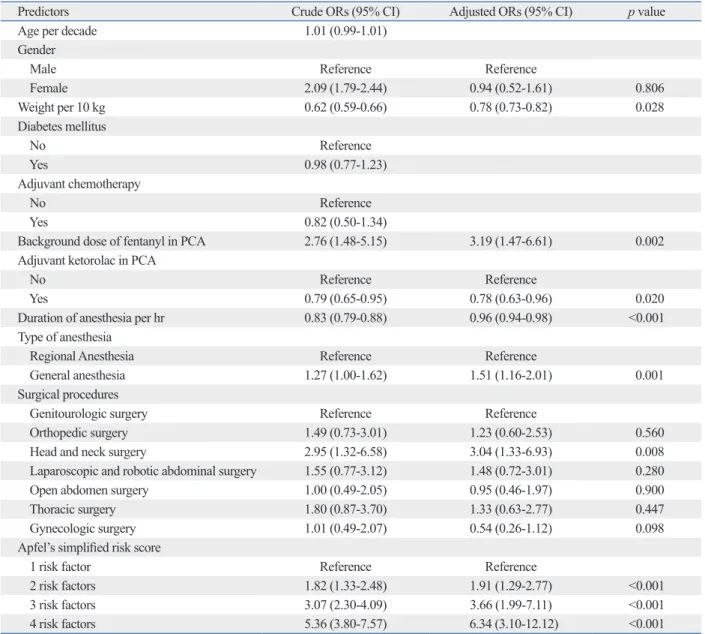
In the univariate analysis, we found that female gender, decreased weight, increased background infusion dose of fentanyl in PCA, non-addition of ketorolac in PCA, decreased duration of anesthesia, general anesthesia, head and neck surgery, and the risk factors of Apfel’s simplified risk score were significantly associated with an increased incidence of IV PCA-related intractable PONV (Table 1). In the multi- variate analysis of these variables, weight, background in- fusion dose of fentanyl, addition of ketorolac in PCA, dura- tion of anesthesia, general anesthesia, head and neck surgery, and a high Apfel simplified risk score remained indepen- dent risk factors for IV PCA-related intractable PONV (Ta- ble 2). Additionally, the cessation rate of IV PCA due to in- tractable PONV was proportionally increased according to Apfel’s simplified risk score with statistical significance this observational study (6128 patients in the completion
group and 872 patients in the cessation group) (Fig. 1).
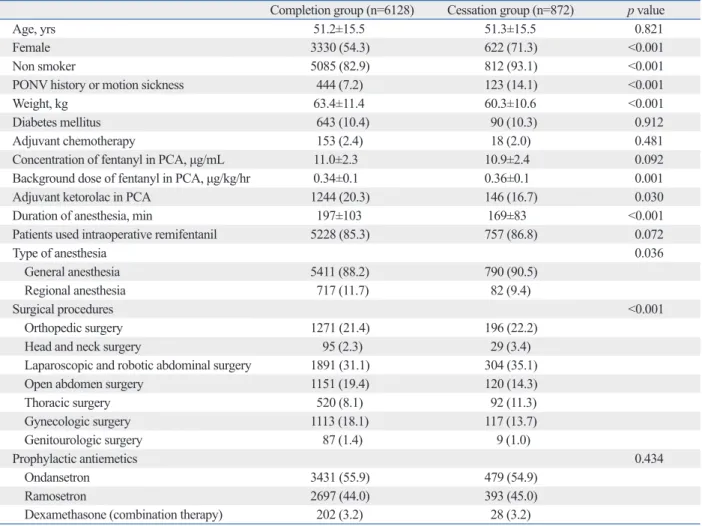
Data pertaining to patient characteristics, anesthesia, and surgery are described in Table 1. There were no significant differences between the completion group and the cessation group in age, presence of diabetes mellitus and neoadjuvant chemotherapy, concentration of fentanyl in PCA, and the number of incidence for intraoperative remifentanil infu- sion. All patients received prophylactic antiemetic therapy (5-HT3 antagonists) at the end of surgery. The percentage of patients receiving combination prophylactic antiemetic therapy (5-HT3 antagonist plus dexamethasone) was also similar between the two groups. There was a significant dif- ference between the three volatile anesthetics used regarding to the overall cessation rate (9%, 15%, and 12% after isoflu- rane, desflurane, and sevoflurane, respectively; p<0.001), al- though the cessation rate during the initial 1-6-hr postopera- tive period did not differ among them (0.7%, 1.2%, and 1.1%
after isoflurane, desflurane, and sevoflurane, respectively;
Table 1. Patient Characteristics, Anesthetic and Surgical Data
Completion group (n=6128) Cessation group (n=872) p value
Age, yrs 51.2±15.5 51.3±15.5 0.821
Female 3330 (54.3) 622 (71.3) <0.001
Non smoker 5085 (82.9) 812 (93.1) <0.001
PONV history or motion sickness 444 (7.2) 123 (14.1) <0.001
Weight, kg 63.4±11.4 60.3±10.6 <0.001
Diabetes mellitus 643 (10.4) 90 (10.3) 0.912
Adjuvant chemotherapy 153 (2.4) 18 (2.0) 0.481
Concentration of fentanyl in PCA, μg/mL 11.0±2.3 10.9±2.4 0.092
Background dose of fentanyl in PCA, μg/kg/hr 0.34±0.1 0.36±0.1 0.001
Adjuvant ketorolac in PCA 1244 (20.3) 146 (16.7) 0.030
Duration of anesthesia, min 197±103 169±83 <0.001
Patients used intraoperative remifentanil 5228 (85.3) 757 (86.8) 0.072
Type of anesthesia 0.036
General anesthesia 5411 (88.2) 790 (90.5)
Regional anesthesia 717 (11.7) 82 (9.4)
Surgical procedures <0.001
Orthopedic surgery 1271 (21.4) 196 (22.2)
Head and neck surgery 95 (2.3) 29 (3.4)
Laparoscopic and robotic abdominal surgery 1891 (31.1) 304 (35.1)
Open abdomen surgery 1151 (19.4) 120 (14.3)
Thoracic surgery 520 (8.1) 92 (11.3)
Gynecologic surgery 1113 (18.1) 117 (13.7)
Genitourologic surgery 87 (1.4) 9 (1.0)
Prophylactic antiemetics 0.434
Ondansetron 3431 (55.9) 479 (54.9)
Ramosetron 2697 (44.0) 393 (45.0)
Dexamethasone (combination therapy) 202 (3.2) 28 (3.2)
PCA, patient controlled analgesia; PONV, postoperative nausea and vomiting.
Values are number of patients (%) or means±standard deviation.
the study period (1-6 hr: 5% vs. 38%; 6-24 hr: 4% vs. 34%;
24-48 hr: 1% vs. 19%; p<0.001). There were no differences among pain scores or the need for rescue analgesics be- tween the two groups in each of the assessment intervals, except for the need for rescue analgesics in the 6-24 hr peri- od, which was higher in the cessation group than the com- pletion group (36% vs. 30%, p=0.008).
DISCUSSION
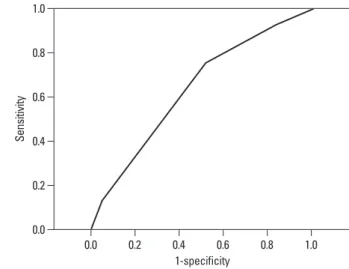
This is the first study to analyze which patients, anesthetics, and surgical variables affect intractable PONV in the opi- oid-based IV PCA environment, resulting in the cessation based on the Cochran-Armitage trend test (p<0.001) (Fig.
2). The area under the ROC curve for the Apfel risk score was 0.671 (95% CI 0.661-0.686) and the optimal cut-off point was ≥3 risk factors (corresponding sensitivity=71%, specificity=58%) (Fig. 3).
During the entire PONV assessment period, the percent- age of patients experiencing PONV and receiving rescue antiemetics was significantly higher in the cessation group than in the completion group (p<0.001), except for the per- centage of patients receiving rescue antiemetics in the 24- 48 hr postoperative period (p=0.377) (Fig. 4). The propor- tion of patients who experienced moderate-to-severe nausea (verbal rating score ≥4) was also significantly higher in the cessation group than in the completion group throughout
Table 2. Factors Associated with Cessation of IV PCA Due to PONV: Results of the Logistic Regression Analysis
Predictors Crude ORs (95% CI) Adjusted ORs (95% CI) p value
Age per decade 1.01 (0.99-1.01)
Gender
Male Reference Reference
Female 2.09 (1.79-2.44) 0.94 (0.52-1.61) 0.806
Weight per 10 kg 0.62 (0.59-0.66) 0.78 (0.73-0.82) 0.028
Diabetes mellitus
No Reference
Yes 0.98 (0.77-1.23)
Adjuvant chemotherapy
No Reference
Yes 0.82 (0.50-1.34)
Background dose of fentanyl in PCA 2.76 (1.48-5.15) 3.19 (1.47-6.61) 0.002
Adjuvant ketorolac in PCA
No Reference Reference
Yes 0.79 (0.65-0.95) 0.78 (0.63-0.96) 0.020
Duration of anesthesia per hr 0.83 (0.79-0.88) 0.96 (0.94-0.98) <0.001
Type of anesthesia
Regional Anesthesia Reference Reference
General anesthesia 1.27 (1.00-1.62) 1.51 (1.16-2.01) 0.001
Surgical procedures
Genitourologic surgery Reference Reference
Orthopedic surgery 1.49 (0.73-3.01) 1.23 (0.60-2.53) 0.560
Head and neck surgery 2.95 (1.32-6.58) 3.04 (1.33-6.93) 0.008
Laparoscopic and robotic abdominal surgery 1.55 (0.77-3.12) 1.48 (0.72-3.01) 0.280
Open abdomen surgery 1.00 (0.49-2.05) 0.95 (0.46-1.97) 0.900
Thoracic surgery 1.80 (0.87-3.70) 1.33 (0.63-2.77) 0.447
Gynecologic surgery 1.01 (0.49-2.07) 0.54 (0.26-1.12) 0.098
Apfel’s simplified risk score
1 risk factor Reference Reference
2 risk factors 1.82 (1.33-2.48) 1.91 (1.29-2.77) <0.001
3 risk factors 3.07 (2.30-4.09) 3.66 (1.99-7.11) <0.001
4 risk factors 5.36 (3.80-7.57) 6.34 (3.10-12.12) <0.001
OR, odds ratio; CI, confidence interval; PCA, patient-controlled analgesia; PONV, postoperative nausea and vomiting.
Significant variables (p<0.05) in univariate analysis were selected for multivariate analysis.
dict the risk of PONV with more favorable discrimination and calibration properties than other PONV scoring sys- tems.14,17,22 In our multivariate analysis, the Apfel’s simpli- fied risk score was the strongest predictive factor for IV PCA-related intractable PONV among the numerous pa- tients, anesthetics and surgical parameters that we assessed.
In addition, the Apfel’s simplified risk score was propor- tionally correlated with an increase in the cessation rate of IV PCA due to PONV. The value of AUC for prediction of PONV using the Apfel’s simplified risk score (AUC=0.67) was similar to that of multi-center studies conducted in non- IV PCA environments (AUC=0.63 to 0.72).15,17 All of the patients in the present study had more than one risk factor of the Apfel’s score (use of postoperative opioid) and re- ceived a prophylactic antiemetic therapy. These reasons may of IV PCA. We identified the Apfel’s simplified risk score,
background infusion dose of fentanyl in PCA, addition of ketorolac in the PCA, type of surgery, anesthetic technique, and duration of anesthesia as significant predictors for the cessation of IV PCA caused by intractable PONV. In addi- tion, the Apfel’s simplified risk score, which demonstrated the highest OR among the predictors, was strongly correlat- ed with the cessation rate of IV PCA.
The Apfel’s simplified risk score for predicting PONV consists of four predictors: female gender, nonsmoking, history of PONV or motion sickness, and the use of postop- erative opioids. When none, one, two, three, or four of these risk factors were present, it was found that the incidences of PONV were 10%, 21%, 39%, 61%, and 79%, respective- ly.18 Furthermore, the Apfel’s simplified risk score can pre-
0 5 10 15 20 25
0.0 0.2 0.4 0.6 0.8 1.0
0 10 20 30 40 50 60
Cessation rate of IV PCA (%) Sensitivity
% of patients
1 2 3 4
Apfelʼs simplified risk score (no. of risk factors)
0.0 0.2 0.4 0.6 0.8 1.0
1-specificity
1-6 hr 6-24 hr 24-48 hr 1-6 hr 6-24 hr 24-48 hr 1-6 hr 6-24 hr 24-48 hr
Nausea Vomiting/retching Antiemetics
Assessment intervals Fig. 2. The correlation between Apfel’s simplified risk score and the cessation
rate of IV PCA due to PONV. Data showed strong linear correlation between them based on Cochran-Armitage trend test (p<0.001). IV PCA, intravenous patient controlled analgesia; PONV, postoperative nausea and vomiting.
Fig. 3. ROC-curve for the prediction of PONV for Apfel’s simplified risk score (AUC 0.67, 95% CI 0.66-0.68). ROC-curve, receiver operating characteristic curve; PONV, postoperative nausea and vomiting; AUC, area under the ROC curve; CI, confidence interval.
Fig. 4. The percentages of patients experiencing PONV and receiving rescue antiemetics at 1-6, 6-24, and 24-48 hr after surgery. *p<0.001 versus completion group. PONV, postoperative nausea and vomiting.
5
9
14
23
*
*
*
*
*
*
*
*
Completion group Cessation group
to intractable PONV in our study. This result may be ex- plained by the close correlation between weight and the background infusion dose of fentanyl in the PCA despite a similar concentration of fentanyl between the two groups.
In a previous study, the effect of weight on IV PCA mor- phine requirements increased gradually from 10th percen- tile to 80th percentile of weight but decreased at the 90th percentile.3 Likewise, a careful determination of fentanyl dosage in the IV PCA should be considered especially for patients with low weight. On the other hand, age was not a significant predictor for the cessation of IV PCA due to in- tractable PONV in our study. Although the incidence of PONV is the highest in young female adults, the known ef- fects of age are not strong enough for its incorporation in the risk model for PONV.12,18,22
The effect of the type of surgery on the incidence of PONV has been debated in the literature. Some studies have sug- gested that the type of surgery was associated with a high incidence of PONV, whereas others have suggested that differences in the incidence of PONV were mainly due to patient- or anesthesia-related factors.27 In our study, we cat- egorized the type of surgery as anatomical groups of proce- dures to exclude the bias of narrow classifications such as gender, anesthetic technique, or particular surgical proce- dure.28 We found that patients who underwent head and neck surgery were the highest risk for the cessation of IV PCA in a fentanyl-based IV PCA environment. In our cate- gorization, head and neck surgery included extensive pro- cedures, such as facial reconstruction surgery with wired jaw and radical neck dissection, which required a long dura- tion of balanced anesthesia. In addition, head and neck sur- gery incorporated multiple factors related to the pathogene- sis of PONV, such as activation of target receptors in the chemoreceptor trigger zone and vestibular system, which might also explain our results.29
The duration of anesthesia is also a possible risk factor for PONV,11,27 although this association is not yet well es- tablished.18,22 Interestingly, our analysis showed that a pro- longed duration of anesthesia was associated with a reduc- tion in the frequency of IV PCA-related intractable PONV and the decrease in the cessation rate of IV PCA due to PONV. Duration of anesthesia can be affected by various factors, such as type of surgery and anesthesia technique.
The duration of anesthesia still remained an independent predictor for IV PCA related PONV in multivariate analysis with adjustment of these factors. This result might be ex- plained by the characteristics of our study population distri- affect the PONV predictive power of the Apfel’s score in
our study. Female gender is the strongest single predictor for PONV among four predictors in Apfel’s simplified risk score.15 We thus included female gender in the multivariate analysis as a separate variable despite the possibility of in- teractions in variables of the Apfel’s model. Female gender was a significant independent predictor of IV PCA related intractable PONV in the univariate analysis, although this factor did not remain significant in the multivariate analy- sis. This result was consistent with a previous study, which found that the Apfel’s simplified risk score model with four predictors was superior to a single predictor model with fe- male gender alone for estimating individual risk for PONV.15
Next in importance to the Apfel’s simplified risk score for predicting IV PCA-related intractable PONV was the infusion dose of fentanyl. Our results were consistent with previous studies that demonstrated a strong dose-response relationship between postoperative opioid use and PONV.23,24 In our study, ketorolac, nonsteroidal anti-inflammatory drug, were combined with fentanyl as an adjuvant therapy in the IV PCA for approximately 20% of the analyzed patients.
Previously, the addition of ketorolac to an opioid-based IV PCA has been reported to reduce postoperative opioid re- quirements and opioid related side effects.10 We similarly found that the addition of ketorolac was associated with a reduced dose of fentanyl, which led to a decrease in the ces- sation rate of IV PCA (11% vs. 13%, p=0.014) compared with the use of fentanyl alone. In our study, the IV PCA de- vice was programmed to deliver a continuous background infusion, which may increase the total amount of opioid de- livered and the incidence of side effects.25 Although the con- sumption of fentanyl could not be assessed in each of the time intervals because of the simplicity of our balloon type PCA device, postoperative pain scores were similar be- tween the two groups during the 48-hrpostoperative period.
However, the need for rescue analgesics in the 6-24 hr peri- od was higher in the cessation group than the completion group because the cessation of IV PCA might require addi- tional pain treatment, especially in the acute postoperative pain phase.
In general, the IV PCA opioid use has primarily been based on gender, age, body weight, cancer, and surgical site.3 Body weight was found to be a significant predictor for IV PCA demand, although body weight and BMI ap- peared to have little influence on the incidence of PONV.3,26 By logistic regression analysis, low body weight were sig- nificant factors for predicting the cessation of IV PCA due
strong predictors might need careful attention in the selec- tion of intraoperative anesthetic technique, dose of fentanyl used in IV PCA, and prophylactic antiemetic strategies.
These results may offer practical information for the pre- vention of IV PCA-related PONV and the improvement of the quality of pain control.
ACKNOWLEDGEMENTS
We wish to thank PCA nurse practitioner Won-Hee Baek and Sun-Young Oh for their expert assistance in collecting data. In addition, statistical help from Associate Professor Jieun Kim and Research Assistant Min-Woong Kang at the Biostatistics Collaboration Unit of Yonsei University Col- lege of Medicine was greatly appreciated.
REFERENCES
1. Macintyre PE. Safety and efficacy of patient-controlled analgesia.
Br J Anaesth 2001;87:36-46.
2. Ballantyne JC, Carr DB, Chalmers TC, Dear KB, Angelillo IF, Mo- steller F. Postoperative patient-controlled analgesia: meta-analyses of initial randomized control trials. J Clin Anesth 1993;5:182-93.
3. Yen CR, Tsou MY, Mandell MS, Chan CT, Chan KH, Chen TH, et al. An analysis of patient variables that influence intravenous patient-controlled analgesic use of morphine with quantile regres- sion. Anesthesiology 2010;112:688-95.
4. Song JW, Park EY, Lee JG, Park YS, Kang BC, Shim YH. The ef- fect of combining dexamethasone with ondansetron for nausea and vomiting associated with fentanyl-based intravenous patient- controlled analgesia. Anaesthesia 2011;66:263-7.
5. Ishikawa Y, Imashuku Y, Kitagawa H, Kawamoto S, Yuasa M, Nosaka S. [Evaluation of the side effects of intravenous patient controlled analgesia after spine surgery]. Masui 2011;60:920-3.
6. Choi DK, Chin JH, Lee EH, Lim OB, Chung CH, Ro YJ, et al.
Prophylactic control of post-operative nausea and vomiting using ondansetron and ramosetron after cardiac surgery. Acta Anaesthe- siol Scand 2010;54:962-9.
7. Tramèr MR, Walder B. Efficacy and adverse effects of prophylac- tic antiemetics during patient-controlled analgesia therapy: a quan- titative systematic review. Anesth Analg 1999;88:1354-61.
8. Maxwell LG, Kaufmann SC, Bitzer S, Jackson EV Jr, McGready J, Kost-Byerly S, et al. The effects of a small-dose naloxone infu- sion on opioid-induced side effects and analgesia in children and adolescents treated with intravenous patient-controlled analgesia:
a double-blind, prospective, randomized, controlled study. Anesth Analg 2005;100:953-8.
9. Woodhouse A, Mather LE. Nausea and vomiting in the postopera- tive patient-controlled analgesia environment. Anaesthesia 1997;
52:770-5.
10. Kim SY, Kim EM, Nam KH, Chang DJ, Nam SH, Kim KJ. Post- operative intravenous patient-controlled analgesia in thyroid sur-
bution. In our study, patients with high Apfel’s scores under- went a shorter duration of anesthesia (1 risk factor: 218±98 min, 2 risk factors: 215±103 min, 3 risk factors: 178±98 min, 4 risk factors: 174±90 min, respectively; p<0.001).
Also, most of our study population is limited to patients with
≥90 min prolonged duration of anesthesia (86% of all pa- tients), and there was no difference in the cessation rate of IV PCA due to PONV between patients with <90 min and
≥90 min duration of anesthesia (13.6% vs. 12.3%, p=0.213), which should be considered for the interpretation of the data.
Intraoperative opioids and volatile anesthetics have also been suggested as possible risk factors for PONV,22 but these factors mainly affect PONV in the early postoperative peri- od, including the time in the post-anesthesia care unit.16,30,31 In our study, the cessation rate during the initial 1-6-hr post- operative period represented a relatively small portion of the study population, and this did not differ among the three volatile anesthetics. Thus, we did not include intraoperative opioids or the type of volatile anesthetics in our logistic re- gression analysis. However, general volatile or balanced anesthesia was associated with a higher incidence of PONV than was regional anesthesia in our study, which is consis- tent with previous studies.13,32 Thus, reducing baseline risk factors associated with anesthesia technique should be kept in mind for prevention of IV PCA related PONV.
We acknowledge several limitations of this study. Being observational in nature, this study also used the real-world clinical practice model in which attending physicians from various surgical departments decided on rescue antiemetics, as well as the use and the cessation of IV PCA on the gen- eral ward, according to institutional guidelines. Therefore, the decision to administer antiemetics or to cease IV PCA could have been influenced by the attending physician’s judgment and preconceptions concerning IV PCA-related PONV. Furthermore, combination antiemetic prophylaxis was conducted in only 6% of all patients. Finally, we could not collect data on patients who underwent TIVA, which was conducted mainly by neurosurgery in our hospital.
Hence, we were unable to study an entire surgical popula- tion, including patients uninfluenced by combination anti- emetic prophylaxis or who underwent TIVA. Therefore, further studies will be needed to take these limitations into consideration.
In conclusion, our results suggest that anesthesiologists can predict an increased risk of IV PCA-related intractable PONV in patients with high Apfel’s scores and those under- going head and neck surgery. Thus, patients with these
Anesth Analg 2006;102:1884-98.
23. Roberts GW, Bekker TB, Carlsen HH, Moffatt CH, Slattery PJ, McClure AF. Postoperative nausea and vomiting are strongly in- fluenced by postoperative opioid use in a dose-related manner.
Anesth Analg 2005;101:1343-8.
24. Buvanendran A, Kroin JS, Tuman KJ, Lubenow TR, Elmofty D, Moric M, et al. Effects of perioperative administration of a selec- tive cyclooxygenase 2 inhibitor on pain management and recovery of function after knee replacement: a randomized controlled trial.
JAMA 2003;290:2411-8.
25. Doyle E, Robinson D, Morton NS. Comparison of patient-con- trolled analgesia with and without a background infusion after lower abdominal surgery in children. Br J Anaesth 1993;71:670-3.
26. Kranke P, Apfel CC, Papenfuss T, Rauch S, Löbmann U, Rübsam B, et al. An increased body mass index is no risk factor for postop- erative nausea and vomiting. A systematic review and results of original data. Acta Anaesthesiol Scand 2001;45:160-6.
27. Apfel CC, Korttila K, Abdalla M, Kerger H, Turan A, Vedder I, et al. A factorial trial of six interventions for the prevention of post- operative nausea and vomiting. N Engl J Med 2004;350:2441-51.
28. Ruiz JR, Kee SS, Frenzel JC, Ensor JE, Selvan M, Riedel BJ, et al. The effect of an anatomically classified procedure on antiemet- ic administration in the postanesthesia care unit. Anesth Analg 2010;110:403-9.
29. Kovac AL. Prevention and treatment of postoperative nausea and vomiting. Drugs 2000;59:213-43.
30. Junger A, Hartmann B, Benson M, Schindler E, Dietrich G, Jost A, et al. The use of an anesthesia information management system for prediction of antiemetic rescue treatment at the postanesthesia care unit. Anesth Analg 2001;92:1203-9.
31. Wallenborn J, Rudolph C, Gelbrich G, Goerlich TM, Helm J, Olthoff D. The impact of isoflurane, desflurane, or sevoflurane on the frequency and severity of postoperative nausea and vomiting after lumbar disc surgery. J Clin Anesth 2007;19:180-5.
32. Borgeat A, Ekatodramis G, Schenker CA. Postoperative nausea and vomiting in regional anesthesia: a review. Anesthesiology 2003;98:530-47.
gery: comparison of fentanyl and ondansetron regimens with and without the nonsteriodal anti-inflammatory drug ketorolac. Thy- roid 2008;18:1285-90.
11. Sinclair DR, Chung F, Mezei G. Can postoperative nausea and vomiting be predicted? Anesthesiology 1999;91:109-18.
12. Koivuranta M, Läärä E, Snåre L, Alahuhta S. A survey of postop- erative nausea and vomiting. Anaesthesia 1997;52:443-9.
13. Stadler M, Bardiau F, Seidel L, Albert A, Boogaerts JG. Differ- ence in risk factors for postoperative nausea and vomiting. Anes- thesiology 2003;98:46-52.
14. Pierre S, Benais H, Pouymayou J. Apfel’s simplified score may favourably predict the risk of postoperative nausea and vomiting.
Can J Anaesth 2002;49:237-42.
15. Apfel CC, Kranke P, Greim CA, Roewer N. What can be expected from risk scores for predicting postoperative nausea and vomit- ing? Br J Anaesth 2001;86:822-7.
16. Apfel CC, Kranke P, Katz MH, Goepfert C, Papenfuss T, Rauch S, et al. Volatile anaesthetics may be the main cause of early but not delayed postoperative vomiting: a randomized controlled trial of factorial design. Br J Anaesth 2002;88:659-68.
17. Apfel CC, Kranke P, Eberhart LH, Roos A, Roewer N. Compari- son of predictive models for postoperative nausea and vomiting.
Br J Anaesth 2002;88:234-40.
18. Apfel CC, Läärä E, Koivuranta M, Greim CA, Roewer N. A sim- plified risk score for predicting postoperative nausea and vomit- ing: conclusions from cross-validations between two centers. An- esthesiology 1999;91:693-700.
19. Wallenborn J, Gelbrich G, Bulst D, Behrends K, Wallenborn H, Rohrbach A, et al. Prevention of postoperative nausea and vomit- ing by metoclopramide combined with dexamethasone: ran- domised double blind multicentre trial. BMJ 2006;333:324.
20. Chen PP, Chui PT, Ma M, Gin T. A prospective survey of patients after cessation of patient-controlled analgesia. Anesth Analg 2001;92:224-7.
21. Macario A, Weinger M, Carney S, Kim A. Which clinical anesthe- sia outcomes are important to avoid? The perspective of patients.
Anesth Analg 1999;89:652-8.
22. Gan TJ. Risk factors for postoperative nausea and vomiting.