www.kafm.or.kr
682
서 론평균 수명의 연장으로 노인 인구의 비율은 최근 급격히 증가하고 있다. 통계청 발표에 의하면 2009년 65세 이상 노인 인구의 비율이 10.7%이며, 2040년에는 32.5%에 이를 것으로 추산하고 있다.1) 노인 인 구의 증가는 만성질환의 증가를 초래하며 이러한 만성질환에 대한
약물 치료 과정에서 약물 자체의 독성 효과 및 약물 상호 작용에 따 른 부작용에 의해 다양한 건강상의 문제들이 야기되고 있다.
약물 부작용은 고령자에서 우울증, 변비, 낙상, 거동장애, 고관절 골절 등과 같은 예방 가능한 문제들과 연관되어 있다.2) 약물 부작용 과 관련된 병원 입원은 과거 20년 동안 증가해 왔으며, 특히 80대 이 상의 환자에서 많았다.3) 스웨덴에서는 치명적인 약물 부작용이 전
Original Article
남성 노인에서 부적절한 약물 복용에 따른 사망률 및 건강결과 지표의 차이
조진원, 정영진*, 이준용, 전태희, 문나연, 김세중, 김홍경
중앙보훈병원 가정의학과
Differences of Health Outcome Indicators Including Mortality according to Potentially Inappropriate Drug Utilization in the Elderly Male
Jinwon Cho, Young-Jin Jeong*, Junyong Lee, Tae-Hee Jeon, Nayeon Moon, Sejung Kim, Hongkyung Kim
Department of Family Medicine, Veterans Health Service Medical Center, Seoul, KoreaBackground: In recent years, rapid growth of the elderly population has resulted in many chronic diseases, which are the main cause of increased
medication use in the population. In this study, we investigated the prevlalence of potentially inappropriate drug utilization among elderly veterans and analyzed the association between utilization of potentially inappropriate medication and health outcome indicators.
Methods: Potentially inappropriate medication was defined according to the Beers’ criteria. A total of 7,047 male subjects over 65 years of age were
included in this study. Information on the study subjects was obtained from the Seoul Veterans Hospital database, from January 1, 2004 to December 31, 2004. The following details of hospital admissions between January 2005 and December 2009 were also obtained from the database:
number of admissions, total length of stay, and mean length of stay. Death of the study subjects was verified using the database of the Ministry of Patriots and Veterans Affairs, updated in August 2010.
Results: Approximately 54% of the prescriptions examined in this study were deemed potentially inappropriate, according to Beers’ criteria. Proportion
of potentially inappropriate medication - independent of diagnoses or conditions - was 42.16%. Probabilities to become highest 10% of admission number, total length of stay, mean length of stay 1.27, 1.47, and 1.66 times greater among potentially inappropriate medication group. Hazards ratio for death from use of potentially inappropriate medication was 1.07 (0.90–1.26), which was not statistically significant.
Conclusion: We observed the prescription of a high proportion of potentially inappropriate medication among elderly patients visiting a Veterans
Hospital outpatients. It is important to develop strategies to reduce the use of potentially inappropriate medication among elderly patients.
Keywords: Inappropriate Drug Utilization; Beers’ Criteria; Mortality; Health Outcome Indicator https://doi.org/10.21215/kjfp.2016.6.6.682
eISSN 2233-9116
Korean J Fam Pract. 2016;6(6):682-687
KJFP
Korean Journal of Family PracticeReceived May 9, 2016 Revised July 28, 2016 Accepted August 7, 2016 Corresponding author Young-Jin Jeong
Tel: +82-2-2225-1291, Fax: +82-2-484-1545 E-mail: [email protected]
Copyright © 2016 The Korean Academy of Family Medicine
This is an open-access article distributed under the terms of the Creative Commons At- tribution Non-Commercial License (http://creativecommons.org/licenses/by-nc/4.0) which permits unrestricted noncommercial use, distribution, and reproduction in any medium, provided the original work is properly cited.
www.kafm.or.kr 조진원 외. 노인에서 부적절한 약물 복용에 따른 건강결과 지표의 차이
Korean J Fam Pract. 2016;6(6):682-687
683
Korean Journal of Family Practice
KJFP
Original Article
Korean Journal of Family Practice 체 사망의 3%에 달했으며, 중간값이 83세인 남자, 81세인 여자에서 주
로 발생한다4)고 보고되었다. 네덜란드에서 21개 병원의 입원 환자들 을 대상으로 시행된 연구5)에서 13,000명에 달하는 예정되지 않은 입 원 환자 중 714명(5.6%)이 약물과 관련되어 있었으며, 그 중 거의 절반 (46.5%)이 잠재적으로 예방 가능하였다.
노인에서 약물 복용과 관련된 문제들을 줄이기 위해 잠재적으로 부적절한 약물 복용에 주목하고 있다. 잠재적으로 부적절한 약물 복용은 특정 합의 기준 혹은 연구자의 정의 등을 통해서 평가하고 있었다. 가장 많이 사용하는 두 가지 합의 기준은 Beers’ criteria와 Canadian criteria이다.6-8) Beers’ criteria는 1991년과 1997년 발표된 이 후에 광범위하게 사용되었고, 새로운 약물의 등장, 기존 약물에 대 한 지식의 증가, 기존 약물의 퇴출 등을 반영하여 2003년 개정된 Beers’ criteria가 발표되었다.9)
1991년부터 2006년 사이 발간된 18개의 논문을 바탕으로 Beers’
criteria와 관련된 건강 결과를 평가한 연구에서는 지역에 거주하는 고령자에서 Beers’ criteria가 입원율을 높이는 경우가 4편의 논문 중 에 3편에서 나타나지만, 사망률에 영향을 미치는 경우는 4편의 논문 중에 하나도 없었다. 요양시설에 거주하는 고령자의 경우 입원율 및 사망률에 영향을 미치는 경우는 각각 2편 중에 1편, 3편 중에 1편 있 었다. 병원에 입원한 환자의 경우에는 Beers’ criteria와 입원율 및 사 망률의 관계가 통계적으로 유의하지 않다는 보고가 있었다.10) 하지 만 국내에서는 부적절한 약물 복용과 건강결과와의 관련성을 연구 한 논문은 아직 없었다.
따라서 본 연구를 통하여 우리나라 고령 환자에서 잠재적으로 부 적절한 약물 복용의 실태를 파악하고 사망률을 비롯한 건강결과와 의 관련성을 검토해 보고자 하였다.
방 법
1. 연구대상
2004년 1월 1일부터 2004년 12월 31일 사이에 일개 종합병원에서 외래 진료를 받은 국가유공자 23,547명을 대상으로 하였다. 암환자 의 경우 부적절한 약물 복용의 부정적 효과를 평가하는 것이 임상 적으로 큰 의미를 가지고 있지 않을 것으로 생각되어 2004년 전산기 록상 진단코드에서 암에 해당하는 진단코드를 가진 1,188명을 제외 하였다. 2010년 8월 1일자로 자료 갱신된 국가보훈처 자격조회를 통 해 고엽제 등외 환자 3,530명을 배제하였는데, 이들은 해당질환에 대 해서만 무료 진료가 되므로 다른 종류의 약 복용은 외부에서 이루 어질 가능성이 높기 때문이었다. 2004년 12월 31일 이전 사망한 234 명을 배제하고, 이 중 65세 이상인 7,064명 중에서 여성 17명을 제외
한 7,047명을 최종 분석대상으로 선정하였다.
2. 연구방법
1) 잠재적으로 부적절한 약물 복용의 정의
본 연구에서는 잠재적으로 부적절한 약물 복용을 Beers’ criteria에 따라 조사하였다. 이 기준에서 국내에서 현재 유통 또는 생산되지 않는 약물을 배제하였고, 일부 약물군에 있어서는 최근에 출시된 성분들도 포함하였다. 킴스온라인(www.kimsonline.co.kr)에서 보험 급여 여부와 상관없이 현재 국내에서 유통 혹은 생산 중인 모든 경 구용 약제를 조사하였다.11) 비스테로이드성 소염제, 진경제, 근이완 제, 항정신약제, 칼슘채널차단제는 킴스온라인에서 약효군별 검색 에서 분류된 모든 약물을 포함하였고, 항콜린제의 경우 킴스온라인 에서 항파킨슨약물에 등재된 약물들의 Anatomical Therapeutic Chemical (ATC) code를 검색하여 결정하였다. 다이어트용 약물의 경 우 킴스온라인에서 약효군별 검색을 통해 비만치료제 검색 후 단일 제재 약물을 선정하였다. 한편, 벤조다이아제핀의 경우 Harrison‘s principles of internal medicine에 수록된 표에 따라 구분하고 킴스온 라인에서 진정제, 수면제에서 추가 검색하여 조사하였으며,12) 항히 스타민제의 경우 Cecil textbook of medicine에 수록된 표에 따라 구 분하고 킴스온라인에서 약물을 조사하였다.13) 단, 조사된 2세대 항 히스타민제의 경우는 항콜린 작용이 적은 것으로 알려져 있어서 Beers’ criteria에서는 배제하였다. 킴스온라인에서 국내 유통 및 생산 이 되지 않는 약물로 확인된 경우에 건강보험심사평가원에서 제공 하는 약제급여목록을 이용하여 재확인하였다(Supplement 1).14)
2) 자료 수집
일개 종합병원 외래 전산 데이터베이스에서 2004년 1월 1일부터 2004년 12월 31일 사이에 외래 진료를 받은 국가유공자 23,547명에 대한 환자 병록번호, 주민등록번호, 진단코드, 처방 약물 코드 등을 수집하였다. 2005년 1월부터 2009년 12월까지 해당 보훈병원에 입원 한 적이 있는 사람들의 입원횟수, 총 재원일수 및 평균 재원일수가 포함된 자료를 제공받았다. 입원횟수, 총 재원, 평균재원일수의 경우 상위 10%에 해당하는 군을 입원횟수 다빈도군, 총 재원일수 장기군, 평균 재원일수 장기군으로 분류하여 건강 결과의 지표로 삼았다.
2010년 8월 1일자로 갱신된 국가보훈처 자격조회 자료에서 고엽제 등 외 환자 및 사망 여부를 확인하였다. 본 연구는 중앙보훈병원 연구 윤리위원회의 승인(2010-3)을 받고 진행되었다.
3. 통계 분석
단변량 분석은 t-test, chi-square test 등을 시행하였다. 동반질환의
Jinwon Cho, et al. Health Outcome Differences according to Inappropriate Drug Utilization
www.kafm.or.kr
684
Korean J Fam Pract. 2016;6(6):682-687Korean Journal of Family Practice
KJFP
중증도를 보정하기 위해서 Charlson comorbidity index를 사용하였 다. 연령, 만성질환의 개수, 동반질환의 중증도를 보정하기 위한 다변 량 분석은 multiple logistic regression analysis 및 Cox proportional haz- ards model을 이용하였으며, 통계적 유의수준은 P<0.05로 하였다. 분 석은 PASW Statistics ver. 18.0 (IBM Co., Armonk, NY, USA)을 이용하 였다.
결 과
1. 잠재적으로 부적절한 약물 복용 실태
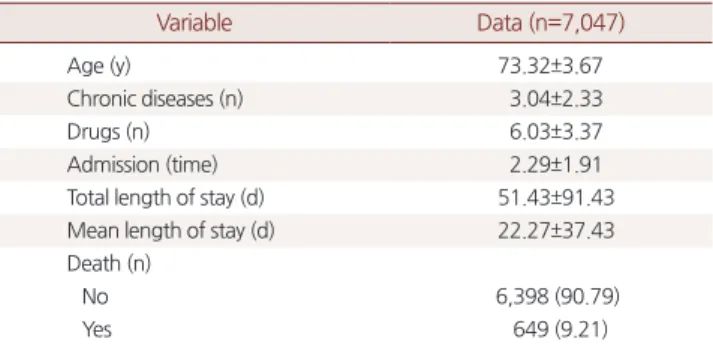
1) 일반적 특성총 분석대상은 7,047명이며, 평균 연령은 73.32±3.67세였다. 평균적 인 복용 약물 갯수는 6.03±3.37개였다. 연구기간 중 사망자는 649명 으로 연구대상자의 9.21%이고, 평균 입원횟수는 2.29±1.91회였으며, 총 재원일수의 평균은 51.43±91.43일, 평균 재원일수의 평균은 22.27±37.43일이었다(Table 1).
2) 잠재적으로 부적절한 약물 복용 실태
Beers’ criteria로 평가한 잠재적으로 부적절한 약물 복용은 3,809명 (54.05%)에서 발견되었다. 질병이나 상태와 무관하게 잠재적으로 부 적절한 약물 복용은 42.16%였으며, 아미트립틸린 1,225명(17.38%), 디 아제팜 1,074명(15.24%), 하이드록시진 731명(10.37%), 시메티딘 340명 (4.82%)의 순으로 높았으며, 비스테로이드성 소염제를 장기간(30일 이상) 복용한 경우는 53명(0.75%)이었다(Supplement 2). 짧은 반감기 의 벤조다이아제핀, 디곡신, 철분의 경우 용량을 파악할 수 없었기 때문에 적절성을 평가하지 못했다. 질병이나 상태를 고려한 경우는 방광출구폐쇄가 있는 경우에 1,199명(17.01%), 만성 변비가 있는 경우 에 584명(8.28%), 위 및 십이지장 궤양이 있는 경우에 507명(7.19%), 우 울증의 경우에 198명(2.81%), 실신 및 낙상의 경우에 189명(2.68%), 고 혈압의 경우에 169명(2.40%)의 순이었다(Supplement 3). 여기에 주로
해당되는 약물들은 항우울제, 비스테로이드성 소염제, 벤조다이아 제핀, 항콜린제 등이었다.
2. 건강결과와의 관련성
1) 잠재적으로 부적절한 약물 복용과 건강결과 간 단변량분석
Beers’ criteria에 따른 잠재적으로 부적절한 약물 복용 여부에 따 라 비교해 보면, 잠재적으로 부적절한 약물 복용인 군에서 만성질환 의 개수, 입원횟수, 총 재원일수가 각각 3.85±2.49개, 2.40±2.02번, 56.76±99.82일 등으로 잠재적으로 부적절한 약물 복용을 하지 않은 군의 2.07±1.68개, 2.10±1.71번, 42.99±75.56일과 비교하여 통계적으로 유의하게 높았다. 반면에 평균 재원일수, 사망률에 있어서는 두 군 간에 통계적으로 유의한 차이가 없었다(Table 2).
2) 잠재적으로 부적절한 약물 복용과 건강결과의 다변량분석
연령 및 만성질환 개수, 동반질환의 중증도를 보정한 상태에서 건 강결과와의 관련성을 살펴보면 Beers’ criteria에 따른 잠재적으로 부 적절한 약물 복용이 있는 경우에 입원횟수 다빈도군, 총 재원일수 장기군, 평균 재원일수 장기군이 될 가능성이 1.27배(0.98–1.66), 1.47 배(1.14–1.90), 1.66배(1.29–2.14) 높았다. 다만, 입원횟수 다빈도군과는 통계적으로 유의하지 않았다.
사망에 관해서는 잠재적으로 부적절한 약물 복용이 있는 연구대 상자의 경우에는 그렇지 않은 경우에 비해 사망할 가능성이 1.07배 (0.90–1.26) 높았으나 통계적 유의성은 없었다(Table 3).
고 찰
Gallagher 등15)은 부적절한 약물 복용이란, 해당 상태를 치료하기 위해 좀더 낫거나 비슷한 효과를 보이면서 더 적은 위험을 가진 대
Table 1. Baseline characteristics of study subjects
Variable Data (n=7,047)
Age (y) 73.32±3.67
Chronic diseases (n) 3.04±2.33
Drugs (n) 6.03±3.37
Admission (time) 2.29±1.91
Total length of stay (d) 51.43±91.43
Mean length of stay (d) 22.27±37.43
Death (n)
No 6,398 (90.79)
Yes 649 (9.21)
Values are presented as mean±standard deviation or number (%).
Table 2. Comparisons of the baseline characteristics and health out- comes by potentially inappropriate medication (PIM) as assessed by univariate analysis
Variable PIM by Beers’ criteria No (n=3,238) Yes (n=3,809)
Age (y) 73.27±3.62 73.37±3.69
Chronic diseases (n) 2.07±1.68 3.85±2.49*
Number of admission (time) 2.10±1.71 2.40±2.02* Total length of stay (d) 42.99±75.56 56.76±99.82* Mean length of stay (d) 20.74±36.58 23.24±37.94 Death†
No 2,953 (91.20) 3,445 (90.44)
Yes 285 (8.80) 364 (9.56)
Values are presented as mean±standard deviation or number (%).
*Statistically different by t-test (P<0.05). †By chi-square test.
www.kafm.or.kr 조진원 외. 노인에서 부적절한 약물 복용에 따른 건강결과 지표의 차이
Korean J Fam Pract. 2016;6(6):682-687
685
Korean Journal of Family Practice
KJFP
체 치료의 근거가 있음에도 불구하고 약물 관련 부작용 발생의 상당 한 위험을 초래하는 약물을 복용하는 것을 의미한다고 하였다. 또한, 임상적으로 지시된 것보다 더 자주 혹은 더 길게 약물을 복용하는 것, 약물-약물 상호작용, 약물-질환의 상호작용이 알려진 많은 약물 을 복용하는 것, 임상적으로 지시되어 있으나 고령 혹은 불합리한 이 유로 이득이 큰 약물을 과소 복용하는 것 등도 포함한다고 하였다.
타당성이 검증된 잠재적으로 부적절한 약물 복용(potentially in- appropriate medication)을 선별하는 도구로는 Beers’ criteria와 im- proved prescribing in the elderly tool (IPET)이 있다. 이러한 도구들은 고령자에서 부작용을 야기할 높은 잠재력을 가진 약물을 언급하고 적은 위험을 가진 대체 약물을 권장하고 있다. 2000년에 처음 만들 어진 IPET의 경우 일상적인 임상 상황에서 가장 흔히 발생하는 부적 절한 약물 복용에 관한 간략한 목록을 제시하고 있다.8) 하지만, 심혈 관계 및 정신과 약물, 비스테로이드성 소염제 복용에 상당한 비중을 둔 14가지 상황만을 언급하고 있다는 점에서 포괄적이지 못하다는 평가를 받고 있다.15)
Beers’ criteria의 경우는 1991년에 요양원(nursing home) 재소자에 서 부적절한 약물 복용을 선별하는 기준으로 만들어졌으며,6) 1994 년에는 지역사회에 거주하는 고령자들에서 부적절한 약물 복용을 선별하는 기준으로 개정되었다. 1997년에는 거주 지역에 상관없이 모든 고령자들에게 적용되는 기준으로 만들어졌다.7) 2002년 개정판 에는 안전한 대체약물이 존재하고, 효과가 없거나 고령자에게 불필 요한 위험을 초래하기 때문에, 65세 이상의 고령자에게 일반적으로 피해야 하는 약물 및 약물군 48개와, 특정한 의학적 상황을 가진 고 령자가 복용하지 말아야 하는 20개의 약물을 언급하고 있다.9) 한편, 2002년 Beers’ criteria 개정을 주도한 Fick 등9)은 이것이 의사들의 임 상적 판단이나 평가를 대신하는 방식으로 진료를 통제하는 것을 의 미하지는 않는다고 밝히고 있으며, 이러한 기준을 주의 깊게 적용하 게 되면 공급자나 보험자가 약물관련 비용 및 전반적인 의료비를 줄 이기 위한 중재 방법을 계획하는 데 유용할 것이라고 하였다. 하지 만, 개정된 Beers’ criteria의 경우도 약물 상호 작용과 같은 모든 잠재 적으로 부적절한 약물 복용을 포함하고 있지 못하며, 잠재적으로 부적절하다고 평가된 약물에 대해서도 일부 이견이 존재한다.15)
Beers’ criteria와 IPET의 경우는 미국과 캐나다의 약품 사용 현황 에 기초하여 만들어진 것이다. 우리나라의 약품 사용 현황이 미국이 나 캐나다 등과 다르기 때문에 우리나라에서 잠재적으로 부적절한 약물 복용을 확인하기 위해서는 우리 실정에 맞는 별도의 기준이 필 요하지만, 현재까지는 국내에서 이러한 기준이 만들어진 적은 없다.
국내에서 잠재적으로 부적절한 약물 복용에 관한 연구들을 살펴보 면 Beers’ criteria를 이용한 연구가 대부분이다.16-18)
Table 3. Associations between admission related health outcome indicators, mortality and potentially inappropriate medication (PIM) Odds ratio (95% CI)*Hazards Ratio for death (95% CI)† Number of admission >10% groupTotal length of stay >10% groupMean length of stay >10% groupUnivariateModel 1Model 2 PIM by Beers’ criteria 1.272 (0.977–1.657)1.473 (1.139–1.904)1.660 (1.287–2.143)1.091 (0.935–1.274)1.083 (0927–1.265)1.065 (0.901–1.259) Age 0.974 (0.944–1.005)1.023 (0.993–1.053)1.037 (1.007–1.067)1.069 (1.048–1.090)1.071 (1.050–1.092) Number of chronic diseases1.180 (1.121–1.242)1.081 (1.026–1.139)1.131 (0.976–1.089)0.945 (0.911–0.976) Charlson comorbidity index1.150 (1.058–1.249)1.200 (1.139–1.904)1.151 (1.057–1.254)1.214 (1.143–1.291) Adjusted for age, number of chronic diseases, Charlson comorbidity index. Model 1, adjusted for age; Model 2, adjusted for age, number of chronic diseases, Charlson comorbidity index. CI, confidence interval. *By multiple logistic regression. †By Cox-proportional model.
Jinwon Cho, et al. Health Outcome Differences according to Inappropriate Drug Utilization
www.kafm.or.kr
686
Korean J Fam Pract. 2016;6(6):682-687Korean Journal of Family Practice
KJFP
본 연구에서 Beers’ criteria를 이용한 잠재적으로 부적절한 약물 복용은 54.05%로 매우 높았으나 개별적인 약물 특히 아미트립틸린 및 디아제팜이 차지하는 비중은 각각 17.38%, 15.24% 등으로 다른 연 구와 유사하였다. 미국의 한 연구에서 medicare-managed care 집단을 대상으로 Beers’ criteria를 적용했을 때 잠재적으로 부적절한 약물 복용은 23%였다.19) 2004년 일개 종합병원을 대상으로 1997년 개정된 Beers’ criteria를 이용한 Cho 등17)의 연구에서는 10.96%가 부적절한 약품 복용이었다. 2004년 2개 종합병원 환자들을 대상으로 수행된
‘한국 노인환자의 약물사용현황 및 적절성 연구’18)에서는 질병이나 상태를 고려하지 않은 상태에서 잠재적으로 부적절한 약물 복용을 하는 외래 환자수가 전체 외래 환자의 27.84%에 해당한다고 보고하 고 있었으며, 구체적인 현황을 보면 남성에서 아미트립틸린, 짧은 반 감기의 벤조다이아제핀, 긴 반감기의 벤조다이아제핀, 나프록센 2주 이상, 항콜린성 항히스타민제가 각각 19.5%, 17.3%, 15.2%, 10.6%, 10.3%
였다. 이렇게 잠재적으로 부적절한 약물 복용이 많은 이유는 연구대 상 집단에 상이군경 및 월남 참전에 따른 고엽제 피해자 등이 상당 수 포함되어 있어 만성적인 통증 등과 관련하여 중독성이 강한 약 물에 대한 의존도가 높아져 있기 때문으로 생각된다. 그리고 기존 국 내 연구에서는 비스테로이드성 소염제에 포함되는 약물을 나프록 센, 피록시캄으로 국한하였으나 본 연구에서는 현재 유통 및 생산 중인 모든 종류의 비스테로이드성 소염제를 포함하였고, 항우울제 의 경우에도 좀 더 많은 성분을 포함시킨 것도 영향을 미쳤을 것으 로 생각된다. 한편 타 연구와 비교하여 개별 약물 사용은 비슷하지 만 잠재적으로 부적절한 약물 복용의 분율이 높은 이유는 연구 대 상 병원의 전산 처방 프로그램이 중추신경계에 작용되는 일부 약물 (예를 들면, 아미트립틸린과 디아제팜)의 중복사용을 제한하는 프 로그램을 가지고 있기 때문으로 생각된다. 이 프로그램은 각각의 약 물사용은 제한하지 않으나 함께 처방되는 것은 차단하기 때문에 동 시에 투약되는 경우가 거의 없어서 잠재적으로 부적절한 약물 사용 의 분율이 높아진 것으로 생각된다.
본 연구에서는 Beers’ criteria에 따른 잠재적으로 부적절한 약물 복용은 사망, 입원횟수 다빈도군이 될 확률은 통계적으로 유의하게 증가하지 않았지만, 총 재원일수 장기군, 평균 재원일수 장기군이 될 확률은 통계적으로 유의하게 증가하였다. 3,234명을 대상으로 한 Duke 코호트 연구에서는 사망률과 Beers’ criteria에 의한 잠재적으로 부적절한 약물 복용과의 관련성을 찾을 수 없었다.20) 1991년부터 2006년 사이 발간된 18개의 논문을 바탕으로 Beers’ criteria와 관련된 건강 결과를 평가한 연구에서는 지역에 거주하는 고령자의 경우에 Beers’ criteria가 입원율을 높이는 경우가 4편의 논문 중에 3편에서 나타나지만, 사망률에 영향을 미치는 경우는 4편의 논문 중에 한 편
도 없었다. 요양시설에 거주하는 고령자의 경우 입원율 및 사망률에 영향을 미치는 경우는 각각 2편 중에 1편, 3편 중에 1편 있었다. 병원 에 입원한 환자의 경우에는 Beers’ criteria와 입원율 및 사망률과 통계 적으로 유의하지 않은 1편의 논문이 있었다.10) 선행연구와 유사하게 잠재적으로 부적절한 약물 복용과 사망 및 입원횟수에 있어서 관련 성은 없지만, 총 재원일수 및 평균 재원일수에 있어서의 관련성이 있 다는 것은 잠재적으로 부적절한 약물 복용의 경우 입원을 요하는 정도 이상의 심각한 약물 부작용은 없다고 할지라도 질병의 회복, 노 인들의 기능 개선 및 상태에는 부정적 영향을 미친다고 볼 수 있다.
다만 본 연구에서 노인들의 기능 평가가 없었기 때문에 이에 관한 명 확한 평가를 할 수는 없었다.
본 연구의 한계점으로는 첫째, 후향적 연구로서 관련 변수에 관한 충분한 자료 수집이 어려웠다. 노인 환자에게 있어서 재원일수 등에 영향을 미칠 수 있는 기능적 평가, 또한 사망률에 영향을 미칠 수 있 는 흡연력을 비롯한 다양한 교란 변수를 보정하지 못하였지만, 충분 한 표본 크기를 가진 연구로서 제한적이지만 국내에서 부적절한 약 물 복용의 유해성을 입증했다는 점에서 의의가 있다.
둘째, Beers’ criteria의 경우 개별적인 약물 사용의 임상적 타당성에 관한 충분한 문헌 고찰 및 전문가 의견 수렴을 거치지 못하였다. 그 리고 일부 약물은 적정성 평가 시 복용 용량에 대한 충분한 고려가 이루어지지 못하였다. 하지만, 잠재적으로 부적절한 약물 복용에서 높은 비율을 차지하는 세 가지 약물, 즉 아미트립틸린, 디아제팜, 하 이드록시진이 기존의 Beers’ criteria에서 합의된 약물이라는 점에서 결과에 미치는 영향은 제한적일 것으로 여겨진다.
마지막으로 본 연구의 대상 집단은 일개 종합병원에 내원한 65세 이상의 국가유공자로서 모두 남성으로 구성되어 있다. 2003년 국민 건강영양조사 자료21)와 비교하여 전체적인 만성질환의 유병률에 있 어서는 90% 가량으로 큰 차이를 보이고 있지 않지만, 전액 무료로 진 료를 받을 수 있어 약물 복용, 입원 및 외래를 경제적 부담 없이 이용 할 수 있기 때문에 우리나라 전체 노인 집단에 비해서는 약물 복용 및 입원횟수가 상대적으로 많을 가능성이 있다.
결론적으로 우리나라 남성노인에서 잠재적으로 부적절한 약물 복용의 비율이 매우 높은 편이며 사망 및 입원횟수와는 관련이 없었 지만 재원일수에는 영향을 미치는 것으로 보아 질병의 회복, 노인들 의 기능 개선 및 상태에는 영향을 미치는 것으로 여겨진다. 잠재적으 로 부적절한 약물 복용에 관한 지속적인 관심이 필요하다고 생각되 며, 향후 본 연구의 한계점을 극복하기 위해서는 노인기능 평가도구 를 활용한 전향적인 연구가 필요하다고 생각된다.
www.kafm.or.kr 조진원 외. 노인에서 부적절한 약물 복용에 따른 건강결과 지표의 차이
Korean J Fam Pract. 2016;6(6):682-687
687
Korean Journal of Family Practice
KJFP
요 약
연구배경:
복합 만성질환을 가지고 있는 노인에서 다약제 복용에 의한 부작용으로 여러 건강상의 문제들이 야기되고 있다. 따라서 국 내의 잠재적으로 부적절한 약물 복용의 실태를 파악하고 사망률을 비롯한 건강결과와의 관련성을 조사하고자 하였다.방법:
잠재적으로 부적절한 약물 복용은 Beers’ criteria에 따라 조사 하였다. 일개 종합병원에서 2004년 1월 1일부터 2004년 12월 31일 사 이에 진료받은 국가유공자 23,547명에 대한 병록 번호, 진단코드, 처 방약물 코드 등을 수집하였다. 2005년 1월부터 2009년 12월까지 입 원횟수, 총 재원일수 및 평균 재원일수를 조사하였고, 각각의 상위 10%에 해당하는 입원횟수 다빈도군, 총 재원일수 장기군, 평균 재원 일수 장기군에 대해 2010년 8월 1일자 국가보훈처 자료의 사망 여부 를 확인하였다. 총 23,547명 중 65세 이상 남성 7,047명을 최종 분석대 상으로 선정하였다.결과:
총 분석대상은 7,047명으로, 잠재적으로 부적절한 약물 복용 은 3,809명(54.05%)에서 발견되었다. 질병이나 상태와 무관하게 잠재 적으로 부적절한 약물 복용은 42.16%였다. 잠재적으로 부적절한 약 물 복용이 있는 경우에 입원횟수 다빈도군, 총 재원일수 장기군, 평 균 재원일수 장기군이 될 가능성이 1.27배(0.98–1.66), 1.47배(1.14–1.90), 1.66배(1.29–2.14) 높았다. 잠재적으로 부적절한 약물 복용이 있 는 연구대상자의 경우에는 그렇지 않은 경우에 비해 사망할 가능성 이 1.07배(0.90–1.26) 높았으나 통계적 유의성은 없었다.
결론:
잠재적으로 부적절한 약물 복용은 사망, 입원횟수와는 통계 적으로 유의한 관계를 보이지 않았으나, 총 재원일수, 평균 재원일수 는 통계적으로 유의하게 높았다. 잠재적으로 부적절한 약물 복용을 줄이기 위한 다양한 노력은 65세 이상 노인들의 건강 결과에 긍정적 인 효과를 미칠 것으로 생각된다.중심단어:
잠재적으로 부적절한 약물 복용; 비어스 기준; 사망률;건강결과 지표
REFERENCES
1. Statistics Korea. Social indicators in Korea in 2009 [Internet]. Daejeon: Sta- tistics Korea; 2010 [cited 2010 Dec 12]. Available from: http://www.kostat.
go.kr.
2. Bootman JL, Harrison DL, Cox E. The health care cost of drug-related mor- bidity and mortality in nursing facilities. Arch Intern Med 1997; 157: 2089-96.
3. Burgess CL, Holman CD, Satti AG. Adverse drug reactions in older Austra-
lians, 1981-2002. Med J Aust 2005; 182: 267-70.
4. Wester K, Jönsson AK, Spigset O, Druid H, Hägg S. Incidence of fatal ad- verse drug reactions: a population based study. Br J Clin Pharmacol 2008;
65: 573-9.
5. Leendertse AJ, Egberts AC, Stoker LJ, van den Bemt PM; HARM Study Group. Frequency of and risk factors for preventable medication-related hospital admissions in the Netherlands. Arch Intern Med 2008; 168: 1890-6.
6. Beers MH, Ouslander JG, Rollingher I, Reuben DB, Brooks J, Beck JC. Ex- plicit criteria for determining inappropriate medication use in nursing home residents. UCLA division of geriatric medicine. Arch Intern Med 1991; 151: 1825-32.
7. Beers MH. Explicit criteria for determining potentially inappropriate medi- cation use by the elderly. An update. Arch Intern Med 1997; 157: 1531-6.
8. McLeod PJ, Huang AR, Tamblyn RM, Gayton DC. Defining inappropriate practices in prescribing for elderly people: a national consensus panel.
CMAJ 1997; 156: 385-91.
9. Fick DM, Cooper JW, Wade WE, Waller JL, Maclean JR, Beers MH. Updat- ing the beers criteria for potentially inappropriate medication use in older adults: results of a US consensus panel of experts. Arch Intern Med 2003;
163: 2716-24.
10. Jano E, Aparasu RR. Healthcare outcomes associated with beers’ criteria: a systematic review. Ann Pharmacother 2007; 41: 438-47.
11. kimsonline.co.kr [Internet]. Seoul: KIMs; 2010 [cited 2010 Dec 12]. Avail- able from: http://www.kimsonline.co.kr/.
12. Fauci AS, Braunwald E, Kasper DL, Hauser SL, Longo DL, Jameson JL, et al.
Harrison‘s principles of internal medicine. 17th ed. New York: McGraw-Hill companies Inc; 2008. p. 2713.
13. Goldman L, Ausiello D. Cecil textbook of medicine. 22nd ed. Philadelphia:
W.B. Saunders; 2004. p. 1609.
14. Health Insurance Review and Assessment Service. The lists of insurance cost for drug [Internet]. Wonju: Health Insurance Review and Assessment Service; 2010 [cited 2010 Dec 12]. Available from: http://www.hira.or.kr.
15. Gallagher P, Barry P, O’Mahony D. Inappropriate prescribing in the elderly. J Clin Pharm Ther 2007; 32: 113-21.
16. Lee JS, Lee JE, Jung KY, Ma SH, Kim MY, Yoo SH, et al. Polypharmacy and inappropriate drug prescription in community-dwelling elderly. Korean J Fam Med 2008; 29: 925-31.
17. Cho MK, Chon SJ, Lee ES, Lee BG, Kim KI, Kim CH. Study on the status of polypharmacy in geriatric patients. J Korean Soc Hosp Pharm 2006; 22: 104-11.
18. Oh JM. Drug use pattern and evaluation for appropriateness in geriatric pa- tients. Cheongwon: Korea Food and Drug Administration; 2004.
19. Fick DM, Waller JL, Maclean JR, Heuvel RV, Tadlock JG, Gottlieb M, et al.
Potentially inappropriate medication use in medicare managed care popu- lation: association with higher costs and utilization. J Managed Care Pharm 2001; 7: 407-13.
20. Hanlon JT, Fillenbaum GG, Kuchibhatla M, Artz MB, Boult C, Gross CR, et al. Impact of inappropriate drug use on mortality and functional status in representative community dwelling elders. Med Care 2002; 40: 166-76.
21. Korean Ministry of Health and Welfare. The Report of third Korea National Health and Nutrition Examination Survey (KNHANES-III) 2005. Seoul:
Korean Ministry of Health and Welfare; 2005.
Supplement 1. List of drugs manufactured in Korea among those included in 2002 Beers’ criteria
약물군 성분명 국내 유통 및 생산
유무
상품명
alpha-blocker doxazocin Yes 독사신 정 외 29 개
prazocin Yes 미네신 정 외 3 개
terazoxin Yes 네오트린 정 외 36 개
Anticholinergics benztropin Yes 명인 벤즈트로핀메실레이트 정 1mg 외 6 개
biperiden Yes 아톨 정 2mg 외 1 개
trihexyphenidyl Yes 트리헥신 정 2mg 외 2 개 Antidepressants
(MAOIs)
dothiepin Yes 푸로치아덴 캡슐 25mg
isocarboxazid No
phenelzine No
quinupramine Yes 키누프릴 정 2.5mg 외 1 개
tranylcypromine No
Antidepressants (Mixed action drug)
amoxapine Yes 아디센 정 100mg 외 1 개
bupropion Yes 웰부트린 서방정 150mg 외 5 개
nefazodone Yes 설존 정 50mg 외 2 개
trazodone Yes 트리티코 정 25mg 외 6 개
Antidepressants (Mixed NE/SR inhibitors)
duloxetine Yes 심발타 캡슐 30mg 외 1 개
mirtazapine Yes 레메론 솔탭 정 15mg 외 8 개
venlafaxine Yes 라벤사 서방캡슐 75mg 외 17 개
Antidepressants (others)
hypericum Yes 노이로민 정 300mg 외 5 개
mianserin Yes 볼비돈 정 10mg 외 1 개
tianeptine Yes 스타브론 정 12.5mg 외 1 개
Antidepressants (SSRIs)
citalopram Yes 산도스시탈로프람정 20mg
escitalopram Yes 뉴프람 정 10mg 외 28 개
fluoxetine Yes 그리팅 캡슐 22.4mg 외 57 개
fluvoxamine Yes 듀미록스 정 50mg 외 1 개
paroxetine Yes 세로자트 정 10mg 외 16 개
sertraline Yes 셀트라 정 50mg 외 3 개
Antidepressants (TCAs)
amitriptyline Yes 아린 정 25mg 외 7 개 clomipramine Yes 그로민 캅셀 10mg 외 2 개
dexipramine No
doxepin No
imipramine Yes 명인 염산이미프라민 정 25mg 외 2 개
nortriptyline Yes 센시발 정 10mg 외 1 개 Antihistamines
(1st generation)
chlorpheniramine Yes 감탁캅셀 외 9 개 cyproheptadine Yes 싸이푸 정 4mg 외 5 개 dhphenhydramine Yes 단자민 정 외 8 개
hydroxyzine Yes 로진정 25mg 외 9 개
tripelennamine No
Antihistamines (2nd generation)
acrivastine No
azelastine Yes 아라틴 정 1mg 외 19 개
certirizine Yes 그린 노즈 캡슐 외 3 개
desloratadine No
ebastine Yes 리노드린 서방캡슐 외 15 개
fexofenadine Yes 알러프리 정 외 16 개
levocertirizine Yes 레보세잘 정 외 43 개
loratardine Yes 로다인 정 10mg 외 21 개
mizolastine Yes 미졸렌 정 10mg
(continued)
Supplement 1. List of drugs manufactured in Korea among those included in 2002 Beers’ Criteria (continued)
약물군 성분명 국내 유통 및
생산 유무 상품명
Calcium channel blocker
amlodipine Yes 넥사드 정 5mg 외 122 개
barnidipine Yes 올데카 캅셀 10mg 외 2 개
benidipine Yes 벤디핀 정 2mg 외 10 개
cilnidipine Yes 시나디핀 정 10mg 외 6 개
diltiazem Yes 디젬 서방정 30mg 외 23 개
felodipine Yes 디로딜 정 5mg 외 47 개
isradipine Yes 다이나써크 서방캡슐 5mg
lacidipine Yes 나시디피 정 4mg 외 11 개
lercanidipine Yes 라니딥 정 10mg 외 54 개
manidipine Yes 마디핀 정 10mg 외 1 개
nicardipine Yes 니카르 정 20mg 외 6 개 nifedipine(long acting) Yes 니페드 솔 정 30mg 외 4 개
nisoldipine Yes 니솔딘 정 5mg 외 3 개
nitrendipine Yes 니토핀 정 10mg 외 8 개
verapamil Yes 일성 이솝틴 정 40mg 외 3 개
Conventional antipsychotics
amisulpride Yes 슬리안 정 100mg 외 3 개 aripiprazole Yes 아라졸 정 10mg 외 5 개 bromperidol Yes 부룸 정 1mg 외 11 개 chlorpromazine Yes 네오마찐 정 100mg 외 5 개
chlorprothixene Yes 장우 클로르프로칙센 정 10mg 외 2 개
clozapine Yes 클로자릴 정 25mg 외 1 개
haloperidol Yes 에디피 정 0.5mg 외 45 개 levomepromazine Yes 티세르신 정 100mg 외 2 개
lithium Yes 리단 정 300mg 외 2 개
mesoridazine Yes 베리다진 정 25mg 외 1 개 molindone Yes 모반 정 10mg 외 1 개
nemonapride Yes 네포니드 정 3mg 외 1 개
olanzapine Yes 뉴로자핀 정 10mg 외 16 개
paliperidone Yes 인베가 서방정 3mg 외 3 개
pimozide Yes 마이팜 피모짓 정 1mg 외 10 개
quetiapine Yes 스무디핀 정 25mg 외 29 개
risperidone Yes 리소페린 정 1mg 외 28 개
sulpiride Yes 곰마틸 정 200mg 외 8 개
thioridazine Yes 리라디팜 정 100mg
ziprasidone Yes 잴독스 캡슐 20mg 외 3 개
zotepine Yes 로도핀 정 25mg 외 2 개
Muscle relaxants aescin Yes 에코시나 정 외 4 개
afloqualone Yes 미아론 정 20mg 외 11 개
baclofen Yes 바라파 정 10mg 외 45 개
chlorphenesin Yes 도나락스 정 125mg 외 27 개
chlorzoxazone Yes 렉스판 정 외 19 개
cyclobenzaprine Yes 벤자민 정 10mg 외 6 개
dantrolene Yes 이노렉스 캅셀 25mg
eperisone Yes 뮤렉스 정 50mg 외 35 개
methocarbamol Yes 담프리 정 외 44 개
orhphenadrine Yes 닉신 정 25mg 외 12 개
pridinol Yes 미놀판 정 2mg 외 7 개
thiocolchicoside Yes 무코나 캡슐 4mg 외 6 개 tolperisone Yes 미도캄 정 150mg 외 6 개
(continued)
Supplement 1. List of drugs manufactured in Korea among those included in 2002 Beers’ Criteria (continued)
약물군 성분명 국내 유통 및
생산 유무 상품명
Benzodiazepines, short to intermediate acting
alprazolam Yes 새프람 정 0.4mg 외 25 개
bromazepam Yes 렉토팜 정 3mg 외 2 개
brotizolam Yes 렡돌림 정 0.25mg
chlordiazepoxide Yes 리버티정 5mg 외 3 개
clobazam Yes 센틸 정 5mg
clorazepate Yes 트랑센 캅셀 5mg 외 2 개
clotiazepam Yes 리제 정 5mg
diazepam Yes 메로드 정 2mg 외 11 개
etizolam Yes 데파스 정 0.25mg 외 3 개
flunitrazepam Yes 라젬팜 정 1mg 외 1 개
flurazepam Yes 달마돔 정 15mg
loflazepate Yes 빅손 정 1mg 외 2 개
lorazepam Yes 로라반 정 0.5mg 외 1 개
mexazolam Yes 메리움 정 0.5mg
tofisopam Yes 이소판 정 50mg 외 4 개
triazolam Yes 졸민 정 0.125mg 외 4 개
zolpidem Yes 스틸녹스 씨알 정 12.5mg 외 10 개
Gastrointestinal antispasmodics
alverine Yes 가베스판 연질캡슐 외 19 개
caroverine Yes 갈스파 연질캅셀 외 9 개
cimetropium Yes 멕시움 정 50mg 외 8 개
difemerine Yes 디페딘 캅셀 2.5mg 외 5 개
fenoverine Yes 펙사딘 캡슐 100mg
hyoscine Yes 무스판 정 외 4 개
mebeverine Yes 가스타진 100mg 외 7 개
octylonium Yes 마티란 정 20mg 외 29 개
oxapium Yes 옥사페란 정 10 mg
phloroglucinol Yes 구루신 정 80mg 외 19 개
pinaverium Yes 디세틸 정 50mg 외 8 개
pipoxolan Yes 스파솔란 정 10mg 외 1 개
ramosetron Yes 나제아 오디 정 0.1mg 외 4 개
scopolamine Yes 니칼 정 외 19 개
tiemonium Yes 스파긴 정 40mg
timepidium Yes 폰트릴 캅셀 30mg
tiquizium Yes 스파티 캡슐 10mg 외 2 개
tiropramide Yes 뉴티로 정 100mg 외 65 개
trospium Yes 뉴로피움 정 20mg 외 35 개
NSAIDs aceclofenac Yes 뉴마탈 정 100mg 외 89 개
acemetacin Yes 류메탄 캅셀 60mg 외 9 개
auranofin Yes 리도라 정 3mg 외 1 개
benorylate Yes 듀오펜 정 750mg
bucillamine Yes 뉴마틸 정 100mg 외 7 개
bumadizone Yes 오이모톨 정 110mg
cinnoxicam Yes 부광 시나트롬 정 15mg
clematis Yes 류마스 정 200mg 외 40 개
clonixin Yes 노리스 정 125mg 외 40 개
dexibuprofen Yes 그리펜-에스 정 300mg 외 63 개
diacerein Yes 다이세린 캡슐 50mg 외 13 개
diclofenac Yes 나우렌 서방정 100mg 외 38 개
diflunisal Yes 도비드 정 500mg
(continued))
Supplement 1. List of drugs manufactured in Korea among those included in 2002 Beers’ Criteria (continued)
약물군 성분명 국내 유통 및
생산 유무 상품명
NSAIDs diphenhydramine Yes 단자민 정 외 8 개
etodolac Yes 로디오 캅셀 200mg 외 22 개
fenoprofen Yes 로스론 정 600mg 외 14 개
flufenamic acid Yes 페록살 정 100mg 외 4 개 flurbiprofen Yes 세부틴 정 40mg 외 2 개
ibuprofen Yes 게보콜 캡슐 외 3 개
indomethacin Yes 광명 인도메타신 캅셀 25mg
ketoprofen Yes 로이친 캅셀 25mg 외 2 개
ketorolac Yes 드로알 정 10mg 외 10 개
lonazolac Yes 렌타 정 200mg 외 1 개
lornoxicam Yes 로노켐 정 4mg 외 3 개
loxoprofen Yes 녹사펜 정 68.1mg 외 43 개 meclofenamate Yes 메코펜 캅셀 50mg 외 4 개 mefenamic acid Yes 메가판 캅셀 250mg 외 36 개
meloxicam Yes 뉴록캄 캡슐 7.5mg 외 70 개
morniflumate Yes 모노펜 정 350mg 외 9 개
nabumetone Yes 나메린 정 500mg 외 34 개
naproxen Yes 나렉신 정 275mg 외 55 개
nimesulide Yes 니막스 정 100mg 외 19 개
oxaprozin Yes 옥사진 정 200mg 외 4 개
pelubiprofen Yes 펠루빈 정 30mg
piroxicam Yes 그란딘 캅셀 10mg 외 47 개
pranoprofen Yes 프라노 캅셀 75mg
proglumetacin Yes 아노벤 캅셀 150mg 외 7 개 pyrazinobutazone Yes 카루돌 캅셀 30mg
salsalate Yes 디살 정 500mg 외 1 개
sulindac Yes 아스탈 정 100mg 외 4 개
talniflumate Yes 니후루겐 정 370mg 외 68 개
tenoxicam Yes 테노캄 정 10mg 외 16 개
toluensulfonate Yes 데나신 정 200mg 외 6 개 zaltoprofen Yes 라보펜 정 80mg 외 8 개
Diet pill
diethylpropion Yes 디피온 정 25mg 외 6 개
mazindol Yes 마자놀 정 1mg 외 1 개
phendimetrazine Yes 다이트린 정 35mg 외 15 개 phentermine Yes 노브제 정 30mg 외 22 개
Sibutramine Yes 디아트라민 캡슐 12.55mg 외 33 개 Benzodiazepines,
long-acting
clonazepam Yes 리보트릴 정 0.5mg
oxazepam Yes 본초 옥사제팜 정 10mg
termazepam No
Supplement 2. Proportion of potentially inappropriate medication on study subjects-independent of diagnoses and conditions
Drug
No. of patients(%)Severity Rating
(High or Low)
Indomethacin 0 High
Pentazocin 1(0.01) High
Muscle relaxants and antispasmodics:
methocarbamol chlorzoxanzone cyclobenzaprine
oxybutynin (not Ditropan XL)
0 0 0 82(1.16)
High
Flurazepam 116(1.64) High
Amitriptyline 1225(17.38) High
Doses of short-acting benzodiazepines: doses greater than lorazepam, 3mg; oxazepam, 60mg; alprazolam, 2mg; termazepam, 15mg; and triazolam, 0.25mg
not assessed High
Long-acting benzodiazepines:
chlordiazepoxide diazepam chlorazepate
29(0.41) 1074(15.24) 0
High
Digoxin(should not exceed >0.125mg/d except when
treating atrial arrhythmias) not assessed Low
Short-acting dipyridamole. 0 Low
Gastrointestinal antispasmodics drugs: dicyclomine,
hyoscyamine, belladonna alkaloids 0 High
Anticholinergics and antihistamines:
chlorpheniramine diphenhydramine hydroxyzine cyproheptadine
0 1(0.01) 731(10.37)
32(0.45)
High
Diphenhydramine 1(0.01) High
Ergot mesyloids and cyclandelate 0 Low
Ferrous sulfate( >325mg/dose) not assessed Low
Ticlopidine 39(0.55) High
Ketorolac 0 High
Long-term use of full-dosage, longer half-life, non- COX-selective NSAIDs:
naproxen, oxaprozin, piroxicam
53(0.75) High
Daily fluoxetine 79(1.12) High
Long-term use of stimulant laxatives; bisacodyl
except in the presense of opiate analgesic use 17(0.24) High
Amiodarone 22(0.31) High
Orphenadrine 6(0.09) High
Nitrofurantoin 0 High
Doxazocin 0 Low
Methyltestosterone 0 High
Thioridazine 11(0.15) High
Mesoridazine 0 High
Short acting nifedipine 105(1.49) High
Cimetidine 340(4.82) Low
Estrogen only 0 Low
PIM: Potentially Inappropriate Medication
Supplement 3. Proportion of potentially inappropriate medication on study subjects-considering diagnoses and conditions
Disease or Condition Drug No of Beers’ criteria Severity Rating (High or Low)
Hypertension Pseudoephedrine, diet pills 169(2.40) High
Gastric or duodenal ulcers
NSAIDs, aspirin(>325mg)
(coxibs excluded) 507(7.19) High
Seizures or epilepsy Clozapine, chlorpromazine, thioridazine 0 High Blood clotting
disorders/receiving anticoagulant therapy
Aspirin, NSAIDs, dipyridamole,
ticlopidine, and clopidogrel 9(0.13) High
Bladder outflow obstruction
Anticholinergics and antihistamines, gastro-intestinal antispasmodics, muscle relaxants, oxybutynin,
flavoxate, anticholinergics, antidepressants, and tolterodine
1199(17.01) High
Stress incontinence Alpha-blockers, anticholinergics, tricyclic antidepressants
(imipramine hydrochloride, amitriptyline hydrochloride) and long-acting benzodiazepines
0 High
Arrhythmia Tricyclic antidepressants (imipramine hydrochloride, amitriptyline
hydrochloride)
24(0.34) High
Insomnia Decongestants, theophylline,
methyphenidate, MAOIs 21(0.29) High
Parkinson disease Metoclopramide, conventional
antipsychotics 8(0.11) High
Cognitive impairment Barbiturates, anticholinergics, antispasmodics, muscle relaxants CNS stimulants: methylphenidate
57(0.81) High
Depression Long-term benzodiazepines use 198(2.81) High
Anorexia and malnutrition
CNS stimulants: methylphenidate
fluoxetine 0 High
Syncope or falls Short- to intermediate-acting benzodiazepines and Tricyclic antidepressants
189(2.68) High
SIADH / hyponatremia SSRIs: fluoxetine, citalopram,
luvoxamine, paroxetine and sertraline 0 Low
Seizure disorder Bupropion 0 High
Obesity Olanzapine 0 Low
COPD Long-acting benzodiazepines: diazepam, chlordiazepoxide, chlorazepate.
beta-blockers: propranolol
130(1.84) High
Chronic constipation Calcium channel blockers, anticholinergics and Tricyclic antidepressants
584(8.28) Low
PIM: Potentially Inappropriate Medication