Investigation of shinning Spot Defect on Hot-Dip Galvanized Steel Sheets
LIU Yonggang and CUI Lei
Auto Sheet Strategic Business Unit, Maanshan Iron & Steel Co. Ltd., Maanshan, Anhui Province, 243000, China (Received April 22, 2014; Revised August 28, 2014; Accepted August 28, 2014)
Shinning spot defects on galvanized steel sheets were studied by optical microscope, scanning electron microscope(SEM), Energy Dispersive Spectrometer (EDS) and Laser-Induced Breakdown Spectroscopy Original Position Statistic Distribution Analysis (LIBSOPA) in this study. The research shows that the coating thickness of shinning spot defects which caused by the substrate defect is much lower than normal area, and when skin passed, the shinning spot defect area can not touch with skin pass roll which result in the surface of shinning spot is flat while normal area is rough. The different coating morphologies have different effects on the reflection of light, which cause the shinning spot defects more brighter than normal area.
Keywords :shinning spot defect, coating morphologies, coating thickness, substrate defect.
†Corresponding author: [email protected]
1. Introduction
Hot dip galvanized (GI) steel sheet is widely used for automobile and household industry due to its excellent corrosion resistance and painting ability. The Automobile outer panel and some components of household electric appliance such as outer panel of refrigerator, air-con- ditioning etc. requires much higher surface quality because even some subtle defects like spot-type defect would be magnified after painting.
Among all the regular spot-type defects, the ‘Shinning spot’ defect is a very famous one which has several differ- ent types and the major character is its brightness higher than normal area. In the past decade, the different causes and control measures of shinning spot defect have been studied. N-Y Tang1) found that shinning spot defect asso- ciate with a thick coating abraded in temper rolling which result in these area flatter than the surrounding and appear brighter. Jin xinyan2) investigated a kind of spot defect on the coating surface of hot-dip galvannealed steel when the surface quality of the skin pass roll is poor. He sug- gested to keeping the rolls in better surface quality to make less zinc stick to the roll and reduce the spot defect. Cheng Guo-ping3) studied the shinning spot derived from galvan- nealed steel sheet after press forming and suggests that the shinning spot results from the foreign body on the steel surface. When press forming, the surface contact with foreign body turned to a pit and the other side turned
to shinning spot. Beside the studies above, some spot-type defects caused by substrate tiny scratches, hearth roll pick-in, dross, zinc dust had been investigated.4,5) As point- ed out in earlier publications,6) poor incoming substrate quality, improper substrate cleaning, inadequate process control in heat treating, coating, air-knife and skin pass conditioning, and customer fabricating are the main source of coating defect. And this is the same with shinning spot defect.
In present study, one type of shinning spot defect formed on hot dip galvanized steel sheet was investigated, and the formation mechanism of the Shinning spot defect was discussed based on the results.
2. Materials and experimental procedures
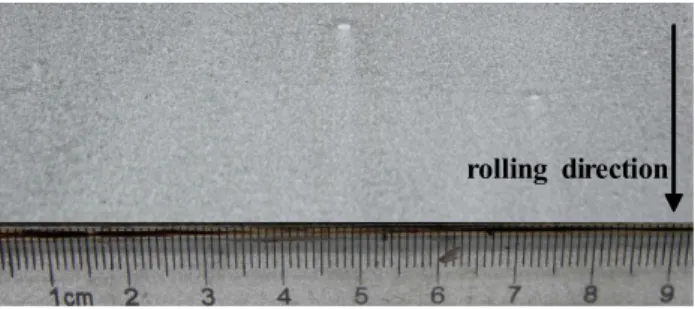
The sample of shinning spot defects as shown in Fig.
1. was obtained from continuous galvanizing line (CGL).
The shinning spot defect is usually about 1mm long and 0.5mm wide which looks lighter than the normal area, and the length direction is perpendicular to rolling direction. The chemical composition of base steel which usually exist shinning spot defect is shown in Table 1 and the coating weight is usually under 60g/m2 per side.
The surface and cross-sectional morphologies of the coat- ing and the interface morphology after GI coating re- moved by 25%HCl solution with an addition of the in- hibitor ((CH2)6N4) were investigated using a ZEISS Imager.A2m optical microscope (OM) and XL30 scanning electron microscopy (SEM), and the chemical of the defect
rolling direction
Fig. 1. Shinning spot defects obeserved on GI coatings.
Table 1. Chemical composition of the base steel sheet(wt.%)
C Si Mn P S Ti
≤0.08 ≤0.03 0.14~0.20 ≤0.015 ≤0.010 ≤0.06
a b
rolling direction
c d
Fig. 2. The surface morphology and EDS analyses of the GI coating: a) normal area; b) shinning spot defect; c) EDS analyses of normal area; d) EDS analyses of shinning spot defect.
areas was investigated using DX4i Energy Dispersive Spectrometer (EDS). In order to show the defect more visually, a three dimensional surface morphologies was investigated by KEYENCE VHX900. The iron and man- ganese content of both normal and defect area was inves-
tigated by LIBSOPA.
3. Results and discussion
3.1 Features of the shinning spot defect
Both the surface morphology and EDS analyses of the GI coating observed on the shinning spot defect and nor- mal area are shown in Fig. 2. Being different from the rough surface of normal area which made by skin-pass- mill, the surface of shinning spot defect is much flatter.
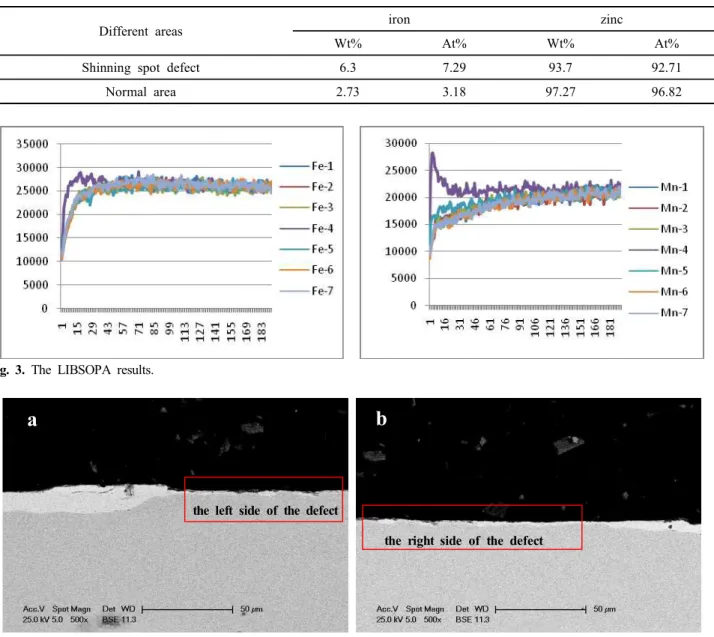
On the upper side of shinning spot defect, the boundary between shinning spot defect and normal area is very clear; while on the other side, the boundary is unclear and the surface gradually transition from flat to rough (Fig. 2b). All the shinning spot area seems like lower than normal area. The results of EDS showed that the chemical composition of both the shinning spot defect and normal area are iron and zinc. The iron content of shinning spot defect is 6.3 wt%, which is higher than normal area where the iron content is 2.73wt%.
Table 2. The EDS results of shinning spot defect and normal area
Different areas iron zinc
Wt% At% Wt% At%
Shinning spot defect 6.3 7.29 93.7 92.71
Normal area 2.73 3.18 97.27 96.82
Fig. 3. The LIBSOPA results.
a b
the left side of the defect
the right side of the defect
Fig. 4. The cross sectional morphology of the GI coatings and substrate: a) the left side of shinning spot defect; b) the right side of shinning spot defect.
The LIBSOPA results of normal and defect are shown in Fig. 3. The point 4 was defect area , and other points were normal area. Being different from normal areas, the iron and manganese content is obvious higher.
The cross sectional morphologies of the GI coatings and substrate observed on the shinning spot defect are shown from Fig. 4a) and b). The coating thickness of shin- ning spot defect is about 2μm, which is much thinner than normal area where the coating thickness is about 10μm.
This can explian why the iron content of shinnig spot de- fect higher than normal area which shown in Fig. 2 and Table. 2. Contrasted the shinning spot defect with normal area, it can be found that the coating surface of shinning
spot defect is lower than normal area. Between the left side of shinning spot defect and normal area, a clear step on coating surface can be found where the coating thick- ness thinned quickly, while on the other side of shinning spot defect, the coating thickness thickened gradually. This is in agreement with the surface morphology in Fig. 2b).
The substrate rightly under the shinning spot defect is higher than substrate under normal area, and on the left side of the substrate under shinning spot defect, a quickly raised step can be found which corresponds to the coating step where the coating thickness thinned quickly. While on the other side, the substrate declined gradually. The substrate beside the quickly raised area seems like a little
1.0mm
1.0mm
a b
Fig. 5. The surface morphology before (a) and after (b) zinc coating been removed.
rolling direction
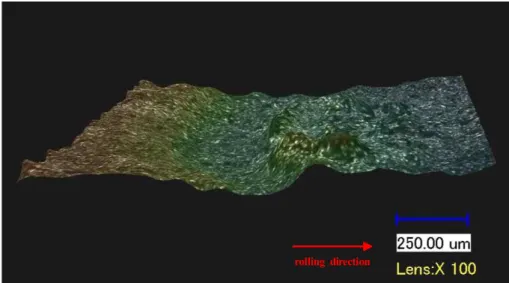
Fig. 6. Three dimensional surface morphology of substrate after zinc coating been removed.
lower than normal substrate area and the coating thickness here is 17μm, which is thicker than normal area where coating thickness is 10μm.
From the results above, it can be confirmed that the substrate under the shinning spot defect may be exist defect. The interfaces of the coating/substrate after zinc coating been removed by HCl with addition of inhibitor are shown in Fig. 5b) which investigated by OM because morphology investigated by SEM is very unclear. Before zinc coating been removed, a square sign has been made around the shinning spot defect in order to determine the position of the substrate defect, which is shown in Fig.
5a). Contrast the deposition of the substrate defect with the shinning spot defect, it can be found that the substrate under the clear boundary between shinning spot defect and normal area on coating surface exist defect like
‘scratch’.
In order to show the defect more visually, a three di- mensional surface morphology is shown in Fig. 6. The substrate defect contains a dent and a adjacent raised area.
Draw a comparison between Fig. 6, Fig. 4b) and Tig.5b), it can be confirmed that the shinning spot defect on coat- ing surface is exactly on the top of the raised areas and the clear boundary between shinning spot defect and nor- mal area justly corresponds to the boundary between dent and raised area on substrate. The coating thickness above the dent of substrate is higher than normal area.
3.2 Discussion
From the results above, it was clearly known that the shinning spot defect on coating surface is originated from the steel substrate because : 1) the position of both GI coating defects and substrates is almost completely con- cordance, 2) the iron and manganese content of defect
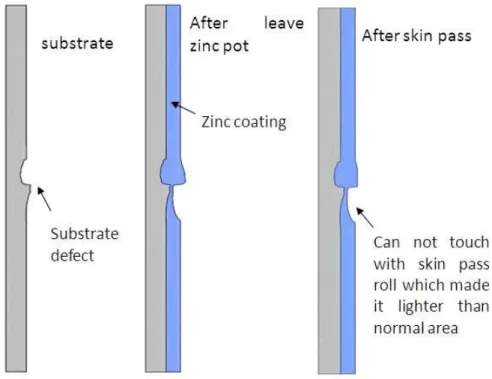
Fig. 7. Schematic diagram of the formation mechanism of the shinning spot defect.
is obvious higher than normal area. The formation mecha- nism of the shinning spot defect investigated in this paper is shown in Fig. 7. When there is a defect which contains a dent and adjacent raised area like Fig. 6 where wet abil- ity may be poor, zinc liquid will be hold together above the dent area while it will be very limited at the raised area due to surface tension and greatly raised substrate when steel sheet leave zinc pot. So a clear boundary formed due to the obvious difference of coating thickness.
While on the other side of the raised area on substrate surface, the zinc liquid gradually returned to normal range due to gravity and gradually declined substrate. After skin pass, the zinc coating on the raised area can not touch with skin pass roll because where the zinc coating is lower than normal area, which cause the zinc coating surface at the raised area still keeping flatten while normal coating surface being rough. The different coating morphologies have different effects on the reflection of light and cause the shinning spot defect lighter than normal coating area in the end.
4. Conclusions
A certain type of shinning spot defect observed on the GI coating surface was characterized by OM, SEM and three-dimensional video microscope. The following con- clusions can be drawn from the results of this work.
The coating surface of the shinning spot defect is much
flatter than normal area. It is the difference of the coating surface that leads to brightness difference between these two areas. The coating thickness of shinning spot defect is much lower than normal area. The defect area can not touch with skin pass roll which result in shinning spot defect flatter than normal area. It can be confirmed that the shinning spot defect was caused by substrate defect.
So as a matter of fact, the substrate surface quality is of paramount importance for producing a high quality coating.
References
1. N. Y. Tang and F. E. Goodwin, A study of defects in galvanized coatings, Galvatech 2001, p. 44, Brussels, Belgium (2001).
2. Jin xinyan, Liu xin, and Qian hongwei, Study of a spot defect caused by flaking of hot-dip galvannealed coating.
Baosteel technology, 59, 3 (2008).
3. Cheng guoping, Yuan mingsheng, and Ji sikai, Cause analysis of shinning dots on surface of galvannealed steel sheets after press forming, Baosteel technology, 6, 35 (2003).
4. Francis Chen and Ram Patil, An In-depth analysis of various subtle coating defects, Galvatech 2004, p. 1055, Chicago, American (2004).
5. Dong-Soo Han and Moon-Hi Hong, Characterization of the tiniest defects for automotive exposed panels, Galvatech 2007, p. 285, Osaka, Japan (2007).
6. N. Y. Tang and F. N. Coady, Coating defects, origin and remedies, Galvanizers association 2001, 93rd Galvanizers as- sociation meeting, Portland, 2001.