Uterine rupture is defined as a full-thickness separation of the uterine wall and overlying vis- ceral peritoneum.1 According to a systematic re- view of maternal morbidity and mortality by the World Health Organization in 2005, the median incidence of uterine rupture is 5.3 per 10000 deliveries. A major risk factor for uterine rupture is previous cesarean section, including a short du- ration (less than 18 months) since the last cesarean delivery, the number of previous cesarean sec- tions and single layer closure instead of two-layer closure. Other risk factors include previous scar- ring of the uterus after myomectomy, placenta
previa, uterine trauma, uterine instrumentation and congenital uterine anomaly.2
Uterine rupture presents with fetal heart rate change, most commonly bradycardia. Mother’s clinical features include abdominal pain, vaginal bleeding and altered uterine contraction. More severe conditions of uterine rupture are presented as hypotension, shock, hematuria, scar tender- ness and maternal tachycardia.2 For differential diagnosis of uterine rupture, placental abruption, placenta previa, uterine inversion, cervical tear, vaginal tear, coagulopathy, uterine atony and ute- rine artery rupture may be considered.3 Placental
Case Report
Spontaneous uterine rupture due to placenta percreta in the second trimester of pregnancy: a case report
So Young Seo1, Dong Wook Kim1, Bo Mi Kim2, Sung Wook Chun1
1Department of Obstetrics and Gynecology, Inje University Haeundae Paik Hospital, Busan, Korea
2Department of Pathology, Inje University Haeundae Paik Hospital, Busan, Korea
A 32-year-old multiparous woman (gravida 2, para 2) with a history of previous cesarean section had acute abdominal pain and collapsed at 21 weeks of gestation. Exploratory laparotomy was performed because of the patient’s worsening condition; ultrasound examination results were suggestive of massive hemoperitoneum, and fetus in vertex presentation with bradycardia. Uterine rupture between the left lower segment and borderline of the cervix in the anterior wall with active bleeding was confirmed. An uncomplicated classical cesarean section was performed, but the fetus was stillborn due to preterm birth. Hysterectomy was performed after the cesarean section. The patient was admitted to intensive care units for 3 days and was discharged in 12 days following delivery. Placenta percreta at the anterior lower segment of the uterus was confirmed in the pathology report.
Key Words: Hemoperitoneum, Hysterectomy, Placenta percreta, Uterine rupture
Corresponding Author: Sung Wook Chun, Department of Obstetrics and Gynecology, Inje University Haeundae Paik Hospital, 875, Haeun-daero, Haeundae-gu, Busan 48108, Korea
Tel: +82-51-797-2020 Fax: +82-51-797-2030 E-mail: [email protected]
Received:
Revised:
Accepted:
Aug. 03, 2016 Aug. 11, 2016 Aug. 24, 2016
invasion anomalies refer to the abnormal adher- ence of the placenta to the uterine wall, resulting in detachment failure after delivery.4 Placental in- vasion anomalies are classified according to in- vasion depth. Placenta accreta occurs when the vil- li penetrate the decidua but not the myometrium.
Placenta increta occurs when the villi penetrate the myometrium. Placenta percreta occurs when these villi penetrate the serosa and occasionally invade into adjacent organs such as the bladder.5
Here we present the case of a woman who de- veloped uterine rupture during due to placenta percreta during the second trimester, after two previous cesarean sections.
CASE
A 32-year-old woman gravida 2, para 2 at 21 weeks’ gestation presented to the emergency room with acute, moderate abdominal pain. She was drowsy and had a history of two previous ce- sarean sections. Physical examination revealed a systolic blood pressure of 40 mmHg and that she was in hypovolemic shock. Her abdomen was soft but distended. Massive hemoperitoneum and fetal bradycardia were detected with ultrasound examination. Hematoma was also found posterior to the placenta. Central venous catheter place- ment on the jugular vein and arterial line place- ment were performed. Emergency transfusion was commenced. She was transported to the operating room for an emergency cesarean section. A mid-
line laparotomy was performed, and the peri- toneal cavity was filled with the massive hematoma. The hematoma was being expelled through the incision and an extended incision was required. Uterine rupture (approximately 1-2 cm) was detected between the left lower segment of the uterus and the borderline of the cervix in the anterior wall. A male neonate weighing 232 g, was delivered but was stillborn without spontaneous breathing. The placenta was lying over the ante- rior lower segment uterine wall covering the cer- vical orifice, and it was suspected to total or parti- al placenta previa. The placenta was manually re- moved but immediate complete removal was infeasible. Even after suturing the tear in the ute- rine wall, active bleeding continued from the in- ner orifice of the cervix which was indicative of placenta increta or percreta. Subtotal hyster- ectomy was performed without removing both ovaries because the bleeding site was not clear inside the uterus. After subtotal hysterectomy, however, bleeding was persistent, especially from near the inner orifice. She was also bleeding from a laceration between the bladder dome and cervix. It was concluded that removal of the cervix was necessary for bleeding control. Once the ret- roperitoneal bleeding was controlled and the re- moval of the hematoma was completed, the tear in the bladder dome was sutured and total hyster- ectomy was performed. The estimated blood loss during the surgery was 19,000 ml. She received 36 units of packed red blood cells, 13 units of fresh frozen plasma and 16 units of platelet con-
centrate during the operation. The uterus was sent for biopsy to have the pathology confirmed (Fig.
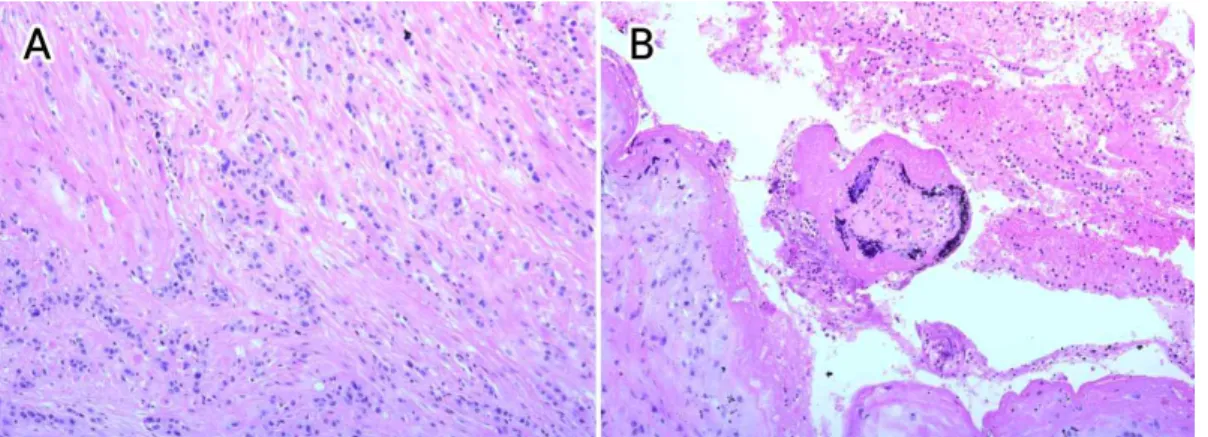
1), and the pathology report revealed placenta percreta (Fig. 2). She was then admitted to the intensive care unit and was discharged from the hospital in good general condition in 12 days.
DISCUSSION
In our case, the patient had two previous cesar- ean sections, abnormal placental invasion is diag- nosed either clinically during cesarean delivery or histopathologically after hysterectomy. As in case, uterine rupture due to placenta percreta
during the second trimester, is a rare, but life-threating complication. Ulkumen BA et al.6 published a similar report as our case. A 25-year-old woman had acute abdominal pain at 24 gesta- tional weeks and had emergency cesarean section performed. Placental biopsy after the operation confirmed placenta percreta. In another case, a woman at 16 weeks gestation experienced uterine rupture due to placenta percreta. She also had a previous history of cesarean section as well as dilation and curettage.7 In Korea, Park SH et al.8 reported that women with a history of previous cesarean section and placenta previa were treated with cesarean hysterectomy because of sponta- neous uterine rupture with placenta percreta at Fig. 1. Gross findings of the specimen. Hysterectomy speciment was separated
because of uterine perforation. On gross examination, no placenta was found to be growing through the uterine wall.
37weeks. Another reported the spontaneous rup- ture of the uterus at 14 weeks of pregnancy with
three previous cesarean sections.9 Few case re- ports have been published after that report.
Uterine rupture is an uncommon but serious obstetrical complication.10 The overall incidence of uterine rupture is estimated at 0.05% of total deliveries.4 Furthermore, spontaneous uterine rupture due to placenta accreta or percreta is a rare obstetric emergency with an estimated in- cidence of 1/5000 pregnancies.5 90% of cases oc- cur in women with a uterine scar, most commonly from a previous cesarean section.4,6 92.3% of rup- tures of scarred uterus involved the lower uterus, and 3.8% of uterine ruptures were located in the parametrium.11 The majority of uterine ruptures occur during the third trimester due to a thinned uterine lower segment. Mothers with uterine rup- ture present with hypovolemic shock secondary to hemorrhage, disseminated intravascular coag- ulation (DIC), genitourinary injury, a potential need for hysterectomy and maternal death.12 Uterine rupture results in change in fetal heart
rate, bradycardia and late deceleration, fetal hy- poxia, fetal acidosis and fetal or neonatal death.13 Patients with clinical shock need resuscitation and immediate surgical intervention. After urgent evaluation, clinicians need to decide if the rupture is surgically repairable or hysterectomy is needed.
The choice of the surgical procedure depends on the type, location, and extent of uterine tear.14 If a pregnant woman has acute abdominal pain or distension, the doctor should consider the dif- ferential diagnosis, including acute appendicitis, ovarian torsion or cyst rupture and hepatic or splenic rupture.
Uterine rupture can also occur in an unscarred uterus. It is more common in older, multiparous women, compared to rupture of the scarred uterus. Thus, if a pregnant woman has acute ab- dominal pain, vaginal bleeding, fetal deceleration or fetal bradycardia, the differential diagnosis Fig. 2A. Histologic findings from the resected specimen (H&E, x 200). Invasive
intermediate trophoblasts penetrated the myometrium through the superficial and deep portion.
Fig. 2B. (H&E, x 200). In the perforation site near serosal side, there was a floating well developed villus admixed with fibrin material.
should include uterine rupture, placental abrupt- ion, placenta previa and uterine atony. The ab- normal placental implantation at the uterine scar of our patient may have increased the risk of ute- rine rupture. A history of dilatation and curettage, cesarean section, manual removal of the placenta, uterine sepsis and previous uterine surgery can cause the deficiency of decidua, which predis- poses to abnormal placental invasion.12
Although uterine rupture during pregnancy is a rare event, it should be considered in pregnant women with hemoperitoneum, particularly when the patient has a history of previous cesarean section. In patients with atypical histories, diag- nosis maybe delayed or may even be established at the time of laparotomy, thereby increasing ma- ternal and fetal morbidity and mortality. Important steps for the successful management of uterine rupture include prompt diagnosis followed by de- finitive surgical management.
ACKNOWLEDGMENTS
The authors have declared no potential con- flicts of interest.
REFERENCES
1. Veena P, Habeebullah S, Chaturvedula L. A review of 93 cases of ruptured uterus over a period of 2 years in a tertiary care hospital in South India.
J Obstet Gynecol 2012;32:260-3.
2. Sutton C, Standen P, Acton J, Griffin C.
Spontaneous Uterine Rupture in a Preterm Pregnancy following Myomectomy. Case Rep Obstet Gynecol 2016;2016:6195621.
3. Hofmeyr GJ, Say L, Gülmezoglu AM. WHO system- atic review of maternal mortality and morbidity:
the prevalence of uterine rupture. BJOG 2005;112:1221-8.
4. Kent A. Management of placenta accreta. Rev Obstet Gynecol 2009;2:127-8.
5. Ultrasonography in Obstetrics and Gynecology.
5th ed. Philadelphia (PA): Saunders Elsevier. 2008.
6. Ulkumen BA, Pala HG, Baytur Y. Acute abdomen and massive hemorrhage due to placenta percreta leading to spontaneous uterine rupture in the sec- ond trimester. Saudi Med J 2014;35:1131-2.
7. Neyazi SM. Placenta percreta and uterine rupture at 16 weeks. Saudi Med J 2013;34:753-6.
8. Park SH, Kim HS, Kim MH, Choi JS, Han JY, Hong SR, et al. Spontaneous uterine rupture with pla- centa percreta. Korean J Obstet Gynecol 2003;46:1236-41.
9. Kwon MJ, Chae KA, Shin HM, Kwon I, Lee GS, Kim SJ, et al. A case of Spontaneous uterine rupture due to placenta percreta on 1st trimester. Korean J Obstet Gynecol 2003;46:2538-42.
10. Ripley DL. Uterine emergencies. Atony, inversion, and rupture. Obstet Gynecol Clin North Am 1999;26:419-34.
11. Roeters AE, Oudijk MA, Heydanus R, Bruinse HW.
Pregnancy outcome after intra-abdominal bleed- ing due to placenta percreta at 14 weeks of gestation. Obstet Gynecol 2007;109:574-6.
12. Zwart JJ, Richters JM, Ory F, Vries JI, Bloemenkamp KW, van Roosmalen J. Uterine rupture in the Netherlands: a nationwide population-based co- hort study. BJOG 2009;116: 1069-80.
13. Chauhan SP, Martin JN Jr, Henrichs CE, Morrison JC, Magann EF. Maternal and perinatal complica- tions with uterine rupture in 142,075 patients who
attempted vaginal birth after cesarean delivery:
A review of the literature. Am J Obstet Gynecol 2003;189:408-17.
14. Sinha P, Mishra M. Caesarean scar pregnancy:
a precursor of placenta percreta/accrete. J Obstet Gynecol 2012;32:621-3.