Research Article Open Access
Comparison of Abdominal Muscle Activity after Sling and Swiss-ball Exercises in Asymptomatic Adults
Myoung-Hee Lee, PT, PhD, Byung-Kon Kim, PT, PhD
1†Department of Physical Tharepy, Kyungsung University
1
Department of Physical Therapy, Daegu Health College
Received: August 7, 2014 / Revised: August 12, 2014 / Accepted: August 20, 2014
ⓒ 2014 J Korean Soc Phys Med
1)
| Abstract |
PURPOSE: The purpose of this study was to investigate any changes in abdominal muscle activity after curl-up and jack-knife exercisse using a sling and swiss-ball.
METHODS: Sixteen asymptomatic subjects were randomly assigned into either a sling exercise group (SG) or swiss-ball exercise group (SBG). Subjects performed curl-up and jack-knife exercise using sling and swiss ball. Activity of abdominal muscles (rectus abdominis and external oblique) was assessed using surface electromyography (EMG) and normalized maximal voluntary isometric contraction (MVIC) before and after exercises. The significance of differences between the SG and the SBG was evaluated by analysis of covariance (ANCOVA).
RESULTS: There was an increase in activity of all abdominal muscles after the curl-up and jack-knife exercises for 6 weeks. However, there was not a significant difference between the SG and the SBG after curl-up exercise (p>.05).
There was also not a significant difference between the SG and
†Corresponding Author : [email protected]
This is an Open Access article distributed under the terms of the Creative Commons Attribution Non-Commercial License (http://creativecommons.org/licenses/by-nc/3.0) which permits unrestricted non-commercial use, distribution, and reproduction in any medium, provided the original work is properly cited.
the SBG after Jack-knife exercise (p>.05) except for the right external oblique muscle (p<.05).
CONCLUSION: Exercises on an unstable surface using a sling and swiss ball are effective ways of abdominal muscle exercise.
Key Words: Sling, Swiss ball, Abdominal muscles
Ⅰ. Introduction
Decreased spine stability is one of the common causes
of lower back pain (LBP) (McGill et al, 2003; Norris &
Matthews, 2008), and patients with chronic LBP display
a shift beyond joint movements strategies in comparison
with healthy adults (Thomas et al., 2007). Many study
results indicate that when patient with chronic LBP perform
activities of daily living, their erector muscles and
abdominal muscles show muscle activity patterns different
from those of healthy adults (Thomas et al., 2007; Van
Daele et al., 2010; Descarreaux et al., 2005; Silfies et al.,
2009; van der Hulst et al., 2010). This can cause problems
for the balance between the abdominal muscles and the
trunk muscles, which contribute to the stability of the lower
trunk and play important roles in postural control and
movements. Spine stability is achieved by appropriate
(McGill et al., 2003).
Results from a previous study indicate that improved stability could relieve LBP (Hodges et al., 2003), and spinal exercises using an unstable surface, such as a swiss ball or wobble board, have been used (Vera-Garcia et al., 2000).
Exercises using an unstable swiss ball are low impact, can be highly utilizable in a home exercise program, and can strongly stimulate the proprioceptors for improving the ability to maintain balance (Han et al., 2001; Kim & Han, 2011). In studies on LBP, these exercises were reported to be effective in reducing pain and strengthening abdominal and lumbar muscles (Choi et al., 2012; Marshall & Murphy, 2006).
Another method for improving spinal stability is sling exercises, which are more effective for sense-exercise training than exercises on a mat. Previous studies have shown that sling exercises improve muscle strength and proprioception of patients using a closed kinematic chain (Dannelly et al., 2011) and maximize the effects of exercises because the proprioceptors can be facilitated (Jang et al., 2010; Jang et al., 2005). Therefore, sling exercises are quite effective for patient with LBP and impaired proprioceptive senses, and they can be applied in acute phases because they are performed to offset body weight.
Although diverse studies on abdominal muscle exercises in association with spinal stability and trunk muscle balance have been conducted to solve the problem, few study results could present specific effects between unstable surface exercises. Therefore, in the present study, we investigated whether sling and swiss-ball exercises that can be applied to abdominal muscles were effective in muscle activation, and we compared differences in muscle activity among exercise methods.
Ⅱ. SUBJECTS AND METHODS
1. Subjects
Sixteen asymptomatic male college students who listened to a detailed explanation about this study participated. The subjects were randomized to two experimental groups: a sling exercise group (SG) and a swiss-ball exercise group (SBG). No subjects from either group had done any professional exercises or had a history of musculoskeletal disease, and they were instructed not to do concentrated exercises during the experiment time. The general characteristics of the subjects in this study are shown in Table 1. The study’s principal objective and all study procedures were explained to the subjects, and written informed consent was obtained before the study. This protocol was conducted in accordance with the ethical standards of the Declaration of Helsinki.
2. Procedures
1) Exercise methods
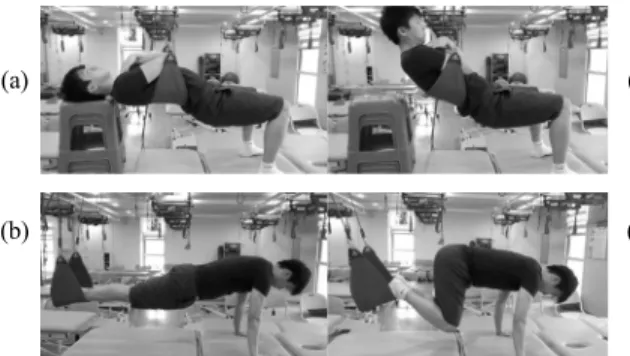
The subjects were randomized into two experimental groups of SG and SBG. The subjects were taught to perform the curl-up and jack-knife exercises under the guidance of the researcher (Fig 1, 2).
Each set of abdominal muscle exercises consisted of 3 sessions, and each session consisted of 5 repetitions.
It took 9 seconds for the subject to perform once. For
all exercises, a 10-second break was given between each
time and a 2-minute break was given between each
session.
(a)
Fig 1. Sling exercise (a) curl-up (b) jack-knife (a)
Fig 2. Swiss-ball exercise (a) curl-up (b) jack-knife
(b) (b)
2) Measuring of surface electromyography
Surface electromyography (Myosystem 1200, Norraxon Inc., USA) was used to measure the muscle activity of abdominal muscles before and after exercise. The analog signals of the collected electromyography were sent to Myosystem 1200 and converted from analog to digital signals. They were filtered and other signals were processed with the software application Myoresearch XP 1.04 on a personal computer. The sampling rate of electromyography signals was set to 1,000 Hz (1,000 samples/sec) and the amplified waveforms were filtered to 20∼500 Hz through band pass filtering. Artifacts were removed through a 60Hz notch filter and an ECG reduction filter. To quantify the electromyography signals collected from the target muscles during each exercise, the signals were analyzed by root mean square (RMS). To normalize the signals, the maximal voluntary isometric contraction (MVIC) of each muscle was measured for 7 seconds and the values of 3 seconds in the middle were averaged (% MVIC). To measure the MVIC of each muscle, verbal cues were given to ensure maximal effort, and each different isometric exercise against manual resistance was performed. Subjects performed maximal isometric contraction in three trials for 7 seconds before the experimental tasks. Fatigue was minimized by giving a 2-minute break after each contraction. The measurements for 3 seconds in the middle were averaged for normalization of the electromyography signals (%
MVIC). Bipolar surface electrodes with a 3.0 ㎜ radius
were attached to the muscle fiber running in the direction of the belly for each muscle. For measurement of the rectus abdominis, the electrodes were attached 1.5 ㎝ to the left and right of the navel. The electrode sites on the body surface were shaved and cleaned with rubbing alcohol to reduce skin resistance.
3. Statistics
All values of muscle activity are expressed as mean and standard deviation. The significance of difference in abdominal muscle activity between the SG and the SBG was evaluated by analysis of covariance (ANCOVA). The level for statistical significance was defined as p-value less than .05.
Ⅲ. Results
1. General characteristics of subjects
The demographic characteristics of the subjects are displayed in Table 1.
Group Age (years) Height (㎝) Weight (㎏) Sling group
(n=8) 22.25±2.12 173.88±3.14 69.63±5.40 Swiss-ball group
(n=8) 22.25±1.83 174.00±2.98 67.38±4.03 Table 1. General characteristics of subjects
(mean±SD)
according to group
There was an increase in muscle activity of all abdominal muscles after curl-up and jack-knife exercises for 6 weeks.
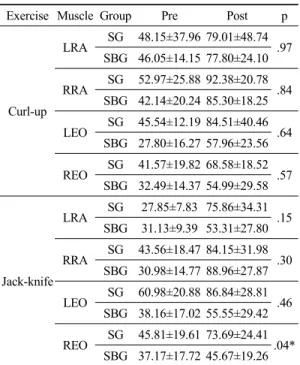
After curl-up exercise, activity of all abdominal muscles in the SBG was greater than in the SG. However, there was no significant difference between the groups (p>.05) (Table 2).
After Jack-knife exercise, activity of abdominal muscles also was not significantly different between the groups.
However, activity of the right external oblique muscle in the SG was significantly greater than in the SBG (p<.05) (Table 2).
Exercise Muscle Group Pre Post p
Curl-up
LRA SG 48.15±37.96 79.01±48.74 SBG 46.05±14.15 77.80±24.10 .97
RRA SG 52.97±25.88 92.38±20.78 SBG 42.14±20.24 85.30±18.25 .84
LEO SG 45.54±12.19 84.51±40.46 SBG 27.80±16.27 57.96±23.56 .64
REO SG 41.57±19.82 68.58±18.52 SBG 32.49±14.37 54.99±29.58 .57
Jack-knife
LRA SG 27.85±7.83 75.86±34.31 SBG 31.13±9.39 53.31±27.80 .15
RRA SG 43.56±18.47 84.15±31.98 SBG 30.98±14.77 88.96±27.87 .30
LEO SG 60.98±20.88 86.84±28.81 SBG 38.16±17.02 55.55±29.42 .46
REO SG 45.81±19.61 73.69±24.41 SBG 37.17±17.72 45.67±19.26.04*
LRA: left rectus abdominis, RRA: right rectus abdominis, LEO: left external oblique, REO: right external oblique, SG: sling exercise group, SEG: swiss ball exercise group
* p<.05
Table 2. Results of abdominal muscle activity according to group
(mean±SD)