Pancreatic pseudocyst with fistula to the dilated common bile duct:
Mimmicking choledocal cyst?
Nari Gustavo, Lopez Alesio, Romero Tanus Lorna, De Elias Eugenia, and Lopez Flavia
General Surgery Service, Tránsito Cáceres de Allende Hospital, Córdoba, Argentina
We present a rare case of a fistula between a pancreatic pseudocyst and the bile duct with saccular dilatation that appeared to be a type I choledocal cyst. There are only 19 described cases in the consulted bibliography. The patient was studied with an ultrasound, CT and MRCP and later surgically intervened. A resection was performed of the extra- hepatic biliary and hepaticojejunostomy. There was a subsequent good evolution. (Ann Hepatobiliary Pancreat Surg 2021;25:155-159)
Key Words: Pancreatic; Pseudocyst; Fistula; Bile duct
Received: June 22, 2020; Revised: July 11, 2020; Accepted: July 12, 2020 Corresponding author: Gustavo Nari
General Surgery Service, Tránsito Cáceres de Allende Hospital, Buchardo 1250-5000, Córdoba, Argentina Tel: +54-351-2181218, Fax: +54-351-4342403, E-mail: [email protected]
Copyright Ⓒ 2021 by The Korean Association of Hepato-Biliary-Pancreatic Surgery
This is an Open Access article distributed under the terms of the Creative Commons Attribution Non-Commercial License (http://creativecommons.org/
licenses/by-nc/4.0) which permits unrestricted non-commercial use, distribution, and reproduction in any medium, provided the original work is properly cited.
Annals of Hepato-Biliary-Pancreatic Surgery ∙ pISSN: 2508-5778ㆍeISSN: 2508-5859
INTRODUCTION
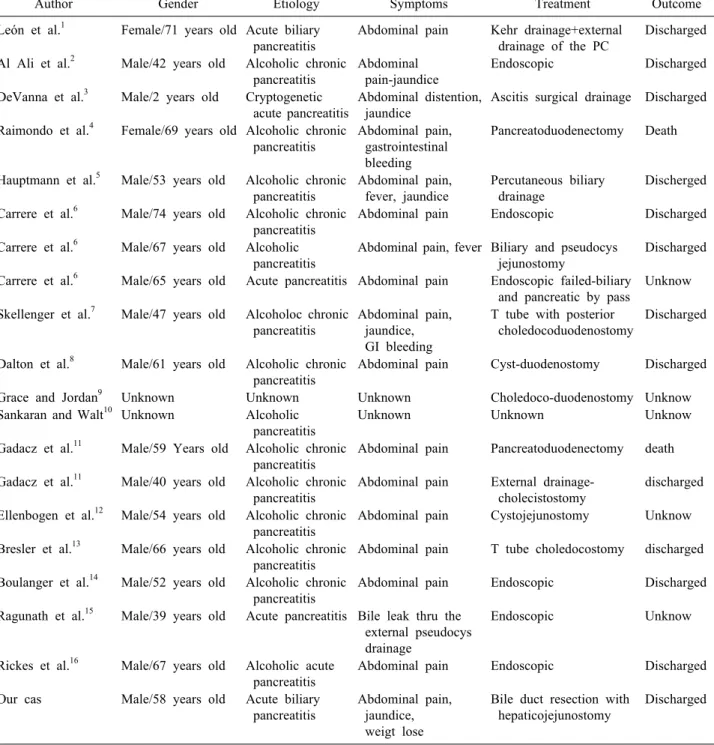
The formation of a pancreatic pseudocyst originates from inflammation or trauma of the pancreatic gland,1-6 this le- sion can establish a fistula with neighboring organs within which the stomach, duodenum and colon are the most fre- quent while less frequent would be within the esophagus and very rarely in the common bile duct, we have only found 19 cases in the bibliographic search.1-16 These fistu- las usually cause complications such as: pain, cholangitis and hemorrhages that can lead to the death of the patient.
The aim of this communication is to contribute a new case with the particularity that the bile duct presented cys- tic dilation and to review the different therapeutic alterna- tives for this rare condition.
CASE
A 60 year old male patient was admitted with 20 day progressive jaundice, associated with pruritus, choluria and hypocolia. Patient reports mild and nonspecific pain in the right hypochondrium. Presented episodes of nausea and vo- miting. Weight loss of 12 kg in 3 months.
As of his surgical history, he refers to a right nephrec-
tomy because of a tumor 1 year ago in another hospital.
A year and a half ago he reported an episode of severe acute pancreatitis of probably lithiasic origin in another institution (previous studies could not be retrieved).
Admission laboratory: leukocytosis: 16300, PRC: 105 mg/
dl. Total bilirubinemia: 15 mg/dl. Direct bilirubin: 13 mg/dl.
Alkaline phosphatase: 343 UI/L. GGT: 176 UI/L. GOT: 51 U/
L. GPT: 57 U/L.
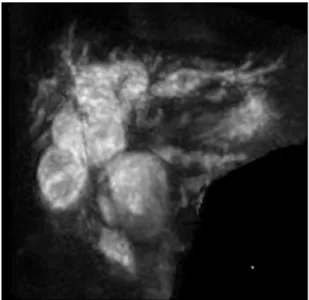
Ultrasound reports a dilated intrahepatic bile duct, 11 mm common bile duct. Gallbladder with thickened walls with lithiasis inside. Cystic and heterogeneous collection (74×80 mm) in head and body of pancreas. Duct of Wir- sung dilation. CT: enlarged pancreas, 74-mm cystic image in the head of páncreas. Marked Wirsung dilatation (13- mm). Important dilatation of the extrahepatic bile duct with a 36 mm of diameter in the common bile duct and lithiasis in its interior. Cholelithiasis. Normal chest CT.
Nuclear magnetic resonance cholangiography (MRCP):
dilatation of the extrahepatic bile duct. Pancreatic pseudo- cyst with fistula to the main bile duct (Figs. 1-3)?
A percutaneous drainage of the bile duct was decided through which a cholangiography was performed, which reaffirmed the findings of the MRCP and did not objec- tively progress the contrast medium towards the Duct of
Fig. 1. CT showing the pseudocyst and the great dilatation of the bile ducts.
Fig. 2. MRCP, pseudocyst is comunicated and compressing the bile duct.
Fig. 3. Intraoperative Cholangiography. Bile duct dilatation co- municated with pseudocyst.
Wirsung, bile was sent for amylase dosing, reporting a value greater than 25,000 U/L. CEA markers: 3.0 ng/ml.
CA 19.9: 88 U/ml. CA 125: 16 U/ml. Alpha fetoprotein:
2.65 ng/ml.
With the diagnosis of a common bile duct cyst fistu- lized into a pancreatic pseudocyst without communication with the duct of Wirsung, surgical conduct was decided, the findings of which are: hypoplastic gallbladder with a stone, increased duodenal-pancreatic vascular comb, large saccular dilatation of the extrahepatic bile duct and thin/
transparent walls.
Cholecystectomy and intraoperative cholangiography were performed, showing saccular dilatation of the extrahepatic bile duct and dilatation of the intrahepatic bile duct. As a surgical procedure, resection of the cystic bag was per-
formed with closure of the stump and hepaticojejunal- anastomosis in Roux en Y with transanastomotic intuba- tion. The patient evolved favorably being discharged on the 7th postoperative day. Thirty days after the operation a new CT scan was performed, showing a significant de- crease in the size of the pseudocyst, going from 74 mm to 25 mm in the control and a reduction in the size of the duct of Wirsung from 13 mm to 3 mm in the control.
Three months after surgery, the patient is asymptomatic and has recovered weight.
DISCUSSION
A pancreatic pseudocyst is a complication of pancrea- titis of any etiology, around 20 to 40% of patients with chro-
Table 1. Cases reported in the literature
Author Gender Etiology Symptoms Treatment Outcome
León et al.1 Female/71 years old Acute biliary pancreatitis
Abdominal pain Kehr drainage+external drainage of the PC
Discharged
Al Ali et al.2 Male/42 years old Alcoholic chronic pancreatitis
Abdominal pain-jaundice
Endoscopic Discharged
DeVanna et al.3 Male/2 years old Cryptogenetic acute pancreatitis
Abdominal distention, jaundice
Ascitis surgical drainage Discharged
Raimondo et al.4 Female/69 years old Alcoholic chronic pancreatitis
Abdominal pain, gastrointestinal bleeding
Pancreatoduodenectomy Death
Hauptmann et al.5 Male/53 years old Alcoholic chronic pancreatitis
Abdominal pain, fever, jaundice
Percutaneous biliary drainage
Discherged
Carrere et al.6 Male/74 years old Alcoholic chronic pancreatitis
Abdominal pain Endoscopic Discharged
Carrere et al.6 Male/67 years old Alcoholic pancreatitis
Abdominal pain, fever Biliary and pseudocys jejunostomy
Discharged
Carrere et al.6 Male/65 years old Acute pancreatitis Abdominal pain Endoscopic failed-biliary and pancreatic by pass
Unknow
Skellenger et al.7 Male/47 years old Alcoholoc chronic pancreatitis
Abdominal pain, jaundice, GI bleeding
T tube with posterior choledocoduodenostomy
Discharged
Dalton et al.8 Male/61 years old Alcoholic chronic pancreatitis
Abdominal pain Cyst-duodenostomy Discharged
Grace and Jordan9 Unknown Unknown Unknown Choledoco-duodenostomy Unknow
Sankaran and Walt10 Unknown Alcoholic pancreatitis
Unknown Unknown Unknow
Gadacz et al.11 Male/59 Years old Alcoholic chronic pancreatitis
Abdominal pain Pancreatoduodenectomy death
Gadacz et al.11 Male/40 years old Alcoholic chronic pancreatitis
Abdominal pain External drainage- cholecistostomy
discharged
Ellenbogen et al.12 Male/54 years old Alcoholic chronic pancreatitis
Abdominal pain Cystojejunostomy Unknow
Bresler et al.13 Male/66 years old Alcoholic chronic pancreatitis
Abdominal pain T tube choledocostomy discharged
Boulanger et al.14 Male/52 years old Alcoholic chronic pancreatitis
Abdominal pain Endoscopic Discharged
Ragunath et al.15 Male/39 years old Acute pancreatitis Bile leak thru the external pseudocys drainage
Endoscopic Unknow
Rickes et al.16 Male/67 years old Alcoholic acute pancreatitis
Abdominal pain Endoscopic Discharged
Our cas Male/58 years old Acute biliary pancreatitis
Abdominal pain, jaundice, weigt lose
Bile duct resection with hepaticojejunostomy
Discharged nic pancreatitis will develop a collection of these charac-
teristics at some point in their evolution, about 30% of them will not require any treatment. They tend to settle more frequently in the body and pancreatic neck, the head of the organ being less affected. The pseudocyst can suf- fer complications such as infection, hemorrhage, free rup- ture to the abdominal cavity and fistulas. Of these complica- tions, fistulization to neighbouring organs is the least fre- quent, the organs most affected are the stomach, duode-
num and colon with less frequent problems in the esoph- agus and pleura. Fistula with the bile duct is extremely infrequent, with only 11 cases being counted until 19984 and 19 cases until 20131 (Table 1), our patient becomes case number 20. Erosion of the wall of the bile duct would be produced by the tension of the pseudocyst and the con- sequent fistula.6 Of all the cases reported to date, the male sex was affected in an almost exclusive way, most with an age of over 50 years, which is coincident with the case
presented. Pancreatitis of alcoholic origin was the most common origin of the pseudocyst, whereas pancreatitis of biliary origin was present only 2 times and coincidentally in two patients from South American countries where lith- iasis was the most common origin of acute pancreatitis.
The clinical symptoms of these patients have abdominal pain as the cardinal symptom, followed by jaundice. In our patient, these two symptoms were associated with signifi- cant weight loss. The literature coincides that the use of an ultrasound, tomography and MRCP are the ones that will make it possible to confirm the diagnosis not only of the pseudocyst but also to confirm the presence of a communication with the biliary tree; ERCP is another val- uable study that had the advantage of being able to per- form therapeutic gestures. Our case was studied with ul- trasound, tomography and MRI, initially we suspected a compression of the bile duct due to its large dilation. The placement of a percutaneous bile drainage to improve liv- er function allowed us to perform a cholangiography to observe what we interpret as a saccular dilation of the ex- trahepatic bile duct communicated to the pseudocyst, the analysis of the extracted bile showed an amylase value greater than 20 thousand that justified communication, but also the possibility of a cystic dilation of the bile duct.
Given this eventuality, surgical behaviour is decided to re- solve biliary pathology and evaluate possible treatment for the pseudocyst. The finding of a hypoplastic gallbladder associated with a large dilatation of the extrahepatic bile duct with extremely thin walls as usually occurs in com- mon bile duct cysts led us to perform a complete resection of the bile duct with a Roux-en-Y hepaticojejunostomy and a puncture and evacuation of the pseudocyst.17
From the bibliography consulted, most of the cases were resolved with surgical treatment, most of the procedures were a bypass and of the 12 patients treated with surgery, in 8 biliary drainage was performed, whether internal or external. In our patient, the lack of communication with the duct of Wirsung made an internal or external shunt of the pseudocyst unnecessary. Endoscopic treatment was used to a lesser extent, some of them required more than one procedure and in some, the patient required surgical treatment due to its failure.2,6 The percutaneous approach was used and successful with only one patient. There were 2 deaths within all of the patients reported and both were in pancreatoduodenectomies. Although the treatments are
dissimilar and span over many years, we believe that it is likely that the treatment will depend a lot on 2 factors, the first of which is the possibility of mini-invasive proce- dures in the institution, the second is of the local charac- teristics of the pathology, it will be different if the fistula is from the pseudocyst into the bile duct without commu- nication with the pancreatic duct than if the two systems (bile and pancreatic) are connected; in the first situation, the approach to the bile duct will resolve the fistula as it could be observed in cases where only internal or ex- ternal biliary drainage was used. In the second situation, where both the bile duct and the duct of Wirsung are in communication with the pseudocyst, diversion of both the bile duct and the pseudocyst will be necessary. In our pa- tient, the absence of communication with the pancreatic duct and the suspicion of the association of a common bile duct cyst induced us to perform the resection of the large cystic pouch and the preparation of a hepaticojeju- nostomy with very good subsequent evolution. Pancreato- duodenectomy as a treatment4 for the pseudocyst with a biliary fistula seems to us to be exaggerated despite the fact that its morbidity and mortality have currently dec- reased.18 Pathological anatomy reported findings compat- ible with congenital cystic dilatation of the bile duct. In this regard, it may be asked whether the patient actually had a common bile duct cyst with a probable Babit theory that justifies the reflux of pancreatic fluid into the bile duct or that the fistula from the pseudocyst has favored the passage of amylase to a normal bile duct during more than a year, with enzymatic activation and digestion, ex- ercising the same pathophysiological pathway as if it had been congenital.
ACKNOWLEDGEMENTS
To miss Lucia Barquin for the translation of the text.
CONFLICT OF INTEREST
No conflict of interst and no funds received.
ORCID
Nari Gustavo: https://orcid.org/0000-0002-2559-5704 Lopez Alesio: https://orcid.org/0000-0001-8412-6265
Romero Tanus Lorna: https://orcid.org/0000-0002-9679-8031 De Elias Eugenia: https://orcid.org/0000-0003-4619-4149 Lopez Flavia: https://orcid.org/0000-0003-2125-175X
AUTHOR CONTRIBUTIONS
Data recolection, figures editing: LA, DEE. Bibliogra- phic search and selection: RTL, LF. Writing, review and editing: NG.
REFERENCES
1. León FF, Tapia VÁ, Avendaño RG. [Fistula formation between a pancreatic pseudocyst and the biliary tree]. Rev Chil Cir 2013;65:549-553. Spanish.
2. Al Ali JA, Chung H, Munk PL, Byrne MF. Pancreatic pseudo- cyst with fistula to the common bile duct resolved by combined biliary and pancreatic stenting--a case report and literature rev- iew. Can J Gastroenterol 2009;23:557-559.
3. DeVanna T, Dunne MG, Haney PJ. Fistulous communication of pseudocyst to the common bile duct: a complication of pancrea- titis. Pediatr Radiol 1983;13:344-345.
4. Raimondo M, Ashby AM, York EA, Derfus GA, Farnell MB, Clain JE. Pancreatic pseudocyst with fistula to the common bile duct presenting with gastrointestinal bleeding. Dig Dis Sci 1998;
43:2622-2626.
5. Hauptmann EM, Wojtowycz M, Reichelderfer M, McDermott JC, Crummy AB. Pancreatic pseudocyst with fistula to the com- mon bile duct: radiological diagnosis and management. Gastrointest Radiol 1992;17:151-153.
6. Carrere C, Heyries L, Barthet M, Bernard JP, Grimaud JC, Sahel J. Biliopancreatic fistulas complicating pancreatic pseudocysts: a report of three cases demonstrated by endoscopic retrograde chol- angiopancreatography. Endoscopy 2001;33:91-94.
7. Skellenger ME, Patterson D, Foley NT, Jordan PH Jr. Cholesta- sis due to compression of the common bile duct by pancreatic pseudocysts. Am J Surg 1983;145:343-348.
8. Dalton WE, Lee HM, Williams GM, Hume DM. Pancreatic pseudocyst causing hemobilia and massive gastrointestinal hemorr- hage. Am J Surg 1970;120:106-107.
9. Grace RR, Jordan PH Jr. Unresolved problems of pancreatic pseudocysts. Ann Surg 1976;184:16-21.
10. Sankaran S, Walt AJ. The natural and unnatural history of pan- creatic pseudocysts. Br J Surg 1975;62:37-44.
11. Gadacz TR, Lillemoe K, Zinner M, Merrill W. Common bile duct complications of pancreatitis evaluation and treatment. Surgery 1983;93:235-242.
12. Ellenbogen KA, Cameron JL, Cocco AE, Gayler BW, Hutcheon DF. Fistulous communication of a pseudocyst with the common bile duct: demonstration by endoscopic retrograde cholangiopan- creatography. Johns Hopkins Med J 1981;149:110-111.
13. Bresler L, Vidrequin A, Poussot D, Mangin P, Pinelli G, Boissel P, et al. Fistulous communication of a pancreatic pseudocyst with the common bile duct: demonstration by operative cholan- giogram. Am J Gastroenterol 1989;84:835-836.
14. Boulanger S, Volpe CM, Ullah A, Lindfield V, Doerr R. Pancre- atic pseudocyst with biliary fistula: treatment with endoscopic in- ternal drainage. South Med J 2001;94:347-349.
15. Ragunath K, Anagnostopoulos GK, Dunn K. Education and ima- ging. Hepatobiliary and pancreatic: choledochopancreatic fistula complicating acute pancreatitis. J Gastroenterol Hepatol 2006;21:
1753.
16. Rickes S, Mönkemüller K, Peitz U, Schinkel S, Kolfenbach S, Malfertheiner P, et al. Sonographic diagnosis and endoscopic the- rapy of a biliopancreatic fistula complicating a pancreatic pseu- docyst. Scand J Gastroenterol 2006;41:989-992.
17. Nari GA, Nassar M, Moreno E, Ponce O. Congenital cystic dila- tion of the biliary tract. Report on six patients. Cir Gen 2001;
23:168-172.
18. Nari G, Granero L, Silva J, Layún J, Mariot D, Duran N, et al.
[Pancreatic fistula after pancreaticoduodenectomy. Pancreaticogas- trostomy vs. pancreaticojejunostomy]. Rev Argent Cirug 2019;111:
79-89. Spanish.