Received June 23, 2014, Revised May 29, 2015, Accepted for publication October 12, 2015
Conflict of interest: Yil-Seob Lee and Joon Hyung Kim are employees of GlaxoSmithKline and have stock/stock options in the company. Any other potential conflict of interest relevant to this article was not reported.
Corresponding author: Won-Soo Lee, Department of Dermatology and Institute of Hair & Cosmetic Medicine, Yonsei University Wonju College of Medicine, 20 Ilsan-ro, Wonju 26426, Korea. Tel: 82-33-741-0622, Fax:
82-33-748-2650, E-mail: [email protected]
This is an Open Access article distributed under the terms of the Creative Commons Attribution Non-Commercial License (http://creativecommons.
org/licenses/by-nc/4.0) which permits unrestricted non-commercial use, distribution, and reproduction in any medium, provided the original work is properly cited.
Copyright © The Korean Dermatological Association and The Korean Society for Investigative Dermatology
Ann Dermatol Vol. 28, No. 4, 2016 http://dx.doi.org/10.5021/ad.2016.28.4.444
ORIGINAL ARTICLE
Safety and Tolerability of the Dual 5-Alpha Reductase Inhibitor Dutasteride in the Treatment of Androgenetic Alopecia
Gwang Seong Choi, Joon Hyung Kim1, Shin-Young Oh1, Jung-Min Park1, Ji-Soo Hong1, Yil-Seob Lee1, Won-Soo Lee2
Department of Dermatology, Inha University College of Medicine, Incheon, 1GlaxoSmithKline, Seoul, 2Department of Dermatology and Institute of Hair & Cosmetic Medicine, Yonsei University Wonju College of Medicine, Wonju, Korea
Background: After the approval of dutastride for androgenic alopecia (AGA) in 2009, Korean authority required a post-marketing surveillance to obtain further data on its safe- ty profile. Objective: The objective was to monitor adverse events (AEs) of dutasteride 0.5 mg in Korean AGA male pa- tients in a clinical practice environment. Methods: Open la- bel, multi-center, non-interventional observational study was done from July 2009 to July 2013. AGA subjects (18∼41 years of age) with no experience of dutasteride were enrolled. Dosage regimen was recommended according to the prescribing information. The incidences of any AEs, seri- ous adverse events (SAEs), and adverse drug reactions (ADRs) were evaluated. Multiple logistic regression method was used to identify risk factors related to ADRs.
Effectiveness was generally evaluated by physicians. Results:
During study period, 712 subjects were enrolled. The sub- jects of 29.3±6.0 years old exposed to dutasteride for 204.7±161.5 days. One hundred and ten (15.4%) of sub-
jects reported 138 AEs. Four subjects (0.6%) reported 5 SAEs (right radius fracture, 2 events of chronic follicular tonsillitis, influenza infection, and acute appendicitis). Sixty-six sub- jects (9.3%) reported 80 ADRs. Most frequent ADRs were li- bido decreased (9 subjects, 1.3%), dyspepsia (8 subjects, 1.1%), impotence (7 subjects, 1.0%), and fatigue (5 subjects, 0.7%). Other interested ADRs were sexual function abnor- mality (4 subjects, 0.6%), gynecomastia (2 subjects, 0.3%), and ejaculation disorder (1 subject, 0.1%). Most subjects (78.6%) showed overall improvement after treatment of du- tasteride in the effectiveness. Conclusion: Dutasteride 0.5 mg is to be well-tolerated in 18 to 41 years old AGA patients in a clinical practice environment. (Ann Dermatol 28(4) 444∼
450, 2016) -Keywords-
Alopecia, Drug-related side effects and adverse reactions, Dutasteride, Product surveillance, postmarketing, Safety, Treatment outcome
INTRODUCTION
Androgenetic alopecia (AGA) is an androgen-induced, progressive disorder, which is the most common type of alopecia after puberty. In AGA patients, hairs in affected area get thinner and shorter. A hairline recedes at the tem- ples and the vertex gets bald.
AGA is often perceived as normal aging process, but many patients are suffering from AGA. DeMuro-Mercon et al.1 revealed that 90% of Norwegian men aged 26∼50 years self-reported having at least some hair loss. In this study, men who perceive themselves as having greater
hair loss are more suffered from their hair loss. The preva- lence of AGA in North East Asian (Japanese, Taiwanese, Chinese, and Korean) is lower than in Caucasians2-5. Patients visiting clinics are getting younger6, and hair loss can significantly cause psychosocial manifestations, lead- ing to economic on household health expenditure partic- ularly in young patients7.
Given the high prevalence, the treatment option for AGA is relatively limited though minoxidil and 5-alpha reduc- tase inhibitors are widely used8. Dutasteride 0.5 mg was recently added on the treatment options. Several studies proved that 0.5 mg of dutasteride improved hair growth and was relatively well tolerated for the treatment of AGA9-11. However, concerns on the safety and tolerability remain.
The objective of this study was to explore adverse events of dutasteride in Korean patients with AGA as per the re- quirement of Korea Ministiry of Food and Drug Safety.
MATERIALS AND METHODS
Subjects
Men 18 to 41 years of age diagnosed as AGA were eligi- ble for this study if they will be treated with dutasteride 0.5 mg on the physician’s medical judgement. Patients who previously treated with minoxidil or finasteride were eligible for this study but they must never have used du- tasteride before for any reasons. Subjects who could not comply with the requirements of the protocol and follow the administration regimen were not enrolled. The institu- tional review boards approved the study protocol. The study was carried out from July 2009 to July 2013 at 21 centers in Korea (Ajou University Hospital, Asan Medical Center, Chonnam National University Hospital, Chung- Ang University Hospital, Chungbuk National University Hospital, Chungnam National University Hospital, Dankook University Hospital, Dong-A University Hospital, Inha University Hospital, Keimyung University Dongsan Medical Center, Konkuk University Medical Center, Korea University Ansan Hospital, Kyung Hee University Hospital at Gangdong, Kyungpook National University Hospital, Myongji Hospital, Samsung Medical Center, SMG-SNU Boramae Medical Center, Seoul National University Bundang Hospital, Seoul National University Hospital, Severance Hospital, Wonju Severance Christian Hospital).
Approximately 900 subjects planned to be enrolled in or- der to provide 600 evaluable subjects for the primary analysis (according to Guideline for Korean New Drug Re-Examination12) in consideration of an expected 30%
drop out rate.
Study design
In the open-label, multi-center, observational study, der- matologists in Korea were asked to document on case re- port forms their observations for the contracted number of AGA subjects who were to receive dutasteride 0.5 mg dai- ly on the physician’s medical judgement.
Treatment
The subjects received dutasteride as monotherapy or as part of a combination therapy, based on the physician’s medical judgement. In accordance with the prescribing in- formation, dutasteride 0.5 mg once a day was prescribed.
The treatment duration was not pre-specified.
Subject evaluation
Each physician decided visit schedules based on their rou- tine practices. At the initial consultation, demographic in- formation (including age, height, and weight), medical his- tory (including allergy history, family history, concomitant diseases, and AGA treatment history), modified Norwood- Hamilton classification, and concomitant medications were recorded. Physicians were guided to record any treatment-emergent adverse events during the follow up.
At the last treatment visit, the effectiveness was addition- ally evaluated as “improved”, “no change”, “worsened”
and “not assessed.” The overall effectiveness assessment will depend on the physician’s medical judgement.
Definitions
An adverse event (AE), which was coded based on World Health Organization Adverse Reactions Terminology 092, was defined as any untoward medical occurrence in a subject temporally associated with the use of a dutas- teride, whether or not considered related to the medicinal product. Serious adverse event (SAE) is any untoward medical occurrence that at any dose; 1) results in death, 2) is life-threatening, 3) requires inpatient hospitalisation or prolongation of existing hospitalisation, 4) results in persis- tent or significant disability/incapacity, or 5) is a con- genital anomaly/birth defect. An adverse drug reaction (ADR) was defined as all noxious and unintended re- sponses related to dutasteride 0.5 mg. Physicians classi- fied the relatedness into 6 category; “certain”, “probable/
likely”, “possible”, “unlikely”, “conditional/unclassified,”
and “unassessable/unclassifiable.” If the causality between dutasteride and AEs are considered “certain”, “probable/
likely”, “possible” “conditional/unclassified,” and “unas- sessable/unclassifiable,” AEs were classified as ADRs.
After dutasteride treatment, the effectiveness was eval- uated by treating physicians as “improved”, “no change”,
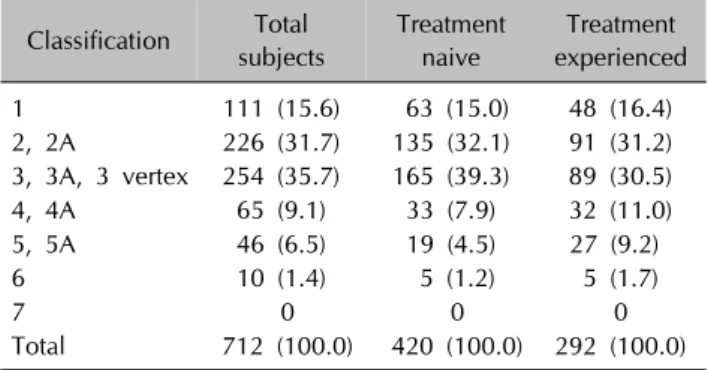
Table 1. Number of subjects with baseline modified Norwood- Hamilton classification
Classification Total subjects
Treatment naive
Treatment experienced
1 111 (15.6) 63 (15.0) 48 (16.4)
2, 2A 226 (31.7) 135 (32.1) 91 (31.2) 3, 3A, 3 vertex 254 (35.7) 165 (39.3) 89 (30.5)
4, 4A 65 (9.1) 33 (7.9) 32 (11.0)
5, 5A 46 (6.5) 19 (4.5) 27 (9.2)
6 10 (1.4) 5 (1.2) 5 (1.7)
7 0 0 0
Total 712 (100.0) 420 (100.0) 292 (100.0) Values are presented as number (%).
“worsened”, or “not evaluable”. “Improved” is defined as an improvement or maintenance of the treating condition.
Patients are classified as “improved” if the patient experi- enced hair growth or if the patient experienced com- parable hair growth from prior treatment or if the patient experienced less hair loss. “No change” is defined as no improvement of the condition after treatment. Patients are classified as “no change” if the patient is on treatment and experiences the no improvements of hair loss compared to baseline or without any treatment. “Worsened” is defined as worsening of the condition after treatment. Patients are classified as “worsened” if the patient on treatment and experiences worsening of hair loss compared to baseline or without any treatment.
Statistical analysis
Continuous variables are expressed as the mean with one standard deviation and discrete variables are expressed as the frequency and rate. The primary objective was to eval- uate the frequency and cases of AE after dutasteride administration. After all AEs were classified by preferred terms and system-organ classes, frequency and percent of each AE were estimated. Chi-square test or Fisher’s exact test were used in order to check whether ADRs are asso- ciated with specific factors. Multivariate logistic regression was used to predict the factors affecting the frequency of ADR. The potential factors were initially evaluated sepa- rately, then all the factors with a p-value smaller than 0.2 were tested simultaneously in the multivariate logistic re- gression model. p-value less than 0.05 was considered statistically significant. Statistical calculation was carried out using SAS ver 9.2 (SAS Institute Inc., Cary, NC, USA).
RESULTS
Subject characteristics
During the study period, 712 subjects were enrolled and exposed to dutasteride for 204.7±161.5 days. The mean age of subjects was 29.3±6.0 years and 56.4% of subjects were less than 30 years old. The mean height and weight were 173.9±5.0 cm and 71.5±9.0 kg, respectively. The number of subjects with the AGA treatment history was 292 (41.0%). The number of subjects classified by modi- fied Norwood-Hamilton classification is described in Table 1. Of the treatment experienced subjects, 109 sub- jects (37.3%) were treated with combination of finasteride and minoxidil, 104 subjects (35.6%) with finasteride, and 55 subjects (18.8%) with minoxidil. It is reported that 488 subjects (68.6%) had family history of AGA and 52 sub- jects (7.3%) had allergic history. In all, 436 subjects (61.2%) took other medicines with dutasteride and 55
subjects (7.7%) used minoxidil as well. The average treat- ment duration was 204.7±161.5 days.
Safety and tolerability
Of 712 subjects, 110 subjects (15.4%) reported 138 AEs.
Dyspepsia (11 subjects, 1.5%) was most frequent AE, fol- lowed by decreased libido (9 subjects, 1.3%), pruritus (7 subjects, 1.0%), rash (7 subjects, 1.0%), and impotence (7 subjects, 1.0%). The number AEs reported to be resolved was 106 (76.8%).
Four subjects (0.6%) reported 5 SAEs. Twenty-six years old subject taking dutasteride for about 3.5 months had surgery for right distal radius fracture. Thirty-one years old subject taking dutasteride for 2 months admitted for influ- enza infection. Thirty-five years old subject admitted on the day dutasteride was prescribed and had tonsillectomy for chronic follicular tonsillitis. After a few days he had chronic follicular tonsillitis again and underwent medical treatment. Twenty-five years old subject taking dutasteride for 8 months had appendectomy for acute appendicitis.
All these SAEs were recovered and considered not to be associated with treatment.
Sixty-six subjects (9.3%) reported 80 ADRs (Table 2). Most frequent ADR was libido decreased (9 subjects, 1.3%), fol- lowed by dyspepsia (8 subjects, 1.1%), impotence (7 sub- jects, 1.0%), and fatigue (5 subjects, 0.7%). Other inter- ested ADRs were sexual function abnormality (4 subjects, 0.6%), gynecomastia (2 subjects, 0.3%) and ejaculation disorder (1 subject, 0.1%). No subject reported prostate cancer, breast cancer or heart failure.
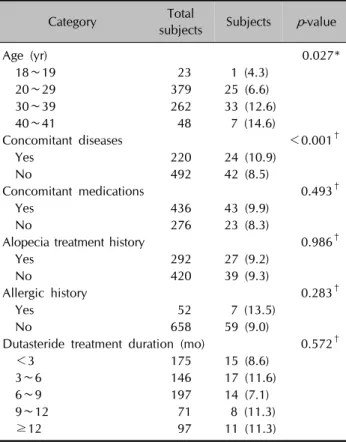
Frequency of adverse drug reactions by subject profiles are described in Table 3. The results of multivariate analy- sis for significant factors affecting the rate of ADR are Table 4. Age was found to be significantly associated with the frequency of ADR after controlling for potential confounders. Older subjects experienced more frequent ADR.
Table 2. The frequency of adverse drug reactions
Adverse drug reaction Subjects (n=712)
Total events
Resolved events
Unresolved events
Unknown results
Skin and appendages disorders 18 (2.5) 18 13 1 4
Rash 4 (0.6) 4 3 1 0
Pruritus 3 (0.4) 3 3 0 0
Acne 2 (0.3) 2 2 0 0
Alopecia 2 (0.3) 2 1 0 1
Folliculitis 2 (0.3) 2 2 0 0
Other skin disorder 2 (0.3) 2 1 0 1
Dermatophytosis 1 (0.1) 1 1 0 0
Seborrhea 1 (0.1) 1 0 0 1
Verruca 1 (0.1) 1 0 0 1
Gastro-intestinal system disorders 9 (1.3) 10 8 0 2
Dyspepsia 8 (1.1) 8 6 0 2
Diarrhea 2 (0.3) 2 2 0 0
Psychiatric disorders 13 (1.8) 13 11 1 1
Libido decreased 9 (1.3) 9 9 0 0
Depression 2 (0.3) 2 1 0 1
Insomnia 1 (0.1) 1 1 0 0
Somnolence 1 (0.1) 1 0 1 0
Reproductive disorders, male 12 (1.7) 12 5 3 4
Impotence 7 (1.0) 7 3 3* 1†
Sexual function abnormality 4 (0.6) 4 1 0 3‡
Ejaculation disorder 1 (0.1) 1 1 0 0
Liver and biliary system disorders 5 (0.7) 9 9 0 0
SGPT increased 4 (0.6) 5 5 0 0
SGOT increased 2 (0.3) 3 3 0 0
Bilirubinaemia 1 (0.1) 1 1 0 0
Body as a whole, general disorders 5 (0.7) 5 5 0 0
Fatigue 5 (0.7) 5 5 0 0
Resistance mechanism disorders 1 (0.1) 1 1 0 0
Pharyngitis 1 (0.1) 1 1 0 0
Respiratory system disorders 1 (0.1) 1 1 0 0
Epistaxis 1 (0.1) 1 1 0 0
Metabolic and nutritional disorders 2 (0.3) 2 1 1 0
Hypertriglyceridaemia 1 (0.1) 1 1 0 0
Weight increase 1 (0.1) 1 0 1 0
Central and peripheral nervous system disorders 2 (0.3) 2 2 0 0
Paraesthesia 1 (0.1) 1 1 0 0
Dizziness 1 (0.1) 1 1 0 0
Endocrine disorders 3 (0.4) 3 1 1 1
Gynaecomastia 2 (0.3) 2 1 1∥ 0
Testosterone decreased 1 (0.1) 1 0 0 1
Heart rate and rhythm disorders 2 (0.3) 2 2 0 0
Palpitation 2 (0.3) 2 2 0 0
Special senses other, disorders 1 (0.1) 1 0 0 1
Taste perversion 1 (0.1) 1 0 0 1
Secondary terms 1 (0.1) 1 1 0 0
Surgical intervention§ 1 (0.1) 1 1 0 0
Values are presented as number (%) or number only. SGPT: serum glutamic-pyruvic transaminase, SGOT: serum glutamic oxaloacetic transaminase. *After the end of the study, 2 impotence events were resolved even under dutasteride treatment. Another patient who discontinued dutasteride was unreachable after the end of the study. †One event with the unknown prognosis of sexual dysfunction continued to take dutasteride. ‡Three events with the unknown prognosis of sexual dysfunction continued to take dutasteride 0.5 mg and didn’t take any medicine to treat sexual dysfunction. §Posterior tooth extraction. ∥Gynaecomastia was reported only after 4 days of treatment with dutasteride, which was stopped after 1 month and was finally resolved after the end of the study.
Table 4. Results of multivariate analysis for significant factors affecting the frequency of adverse drug reaction
Variable Description Parameter estimate
Standard
error p-value Odds ratio 95% confidence interval
Lower Upper
Age 1 year 0.0720 0.0214 0.0008 1.075 1.030 1.121
Concomitant disease yes 0.3030 0.2725 0.2662 1.354 0.794 2.310
Analysis with log odds regression models.
Table 3. Frequency of adverse drug reactions by subject profiles
Category Total
subjects Subjects p-value
Age (yr) 0.027*
18∼19 23 1 (4.3)
20∼29 379 25 (6.6)
30∼39 262 33 (12.6)
40∼41 48 7 (14.6)
Concomitant diseases <0.001†
Yes 220 24 (10.9)
No 492 42 (8.5)
Concomitant medications 0.493†
Yes 436 43 (9.9)
No 276 23 (8.3)
Alopecia treatment history 0.986†
Yes 292 27 (9.2)
No 420 39 (9.3)
Allergic history 0.283†
Yes 52 7 (13.5)
No 658 59 (9.0)
Dutasteride treatment duration (mo) 0.572†
<3 175 15 (8.6)
3∼6 146 17 (11.6)
6∼9 197 14 (7.1)
9∼12 71 8 (11.3)
≥12 97 11 (11.3)
Values are presented as number only or number (%). *Fisher’s exact test, †chi-square test.
Effectiveness
Effectiveness was evaluated based on the treating physi- cians’ clinical opinion in 332 subjects. The number of subjects who was evaluated as “improved” was 261 (78.6%). Sixty-nine subjects (20.8%) were classified as “no change” and only two subjects (0.6%) “worsened.” Older subjects were more classified as “improved.” Subjects in modified Norwood-Hamilton classification 4, 4A bene- fited most with 100% “improved.”
DISCUSSION
Dihydrotestosterone (DHT) plays a key role in the patho-
genesis of AGA. Although testosterone is a major circulat- ing androgen, DHT, which is converted by 5-alpha reduc- tase from testosterone, is more active in scalp hair follicles.
The role of type 2 5-alpha reductase in AGA has been sup- ported by the men with a congenital deficiency of type 2 5-alpha reductase13 and by the finasteride, a selective type 2 5-alpha reductase inhibitor14. Type 1 5-alpha reductase is the major isoenzyme in sebaceous and sweat glands in skin15-17 and liver17. However, the virilization at puberty of pseudohermaphrodites without type 2 5-alpha reductase associates with increasing type 1 5-alpha reductase ex- pression in skin, suggesting that DHT can have paracrine effects17. As a result, this suggests that the inhibition of both the type 1 and 2 5-alpha reductases may be needed to control DHT effectively.
Dutasteride inhibits both type 1 and 2 5-alpha reductases, eventually suppressing DHT in circulation and the target organ. In phase II trial, dutasteride from 0.05 mg to 2.5 mg suppressed serum and scalp DHT concentrations, which were inversely correlated with target area hair count, in a dose-related manner11. Considering the fact that there was no dose-response relationship among finasteride groups18, dutasteride’s type 1 5-alpha reductase inhibition is likely to lead to the difference in dose-response of serum and scalp DHT inhibition. In the Olsen et al.’s report11, dutas- teride 0.5 mg suppressed DHT concentrations in serum by 92% and in scalp by 51%, while finasteride 5 mg in se- rum by 73% and in scalp by 41%. Recent study with big- ger number of subjects showed the close dose response in hair count increase across dutasteride 0.02 mg, 0.1 mg and 0.5 mg10 and added that dutasteride 0.1 mg was non-inferior to finasteride 1 mg and dutasteride 0.5 mg was superior to finasteride 1 mg.
In addition to the efficacy, it is believed that the AE is re- lated to the DHT suppression. As a result, physicians per- ceive that the more potent DHT suppression by dutas- teride, the more hair growth but the more AEs. Though this study does not have control group, the result on the safety in the real world can give some insights on safety information of dutasteride 0.5 mg in AGA.
In this observational study, decreased libido was reported
in 9 subjects (1.3%), impotence in 7 (1.0%), sexual func- tion abnormality in 4 (0.6%), and ejaculation disorder in 1 subject (0.1%). In dose ranging phase II trial, 9 men (13%) in the 2.5-mg dutasteride group complained of decreased libido, compared with 1 man (1%) in the 0.5-mg dutas- teride group and 3 men (4%) in the finasteride 5 mg group11. In Eun et al.’s report9, sexually related AE was not different between dutasteride 0.5 mg group (4.1%) and placebo group (4.0%). Eun et al.9 added that sexual dys- function, which occurred for 3 of 73 (4.1%) in dutasteride group and 2 of 75 (2.7%) in placebo group and that both erectile dysfunction and ejaculation disorder was noted in one subject in placebo group. More recently, sexual AEs in all active groups (including dutasteride 0.02 mg, 0.1 mg, 0.5 mg and finasteride 1mg) comparing placebo group showed no dose response relationship in dutas- teride doses10. Gubelin Harcha et al.10 also reported that decreased libido was reported by 9 subjects (4.9%) in du- tasteride 0.5 mg group and by 12 subjects (6.7%) in finas- teride 1 mg group.
The reports on the prognosis of the AEs in alopecia sub- jects are not found. In the 4-year follow-up of the phase III trials in benign prostate hyperplasia (BPH), the incidence of the sexual AEs was low and tended to decrease over time19.
The reported sexually related AE in this observational study is relatively lower than other controlled studies. This difference might be from the age of study subjects. This observational study included male subjects from 18 to 41 years old per prescribing information while other studies enrolled up to 50 years old male.
Gynaecomastia is also one of the interesting AEs occurring after treatment with dutasteride. Gynaecomastia was re- ported in 2 subjects (0.3%) in this study. In phase II trial, the only subject to develop gynecomastia was in the pla- cebo group and not in the dutasteride groups and finas- teride groups11. Gubelin Harcha et al.10 reported that 1 subject (0.5%) experienced gynaecomastia in dutasteride 0.5 mg group and 1 subject (0.6%) in fiansteride 1 mg group. The frequency is about 1%∼2% even in long term trials with thousands of older subjects for BPH18. The rea- son for the lower gynaecomastia in trials for AGA may be from the shorter follow up period and the younger subjects.
Like other studies for AGA with dutasteride, this ob- servational study showed no reports of prostate cancer, breast cancer, or cardiovascular AEs of special interest.
There are some limitations in this study in terms of assess- ment of the effectiveness and safety of the drug in a real practice with uncontrolled design. Firstly, though this study was designed to evaluate the safety and tolerability
of the dutasteride, all the other treatment was allowed and more than half of subjects had other treatment as well.
These additional medicines might have caused biases.
Secondly, 380 subjects out of 712 in the safety population could not be assessed for effectiveness due to effective- ness assessment being not documented or effectiveness being not evaluable. The incomplete result data due to those subjects who were not assessed for effectiveness may have induced withdrawal bias. Thirdly, although 78.6% of the subjects in the analysis set were assessed to have improved in this study, there were no objective vari- ables and determined time to assess effectiveness and therefore the status in those subjects who indicated im- provement could not be confirmed. However, this study can provide the information on safety and effectiveness in a clinical practice environment.
In this study, we evaluated AEs of dutasteride in Korean patients with AGA in the real world. However, we rela- tively more focused on the ADR in this article because in- formation on ADRs rather than AEs are more useful to the clinicians. Further evidences for safety and effectiveness of duatsteride in AGA are needed.
ACKNOWLEDGMENT
Funding for this study was provided by GlaxoSmithKline Korea (NCT01004809). All listed authors meet the criteria for authorship set forth by the International Committee for Medical Journal Editors. Author Jung-Min Park was a full- time employee of GSK at the time the study manuscript was written. We would like to thank all the investigators and patients for their contributions to the study. We ac- knowledge the statistical support provided by Seung-Ok An.
REFERENCES
1. DeMuro-Mercon C, Rhodes T, Girman CJ, Vatten L. Male- pattern hair loss in Norwegian men: a community-based study. Dermatology 2000;200:219-222.
2. Takashima M, Iju K, Sudo M. Alopecia androgenica: its incidence in Japanese and associated conditions. In:
Orfanos CE, Montagna W, Stuttgen G, editors. Hair research status and future aspects. Berlin: Springer-Verlag, 1981:287-293.
3. Paik JH, Yoon JB, Sim WY, Kim BS, Kim NI. The prevalence and types of androgenetic alopecia in Korean men and women. Br J Dermatol 2001;145:95-99.
4. Su LH, Chen TH. Association of androgenetic alopecia with smoking and its prevalence among Asian men: a com- munity-based survey. Arch Dermatol 2007;143:1401-1406.
5. Xu F, Sheng YY, Mu ZL, Lou W, Zhou J, Ren YT, et al.
Prevalence and types of androgenetic alopecia in Shanghai,
China: a community-based study. Br J Dermatol 2009;160:
629-632.
6. Jang WS, Son IP, Yeo IK, Park KY, Li K, Kim BJ, et al. The annual changes of clinical manifestation of androgenetic alopecia clinic in Korean males and females: a outpatient- based study. Ann Dermatol 2013;25:181-188.
7. Ellis JA, Sinclair RD. Male pattern baldness: current treatments, future prospects. Drug Discov Today 2008;13:
791-797.
8. Choi GS. Hair characteristics and androgenetic alopecia in Koreans. J Korean Med Assoc 2013;56:45-54.
9. Eun HC, Kwon OS, Yeon JH, Shin HS, Kim BY, Ro BI, et al.
Efficacy, safety, and tolerability of dutasteride 0.5 mg once daily in male patients with male pattern hair loss: a randomized, double-blind, placebo-controlled, phase III study. J Am Acad Dermatol 2010;63:252-258.
10. Gubelin Harcha W, Barboza Martínez J, Tsai TF, Katsuoka K, Kawashima M, Tsuboi R, et al. A randomized, active- and placebo-controlled study of the efficacy and safety of different doses of dutasteride versus placebo and finasteride in the treatment of male subjects with androgenetic alopecia. J Am Acad Dermatol 2014;70:489-498.e3.
11. Olsen EA, Hordinsky M, Whiting D, Stough D, Hobbs S, Ellis ML, et al. The importance of dual 5alpha-reductase inhibition in the treatment of male pattern hair loss: results of a randomized placebo-controlled study of dutasteride versus finasteride. J Am Acad Dermatol 2006;55:1014- 1023.
12. Korea Food and Drug Administration. Guideline for Korean New Drug Re-Examination [Internet]. Cheongju: Korea Food and Drug Administration; 2012 Jul [cited 2015 Apr 8].
Available from: https://www.drugsafe.or.kr/iwt/ds/ko/bbs/
EgovBbs.do?bbsId=BBSMSTR_000000000041&nttId=536.
13. Wilson JD, Griffin JE, Russell DW. Steroid 5 alpha-reductase 2 deficiency. Endocr Rev 1993;14:577-593.
14. Kaufman KD, Olsen EA, Whiting D, Savin R, DeVillez R, Bergfeld W, et al. Finasteride in the treatment of men with androgenetic alopecia. J Am Acad Dermatol 1998;39:578- 589.
15. Thiboutot D, Harris G, Iles V, Cimis G, Gilliland K, Hagari S. Activity of the type 1 5 alpha-reductase exhibits regional differences in isolated sebaceous glands and whole skin. J Invest Dermatol 1995;105:209-214.
16. Eicheler W, Tuohimaa P, Vilja P, Adermann K, Forssmann WG, Aumüller G. Immunocytochemical localization of human 5 alpha-reductase 2 with polyclonal antibodies in androgen target and non-target human tissues. J Histochem Cytochem 1994;42:667-675.
17. Thigpen AE, Silver RI, Guileyardo JM, Casey ML, McConnell JD, Russell DW. Tissue distribution and ontogeny of steroid 5 alpha-reductase isozyme expression. J Clin Invest 1993;
92:903-910.
18. Drake L, Hordinsky M, Fiedler V, Swinehart J, Unger WP, Cotterill PC, et al. The effects of finasteride on scalp skin and serum androgen levels in men with androgenetic alopecia. J Am Acad Dermatol 1999;41:550-554.
19. Debruyne F, Barkin J, van Erps P, Reis M, Tammela TL, Roehrborn C; ARIA3001, ARIA3002 and ARIB3003 Study Investigators. Efficacy and safety of long-term treatment with the dual 5 alpha-reductase inhibitor dutasteride in men with symptomatic benign prostatic hyperplasia. Eur Urol 2004;
46:488-494.