Prognosis of patients with pT1b/T2 gallbladder carcinoma who have undergone laparoscopic cholecystectomy
as an initial operation
Ye-Jong Park, Shin Hwang, Ki-Hun Kim, Young-Joo Lee, Chul-Soo Ahn, Deok-Bog Moon, Kwang-Min Park, Tae-Yong Ha, Gi-Won Song, Dong-Hwan Jung,
Gil-Chun Park, Jae-Hun Lee, and Sung-Gyu Lee
Department of Surgery, Asan Medical Center, University of Ulsan College of Medicine, Seoul, Korea
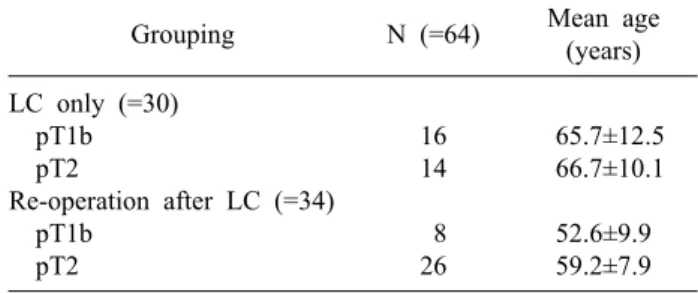
Backgrounds/Aims: Laparoscopic cholecystectomy (LC) has become a standard procedure for treatment of benign gall- bladder diseases. There has been a small proportion of gallbladder cancer (GBC) which was incidentally found in the gallbladder specimen, and LC has been tried in some patients with faintly suspected GBC. This study intended to analyze the prognosis of patients with pT1b/T2 GBC who have undergone LC and the outcome of extended re-operation. Methods: After analyzing the institutional profiles of 500 GBC patients who have undergone surgical re- section, we selected 64 patients who underwent LC initially from January 1996 to December 2008 and whose gall- bladder pathology was confined to pT1b or pT2 lesions. Of them, 34 patients (53.1%) underwent extended reoperation.
Their medical records were reviewed retrospectively. Results: In the LC only group (n=30), mean age of the 16 pT1 patients was 65.7±12.5 years and mean age of the 14 pT2 patients was 66.7±10.1 years. In the reoperation group (n=34), mean age of the 8 pT1b patients was 52.6±9.9 years and in 26 pT2 patients, mean age was 59.2±7.9 years.
The reoperation group showed a younger patient age pattern than the LC only group (p=0.001). The types of reopera- tion were liver resection with lymph node (LN) dissection in 17, bile duct resection with LN dissection in 2, and hep- atectomy and bile duct resection with LN dissection in 15. In the LC only group, the 5-year survival rate (5-YSR) was 70.3% in pT1b and 43.2% in pT2. In the reoperation group, 5-YSR was 62.5% in pT1b (n=8) and 59.5% in pT2 (n=26). A survival comparison between the two groups showed no significant survival gain in pT1 patients (p=0.69) and in pT2 patients (p=0.14). In our whole database analysis, 5-YSR of pT1bNx lesions was 70% after cholecystectomy and 78% after extended cholecystectomy. Lymph node metastasis was identified in 11% of pT1b lesions. For pT2N0 lesions, overall 5-YSR was 62% after R0 resection, showing no survival difference between primary extended surgery and LC-redo operation (p=0.45). Conclusions: The survival gain of reoperation was not evident in pT1b lesions. In contrast, some noticeable but not statistically significant survival difference was observed in pT2 lesions. Thus, reopera- tion for pT1b/T2 GBC following LC is indicated for individualized reasons, especially in patients with pT1b lesions.
Old age was one of the important factors in deciding not to reoperate. (Korean J Hepatobiliary Pancreat Surg 2013;17:
113-117)
Key Words: Gallbladder carcinoma; Laparoscopic cholecystectomy; Extended cholecystectomy; Recurrence; Reoperation
Received: July 22, 2013; Revised: August 4, 2013; Accepted: August 12, 2013 Corresponding author: Shin Hwang
Department of Surgery, Asan Medical Center, University of Ulsan College of Medicine, 388-1, Poongnap-dong, Songpa-gu, Seoul 138-736, Korea Tel: +82-2-3010-3930, Fax: +82-2-3010-6701, E-mail: [email protected]
Copyright Ⓒ 2013 by The Korean Association of Hepato-Biliary-Pancreatic Surgery Korean Journal of Hepato-Biliary-Pancreatic Surgery ∙ ISSN: 1738-6349
INTRODUCTION
Gallbladder carcinoma (GBC) is a relatively rare tumor;
however, its prognosis has been poor over the past few decades. There is no effective therapy for GBC except for curative surgical resection. The prognosis for patients with early GBC shows a 5-year survival rate of 82-100%.1-3 Due to the anatomical proximity to important organs, sur- gery for advanced GBC requires an aggressive approach.
For T2 or more advanced tumors, it is advocated to per- form radical resection with lymph node dissection.
Laparoscopic cholecystectomy (LC) has become a standard procedure for the treatment of benign gallbladder diseases. There is a small proportion of GBC cases which were incidentally found in the gallbladder specimens, and LC has been tried in some patients with faintly suspected GBC.
When GBC is pathologically diagnosed after LC in the
Table 1. Comparison of patient age between the laparoscopic cholecystectomy (LC) only group and re-operation. Reopera- tion group showed a younger patient age pattern than LC only group (p=0.001)
Grouping N (=64) Mean age
(years) LC only (=30)
pT1b pT2
Re-operation after LC (=34) pT1b
pT2
16 14 8 26
65.7±12.5 66.7±10.1 52.6±9.9 59.2±7.9 tumors survived for more than 5 years after chol-
ecystectomy alone.6
It is difficult to propose reliable treatment guidelines for histologically confirmed T1b and T2 GBC after LC.
This study intended to analyze the prognosis of patients with pT1b/T2 GBC who had undergone LC and the out- come of extended re-operation.
METHODS
Patient selection
From our institutional database of GBC which con- tained more than 600 cases of patients who had undergone surgical resection, we selected 64 patients who underwent LC initially from January 1996 to December 2008 and whose gallbladder pathology was confined to pT1b or pT2 lesions. They had a follow-up period for more than 4 years. Their medical records were reviewed retro- spectively after approval by the Institutional Review Board of our institution.
In addition to these GBC patients who underwent LC first, we also investigated the survival outcomes of GBC patients with pT1bNx lesions and pT2Nx lesions who un- derwent open surgery as the first operation.
Reoperation
Of overall 64 patients, 34 patients (53.1%) did not un- dergo repeat surgery, with 16 cases of pT1b and 14 cases of pT2. In contrast, 30 patients (46.9%) underwent ex- tended reoperation, with 8 cases of pT1b and 26 cases of pT2. The suggested types of extended reoperation were extended cholecystectomy with lymph node sampling for pT1b lesions and extended cholecystectomy (or more ex- tended hepatectomy) with lymph node dissection±bile
RESULTS
In this series, 8 of 24 pT1b patients (33.3%) and 26 of 40 pT2 patients (65%) underwent extended reoperation (p=0.02).
In the LC only group (n=30), the mean age was 65.7±12.5 years in 16 cases of pT1 patients and 66.7±10.1 years in 14 cases of pT2 patients. In the reoperation group (n=34), the mean age was 52.6±9.9 years in 8 cases pT1b patients and 59.2±7.9 years in 26 cases of pT2 patients.
Thus, the reoperation group showed a younger patient age pattern than the LC only group (p=0.001) (Table 1).
Types of reoperation were liver resection (hepatic wedge resection in 14 and S4aS5 resection in 3) with lymph node dissection in 17, bile duct resection with lymph node dissection in 2, and hepatectomy (hepatic wedge resection in 10 and S4aS5 resection in 5) and bile duct resection with lymph node dissection in 15.
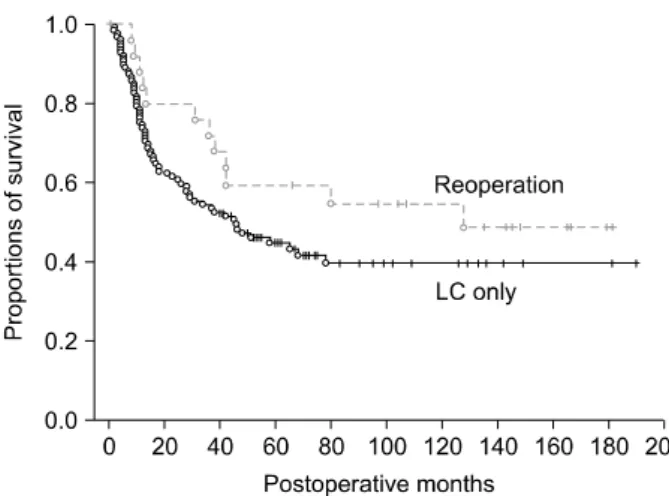
In the LC only group, the 5-year survival rate (5-YSR) was 70.3% in pT1b and 43.2% in pT2. In the reoperation group, the 5-YSR was 62.5% in pT1b (n=8) and 59.5%
Fig. 1. Comparison of overall patient survival in pT1b gall- bladder patients who underwent laparoscopic cholecystectomy (LC) as the first operation.
Fig. 2. Comparison of overall patient survival in pT2 gall- bladder patients who underwent laparoscopic cholecystectomy (LC) as the first operation.
in pT2 (n=26). A survival comparison between the two groups showed no significant survival gain in pT1b pa- tients (p=0.69) (Fig. 1) and in pT2 patients (p=0.14) (Fig.
2).
In an additional analysis of our whole GBC database, the 5-YSR of pT1bNx lesions was 70% after chol- ecystectomy and 78% after extended cholecystectomy.
Lymph node metastasis was identified in 11% of pT1b lesions. For pT2N0 lesions, overall 5-YSR was 62% after R0 resection, showing no survival difference between pri- mary extended surgery and LC-redo operation (p=0.45).
DISCUSSION
The treatment of choice for patients with Tis and T1a disease is a simple cholecystectomy with a 5-YSR of 100% in most series. But, there is controversy regarding the optimum management of T1b lesions.5
Shirai et al.7 had 11 patients with T1b with no evidence of loco-regional recurrences on follow up following a simple cholecystectomy. Wakai et al.8 compared the sur- vival outcomes in patients of T1b undergoing simple chol- ecystectomy or extended cholecystectomy, in which the overall 10-YSR was 87% with no difference between the two surgical methods. On the other hand, in patients with pT1b, consequently simple cholecystectomy may have a higher incidence of loco-regional failure. The pT1b dis- eases are known to have potential of lymph node metastasis. De Aretxabala et al.9 reported a 20% incidence of nodal metastasis, which would warrant an extended
cholecystectomy, in T1b lesions. Other series have re- ported a 28% incidence of lymphatic or venous involve- ment and 15.6% nodal metastasis in patients with T1b lesions.10,11 Ouchi et al.5,10 encountered recurrences in 60% of patients with T1b treated by a simple chol- ecystectomy, and similar experience is reported by other authors, suggesting that simple cholecystectomy may not be an adequate procedure for T1b disease. Wagholikar et al.12 reported that the cumulative survival in the whole group was 68% at 5 years. They concluded that T1b dis- ease is a locally aggressive disease and the treatment of choice was extended resection to improve long-term survival. Since T1b disease is associated with node meta- stasis and does have loco-regional failure, an extended cholecystectomy rather than simple cholecystectomy is the procedure of choice.
In this study, the 5-YSR was 70.3% in the pT1b in LC only group, and 62.5% in pT1b (n=8) in the reoperation group. The 5-YSR of pT1bNx lesions was 70% after chol- ecystectomy and 78% after extended cholecystectomy.
Lymph node metastasis was identified in 11% of pT1b lesions. Considering that a majority of patients were old-aged, survival outcome with meticulous age adjust- ment did not show statistical significance in survival out- comes regarding the extent of resection.
The management of pT2 disease is less controversial.
Lymph node metastasis occurs in 20-62% of patients with pT2 GBC.5,13-21 The majority of authors recommend that these patients merit re-operative surgery and if there is no evidence of dissemination, then extended cholecystectomy
is the procedure of choice (Table 2). Suzuki et al.15 pre- sented their results of pT2 GBC undergoing extended re- section as a primary procedure (n=12) or a re-operation following cholecystectomy (n=8), which showed a 5-year survival of 77%. There was no difference in the outcome of patients undergoing primary surgery versus re-operative extended surgery. Grade of tumor differentiation and the presence of perineural invasion were significant factors re- lated to long-term survival. Shirai et al.18 retrospectively analyzed 98 patients of inapparent GBC. 39 patients with pT1 (pT1b=4) had a 5-YSR of 100% after cholecys- tectomy. Of the 48 patients with pT2, the 5-YSR was 40%
after simple cholecystectomy compared to 90% in the pa- tients undergoing re-operation, indicating the survival ad- vantage of extended resections in T2 disease.
Wakai et al.13 analyzed 28 patients with early GBC de- tected after LC. 10 patients (3 cases of pT1 and 7 cases of pT2) underwent re-operation with extended resections following LC. A significant survival benefit at 5 years was observed in patients with pT2 undergoing extended resections compared to those with only LC (50% vs.
100%; p=0.039). In this study, the 5-YSR was 43.2% in pT2 with LC only. In the reoperation group, 5-YSR was 59.5% in pT2 (n=26).
In this study, a survival comparison between the two groups showed no significant survival gain in pT1b pa- tients (p=0.69) and in pT2 patients (p=0.14). In our whole database analysis, the 5-YSR of pT1bNx lesions was 70%
after cholecystectomy and 78% after extended cholecy- stectomy. For pT2N0 lesions, overall 5-YSR was 62% af- ter R0 resection, showing no survival difference between primary extended surgery and LC-redo operation (p=
0.45). We strongly presume that old age was one of the
REFERENCES
1. Kohya N, Miyazaki K. Hepatectomy of segment 4a and 5 com- bined with extra-hepatic bile duct resection for T2 and T3 gall- bladder carcinoma. J Surg Oncol 2008;97:498-502.
2. Nimura Y. Extended surgery in bilio-pancreatic cancer: the Japanese experience. Semin Oncol 2002;29(6 Suppl 20):17-22.
3. Tsukada K, Hatakeyama K, Kurosaki I, et al. Outcome of radical surgery for carcinoma of the gallbladder according to the TNM stage. Surgery 1996;120:816-821.
4. Ogura Y, Mizumoto R, Isaji S, et al. Radical operations for carci- noma of the gallbladder: present status in Japan. World J Surg 1991;15:337-343.
5. Sikora SS, Singh RK. Surgical strategies in patients with gall- bladder cancer: nihilism to optimism. J Surg Oncol 2006;93:
670-681.
6. Wakai T, Shirai Y, Yokoyama N, et al. Early gallbladder carcino- ma does not warrant radical resection. Br J Surg 2001;88:
675-678.
7. Shirai Y, Yoshida K, Tsukada K, et al. Early carcinoma of the gallbladder. Eur J Surg 1992;158:545-548.
8. Wakai T, Shirai Y, Yokoyama N, et al. Early gallbladder carcino- ma does not warrant radical resection. Br J Surg 2001;88:
675-678.
9. de Aretxabala X, Roa I, Burgos L, et al. Gallbladder cancer in Chile. A report on 54 potentially resectable tumors. Cancer 1992;
69:60-65.
10. Ouchi K, Owada Y, Matsuno S, et al. Prognostic factors in the surgical treatment of gallbladder carcinoma. Surgery 1987;101:
731-737.
11. Ogura Y, Mizumoto R, Isaji S, et al. Radical operations for carci- noma of the gallbladder: present status in Japan. World J Surg 1991;15:337-343.
12. Wagholikar GD, Behari A, Krishnani N, et al. Early gallbladder cancer. J Am Coll Surg 2002;194:137-141.
13. Wakai T, Shirai Y, Hatakeyama K. Radical second resection pro- vides survival benefit for patients with T2 gallbladder carcinoma first discovered after laparoscopic cholecystectomy. World J Surg 2002;26:867-871.
14. Toyonaga T, Chijiiwa K, Nakano K, et al. Completion radical surgery after cholecystectomy for accidentally undiagnosed gall- bladder carcinoma. World J Surg 2003;27:266-271.
15. Suzuki S, Yokoi Y, Kurachi K, et al. Appraisal of surgical treat- ment for pT2 gallbladder carcinomas. World J Surg 2004;28:
160-165.
16. Muratore A, Polastri R, Bouzari H, et al. Radical surgery for gall-
bladder cancer: a worthwhile operation? Eur J Surg Oncol 2000;
26:160-163.
17. Wakai T, Shirai Y, Yokoyama N, et al. Depth of subserosal in- vasion predicts long-term survival after resection in patients with T2 gallbladder carcinoma. Ann Surg Oncol 2003;10:447-454.
18. Shirai Y, Yoshida K, Tsukada K, et al. Inapparent carcinoma of the gallbladder. An appraisal ofa radical second operation after simple cholecystectomy. Ann Surg 1992;215:326-331.
19. Yamaguchi K, Tsuneyoshi M. Subclinical gallbladder carcinoma.
Am J Surg 1992163:382-386.
20. Kosuge T, Sano K, Shimada K, et al. Should the bile duct be preserved orremoved in radical surgery for gallbladder cancer?
Hepatogastroenterology 1999;46:2133-2137.
21. Chijiiwa K, Nakano K, Ueda J, et al. Surgical treatment of pa- tients with T2 gallbladder carcinoma invading the subserosal layer. J Am Coll Surg 2001;192:600-607.
22. Fong Y, Heffernan N, Blumgart LH. Gallbladder carcinoma dis- covered during laparoscopic cholecystectomy: aggressive re- resection is beneficial. Cancer 1998;83:423-427.