Heart-type Fatty Acid Binding Protein as an Adjunct to Cardiac Troponin-I for the Diagnosis of Myocardial Infarction
We hypothesized that when used in combination with cardiac troponins, heart-type fatty acid binding protein (H-FABP) would have greater diagnostic value than conventional markers for the early diagnosis of myocardial infarction (MI). Patients with typical chest pain at a single emergency department were consecutively enrolled. Initial blood samples were drawn for H-FABP, myoglobin, creatine kinase isoenzyme MB (CK-MB), and cardiac troponin-I (cTnI) measurements. MI was defined by serial cTnI measurements. To evaluate the adjunctive role of biochemical markers, we derived and compared logistic regression models predicting MI in terms of their discrimination (area under the receiver operating characteristics curve, AUC) and overall fit (Bayesian information criterion, BIC). Seventy- six of 170 patients were diagnosed as having MI. The AUC of cTnI, H-FABP, myoglobin, and CK-MB were 0.863, 0.827, 0.784, and 0.772, respectively. A logistic regression model using cTnI (P = 0.001) and H-FABP (P < 0.001) had the biggest AUC (0.900) and the best fit determined by BIC. Sensitivity, specificity, positive likelihood ratio, and negative likelihood ratio of this model at 30% probability were 81.6%, 80.9%, 4.26, and 0.23, respectively. H-FABP has a better diagnostic value than both myoglobin and CK-MB as an adjunct to cTnI for the early diagnosis of MI.
Key Words: Myocardial Infarction; Fatty Acid-Binding Proteins; Point-of-Care Systems;
Chest Pain Kyung Su Kim1, Hui Jai Lee1,
Kyuseok Kim2, You Hwan Jo2, Tae Yun Kim2, Jin Hee Lee2, Joong Eui Rhee2, Gil Joon Suh1, Mi Ran Kim3, Christopher C. Lee4, and Adam J. Singer4
1Department of Emergency Medicine, Seoul National University Hospital, Seoul; 2Department of Emergency Medicine, Seoul National University Bundang Hospital, Seongnam; 3Department of Emergency Medicine, Inje University College of Medicine, Goyang, Korea; 4Department of Emergency Medicine, Stony Brook University Hospital, Stony Brook, New York, USA Received: 3 March 2010
Accepted: 7 June 2010 Address for Correspondence:
Kyuseok Kim, MD
Department of Emergency Medicine, Seoul National University Bundang Hospital, 166 Gumi-ro, Bundang-gu, Seongnam 463-707, Korea
Tel: +82.31-787-7572, Fax: +82.31-787-4055 E-mail: [email protected]
Rennesens GmbH (Berlin, Germany) supported CardioDetect®
med kit partly and CardioDetect® quant.
DOI: 10.3346/jkms.2011.26.1.47 • J Korean Med Sci 2011; 26: 47-52 Cardiovascular Disorders
INTRODUCTION
Biochemical markers, such as the highly sensitive and specific cardiac troponins, play a pivotal role in the diagnosis and man- agement of patients with acute coronary syndrome (ACS) (1).
With its higher sensitivity and virtually total specificity, cardiac troponin has become a critical determinant for the diagnosis of myocardial infarction (MI) (2).
Because cardiac troponins generally do not appear in the se- rum prior to 4-10 hr after symptom onset, early markers such as myoglobin have been used (3). However, as the sensitivity of troponin assays continues to improve and as the 99th percen- tile of the upper reference limit (URL) is used as a cutoff for the diagnosis of MI, the clinical value of such early markers is now doubtful (4-6).
Heart-type fatty acid binding protein (H-FABP) is one of the most abundant proteins in the heart and has performed better than myoglobin for the early diagnosis of MI (7-9). Rapid point- of-care tests (POCT) of H-FABP have also shown similar results (10, 11).
We hypothesized that when used in combination with cardi- ac troponins, H-FABP would have greater diagnostic value than other conventional markers for the early diagnosis of MI.
The aim of this study was to test this hypothesis by compar- ing the diagnostic performances of initial biochemical markers including H-FABP, myoglobin, and creatine kinase isoenzyme MB (CK-MB) along with cardiac troponin-I (cTnI).
MATERIALS AND METHODS Patients
We performed this study at a single academic, urban emergen- cy department (ED) with an annual census of approximately 65,000 from December 2006 to September 2007. Patients with chest pain who visited the ED between 9:00-17:00 on weekdays were screened upon the availability of a research nurse.
Patients were consecutively enrolled by senior residents or attending physicians of emergency medicine if their chest pain had satisfied any of the following criteria: 1) typically located in the substernal region, 2) sense of heaviness or squeezing nature,
3) caused by exercise, or 4) relieved by resting or nitroglycerin.
Exclusion criteria included age under 18 yr old, refusal to participate, and history of chronic renal insufficiency. Patients with increased levels of serum creatinine (≥ 1.5 mg/dL [132 μM/
L]) were further excluded from the analysis to reduce false posi- tive results, because elimination of H-FABP mostly depended on renal excretion (12). This study was approved by the institu- tional review board, and all participants gave informed consent (IRB No. B-0706/046-011).
Measurement of biochemical markers
Immediately after enrollment, peripheral blood samples were collected for initial biochemical assays. cTnI, myoglobin, and CK-MB were measured at an emergency clinical laboratory us- ing the Dimension® clinical chemistry system (Siemens, New- ark, NJ, USA) with a one-step enzyme immunoassay based on the “sandwich” principle.
H-FABP was measured by the research nurse using Cardio- Detect® med (Rennesens GmbH, Berlin, Germany) and Car- dioDetect® quant (Rennesens GmbH). After placing three drops of whole blood onto a test strip of CardioDetect® med, H-FABP in the serum was bound to the monoclonal antibody resulting in a red line within 15 min. In order to avoid interpretation prob- lems of qualitative measures of CardioDetect® med, CardioDe- tect® quant was further used to quantify the results (13). The medical staff responsible for patient care was blinded to the re- sults of the assay.
The URLs and coefficients of variation (CV) of biochemical markers provided by the manufacturer at the specific limit were as follows: cTnI (99% URL = 0.07 ng/mL, CV = 15%), myoglobin (95% URL = 92 ng/mL, CV = 3.2%), CK-MB (95% URL = 3.6 ng/
mL, CV = 9.7%), and H-FABP (99% URL = 7 ng/mL, CV = 15%).
Outcomes
All patients underwent serial electrocardiography (ECG) and serial cTn-I measurements. Other diagnostic evaluations that were at the discretion of the attending physicians, included multi- detector row coronary angiographic computed tomography (MDCT), conventional coronary angiography (CAG), a tread- mill test, or cardiac single photon emission computed tomog- raphy (SPECT).
Acute MI was defined as having a typical rise and fall in serial cTn-I with ischemic ECG changes or significant coronary lesions (2). ST segment elevation myocardial infarction (STEMI) was defined as having initial ECG changes indicative of a significant ST elevation (≥ 2 continuous leads of ≥ 0.1 mV in limb leads or
≥ 0.2 mV in precordial leads) in MI patients. Non-ST segment elevation myocardial infarction (NSTEMI) was defined as hav- ing any initial ECG findings other than a significant ST elevation in MI patients. Angina was diagnosed in the presence of signifi- cant coronary lesions found on CAG or MDCT or with positive
test results on the treadmill test or SPECT in the absence of ele- vated cTn-I. Non-cardiac was diagnosed in the presence of neg- ative results on CAG, MDCT, the treadmill test, or SPECT.
Statistical analyses
Continuous variables are expressed as means ± standard devia- tion (SD), and categorical data are presented as the percent fre- quency of occurrence. The Student t-test was used to compare continuous variables, and the chi-squared test was used to com- pare binomial variables.
The performances of initial biomarkers were compared us- ing the area under the receiver operating characteristics curve (AUC).
To assess an adjunctive role of biochemical markers, we de- rived multivariate logistic regression models for the diagnosis of MI using variables composed of initial biochemical markers, i.e. Model 1 using cTnI only, Model 2 using cTnI and H-FABP, Model 3 using cTnI and myoglobin, and Model 4 using cTnI and CK-MB.
Because AUC ignores the predicted probability values and the goodness-of-fit of the model, the performances of these models were compared in terms of discrimination and overall fit (14). Discrimination was assessed using AUC, and overall fit was assessed using Bayesian information criterion (BIC). When using maximum likelihood estimation, it is possible to increase the likelihood by adding variables. BIC is a criterion for model selection that penalizes the number of variables to avoid over- fitting (15). Unlike a likelihood ratio (LR) test, BIC can be used to compare the fit of two models which are not nested. A model is better than another if it has a smaller BIC value (16).
Since AUC weighs sensitivity and specificity equally, AUC can- not precisely estimate the performance of predictive models under the conditions in which sensitivity is clinically more im- portant. Therefore, the diagnostic performances of initial bio- chemical markers at URL and of logistic regression models at 30% probability were examined using sensitivity, specificity, pos- itive LR, and negative LR with each 95% confidence intervals.
All statistical procedures were performed using Stata version 10.1 (Stata corp., College Station, TX, USA), and a two-tailed P value < 0.05 was considered as statistically significant.
RESULTS
A total of 186 patients were enrolled during the study period.
After excluding 16 patients with elevated serum creatinine, 170 patients were included in the final analysis.
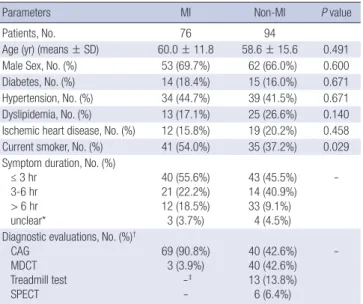
Among 76 patients (44.7%) with MI, 54 had STEMI, and 22 had NSTEMI. Among 94 patients (55.3%) with non-MI, 41 had angina, and 53 had non-cardiac chest pain. The clinical charac- teristics of patients are described in Table 1.
Receiver operating characteristics (ROC) curves of initial bio-
chemical markers are presented in Fig. 1. AUCs of myoglobin and CK-MB were 0.784 (95% confidence intervals [CI], 0.711- 0.858) and 0.772 (95% CI, 0.697-0.847), respectively. Those were significantly lower than that of cTnI, which was 0.863 (95% CI, 0.808-0.919). AUC of H-FABP was 0.827 (95% CI, 0.761-0.893).
Logistic regression models using initial biochemical markers were derived and assessed in terms of discrimination and overall fit and are presented in Table 2. Only H-FABP had an indepen- dent predictive value when combined with cTnI in the model.
The logistic regression model including cTnI and H-FABP (Mod- el 2) had the best discrimination ability measured by AUC. How- ever, it was not statistically different from that of Model 1 (cTnI only). Model 2 also had the best overall fit measured by BIC (i.e., the smallest BIC). A difference in BIC over 20 means a very de-
cisive support for the selection of model with lower BIC (16).
ROC curves of Model 1 and Model 2 were presented in Fig. 2.
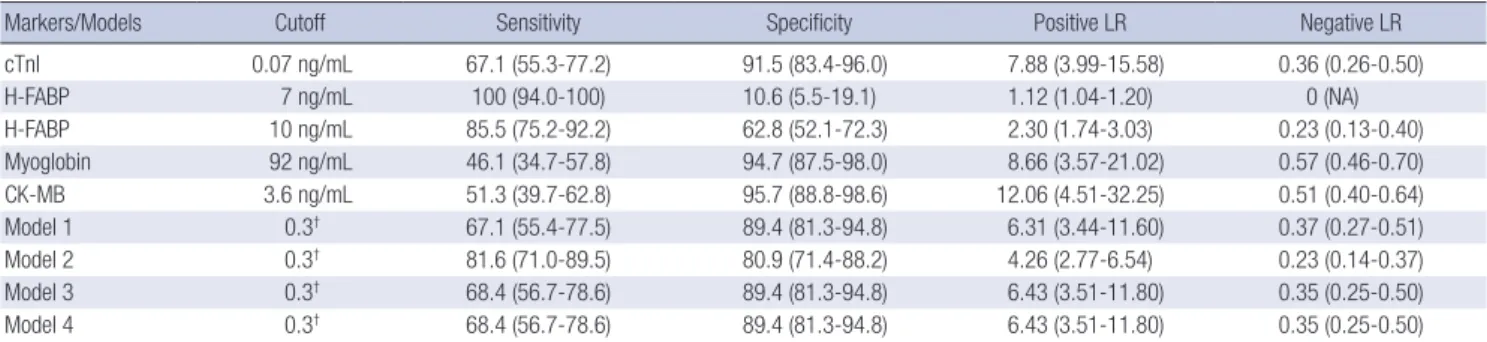
Sensitivity, specificity, positive LR, and negative LR of initial biochemical markers at URL and at the 30% predictive proba- bility of logistic regression models are described in Table 3. In contrast to Model 2, neither Model 3 nor Model 4 had any im- provement of diagnostic performances compared with Model 1 in terms of sensitivity.
DISCUSSION
In this study, only H-FABP had an adjunctive diagnostic value to initial cTnI for the diagnosis of MI. The discrimination power of cTnI was best among initial biochemical markers, and other
Table 2. Performances of logistic regression models for diagnosis of MI
Variables Model 1 Model 2 Model 3 Model 4
Variable 1 OR (95% CI)*
P value
cTnI 185.8 (10.9-3171.6)
< 0.001
cTnI 117.1 (6.5-2126.2)
0.001
cTnI 127.0 (6.6-2436.9)
0.001
cTnI 82.1 (2.4-2833.0)
0.015 Variable 2
OR (95% CI)*
P value
- - -
H-FABP 1.2 (1.1-1.3)
< 0.001
Myoglobin 1.0 (1.0-1.0)
0.426
CK-MB 1.1 (0.8-1.4)
0.506 Discrimination
AUC (95% CI) P value†
0.863 (0.808-0.919) -
0.900 (0.853-0.948) 0.121
0.871 (0.813-0.928) 0.593
0.845 (0.783-0.908) 0.237 Overall fit
Log (likelihood) BIC ΔBIC‡
-76.368 -75.888
-
-63.760 -95.970 -20.082
-76.043 -71.402 4.486
-76.141 -71.206 4.682
*OR per 1 unit increment of each biochemical marker; †When compared with AUC of Model 1; ‡When compared with BIC of Model 1. MI, myocardial infarction; cTnI, cardiac troponin-I; H-FABP, heart-type fatty acid binding protein; CK-MB, creatine kinase isoenzyme MB; OR, odds ratio; CI, confidence intervals; AUC, area under the receiver operating characteristics curve; BIC, Bayesian information criteria.
Table 1. Clinical characteristics of patients
Parameters MI Non-MI P value
Patients, No. 76 94
Age (yr) (means ± SD) 60.0 ± 11.8 58.6 ± 15.6 0.491
Male Sex, No. (%) 53 (69.7%) 62 (66.0%) 0.600
Diabetes, No. (%) 14 (18.4%) 15 (16.0%) 0.671
Hypertension, No. (%) 34 (44.7%) 39 (41.5%) 0.671 Dyslipidemia, No. (%) 13 (17.1%) 25 (26.6%) 0.140 Ischemic heart disease, No. (%) 12 (15.8%) 19 (20.2%) 0.458 Current smoker, No. (%) 41 (54.0%) 35 (37.2%) 0.029 Symptom duration, No. (%)
≤ 3 hr 3-6 hr > 6 hr unclear*
40 (55.6%) 21 (22.2%) 12 (18.5%) 3 (3.7%)
43 (45.5%) 14 (40.9%) 33 (9.1%) 4 (4.5%)
-
Diagnostic evaluations, No. (%)† CAG
MDCT Treadmill test SPECT
69 (90.8%) 3 (3.9%)
-‡ -
40 (42.6%) 40 (42.6%) 13 (13.8%) 6 (6.4%)
-
*Cases with missing data of symptom duration; †One can have more than one eva- luation; ‡Evaluations are not indicated in these cases. MI, myocardial infarction; No., number; SD, standard deviation; CAG, coronary angio graphy; MDCT, multi-detector row coronary angiographic computed tomography; SPECT, single photon emission computed tomography.
Sensitivity
1-Specificity
0.00 0.25 0.50 0.75 1.00
1.00
0.75
0.50
0.25
0.00
Fig. 1. Receiver operating characteristics curves of initial biochemical markers for the diagnosis of myocardial infarction. cTnI indicates cardiac troponin-I; H-FABP, heart-type fatty acid binding protein; CK-MB, creatine kinase isoenzyme MB. *P value
< 0.05 when compared with AUC of cTnI.
cTnl H-FABP myoglobin*
CK-MB*
markers other than H-FABP had a significantly lower AUC than that of cTnI. A logistic regression model including cTnI and H- FABP had the highest AUC. The overall fit determined by BIC was best in the model that included both cTnI and H-FABP.
Combining cTnI and H-FABP in the logistic regression model has resulted in increased sensitivity.
Clinical decisions for the management of MI are guided by various clinical and laboratory findings such as demographics, history, ECG, physical examination, and biochemical markers.
Early identification of MI may enable physicians to initiate ag- gressive medical treatments or early invasive management, es- pecially in patients with high risk (17). Myoglobin is considered useful in the early detection of MI because of its high sensitivity (17). However, our results suggest that H-FABP may play a great- er role in the early detection of MI.
There are several possible reasons why H-FABP may be su- perior to myoglobin as an early adjunctive marker of MI. One possibility is that the levels of H-FABP in cardiac muscles are 2
Table 3. Diagnostic performances of initial biochemical markers and logistic regression models for the diagnosis of MI*
Markers/Models Cutoff Sensitivity Specificity Positive LR Negative LR
cTnI 0.07 ng/mL 67.1 (55.3-77.2) 91.5 (83.4-96.0) 7.88 (3.99-15.58) 0.36 (0.26-0.50)
H-FABP 7 ng/mL 100 (94.0-100) 10.6 (5.5-19.1) 1.12 (1.04-1.20) 0 (NA)
H-FABP 10 ng/mL 85.5 (75.2-92.2) 62.8 (52.1-72.3) 2.30 (1.74-3.03) 0.23 (0.13-0.40)
Myoglobin 92 ng/mL 46.1 (34.7-57.8) 94.7 (87.5-98.0) 8.66 (3.57-21.02) 0.57 (0.46-0.70)
CK-MB 3.6 ng/mL 51.3 (39.7-62.8) 95.7 (88.8-98.6) 12.06 (4.51-32.25) 0.51 (0.40-0.64)
Model 1 0.3† 67.1 (55.4-77.5) 89.4 (81.3-94.8) 6.31 (3.44-11.60) 0.37 (0.27-0.51)
Model 2 0.3† 81.6 (71.0-89.5) 80.9 (71.4-88.2) 4.26 (2.77-6.54) 0.23 (0.14-0.37)
Model 3 0.3† 68.4 (56.7-78.6) 89.4 (81.3-94.8) 6.43 (3.51-11.80) 0.35 (0.25-0.50)
Model 4 0.3† 68.4 (56.7-78.6) 89.4 (81.3-94.8) 6.43 (3.51-11.80) 0.35 (0.25-0.50)
*Data are shown percentages or ratio with 95% confidence intervals; †Predicted probability of 0.3 was used for a cutoff. MI, myocardial infarction; LR, likelihood ratio; cTnI, cardiac troponin-I; H-FABP, heart-type fatty acid binding protein; CK-MB, creatine kinase isoenzyme MB; NA, not applicable.
Sensitivity
1-Specificity
0.00 0.25 0.50 0.75 1.00
1.00
0.75
0.50
0.25
0.00
Fig. 2. Receiver operating characteristics curves of logistic regression model for the diagnosis of myocardial infarction. Model 1 was derived using cTnI only as a predictive variable and model 2 was derived using both cTnI and H-FABP. cTnI indicates cardiac troponin-I; H-FABP, heart-type fatty acid binding protein.
Model 1 Model 2
to 10 folds higher than the levels in skeletal muscle, while the levels of myoglobin in cardiac muscles are 2 folds lower than the levels in skeletal muscles. A second possibility is that nor- mal baseline concentrations of H-FABP are considerably lower than myoglobin. These two facts suggest that H-FABP may have higher sensitivity and specificity for myocardial injury than myo- globin. While H-FABP was superior to myoglobin in this study, the specificity of H-FABP at 7 ng/mL was only 10.6%. This low specifity is discordant with previous studies using CardioDetect® med (10, 11, 18). One possible cause of this discrepancy is the use of a new definition of MI. Another is the high prevalence of MI or myocardial ischemia in this study. H-FABP is a very sen- sitive marker, which can be elevated in patients with ischemia or even congestive heart failure (19). However, when a cutoff value of 10 ng/mL was used, H-FABP demonstrated improved specificity while retainning high sensitivity (Table 3).
CK-MB is highly specific to myocardial injury. However, the initial CK-MB has low sensitivity because CK-MB takes a simi- lar amount of time as cTnI to appear in serum. In fact, the use- fulness of CK-MB resides mainly in the diagnosis of re-infarc- tion because of its short half-life (1).
Unlike older studies using enzyme-linked immunosorbent assays (ELISA), rapid POCT of H-FABP was used in this study (7, 8). Furthermore, CardioDetect® quant has enabled quantitative measurements of this rapid POCT, eliminating the interpreta- tion problem raised by Mad et al. (18). The whole assay time was less than 20 min. It is worth mentioning that rapid POCT of H-FABP was superior to conventional ELISA of myoglobin.
Rapid POCT has several merits, especially in emergency situa- tions. It would shorten the time lag for the diagnosis and does not require a specific laboratory facility. Quantitative tests have some advantages over qualitative tests, too. For instance, higher levels generally indicate a greater probability of myocardial in- jury or a larger size of myocardial infarction. Thus, along with other biomarkers or clinical findings, quantitative measures of H-FABP can be used for diagnosis, risk stratification, and prog- nosis of patients with MI (19, 20).
Due to the outstanding diagnostic performance of cardiac
troponins, H-FABP is likely to play a role only in the early pre- sentation after symptom onset. That is the reason why we have only evaluated initial biomarkers.
Subgroup analyses performed in patients with different symp- tom durations did not demonstrate any results worth mention- ing. Furthermore, the relatively modest patient number has lim- ited this kind of analysis.
Several limitations apply to this study. First is that we did not exclude patients with STEMI. Because early biochemical mark- ers are not helpful in these patients, it might have been better to have excluded these patients at the enrollment step.
Second is that the prevalence of MI was high (46.0%). This is probably due to the fact that we included patients with typical angina pain who require diagnostic evaluations to confirm di- agnosis. Thus the results of this study might not reflect the usual population suspected of acute coronary syndrome. However, our patients are representative of the patients with a high risk and prevalence of MI.
In conclusion, the initial H-FABP measured by quantitative POCT has a better diagnostic value than initial myoglobin or initial CK-MB as an adjunct to the initial cardiac troponins for the early diagnosis of MI. H-FABP deserves further investiga- tion for the early diagnosis of MI, especially in patients present- ing early after symptom onset.
REFERENCES
1. Panteghini M. Acute coronary syndrome. Biochemical strategies in the troponin era. Chest 2002; 122: 1428-35.
2. Thygesen K, Alpert JS, White HD; Joint ESC/ACCF/AHA/WHF Task Force for the Redefinition of Myocardial Infarction. Universal definition of myocardial infarction. J Am Coll Cardiol 2007; 50: 2173-95.
3. Panteghini M, Pagani F, Bonetti G. The sensitivity of cardiac markers: an evidence-based approach. Clin Chem Lab Med 1999; 37: 1097-106.
4. Apple FS, Quist HE, Doyle PJ, Otto AP, Murakami MM. Plasma 99th percentile reference limits for cardiac troponin and creatine kinase MB mass for use with European Society of Cardiology/American College of Cardiology consensus recommendations. Clin Chem 2003; 49: 1331-6.
5. Hjortshøj S, Dethlefsen C, Kristensen SR, Ravkilde J. Improved assay of cardiac troponin I is more sensitive than other assays of necrosis mark- ers. Scand J Clin Lab Invest 2008; 68: 130-3.
6. Ilva T, Lund J, Porela P, Mustonen H, Voipio-Pulkki LM, Eriksson S, Pet- tersson K, Tanner P, Pulkki K. Early markers of myocardial injury: cTnI is enough. Clin Chim Acta 2009; 400: 82-5.
7. Glatz JF, van der Vusse GJ, Simoons ML, Kragten JA, van Dieijen-Visser MP, Hermens WT. Fatty acid-binding protein and the early detection of acute myocardial infarction. Clin Chim Acta 1998; 272: 87-92.
8. Haastrup B, Gill S, Kristensen SR, Jørgensen PJ, Glatz JF, Haghfelt T, Hørder M. Biochemical markers of ischaemia for the early identification of acute myocardial infarction without ST segment elevation. Cardiolo- gy 2000; 94: 254-61.
9. Kim YJ, Kim H, Park SM, Cha KC, Lee KH, Hwang SO. The diagnostic
value of h-FABP (hearttype fatty acid binding protein) in acute myocar- dial infarction. J Korean Soc Emerg Med 2009; 20: 163-9.
10. Alhashemi JA. Diagnostic accuracy of a bedside qualitative immuno- chromatographic test for acute myocardial infarction. Am J Emerg Med 2006; 24: 149-55.
11. Ecollan P, Collet JP, Boon G, Tanguy ML, Fievet ML, Haas R, Bertho N, Siami S, Hubert JC, Coriat P, Montalescot G. Pre-hospital detection of acute myocardial infarction with ultra-rapid human fatty acid-binding protein (H-FABP) immunoassay. Int J Cardiol 2007; 119: 349-54.
12. Górski J, Hermens WT, Borawski J, Mysliwiec M, Glatz JF. Increased fatty acid-binding protein concentration in plasma with chronic renal failure.
Clin Chem 1997; 43: 193-5.
13. Chan CP, Sum KW, Cheung KY, Glatz JF, Sanderson JE, Hempel A, Lehm- ann M, Renneberg I, Renneberg R. Development of a quantitative later- al-flow assay for rapid detection of fatty acid-binding protein. J Immu- nol Methods 2003; 279: 91-100.
14. Lobo JM, Jiménez-Valverde A, Real R. AUC: a misleading measure of the performance of predictive distribution models. Glob Ecol Biogeogr 2008; 17: 145-51.
15. Schwarz G. Estimating the dimension of a model. Ann Stat 1978; 6: 461-4.
16. Kass RE, Raftery AE. Bayes Factors. J Am Stat Assoc 1995; 90: 773-95.
17. Anderson JL, Adams CD, Antman EM, Bridges CR, Califf RM, Casey DE Jr, Chavey WE 2nd, Fesmire FM, Hochman JS, Levin TN, Lincoff AM, Peterson ED, Theroux P, Wenger NK, Wright RS, Smith SC Jr, Jacobs AK, Adams CD, Anderson JL, Antman EM, Halperin JL, Hunt SA, Krumholz HM, Kushner FG, Lytle BW, Nishimura R, Ornato JP, Page RL, Riegel B;
American College of Cardiology; American Heart Association Task Force on Practice Guidelines (Writing Committee to Revise the 2002 Guide- lines for the Management of Patients With Unstable Angina/Non-ST- Elevation Myocardial Infarction); American College of Emergency Phy- sicians; Society for Cardiovascular Angiography and Interventions; So- ciety of Thoracic Surgeons; American Association of Cardiovascular and Pulmonary Rehabilitation; Society for Academic Emergency Medicine.
ACC/AHA 2007 guidelines for the management of patients with unsta- ble angina/non-ST-segment elevation myocardial infarction: a report of the American College of Cardiology ⁄ American Heart Association Task Force on Practice Guidelines (Writing committee to revise the 2002 guide- lines for the management of patients with unstable angina ⁄ non-ST-ele- vation myocardial infarction) developed in collaboration with the Amer- ican College of Emergency Physicians, the Society for Cardiovascular An- giography and Interventions, and the Society of Thoracic Surgeons en- dorsed by the American Association of Cardiovascular and Pulmonary Rehabilitation and the Society for Academic Emergency Medicine. J Am Coll Cardiol 2007; 50: e1–e157.
18. Mad P, Domanovits H, Fazelnia C, Stiassny K, Russmüller G, Cseh A, Sodeck G, Binder T, Christ G, Szekeres T, Laggner A, Herkner H. Human heart-type fatty-acid-binding protein as a point-of-care test in the early diagnosis of acute myocardial infarction. QJM 2007; 100: 203-10.
19. Goto T, Takase H, Toriyama T, Sugiura T, Sato K, Ueda R, Dohi Y. Circu- lating concentrations of cardiac proteins indicate the severity of conges- tive heart failure. Heart 2003; 89: 1303-7.
20. Glatz JF, Kleine AH, van Nieuwenhoven FA, Hermens WT, van Dieijen- Visser MP, van der Vusse GJ. Fatty-acid-binding protein as a plasma marker for the estimation of myocardial infarct size in humans. Br Heart J 1994; 71: 135-40.
AUTHOR SUMMARY
Heart-type Fatty Acid Binding Protein as an Adjunct to Cardiac Troponin-I for the Diagnosis of Myocardial Infarction
Kyung Su Kim, Hui Jai Lee, Kyuseok Kim, You Hwan Jo, Tae Yun Kim, Jin Hee Lee, Joong Eui Rhee, Gil Joon Suh, Mi Ran Kim, Christopher C. Lee, and Adam J. Singer
We tested whether the heart-type fatty acid binding protein (H-FABP) would have greater diagnostic value than conven tional markers for the early diagnosis of myocardial infarction (MI), when used in combination with cardiac troponins-I (cTnI). Initial H-FABP, myoglobin, creatine kinase isoenzyme MB (CK-MB), and cTnI were measured in consecutive patients with typical chest pain at a single emergency department. Seventy-six of 170 patients had MI. Area under the curve (AUC) of cTnI, H-FABP, myoglobin, and CK-MB were 0.863, 0.827, 0.784, and 0.772, respectively. A logistic regression model using cTnI (P = 0.001) and H-FABP (P < 0.001) had the biggest AUC (0.900) and the best fit. H-FABP has a better diagnostic value than both myoglobin and CK-MB as an adjunct to cTnI for the early diagnosis of MI.