• 검색 결과가 없습니다.

Total Arterial Revascularization Using Y-composite Graft for Isolated Left Main Coronary Artery Disease

N/A
N/A
Protected

Academic year: 2021

Share "Total Arterial Revascularization Using Y-composite Graft for Isolated Left Main Coronary Artery Disease"

Copied!
8
0
0

로드 중.... (전체 텍스트 보기)

전체 글

(1)

Total Arterial Revascularization Using Y-composite Graft for Isolated Left Main Coronary Artery Disease

Background: For the treatment of isolated left main coronary artery disease, twelve arterial revascularizations with Y-composite grafts using left internal thoracic artery and radial artery or right gastroepiploic artery were performed.

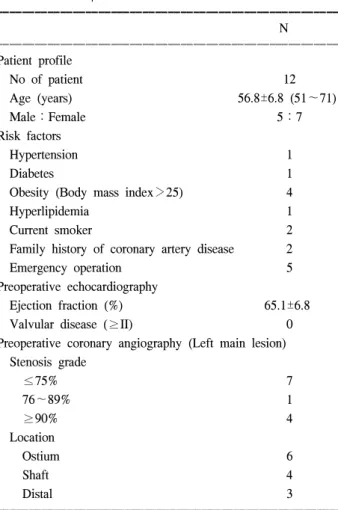
This study was performed to investigate whether Y-composite graft can satisfy the blood flow required to make myocardium act properly or not. Borderline stenotic lesions on the left main coronary artery, which are very prone to remodel the bypassed vessels due to competitive flows, were also considered. Material and Method: Among 247 patients who underwent coronary artery bypass grafting from March 2000 to April 2003, 12 patients (4.7%) who had received total arterial revascularizations for the isolated left main coronary artery disease were studied retrospectively.

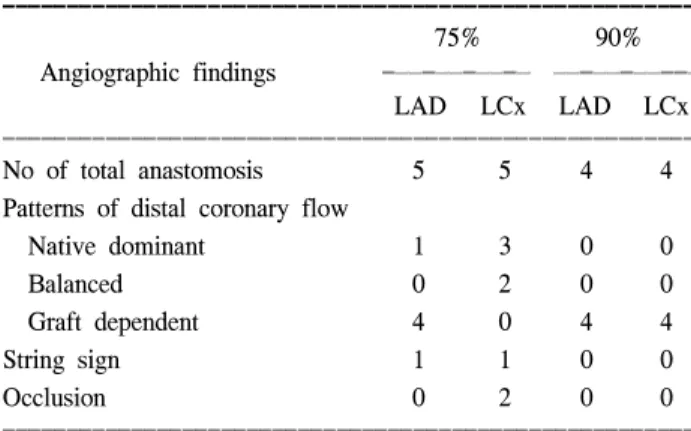
Result: Left anterior descending arteries were bypassed with left internal thoracic artery by off-pump technique in all patients, however, 2 cases of left obtuse marginal branches were bypassed under on-pump beating heart. Except for one patient, who did not have an obtuse marginal branch more than 1 mm in diameter, 11 patients had gone through complete arterial revascularizaions by use of the Y shape arterial graft. Among five patients who had less than 75% stenosis, one patient showed string sign on left internal thoracic artery grafted to left anterior descending artery. However, two grafts to obtuse marginal branches were completely obstructed and one showed slender sign.

There were no graft-dominant flow in patients with stenotic lesion less than 75%. On the contrary to the result of patients with stenotic lesions less than 75%, all the patients with stenotic lesions more than 90% showed graft-dominant blood flow. Conclusion: In conclusion, it is assumed that, when stenotic lesions are over 90%, cor- onary artery bypass grafting with an Y shape arterial graft could possibly give enough help to the obstructed coronary arteries in blood supplying to myocardium, which needs massive quantity of blood to act well. However, when patients have borderline stenoses, through scrupulous examinations, more prudent and flexible decisions are required in

단독 좌주간 관동맥 협착병변에서 Y-도관을 이용한 완전 동맥도관 관상동맥우회로 조성술
(2)

choosing the treatment methods, such as, direct anastomosis of vein or artery to aorta, or adding supplementary treatment methods like percutaneous coronary intervention, rather than choosing a fixed treatment methods.

(Korean J Thorac Cardiovasc Surg 2004;37:35-42)

Key words: 1. Coronary artery bypass 2. Conduit, arterial

3. Coronary artery disease

(3)

Table 1. Preoperative characteristics Table 2. Distribution of conduits

Table 3. Postoperative data

(4)

Table 4. Follow-up coronary angiographic results

(5)
(6)
(7)
(8)

=국문 초록=

배경:

대상 및 방법:

결과:

결론:

중심 단어

수치

Table  1.  Preoperative  characteristics Table  2.  Distribution  of  conduits
Table  4.  Follow-up  coronary  angiographic  results

참조

관련 문서

Internal thoracic artery; LAD=Left anterior descending coronary artery; OM=Obtuse marginal branch of left circumflex coronary artery; RA=Radial artery; RCA=Right

Comparison of coronary artery bypass surgery with percutaneous coronary intervention with drug-eluting stents for unprotected left main coronary artery disease..

We evaluated the early clinical outcome and the angiographic patency of the saphenous vein composite graft based on the left in- ternal thoracic artery, and compared these results

Background: For the surgical management of anomalous origin of the left coronary artery from the pulmonary ar- tery (ALCAPA), there have been various techniques that reduce the

After percutaneous intervention to the right coronary artery, off-pump coronary artery bypass grafting for the left coronary territory was done using a right ITA

Dual left anterior descending coronary artery (LAD) is a rare coronary anomaly and is incidentally detected during coronary angiography.. We report a case of a 65-year-old

Revascularization for Patients with Multivessel Coronary Artery Disease and Left Ventricular Systolic Dysfunction in Drug-Eluting Stent Era.. We aimed to investigate that

This study evaluated the outcomes of off-pump coronary artery bypass surgery (OPCAB) with severe left ventricular dysfunction using composite bilateral internal thoracic artery