간질성 방광염의 개괄과 한의학적 연구의 필요성
박상우, 김철중, 조충식 대전대학교 한의과대학 신계내과학교실
Original Article
⋅Received:30 May 2012 ⋅Revised:13 August 2012 ⋅Accepted:13 August 2012
⋅Correspondence to:조충식(Chung-sik Cho)
충남 천안시 서북구 두정동 421번지 대전대학교 부속 천안한방병원 신계내과학교실 Tel : +82-41-521-7531, Fax : +82-41-521-7007, E-mail : [email protected]
Review of Interstitial Cystitis and Need for Therapeutic Strategy Using Traditional Korean Medicine
Sang-woo Park, Chul-jung Kim, Chung-sik Cho
Internal Department of Oriental Medicine College, Daejeon University
Objectives: This study aimed to analyze the current status of treatments and patients with interstitial cystitis, and then map out a strategy for development of generalized-treatments for interstitial cystitis in Traditional Korean Medicine.
Methods: We selected research paper from various databases such as PubMed, Google, KStudy, KoreanTK, OIM, and KOMS. Also, to understand current tendencies of medical cost related with interstitial cystitis, we requested Health Insurance Review and Assessment Service clinical data from 2007 to 2011.
Results: It was reported that treatment of interstitial cystitis using Traditional Korean Medicine was effective.
However, patients of this usually visit a Western medical center rather than seek Traditional Korean Medicine. To take charge of clinical fields related with interstitial cystitis by Traditional Korean Medicine, we need more research and experiments of interstitial cystitis using Traditional Korean Medicine, and we must make a standardized protocol.
Conclusions: Various studies related with interstitial cystitis using Traditional Korean Medicine will have to be undertaken. We expect that Traditional Korean Medicine will play a role in treatment of interstitial cystitis.
Key Words : iinterstitial cystitis, Traditional Korean Medicine, Western medicine
서 론
간질성 방광염은 특징적인 병리학적 원인 없이 빈 뇨, 급박뇨, 방광통증, 성교통 등의 증상을 특징으로 하는 증후군이다1.
간질성 방광염은 원인이나 병태 생리가 아직까지 밝혀져 있지 않으며, 진단기준 역시 모호하여 논란의 여지가 있다. 환자들은 다양한 임상증상을 경험하므 로 초기의 증상으로 간질성 방광염을 확인하는 것조 차 어려운 경향이 있다2.
현재까지 알려진 유발원인에 대한 가설들은 이 질 환이 신경혈관손상의 결과이며, 이로 인해 나타나는 증상들은 방광손상과정의 2차적 결과라는 점이다3. 즉 방광내 염증이나 혈관장애, 점막손상 등을 유발인 자로 보며 그로 인한 신경손상의 결과로 증상이 나타 난다는 것이다. 그 외 정신신체장애, 성행위, 생리주 기, 스트레스, 음식 등도 증상의 호악에 영향을 주는 것으로 밝혀져 있다1.
최근에는 약물 치료 뿐 아니라 수술적 요법, 방광 확장술등의 다양한 치료방향이 제시되었으나 증상이
수주~수개월을 간격으로 악화와 호전을 반복하는 경 향을 보인다. 따라서 치료의 목표를 완치가 아닌 증 상의 호전에 중점을 두어야 하며, 주기적으로 증상을 경과관찰 하는 것이 중요하다4,5.
현재 간질성 방광염은 이처럼 근본적인 치료보다 는 대부분 대증치료 차원에서 이뤄지고 있으며, 여러 약물 치료 및 외과적 치료가 유효하다는 보고18가 있 지만 그 기능이 제한적이며 불완전하여 새로운 접근 방식이 필요한 상황이다.
일부 한의학 연구에서 간질성 방광염에 침, 전침, 한약이 유효하다는 보고6.7가 있었으며 이는 특정 병 인을 제거하기 보다는 환자 개개인의 증상, 체질을 바탕으로 접근하는 한의학적 진료 특성과 연관이 있 다고 할 수 있다. 따라서 간질성 방광염에 대한 한의 학적인 연구와 치료 방법의 확립은 대증치료 수준에 머물러 있는 현 단계를 극복할 수 있는 방편이 될 수 있을 것으로 기대된다.
이에 본 연구는 간질성 방광염과 관련된 연구와 치료패턴을 조사하고 간질성 방광염에 대한 한의학 적 연구의 필요성을 제기하고자 한다.
연 구 방 법
1.
연구 설계본 연구는 간질성 방광염의 치료에 있어 향후 한 의학적 연구의 필요성 및 방법을 제안하고자 간질성 방광염에 대한 국내외 논문을 조사하여 현재 간질성 방광염의 연구 및 치료에 관하여 알아보았다.
2.
자료 수집본 연구를 위하여 Pubmed(http://www.pubmed.co m/), Google(http://www.google.co.kr/), 한국 전통지 식 포탈(http://www.koreantk.com/), 한국학술정보(htt p://www.kstudy.com/), 대한한방내과학회(http://www.
oim.or.kr/), 대한한의학회 (http://www.koms.or.kr/)의 학회지의 사이트에서 수집한 국내외의 문헌을 조사 하였다(Table 1).
본론 및 고찰
1.
간질성 방광염의 한.
양방 연구 동향 분석 1)논문들의 기본정보간질성 방광염의 논문들의 기본정보를 얻기 위해 abstract와 full text를 통해 발표 연도, 연구 방식, 연 구 주제에 대하여 조사하였다. 연구된 방식을 분류할 때는 중복을 허용하였다.
2)분류
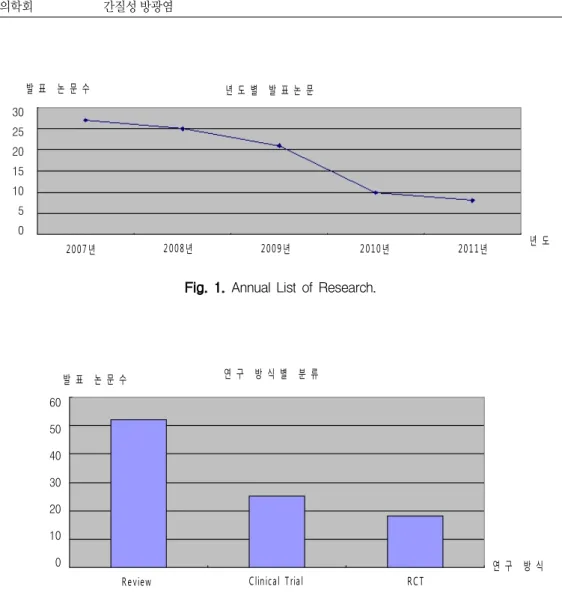
총 95건의 논문이 최종 검색되었다. 이중 1편은 원 문이 검색되지 않아 제외하였다. 총94편의 논문 중 최근 5년을 기준으로 2011년 8편, 2010년 10편, 2009 년 21편, 2008년 25편, 2007년 27편 2007년이전 3편 으로 검색되었다(Fig. 1).
연구 방식별로는 중복을 허용하였으며 Review논 문 52편으로 전체의 55%를 차지하였으며 그 다음으 로 Clinical Trial 논문으로 총25건 26%, RCT논문 총 18건으로 19%를 차지하였다(Fig. 2).
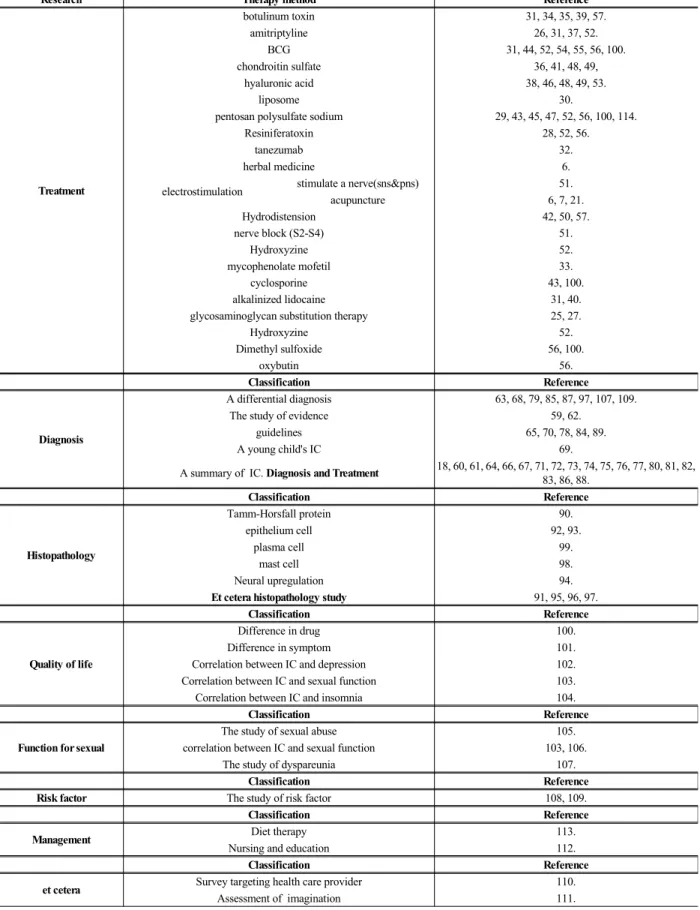
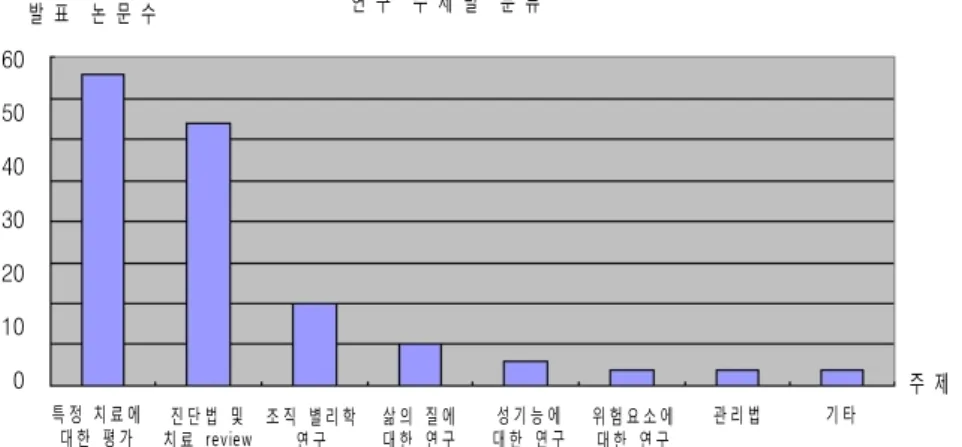
연구 주제별 분류는 치료에 대한 연구가 38건으로 가장 많았으며 그 중 약물치료에 대한 것이 31건, 침, 한약 등의 한방치료에 대한 것이 3건, 외과적 치료에 대한 것이 4건으로 나타났다. 약물치료에 대한 연구 중 생약제재에 대한 내용은 없었으며 모두 특정 성분 에 대한 연구들이고 한약을 사용한 것이 1건 있었다.
그 다음으로 간질성 방광염의 진단 및 진료 가이드 라인에 대한 논문이 32건, 병리생태에 대한 조직학적 연구가 10건, 환자들의 삶의 질에 대한 평가논문이 5 건, 성적 기능관련 논문이 3건, 위험인자들의 관리에 대한 논문이 2건, 관리법에 대한 논문이 2건, 기타2건 으로 나타났다. 기타논문은 의료인의 설문조사 1건 및 상상요법에 대한 논문1건으로 나타났다(Fig. 3).
연구 주제별 분류에 대한 상세 분류는 다음과 같 다(Table 2).
전체 논문 중 한의학 논문은 3건이 보고되었는데 침만으로 단독 치료한 것은 2건, 침과 약을 동시에 처방한 것이 1건 이었다. 3건 모두 膀胱의 募穴인 中 極, 氣海, 水道, 關元 등의 하복부의 혈위에 전침을 사용하고 三陰交, 陰陵泉등을 자침하여 유의성 있는 치료 효과를 나타내었다. 또한 침치료와 한약을 동시
Site Terms Condition
Pubmed interstitial cystitis Humans, Clinical Trial, Meta-Analysis, Practice Guideline, Randomized Controlled Trial, Review, English, published in the last 5 years, Field: Title
Google 간질성 방광염
한국전통지식포탈 간질성 방광염
한국학술정보 간질성 방광염
대한한방내과학회 간질성 방광염
대한한의학회 간질성 방광염
에 처방하는 것이 침만으로 단독 치료하는 것보다 더 욱 빠른 효과를 나타내는 것으로 보고되었다6. 이는 향후 간질성 방광염에 대한 한의학적 접근이 유효한
효과를 나타낼 수 있는 가능성을 보여준다고 할 수 있다.
Table 1. Searching Sites and Terms
30 25 20 15 10 5 0
2 0 0 9 년
2 0 0 7 년 2 0 0 8 년 2 0 1 0 년 2 0 1 1 년
년 도 별 발 표 논 문
년 도 발 표 논 문 수
Fig. 1. Annual List of Research.
60 50 40 30 20 10 0
C linical T ria l
R e view R C T
연 구 방 식 별 분 류
연 구 방 식 발 표 논 문 수
Fig. 2. Classification of Research Means.
Research Therapy method Reference
Treatment
botulinum toxin 31, 34, 35, 39, 57.
amitriptyline 26, 31, 37, 52.
BCG 31, 44, 52, 54, 55, 56, 100.
chondroitin sulfate 36, 41, 48, 49,
hyaluronic acid 38, 46, 48, 49, 53.
liposome 30.
pentosan polysulfate sodium 29, 43, 45, 47, 52, 56, 100, 114.
Resiniferatoxin 28, 52, 56.
tanezumab 32.
herbal medicine 6.
electrostimulation stimulate a nerve(sns&pns) 51.
acupuncture 6, 7, 21.
Hydrodistension 42, 50, 57.
nerve block (S2-S4) 51.
Hydroxyzine 52.
mycophenolate mofetil 33.
cyclosporine 43, 100.
alkalinized lidocaine 31, 40.
glycosaminoglycan substitution therapy 25, 27.
Hydroxyzine 52.
Dimethyl sulfoxide 56, 100.
oxybutin 56.
Classification Reference
Diagnosis
A differential diagnosis 63, 68, 79, 85, 87, 97, 107, 109.
The study of evidence 59, 62.
guidelines 65, 70, 78, 84, 89.
A young child's IC 69.
A summary of IC. Diagnosis and Treatment 18, 60, 61, 64, 66, 67, 71, 72, 73, 74, 75, 76, 77, 80, 81, 82, 83, 86, 88.
Classification Reference
Histopathology
Tamm-Horsfall protein 90.
epithelium cell 92, 93.
plasma cell 99.
mast cell 98.
Neural upregulation 94.
Et cetera histopathology study 91, 95, 96, 97.
Classification Reference
Quality of life
Difference in drug 100.
Difference in symptom 101.
Correlation between IC and depression 102.
Correlation between IC and sexual function 103.
Correlation between IC and insomnia 104.
Classification Reference
Function for sexual
The study of sexual abuse 105.
correlation between IC and sexual function 103, 106.
The study of dyspareunia 107.
Classification Reference
Risk factor The study of risk factor 108, 109.
Classification Reference
Management Diet therapy 113.
Nursing and education 112.
Classification Reference
et cetera Survey targeting health care provider 110.
Assessment of imagination 111.
Table 2. Analysis of Paper.
60 50 40 30 20 10 0
조 직 별 리 학 연 구 특 정 치 료 에
대 한 평 가
관 리 법 연 구 주 제 별 분 류
주 제 발 표 논 문 수
진 단 법 및 치 료 review
삶 의 질 에 대 한 연 구
성 기 능 에 대 한 연 구
위 험 요 소 에 대 한 연 구
기 타
Fig. 3. Classification of Research Subject.
18,000 16,000 14,000 12,000 10,000 8,000 6,000 4,000 2,000 0
2 0 0 9 년
2 0 0 7 년 2 0 0 8 년 2 0 1 0 년 2 0 1 1 년
최 근 5 년 간 청 구 진 료 비 및 환 자 수 환 자 수
1,200,000
1,150,000
1,100,000
1,050,000
1,000,000
950,000
900,000
청 구 진 료 비 ( 천 원 ) 환 자 수
총 진 료 비
Fig. 4. Annual Medical Cost of Interstitial Cystitis Patients(2007-2011).
2.
간질성 방광염의 유병률국내에서의 간질성 방광염의 진료를 알아보기 위 해 건강보험 심사평가원에 2007년도부터 2012년도까 지의 관련 진료자료를 의뢰하여 결과를 분석하였다.
한국표준질병․사인분류(2007), 통계청 상병기호에 의하여 N301(간질성 방광염)을 조사하였다(Fig. 4).
간질성 방광염은 우리나라에서는 정확한 진단이 되지 않아 드물게 보고된다고 한다7. 그러나 건강보 험 심사평가원자료에 의하면, 통계청 인구조사(2010 년) 4800만 명 기준으로 인구 10만 명당 25명~32명
정도로 건강보험공단에 청구되고 있다. 이는 일반적 으로 간질성 방광염을 보고된 나라 및 진단 기준에 따라 어느 정도 차이는 존재하지만, 미국의 경우 인 구 10만 명당 60명8, 유럽에서는 18명, 인종적으로 우리와 비슷한 일본에서는 3~4명으로 보고된 바와9 비교해볼 때 인종적으로 비슷한 일본보다 약6~8배의 발병률을 보이며, 미국과 유럽의 중간정도의 발병률 을 보이는 것으로 나타났다. 성별로는 전체 환자의 90%가 여성에게서 발생하며, 이들에게서 산과력 결 혼상태 등의 특이 원인은 없는 것으로 밝혀져 있다8.
3.
간질성 방광염의 한.
양의학적 병태에 대한 개괄 1)간질성 방광염의 서양의학적 병태간질성 방광염의 발생원인으로는 Detrusor근육과 점막 세포의 비정상적인기능, 방광내강의 glyco- saminoglycan층의 이상, 바이러스 감염, 소변의 독성 물질, 자가면역 등의 여러 가지 가설이 고려되고 있 으나 명확히 밝혀진 것은 없다10-13. 이처럼 병인이 명 확히 이해되고 있지 않아서 병의 과정이나 증상 치료 의 반응 및 예후가 매우 다양하게 나타난다1.
간질성 방광염은 크게 두가지로 분류 된다. 방광경 검사상 방광벽의 손상이 관찰되는. Hunner's ulcer type과 검사상 정상이나 증상만 있는 nonulcer type으 로 분류된다1. 원인은 명확하지는 않으나 방광근층이 특정원인에 의해 섬유화가 진행되며, 이 결과로 방광 용적이 감소하게 되어 빈뇨 급박뇨 하복통 등의 증상 이 나타나게 된다. 이러한 섬유화 현상은 방광의 기 저부에서 가장 심하며 최악의 경우에는 소변의 역류 를 일으켜 수뇨관신증과 신우신염, 신부전등을 일으 킬 수 있는 것으로 알려져 있다14.
증상은 대게 환자별로 매우 다양하고 점진적으로 나타나는 특징을 보인다. 약50%의 환자에서는 발생 8개월 안에 자연호전이 이루어지기도 하며, 이 환자 들은 증상이 완전 소실되기도 하며 호전된 상태로 지 내기도 한다9. 반면 일반적으로 환자들에게서 골반내 통증, 묵직한 느낌 잔뇨감, 급박뇨 등이 대표적인 증 상으로 나타나며, 대부분은 치료를 받았음에도 호악 을 반복하고, 감정적 정신적 문제와 연관이 있는 경 우도 있다15-17.
또한 이러한 다양한 증상이 방광 혹은 골반 수술 을 받은 이후에 시작되거나 도뇨관을 삽입한 이후 발 생하기도하며 이러한 간질성방광염 환자들은 과민성 방광염, 근막동통증후군, 외음부질염 등의 증상을 갖 고 있는 경우도 많이 있다9.
치료 방법으로는 우선 환자 교육이 중요하며, 환자 는 간질성방광염이 완치가 어려우며, 증상이 지속적 으로 호악을 반복한다는 것을 인식하여야 한다13. 치 료의 목표는 증상의 호전에 중점을 두어야 하며 생활 습관의 교정 및 식이요법의 병행 및 지속적으로 환자 의 증상을 경과관찰 하여야 한다18. 수술적 요법은 이 러한 보존적 치료가 실패한 경우에 적용하며 방광수
압확장술에 있어서 약 30%정도 호전이 된다고 알려 져 있으나 질환의 특성상 재발하기가 쉬우며19 방광 성형술, 확대술의 경우 성공률이 25~100%정도로 매 우 다양하게 나타나는 특성을 보인다20.
2) 간질성 방광염의 한의학적 병태
한의학적으로 간질성 방광염에 정확하게 부합하는 명칭은 없다. 증상을 보면 頻尿, 急迫尿, 尿道澁通, 小 腹拘急 등의 증상을 나타내는 淋病의 범주에 포함되 는 것으로 볼 수 있으며, 그 중에서도 難尿, 排尿痛, 頻尿, 点滴尿, 尿後重, 下腹部 膨滿感, 疼痛을 나타내 는 氣淋의 범주로 볼 수 있겠다21. 이러한 淋病의 발 병 원인을 역대의가들은 七情損傷, 臟腑의 機能失調,
무절제한 性交, 飮食不節 外邪 藥物 등으로 보았으며
그로 인해 腎虛한 상태에서 膀胱에 熱邪가 쌓여서 발
생하였다고 보았다22. 또한 金匱要略에서는 그 원인을 熱在下焦라 하고, 千金方에서는 腎虛가 本 ,膀胱熱이 表라고 정리하여 淋病의 원인을 일관성 있게 보고 있 음을 알 수 있다23. 이러한 淋病중 간질성 방광염과 증상이 가장 유사한 氣淋을 鬱怒傷肝 하여 肝氣鬱結
되어 氣鬱化火하고 膀胱氣化 不利하게 되면서 발생
한다고도 보아23 정신적인 스트레스와의 연관성을 기 록하였으며, 이는 양방에서 불안증, 우울증, 적응장애 등의 정신과적 문제가 간질성 방광염과 관련이 있다 는 견해와 연관성을 보인다고 할 수 있겠다24.
이처럼 한의학에서는 일관성 있게 淋病의 병리를 파악하고 있으며, 간질성 방광염의 증상인 배뇨장애 및 통증에 대하여 약물치료와 침구치료시의 혈위에 대한 기록은 문헌적으로 기록되어 있으나 임상적으 로 간질성 방광염에 대한 연구는 매우 미미한 수준이 다7. 다만 그 결과가 유의한 효과를 나타내는 것으로 보여 향후 한의학적인 연구가 간질성 방광염의 치료 에 새로운 방향을 제시할 수 있을 것으로 보인다.
4.
간질성 방광염에 대한 한의학적 연구의 필요성 간질성 방광염은 지속적으로 환자가 발생하는 질 환이며 특히 우리나라에서는 인종적으로 비슷한 일 본보다 그 발병률이 6~8배에 이르는 것으로 나타났 다(Fig. 4). 또한 치료비용 역시 줄지 않고 꾸준히 유 지되고 있는 질환이다. 그러나 아직까지 그 원인이나병리기전이 명확하게 밝혀지지 않았으며, 그로인해 증상에 대한 치료 및 예후, 생활관리 역시 매우 다양 하게 나타나고 있다.
현재까지 발표된 간질성 방광염의 한의학 논문들 은 비록 그 수가 적으나 병리기전이 비교적 명확하 며, 환자 개개인의 변증을 바탕으로 하여 中極, 氣海, 水道, 關元 등의 하복부의 혈위에 전침을 사용하고 三陰交, 陰陵泉등에 자침하여 유효한 효과를 얻었고 또한 한약을 동시에 투여한 것이 보다 더 빠른 효과 를 보여주고 있다는 보고들이 있다6,7,21.
전체 의료시장에서의 한의학의 규모 및 현 간질성 방광염 환자들의 대부분이 양방치료에 의존하고 있 으나 명확한 치료법이 없으며, 그 효과가 다양하게 나타나는 상황을 고려해 본다면 병태 생리가 비교적 명확하게 나타나 있는 한의학적 연구가 충분한 가치 가 있음을 알 수 있다고 판단되며 간질성 방광염의 접근 및 치료에 새로운 방향을 제시할 수 있을 것으 로 보인다.
결 론
간질성 방광염은 정확한 원인 및 병리 기전이 완 전히 밝혀지지 않았으며, 증상의 다양함과 호악을 반 복하는 질환적 특성상 매년 꾸준한 의료비를 발생시 키고 있는 질환이다. 특히 우리나라에서는 그 발병률 이 인구 10만명당 25명~32명 정도로 상당히 높은 수 준을 유지하고 이로 인해 매년 10억 원 이상의 의료 비가 꾸준히 발생하고 있어 그 병리기전 및 치료에 대한 연구가 더욱 필요함을 알 수 있다.
한의학에서는 간질성 방광염을 淋病의 범주로 접 근하며, 비록 아직까지 그 수는 적으나 전침 등을 이 용한 침 치료 및 한약 치료에 관한 논문들이 일부 발 표되었다.
한의학에서 간질성 방광염은 환자 개개인의 특성 에 맞추는 한의학적 변증체계를 이용하여 접근한다.
그러나 이러한 특성으로 인해 환자의 치료에 대한 평 가가 객관적이지 못하며, 정형화된 치료방법을 확보 하지는 못하였으며, 한의사 개인의 직관 및 능력에 의존하는 경향이 커서 진단 및 치료의 객관성 확보에 문제점을 나타내고 있다.
현재까지 한의학에서 발표된 논문들은 주로 환자
의 자각증상을 기준으로 평가하고 있으나 이는 환자 의 주관적인 증상에만 의존하는 것들로 객관성이 다 소 부족한 편이다. 따라서 이러한 점을 보다 객관적 으로 나타내기 위해 요속검사 및 요량의 측정 배뇨기 록지 등을 적극 활용하여야 한다.
향후 이러한 문제점을 해결하며 객관성 확보 및 개연성 확보를 위해 자본력과 연구 인력 등이 갖추어 진 병원급 의료기관에서 연구를 실시하여 데이터베 이스를 축적해야 한다. 그리하여 이러한 연구를 바탕 으로 치료의 방향을 제시하고 변증체계를 객관화하 는 노력이 필요하다.
이를 바탕으로 한의학만의 진료 프로토콜이 확립 된다면, 간질성 방광염의 치료율을 높이는데 큰 도움 이 될 수 있을 것이다.
참고문헌
1. Metts JF. interstitial cystitis:Urgency and fre- quency syndrome. American Family Physician.
2001;64(7):1212-4.
2. Shlomo R, Larissa VR. painful bladder syn- drome and interstitial cystitis. Female urology.
Chap 92.
3. David W, Rodney A. A Headache in the Pelvis:
A new understanding and treatment for prostatitis and chronic pelvic pain syndromes. Seoul:
koonja. 2008:220-30.
4 Kahn BS, Stanford EJ, Mishell DR Jr, Rosenberg MT, Wysocki S. Management of patients with interstitial cystitis or chronic pelvic pain of blad- der origin: A consensus report. Curr Med Res Opin. 2005;21:509-16.
5. Dell JR, Parsons CL. Multimodal therapy for in- terstitial cystitis. J Reprod Med 2004;49(3Suppl):
243-52.
6. Kim SA, Yun KS, Kang YH, Yoon CH. A Case report of interstitial cystitis treated with Herb-med and electroacupuncture. The Society of Korean Oriental Internal Medicine. 2005;
aut(1):128-34.
7. Choi WS, Song Ik, Park JS, Lee SD, Kim KS.
The Clinical observations of 4 case of Interstitial cystitis patient treated with Hapgokja(合谷刺) and Electroacupuncture. The Korean Acupuncture & Moxibustion Society. 2002;19 (6):193-204.
8. Curhan GC, Speizer EF, Hunter DJ, Curhan SG,Stampfer MJ. Epidemiology of interstitial cystitis: apopulation based study. J Urol 1999;
161:549-52.
9. Eric SR, Brett DL. Interstitial cystitis. 2005. Avai lable at :URL:http://emedicine.medscape.com/art icle/441831-overview Accessed April. 2012.
10. Duncan JL, Schaeffer AJ. Do infectious agents cause interstitial cystitis? Urology 1997;49(5A Suppl):48-51.
11. Al-Hadithi HN, Williams H, Hart CA, Frazer M, Adams EJ, Richmond DH, et al. Absence of bac- terial and viral DNA in bladder biopsies from patients with interstitial cystitis/chronic pelvic pain syndrome. J Urol 2005;174:151-4.
12. Parsons CL, Greenberger M, Gabal L, Bidair M, Barme G. The role of urinary potassium in the pathogenesis and diagnosis of interstitial cystitis.
J Urol 1998; 159: 1862-6; discussion 1866-7.
13. Evans RJ. Treatment approaches for interstitial cystitis: Multimodality therapy. Rev Urol 2002;
4 Suppl 1: S16-20.
14. 대한비뇨기과학회. 비뇨기과학. 제3판. 서울:고 려의학. 2009:198-9.
15. Gleckman RA. Urinary tract infection in women.
New perspectives on office management.
Postgrad Med 1983;73:277-82.
16. Messing EM, Stamey TA. Interstitial cystitis:
Early diagnosis, pathology, and treatment.
Urology 1978;12:381-92.
17. Diagnosing and treating interstitial cystitis. If on- ly it were as simple as a urinary tract infection.
Harv Womens Health Watch. 2003;10:3-5.
18. Cho HH. Diagnosis and treatment of interstitial cystitis and painful bladder syndrome. Korean Journal of Obstetrics and Gynecology. 2009;52 (1):987-93.
19. Michael BC, Naoki Y. Treatment of interstitial cystitis. Urology. 2004;63(3A):85-92.
20. Diagnosing and treating interstitial cystitis. If on- ly it were as simple as a urinary tract infection.
Harv Womens Health Watch. 2003;10:3-5.
21. Choi YH, Lee SD, Kim GS. Effects of Acupuncture on Symptoms in a Patient with Interstitial Cystitis. The Korean Acupuncture &
Moxibustion Society. 2001;18(4):212-20.
22. Song BG, Yoo GY. Comparative Study on the Symptom of Linbing. Korean Oriental Medical Society. 1992;13(2):212-23.
23. 方葯中, et al. 實用中醫內科學. 上海:上海科學技 術出版社. 1983:276-85.
24. Moldwin RM, Kaye J. Pelvic floor dysfunction in the painful bladder syndrome/interstitial cys- titis(PBS/IC) population. 2006 NIDDK interna- tional symposium: Frontiers in painful bladder syndrome and interstitial cystitis, Bethesda, MD, October 26 and 27, 2006.
25. Daha LK, Lazar D, Simak R, Pflger H. Is there a relation between urinary interleukin-6 levels and symptoms before and after intra-vesical gly- cosaminoglycan substitution therapy in patients with bladder pain syndrome/interstitial cystitis.
Int Urogynecol J Pelvic Floor Dysfunct. 2007 Dec;18(12):1449-52.
26. Hertle L, van Ophoven A. Long-term results of amitriptyline treatment for interstitial cystitis.
Aktuelle Urol. 2010 Jan;41 Suppl 1:S61-5.
27. Daha LK, Riedl CR, Lazar D, Simak R, Pflger H. Effect of intravesical glycosaminoglycan subs titution therapy on bladder pain syndrome/intersti tial cystitis, bladder capacity and potassium sensi tivity. Scand J Urol Nephrol. 2008;42(4):369-72.
28. Mourtzoukou EG, Iavazzo C, Falagas ME.
Resiniferatoxin in the treatment of interstitial cystitis: a systematic review. Int Urogynecol J Pelvic Floor Dysfunct. 2008 Nov;19(11):1571-6.
29. Nickel JC, Kaufman DM, Zhang HF, Wan GJ, Sand PK. Time to initiation of pentosan poly- sulfate sodium treatment after interstitial cystitis diagnosis: effect on symptom improvement.
Urology. 2008 Jan;71(1):57-61.
30. Lee WC, Chuang YC, Lee WC, Chiang PH.
Safety and dose flexibility clinical evaluation of intravesical liposome in patients with interstitial cystitis or painful bladder syndrome. Kaohsiung J Med Sci. 2011 Oct;27(10):437-40.
31. Seth A, Teichman JM. What's new in the diag- nosis and management of painful bladder syn- drome/interstitial cystitis? Curr Urol Rep. 2008 Sep;9(5):349-57.
32. Evans RJ, Moldwin RM, Cossons N, Darekar A, Mills IW, Scholfield D. Proof of concept trial of tanezumab for the treatment of symptoms as- sociated with interstitial cystitis. J Urol. 2011 May;185(5):1716-21.
33. Yang CC, Burks DA, Propert KJ, Mayer RD, Peters KM, Nickel JC, et al; Early termination of a trial of mycophenolate mofetil for treatment of interstitial cystitis/painful bladder syndrome:
lessons learned. J Urol. 2011 Mar;185(3):901-6.
34. Gottsch HP, Miller JL, Yang CC, Berger RE. A pilot study of botulinum toxin for interstitial cys- titis/painful bladder syndrome. Neurourol Urodyn. 2011 Jan;30(1):93-6.
35. Tirumuru S, Al-Kurdi D, Latthe P. Intravesical botulinum toxin A injections in the treatment of painful bladder syndrome/interstitial cystitis: a systematic review. Int Urogynecol J. 2010 Oct;21(10):1285-300.
36. Nickel JC, Egerdie RB, Steinhoff G, Palmer B, Hanno P. A multicenter, randomized, dou-
ble-blind, parallel group pilot evaluation of the efficacy and safety of intravesical sodium chon- droitin sulfate versus vehicle control in patients with interstitial cystitis/painful bladder syndrome. Urology. 2010 Oct;76(4):804-9.
37. Foster HE Jr, Hanno PM, Nickel JC, Payne CK, Mayer RD, Burks DA, et al. Effect of amitripty- line on symptoms in treatment nave patients with interstitial cystitis/painful bladder syndrome. J Urol. 2010 May;183(5):1853-8.
38. Shao Y, Shen ZJ, Rui WB, Zhou WL.
Intravesical instillation of hyaluronic acid pro- longed the effect of bladder hydrodistention in patients with severe interstitial cystitis. Urology.
2010 Mar;75(3):547-50.
39. Kuo HC, Chancellor MB. Comparison of intra- vesical botulinum toxin type A injections plus hydrodistention with hydrodistention alone for the treatment of refractory interstitial cys- titis/painful bladder syndrome. BJU Int. 2009 Sep;104(5):657-61.
40. Nickel JC, Moldwin R, Lee S, Davis EL, Henry RA, Wyllie MG. Intravesical alkalinized lido- caine (PSD597) offers sustained relief from symptoms of interstitial cystitis and painful blad- der syndrome. BJU Int. 2009 Apr;103(7):910-8.
41. Nickel JC, Egerdie B, Downey J, Singh R, Skehan A, Carr L, et al. A real-life multicentre clinical practice study to evaluate the efficacy and safety of intravesical chondroitin sulphate for the treatment of interstitial cystitis. BJU Int. 2009 Jan;103(1):56-60.
42. Aihara K, Hirayama A, Tanaka N, Fujimoto K, Yoshida K, Hirao Y. Hydrodistension under local anesthesia for patients with suspected painful bladder syndrome/interstitial cystitis: safety, di- agnostic potential and therapeutic efficacy. Int J Urol. 2009 Dec;16(12):947-52
43. Sairanen J, Hotakainen K, Tammela TL,
Stenman UH, Ruutu M. Urinary epidermal growth factor and interleukin-6 levels in patients with painful bladder syndrome/interstitial cystitis treated with cyclosporine or pentosan polysulfate sodium. Urology. 2008 Apr;71(4):630-3.
44. Propert KJ, Mayer R, Nickel JC, Payne CK, Peters KM, Teal V, et al. Followup of patients with interstitial cystitis responsive to treatment with intravesical bacillus Calmette-Guerin or placebo. J Urol. 2008 Feb;179(2):552-5.
45. Davis EL, El Khoudary SR, Talbott EO, Davis J, Regan LJ. Safety and efficacy of the use of intravesical and oral pentosan polysulfate sodium for interstitial cystitis: a randomized double-blind clinical trial. J Urol. 2008 Jan;179(1):177-85.
46. Riedl CR, Engelhardt PF, Daha KL, Morakis N, Pfluger H. Hyaluronan treatment of interstitial cystitis/painful bladder syndrome. Int Urogynecol J Pelvic Floor Dysfunct. 2008 May;
19(5):717-21.
47. Daha LK, Lazar D, Simak R, Pfluger H. The ef- fects of intravesical pentosanpolysulfate treat- ment on the symptoms of patients with bladder pain syndrome/interstitial cystitis: preliminary results Int Urogynecol J Pelvic Floor Dysfunct.
2008 Jul;19(7):987-90.
48. Cervigni M, Natale F, Nasta L, Padoa A, Voi RL, Porru D. A combined intravesical therapy with hyaluronic acid and chondroitin for re- fractory painful bladder syndrome/interstitial cystitis. Int Urogynecol J Pelvic Floor Dysfunct.
2008 Jul;19(7):943-7.
49. Porru D, Cervigni M, Nasta L, Natale F, Lo Voi R, Tinelli C, et al. Results of endovesical hyalur- onic acid/chondroitin sulfate in the treatment of Interstitial Cystitis/Painful Bladder Syndrome.
Rev Recent Clin Trials. 2008 May;3(2):126-9.
50. Kim SH, Kim SU, Oh SJ. Characteristics of Pain and Change in the Severity of Pain after
Hydrodistension in Patients with Interstitial Cystitis.
Korean Journal of Urology. 2008;49(10): 931-6.
51. Zabihi N, Mourtzinos A, Maher MG, Raz S, Rodriguez LV. Short-term results of bilateral S2-S4 sacral neuromodulation for the treatment of refractory interstitial cystitis, painful bladder syndrome, and chronic pelvic pain. Int Urogynecol J Pelvic Floor Dysfunct. 2008 Apr;19(4):553-7.
52. Dimitrakov J, Kroenke K, Steers WD, Berde C, Zurakowski D, Freeman MR, et al. Pharmacologic management of painful bladder syndrome/inter- stitial cystitis: a systematic review. Arch Intern Med. 2007 Oct 8;167(18): 1922-9.
53. Iavazzo C, Athanasiou S, Pitsouni E, Falagas ME.
Hyaluronic acid:an effective alternative treatment of interstitial cystitis, recurrent urinary tract in- fections, and hemorrhagic cystitis? Eur Urol. 2007 Jun;51(6):1534-40; discussion 1540-1.
54. Keay S, Reeder JE, Koch K, Zhang CO, Grkovic D, Peters K, et al. Prospective evaluation of can- didate urine and cell markers in patients with in- terstitial cystitis enrolled in a randomized clinical trial of Bacillus Calmette Guerin (BCG) World J Urol. 2007 Oct;25(5):499-504.
55. Propert KJ, Mayer R, Nickel JC, Payne CK, Peters KM, Teal V, et al. Did patients with inter- stitial cystitis who failed to respond to initial treatment with bacillus Calmette-Guerin or pla- cebo in a randomized clinical trial benefit from a second course of open label bacillus Calmette-Guerin? J Urol. 2007 Sep;178(3 Pt 1):886-90.
56. Dawson TE, Jamison J. Intravesical treatments for painful bladder syndrome/ interstitial cystitis Cochrane Database Syst Rev. 2007 Oct 17;(4):
CD006113.
57. Liu HT, Kuo HC. Intravesical botulinum toxin A injections plus hydrodistension can reduce
nerve growth factor production and control blad- der pain in interstitial cystitis. Urology. 2007 Sep;70(3):463-8.
58. Peters KM, Feber KM, Bennett RC. A pro- spective, single-blind, randomized crossover trial of sacral vs pudendal nerve stimulation for inter- stitial cystitis. BJU Int. 2007 Oct;100(4):835-9.
59. Son HM, Kim JI. Evaluation of the Interstitial Cystitis Symptom Index and Problem Index- Korean Version. The Korean Journal of Women Health Nursing. 2008;14(4):290-6.
60. Whitmore KE, Theoharides TC. When to suspect interstitial cystitis J Fam Pract. 2011;Jun;60(6):
340-8.
61. Hanno P, Nordling J, van Ophoven A. What is new in bladder pain syndrome/interstitial cys- titis? Curr Opin Urol. 2008 Jul;18(4):353-8.
62. Fall M, Oberpenning F, Peeker R. Treatment of bladder pain syndrome/interstitial cystitis 2008:
can we make evidence-based decisions Eur Urol.
2008 Jul;54(1):65-75. 63. Parsons CL. The role of a leaky epithelium and potassium in the gen- eration of ladder symptoms in interstitial cys- titis/overactive bladder, urethral syndrome, pros- tatitis and gynaecological chronic pelvic pain.
BJU Int. 2011 Feb;107(3):370-5.
64. Marinkovic SP, Moldwin R, Gillen LM, Stanton SL. The management of interstitial cystitis or painful bladder syndrome in women. BMJ. 2009 Jul 31;339:b2707.
65. Forrest JB, Dell JR. Successful management of interstitial cystitis in clinical practice. Urology.
2007 Apr;69(4 Suppl):82-6
66. Hanno PM. Re-imagining interstitial cystitis Urol Clin North Am. 2008 Feb;35(1):91-9; vii.
67. Moldwin RM, Evans RJ, Stanford EJ, Rosenberg MT. Rational approaches to the treatment of pa- tients with interstitial cystitis. Urology. 2007 Apr;69(4 Suppl):73-81
68. Butrick CW. Patients with chronic pelvic pain:
endometriosis or interstitial cystitis/painful blad- der syndrome. JSLS. 2007 Apr-Jun;11(2):182-9.
69. Sea J, Teichman JM. Paediatric painful bladder syndrome/interstitial cystitis: diagnosis and treat- ment Drugs. 2009;69(3):279-96.
70. Homma Y, Ueda T, Ito T, Takei M, Tomoe H.
Japanese guideline for diagnosis and treatment of interstitial cystitis. nt J Urol. 2009 Jan;16(1):4-16.
71. Moutzouris DA, Falagas ME. Interstitial cystitis:
an unsolved enigma. Clin J Am Soc Nephrol.
2009 Nov;4(11):1844-57.
72. Rosenberg MT, Newman DK, Page SA.
Interstitial cystitis/painful bladder syndrome:
symptom recognition is key to early identi- fication, treatment. Cleve Clin J Med. 2007 May;74 Suppl 3:S54-62.
73. Dell JR. Interstitial cystitis/painful bladder syn- drome: appropriate diagnosis and management.
J Womens Health (Larchmt). 2007 Oct;16(8):
1181-7.
74. Klutke CG, Klutke JJ. Interstitial cystitis/painful bladder syndrome for the primary care physician.
Can J Urol. 2008 Aug;15 Suppl 1:44-52; dis- cussion 52-3.
75. Dasgupta J, Tincello DG. Interstitial cys- titis/bladder pain syndrome: an update.
Maturitas. 2009 Dec 20;64(4):212-7.
76. Kelada E, Jones A. Interstitial cystitis. Arch Gynecol Obstet. 2007 Apr;275(4):223-9.
77. Persu C, Cauni V, Gutue S, Blaj I, Jinga V, Geavlete P. From interstitial cystitis to chronic pelvic pain. J Med Life. 2010 Apr-Jun;3(2):
167-74.
78. Chung MK, Jarnagin B. Early identification of interstitial cystitis may avoid unnecessary hysterectomy. JSLS. 2009 Jul-Sep;13(3):350-7.
79. Dell JR, Mokrzycki ML, Jayne CJ.
Differentiating interstitial cystitis from similar
conditions commonly seen in gynecologic practice. Eur J Obstet Gynecol Reprod Biol. 2009 Jun;144(2):105-9.
80. Forrest JB, Moldwin R. Diagnostic options for early identification and management of inter- stitial cystitis/painful bladder syndrome. Int J Clin Pract. 2008 Dec;62(12):1926-34.
81. Van de Merwe JP, Nordling J, Bouchelouche P, Bouchelouche K, Cervigni M, Daha LK, et al.
Diagnostic criteria, classification, and nomencla- ture for painful bladder syndrome/interstitial cys- titis: an ESSIC proposal. Eur Urol. 2008 Jan;53(1):60-7.
82. Evans RJ, Sant GR. Current diagnosis of inter- stitial cystitis: an evolving paradigm. Urology.
2007 Apr;69(4 Suppl):64-72.
83. Teichman JM, Parsons CL Contemporary clinical presentation of interstitial cystitis. Urology. 2007 Apr;69(4 Suppl):41-7.
84. Homma Y, Ueda T, Tomoe H, Lin AT, Kuo HC, Lee MH, et al. Clinical guidelines for interstitial cystitis and hypersensitive bladder syndrome. Int J Urol. 2009 Jul;16(7):597-615.
85. Forrest JB, Nickel JC, Moldwin RM. Chronic pros- tatitis/chronic pelvic pain syndrome and male inter- stitial cystitis: enigmas and opportunities. Urology.
2007 Apr;69(4 Suppl):60-3.
86. Forrest JB, Mishell DR Jr. Breaking the cycle of pain in interstitial cystitis/painful bladder syn- drome: toward standardization of early diagnosis and treatment: consensus panel recommendations.
J Reprod Med. 2009 Jan;54(1):3-14.
87. Hanno PM, Chapple CR, Cardozo LD. Bladder pain syndrome/interstitial cystitis: a sense of urgency. World J Urol. 2009 Dec;27(6):717-21 88. Mahmoud MS. Bladder pain syndrome/inter- stitial cystitis: a reappraisal for the clinician. J Reprod Med. 2011 Sep-Oct;56(9-10):405-9.
89. Hanno PM, Burks DA, Clemens JQ,
Dmochowski RR, Erickson D, Fitzgerald MP, et al. AUA guideline for the diagnosis and treat- ment of interstitial cystitis/bladder pain syndrome. J Urol. 2011 Jun;185(6):2162-70.
90. Parsons CL, Proctor J, Teichman JS, Nickel JC, Davis E, Evans R, et al. A multi-site study con- firms abnormal glycosylation in the Tamm-Horsfall protein of patients with inter- stitial cystitis. J Urol. 2011 Jul;186(1):112-6.
91. Keay S. Cell signaling in interstitial cys- titis/painful bladder syndrome. Cell Signal. 2008 Dec;20(12):2174-9.
92. Parsons CL. The role of the urinary epithelium in the pathogenesis of interstitial cys- titis/prostatitis/urethritis. Urology. 2007 Apr;69 (4 Suppl):9-16.
93. Teichman JM, Moldwin R. The role of the bladder surface in interstitial cystitis/painful bladder syndrome. Can J Urol. 2007 Aug;14(4):3599-607.
94. Nazif O, Teichman JM, Gebhart GF. Neural up- regulation in interstitial cystitis Urology. 2007 Apr;69(4 Suppl):24-33.
95. Theoharides TC, Whitmore K, Stanford E, Moldwin R, O'Leary MP. Interstitial cystitis:
bladder pain and beyond. Expert Opin Pharmacother. 2008 Dec;9(17):2979-94.
96. Elgavish A. Epigenetic reprogramming: a possi- ble etiological factor in bladder pain syn- drome/interstitial cystitis? J Urol. 2009 Mar;
181(3):980-4.
97. Van de Merwe JP. Interstitial cystitis and sys- temic autoimmune diseases. Nat Clin Pract Urol.
2007 Sep;4(9):484-91.
98. Sant GR, Kempuraj D, Marchand JE, Theoharides TC. The mast cell in interstitial cys- titis: role in pathophysiology and pathogenesis Urology. 2007 Apr;69(4 Suppl):34-40.
99. Pacella M, Varca V, Venzano F, Toncini C, Carmignani G, Simonato A. Interstitial cystitis
with plasma cell bladder infiltration: case report and literature review. Arch Ital Urol Androl.
2010 Jun;82(2):122-4
100. Sairanen J, Leppilahti M, Tammela TL, Paananen I, Aaltomaa S, Taari K, et al.
Evaluation of health-related quality of life in pa- tients with painful bladder syndrome/interstitial cystitis and the impact of four treatments on it.
Scand J Urol Nephrol. 2009;43(3):212-9.
101. El Khoudary SR, Talbott EO, Bromberger JT, Chang CC, Songer TJ, Davis EL. Severity of in- terstitial cystitis symptoms and quality of life in female patients. J Womens Health (Larchmt).
2009 Sep;18(9):1361-8.
102. Kim JI, Margaret MH. Interstitial Cystitis/Painful Bladder Syndrome: Prevalence Estimates, Quality of Life and Depression among Older Adult Korean Women. The Korean Journal of Women Health Nursing. 2009;15(4):381-6.
103. Nickel JC, Tripp D, Teal V, Propert KJ, Burks D, Foster HE, et al. Sexual function is a determi- nant of poor quality of life for women with treat- ment refractory interstitial cystitis. J Urol. 2007 May;177(5):1832-6.
104. Nickel JC, Payne CK, Forrest J, Parsons CL, Wan GJ, Xiao X. The relationship among symp- toms, sleep disturbances and quality of life in pa- tients with interstitial cystitis. J Urol. 2009 Jun;181(6):2555-61.
105. Mayson BE, Teichman JM. The relationship be- tween sexual abuse and interstitial cys- titis/painful bladder syndrome. Curr Urol Rep.
2009 Nov;10(6):441-7.
106. Nickel JC, Parsons CL, Forrest J, Kaufman D, Evans R, Chen A, et al. Improvement in sexual functioning in patients with interstitial cys- titis/painful bladder syndrome. J Sex Med. 2008 Feb;5(2):394-9.
107. Whitmore K, Siegel JF, Kellogg-Spadt S.
Interstitial cystitis/painful bladder syndrome as a cause of sexual pain in women: a diagnosis to consider. J Sex Med. 2007 May;4(3):720-7.
108. Li GZ, Zhang N, Du P, Yang Y, Wu SL, Xiao YX, et al. Risk factors for interstitial cys- titis/painful bladder syndrome in patients with lower urinary tract symptoms: a Chinese mul- ti-center study. Chin Med J (Engl). 2010 Oct;123(20):2842-6.
109. Stanford EJ, Dell JR, Parsons CL. The emerging presence of interstitial cystitis in gynecologic pa- tients with chronic pelvic pain. Urology. 2007 Apr;69(4 Suppl):53-9.
110. Clemens JQ, Calhoun EA, Litwin MS, Walker-Corkery E, Markossian T, Kusek JW, et al. A survey of primary care physician practices in the diagnosis and management of women with interstitial cystitis/painful bladder syndrome.
Urology. 2010;76(2):323-8.
111. Carrico DJ, Peters KM, Diokno AC. Guided im- agery for women with interstitial cystitis: results of a prospective, randomized controlled pilot study. J Altern Complement Med. 2008 Jan-Feb;14(1):53-60.
112. Warren JW. Interstitial cystitis/painful bladder syndrome. Urol Nurs. 2007 Jun;27(3):185-9;
quiz 190.
113. Klumpp DJ, Rudick CN. Summation model of pelvic pain in interstitial cystitis. Nat Clin Pract Urol. 2008 Sep;5(9):494-500.
114. Sand PK, Kaufman DM, Evans RJ, Zhang HF, Alan Fisher DL, Nickel JC. Association between response to pentosan polysulfate sodium therapy for interstitial cystitis and patient ques- tionnaire-based treatment satisfaction. Curr Med Res Opin. 2008 Aug;24(8):2259-64.