Copyright © 2018 The Korean Society for Bone and Mineral Research
This is an Open Access article distributed under the terms of the Creative Commons Attribution Non-Commercial Li- cense (http://creativecommons.org/licenses/by-nc/4.0/) which permits unrestricted non-commercial use, distribu- tion, and reproduction in any medium, provided the original work is properly cited.
Improvement of Osteoporosis Medication after Multimodal Intervention in Patients with Hip Fracture: Prospective Multicenter Study
Yong-Geun Park1, Kwang Woo Nam1, Sang-Rim Kim1, Min-Suk Park2, Sang-Jae Kim2, Yong-Chan Ha3
1Department of Orthopaedic Surgery, Jeju National University Hospital, Jeju National University School of Medicine, Jeju;
2Department of Orthopedic Surgery and Traumatology, Cheju Halla General Hospital, Jeju;
3Department of Orthopaedic Surgery, Chung-Ang University College of Medicine, Seoul, Korea
Background: The authors had earlier conducted a retrospective cohort study from 2008 to 2011 in Jeju Island, among 945 hip fracture patients above 50 years of age. Of these 945 patients, 344 patients (36.4%) underwent a bone mineral density test and 218 pa- tients (23.1%) received treatment for osteoporosis. The purpose of this study was to de- termine whether a patient education program could improve osteoporosis manage- ment after hip fracture. The data of the previous study was used for comparison. Meth- ods: From November 1, 2014 to September 30, 2015, 190 patients above 50 years of age who were admitted for hip fractures at six different hospitals, were enrolled in the pres- ent study. During the hospitalization period, patients underwent education sessions and were provided brochures. Patients were evaluated for diagnosis and treatment of osteo- porosis at six months after discharge and were followed-up for at least a year. Results:
Of the 222 patients with hip fractures, 190 patients (37 men, 153 women) were enrolled at six hospitals in 2015. Dual energy X-ray absorptiometry was performed on 115 pa- tients (60.5%) and 92 patients (48.4%) were prescribed medication for osteoporosis at the time of discharge. A total of 43.7% and 40.2% of the patients were found to be com- pliant with osteoporosis medication at 6 months and 12 months follow-up respectively.
Conclusions: This interventional multicenter study demonstrated that a patient educa- tion program in patients with hip fractures can improve compliance to osteoporosis medication up to 12 months of follow-up.
Key Words: Hip fractures, Osteoporosis, Patient education as topic, Therapeutics
INTRODUCTION
Hip fracture is most serious complication of osteoporosis related fractures and is associated with several adverse effects in the elderly. The incidences of hip frac- ture in global populations are reporting that number and incidence of hip fracture are increasing trends.[1] In Korea, numbers and incidence of hip fracture is also expected increasing trend until 2026.[2] Hip fractures are notorious high mortality, morbidity, secondary hip fracture, and considerable socioeconomic burdens.[3-5]
To minimize complications after hip fracture, appropriate osteoporosis medica- tion are recommend to reduce risks of subsequent fractures and mortality.[6-8]
Corresponding author Yong-Chan Ha
Department of Orthopaedic Surgery, Chung- Ang University College of Medicine, 102 Heukseok-ro, Dongjak-gu, Seoul 06973, Korea Tel: +82-2-6299-1591
Fax: +82-2-822-1710 E-mail: [email protected] Received: March 29, 2018 Revised: May 13, 2018 Accepted: May 16, 2018
No potential conflict of interest relevant to this article was reported.
Original Article
pISSN 2287-6375 eISSN 2287-7029
However, treatment rates after osteoporotic fracture are still insufficient.[9,10] To improve diagnosis and treatment rate of osteoporosis, physician, patients, and reimburse- ment system are very important.[11]
Previously we reported that increased awareness of or- thopaedic surgeons after educations improved the detec- tion rate of osteoporosis from 20.1% to 45% and treatment rates from 15.1% to 32.2%.[12] However, during follow-up, maintenance of osteoporosis medication was steeply re- duced 12% at mean of 9.5 months follow-up.[12] In addi- tion, follow-up observational study after finishing inter- ventional study was disappointed,[13] detection and treat- ment rate of osteoporosis following hip fracture in same cohort from 2008 to 2011 were still not enough (mean, 36.4% [range, 24.2%-40.5%]; mean, 23.1% [range, 20%- 29%], respectively).[13]
Therefore, we designed additional intervention studies for patients with hip fracture are required to further im- provement of osteoporosis treatment rates after hip frac- ture. This prospective intervention multicenter study was to determine whether an education program after surgery in patients with hip fracture could increase the osteoporo- sis treatment rate after a hip fracture, and to confirm main- tenance of osteoporosis medications.
METHODS
The design and protocol of this study was approved by the Institutional Review Board (IRB) at our hospital. Patients were informed their medical data might be used in a sci- entific study and provided consent.
1. Participants
This prospective interventional multicenter study was performed on patients over 50 years of age who were ad- mitted for a hip fracture between November 1, 2014 and September 30, 2015 at the six hospitals. There are six hos- pitals (one university hospital and five general hospitals) on the island with orthopedic department and emergency admission facilities and all hospitals used dual energy X- ray absorptiometry (DXA) to determine bone mineral den- sities. Medical charts and radiological records were reviewed.
Patients who met the diagnostic criteria of a femoral neck or intertrochanteric fractures based on the International Classification of Diseases, 10th revision (ICD-10; S720, S721)
and who were over 50 years of age at fracture diagnosis were enrolled. The exclusion criteria were; a non-resident of Jeju Island, a pathologic bone fracture (metastasis), seri- ous medical illness including chronic renal failure, cancer history, mental illness, and refusal of participating study.
Diagnosis at admission, mechanism of injury, detection of osteoporosis (DXA), and procedures performed during hos- pitalization, and discharge medications were then extract- ed and analyzed.
2. Statistical power and sample size justification We calculated the required study sample size using the 2008 to 2011 data, in which the initiation rate of osteopo- rosis treatment was 23.1% (218/945 patients).[13] Based on a power of 80%, significance level of 5%, and an esti- mated increasing rate of osteoporosis treatment of 17.3%
in the patients who were diagnosed with hip fracture, the inclusion of 112 patients was estimated as optimal sample size. Since we expected a drop-out rate of 20% during fol- low-up due to the high mortality rate after hip fracture, we included 135 patients.
3. Intervention
Prior to start intervention study, all of orthopaedic sur- geons and assistants in the cohort completed standardiza- tion for patient’s education. To standardization of patient’s education, all orthopaedic surgeon and participant were provided with education sessions at prior to study. The ed- ucation program included the relationship between osteo- porosis and hip fracture, necessity of DXA for the detection of osteoporosis, importance of osteoporotic drugs in its treatment and routine follow-up for medication. After ac- quiring informed consent, patients at six hospitals were provided with education sessions during admission and brochures for increasing osteoporosis management. These education sessions involved providing information on the knowledge of osteoporosis, exercise and foods for prevent- ing osteoporosis, the efficacy of DXA for the diagnosis of osteoporosis, the effectiveness of osteoporotic drugs and the importance of follow-up for the management of os- teoporosis and of routine orthopaedic follow-up. Diagno- sis at admission, mechanism of injury, detection of osteo- porosis (DXA), procedures performed during hospitaliza- tion, and discharge medications were extracted from hos- pital records and analyzed. Osteoporosis treatment was
defined as medication including a selective estrogen re- ceptor modulator (SERM), bisphosphonate, or calcitonin therapy or parathyroid hormone (PTH) therapy. Treatment initiation and duration were confirmed by reviewing medi- cal records at 6 months and 12 months after discharge from hospital.
Mortality status of the patients was identified from hos- pital record and/or interview with patient’s family. In addi- tion, a death certificates at the National Registry Office were search for information on patients lost to follow-up.
4. Primary and secondary end points
The primary study outcome was detection rate of osteo- porosis (DXA) and rate of osteoporosis medication at 6 mon- ths after discharge from hospital. Secondary outcome was treatment rate of osteoporosis at 12 months follow-up.
5. Statistical analysis
The χ2 test was used to analyze categorical variables. P- values were reported two sided, with P<0.05 indicating statistical significance. Statistical analyses were performed using SPSS software version 19.0 (SPSS Inc., Armonk, NY, USA).
6. Ethics statement
The design and protocol of this study were approved by the IRB at the Jeju National University Hospital (JNUH-IRB
No. 2014-12-001). Informed consent was submitted by all subjects when they were enrolled.
RESULTS
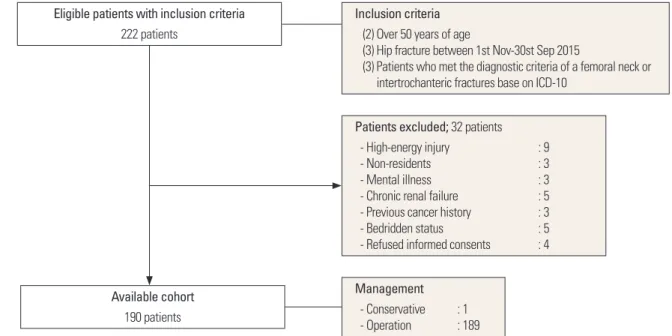
During study periods, 222 patients that sustained a hip fracture and who were treated at one of the six participat- ing hospitals were identified as possible candidates for this study. Thirty-two patients were excluded for the following reasons; nine for a high-energy injury resulting from a traf- fic accident or a fall from height, three because they were non-residents, three for mental illness, five for chronic re- nal failure, three for previous cancer history, five for bedrid- den status, and four who refused informed consents (Fig.
1). One hundred ninety patients (37 men and 153 women) patients with a hip fracture, 97 femoral neck fractures (51.1%) and 93 intertrochanteric fractures (48.9%) were enrolled.
Mean age at time of diagnosis was 79.9 years (72.8 years in men [range, 52-95 years]; and 81.6 years in women [range, 50-101 years]). Of these 190 patients, 189 patients under- went surgery, but one patient underwent conservative treatment for a non-displaced fracture (Table 1).
Eight of the 190 patients had received a diagnosis of os- teoporosis prior to hip fracture, but only two of these eight were taking prescribed osteoporosis medications at time of admission. After education sessions, DXA was performed on 115 patients (60.5%) during admission and first visit of
Fig. 1. Flow of the cohort study. ICD-10, International Classification of Diseases, 10th revision.
Available cohort 190 patients
Inclusion criteria (2) Over 50 years of age
(3) Hip fracture between 1st Nov-30st Sep 2015
(3) Patients who met the diagnostic criteria of a femoral neck or intertrochanteric fractures base on ICD-10
Patients excluded; 32 patients - High-energy injury : 9
- Non-residents : 3
- Mental illness : 3
- Chronic renal failure : 5 - Previous cancer history : 3
- Bedridden status : 5
- Refused informed consents : 4
Management - Conservative : 1 - Operation : 189 Eligible patients with inclusion criteria
222 patients
out-patients clinics after discharge; at the hip and spine in 90 and at the spine in 25. Of them, there were 95 patients (82.6%) in osteoporosis (T-score≤-2.5), 16 patients (13.9%) in osteopenia (-2.5<T-score<-1) and four patients in normal.
Of these 115 patients, 92 patients (80%) were prescribed osteoporosis medications (73 patients [79.3%] in bisphos- phonates, 16 patients in SERM, and 3 in PTH) at time of dis- charge and first visit of out-patients clinic after discharge.
Other anti-osteoporotic drugs, such as, calcitonin, and hor- mone replacement therapy were not prescribed. At six mon- ths follow-up, 83 patients (72.2%) were maintained osteo-
porosis medications (67 patients in bisphosphonates, 13 patients in SERM, and 3 in PTH). Six patients were stopped medication due to gastrointestinal-related complication and 3 patients were loss of follow-up. At 12 months follow- up, 74 patients (64.3%) were maintained osteoporosis med- ications (63 patients in bisphosphonates and 11 patients in SERM). Two patients were refused osteoporosis medica- tions due to difficulty of medication and/or complications.
Six patients were died during follow-up. One patient was lost of follow-up at 12 months follow-up.
DISCUSSION
Undertreatments of osteoporosis in patients with hip fracture are notorious and considering problems to over- come. We found that improvement of patient’s awareness through education could lead to increase rate of detection and treatment of osteoporosis after hip fracture. Compar- ing with previous reports (36.4% of BMD testing and 23.1%
of osteoporosis medication) in the same cohort,[13] edu- cation of patients with hip fracture are increasing 60.5% of BMD testing, and 48.4% of osteoporosis medication at dis- charge and 40.2% of osteoporosis medication at the 12 months follow-up.
Several interventional studies for improving osteoporo- sis management following hip fracture have demonstrated that patients and/or physicians education can lead to im- provement of initiation rate of anti-osteoporosis medica- tions in patients with hip fracture.[14-19] Previously, we performed interventional study for improving orthopaedic surgeon awareness and reported an improved medication rate of osteoporosis from 15% to 32% in patients with hip fracture.[12] However, 32% of the osteoporosis treatment rate at six months following hip fracture was still lower than other intervention studies.[12] Therefore, we designed mul- timodal interventional study for patients and orthopaedic surgeons and resulted in improvement of osteoporosis med- ication from 23.1% to 40.2% at 12 months follow-up.
In terms of medication persistence in interventional study, for preventive effect of osteoporotic fracture, anti-osteopo- rosis medication should be taken for minimum 6 months.
[20] However, medication duration times in several studies are relatively short within 6 months.[20] Increasing rate of osteoporosis medication in patient with hip fracture use beyond 6 months of the intervention ranged from 16% to Table 1. Patient’s demographic data
Number of patients (hips) 222
Exclude of patients 32
High-energy injury 9
Non-residents 3
Mental illness 3
Chronic renal failure 5
Previous cancer history 3
Bedridden status 5
Refused informed consents 4
Participant patients 190
Hospitals (six hospitals, hips)
1 90
2 36
3 22
4 21
5 16
6 5
Men:Women 37 (19.5%):153 (80.5%)
Age (year) (mean) 79.9
Man 72.8 (range, 52-95)
Woman 81.6 (range, 50-101)
Diagnosis
Neck 97 (51.1%)
Intertrochanter 93 (48.9%)
Management
Conservative 1 (0.5%)
Operation 189 (99.5%)
DXA
Prior to hip fracture 8 (4.2%)
After hip fractue 115 (60.5%)
Osteoporosis (-2.5≥T-score) 95 (82.6%) Osteopenia (-1>T-score>2.5) 16 (13.9%)
Normal 4 (3.5%)
DXA, dual energy X-ray absorptiometry.
34.1% (Table 2).[14-19] Our findings are corresponded with other previous reports. In this study, comparing with con- trol group, increasing rate of anti-osteoporosis medication was increased by 17.2% and medication persistence was 40.2% at the 12 months follow-up. Especially, intervention study for patients with hip fracture is important advan- tage, because patients after surgical intervention should be recommended regularly scheduled visits for radiologi- cal and clinical evaluations.
So far, intervention studies have involved one or two spe- cific centers, and it is difficult to extrapolate their results at other university and local hospitals. The results of this multi- center study could be shown possibility to expendable an effective and easily applied intervention method in osteopo- rotic patients with a hip fracture. The fracture liaison servic- es for hip fracture patients have been introducing since last decade. Fracture liaison services are proven as an effective method to address the post-fracture care gap, cost effec- tiveness, and to reduce the risk of secondary fracture.[11,21- 23] Program of fracture liaison service are mainly consisted with patient’s education including knowledge of osteoporo- sis, importance of anti-osteoporosis medications, calcium and vitamin D rich food intake, and physical exercise.[24]
Education programs in this study were very similar to pro- gram of fracture liaison service. Therefore, success of this prospective multicenter interventional study was shown possibility of conversion to fracture liaison service in Korea.
This study has some limitations. First, this study was per- formed in various hospital settings within the same cohort, although education programs were standardized in all in- stitutions. Second, the medical care system in Korea is not a same to other countries, because orthopedic surgeons undertake the role of primary care physicians after surgery.
Therefore, the results of intervention programs in this study might be difficult to generalize in the other countries. How- ever, recent studies have shown that the active participa- tion of orthopedic surgeons is possible to improve osteo- porosis treatment in patients with hip fracture. Finally, com- paring control study, two hospitals had to exclude because of IRB permission. This change might have influenced on the outcomes.
CONCLUSIONS
In conclusion, the osteoporosis detection and medica- Table 2. Interventional study of osteoporosis treatment after hip fracture since last AuthorStudy designTrial subjectInterventionFollow-upOutcomes (Control)Outcomes (Intervention) Majumdar et al. [14]Prospective RCTPhysician, patientsEducation6 monthsBMD scan 29% (32/110) Osteoporosis Tx 22% (24/110)BMD scan 80% (88/111) Osteoporosis Tx 51% (56/110) Miki et al. [15]Prospective RCTPhysician, patientsEducation6 monthsBMD scan 29% (7/24) Osteoporosis Tx 29% (7/24)BMD scan 100% (26/26) Osteoporosis Tx 58% (15/26) Morrish et al. [16]Prospective RCTPatientsEducation12 monthsBMD scan 68% (75/110) Osteoporosis Tx 38% (42/110)BMD scan 88% (88/110) Osteoporosis Tx 54% (59/110) Piziak and Rajab [17]Prospective nonrandomizedPatientsOsteoporosis consultation6 monthsOsteoporosis Tx 12.4% (17/137)Osteoporosis Tx 47.5% (65/137) Kandel et al. [18]Prospective nonrandomizedPatientsEducation3 months 6 monthsOsteoporosis Tx 19% (17/137) Osteoporosis Tx 19% (17/137)Osteoporosis Tx 19% (65/137) Osteoporosis Tx 39% (65/137) Sjöberg and Wallerstedt [19]Prospective RCTPhysicianEducation12 monthsOsteoporosis Tx 58% (1/31)Osteoporosis Tx 77% (28/53) Current studyProspective before and after multicenter studyOrthopaedic sur- geon, PatientsEducationAt dischargeBMD scan 36.4% (344/945) Osteoporosis Tx 23.1% (218/945)BMD scan 60.5% (115/190) Osteoporosis Tx 48.4% (92/190) 6 monthsOsteoporosis Tx 43.7% (83/190) 12 monthsOsteoporosis Tx 40.2% (74/184) RCT, randomized controlled trial; BMD, bone mineral density; Tx, treatment.
tion rate after hip fracture increased two fold after the mul- timodal approach with orthopaedic surgeon and patients.
This interventional multicenter study demonstrate that patients education program in patients with hip fracture can improve osteoporosis medication and well maintained up to 12 months follow-up and could be possible to po- tentially converse to fracture liaison service.
ACKNOWLEDGMENT
This research was supported by a grant of the Korea Health Technology R&D Project through the Korea Health Indus- try Development Institute (KHIDI), funded by the Ministry of Health & Welfare, Korea (grant number : HI13C1522, HI15C1189).
REFERENCES
1. Ha YC, Park YG, Nam KW, et al. Trend in hip fracture inci- dence and mortality in Korea: a prospective cohort study from 2002 to 2011. J Korean Med Sci 2015;30:483-8.
2. Ha YC, Kim TY, Lee A, et al. Current trends and future pro- jections of hip fracture in South Korea using nationwide claims data. Osteoporos Int 2016;27:2603-9.
3. Abrahamsen B, van Staa T, Ariely R, et al. Excess mortality following hip fracture: a systematic epidemiological re- view. Osteoporos Int 2009;20:1633-50.
4. Choi HJ, Shin CS, Ha YC, et al. Burden of osteoporosis in adults in Korea: a national health insurance database study.
J Bone Miner Metab 2012;30:54-8.
5. Lee SR, Ha YC, Kang H, et al. Morbidity and mortality in Jeju residents over 50-years of age with hip fracture with mean 6-year follow-up: a prospective cohort study. J Ko- rean Med Sci 2013;28:1089-94.
6. Lee YK, Ha YC, Yoon BH, et al. Incidence of second hip frac- ture and compliant use of bisphosphonate. Osteoporos Int 2013;24:2099-104.
7. Lee YK, Ha YC, Choi HJ, et al. Bisphosphonate use and sub- sequent hip fracture in South Korea. Osteoporos Int 2013;
24:2887-92.
8. Lyles KW, Colón-Emeric CS, Magaziner JS, et al. Zoledronic acid and clinical fractures and mortality after hip fracture.
N Engl J Med 2007;357:1799-809.
9. Shibli-Rahhal A, Vaughan-Sarrazin MS, Richardson K, et al.
Testing and treatment for osteoporosis following hip frac-
ture in an integrated U.S. healthcare delivery system. Os- teoporos Int 2011;22:2973-80.
10. Lai MM, Ang WM, McGuiness M, et al. Undertreatment of osteoporosis in regional Western Australia. Australas J Age- ing 2012;31:110-4.
11. Bogoch ER, Elliot-Gibson V, Beaton DE, et al. Effective initi- ation of osteoporosis diagnosis and treatment for patients with a fragility fracture in an orthopaedic environment. J Bone Joint Surg Am 2006;88:25-34.
12. Kim SR, Ha YC, Park YG, et al. Orthopedic surgeon’s aware- ness can improve osteoporosis treatment following hip fracture: a prospective cohort study. J Korean Med Sci 2011;
26:1501-7.
13. Kim SR, Park YG, Kang SY, et al. Undertreatment of osteo- porosis following hip fractures in jeju cohort study. J Bone Metab 2014;21:263-8.
14. Majumdar SR, Beaupre LA, Harley CH, et al. Use of a case manager to improve osteoporosis treatment after hip frac- ture: results of a randomized controlled trial. Arch Intern Med 2007;167:2110-5.
15. Miki RA, Oetgen ME, Kirk J, et al. Orthopaedic manage- ment improves the rate of early osteoporosis treatment after hip fracture. A randomized clinical trial. J Bone Joint Surg Am 2008;90:2346-53.
16. Morrish DW, Beaupre LA, Bell NR, et al. Facilitated bone mineral density testing versus hospital-based case man- agement to improve osteoporosis treatment for hip frac- ture patients: additional results from a randomized trial.
Arthritis Rheum 2009;61:209-15.
17. Piziak VK, Rajab MH. An effective team approach to im- prove postoperative hip fracture care. J Orthop Trauma 2011;25:72-5.
18. Kandel L, Schler D, Brezis M, et al. A simple intervention for improving the implementation rate of a recommend- ed osteoporosis treatment after hip fracture. Endocr Pract 2013;19:46-50.
19. Sjöberg C, Wallerstedt SM. Effects of medication reviews performed by a physician on treatment with fracture-pre- venting and fall-risk-increasing drugs in older adults with hip fracture-a randomized controlled study. J Am Geriatr Soc 2013;61:1464-72.
20. Gallagher AM, Rietbrock S, Olson M, et al. Fracture out- comes related to persistence and compliance with oral bisphosphonates. J Bone Miner Res 2008;23:1569-75.
21. Sale JE, Beaton D, Posen J, et al. Systematic review on inter-
ventions to improve osteoporosis investigation and treat- ment in fragility fracture patients. Osteoporos Int 2011;22:
2067-82.
22. Eisman JA, Bogoch ER, Dell R, et al. Making the first frac- ture the last fracture: ASBMR task force report on second- ary fracture prevention. J Bone Miner Res 2012;27:2039- 46.
23. Ganda K, Puech M, Chen JS, et al. Models of care for the
secondary prevention of osteoporotic fractures: a system- atic review and meta-analysis. Osteoporos Int 2013;24:393- 406.
24. Bogoch ER, Elliot-Gibson V, Beaton D, et al. Fracture pre- vention in the orthopaedic environment: outcomes of a coordinator-based fracture liaison service. J Bone Joint Surg Am 2017;99:820-31.