• 검색 결과가 없습니다.

Effect of Surfactant on the Physical Properties and Crosslink Density of Silica Filled ESBR Compounds and Carbon Black Filled Compounds

N/A
N/A
Protected

Academic year: 2021

Share "Effect of Surfactant on the Physical Properties and Crosslink Density of Silica Filled ESBR Compounds and Carbon Black Filled Compounds"

Copied!
9
0
0

로드 중.... (전체 텍스트 보기)

전체 글

(1)

Effect of Surfactant on the Physical Properties and Crosslink Density of Silica Filled ESBR Compounds and Carbon Black Filled Compounds

Kiwon Hwang, Woong Kim, Byungkyu Ahn, Hyunsung Mun, Eunho Yu, Donghyuk Kim, Gyeongchan Ryu, and Wonho Kim

Department of Polymer Science & Chemical Engineering, Pusan National University 2, Busandaehak-ro 63beon-gil, Geumjeong-gu, Busan 46241, Republic of Korea

(Received April 13, 2018, Revised May 10, 2018, Accepted May 24, 2018)

Abstract: Styrene-butadiene rubber (SBR) is widely used in tire treads due to its excellent abrasion resistance, braking per- formance, and reasonable cost. Depending on the polymerization method, SBR is classified into solution-polymerized SBR (SSBR) and emulsion-polymerized SBR (ESBR). ESBR is less expensive and environmentally friendlier than SSBR because it uses water as a solvent. A higher molecular weight is also easier to obtain in ESBR, which has advantages in mechanical properties and tire performance. In ESBR polymerization, a surfactant is added to create an emulsion system with a hydrophobic monomer in the water phase. However, some amount of surfactant remains in the ESBR during coag- ulation, making the polymer chains in micelles clump together. As a result, it is well-known that residual surfactant adversely affects the physical properties of silica-filled ESBR compounds. However, researches about the effect of residual surfactant on the physical properties of ESBR are lacking. Therefore, in this study we compared the effects of remaining surfactant in ESBR on the mechanical properties of silica-filled and carbon black-filled compounds. The crosslinking den- sity and filler-rubber interaction are also analyzed by using the Flory-Rehner theory and Kraus equation. In addition, the effects of surfactant on the mechanical properties and crosslinking density are compared with the effects of TDAE oil (a conventional processing aid).

Keywords: SSBR, silica filled compound, carbon black filled compound, surfactant, processing oil

Introduction

최근 차량의 성능이 향상됨에 따라 이에 적합한 고성능의 타이어 수요 역시 증가하였다. 이에 따라 타이어 제조업체에 서는 기존의 고성능 타이어(High Performance Tire, HPT)에 서 진일보한 초고성능 타이어(Ultra High Performance Tire, UHPT) 의 개발에 많은 노력을 기울이고 있다.

1-7

초고성능타이 어는 일반 타이어와 비교 시 연비성능(회전저항), 제동성능, 고속 주행 시 조종 안정성과 내마모성을 동시에 만족시켜야 하는데 이를 만족시키는 여러 가지 방법 중 기존의 카본블랙 대신 실리카를 충진제로 사용하는 방법을 많이 사용하고 있 다.

8-15

이 중 제동 성능은 주행 안전을 판단하는 성능으로써, 직접 도로 노면과 접촉하는 타이어 트레드가 큰 영향을 미친

다.

16,17

따라서 타이어 트레드용 고무 컴파운드에는 가격과 품

질적인 면을 고려하였을 때 제동능력이 우수한 styrene- butadiene rubber(SBR) 을 적용하여 많은 연구가 이루어지고 있다.

18-20

SBR 은 중합 방법에 따라 크게 emulsion polymerized styrene-

butadiene rubber (ESBR) 과 solution polymerized styrene- butadiene rubber (SSBR) 로 나뉘며, 물을 용매로 사용하는 ESBR 과 유기 용매를 사용하는 SSBR은 각기 다른 메커니즘 으로 중합된다. 타이어의 성능은 고무의 분자량에 많은 영향 을 받는데 분자량이 높을수록 우수한 효과를 보인다. ESBR 은 SSBR에 비해 제법이 친환경적이고 높은 분자량의 고분자 를 수득하기 용이해 기계적 물성에서 장점을 가진다. ESBR 합성의 경우 물을 용매로 사용하기 때문에 소수성인 단량체 층과 수용액 층의 혼합을 위하여 surfactant를 사용하는데 이 때 surfactant 양을 마이셀 임계 농도 이상으로 투입하여 사용 한다. 이 마이셀 내부에서 중합이 진행되어 라텍스 형태로 ESBR 을 얻을 수 있다. 일반적으로 수용액상에서 마이셀은 전 하를 띠고 있으므로 전기적 척력으로 서로를 밀어내고 있다.

이때, 라텍스에 염 또는 산을 투입하게 되면 전하를 띄는 마 이셀들이 전하를 상실하고, 서로 충돌하여 파괴된 후 마이셀 내부의 성장한 고분자 사슬들이 응집하게 된다. 이후 교반을 통해 고분자 입자의 크기를 키워주는데 이 과정에서 응집하 는 고분자 사슬 사이에 surfactant가 잔존하게 된다.

고분자 내에 남아있는 surfactant는 카본블랙을 충진제로 사

Corresponding author E-mail: [email protected]

(2)

용한 배합물에서는 타이어 표면에 석출되는 물질들을 타이어 트레드 표면에 균일하게 분산시켜 타이어 외관을 개선시킬 수 있지만 기계적 물성 및 마모에 악영향을 주는 것으로 알려져 있다.

21

또한 실리카를 충진제로 사용한 배합물 내에 서 충진 제의 분산을 향상시킬 수 있지만 이와 동시에 기계적 물성 및 마모에 악영향을 주고 높은 히스테리시스를 야기한다고 알려 져 있다.

22-25

하지만 고분자 내에 남아있는 surfactant가 실리카 컴파운드 에서 정확히 어떠한 역할을 하고 물성에 미치는 영향을 연구 한 결과는 부족한 상황이다. 따라서 본 연구에서는 고분자 내 에 남아있는 surfactant가 실리카를 충진제로 사용한 배합물의 기계적 물성에 미치는 영향을 카본블랙을 충진제로 사용한 배 합물과 비교 분석하고, Flory-Rehner theory와 Kraus equation 을 이용하여 가교밀도와 filler-rubber 사이의 상관관계에 미치 는 영향을 분석하고자 한다. 또한 기존의 가공조제인 treated distillate aromatic extracted (TDAE) oil 과 비교하여 기계적 물 성과 가교 밀도에 미치는 영향 및 가공조제로써 계면활성제 와 TDAE oil의 메커니즘의 차이를 비교 분석하기 위해 실험 을 진행하고자 한다.

Experimental

1. 실험재료

Raw polymer 는 SSBR (Kumho Petrochemical Co., styrene content : 26.5 wt%, vinyl content : 26 wt%, non-oil extended, SBR-5220M) 을 사용하였다. 충진제는 실리카(Ultrasil 7000 GR, Evonik) 와 카본블랙 (N330, Columbian Chemicals)을 사 용하였다. Silane coupling agent로 bis-(3-triethoxysilypropyl) disulfide (TESPD) 를 사용하였다. Surfactant는 KOH로 검화된 fatty soap ( 대원산업)를 사용하였으며 oil은 TDAE oil을 사용 하였다. Zinc oxide (ZnO)와 stearic acid는 가교활성제로, (1,3- dimethybutyl)-N’-phenyl-p-phenylenediamine (6PPD) 를 산화

방지제로 사용하였다. 가교시스템은 sulfur, N-cyclohexyl benzothiazyl sulfonamide (CBS), diphenyl guanidine (DPG) 를 함께 사용하였다. 가교구조 평가에는 tetrahydrofuran (THF), n-hexane, toluene (Daejung Chemicals & Metal) 이 용매로 사 용되었다.

2. 컴파운드 제조

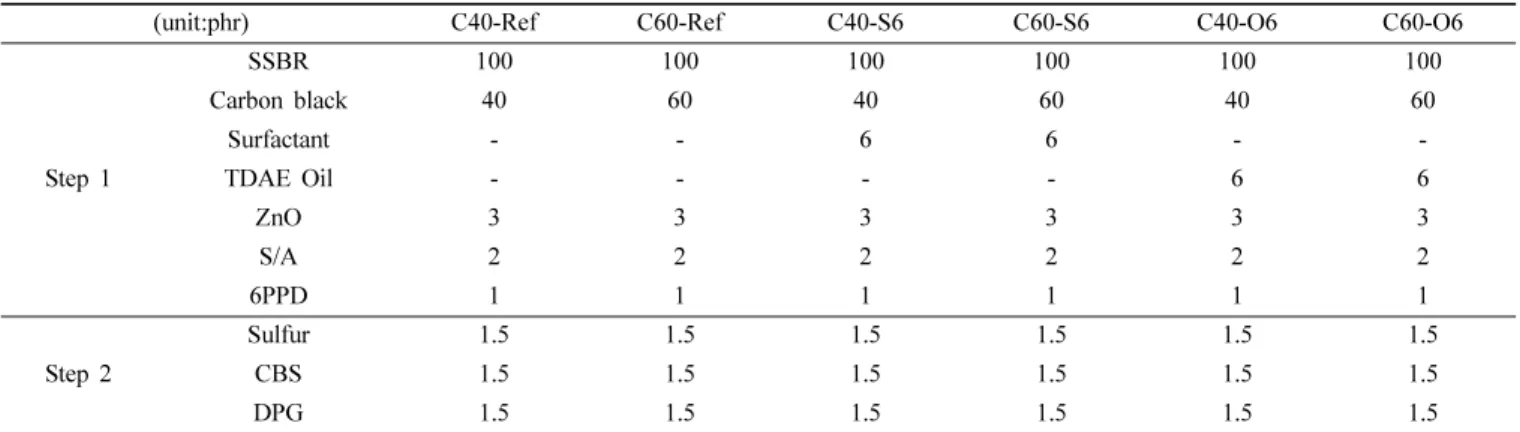
컴파운드 formulation은 Table 1과 Table 2에 나타내었다. 컴 파운드는 Banbury-type의 kneader (300 cc)를 사용하여 제조 되었고 fill factor는 0.7로 설정하여 2 단계에 걸쳐 진행하였 다. 1단계에서는 120°C로 혼련을 시작하여 dump 온도를 150

℃~155℃로 맞추어 총 7분 40초 간 혼련을 진행했다. 잔여하 는 surfactant가 컴파운드에 미치는 영향을 확인하기 위해 surfactant 를 초기에 고무와 함께 투입하였고, 이 후 실리카와 실란을 투입하여 2분 간, ZnO와 stearic acid, 6PPD를 투입한 이후 5분 간 혼련해주었다. 1단계 혼련이 끝난 이후 sulfur와 cure accelerator 를 투입한 후 2분 간 혼련하였다. 자세한 과정 은 Table 3에 나타내었다. 모든 혼련이 끝난 이후 유압 프레 스를 이용하여 160℃ 조건에서 최적가황시간(t

90

) 동안 가류 하여 가황물을 제조하였다.

2.1. 가황 특성(cure characteristics) 측정

Two-roll mill 에서 제조된 컴파운드의 가황 특성은 moving die rheometer (RLR-3; rotorless rheometer, Toyoseiki, Japan) 을 이용하여 20분 동안 진동각 ± 1°, 온도 160℃를 유지한 상 태에서 토크 값을 측정하였다.

2.2. Mooney viscosity 측정

Mooney viscometer 을 이용하여 viscosity를 측정하며 metal disk 를 회전시키는데 필요한 토크값을 측정하여 값을 출력한 다. 1 분 동안 예열한 뒤 4 분 동안 100℃에서 large disk ( φ 38.10 ± 0.05 mm, 두께 5.5 ± 0.05 mm)를 2 rpm으로 작동

Table 1. Formulations of Silica Filled SBR Compounds with Surfactant & TDAE Oil

(unit:phr) S40-Ref S60-Ref S40-S6 S60-S6 S40-O6 S60-O6

Step 1

SSBR 100 100 100 100 100 100

Silica 40 60 40 60 40 60

TESPD 3.2 4.8 3.2 4.8 3.2 4.8

Surfactant - - 6 6 - -

TDAE Oil - - - - 6 6

ZnO 3 3 3 3 3 3

S/A 2 2 2 2 2 2

6PPD 1 1 1 1 1 1

Step 2

Sulfur 1.5 1.5 1.5 1.5 1.5 1.5

CBS 1.5 1.5 1.5 1.5 1.5 1.5

DPG 1.5 1.5 1.5 1.5 1.5 1.5

(3)

시켜 측정하였다.

2.3. Panye effect 측정

Payne effect 는 ASTM D 8059를 이용하여 rubber process analyzer (RPA 2000, Alpha Technologies, USA) 로 측정하였다.

2.4. DSC 측정

열적 특성은 시차 주사열량계(Instrument DSC Q20 V24.11 Build 124) 를 사용하였다. 열 분석 시 질소가스를 50 mL/min의 속도로 공급하며 −40℃~100℃의 온도범위에서 측정하였다.

2.5. 기계적 특성(mechanical properties) 측정

기계적 특성은 ASTM D 412에 따라 100 mm(길이) × 25 mm( 너비) × 2 mm(두께)의 시편을 제작하여 universal testing machine (UTM; KSU-05M-C, KSU Co. Korea) 을 이용하여 신 장률과 인장강도를 측정하였다.

2.6 가교 구조(crosslink structure) 평가

가교구조는 가교밀도를 측정하여 평가하였다. 10 mm × 10 mm 크기로 가황된 시편을 자른다. 그 후 THF (30 mL)와 n- hexane (30 mL) 를 용매로 각각 2일, 1일간 샘플을 침지시켜 샘플 내부의 유기첨가물을 제거한 후 실온에서 1일간 건조시

킨다. 완전 건조 후 유기 첨가물이 추출된 샘플의 중량을 측 정한다. 그리고 이 샘플을 toluene 30 mL에 24시간 동안 침 지시켜 평량한 후 Flory-Rehner equation을 사용해 전체 가교 밀도를 측정하였다.

X : polymer-solvent interaction parameter v : crosslink density (mol/g)

M

c

: average molecular weight between crosslink points (g/mol) V

1

: volume fraction of rubber in the swollen gel at equilib-

rium

V

0

: molar volume of solvent (cm

3

/mol) ρ

r

: density of the rubber sample (g/cm

3

).

V

1

은 다음 식에서 구한다.

W

d

: 팽윤 후 건조된 시편의 질량 v = 1

2M

c

--- ln 1 V ( –

1

) V +

1

+ XV

12

2 ρ

r

V

0

V

11/3

V

1

--- 2

⎝ – ⎠

⎛ ⎞

---

V

1

=

W

d

– W

f

ρ

r

--- W

d

– W

f

ρ

r

--- W

s

– W

d

ρ

s

--- +

--- Table 2. Formulations of Carbon Black Filled SBR Compounds with Surfactant & TDAE Oil

(unit:phr) C40-Ref C60-Ref C40-S6 C60-S6 C40-O6 C60-O6

Step 1

SSBR 100 100 100 100 100 100

Carbon black 40 60 40 60 40 60

Surfactant - - 6 6 - -

TDAE Oil - - - - 6 6

ZnO 3 3 3 3 3 3

S/A 2 2 2 2 2 2

6PPD 1 1 1 1 1 1

Step 2

Sulfur 1.5 1.5 1.5 1.5 1.5 1.5

CBS 1.5 1.5 1.5 1.5 1.5 1.5

DPG 1.5 1.5 1.5 1.5 1.5 1.5

Table 3. A Compounding Procedure

Time Action RPM

Step 1 (120℃)

0:00 – 0:40 (40 sec) rubber, surfactant or TDAE oil 20

0:40 – 1:40 (1 min) silica 1/2 + silane 1/2 40

1:40 – 2:40 (1 min) silica 1/2 + silane 1/2 40

2:40 – 4:40 (2 min) ZnO, St/A, 6PPD 50

4:40 – 5:00 (20 sec) ram up and sweep 50

5:00 – 7:40 (2 min 40 sec) extra mix and dump 50

Step 2 (50℃)

0:00 – 0:20 (20 sec) mix 1 st MB 20

0:20 – 1:00 (40 sec) sulfur, cure accelerator (CBS, DPG) 40

1:00 – 2:00 (1 min) extra mix and dump 40

(4)

W

f

: 시편에서의 필러의 질량 W

s

: 팽윤된 시편의 질량 ρ

s

: 용매의 밀도 ρ

r

: 고무의 밀도

X는 polymer와 용매의 interaction parameter로 고무의 종류 및 분자량, 용매의 종류, 온도, 가교구조 등에 따라 변한다.

β

1

: 0.34

V

0

: molar volume of solvent (cm

3

/mol) δ

p

: solubility parameter of polymer δ

s

: solubility parameter of solvent

2.7. 결합 고무(bound rubber) 평가

고무 컴파운드 0.2 ± 0.05 g의 샘플을 철망에 넣고 toluene 을 용매로 100 mL에 6일간 보관한다. 3일째 되는 날에 용매 를 한번 갈아준다. 추출 후 철망을 100 mL 아세톤에 하루 동 안 넣는다. 이후 샘플을 실온에서 하루 동안 건조한 후 값을 측정하였다.

R

B

: bound rubber content (%) W

fg

: weight of the filler and gel

W

t

: weight of the sample before immersion

m

f

: weight of fraction of the filler in the compound m

r

: weight fraction of rubber in the compound

Results and Discussion

1. Cure characteristic & Mooney viscosity

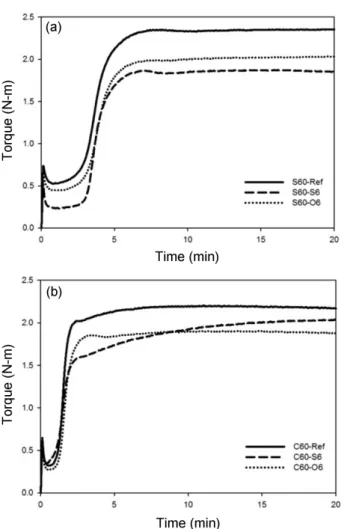
가황특성과 Mooney 점도의 값은 Table 4에 나타내었다.

Surfactant 와 oil을 적용한 경우 reference 컴파운드 대비 Mooney 점도 값과 torque값의 감소를 확인 할 수 있었다. 투

입해 준 surfactant와 oil이 컴파운드 내에서 가공 조제로써 역 할을 하여 나타난 결과로 판단된다. 하지만 실리카를 충진제 로 사용한 경우 surfactant를 적용한 컴파운드에서, 카본블랙 을 충진제로 사용한 경우 oil을 적용한 컴파운드에서 보다 낮 은 Mooney 점도와 T

min

값을 나타내었다. 이는 두 가공 조제 의 메커니즘 차이에서 기인한 것으로 판단된다. 기본적으로 surfactant 와 oil은 고분자 사슬 사이에서 미끌림을 유발시킬 수 있다. Oil을 사용한 경우 실리카와 카본블랙 컴파운드에 delta torque 와 Mooney 점도에서 reference 컴파운드 대비 비 X = β

1

+ V

0

RT --- ( δ

p

– δ

s

)

2

R

B

( ) = % W

fg

– W

t

[ m

f

/ m (

f

+ m

r

) ] W

t

[ m

r

/ m (

f

+ m

r

) ]

--- × 100

Figure 1. Cure characteristics of SBR compounds with (a) silica filled and (b) carbon black filled.

Table 4. Cure Characteristic and Mooney Viscosity of SBR Compounds

S60-Ref S60-S6 S60-O6 C60-Ref C60-S6 C60-O6

t 10 (min) 02:43 03:06 02:57 01:11 01:03 01:17

t 90 (min) 05:15 05:07 05:27 02:21 08:00 02:27

Cure rate (N-m/min) 1.034 1.123 0.874 2.651 1.228 1.904

T min (N-m) 0.524 0.230 0.444 0.320 0.346 0.271

T max (N-m) 2.357 1.873 2.034 2.202 2.040 1.904

ΔT (N-m) 1.833 1.643 1.590 1.882 1.694 1.633

ML 1+4 139.2 105.8 120.3 115.7 112.7 94.4

(5)

슷한 정도의 감소 효과를 보여주었고, 고무 사슬 사이에서 미 끌림을 유도하는 것이 주된 메커니즘으로 가공 조제로써 역 할을 하는 것으로 판단된다. 이와 달리 surfactant의 경우 실 리카 컴파운드에서는 가공조제로써 충분히 역할을 하지만 카 본블랙 컴파운드에서는 가공조제로써의 역할을 충분히 하지 못하였다. 실리카 컴파운드에서는 surfactant가 미끌림을 유발 시키는 것과 동시에 실리카의 표면에 흡착되어 실리카를 소 수화시켜 분산을 도와 filler 응집을 감소시키며 가공조제로써 역할을 한다. 하지만 카본블랙 컴파운드에서는 surfactant가 카본블랙 표면에 흡착되지 못한다. 잔존하는 surfactant는 K

+

이온이 다량 존재하기 때문에 본 실험에서 사용된 촉진제인 CBS 로부터 형성되는 mercaptobenzothiazole (MBT)와 반응하 여 가류 촉진을 저해시킨다.

26-30

따라서 컴파운드 내에 잔존 하는 surfactant가 촉진제와 반응하여 가류 촉진을 방해하고 marching 현상을 유발하며, 카본블랙 컴파운드에서 가공조제 로써 역할을 하지 못하였다.

2. Bound rubber contents

Bound rubber 의 측정결과를 Table 5에 나타내었다. Bound rubber 측정 결과, 가공 조제가 투입된 컴파운드의 bound rubber 함량이 전반적으로 낮아짐을 확인할 수 있다. 일반적 으로, 실리카의 경우 카본블랙 대비 높은 filler-filler interaction 으로 인하여 보다 많은 실리카 응집이 형성되어 더 많은 양 의 occluded rubber 가 존재한다.

31

이로 인하여 실리카 충진 컴파운드가 카본블랙 충진 컴파운드와 비교하여 bound rubber 함량이 높게 측정되었다. 하지만, 실리카 컴파운드에서 surfactant 를 가공조제로 투입하였을 때는 실리카의 표면에 surfactant 가 흡착되어 실리카 응집을 줄일 수 있기 때문에 surfactant 를 적용한 S60-S6 컴파운드의 bound rubber 함량은 S60-Ref 나 S60-O6에 비해 크게 감소한 것으로 나타났다. 카 본블랙을 충진제로 사용한 컴파운드의 경우 surfactant가 충진 제에 흡착되지 않아 단순히 고분자 사슬 사이의 미끌림만을 유도하며 가공조제로써 역할을 한다. Oil을 적용한 컴파운드 의 경우 oil이 카본블랙에 흡착되어 고분자와 충진제 사이의 interaction 을 방해하기 때문에

32

bound rubber 함량이 가장 낮 았다.

3. Payne effect

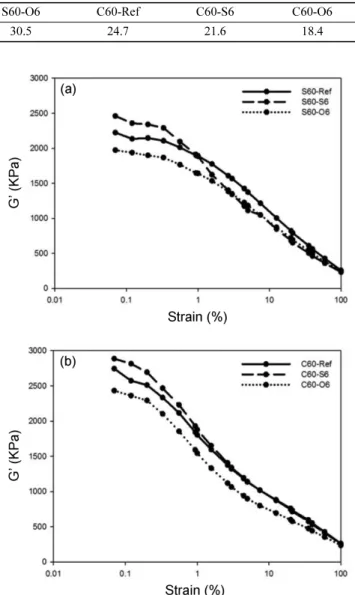
Payne effect 의 측정결과를 Table 6에 나타내었다. Surfactant 가 가공조제로 투입된 경우 실리카와 카본블랙을 사용한 컴 파운드 모두 초기의 G’ 값이 높게 측정되어 가황특성과 bound rubber 측정결과의 경향과 맞지 않는 결과를 나타내었다. 이 는 투입한 surfactant의 crystallization이 원인으로 판단된다.

33

사용한 surfactant를 이용한 DSC 측정 결과 20℃~70℃까지 넓 은 흡열 peak가 관측되는데, 이는 surfactant의 탄화수소 사슬 Table 5. Bound Rubber Contents of SBR Compounds

S60-Ref S60-S6 S60-O6 C60-Ref C60-S6 C60-O6

Bound rubber contents (%) 38.1 18.1 30.5 24.7 21.6 18.4

Figure 2. Payne effect of SBR compounds with (a) silica filled and (b) carbon black filled.

Table 6. Payne Effect of SBR Compounds

S60-Ref S60-S6 S60-O6 C60-Ref C60-S6 C60-O6

△G’ (KPa) (0~100%) 1969 2230 1731 2483 2631 2197

△G’ (KPa) (5~21%) 583 461 490 426 404 321

(6)

수가 12~15개 사이로 crystallization temperature (T

c

) 가 64℃

것을 확인하였다. 따라서 Payne effect는 60℃에서 측정되므 로 crystallization에 의해 낮은 strain 영역에서 높은 G’ 값을 가지는 것을 확인할 수 있다. Surfactant에 의해 형성된 높은 G’ 값은 3% 정도의 strain이 가해지면 사라지게 되고, Payne effect 의 신뢰성이 높은 5%~20% strain 구간

34

에서 ΔG’을 측 정할 경우 surfactant를 가공조제로 투입한 실리카 컴파운드에 서 가장 낮은 값을 나타내었다. 이는 surfactant가 실리카 응 집을 줄여주어 충진제의 분산을 향상시킬 수 있었음을 확인 할 수 있다.

4. Mechanical properties

SBR 의 기계적 특성과 마모량 등은 Table 7에 나타내었다.

일반적으로 M

300%

는 filler-rubber interaction의 척도라고 알려 져 있는데

35

가공 조제가 적용된 경우 낮은 값을 나타내는 것 을 확인할 수 있다. 충진제의 보강효과로 알려진 M

300%

/M

100%

값을 보게 되면 카본블랙 컴파운드에서는 가공조제에 따른 차 이가 미미하지만, 실리카 컴파운드에서는 surfactant가 투입된 컴파운드의 경우 낮은 값을 나타내었다. 이는 surfactant가 충 진제에 흡착되어 가공 조제로써 역할을 하는 동시에 실리카 표면에서 실란의 실란화 반응을 감소시키기 때문에 충진제의

보강 효과 역시 떨어뜨렸음을 알 수 있다.

36

DIN 마모량 역시 앞선 M

300%

결과와 동일한 경항을 보여주고 있고 가공 조제 가 적용 될 경우 충진제 보강 효과가 떨어지고 filler-rubber interaction 가 감소됨을 나타내고 있다.

5. Crosslink density and filler-rubber interaction

Swelling test 를 이용하여 계산된 가교밀도를 Table 8에 나 Figure 3. DSC thermogram of surfactant.

Figure 4. Mechanical properties of SBR compounds with (a) silica filled and (b) carbon black filled.

Table 7. Mechanical Properties of SBR Compounds

S60-Ref S60-S6 S60-O6 C60-Ref C60-S6 C60-O6

Hardness (shore A) 71 67 65 69 68 66

M 100% (kgf/cm 2 ) 30.3 25.6 23.6 39.6 38.0 31.0

M 300% (kgf/cm 2 ) 131.6 89.1 97.5 179.1 168.3 143.5

M 300% /M 100% 4.34 3.48 4.13 4.52 4.43 4.62

Tensile strength (kgf/cm 2 ) 165.9 156.3 196.2 226.8 222.7 203.0

Elongation (%) 347 442 482 377 397 409

DIN Abrasion (mg) 127.7 162.9 140.3 146.0 155.6 162.4

(7)

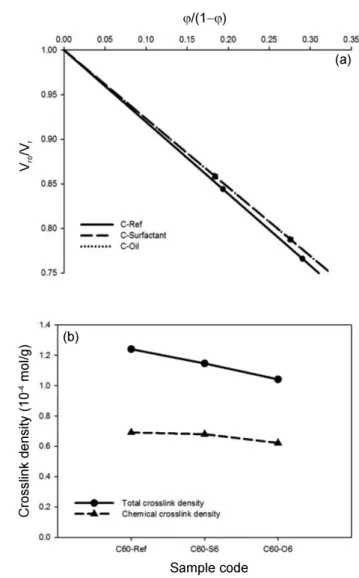
타내었다. Boonstra와 Kraus et al.에 따르면

37,38

rubber 와 강하 게 상호작용 할 수 있는 adhering filler를 rubber 컴파운드에 적용하는 경우, 비 충진 고무에서 고무의 부피 분율(V

r0

) 과 충 진 된 고무에서 고무의 부피 분율(V

r

) 의 비(V

r0

/V

r

) 는 충진제 의 함량(φ)이 증가함에 따라 감소한다. Kraus가 제안한 식에 서 기울기(m) 값이 filler-rubber interaction의 지표로 사용된다.

또한, swelling을 통해 얻어진 V

r

값과 선형 회귀분석으로부 터 얻은 V

r0

값을 Flory-Rehner 방정식에 대입하면 총 가교밀 도와 황에 의한 화학적 가교밀도를 얻을 수 있다. 앞서 얻어 진 총 가교밀도와 황에 의한 화학적 가교밀도의 차이는 filler- rubber interaction 의 크기를 나타낸다.

35

카본블랙 컴파운드에서 인장과 마모 실험 결과 값이 가교 밀도와 동일한 경향을 보이고 특히 총 가교밀도의 감소가 기 계적 특성의 감소에 영향을 미치는 것을 확인할 수 있다.

Surfactant 는 카본블랙에 흡착되지 않고 고무 사슬 사이에서 미끌림만을 유발하는 가공조제로써 역할을 하기 때문에 가교 밀도의 감소에 큰 영향을 못하였다. 실리카 컴파운드의 경우 에도 mechanical properties의 전반적인 결과값이 가교밀도와 유사한 경향을 보이는 것을 확인할 수 있다. Surfactant를 사 용할 경우 surfactant가 실리카의 표면에 흡착되면서 실란의 실란화가 감소되기 때문에 생긴 효과로 보인다. 하지만 앞선 기계적 특성의 결과에서 충진제 보강 효과가 감소하고 filler- Figure 5. Kraus plot (a) and crosslink density (b) of silica filled

SBR compounds.

Figure 6. Kraus plot (a) and crosslink density (b) of carbon black filled SBR compounds.

Table 8. Crosslink Density of SBR Compounds.

S60-Ref S60-S6 S60-O6 C60-Ref C60-S6 C60-O6

Total crosslink density (10

4 mol/g) 1.1167 0.9581 0.9664 1.2409 1.1467 1.0419

Chemical crosslink density (10

4 mol/g) 0.8838 0.6879 0.8448 0.6917 0.6805 0.6225

Filler-rubber interaction (10

4 mol/g) 0.2329 0.2702 0.1216 0.5492 0.4662 0.4194

(8)

rubber interaction 이 감소한 결과를 보였지만 Kraus plot에서 의 기울기 값, 총 가교밀도와 황에 의한 화학적 가교밀도의 값 을 볼 때 filler-rubber interaction가 증가한 것으로 나타난다. 이 는 실리카에 흡착된 surfactant가 컴파운드 내에서 형성한 crystallization 이 swelling을 저해하기 때문에 인장과 마모 성 능 저하 결과와 달리 높은 filler-rubber interaction을 나타낸 것 으로 판단된다.

Conclusion

기본적으로 oil과 surfactant 모두 가공조제로써 고분자 사슬 사이의 slip을 유도할 수 있었다. Oil은 고분자 사슬 사이의 미 끌림을 유도하는 것이 가공조제로써의 주된 메커니즘으로 판 단된다. 하지만 surfactant의 경우 고분자 사슬 사이의 미끌림 이외에도 실리카의 표면에 흡착되어 실리카 응집을 줄이는 메 커니즘으로 작용하였다. 카본블랙 컴파운드와 비교해 보았을 때 실리카 표면에 흡착되어 실리카 응집을 줄여주는 것이 가 공조제로써 surfactant의 더 주된 메커니즘으로 판단된다.

Cure characteristic 과 bound rubber contents 결과를 통해 실 리카 표면에 흡착된 surfactant가 실리카 분산을 개선시킨 것 을 확인하였지만 Payne effect를 통해서는 실리카의 분산효과 를 확인할 수 없었다. 이는 잔존하는 surfactant가 컴파운드 내에서 crystallization 되어 초기 G' 값을 상승시켰기 때문으 로 판단된다. T

c

이하의 온도(60°C)에서 Payne effect 를 측정 한 결과 1%~2% 이상의 strain이 가해 질 경우에 crystallization 이 파괴되는 것으로 판단되고, Payne effect의 신뢰성이 높은 5%~20% 구간에서 ΔG’을 계산하였을 때 surfactant가 충진제 의 분산을 효과적으로 개선시킨 것을 확인할 수 있다.

또한 가공조제로써 surfactant와 oil이 적용되면, 실리카 컴 파운드와 카본블랙 컴파운드의 인장과 DIN 마모에서 불리한 결과를 나타내었다. 특히 실리카 컴파운드에서 surfactant는 충진제에 흡착되어 실리카 표면에서 실란의 실란화 반응을 감 소시키기 때문에 충진제의 보강 효과를 크게 떨어뜨린 것을 확인할 수 있다.

Swelling 을 통하여 total crosslink density와 chemical crosslink density 를 측정한 경우, surfactant를 투입한 실리카 컴파운드에서 물성의 감소 정도에 비해 상대적으로 total crosslink density 의 감소가 적게 측정되었다. 이는 잔존하는 surfactant 가 형성하는 crystallization에 의해 swelling이 덜 일 어난 현상에 기인하여 filler-rubber interaction의 값이 높게 측 정된 것으로 판단된다.

Acknowledgments

이 논문은 부산대학교 기본연구지원사업(2년)에 의하여 연 구되었음.

References

1. E. J. Blok, P. H. Sandstrom, W. Hsu, and A. F. Halasa, U.S.

Patent No. 5,994,448 (1999).

2. T. Fujimaki and N. Oshima, U.S. Patent No. 4,866,131 (1989).

3. D. A. Joyner, J. W. Kang, T. Hashimoto, K. Yuto, and B. L.

Stuck, U.S. Patent No. 5,272,203 (1993).

4. D. Alexander, “High-performance handling for street or track”, ed. by D. Alexander, p. 6-16, Motorbooks Interna- tional, Minneapolis, 2013.

5. B. Rampana, D. Tirelli, U. Kuhlmann, C. Cherif, C. Paul, R.

A. Torun, and O. Diestel, U.S. Patent No. 8,640,753 (2014).

6. B. L. Kim, U.S. Patent Application No. 14/750,914 (2017).

7. R. Shishoo, “Textile advances in the automotive industry”, ed.

by R. Shinshoo, p. 3-17, CRC press, New York, 2008.

8. S. Futamura, U.S. Patent No. 4,925,894 (1990).

9. Y. Li, M. Wang, T. Zhang, F. Zhang, and X. Fu, “Study on dis- persion morphology of silica in rubber”, Rubber Chem. Tech- nol., 67, 4 (1994).

10. U. Goerl, A. Hunsche, A. Mueller, and H. Koban, “Investiga- tions into the silica/silane reaction system”, Rubber Chem.

Technol., 70, 4 (1997).

11. W. H. Waddell, J. H. O'Haver, L. R. Evans, and J. H. Harwell,

“Organic polymer surface modified precipitated silica”, J.

Appl. Polym. Sci., 55, 12 (1995).

12. B. Boonstra, H. Cochrane, and E. Dannenberg, “Reinforce- ment of silicone rubber by particulate silica”, Rubber Chem.

Technol., 48, 4 (1975).

13. E. M. Cichomski, “Influence of physical and chemical poly- mer-filler bonds on tire wet-traction performance indicators for passenger car tire tread materials”, KGK. Kautschuk, Gummi, Kunststoffe, 67 (2014).

14. R. Rauline, U.S. Patent No. 5,227,425 (1993).

15. A. Kato, A. Tohsan, S. Kohjiya, T. Phakkeeree, P. Phin- yocheep, and Y. Ikeda, “Manufacturing and structure of rub- ber nanocomposites”, Progress in Rubber Nanocomposites, 415 (2017).

16. S. Kobayashi, S. Plotkin, and S. K. Ribeiro, “Energy effi- ciency technologies for road vehicles”, Energy Efficiency, 2, 2 (2009).

17. K. Holmberg, P. Andersson, and A. Erdemir, “Global energy consumption due to friction in passenger cars”, Tribol. Int., 47 (2012).

18. A. Roberts, “Lubrication studies of smooth rubber contacts”, The Physics of Tire Traction. ed. by F. H. Donald and L. B.

Alan, p. 179-196, Springer, Boston, MA, 1974.

19. R. Peterson, C. Eckert, and C. Carr, “Tread compound effects

in tire traction”, The Physics of Tire Traction. ed. by F. H.

(9)

Donald and L. B. Alan, p. 223-239, Springer, Boston, MA, 1974.

20. K. Grosch, “The rolling resistance, wear and traction proper- ties of tread compounds”, Rubber Chem. Technol., 69, 3 (1996).

21. P. H. Sandstrom, J. Zhao, A. S. Puhala, J. J. A. Verthe, P. B.

Maxwell, and E. J. Marazzi, U.S. Patent No. 9,205,704 (2015).

22. G. Heinrich and T. Vilgis, “Why silica technology needs S- SBR in high performance tires?: The physics of confined polymers in filled rubbers”, KGK. Kautschuk, Gummi, Kunst- stoffe, 61 (2008).

23. S. Park, S. Kil, B. Jang, K. Song, and S. Kim, “Influence of amine base dispersing agent on properties of silica filled rub- ber compounds”, Polymer Korea, 25, 4 (2001).

24. K. Kim and J. Vanderkooi, “Zinc surfactant effects on Nr/

Tespd/Silica and SBR/Tespd/Silica compounds”, Elast. and Compos., 39, 4 (2004).

25. H. Ismail, P. Freakley, I. Sutherland, and E. Sheng, “Effects of multifunctional additive on mechanical properties of silica filled natural rubber compound”, European Polym. J., 31, 11 (1995).

26. G. Heideman, J. W. M. Noordermeer, R. N. Datta, and B. van Baarle, “Activators in Accelerated Sulfur Vulcanization, A Review”, Rubber Chem. Technol., 77, 512 (2004).

27. G. Heideman, R. N. Datta, J. W. M. Noordermeer, and B. van Baarle, “Influence of Zinc Oxide in Different Stages of Sulfur Vulcanization elucidated by Model Compound Studies”, J.

Appl. Polym. Sci., 95, 6 (2004).

28. G. Heideman, J. W. M. Noordermeer, R. N. Datta, and B. van Baarle, “Effect of Zinc Complexes as Activator for Sulfur Vulcanization in Various Rubbers”, Rubber Chem.Technol., 78, 2 (2005).

29. W. S. Kim, D. H. Lee, I. J. Kim, M. J. Son, W. H. Kim, and S.

G. Cho, “SBR/organoclay nanocomposites for the application on tire tread compounds”, Macromolecular Research, 17, 10 (2009).

30. A. M. Joseph, B. George, K. Madhusoodanan, and R. Alex,

“Current status of sulphur vulcanization and devulcanization chemistry: Process of vulcanization”, Rubber Sci., 28, 1 (2015).

31. S. S Choi, “Difference in bound rubber formation of silica and carbon black with styrene-butadiene rubber”, Polym. Adv.

Technol., 13, 6 (2002).

32. M. J. Wang, T. Wang, Y. L. Wong, J. Shell, and K. Mahmud,

“NR/carbon black masterbatch produced with continuous liq- uid phase mixing”, KGK. Kautschuk und Gummi Kunststoffe, 55, 7 (2002).

33. A. Das, F. R. Costa, U. Wagenknecht, and G. Heinrich,

“Nanocomposites based on chloroprene rubber: Effect of chemical nature and organic modification of nanoclay on the vulcanizate properties”, European Polym. J., 44, 11 (2008).

34. B. Johan, “Measurement of the Payne effect”, Proceedings of the Conference on the VKRT meeting, May 5th, (2009).

35. J. Y. Lee, B. K. Ahn, W. Kim, H. S. Moon, H. J. Paik, and W.

H. Kim, “The effect of accelerator contents on the vulcanizate structures of SSBR/silica vulcanizates”, Compos. Interfaces, 24, 6 (2017).

36. Booth, V. A. “A study of silica-surface particle interactions”, M.S. Dissertation, Oregon Health & Science University (1994).

37. G. Kraus, “Swelling of filler reinforced vulcanizates”, J. Appl.

Polym. Sci., 7, 3 (1963).

38. B. Boonstra and E. Dannenberg, “The equilibrium swelling

data of filled natural rubber”, Rubber Age, 1 (1958).

수치

Table 1. Formulations of Silica Filled SBR Compounds with Surfactant & TDAE Oil
Table 3. A Compounding Procedure
Figure 1. Cure characteristics of SBR compounds with (a) silica filled and (b) carbon black filled.
Figure 2. Payne effect of SBR compounds with (a) silica filled and (b) carbon black filled.
+3

참조

관련 문서

Therefore, the present study aimed to (i) investigate the effect of surfactant on the solubility of valsartan and (ii) improve the dissolution profiles of valsartan

Noorul Haq : Effect of friction welding parameters on mechanical and metallurgical properties of ferritic stainless steel, The international journal of

The influence of normalized middle school physical education and after school sports club on personality. Kim

Effect of planting date on growth and seed yield of Danfa black

The effect of Combined Exercise program on Body composition, Physical fitness and thickness of subcutaneous fat in. Obese

In this regard, this study analyzes the effect of the job characteristics and work environment of workers with physical disabilities on job satisfaction

7 Effect of annealing temperature on the tensile properties of high manganese austenitic stainless steel with two phases of reversed austenite and

• highest occupied molecular orbitals (HOMOs) completely filled highest occupied molecular orbitals (HOMOs) completely filled with electrons.. • Cyclic compound