Effects of a Wrist Extension Splint on Muscle Power and Activities of the Forearm Muscles: Comparison of Day Versus Nighttime Wear Instructions
Ji-yeon Yoon, B.H.Sc., P.T.
Dept. of Physical Therapy, The Graduate School, Inje University Duk-hyun An, Ph.D., P.T.
Won-gyu Yoo, Ph.D., P.T.
Dept. of Physical Therapy, College of Biomedical Sciences and Engineering, Inje University
Abstract
1)The objective of this study was to compare the differences on the activity and power of the wrist flexors and extensors in subjects before the use of a wrist extension splint, after nighttime wearing of the splint, and after daytime wearing of the splint. Ten healthy male and ten healthy female students (mean: 22.4±1.2 years old) volunteered to wear custom-made wrist splints either during the night or dur- ing the day. The hand force of the wrist flexor and extensor, and grip force were measured by PowerTrackⅡ and Dynatron, respectively. At the same time, the activities of the wrist flexor and ex- tensor were recorded by surface electromyography. The maximal hand force and motor unit recruitment of the flexor carpi ulnaris (FCU) increased significantly (p<.05) when the subjects wore the wrist splints during the daytime, but the maximal hand power of the FCU decreased with nighttime use of the splints.
The maximal hand power and motor unit recruitment of the extensor carpi radialis (ECR) and the ECR/FCU ratio decreased both during nighttime and daytime use. The decrement of the ECR/FCU ratio was significant (p<.05). Wearing a wrist extension splint during nighttime led to the maintenance of a lengthened position of the wrist flexor, resulting in the wrist flexor becoming weak. Wearing a wrist ex- tension splint during the day induced the wrist flexors to be greater. In healthy people, the imbalance be- tween the wrist flexors and extensors may be caused by the use of a wrist extension splint. This study indicates that therapists have to consider whether a splint will be effective, as well as the wearing time, when prescribing splints to people with problems of the musculoskeletal system.
Key Words: Muscle power and activities; Wrist extension splint; Wrist flexor and extensor.
Introduction
Cumulative trauma disorders (CTDs) caused by improper postures and great force during tasks or sport activities have proliferated (Armstrong, 1986).
Lateral epicondylitis, or tennis elbow, which is an overuse injury of the soft tissue characterized by pain over the common extensor tendon with or with- out inflammation in the wrist extension, is a com- mon example of a CTD (Assendelft et al, 2004; Peter and Baker, 2001). The main complaints of individuals with lateral epicondylitis are lessened grip force and
pain, which could affect daily activities (Chard and Hazleman, 1989). Orthoses, such as elbow bands or forearm/hand splints of many therapeutic modalities, are used to rest the wrist extensors and to reduce the overload forces (Jansen et al, 1997). Biddulph (1981) showed that grip force increased and pain was relieved when people with a sprained wrist or joint trauma wore wrist orthoses.
Previous studies of wrist extension splints have investigated the difference of effects in hand func- tion among several orthoses, and emphasized the elbow and shoulder joints, as well as the wrist Corresponding author: Duk-hyun An [email protected]
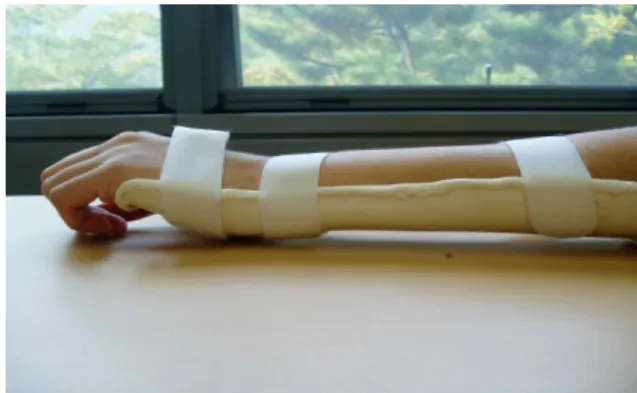
Figure 1. Wearing a wrist extension splint.
joint, for hand function (Mell et al, 2005; Stern et al, 1991). However, when wearing a wrist splint, muscle activities surrounding the wrist and elbow increase (Adams et al, 2004; Bulthaup et al, 1999;
King et al, 2003). Bulthaup et al (1999) found that the long type of wrist extension orthoses led to greater muscle activity for the wrist extensors of healthy people. It is also possible to prescribe wrist extension splints to reduce the force of the extensor carpi radialis brevis or acute tendon injury (Bulthaup et al, 1999; van Elk et al, 2004).
It is important that there is balance in the onset of activities in the wrist flexor and extensor during gripping and that the grip force is reduced as the wrist position changes from an extension of 30° to flexion (Bober et al, 1982; Neumann, 2002). The wrist extensors are not only the main stabilizers of the wrist joint, but also initiators of the stabilizing force during gripping, and they play a role in main- taining the optimal length of the finger flexors (Bober et al, 1982; Neumann, 2002).
Wrist splints are usually prescribed for nighttime wear, but are frequently used during daytime ac- tivities, due to the development of light thermo- plastic splints (Walker et al, 2000). However, few studies have been conducted concerning the wrist flexors which are stretched and immobilized by wrist splinting, and about the most advantageous time for wearing the splint - day or night.
Therefore, the objectives of this study were to compare the effects of splinting on pre-wearing, day, and nighttime users and to identify the difference in muscle power and activity of the wrist flexors and extensors for holding the wrist in a 30° extension position after prolonged wearing of a splint and to determine the optimal wearing instructions in the use of wrist extension splints.
Methods Subjects
Twenty healthy subjects who attended Inje University participated in this investigation. There were 10 male and 10 female volunteers (age: 22.4±1.2 years, height: 170.1±10.0 ㎝, weight: 61.9±13.8 ㎏) and all right-hand dominant. None of the volunteers had a history of radial nerve lesion or wrist joint or muscle injury, and none had current hand or upper extremity dysfunction.
Splints
Wrist extension splints, made out of thermoplastic for each subject in our laboratory, were used on the volar side of the subjects' non-dominant hand. The splints maintained the wrist in a 30° extension posi- tion, measured by a goniometer, and prevented fur- ther wrist flexion (Figure 1).
Hand Force Measurements2)
The hand force of the wrist flexor and extensor muscles was measured by PowerTrackⅡ1). For the wrist flexor examination, the subject was seated, with the forearm placed on a table in supination, and the wrist in flexion. The examiner placed the trans- ducer on the midline of the palmar surface of the
1) PowerTrackⅡ, JTECH Medical, Salt Lake City, Utah 84115, U.S.A.
hand, and broke wrist flexion. After five minutes of rest to recover from fatigue, the wrist extensor was measured, again with the participant seated, but with the forearm placed on a table in pronation, and the wrist in extension. The examiner placed the trans- ducer on the midline of the dorsal surface of the hand, and broke wrist extension. The data were dis- played and stored.
Grip Force Measurements3)
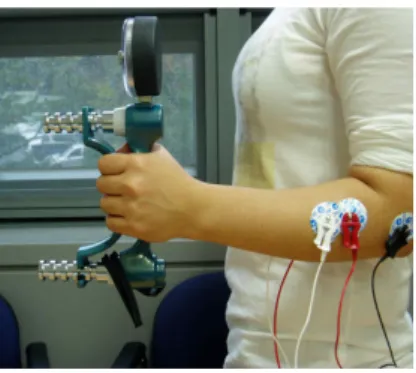
The grip force of the non-dominant hand was measured by Dynatron2), with the participant stand- ing with his/her elbow in 90° of flexion, and the forearm in a neutral position. The hand dynamometer was gripped with maximum isometric effort for five seconds. The measurer noted and recorded the notch mark on the scale.
EMG Measurements4)5)
The muscle activities of the wrist flexor (flexor carpi ulnaris; FCU) and extensor muscles (extensor carpi ra- dialis; ECR) were recorded by an EMG system3) and circular surface EMG disposable electrodes4) with a di- ameter of 35 ㎜. The two electrodes for recording from the wrist flexor (FCU) were placed 3 to 4 ㎝ apart over the belly of the muscle in the direction of the muscle fibers. The two electrodes for recording from the wrist extensor (ECR) were placed 3 to 4 ㎝ in the center of the muscle mass that emerges, with the electrodes oriented on the muscle fibers. The ground electrode was placed over the left lateral epicondyle.
The distance between the electrodes at each pair was 2 ㎝, and each pair was attached parallel to the muscle fibers (Cram et al, 1998). The EMG signals were sampled at 1000 ㎐, notch filtered at 60 ㎐, amplified, and then analyzed with the Acqknowledge 3.9.1 software (BIOPAC System Inc., CA., U.S.A.). The data were stored on a laptop computer after ana- log-to-digital conversion, and then averaged.
Test Procedures
This study consisted of hand force and grip force measurement with EMG. Participants were given verbal instructions before the measurements. The measurer selected muscles which exhibited prom- inently when the subjects extended and flexed their wrists, and marked the positions with a pen. Before placing the electrodes on the muscles, the skin of the left forearm was shaved and rubbed with alcohol to reduce electrical impedance. The electrodes were aligned at the marked positions previously described (Cram et al, 1998).
The non-dominant hand force of each subject was measured, then the measurer was instructed to en- courage the volunteers to use maximal effort for five seconds (Figure 2). Muscle activities of the FCU and ECR were recorded simultaneously by EMG, which was checked before each measurement. Before each assessment, subjects rested for five minutes to less- en the effects of fatigue. Next, volunteers gripped the hand dynamometer with maximum isometric effort for five seconds. Muscle activities of the FCU and ECR were also recorded simultaneously by EMG, which was checked before each measurement (Figure 3). Three trials of each condition were performed and then averaged.
After all measurements, the experiment leader asked the volunteers to wear their splints for eight hours (12:00 AM to 8:00 AM) at night. The meas- urements as described above were again performed after the removal of the splints at 8:00 AM. After two days, all volunteers gathered to wear the splints for eight hours (9:00 AM to 4:00 PM) during the day. The measurements as described above were again performed after the removal of the splints at 4:00 PM. The experiment leader gave all subjects freedom to go about their usual routines, but they were forbidden from removing their splints without permission during the hours assigned to their use.
2) Dynatron, Dynatronics, Salt Lake City, Utah 84121, U.S.A.
3) EMG MP150WSW, BIOPAC System Inc., CA, U.S.A.
4) EL503, BIOPAC System Inc., CA, U.S.A.
Figure 2. Hand force measurement methods of the wrist extensor and flexor.
Figure 3. Grip force measurement method.
Statistical Analysis
The SPSS statistical package (SPSS version 14.0 software) was used to analyze differences in the ECR and FCU muscle activities. Repeated one-way ANOVA tests were used to compare the differences in each measurement of the pre-wearing, the day-wearing, and the nighttime-wearing conditions.
A Bonferroni correction for post-hoc was done, with significance defined as being present when p<.05.
Results
Hand Force of the FCU and ECR
The maximal hand force of the flexor carpi ulnaris (FCU) increased significantly when the volunteers wore the splints during the day (p<.05). The max- imal hand force of FCU decreased after nighttime use, but there was no significant difference. The maximal hand force of the FCU was 12.01±.93, 10.97±.80, and 13.25±1.20 in the pre-wearing, night, and daytime tests, respectively. The maximal hand force of the extensor carpi radialis (ECR) decreased when the volunteers wore the splints during the daytime and the nighttime, however there was no significant difference. The maximal hand force values of the ECR were 11.84±.63, 11.25±.61, and 11.03±.32 in the pre-wearing, night, and daytime tests, re- spectively (Table 1).
EMG Data of the FCU and ECR During the Hand Force Measurement
The EMG data for the FCU during hand force measurements increased significantly when the vol- unteers wore the splints during the daytime (p<.05).
The maximal hand force of the FCU also increased after nighttime use, but there was no significant difference. The EMG data for the FCU during hand force measurements were 170.84±29.07, 173.97±28.95, and 249.12±35.97 in the pre-wearing, night, and day- time tests, respectively. The EMG data for the ECR during hand force measurements decreased when the volunteers wore the splints during the daytime and at night, however there was no significant difference.
The EMG data for the ECR during hand force measurements were 201.51±26.61, 146.84±23.08, and 155.01±25.11 in the pre-wearing, night, and daytime tests, respectively (Table 2).
Difference of the ECR/FCU Ratio During the Grip Force Measurement
The ECR/FCU ratio decreased both after night and daytime use, however, there was a significant difference only after daytime use (p<.05). The means of the ECR/FCU ratios were 1.41±.26, .99±.17, and .62±.11 in pre-wearing, night, and daytime tests, re- spectively (Table 3).
Muscle Power (㎏) Pre-wearing Nighttime Daytime F p
FCU 12.01±.93a 10.97±.80 13.25±1.20 9.138 .002
ECR 11.84±.63 11.25±.61 11.03±.32 2.979 .076
aMean±SD.
Table 1. Hand force of the FCU and ECR (N=20)
Muscle Activity (㎏) Pre-wearing Nighttime Daytime F p
FCU 170.84±29.07a 173.97±28.95 249.12±35.97 4.682 .023
ECR 201.51±26.61 146.84±23.08 155.01±25.11 3.541 .050
aMean±SD.
Table 2. EMG data of the FCU and ECR during the hand force measurement (N=20)
Variable Pre-wearing Nighttime Daytime F p
ECR/FCU ratio 1.41±.26a .99±.17 .62±.11 4.115 .034
aMean±SD.
Table 3. Difference of the ECR/FCU ratio during the grip force measurement (N=20)
Discussion
The present study explored the power and activities of the FCU and ECR muscles before the use of a long-type wrist splint, after wearing it at night, and after wearing it in the daytime. In this study, subjects maintained the wrist in a position of 30° extension, with the wrist flexor lengthened slightly for eight hours by wearing wrist extension splints that limited the use of the wrist flexor at night, weakening the FCU. The results showed that the FCU power de- creased significantly after wearing the splint at night.
On the other hand, the EMG activity and the power of the FCU were significantly greater after wearing the splint during the day. The reason is that the FCU tended to increase its effort by strain- ing opposite to the restriction given by wrist ex- tension splints designed to limit wrist flexion (Bulthaup et al, 1999).
The EMG activity and the power of the ECR de- creased by wearing the splint. This was similar to the result of van Elk et al (2004) where the reduc- tion in the activity of the wrist extensor during gripping in healthy subjects caused the extension force to increase by application of an external wrist extension. Sustained specific joint movements and
postures affect musculoskeletal and neural tissue and finally lead to unsuitable changes in the movement components (Sahrmann, 2002). McGill and Brown (1992) found that a prolonged flexion position for 20 minutes is capable of causing creep in soft tissues.
Kendall and McCreary (1993) showed that muscles in a prolonged elongated position during rest or in- activity became stretched and weakened.
The wrist extensor activated much more than the flexor while gripping because the maximal grip force and wrist torque were the largest when the wrist was extended. In the present study, the normalized EMG data ratio between the ECR and FCU while gripping decreased significantly. The balance of ECR and FCU may have been destroyed because wearing a wrist extension splint weakens the extensor and strengthens the flexor. Hägg and Milerad (1997) found that the wrist extensors caused more static load patterns compared to the flexors during gripping. Moqk and Keir (2003) found that activity of the wrist extensor was greater than activity of the flexor during low to mid-range force levels and a flexed wrist produced only 50~60% of maximal grip force. The wrist extensors should be initiated to counteract the wrist flexion torque to maintain a neutral wrist (Snijders et al, 1987). The function loss
in the wrist and finger extensors causes the hand to destroy the reciprocal tenodesis action and lose wrist stability (Colditz, 1984).
A wrist extension splint, a therapeutic intervention for effective hand function, may actually lead to worsening of muscle balance, particularly if it is worn while working. Therefore, in the treatment of musculoskeletal disorders, we recommend that it is more effective to wear a wrist extension splint dur- ing the nighttime hours. When prescribing wrist ex- tension splints, therapists should consider the in- dividual patient’s condition and direct the time that the splint is used.
There are some limitations to this study. The non-dominant hand of all subjects was selected our data were acquired over a short period of time; and it was impossible to continuously monitor the subjects while they were wearing their splints. In the future, it would be interesting to conduct a longer-term inves- tigation to identify the effects of wearing wrist splints on muscle power and activity. Further studies should also be done on patients with neurological injuries, as well as musculoskeletal disorders.
Conclusion
The purpose of this study was to compare the differences on the activities and power of the wrist flexors and extensors in subjects before the use of a wrist extension splint, after nighttime use, and after daytime use. Wearing a wrist extension splint, which limits wrist flexion, maintained the lengthened posi- tion of the wrist flexors during the nighttime hours, so that the muscles remain inactive, inducing weak- ness to the overstretched wrist flexor. Wearing a wrist extension splint during the day strengthened the wrist flexor, because wrist flexion limitation in healthy subjects had an effect on resistance exercise.
It is concluded that wearing a wrist extension splint in the workplace during the day can increase muscle power and EMG activity of the wrist flexor, and im-
balance between the wrist flexor and extensor during gripping activity in healthy people.
References
Adams BD, Grosland NM, Murphy DM, et al. Impact of impaired wrist motion on hand and upper-extremity performance. J Hand Surg. 2003;28(6):898-903.
Armstrong TJ. Ergonomics and cumulative trauma disorders. Hand Clin. 1986;2(3):553-565.
Assendelft W, Green S, Buchbinder R, et al. Tennis elbow (lateral epicondylitis). Clin Evid.
2004;11(11):1633-1644.
Biddulph SL. The effect of the Futuro wrist brace in pain conditions of the wrist. S Afr Med J.
1981;60(10):389-391.
Bober T, Kornecki S, Lehr RP, et al. Biomechanical analysis of human arm stabilization during force production. J Biomech. 1982;15(11):825-830.
Bulthaup S, Cipriani DJ 3rd, Thomas JJ. An electro- myography study of wrist extension orthoses and upper-extremity function. Am J Occup Ther. 1999;53(5):434-440.
Chard MD, Hazleman BL. Tennis elbow - A reappraisal. Br J Rheumatol. 1989;28(3):186-190.
Colditz JC. Splinting for radial nerve palsy. J Hand Ther. 1987;1(1):18-23.
Cram JR, Kasman GS, Holtz J. Introduction to Surface Electromyography. 5th ed. Aspen Publishers Inc., 1998:298-303.
Hägg GM, Milerad E. Forearm extensor and flexor muscle exertion during simulated gripping work : An electromyographic study. Clin Biomech.
1997;12(1):39-43.
Jansen CW, Olson SL, Hasson SM. The effect of use of a wrist orthosis during functional activities on surface electromyography of the wrist extensors in normal subjects. J Hand Ther. 1997;10(4):283-289.
Kendall FP, McCreary EK. Muscles: Testing and function. 4th ed. Baltimore, Lippincott Williams
& Wilkins, 1993.
This article was received October 9, 2008, and was accepted November 3, 2008.
King S, Thomas JJ, Rice MS. The immediate and short-term effects of a wrist extension orthosis on upper-extremity kinematics and range of shoulder motion. Am J Occup Ther. 2003;57(5):517-524.
McGill SM, Brown S. Creep response of the lumbar spine to prolonged full flexion. Clin Biomech.
1992;7(1):43-46.
Mell AG, Childress BL, Hugher RE. The effect of wearing a wrist splint on shoulder kinematics during object manipulation. Arch Phys Med Rehabil. 2005;86(8):1661-1664.
Moqk JP, Keir PJ. The effects of posture on forearm muscle loading during gripping. Ergonomics.
2003;46(9):956-975.
Neumann DA. Kinesiology of the Musculoskeletal System. New York, Mosby Inc., 2002:188-193.
Peters T, Baker CL Jr. Lateral epicondylitis. Clin Sports Med. 2001;20(3):549-563.
Sahrmann SA. Diagnosis Treatment Movement Impairment Syndromes. New York, Mosby Inc., 2002:10-19.
Snijders CJ, Volkers AC, Mechelse K, et al.
Provocation of epicondylalgia lateralis (tennis el- bow) by power grip or pinching. Med Sci Sports Exerc. 1987;19(5):518-523.
Stern EB. Wrist extensor orthoses: Dexterity and grip strength across four styles. Am J Occup Ther. 1991;45(1):42-49.
van Elk N, Faes M, Degens H, et al. The application of an external wrist extension force reduces electromyographic activity of wrist extensor muscles during gripping. J Orthop Sports Phys Ther. 2004;34(5):228-234.
Walker WC, Metzler M, Cifu DX, et al. Neutral wrist splinting in carpal tunnel syndrome: A comparison of night-only versus full-time wear instructions.
Arch Phys Med Rehabil. 2000;81(4):424-429.