Filum terminale lipoma is an inherited lumbosacral abnormality that can cause tethered cord syndrome.
This report describes an unusual case of lumbago and sciatica, pain suspected to be caused by a filum terminale lipoma where a herniated intervertebral disc had occurred. The patient was hospitalized for 43 days and received integrative Korean medicine treatment, including acupuncture, pharmacopuncture, Chuna therapy, cupping therapy, physiotherapy and herbal medicine. Treatment effectiveness was assessed using the numerical rating scale, Oswestry Disability Index, European Quality of Life 5-Dimensions, and patient symptoms. After inpatient treatment, the pain the patient suffered was significantly reduced, and the evaluation indices scores reflected this. Integrative Korean remedies may be an effective option for lower back pain and lower extremity symptoms which are caused by filum terminale lipoma where a herniated intervertebral disc has occurred. Additional clinical research is required to support this observation.
©2020 Korean Acupuncture & Moxibustion Medicine Society. This is an open access article under the CC BY- NC-ND license (http://creativecommons.org/licenses/by-nc-nd/4.0/).
Article history:
Submitted: April 27, 2020 Revised: August 10, 2020 Accepted: August 26, 2020 Keywords:
Filum Terminale Lipoma, Herniated Disc, Korean medicine, Lumbago, Sciatica,
Tethered cord syndrome.
https://doi.org/10.13045/jar.2020.00143 pISSN 2586-288X eISSN 2586-2898
J Acupunct Res 2020;37(4):281-284
Case Report
Filum Terminale Lipoma with Herniated Intervertebral Disc Treated with Traditional Korean Medicine: A Case Report
Sang-Gyun Kim 1, *, Ju-Hun Park 1 , Han-Bin Park 1 , Dong-Hwi Yoo 1 , Won-Suk Jang 1 , Won-Bin Shin 2 , Kang-Eah Choi 3 , Hyun-Woo Cho 4
1 Department of Acupuncture and Moxibustion, Haeundae Jaseng Hospital of Korean Medicine, Busan, Korea 2 Department of Internal Medicine of Korean Medicine, Bucheon Jaseng Hospital of Korean Medicine, Bucheon, Korea 3 Department of Neuropsychiatry, Haeundae Jaseng Hospital of Korean Medicine, Busan, Korea
4 Department of Rehabilitation Medicine of Korean Medicine, Haeundae Jaseng Hospital of Korean Medicine, Busan, Korea
ABSTRACT
Journal of Acupuncture Research
Journal homepage: http://www.e-jar.org
Introduction
Filum terminale lipoma (FTL) is a common intraspinal fatty lump that is contained within the filum terminale resulting in spinal cord tethering, but is not attached to the conus medullaris.
Although this may be associated with tethered cord syndrome (TCS), it is unclear whether a patient with FTL pathology will be asymptomatic, or present with tethered spinal symptoms [1-4].
TCS is an uncommon neurological disorder that presents as back or leg pain, weakness, and urinary dysfunction [5], and is characterized by signs and symptoms of excessive tension on the spinal cord. Most cases are related to spinal dysraphism. TCS can be present in any age group although, presentations differ according to age and the underlying pathological conditions. Pain, orthopedic deformities, cutaneous signs, and neurological deficits are the most common symptoms [6].
Several patients with lumbago and sciatica have been treated
with integrative Korean medicine, and several articles have been published on the treatment of lumbago and sciatica with integrative Korean medicine. However, FTL has not been treated with integrative Korean medicine treatment. In this report, the outcome of a patient with suspected FTL, herniated intervertebral disc, lumbago, and sciatica who was treated with integrative Korean medicine is presented.
Case Report Patient
OOO (M/38) Chief complaint (onset)
Lower back pain and left leg sciatica that radiated from the left sacrum to the left popliteus along the bladder meridian (December
* Corresponding author. Sang-Gyun Kim, Department of Acupuncture & Moxibustion, Haeundae Jaseng Hospital of Korean Medicine, Busan, Korea E-mail : [email protected]
ORCID: Sang-Gyun Kim https://orcid.org/0000-0001-5583-7623
©2020 Korean Acupuncture & Moxibustion Medicine Society. This is an open access article under the CC BY-NC-ND license (http://creativecommons.org/licenses/by-nc-
nd/4.0/).
J Acupunct Res 2020;37(4):281-284
282
2019).
Past medical history
Herniated intervertebral disc of the lumbar spine (2020).
Height:171cm, weight:81kg, smoker: (-ve), drinker: (-ve), occupation: laborer.
Patient characteristics Height: 171 cm, Weight: 81 kg, Smoker: (-ve), Drinker: (-ve), Occupation: laborer.
Present illness
In December 2019, there was onset of lower back pain and left leg sciatica. In January 2020, following lumbar magnetic resonance imaging at Local Orthopedics, the patient was diagnosed with herniated lumbar disc. He was hospitalized, underwent a medical procedure, and was taking painkillers for 2 weeks with the level of pain improving. However, after returning to work, the pain worsened.
Therefore, he visited the Jaseng Hospital of Korean Medicine on January 29
th, 2020 and was admitted on January 31
st, 2020.
Duration of treatment
The patient was treated from January 31
st, 2020 to March 13
th, 2020 (43 days of hospitalization).
Radiology
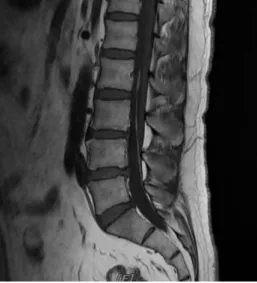
Lumbar magnetic resonance imaging (Fig. 1) was performed on February 1
st, 2020, and revealed.
① L3/4 - Disc bulging.
② L4/5 - Herniated Intervertebral Disc, left central to subarticular protrusion.
③ L5/S1 - Herniated Intervertebral Disc, central protrusion.
④ Degenerative lumbar spondylosis.
⑤ FTL, L2-S1.
Patient confidentiality
Medical records containing the patient’s personal information were obtained after approval from the Institutional Review Board of the Jaseng Korean Medicine Hospital (IRB File no.: 2020-04-001).
Treatment
Pharmacopuncture therapy
Shinbaro pharmacopuncture (Jaseng Wonoe Tangjunwon, Namyangju, Korea) was administered at EX-B2 (left facet joint between the 4
thand 5
thlumbar spines and left facet joint between the 5
thlumbar spine and sacrum). Pharmacopuncture (up to 2 mL) was performed per session using a disposable 26- gauge × 11/2”
(38 mm) needle, with a 3- mL syringe (Sinchangmedical, Gumi, Korea), and was performed twice a day.
Acupuncture therapy
Electroacupuncture (3 Hz) was performed using standard, disposable, sterile 0.25 mm × *30 mm stainless steel needles (The Dongbang acupuncture equipment manufacturer, Boryung, Korea). Electroacupuncture was performed at BL22, BL23, BL24, BL25, BL26, GV3, GV4, GV5, GB 39, SP6 and Ashi points for 15 minutes, twice a day.
Cupping therapy
Wet and dry cupping therapy was administered at, GB29, BL23 points twice a day for 15 minutes. To prevent infection, sterilized disposable cups (The Dongbang acupuncture equipment manufacturer, Boryung, Korea) were used.
Herbal medicine
Chungpajun-H decoction (120 mL/package), Chungwoongbaro- Hwan (tablet), and Gwanjulgo (tablet) were prescribed (Table 1).
Chungpajun-H and Chungwoongbaro-Hwan were taken 3 times a day and Gwanjulgo once a day during the hospitalization period (Table 1).
Chuna therapy
The patient was manipulated with Chuna therapy once a day. Joint distraction, joint mobilization and spine and joint manipulation for the lumbaosacral spine and pelvis were performed.
Physical therapy
The patient underwent spinal manipulation, traction, extracorporeal shock wave therapy and medicinal steaming therapies for the lumbar spine once a day.
Evaluation
Numerical rating scale (NRS)
The NRS was used to measure the severity of subjective pain, which is expressed as a score 1 to 10 (10 = worst imaginable pain, 1 = absence of pain) [7]. The patient was evaluated on the day of admission, the 15th day of hospitalization, and the day of discharge.
European quality of life 5 dimensions (EQ-5D)
The EQ-5D was used to evaluate quality of life. The maximum score is 1, which signifies a high quality of life [8]. The patient was rated on the day of admission, the 15
thday of hospitalization, and the day of discharge.
Fig. 1. T1 weighted sagittal plane central view of a lumbar MRI scan. The MRI scan shows filum terminale lipoma extended from L2 to S1.
Fig. 1. T1 weighted sagittal plane central view of a lumbar MRI scan.
The MRI scan shows filum terminale lipoma extended from L2 to S1.
Kim et al / A Case of Filum Terminale Lipoma
283
Oswestry disability index (ODI)
The ODI evaluates disability in patients with lumbago. It is measured from 0 to 100. The higher the score, the higher the degree of disability and pain [9]. The patient was evaluated on the day of admission, the 15
thday of hospitalization, and the day of discharge.
Progress note
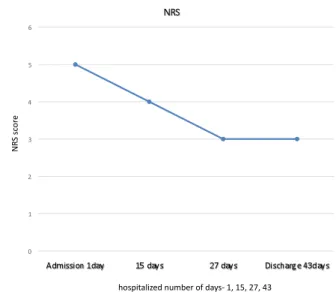
After the previous discharge in January 2020, when the patient underwent a medical procedure, he experienced severe waist pain and severe numbness of the left leg preventing him from walking for more than 5 minutes, and disrupting his sleep. Upon admission to Haeundae Jaseng Hospital of Korean Medicine, his painkillers were stopped to enable an accurate evaluation of his pain. On the day of admission, the NRS, ODI, EQ5D scores for lumbago and left leg sciatica were 5, 57.78, and 0.303, respectively. After the 8
thday of hospitalization, numbness of the left lower leg slowly reduced, but numbness in the posterior femoral region still remained.
On the 13
thday of hospitalization, he walked for more than 30 minutes without any pain and numbness.
On the 15
thday of hospitalization, the NRS scores for lower back pain and left leg sciatica were both 4. The ODI score decreased to 37.78, and the EQ5D score increased to 0.659.
On the 20
thday of hospitalization, left leg discomfort reduced, and on the 24
thday, hypnalgia improved.
On the 26
thday, the NRS scores for lower back pain and left leg sciatica both decreased to 3, but he felt pain in the sacrum when he took bigger strides.
On the 30
thday, he experienced little pain whilst walking. On the 40th day, the numbness in the left leg had almost gone.
On the day of discharge, the NRS scores for lower back pain and left leg sciatica were both 3. The ODI score decreased to 20.00 and the EQ-5D score decreased to 0.841 (Figs. 2-4).
Herbal medicines Herbal components
Chungpajun-H (decoction) Lasiosphaera Seu Calvatia 7.5 g, Acanthopanacis Cortex 5 g, Cibotii Rhizoma 5 g, Eucommiae Cortex 5 g, Achyranthes bidentata Bl. 5 g, Saposhnikovia Radix 5 g, Atractylodis Rhizoma Alba 2.5 g, Geranii Herba 2.5 g, Amomi Fructus 2.5 g, lycyrrhizae Radix 1.6 g, Zingiberis Rhizoma 1.25 g, Scolopendra morsitans L 0.25 g Chungwoongbaro-Hwan (tablet) Eucommiae Cortex 0.34 g, Cibotii Rhizoma 0.34 g, Achyranthes bidentata Bl. 0.18 g, Acanthopanacis Cortex
0.18 g, Saposhnikovia Radix 0.18 g, Bovis Fel 0.09 g, Atractylodis Rhizoma Alba 0.09 g
Gwanjulgo (tablet) Rehmannia Glutinosa 3.27 g, Apis indica Radoszkowski 1.63 g, Poria Cocos 1.63 g, Panax Ginseng 0.82 g, Cervus Elaphus 0.34 g, Achyranthes bidentata Bl. 0.20 g, Asini Gelatinum 0.10 g
Table 1. The Composition of Herbal Medicines.
Fig. 2. Changes in NRS score for lower back pain and left leg sciatica from admission to discharge from hospital.
NRS, numerical rating scale.
Fig. 2
0 1 2 3 4 5 6
NRS score
hospitalized number of days-‐ 1, 15, 27, 43
Fig. 3. Changes in ODI from admission to discharge from hospital.
ODI, Oswestry disability index.
Fig. 3
57.78
37.78
20
0 10 20 30 40 50 60 70
Admission 1day 15 days Discharge 43days
ODI Score
hospitalized number of days-‐ 1, 15, 43
Fig. 4. Changes in EQ5D index from admission to discharge from hospital.
EQ5D, European quality of life 5 dimensions. Fig. 4
0.303
0.659
0.841
0 0.1 0.2 0.3 0.4 0.5 0.6 0.7 0.8 0.9
Admission 1day 15 days Discharge 43days
EQ5D Score
hospitalized number of days-‐ 1, 15, 43
J Acupunct Res 2020;37(4):281-284