
2008, Vol. 52, No. 6
Printed in the Republic of Korea
디메틸(2-시아노페닐아미노)(치환된 아릴)포스포산의 합성과 항균 활성
G. Chandra Sekhar Reddy, B. Siva Kumar, A. Uma Ravi Sankar, M. Veera Narayana Reddy, and C. Suresh Reddy*
Department of Chemistry Sri Venkateswara University, Tirupati – 517502, India (2008. 6. 21 접수)
Synthesis and Antimicrobial Activity of Dimethyl (2-cyanophenylamino) (Substituted Aryl) Methyl Phosphonates
G. Chandra Sekhar Reddy, B. Siva Kumar, A. Uma Ravi Sankar, M. Veera Narayana Reddy, and C. Suresh Reddy*
Department of Chemistry Sri Venkateswara University, Tirupati – 517502, India (Received June 21, 2008)
요 약. 새로운 계열의 α-아미노포스포산 에스테르는 같은 당량의 2-아미노 벤조니트릴, 디메틸아인산염 그리고 여
러가지 알데히드, 이 세가지 성분을 함께 반응하여 무수 톨루엔에서 환류를 통한 Kabachnic-Field반응을 거쳐 높은 수 율(74-85%)로 합성되었다. 대표 화합물의 구조는 원소, IR, 1H, 13C, 31P 그리고Mass 스펙트럼 분석으로 확인되었다.
이 분자들은 상당한 항균활성을 보였다.
주제어: 2-아미노 벤조니트릴, 디메틸아인산염, Kabachnic-Fields 반응, α-아미노포스포산 에스테르, 항균활성도
ABSTRACT. A new class of α-aminophosphonic acid esters (4a-l) have been synthesized by three component one-pot reaction with equimolar quantities of 2-amino benzonitrile (1), dimethylphosphite (3) and various aldehydes (2a-l) in dry toluene at reflux conditions via Kabachnic-Fields reaction in high yields (74-85%).The structure of title compounds has been established by elemental, IR, 1H, 13C, 31P and Mass spectral analysis. They were found to possess significant anti- microbial activity.
Keywords: 2-amino Benzonitrile, Dimethylphosphite, Kabachnic-Fields Reaction, α-aminophosphonic Acid Esters, Antimicrobial Activity
INTRODUCTION
Due to numerous important applications of orga- nophosphorus compounds a detailed survey of liter- ature has been made to get an over view on the present status of organophosphorus compounds and their chemistry. Considerable interest has been focused on the synthesis of α-substituted phospho- nic acids since they are structural analogous of nat- urally occurring α-amino acid in biological systems.
Among the α-functionalised phosphonic acids, α- amino phosphonic acid derivatives are gaining
interest in medicinal chemistry.1 The use of α- amino alkyl phosphonates as enzyme inhibitors,2 antibiotics and pharmacological agents,3 herbi- cides,4 heptants of catalytic antibiotics5 and inhib- itors of EPSP synthase,6 HIV protease,7 renin,8 PTPases9 are well documented.
RESULTS AND DISCUSSION
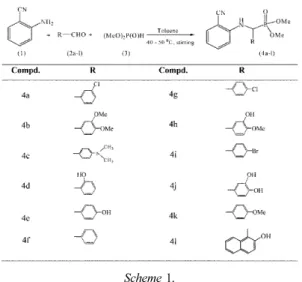
A new class of a-aminophosphonic acid esters (4a-l) was conveniently synthesized by three com- ponent one-pot reaction of equimolar quantities of
2-amino benzonitrile (1), dimethylphosphite (3) and various aldehydes (2a-l) in dry toluene at reflux conditions via Kabachnic-Fields reaction for 3-4 hours. Progress of the reaction was monitored by TLC analysis at different intervals and the product were purified by column chromatography using ethyleacetate:hexane (1:3) as step grade mixtures as eluents. Due to presence of the nitrile group at ortho position in conjugation to the aromatic amino group in 2-amino benzonitrile, the π-electron density increases due to resonance on the substrate and thus renders the -NH2 group of the aromatic amine more nucleophilic. This factor facilitates its nucleophilic addition to the carbonyl carbon of the aldehyde and subsequently yields of the products increases. Another purpose of taking -CN group is that the products may get reduced/oxidized/hydrolysed to CH2-NH2/ CH2OH by enzymatic reduction/hydrolysis and increases its solubility in the bio-medium and sub- sequently increases its biological activity. This assumption is proved by high yields of dimethyl (2-
cyanophenylamino)(substituted aryl) methyl phos- phonates (4a-l) and their increased antimicrobial activity. These results explain the purpose of intro- ducing a -CN function in the aromatic group of the products.
The IR spectra of title compounds (4a-l) showed absorption bands at 3310-3410 cm-1 (N-H),10 1230- 1251 cm-1 (P=O),11-15 1014-1031 cm-1 (P-O-C),16 735- 766 cm-1 (P-Caliphatic)17 and 2216-2221 cm-1 (C≡N)18 stretching frequencies.
Aromatic protons of the two benzene rings of the title compounds (4a-l) showed a complex mul- tiplet at d 6.44-8.15.19 P-C-H protons of 4a-l appeared as doublet of doublet in the region δ 4.75-5.38 (2JP-H= 16.0-17.8, 3JH-H=9.9-10.4 Hz) due to its coupling with the phosphorus and neigh- boring N-H proton. The N-H proton exhibited a triplet in the range of δ 5.42-5.52 due to coupling with neighbouring proton and phosphorus. The methoxy protons of the dimethylphosphite moiety resonated as a two distinct doublets in the range d 3.65-3.81 (d, 3JC-H= 10.7-12.0 Hz)20, 21 showing their non-equivalence.
The 13C NMR spectral data of 4a-l showed char- acteristic absorption peaks for aromatic carbons.
The carbon chemical shift of methoxyl carbon of P-O-CH3 resonated as a doublet at 54.2-54.3 ppm (d, J = 6.5-7.4 Hz).22 Methyne carbon, attached to nitrogen and phosphorus, appears as a doublet at 53.0-56.8 ppm (d, 2J = 7.4 -8.1 Hz).
The 31P NMR signal appeared as a singlet in the range 21.11-22.96 ppm in all the compounds.23
The FAB-Mass spectra of 4a-d (Table 1) agreed with the proposed structures. The fragmentation pathway of 4b is rationalysed as typical example of this series (Scheme 2).24,25
Scheme 1.
Table 1. Mass Spectral data of compounds 4a-f Compd. m/z (%)
4a 350.5 (M+•, 38), 349.2 (36), 348.3 (26), 343.3 (42), 241.3 (100), 240.3 (34), 239 (35), 324.2 (24)
4b 376.3 (M+•, 18), 375.2 (68), 361.2 (25), 267.3 (45), 266.2 (18), 260.2 (20), 259.3 (100), 213.2 (65), 181.2 (17), 137 (10) 4c 359.2 (M+ •, 17), 358.3 (9), 328.3 (12), 312.2 (4), 296.3 (5), 257.2 (4), 250.3(100),248.3 (15), 237.3 (5), 229.3 (10) 4d 332.3 (M+•, 15), 331.2 (88), 301.2 (14), 285.2 (3), 223.2 (100), 221.3 (13), 215.3 (84), 183.3 (5), 102.2 (9), 93.2 (6), 90.2 (4) 4e 332.3 (M+•, 18), 331.0 (70), 330.2 (30), 299 (15), 215.3 (100),
4f 316.2 (M+ •, 20), 315.1 (70), 301.1 (30), 207.2 (60), 199.1 (100), 168.2 (50)
CONCLUSION
A new class of a-aminophosphonic acid esters with moderate antimicrobial activity were conve- niently synthesized in good yields in uncatalysed one-pot three component Kabachnic-Fields reac- tion.
EXPERIMENTAL
The melting points were determined in open cap- illary tubes on a Mel-Temp apparatus and were uncorrected. IR spectra (νmax in cm-1) were recorded in KBr pellets on Perkin Elmer 1000 unit. The 1H,
13C & 31P NMR spectra were recorded on Varian Gemini 300 and Varian AMX 400 MHz NMR spectrometer operating at 300 & 400 MHz for 1H, 75.46 & 100.57 MHz for 13C and 121.7 MHz for
31P. All compounds were dissolved in CDCl3 and chemical shifts were referenced to TMS (1H & 13C) and 85% H3PO4 (31P). Micro analytical data were obtained from Central Drug Research Institute, Lucknow, India.
ANTIMICROBIAL ACTIVITY
Schrader-Clark26 proposed that organophospho- rus compounds containing the general structure (A) may have significant biological activity.
All organophosphorus compounds are inherently good phosphorylating agents of enzymes by virtue Scheme 2.
of the group P-XYZ in the general structure (A).
Slight variation in structure can have very dramatic effects on the efficiency of organophosphorus com- pounds in bio-activity. These chemically and bio- logically variable parameters which are hard to estimate are involved in deciding “structure-activ- ity” relationship of these compounds.
Compounds 4a-l were screened for their antibac- terial activity (Table 2) against Staphylococcus aureus (gram positive) and Escherichia coli (gram negative) by the disc-diffusion method in Mueller- Hinton agar medium, at various concentrations (250, 500 mg/disc) in dimethyl formamide (DMF).
These solutions were added to each filter disc and DMF was used as control. The plates were incu- bated at 35oC and examined for zone of inhibition around each disc after 12 h. The results were com- pared with the activity of the standard antibiotic Penicillin (250 mg/disc). Their antifungal activity27 were evaluated against Curvularia lunata and Fusarium oxysporium at different concentrations (250 & 500 mg/disc). Griseofulvin was used as the reference compound. Fungal cultures were grown on potato dextrose broth at 25oC and finally spore suspension was adjusted to105 spore/mL. Most of
the compounds showed moderate activity against both bacteria and fungi.
General Procedures for the Synthesis of [(2- cyano-phenylamino)-(3,4-dimethoxy-phenyl)- methyl]-phosphonic acid dimethyl ester (4a)
To a stirred solution of 2-amino benzonitrile (1) (2.36 g, 0.02 mole), 3-chloro benzaldehyde (2a) (1.23 mL, 0.02 mole) in dry toluene were added dimethyl phosphite (3) (1.35 mL, 0.02 mole), in dry toluene (30 mL) at room temperature. After the addition has been completed the temperature of the reaction was raised to 40-50oC and maintained for four hours. Progress of the reaction was evaluated by running TLC (silica gel) at different intervals using ethyl acetate and hexane (1:3 by volume) as a mobile phase. After the completion of reaction sol- vent was removed under reduced pressure in a rotary evaporator and obtained crude product was washed repeatedly with petroleum ether, water and purified by column chromatography on 60-120 mesh silica gel using ethyl acetate:hexane (1:3) as eluent to afford the pure [(3-Chloro-phenyl)-(2-cyano-phe- nylamino)-methyl]-phosphonic acid dimethyl ester (4a), yield 5.96 g (~85%), mp. 161-163oC.
Other compounds (4b-l) were prepared by using Table 2. Antimicrobial activity of compounds (4a-l)
Compd.
Zone of inhibition (mm)
Bacteria Fungi
Staphylococcus aureus Escherichia coli Curvularia lunata Fusarium oxysporium 250
µg/disc 500 µg/disc
250 µg/disc
500 µg/disc
250 µg/disc
500 µg/disc
250 µg/disc
500 µg/disc
4a 10.4 14.8 11.2 15.1 4.2 5.8 5.3 6.4
4b 10.6 14.0 10.5 16.6 3.4 4.2 2.6 4.4
4c 9.7 14.2 10.4 13.7 4.6 5.7 3.8 5.8
4d 13.2 19.1 14.1 16.4 3.8 5.2 5.1 6.4
4e 12.7 17.2 11.2 14.5 3.2 4.9 3.7 5.6
4f 13.9 16.8 10.4 14.0 2.7 4.2 3.6 5.3
4g 12.8 18.2 9.2 14.3 4.2 5.7 4.1 6.1
4h 13.4 15.5 10.2 14.1 4.5 6.0 4.6 6.0
4i 16.2 18.2 14.1 19.6 3.8 5.4 4.5 5.8
4j 10.6 16.5 9.9 12.9 2.5 5.1 3.1 5.3
4k 12.3 17.3 10.6 16.1 4.5 6.2 4.7 6.0
4l 11.1 14.1 11.3 15.2 2.6 4.0 2.4 4.4
Penicillina 22.0 - 21.0 -
Griseofulvina 18.0 - 18.0 -
aReference compounds
the same procedure and were characterized with IR,
1H-NMR, 13C-NMR, 31P-NMR and Mass spectral studies.
The representative analytical data for [(3-Chloro- phenyl)-(2-cyano-phenylamino)-methyl]-phospho- nic acid dimethyl ester (4a)
Pale-yellow solid; Yield: 85%; mp 161-163oC;
Molecular formula: C16H16ClN2O3P; Elemental anal- ysis: Carbon 54.78found (54.79cal); Hydrogen 4.58found (4.57cal); Nitrogen8.00found (7.99cal); IR (KBr) (νmax cm-1): 3382 (N-H), 2215 (C≡N), 1242 (P=O), 1020 (P-O-C), 754 (P-Caliph.); 1H-NMR (δ ppm): 6.45- 7.47 (m, 8Harom), 4.77-4.87 (dd, J = 6.0Hz, 1H, CH at Arom.ring), 5.48 (t, 1H on Nitrogen), 3.69 (d, J = 9.0 Hz, 3H, OCH3 at Phosphorus), 3.77 (d, J = 12.0 Hz, 3H, OCH3 at Phosphorus); 13C NMR (δ ppm):
98.1-148.3 -Carom, 117.1 -Cnitrile, 56.2 at Nitrogen, 54.2 -OCH3 at Phosphorus; 31P NMR (δ ppm):
21.32; MS (EI, 70 eV): m/z (%) = 350 (38, M+•), 241(100).
[(2-cyano-phenylamino)-(3,4-dimethoxy-phe- nyl)-methyl]-phosphonic acid dimethyl ester (4b) Pale-yellow solid; Yield: 83%; mp 111-113oC;
Molecular formula: C18H21N2O5P; Elemental analy- sis: Carbon 57.44found (57.45cal); Hydrogen 5.59found (5.58cal); Nitrogen7.44found (7.45cal); IR (KBr) (νmax cm-1): 3404 (N-H), 2216 (C≡N), 1251 (P=O), 1018 (P-O-C), 755 (P-Caliph.); 1H-NMR (δ ppm): 6.55- 8.13 (m, 7Harom), 4.77-4.87 (dd, J = 6.0Hz, 1H, CH at Arom.ring), 5.48 (t, 1H on Nitrogen), 3.65 (d, J = 12. Hz, 3H, OCH3 at Phosphorus), 3.75 (d, J = 12.0 Hz, 3H, OCH3 at Phosphorus), 3.89 (d, J = 9.0 Hz, 6H, OCH3 at Arom.ring); 13C NMR (δ ppm): 97.5- 149.3 -Carom, 119.9 -Cnitrile, 54.0 at Nitrogen, 54.3 -OCH3 at Phosphorus, 55.6 at Arom.ring; 31P NMR (δ ppm): 22.29; MS (EI, 70 eV): m/z (%) = 376 (18, M+•), 259 (100).
[(2-cyano-phenylamino)-(4-dimethylamino-phe- nyl)-methyl]-phosphonic acid dimethyl ester (4c) Dark-yellow solid; Yield: 78%; mp 151-153oC;
Molecular formula: C18H22N3O3P; Elemental analy- sis: Carbon 60.16found (60.17cal); Hydrogen 6.15found (6.13cal); Nitrogen11.69found (11.70cal); IR (KBr) (νmax cm-1): 3356 (N-H), 2218 (C≡N), 1236 (P=O), 1031 (P-O-C), 766 (P-Caliph.); 1H-NMR (d ppm): 6.54-
8.12 (m, 8Harom), 4.81-4.95 (dd, J = 6.0Hz, 1H, CH at Arom.ring), 5.48 (t, 1H on Nitrogen), 3.65 (d, J = 12.0 Hz, 3H, OCH3 at Phosphorus), 3.75 (d, J = 12.0 Hz, 3H, OCH3 at Phosphorus); 13C NMR (δ ppm): 97.5-148.6 -Carom, 120.1 -Cnitrile, 53.0 at Nitro- gen, 54.3 -OCH3 at Phosphorus, 44.5 at Arom.ring;
31P NMR (δ ppm): 21.25; MS (EI, 70 eV): m/z (%)
= 359 (17, M+•), 250 (100).
[(2-cyano-phenylamino)-(2-hydroxy-phenyl)- methyl]-phosphonic acid dimethyl ester (4d) Off- white solid; Yield: 79%; mp 136-138oC; Molecu- lar formula: C16H17N2O4P; Elemental analysis: Car- bon 57.82found (57.83cal); Hydrogen 5.14found (5.12cal);
Nitrogen8.42found (8.41cal); IR (KBr) (νmax cm-1): 3400 (N-H), 2215 (CN), 1250 (P=O), 1015 (P-O-C), 760 (P-Caliph.); 1H-NMR (d ppm): 6.56-7.44 (m, 8Harom), 5.25-5.35 (dd, J = 6.0Hz, 1H, CH at Arom. ring), 5.45 (t, 1H on Nitrogen), 3.73 (d, J = 12.0 Hz, 3H, OCH3 at Phosphorus), 3.79 (d, J = 12.0 Hz, 3H, OCH3 at Phosphorus); 13C NMR (δ ppm): 97.4-156.3 -Carom, 119.0 -Cnitrile, 53.8 at Nitrogen, 54.2 -OCH3 at Phosphorus; 31P NMR (δ ppm): 22.90; MS (EI, 70 eV): m/z (%) = 332 (15, M+•), 223 (100).
[(2-cyano-phenylamino)-(4-hydroxy-phenyl)- methyl]-phosphonic acid dimethyl ester (4e) Pale- yellow solid; Yield: 81%; mp 137-139oC; Molecu- lar formula: C16H17N2O4P; Elemental analysis: Car- bon 57.82found (57.83cal); Hydrogen 5.14found (5.12cal);
Nitrogen8.42found (8.41cal); IR (KBr) (νmax cm-1): 3395 (N-H), 2216 (C≡N), 1250 (P=O), 1021 (P-O-C), 759 (P-Caliph.); 1H-NMR (d ppm): 6.55-8.12 (m, 8Harom), 5.25-5.35 (dd, J = 6.0Hz, 1H, CH at Arom.
ring), 5.45 (t, 1H on Nitrogen), 3.69 (d, J = 9.0 Hz, 3H, OCH3 at Phosphorus), 3.77 (d, J = 12.0 Hz, 3H, OCH3 at Phosphorus); 13C NMR (δ ppm): 97.4-148.5 -Carom, 113.2 -Cnitrile, 56.8 at Nitrogen, 54.3 -OCH3 at Phosphorus; 31P NMR (δ ppm): 22.85; MS (EI, 70 eV): m/z (%) = 332 (15, M+•), 223 (100).
[(2-cyano-phenylamino)-phenyl-methyl]-phos- phonic acid dimethyl ester (4f) Pale-yellow solid;
Yield: 80%; mp 127-130oC; Molecular formula:
C16H16ClN2O3P; Elemental analysis: Carbon 54.77found (54.79cal); Hydrogen 4.56found (4.57cal); Nitrogen8.01found (7.99cal); IR (KBr) (νmax cm-1): 3310 (N-H), 2220 (C≡N), 1230 (P=O), 1017 (P-O-C), 735 (P-Caliph.);
1H-NMR (d ppm): 6.44-7.46 (m, 9Harom), 4.78-4.89 (dd, J = 6.0Hz, 1H, CH at Arom.ring), 5.47 (t, 1H at Nitrogen), 3.70 (d, J = 12.0 Hz, 3H, OCH3 at Phospho- rus), 3.78 (d, J = 12.0 Hz, 3H, OCH3 at Phosphorus);
13C NMR (δ ppm): 96.3-145.6 -Carom, 118.1 -Cnitrile, 56.5 at Nitrogen, 54.7 -OCH3 at Phosphorus; 31P NMR (δ ppm): 20.85; MS (EI, 70 eV): m/z (%) = 316 (20, M+•), 199 (100).
Acknowledgements. The authors thank Prof. C.
Devendranath Reddy, Department of Chemistry, Sri Venkateswara University, Tirupati for his advice.
One of the authors CSR thanks BRNS (2006/37/39/
BRNS/2292), Mumbai, India for providing finan- cial assistance.
REFERENCES
1. Bartlett, P. A.; Hanson, J. E.; Giannousis, P. P. J. Org.
Chem. 1990, 55, 6268.
2. (a) Allen, M. C.; Fuhrer, W.; Tuck, D.; Wade, R.; Wood, J. M. J. Med. Chem. 1989, 32, 1652. (b) Logusch, E.
W.; Walker, D. M.; Mc Donald, J. F.; Leo, G. C.;
Grang, J. E. J.Org. Chem. 1988, 53, 4069. (c) Gian- nousis, P. P.; Bartlett, P. A. J. Med. Chem. 1987, 30, 1603.
3. (a) Atherton, F. R.; Hassal, C. H.; Lambert, R. W. J.
Med. Chem. 1986, 29, 29. (b) Allen, J. G.; Atherton, F.
R.; Hassal, C. H.; Lambert, R. W.; Nisbet, L. J.; Rin- grose, P. S. Nature. 1978, 272, 56. (c) Allen, J. G.;
Atherton, F. R.; Hall, M. J.; Hassal, C. H.; Lambert, R.
W.; Nisbet, L. J.; Ringrose, P. S. Antimicrobe. Agents Chemother. 1979, 15, 684. (d) Atherton, F. R.; Hall, M.
J.; Hassal, C. H.; Lambert, R. W.; Ringrose, P. S. Anti- microbe. Agents Chemother. 1979, 15, 677. (e) Ather- ton, F. R.; Hall, M. J.; Hassal, C. H.; Lambert, R. W.;
Lloyd, W. J.; Ringrose, P. S. Antimicrobe. Agents Chemother.
1979, 15, 696.
4. (a) Emsley, J. E.; Hall, E. D. The Chemistry of Phos- phorous; Harper and Row, London, 1976, p 495. (b) Barder, A. Aldirichimica Acta. 1988, 21, 15.
5. (a) Hirschmann, R.; Smith, A. B. III.; Taylor, C. M.;
Benkovic, T. A.; Taylor, S.D.; Yager, K. M.; Sprengler, P. A.; Venkovic, S. J. Science. 1994, 265, 234. (b) Smith, A. B. III.; Taylor, C. M.; Venkovic, S. J.; Hirschmann, R. Tetrahedron Lett. 1994, 37, 6854.
6. Sikoski, J. A.; Miller, M. J.; Barccolino, D. S.; Cleary,
D. G.; Corey, S. D.; Ream, J. E.; Schnur, D.; Shah, A.;
Walker, M. C. Phosphorous Sulfur Silicon. 1993, 115, 76.
7. Stowasser.; Budt, K. H.; Jian-Qi, L.; Peyman, A.; Rup- pert, D. Tetrahedron Lett. 1989, 30, 6625.
8. Patel, D. V.; Rielly-Gauvin, K.; Ryono, D. E. Tetrahe- dron Lett. 1990, 31, 5587.
9. (a) Jr. Burke, T. R.; Jr. Barchi, J. J.; George, C.; Wolf, G.; Shoelsom, S. E.; Yan, X. J.Med. Chem. 1995, 38, 1386. (b) Jr. Burke, T. R.; Kole, H. K.; Roller, P. P.;
Biochem. Biophys. Res. Commun. 1994, 204, 129.
10. Silverstein, R. M.; Webster, F. X. Spectrometric Iden- tification of Organic Compounds; 6th ed, Chapter-3, John Wiley and Sons, Inc: New York, U.S.A., 1998; p 103.
11. Daash, L. W.; Smith, S. C. Anal. Chem. 1961, 23, 853.
12. Bellamy, L. J.; Beecher, L. J. J. Chem. Soc. 1951, 475.
13. Bellamy, L. J.; Beecher, L. J. J. Chem. Soc. 1953, 728.
14. Corbirdge, D. E. C. J. Appl. Chem. 1956, 6, 456.
15. Emsley, J. E.; Hall, E. D. The Chemistry of Phospho- rous; Harper and Row, London, 1976, p 93.
16. Thomas, L. C.; Chittendem, R. A. Spectrochim. Ata.
1964, 20, 489.
17. Halmann, M. Spectro Chim Acta. 1960, 16, 407.
18. Silverstein, R. M.; Webster, F.X. Spectrometric Identi- fication of Organic Compounds; 6th ed, Chapter-3, John Wiley and Sons, Inc: New York, U.S.A., 1998; p 104.
19. Kiran, B.; Gunasekhar, D.; Reddy, C. D.; Reddy, C. S.;
Tran. K.; Jhane, Le.; Berlin, K. D.; Srinivasan, K.; Devi, M. C. Pest Manage. Sci. 2005, 61, 1016.
20. Pakamas Tongcharoensirikul.; Alirica. I. Suarez.; Troy Voelker.; Charles. M. Thomson. J. Org. Chem. 2004, 69, 2322.
21. Buchanan, G. W.; Whitman, R. H.; Malaiyandi, M. Org.
Magn. Reson. 1982, 19, 98.
22. Cockhart, J. C.; Mc Donelle, M. B.; Tyson, P. D. J. Chem.
Soc., Perkin Trans. 1983, 1, 2153.
23. Crutchfield, M. M.; Dungan, C. H.; Letcher, J. H.; Mark, U.; Van Wazer, J. R. 31P Nuclear Magnetic Resonance;
Inter Science Publishers: New York, U.S.A., 1967; p 155.
24. Reddy, C. D. Rao, C. V. N. Org. Mass Spectrom. 1982, 17, 598.
25. Reddy, C. D.; Reddy, M. S.; Rao, C. V. N.; Raju, C. N.;
Das, C.; Reddy, G. S. Indian J. Heterocycl. Chem. 1995, 5, 49.
26. Schrader, G. The Modification of Biological activity by Structure changes in Organophosphorus Compounds;
World Review Pest Control, 1965, 4, 140.
27. Kavangh, F. Analytical Microbiology; Academic Press:
New York, U.S.A., 1963; p 250.
![α,β-Dichloro Succinic Acid와 수용성 Poly[N-(α,β-Dichlorosuccinic acid)glucosamine]유도체의 합성 및 응용](data:image/gif;base64,R0lGODlhAQABAIAAAP///wAAACH5BAEAAAAALAAAAAABAAEAAAICRAEAOw==)