This is an Open Access article distributed under the terms of the Creative Commons Attribution Non-Commercial License (http://creativecommons.org/licenses/by-nc/4.0/) which permits unrestricted non-commercial use, distribution, and reproduction in any medium, provided the original work is properly cited.
Copyright © 2018. Anatomy & Cell Biology
supplied by the superficial branch of radial nerve (SBRN) and the dorsal cutaneous branch of ulnar nerve (DBUN). The DBUN usually innervates the dorsal medial surface of hand and medial one and half digits while SBRN supplies the dorsal lateral surface of hand and lateral three and a half digits (Fig.
1A) [1].
Due to rapid increase in use of local anaesthesia and sur- geries involving the hand, wrist and digits, it is essential to know the sensory innervation patterns in the dorsum of the hand. In most of surgeries of hand and wrist dorsal approach is preferred. So after getting information about this type of variation in sensory innervations we can demarcate a safe zone for incision over dorsum of hand and wrist [3].
The aim of the present study is to report the bilateral varia- tion of sensory innervations of the dorsum of the hand.
Introduction
The lateral antebrachial cutaneous nerve (LABCN) is the direct continuation of the musculocutaneous nerve which is derived from the lateral cord of brachial plexus (C5‒7) [1].
LABCN lies lateral to the tendon of biceps brachii in the cubi- tal fossa at the level of the interepicondylar line of the humer- us. LABCN gives cutaneous supply to anterolateral surface of forearm upto the base of the thenar eminence and does not supply beyond that [2].
The dorsal cutaneous surface of hand is most commonly
Case Report
https://doi.org/10.5115/acb.2018.51.1.66 pISSN 2093-3665 eISSN 2093-3673
Corresponding author:
Hare Krishna
Department of Anatomy, All India Institute of Medical Sciences, New Delhi 110029, India
Tel: +91-9560500793, Fax: +91-11-26588641, E-mail: hareaiims2012@
gmail.com
Unusual bilateral sensory innervation of the dorsum of hand by lateral antebrachial cutaneous nerve: a case report
Neha
1, Hare Krishna
21Department of Anatomy, North DMC Medical College and Hindu Rao Hospital, Delhi, 2Department of Anatomy, All India Institute of Medical Sciences, New Delhi, India
Abstract: A 68-year-old male cadaver showed bilateral variation in the sensory innervation of the dorsum of hand. On the dorsum of right hand, first digit and lateral half of second digit were supplied by lateral antebrachial cutaneous nerve (LABCN);
medial side of second digit and lateral side of third digit were supplied by superficial branch of radial nerve (SBRN) and medial side of third digit, the fourth and fifth digits were supplied by dorsal cutaneous branch of ulnar nerve (DBUN). On the dorsum of the left hand, lateral side of first digit was supplied by LABCN, medial side of first digit, the second and third digits as well as the lateral side of fourth digit were supplied by SBRN; medial side of fourth digit and fifth digit were supplied by DBUN. These variations would be helpful in understanding peripheral neuropathy, in interpretation of conduction velocity studies and in reconstructive surgery of hand.
Key words: Superficial branch of radial nerve, Dorsal cutaneous branch of ulnar nerve, Antebrachial cutaneous branch, Dorsum of hand, Cutaneous innervations
Received November 16, 2017; Revised December 18, 2017; Accepted December 27, 2017
Unusual sensory innervation of the dorsum of hand by LABCN
https://doi.org/10.5115/acb.2018.51.1.66
Anat Cell Biol 2018;51:66-69
67
www.acbjournal.org
Case Report
During routine upper limb dissection for undergraduate students in the department of Anatomy at North DMC Medi- cal College, Delhi, we found an additional unusual supply to the dorsum of both hands by the LABCN in a 68-year-old male cadaver.
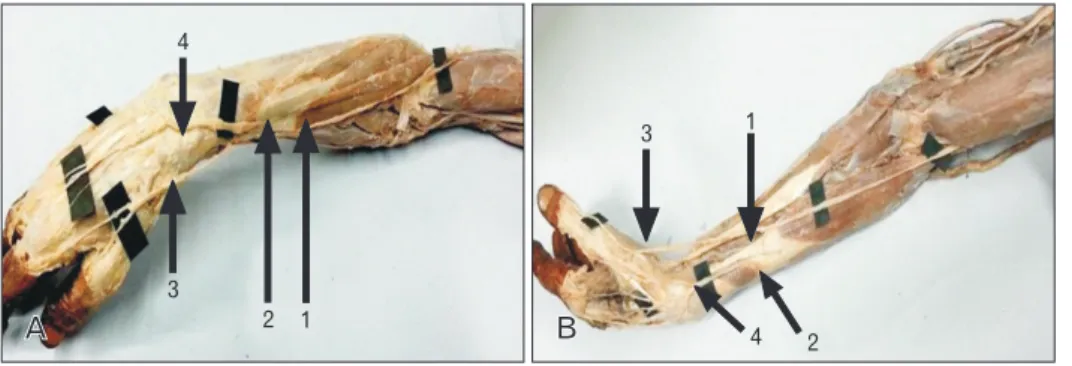
On dorsum of the right hand, the first digit and lateral half of second digit were supplied by the LABCN, medial side of second digit and lateral side of third digit were supplied by SBRN and medial side of third digit, fourth and fifth digits were supplied by DBUN (Figs. 1B, 2A, 3A, B).
However, on dorsum of the left hand, only the lateral side of the first digit was supplied by LABCN. The medial side of first digit, the second and third digits as well as the lateral side of fourth digit received branches from SBRN, medial side of fourth digit and the fifth digit were supplied by DBUN (Figs.
1C, 2B, 3C, D).
Discussion
In this case report, LABCN does not end in the forearm but reaches forward to give contribution in innervation of dorsum of hand along with SBRN and DBUN. This type of variation seen in this study may be due to some abnormal- ity in limb muscles and the peripheral nerves development during the embryonic life. The upper limb muscles develop from the mesenchyme of paraxial mesoderm and the brachial plexus is formed due to addition of growth cones motor axon at the base of the limb bud [4]. At fifth week of embryonic life, the developing brachial plexuses give rise to peripheral nerves into the mesenchyme of the limb buds which grow distally to reach the muscles and skin of upper limb bud [5, 6].
The development of these axons in limb buds is highly coor-
A B C
SBRN DBUN
LABCN
SBRN
DBUN
DBUN
LABCN SBRN
Fig. 1. (A) Common pattern of cutaneous supply on dorsum of the right hand. (B, C) The various pattern of cutaneous supply on dorsum of hand seen on the right and left hand respectively in the present study. SBRN, superficial branch of radial nerve; LABCN, lateral antebrachial cutaneous nerve; DBUN, deep branch of ulnar nerve.
A
A 2 1 BB
3 4
4 2
3 1
Fig. 2. Photographs of dorsal view of the right hand (A) and the left hand (B) showing cutaneous innervation. 1, ten
don of brachioradialis; 2, extensor carpi radialis longus tendon; 3, lateral ante
brachial cutaneous branch; 4, super
ficial branch of radial nerve.
Anat Cell Biol 2018;51:66-69 Neha and Hare Krishna
68
www.acbjournal.org https://doi.org/10.5115/acb.2018.51.1.66
dinated and regulated by some factors such as brain-derived neurotropic growth factor, c-kit ligand, neutrin-1, neutrin-2, etc. [7]. These variations may be due to altered neuronal sig- nalling between the limb bud and the neuronal growth cones or factors at the time of fission of brachial plexus cords [7, 8].
The LABCN variation was first described in 1911, where the radial nerve below the elbow gave only the posterior in- terosseous branch and the SBRN was absent. So, cutaneous supply of the dorsum of hand was given by LABCN and ulnar nerve [9]. Then in 1918, Stopford [10] studied more than 1,000 cases and concluded that there are very considerable variations in the radial nerve distribution and described three most common pattern of sensory distribution of the dorsum of hand. Since then many cases of partial or total commu- nication between the LABCN and the SBRN on the dorsum of the hand have been reported. In 1985, Mackinnon and Dellon [11] studied the anatomical relationship between the LABCN and the SBRN in 53 cadavers. They found that there was significant anatomical overlap between the SBRN and the LABCN at the level of the wrist, with partial or complete overlap of the LABCN and the SBRN occurred in 75% of the cases and an interconnected plexus in 32% of the cases [11].
In 1987, Bourne et al. [12] were studied the LABCN course and relation on 20 specimens and observed that the nerve
emerges from the lateral aspect of the biceps tendon at the level of the interepicondylar line. Bergman et al. [13], 1988 studied variations in the formation, distribution and termina- tion of the musculocutaneous nerve. In 2007, Huanmanop et al. [14] concluded that connections between the SBRN and the LABCN are common but replacements are rare and these variations are important to know in cases of peripheral nerve injuries. Several researchers studied branching patterns of the musculocutaneous nerve and radial nerves [15, 16].
Tryfonidis et al. [17] reported the variation in the course of the SBRN. In 2005, Beldner et al. [18] reported the relation of the LABCN with the cephalic vein. They observed that the LABCN lied either superficial (31 specimens) or deep to the cephalic veins (5 specimens), and divided into two parts: one branch dorsal and one branch volar to the cephalic vein (1 specimen). Due to close approximation to the cephalic vein, the LABCN is susceptible to injury during venepuncture.
Hence, study of the variations in the LABCN will help in un- derstanding peripheral neuropathy caused by venepuncture.
Sontakke et al. [19] described unilateral variant origin of musculocutaneous nerve.
In summary, the present study shows unusual bilateral sensory innervation of the dorsum of hand by LABCN. The knowledge of this variation assumes vital importance for re- A
A BB
C
C DD
1
2
3 1
2 2
2 3
Fig. 3. (A) Photograph showing the dorsal view of right hand from radial aspect. 1, lateral antebrachial cutaneous nerve (LABCN) innervates the first digit and lateral half of second digit;
2, superficial branch of radial nerve (SBRN) innervates medial side of second digit and lateral side of third digit. (B) Photograph showing the dorsal view of right hand from ulnar aspect. 3, dorsal cutaneous branch of ulnar nerve (DBUN) innervates me dial side of third digit, fourth and fifth digits. (C) Photograph showing the dorsal view of left hand from ra dial aspect. 1, LABCN innervates la teral half of the first digit;
2, SBRN inner vates medial side of first digit, the second and third digits as well as the lateral side of fourth digit were supplied by SBRN. (D) Photograph showing the dorsal view of left hand from ulnar aspect. 3, DBUN innervates medial side of fourth digit and the fifth digit.
Unusual sensory innervation of the dorsum of hand by LABCN
https://doi.org/10.5115/acb.2018.51.1.66
Anat Cell Biol 2018;51:66-69
69
www.acbjournal.org
constructive surgery of hand to avoid damage to these nerves and in understanding the peripheral neuropathy of unusual clinical symptoms.
References
1. Standring S. Gray’s anatomy: the anatomical basis of clinical practice. 41th ed. Edinburgh: Elsevier; 2016. p.832-62.
2. Sulaiman S, Soames R, Lamb C. The sensory distribution in the dorsum of the hand: anatomical study with clinical implications.
Surg Radiol Anat 2015;37:779-85.
3. Mok D, Nikolis A, Harris PG. The cutaneous innervation of the dorsal hand: detailed anatomy with clinical implications. J Hand Surg Am 2006;31:565-74.
4. Moore KL, Persaud TV, Torchia MG. Before we are born: essen- tials of embryology and birth defects. 8th ed. Philadelphia, PA:
Elsevier Saunders; 2013. p.241-2.
5. Gupta M, Goyal N, Harjeet. Anomalous communications in the branches of brachial plexus. J Anat Soc India 2005;54:22-5.
6. Arey LB. Developmental anatomy: a textbook and laboratory manual of embryology. 7th ed. London: W.B. Saunders Co.;
1966. p.501-4.
7. Yogesh A, Marathe R, Pandit S. Musculocutaneous nerve sub- stituting for the distal part of radial nerve: A case report and its embryological basis. J Neurosci Rural Pract 2011;2:74-6.
8. Bhanu PS, Sankar KD. Bilateral absence of musculocutaneous nerve with unusual branching pattern of lateral cord and median nerve of brachial plexus. Anat Cell Biol 2012;45:207-10.
9. Appleton AB. A Case of Abnormal Distribution of the N. mus- culo-cutaneus, with complete absence of the ramus cutaneus N.
radialis. J Anat Physiol 1911;46(Pt 1):89-94.
10. Stopford JS. The variations in distribution of cutaneous nerves in
the hand and digits. J Anat 1918;53(Pt 1):14-25.
11. Mackinnon SE, Dellon AL. The overlap pattern of the lateral antebrachial cutaneous nerve and the superficial branch of the radial nerve. J Hand Surg Am 1985;10:522-6.
12. Bourne MH, Wood MB, Carmichael SW. Locating the lateral antebrachial cutaneous nerve. J Hand Surg Am 1987;12(5 Pt 1):697-9.
13. Bergman RA, Thompson SA, Afifi AK, Saadeh FA. Compen- dium of human anatomic variation: catalogue, atlas, and world literature. Baltimore, MD: Urban and Schwarzenberg; 1988.
p.139-43.
14. Huanmanop T, Agthong S, Luengchawapong K, Sasiwongpakdee T, Burapasomboon P, Chentanez V. Anatomic characteristics and surgical implications of the superficial radial nerve. J Med Assoc Thai 2007;90:1423-9.
15. Marathe R, Mankar S, Joshi M, Sontakke Y. Communication between radial nerve and medial cutaneous nerve of forearm. J Neurosci Rural Pract 2010;1:49-50.
16. Yogesh A, Joshi M, Chimurkar V, Marathe R. Unilateral variant motor innervations of flexure muscles of arm. J Neurosci Rural Pract 2010;1:51-3.
17. Tryfonidis M, Jass GK, Charalambous CP, Jacob S. Superficial branch of the radial nerve piercing the brachioradialis tendon to become subcutaneous: an anatomical variation with clinical relevance. Hand Surg 2004;9:191-5.
18. Beldner S, Zlotolow DA, Melone CP Jr, Agnes AM, Jones MH.
Anatomy of the lateral antebrachial cutaneous and superficial ra- dial nerves in the forearm: a cadaveric and clinical study. J Hand Surg Am 2005;30:1226-30.
19. Sontakke YA, Fulzele RR, Tamgire DW, Joshi M, Gajbe UL, Marathe RR. Unilateral variant origin of musculocutaneous nerve. Int J Anat Var 2010;3:59-60.