Characteristics of Molecular Strain Typing of Mycobacterium tuberculosis Isolated from Korea
Mi Hee Jang
1, Go Eun Choi
1, Chulhun L. Chang
1, Yeong Dae Kim
2Departments of
1Laboratory Medicine, and
2Thoracic and Cardiovascular Surgery,
School of Medicine, Pusan National University, Busan, Korea
Molecular strain typing of Mycobacterium tuberculosis is important for the detection of outbreaks of tuber- culosis and laboratory cross contamination, as well as the differentiation between re-infection and re- activation of tuberculosis. In the present review, the authors investigated the currently available typing methods for M. tuberculosis and the current status of strain distribution in Korea. IS6110-restriction frag- ment length polymorphism (RFLP), which is consid- ered a standard method, is based on numbers and positions of the insertion sequence, IS6110. The meth- od has an excellent discriminatory power with a con- siderable amount of worldwide data, although it is time-consuming and labor-intensive. Spoligotyping is based on the presence or absence of spacer se-
quences between direct repeat (DR) regions. PCR amplification allows for the possibility of application in the early suspicious stage. The data can be easily digitized; however, it shows identical profiles in Beijing family strains. Mycobacterial interspersed re- petitive unit-variable number of tandem repeat (MIRU- VNTR) is another PCR-based genotyping method with a good discrimination power whose data can al- so be easily digitized. In Korea, the prevalence of Beijing family strains have been as high as 80 to 87%. (Korean J Clin Microbiol 2011;14:41-47)
Key Words: Mycobacterium tuberculosis, Molecular strain typing, Beijing family
Received 14 December, 2010, Revised 7 January, 2011 Accepted 7 January, 2011
Correspondence: Yeong Dae Kim, Department of Thoracic and Cardiovas- cular Surgery, Pusan National University Hospital, 305 Gudeok-ro, Seo-gu, Busan 602-739, Korea. (Tel) 82-51-240-7822, (Fax) 82-51- 243-9389, (E-mail) domini@ pnu.edu.
41 서 론
우리나라뿐만 아니라 전 세계적으로 결핵은 여전히 인류 건 강을 위협하는 중요한 질병이다. 우리나라는 지난 50년간 결핵 의 발생 빈도가 크게 감소하였지만, 최근 5년 동안 신환자 발생 률이 매년 35,000명 정도로 감소하지 않고 있다[1,2]. 뿐만 아니 라 항결핵제 내성균의 출현 역시 심각한 문제이며, 이러한 내 성 결핵균의 발생빈도는 증가하고 있다[3]. 따라서 결핵의 역학 조사는 결핵균의 감염 경로와 전파 경로의 확인, 결핵균 배양 의 위양성의 파악, 전국적 규모의 결핵 발생 양상의 파악 등에 큰 도움을 줄 수 있을 뿐만 아니라, 결핵이 재발된 경우 재활성 화에 의한 발병인지 아니면 재감염균에 의한 발병인지를 알게 해 주어 결핵관리 대책을 마련하는데도 큰 도움이 된다[4-6].
따라서 균주의 형별 분류는 국가적인 결핵 관리의 측면에서도 반드시 필요하다. 본 논문에서는 현재 실시되고 있는 결핵균의 분자역학조사 방법을 소개하고, 국내 결핵균의 유전적 특징과
다형성에 대해 파악하고자 하였다.
IS6110-restriction fragment length polymorphism (RFLP)
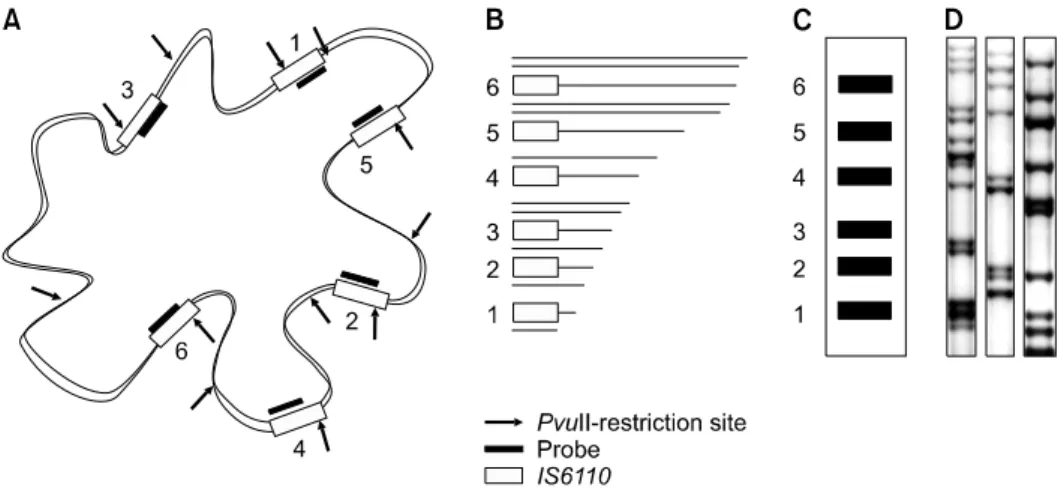
이 방법은 IS6110 유전자의 삽입 위치와 수에 따라 균주를 분리하는 것을 기반으로 한다. 대부분의 결핵균은 IS6110 유전 자를 여러 개 가지고 있다. IS6110 유전자에는 PvuII가 인식하 는 부위가 단 한 군데 존재하기 때문에 결핵균 염색체를 PvuII 제한효소로 처리하면 IS6110의 특정 부위가 절단되고 인접한 결핵균 genomic DNA의 어느 부위가 절단되어 IS6110이 삽입 된 자리에 따라 IS6110의 일부를 포함하는 절편의 총 길이가 달라진다. 따라서 염색체를 PvuII 제한 효소와 반응시켜 DNA 절편을 만들어 전기영동한 후 IS6110 probe를 결합시켜 IS6110 유전자가 포함된 DNA 절편을 검출하는 방법이다(Fig. 1)[7,8].
IS6110-RFLP는 1991년 개발된 이래 결핵균의 균주 감별을 위 한 표준화된 방법으로 간주되고 있으며, 전 세계적으로 풍부한 데이터베이스를 확보하고 있다[7,9-12]. 그러나 이 방법에는 몇 가지 단점이 있다. 이 방법은 PCR 반응을 통해 핵산을 증폭시 키는 방법이 아닌 순수하게 자란 균 집락을 이용하는 방법이기 때문에, 집단 감염 혹은 교차오염이 의심될 때도 상당기간 균
Fig. 1. The principles and procedures of IS6110-RFLP. (A) IS6110-RFLP for epidemiological investigation used the characteristics of polymorphism and copy number of IS6110. Extracted genomic DNA of M. tuberculosis was digested with a frequently cutting restriction enzyme, PvuII. IS6110 has only one restriction site for PvuII. Chromosomal regions other than IS6110 have randomly dispersed multiple restriction sites for PvuII. Therefore, lengths of fragments containing one end of IS6110 are variable; (B) DNA fragments under well-defined conditions were separated on agarose gel, and transferred to a nylon membrane; (C) hybridization with a fragment of the IS6110 sequence developed only IS6110-containing bands; (D) an image of real IS6110-RFLP patterns.
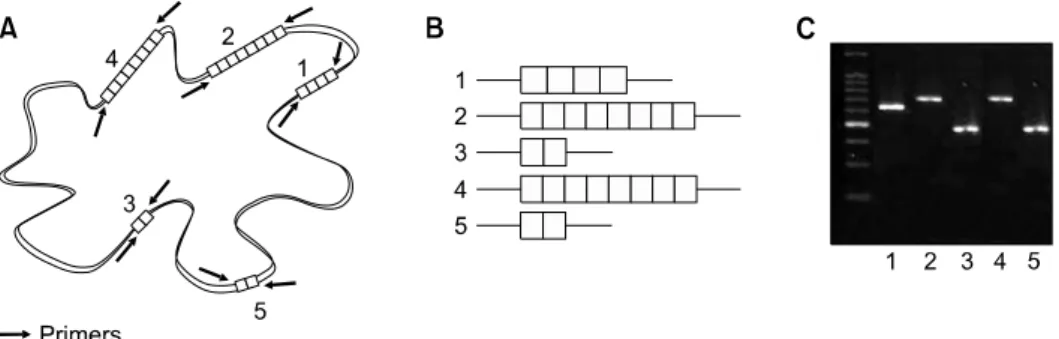
Fig. 2. The principles and procedures of DR spoligotyping. (A) Spoligotyping is based on the polymorphism in the direct repeat locus of the mycobacterial chromosome. The well-conserved 36-bp direct repeats are interspersed with unique spacer sequences varying from 35 to 41 bp in size. Deletion of some spacer regions between DRs is the main cause of strain diversity. Because the DRs have the same sequence, PCR generates fragments containing spacer sequences that are present in a specific strain; (B) Each PCR fragment contained at least one spacer sequence, although it may have many spacer sequences; (C) In a membrane, every probes targeting each spacer sequencer are spotted. PCR fragments are hybridized to the spots. The presence or absence of each spot generated unique spoligotyping pattern.
을 충분히 배양시켜야 하고, 검사를 시작한 후에도 1주일 가량 이 소요된다는 것이다[13-15]. 그 외 IS6110가 없거나 적은 균 주에는 사용할 수 없다는 단점이 있다. 이는 인도 등 몇몇 나라 의 경우 IS6110가 없거나 적은 균주의 비율이 높지만, 우리나 라의 경우 매우 드물어서 크게 문제가 되지 않고 있다[16]. 또 한 이 방법은 고도의 기술과 집중적 노동을 요구하며 비용이 많이 든다는 단점이 있다.
Spoligotyping
2004년 Kamerbeek 등에 의해 RFLP보다 방법이 간단한 spo-
ligotying이 개발된 후[17], 역학 조사의 지표로서 그 유용성이 증명되었고, 현재는 IS6110-RFLP 법 이외에 결핵균의 분자역 학적 조사 방법으로써 광범위하게 사용되고 있다[3,17-21]. 뿐 만 아니라 세계적인 spoligotype database가 구축되면서 전 세계 에서 RFLP의 대체 방법으로 spoligotyping을 실시하였다[22].
Spoligotyping은 결핵균의 direct repeat (DR) region의 사이에 존재하는 spacer sequence의 다형성을 토대로 균주를 분류하는 방법이다(Fig. 2). DR은 36 base pair (bp)이며, 그 사이에 spacer sequence (35∼41 bp)가 존재한다. DR의 서열은 모두 동일하 나, spacer sequence는 각각 다른 서열을 가지고 있기 때문에 각 spacer sequence를 probe로 하여 각각의 DR 사이에 존재하는
Fig. 3. The principles and procedures of MIRU-VNTR. (A) MIRU-VNTRs scattered throughout the whole bacterial genome contain variable copy numbers of repeat sequences. Each isolate is typed according to the number of copies of repeated units; (B) Sequences of variable number tandem repeats are amplified by PCR. The sizes of the amplified produces are dependent on the repeat copy numbers; (C) their sizes are determined by gel electrophoresis.
총 43개의 spacer sequence의 유무를 확인함으로써 균주를 분 류하는데 이용하는 것이다. Spoligotyping은 방법이 간단하고 재현성이 뛰어나며, PCR을 기반으로 하기 때문에 집락이 한두 개만 자라든지, 혹은 도말 양성인 검체에서 직접 검사하는 것 이 가능하기 때문에 RFLP법보다 좀 더 빠른 시기에 검사를 시 행할 수 있고 검사에 소요되는 시간도 적다[17]. 그러나 균주의 변별력이 IS6110-RFLP에 비해 낮기 때문에 IS6110-RFLP 방법 을 완전히 대체하기에는 어려운 점이 있다. 게다가 IS6110- RFLP 방법은 결핵균 유전자 전반에 존재하는 IS6110 유전자를 분류하는 데 반해, spoligotyping은 결핵균 전체 유전자의 0.1%
이하의 유전자로 분류한다는 데 한계점이 있다[23,24]. 또한 균 주 간의 감별 능력에서 Beijing family를 구별하지 못하는 것이 중요한 단점으로 지적된다[25].
Mycobacterial interspersed repetitive unit-variable number of tandem repeat (MIRU-VNTR)
MIRU-VNTR은 결핵균 유전자 전반에 걸쳐 독립적으로 존 재하는 minisatellite-like loci를 검출하는 방법이다(Fig. 3) [15].
MIRU-VNTR은 기준법으로 간주되는 IS6110-RFLP의 단점을 보완하기 위해 대체적인 방법으로 개발되었는데, 2006년 Supply 등에 의해 방법이 표준화되었다[26]. PCR을 기반으로 하는 분자유전학적 역학 조사 방법으로써 spoligotyping에 비해 서 균주 간의 분별력이 높은 것으로 알려져 있으며, 여러 나라 에서 방법의 안정성과 재현성, 그리고 분별력이 입증되었다. 이 방법은 균주의 분류를 위한 각 locus에 반복수를 번호로 된 코 드로 표현하여, 실험실 내 뿐만 아니라 다른 실험실 결과와의 비교를 쉽게 할 수 있는 것이 장점이다. MIRU-VNTR법은 비 교적 최근에 개발된 방법으로 최근까지도 관련 연구가 활발히 진행되고 있으나, 보고자마다 균주 간 분별 능력이 차이를 보 인다고 보고하고 있다. 이는 선택한 primer와 방법의 미묘한 차 이에 의한 것으로 보인다. 일반적으로 사용되는 12개의 loci를
이용한 MIRU-VNTR법을 IS6110-RFLP와 비교했을 때, 분별력 에 있어서는 약간 낮은 것으로 알려져 있지만 방법적인 면에서 상당한 장점을 가지고 있다[26,27]. 예를 들면 소량의 균주에서 DNA를 추출하여도 검사가 가능하여 편리하며, 숫자적 data는 다른 실험실과의 비교를 가능하게 하여 세계적인 역학 분석이 가능하다. 뿐만 아니라 IS6110 copy 수가 적거나 없는 균주에 도입이 가능하다는 장점이 있다[15].
Single nucleotide polymorphism (SNP)
SNP는 광범위한 유전자 내에 존재하는 염기서열의 다형성 을 이용하여 결핵균을 분류하는 것으로 계통적으로 연관성이 있는 임상 균주의 분류 지표로 이용되고 있다[28,29]. SNP 방 법은 두 가지로 분류될 수 있는데, nonsynonymous single nu- cleotide polymorphism (nsSNP)과 synonymous single nucleo- tide polymorphism (sSNP)가 있다. nsSNP는 아미노산의 변화 를 동반하는 것으로 형태학적 특징에도 영향을 끼치는 것으로 결핵균에서의 형태학적 변화는 항결핵제에 대한 내성과 연관 지을 수 있다. 반면 sSNP는 자연적인 변화에 의한 다형성으로, 아미노산의 변화와 관련이 없다. 따라서 균주의 성장에 필수적 인 유전자나 구조를 형성하는데 관여하는 유전자 등 항상 균주 가 보유하고 있는 유전자 내부에 존재하는 염기서열의 다형성 을 조사하여, 진화적 연구에 이용할 수 있다. 이러한 SNP를 통 한 분자역학조사의 지속적인 연구를 위해서는 유전자 형별 분 류에 효과적인 sSNP loci를 선별하는 것이 중요하다. 효과적인 loci가 선별되면, 일관적인 결과를 통해 실험실 간의 비교 분석 하는 것이 가능하기 때문이다. 이러한 SNP는 결핵 균주의 계 통 분석, 약제 내성 그리고 병독성 등 상당한 정보를 제공 받을 수 있다.
이상 여러 가지 분자생물학적인 균주 구별 방법들의 장단점 을 Table 1에 요약하였다.
Table 2. Frequency of Beijing family of M. tuberculosis in Korea
Sources of clinical isolates Periods No. of strains
investigated
Prevalence (%) of
specificstrains References KIT
KIT
One hospital in Taegu KIT
Public Health Centers in Gyeonggi Province One tuberculosis hospital
Nationwide
Two groups combined (Onehospitalin Busan, and KIT) 11 university hospitals
1992∼1994 1995∼1996 1997∼1999 1998∼1999
2004 2005∼2006
2006 2007 2008∼2009
14 138 54 206 715 208 80 187 96
B, 43 B, 72 Not detected K, 18 K, 24 B, 97 B, 80 B, 22 B, 87; K, 15
[30]
[31]
[35]
[4]
[36]
[34]
[32]
[25]
[33]
Abbreviations: KIT, Korean Institute of Tuberculosis; B, Beijing family; K, K strain.
Table 1. Characteristics of molecular strain typing methods fre- quently used for M. tuberculosis
Methods Advantages Disadvantages
IS6110 RFLP
Spoligotyping
MIRU-VNTR
SNP
Well standardized Reproducible
Rapid
Small sample required Reproducible Data digitized Rapid
Small sample required Reproducible Data digitized Economic Rapid
Small sample required Reproducible
Diverse within Beijing family
Time consuming Laborious
Difficult to discriminate low- or high-copy number isolates Single pattern in Beijing
family
Discrimination varies in different loci
Requires efficient target selection and standardization
Abbreviations: RFLP, restriction fragment length polymorphism;
MIRU-VNTR, mycobacterial interspersed repetitive unit-variable number of tandem repeat; SNP, single nucleotide polymorphism.
국내 결핵균의 분자 유전학적 특징과 다형성
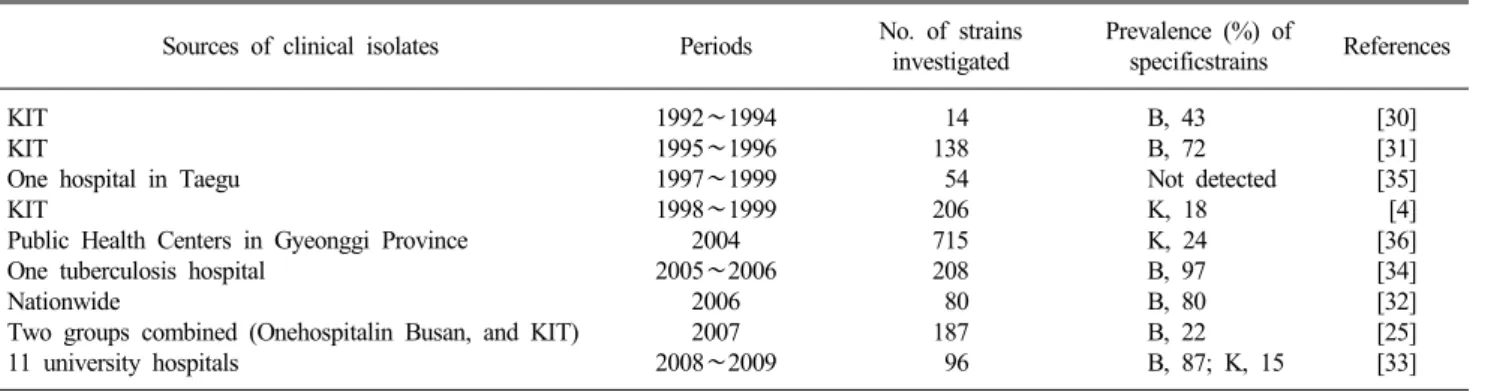
우리나라에서 분리되는 결핵 균주의 분자 유전학적 특징은 1995년 van soolingen 등에 의해 분석된 자료가 처음 문헌상에 나타난 것인데, 14균주에 대한 IS6110-RFLP가 실시되었고, Beijing family 균주는 조사된 균주의 43%를 차지하였다[30].
이는 86%의 중국을 선두로 4번째로 Beijing family 균주의 분 리 비율이 높게 조사되었다. 같은 해에 국내에서 실시된 전국 실태 조사에서는 Beijing family이 72%로 1.7배 정도 높게 나타 났다[31]. 이것은 국내에서 분리되는 결핵균 중 Beijing family
이 상당히 높은 비율을 차지하는 것을 시사한다. 이후 2010년 Kang 등의 연구에서 80%, 그리고 Choi 등의 연구에서 87%로 약 20년간 국내 Beijing family 분리 비율은 지속적으로 높게 나타나는 것을 알 수 있다[32,33]. 다만, 2010년 Shamputa 등의 연구에서 97% 빈도의 Beijing family 균주를 보고한 것은 해당 병원의 환자의 특성에 기인한 것으로 보인다(Table 2)[34].
Beijing family는 몽골과 중국에서 실시한 분자역학조사에서 polymorphism이 낮은 균주들을 포함하여 Beijing family로 처 음 명명되었고, 이 균주들에 대해서 spoligotyping도 같은 양상으 로 나타나는 것을 확인하였다[30]. 이후 여러 나라에서 Beijing family의 비율이 보고되었는데, 우리나라를 포함하여 베트남, 홍콩, 인도네시아, 대만 등에서 현저히 높은 비율을 차지하는 것으로 알려져 있다[10,37]. Beijing family는 IS6110 삽입 수가 15개에서 26개 정도로 많고, IS6110 중에서도 A1 insertion을 가지고 있는 것이 특징이며, spoligotyping에서는 모두 같은 양 상을 나타낸다[37]. Beijing family는 전파력이 높은 것으로 알 려져 있으나, 그 이유에 대해서는 아직 밝혀진 것은 없다. 또한 Beijing family 균주는 다른 형의 결핵균보다 병원성이 높고, 항 결핵제 내성과도 관련성이 높다[11]. 특히 최근에 발표된 여러 연구에 의하면 국내 Beijing family 균주들과 항결핵제 내성 사 이의 연관성이 있는 것으로 밝혀졌으며, Beijing family 균주 내 에서 rpoB 유전자형과 항결핵제 내성 양상과의 관련성에 대해 서도 밝혀진 바 있다[33,34,38,39]. 따라서 Beijing family의 분 리 비율에 따라서 잠재적인 공중 보건의 위험성을 판단하는 척 도가 될 수 있으며, Beijing family의 분리 비율의 모니터링을 통해 결핵 관리에 도움을 줄 수 있을 것으로 판단된다. 뿐만 아 니라 결핵균 배양에 있어 위양성을 파악하는데 IS6110-RFLP 방법을 이용한 국내 보고는 IS6110-RFLP의 결핵균의 유전자 특징을 파악하는 데 있어 상당히 유용한 방법임을 알 수 있다 [40]. 또한 Park 등은 국내에서 빈번하게 분리되면서 IS6110- RFLP 양상이 유럽에서 분리된 결핵균과 구별되는 결핵균의 특 징을 규명하고 Korean isolate 혹은 K strain으로 명명하였다
[31]. K strain은 대부분 8∼12개의 IS6110 유전자를 가지고 있으 며, 이러한 특징은 후속 연구에서도 유사하게 나타났다[35,36].
K strain의 발생 빈도는 1999년에 18%로 처음 보고되었으며, 이후 2004년 24%, 2009년 15%로 보고되었다[4,33,36].
우리나라 균주의 spoligotyping 양상을 조사한 자료는 많지 않다. Spoligotyping에서는 Beijing family가 모두 한 가지 양상 으로 나타나기 때문에, 그런 균주가 많은 비율을 차지하는 국 내 실정에서는 다소 부적합한지도 모른다. 이는 2007년 Song 등의 연구에서도 제시되었는데, IS6110-RFLP에서 Beijing fam- ily type을 나타내는 모든 균주는 spoligotyping에서는 모두 35
∼43번 probe에만 결합하는 것을 확인하였다[25].
MIRU-VNTR법을 이용하여 국내에서도 결핵균의 유전자 형 별 분류를 실시하였는데, 2009년 Yun 등은 국내 환자에서 분리 된 81균주에 대해서 분별력이 높은 6개의 loci를 제시하였고, 2010년 Shamputa 등의 연구에서는 8개의 loci에서 분별력이 높 게 나타났다[34,41]. 이 두 논문에서 제시하는 VNTR loci가 다 르다 하더라도 MIRU-VNTR법이 IS6110-RFLP 수준의 분별력 을 가지고 있는 것은 분명히 알 수 있다. MIRU-VNTR법은 몇 개의 숫자로 이뤄진 코드로 결과를 해석하기 때문에 실험실 간 또는 국가 간의 비교 분석이 가능하여 전파 경로를 파악하는데 용이하다. 2010년 Kang 등의 연구에서는 이러한 장점을 이용 하여 국내 결핵 균주의 유전자 형별 분류뿐만 아니라 일본과 중국의 유전자 형별 분류에 대한 데이터를 비교 분석하여 국내 에서 높은 비율을 차지하는 Beijing family 균주의 sublineage의 계통적 분포에 대한 자료를 제시하였다[32]. 그러나 분자역학 조사에 널리 이용되는 두 가지 방법인 IS6110-RFLP와 MIRU- VNTR을 동시에 실시할 경우, 두 가지 방법의 분류 기준이 다 르고, 두 방법 모두 높은 분별력을 가지고 있기 때문에 각 균주 간의 분류가 일치하지 않는 경우가 있을 수 있다. 이때는 균주 간의 유전자 다형성 차이에 따른 거리를 계산하여 두 방법의 공통점을 찾아내어 분석할 수 있는 방법을 제시하고 있다[42].
최근에는 SNP법 즉, 유전자 전반에 걸친 염기서열의 다형성 을 조사함으로써 결핵균의 계통 분석과 역학 조사에 응용하고 자 하였다. 2006년 Filliol 등에 의해 결핵균 분류에 적합한 nu- cleotide loci가 제시되었고[43], 국내에서는 2010년 Choi 등에 의해 전국에 걸쳐 수집한 결핵균의 SNP typing이 시도되었다 [44]. 그 결과 국내 균주에서도 SNP 방법이 IS6110-RFLP와 비 슷한 수준의 분별력을 가지고 있는 것이 증명되었다.
결 론
우리나라는 1995년부터 현재까지 IS6110-RFLP, spoligotyp- ing, MIRU-VNTR 그리고 SNP 등 여러 가지 방법을 이용하여 결핵의 역학 조사를 실시하였다. 이러한 분자역학조사는 결핵 관리에 있어 상당히 중요한 역할을 하고 있다. 앞으로 빠르고
높은 재현성과 분별력이 있는 분자유전학적 방법들에 대해 표 준화를 실시하고, 실험실 간의 네트워크를 형성하여 데이터를 공유함으로써 전파경로를 색출하거나 집단 발병을 관리하는 데 도움을 줄 수 있도록 하는 것이 필요하다.
감사의 글
This work was supported by the Korea Research Foundation Grant funded by the Korean Government (Ministry of Education and Human Resources Development, Basic Research Promotion Fund) (KRF-2007-331-E00209).
참 고 문 헌
1. Hong YP, Kim SJ, Lew WJ, Lee EK, Han YC. The seventh nationwide tuberculosis prevalence survey in Korea, 1995. Int J Tuberc Lung Dis 1998;2:27-36.
2. World Health Organization. Tuberculosis control in the Western Pacific region: 2008 Report; 2008. http://www.medcastle.com/
tuberculosis-control-in-the-western-pacific-region-2008-report.html 3. Aristimuño L, Armengol R, Cebollada A, España M, Guilarte A,
Lafoz C, et al. Molecular characterisation of Mycobacterium tu- berculosis isolates in the First National Survey of Anti-tuberculosis Drug Resistance from Venezuela. BMC Microbiol 2006;6:90.
4. Kim SJ, Bai GH, Lee H, Kim HJ, Lew WJ, Park YK, et al.
Transmission of Mycobacterium tuberculosis among high school students in Korea. Int J Tuberc Lung Dis 2001;5:824-30.
5. Kan B, Berggren I, Ghebremichael S, Bennet R, Bruchfeld J, Chryssanthou E, et al. Extensive transmission of an isoniazid- resistant strain of Mycobacterium tuberculosis in Sweden. Int J Tuberc Lung Dis 2008;12:199-204.
6. Tostmann A, Kik SV, Kalisvaart NA, Sebek MM, Verver S, Boeree MJ, et al. Tuberculosis transmission by patients with smear-negative pulmonary tuberculosis in a large cohort in the Netherlands. Clin Infect Dis 2008;47:1135-42.
7. van Embden JD, Cave MD, Crawford JT, Dale JW, Eisenach KD, Gicquel B, et al. Strain identification of Mycobacterium tube- rculosis by DNA fingerprinting: recommendations for a standardized methodology. J Clin Microbiol 1993;31:406-9.
8. Gómez Marín JE, Rigouts L, Villegas Londoño LE, Portaels F.
Analysis of restriction fragment length polymorphism (RFLP) in epidemiology of tuberculosis. Bol Oficina Sanit Panam 1995;119:
1-10.
9. van Soolingen D, Hermans PW, de Haas PE, Soll DR, van Embden JD. Occurrence and stability of insertion sequences in My- cobacterium tuberculosis complex strains: evaluation of an insertion sequence-dependent DNA polymorphism as a tool in the epidemiology of tuberculosis. J Clin Microbiol 1991;29:2578-86.
10. Glynn JR, Whiteley J, Bifani PJ, Kremer K, van Soolingen D.
Worldwide occurrence of Beijing/W strains of Mycobacterium tuberculosis: a systematic review. Emerg Infect Dis 2002;8:843-9.
11. European Concerted Action on New Generation Genetic Markers and Techniques for the Epidemiology and Control of Tuberculosis.
Beijing/W genotype Mycobacterium tuberculosis and drug re- sistance. Emerg Infect Dis 2006;12:736-43.
12. Rhee JT, Tanaka MM, Behr MA, Agasino CB, Paz EA, Hopewell
PC, et al. Use of multiple markers in population-based molecular epidemiologic studies of tuberculosis. Int J Tuberc Lung Dis 2000;4:1111-9.
13. Asgharzadeh M, Khakpour M, Salehi TZ, Kafil HS. Use of mycobacterial interspersed repetitive unit-variable-number tandem repeat typing to study Mycobacterium tuberculosis isolates from East Azarbaijan province of Iran. Pak J Biol Sci 2007;10:3769-77.
14. Lee AS, Tang LL, Lim IH, Bellamy R, Wong SY. Discrimination of single-copy IS6110 DNA fingerprints of Mycobacterium tu- berculosis isolates by high-resolution minisatellite-based typing. J Clin Microbiol 2002;40:657-9.
15. Mazars E, Lesjean S, Banuls AL, Gilbert M, Vincent V, Gicquel B, et al. High-resolution minisatellite-based typing as a portable approach to global analysis of Mycobacterium tuberculosis mole- cular epidemiology. Proc Natl Acad Sci USA 2001;98:1901-6.
16. Radhakrishnan I, K MY, Kumar RA, Mundayoor S. Implications of low frequency of IS6110 in fingerprinting field isolates of Mycobacterium tuberculosis from Kerala, India. J Clin Microbiol 2001;39:1683.
17. Kamerbeek J, Schouls L, Kolk A, van Agterveld M, van Soolingen D, Kuijper S, et al. Simultaneous detection and strain differen- tiation of Mycobacterium tuberculosis for diagnosis and epidemiology.
J Clin Microbiol 1997;35:907-14.
18. Gori A, Bandera A, Marchetti G, Degli Esposti A, Catozzi L, Nardi GP, et al. Spoligotyping and Mycobacterium tuberculosis. Emerg Infect Dis 2005;11:1242-8.
19. Gori A, Esposti AD, Bandera A, Mezzetti M, Sola C, Marchetti G, et al. Comparison between spoligotyping and IS6110 restriction fragment length polymorphisms in molecular genotyping analysis of Mycobacterium tuberculosis strains. Mol Cell Probes 2005;19:
236-44.
20. Kwara A, Schiro R, Cowan LS, Hyslop NE, Wiser MF, Roahen Harrison S, et al. Evaluation of the epidemiologic utility of secondary typing methods for differentiation of Mycobacterium tuberculosis isolates. J Clin Microbiol 2003;41:2683-5.
21. Filliol I, Ferdinand S, Sola C, Thonnon J, Rastogi N. Spoligotyping and IS6110-RFLP typing of Mycobacterium tuberculosis from French Guiana: a comparison of results with international databases underlines interregional transmission from neighboring countries.
Res Microbiol 2002;153:81-8.
22. Filliol I, Driscoll JR, Van Soolingen D, Kreiswirth BN, Kremer K, Valétudie G, et al. Global distribution of Mycobacterium tu- berculosis spoligotypes. Emerg Infect Dis 2002;8:1347-9.
23. Diaz R, Kremer K, de Haas PE, Gomez RI, Marrero A, Valdivia JA, et al. Molecular epidemiology of tuberculosis in Cuba outside of Havana, July 1994∼June 1995: utility of spoligotyping versus IS6110 restriction fragment length polymorphism. Int J Tuberc Lung Dis 1998;2:743-50.
24. Doroudchi M, Kremer K, Basiri EA, Kadivar MR, Van Soolingen D, Ghaderi AA. IS6110-RFLP and spoligotyping of Mycobacterium tuberculosis isolates in Iran. Scand J Infect Dis 2000;32:663-8.
25. Song EJ, Jeong HJ, Lee SM, Kim CM, Song ES, Park YK, et al.
A DNA chip-based spoligotyping method for the strain iden- tification of Mycobacterium tuberculosis isolates. J Microbiol Methods 2007;68:430-3.
26. Supply P, Allix C, Lesjean S, Cardoso-Oelemann M, Rüsch-Gerdes S, Willery E, et al. Proposal for standardization of optimized mycobacterial interspersed repetitive unit-variable-number tandem repeat typing of Mycobacterium tuberculosis. J Clin Microbiol.
2006;44:4498-510.
27. Oelemann MC, Diel R, Vatin V, Haas W, Rüsch-Gerdes S, Locht
C, et al. Assessment of an optimized mycobacterial interspersed repetitive- unit-variable-number tandem-repeat typing system com- bined with spoligotyping for population-based molecular epi- demiology studies of tuberculosis. J Clin Microbiol 2007;45:691-7.
28. Bouakaze C, Keyser C, de Martino SJ, Sougakoff W, Veziris N, Dabernat H, et al. Identification and genotyping of Mycobacterium tuberculosis complex species by use of a SNaPshot Minise- quencing-based assay. J Clin Microbiol 2010;48:1758-66.
29. Mahasirimongkol S, Yanai H, Nishida N, Ridruechai C, Matsushita I, Ohashi J, et al. Genome-wide SNP-based linkage analysis of tuberculosis in Thais. Genes Immun 2009;10:77-83.
30. van Soolingen D, Qian L, de Haas PE, Douglas JT, Traore H, Portaels F, et al. Predominance of a single genotype of Myco- bacterium tuberculosis in countries of east Asia. J Clin Microbiol 1995;33:3234-8.
31. Park YK, Bai GH, Kim SJ. Restriction fragment length poly- morphism analysis of Mycobacterium tuberculosis isolated from countries in the western pacific region. J Clin Microbiol 2000;38:191-7.
32. Kang HY, Wada T, Iwamoto T, Maeda S, Murase Y, Kato S, et al.
Phylogeographical particularity of the Mycobacterium tuberculosis Beijing family in South Korea based on international comparison with surrounding countries. J Med Microbiol 2010;59:1191-7.
33. Choi GE, Jang MH, Song EJ, Jeong SH, Kim JS, Lee WG, et al.
IS6110-restriction fragment length polymorphism and spoligotyping analysis of Mycobacterium tuberculosis clinical isolates for investi- gating epidemiologic distribution in Korea. J Korean Med Sci 2010;25:1716-21.
34. Shamputa IC, Lee J, Allix-Béguec C, Cho EJ, Lee JI, Rajan V, et al. Genetic diversity of Mycobacterium tuberculosis isolates from a tertiary care tuberculosis hospital in South Korea. J Clin Microbiol 2010;48:387-94.
35. Jeon CH, Lee SC, Sohn JH, Ahn WS. Restriction fragment length polymorphism analysis of Mycobacterium tuberculosis isolated from Taegu. Korean J Clin Pathol 1999;19:581-6.
36. Park YK, Kang HY, Lim JG, Ha JS, Cho JO, Lee KC, et al.
Analysis of DNA fingerprints of Mycobacterium tuberculosis isolates from patients registered at health center in Gyeonggi Province in 2004. Tuberc Respir Dis 2006;60:290-6.
37. Bifani PJ, Mathema B, Kurepina NE, Kreiswirth BN. Global dissemination of the Mycobacterium tuberculosis W-Beijing family strains. Trends Microbiol 2002;10:45-52.
38. Qian L, Abe C, Lin TP, Yu MC, Cho SN, Wang S, et al. rpoB genotypes of Mycobacterium tuberculosis Beijing family isolates from East Asian countries. J Clin Microbiol 2002;40:1091- 4.
39. Park YK, Shin S, Ryu S, Cho SN, Koh WJ, Kwon OJ, et al.
Comparison of drug resistance genotypes between Beijing and non-Beijing family strains of Mycobacterium tuberculosis in Korea.
J Microbiol Methods 2005;63:165-72.
40. Chang CL, Kim HH, Son HC, Park SS, Lee MK, Park SK, et al.
False-positive growth of Mycobacterium tuberculosis attributable to laboratory contamination confirmed by restriction fragment length polymorphism analysis. Int J Tuberc Lung Dis 2001;5:861-7.
41. Yun KW, Song EJ, Choi GE, Hwang IK, Lee EY, Chang CL.
Strain typing of Mycobacterium tuberculosis isolates from Korea by mycobacterial interspersed repetitive units-variable number of tandem repeats. Korean J Lab Med 2009;29:314-9.
42. Hanekom M, van der Spuy GD, Gey van Pittius NC, McEvoy CR, Hoek KG, Ndabambi SL, et al. Discordance between mycobacterial interspersed repetitive-unit-variable-number tandem-repeat typing and IS6110 restriction fragment length polymorphism genotyping
for analysis of Mycobacterium tuberculosis Beijing strains in a setting of high incidence of tuberculosis. J Clin Microbiol 2008;46:
3338-45.
43. Filliol I, Motiwala AS, Cavatore M, Qi W, Hazbón MH, Bobadilla del Valle M, et al. Global phylogeny of Mycobacterium tuber- culosis based on single nucleotide polymorphism (SNP) analysis:
insights into tuberculosis evolution, phylogenetic accuracy of other
DNA fingerprinting systems, and recommendations for a minimal standard SNP set. J Bacteriol 2006;188:759-72.
44. Choi GE, Jang MH, Cho HJ, Lee SM, Yi J, Lee EY, et al.
Application of single-nucleotide polymorphism and mycobacterial interspersed repetitive units-variable number of tandem repeats analyses to clinical Mycobacterium tuberculosis isolates from Korea. Korean J Lab Med 2011;31:37-43.
=국문초록=
우리나라에서 분리되는 결핵균의 분자역학적 특성
부산대학교 의학전문대학원 1진단검사의학교실, 2흉부외과학교실 장미희1, 최고은1, 장철훈1, 김영대2
결핵의 집단 발병이나 검사실의 교차 오염의 검출, 결핵의 재감염과 재활성화의 구분 등에서 결핵균을 분자생물학적으 로 구분하는 것이 중요하다. 여기서는 현재 이용되는 결핵균의 균주 구분 방법을 알아보고, 한국에서 검출되는 균주의 분포를 알아본다. IS6110-restriction fragment length polymorphism (RFLP) 방법은 표준 방법으로 간주된다. 전세계적으로 풍부한 자료가 있고 균주 구별 능력은 뛰어나나 시간과 노력이 많이 든다. Spoligotyping은 direct repeat (DR) 사이사이에 있는 염기 서열의 존재 여부로 구분한다. PCR을 기반으로 하기 때문에 의심 초기에 검사할 수 있고 결과를 숫자로 표시 할 수 있어서 좋다. Beijing family의 균주들은 모두 같은 형으로 나타나는 것이 단점이다. Mycobacterial interspersed repeti- tive unit-variable number of tandem repeat (MIRU-VNTR) 방법도 PCR을 기반으로 하고 숫자로 결과를 표현할 수 있어 좋 다. 한국에서 분리되는 균주의 80∼87%가 Beijing family에 속하는 균주이다. [대한임상미생물학회지 2011;14:41-47]
교신저자 : 김영대, 602-739, 부산시 서구 구덕로 305 부산대학교병원 흉부외과
Tel: 051-240-7822, Fax: 051-243-9389 E-mail: [email protected].