도토리박 추출물과 푸마르산 및 중온 열 병합처리에 의한 적근대의 미생물 제어 효과
⁃연구노트⁃
박신민․송경빈 충남대학교 식품공학과
Combined Treatment of Acorn Pomace Extract, Fumaric Acid, and Mild Heat for Inactivation of Microorganisms on Red Chard
Shin-Min Park and Kyung Bin Song
Department of Food Science and Technology, Chungnam National University
ABSTRACT In this study, acorn pomace extract (APE) was developed as a natural chemical sanitizer and substitute for chlorine-based sanitizers such as sodium hypochlorite containing harmful substances. Antimicrobial activities of APE and its combined treatments with fumaric acid (FA) and mild heat against Listeria monocytogenes inoculated on red chard were examined. Among the treatments, combined treatment of 0.5% APE at 50°C and 0.5% FA was the most effective, causing reduction of L. monocytogenes populations by 3.36 log CFU/g compared to the control.
After combined treatment, populations of aerobic mesophilic bacteria in the red chard decreased by 2.89 log CFU/g during storage at 4°C for 8 days compared to the control. Regarding color changes in red chard upon combined treatment, there was no significant change among the red chard samples. These results indicate that combined treatment of APE, FA, and mild heat can improve microbial safety of red chard without affecting quality such as color during storage.
Key words: acorn pomace extract, natural chemical sanitizer, Listeria monocytogenes
Received 5 July 2016; Accepted 28 September 2016
Corresponding author: Kyung Bin Song, Department of Food Science and Technology, Chungnam National University, Daejeon 34134, Korea
E-mail: [email protected], Phone: +82-42-821-6723
서 론
최근 샐러드와 같은 신선편이 채소의 소비가 증가하는 추 세이다. 그러나 이에 따른 식중독 사고 또한 빈번하게 일어 나고 있는데, 미국 Center for Disease Control and Pre- vention(CDC)에 따르면 2016년 1월에 샐러드를 섭취하고 19명의 Listeria 감염자가 발생하여 1명이 사망하였다는 보 고가 있다(1). 따라서 수확 후 채소에서 Listeria와 같은 식 중독균에 대한 미생물학적 안전성을 확보하는 것이 중요하 며, 이를 위해 수확 후 세척처리와 관련한 많은 연구가 진행 되고 있다(2-5).
신선편이 채소의 수확 후 처리 방법으로는 ozone, sodi- um hypochlorite, chlorine dioxide, organic acid, ultra- violet-C 또는 gamma irradiation, mild heat 등이 적용된 다(4,6-9). 특히 푸마르산(fumaric acid, FA)은 유기산의 하나로서 신선편이 채소 세척에 대한 연구가 많이 진행되었 다(3,9-10). 그러나 가장 많이 사용되는 염소계 살균세척제 의 경우 저비용으로 높은 살균력을 나타내지만, 발암물질
발생 가능성 등 부정적인 문제점들로 인해 그것을 대체하는 천연 살균세척제에 대한 연구가 필요하다.
본 연구에서 사용된 천연 살균세척제인 도토리박 추출물 (acorn pomace extract, APE)은 도토리에서 전분을 추출 한 후 발생하는 껍질로부터 추출한 것인데, 도토리 껍질의 6~9%는 ellagic acid, valoneic acid dilactone, gallic acid 등과 같은 탄닌계 페놀화합물 성분으로 구성되어 있다 (11). 그러나 이와 같은 탄닌계 페놀화합물을 함유하는 APE 를 이용하여 신선편이 채소의 살균세척수로 활용한 연구는 아직 보고된 바가 없다.
따라서 본 연구에서는 신선편이 채소인 적근대를 대상으 로 APE의 천연 살균세척제로서의 미생물 저감화 효과를 분 석하였다. 또한, 이전 연구(9)에서 얻어진 시금치에 대한 0.5% 푸마르산과 50°C에서의 mild heat 병합처리 조건에 의한 미생물 저감화 연구 결과를 토대로 하여 본 연구에서는 적근대를 대상으로 APE와의 최적 병합처리를 수행한 후 저 장 중 미생물의 저감화 효과를 분석함으로써 APE의 천연 살균세척제로의 활용 가능성을 연구하고자 하였다.
재료 및 방법 실험재료
본 연구에서 사용한 적근대는 대전광역시의 대형마트에서
실험 당일 구입한 후 사용하였다. 또한, 도토리박은 증평식 품(Zeungpyung, Chungbuk, Korea)에서 얻어 사용하였다.
APE 제조
도토리박을 70°C에서 건조하여 수분을 제거한 후 분쇄기 (Osaka Chemical Co., Ltd., Osaka, Japan)로 3,000 rpm 의 조건에서 분쇄하였다. 분쇄된 도토리박 50 g에 다양한 추출용매 및 추출온도 등 추출조건에 관한 예비실험 결과를 토대로 얻어진 70% 에탄올을 1:20(w/v) 비율로 가하여 hot plate stirrer(Corning PC-420D, Corning Incorporated Life Sciences, Tewksbury, MA, USA)를 사용하여 50°C 에서 3시간 추출한 후 추출액을 거즈로 여과한 다음 회전감 압농축기(VV2011, Heidolph, Schwabach, Germany)로 농축하였고, 이를 동결건조 하여 제조한 도토리박 가루를 실험에 사용하였다.
APE의 HPLC 분석
동결 건조된 도토리박 추출물 시료 0.1 g에 80% 메탄올 25 mL를 첨가하여 섞은 후 5,000×g에서 5분간 원심분리 하여 상층액을 취한 다음 0.45 µm syringe filter(PTFE Syringe Filter, GE Healthcare Inc., Bucks, UK)로 여과한 시료를 분석에 사용하였다. 성분 분석에 사용한 고성능 액체 크로마토그래피(HPLC)는 Waters 1525 series(Waters Inc., Milford, CT, USA)를 사용하였고, 검출기는 UV de- tector를 사용하였다. Column은 Kinetex 5u EVO C18 100A(250×4.6 mm, 5 µm, Phenomenex Inc., Torrance, CA, USA)를 사용하였고, 이동상은 solvent A(1.0% formic acid in water), solvent B(acetonitrile)를 사용하여 0~20 분: 1~25% B, 20~30분: 25~55% B, 30~35분: 55~1%
B의 조건에서 1.0 mL/min의 유속으로 기울기 용리하였고 분석 시료는 255 nm에서 검출하였다.
미생물 배양 및 접종
본 연구에서는 대표적인 식중독 균의 하나인 Listeria monocytogenes(ATCC 19115, KCTC 13064)를 사용하 였다. L. monocytogenes는 Brain heart infusion broth (BHIB, Difco, Detroit, MI, USA)에 접종하여 37°C에서 24 시간 배양한 후, 멸균된 0.1% 펩톤수(Difco)로 농도가 약 7~8 log CFU/mL가 되도록 희석하였다. Laminar flow hood에서 시료에 원래 부착되어 있는 미생물을 제거하기 위해 시료 양면에 자외선을 각각 10분간 조사한 후 균액 1 mL를 취하여 시료에 접종한 다음 균이 시료에 부착될 수 있도록 1시간 동안 건조하였다.
세척처리 및 저장 조건
적근대 시료를 각기 다른 농도(0.1, 0.25, 0.5%(w/v))의 APE 또는 0.5%(w/v) FA(Sigma-Aldrich Co., St. Louis, MO, USA)를 이용하여 1:20(w/v)의 비율로, APE는 25°C
와 50°C(mild heat)에서, FA는 25°C에서 3분간 세척처리 하였다. 각각의 세척 용액은 3차 증류수로 제조하였다. 또 한, 병합 세척처리를 위해 0.5% APE를 1:20(w/v)의 비율로 하여 50°C에서 3분간 세척한 후 laminar flow hood에서 30분간 건조하여 물기를 제거하여 다음 처리를 위해 준비가 된 후, 0.5% FA를 동일한 세척 비율로 25°C에서 3분간 세 척한 후 30분간 건조하였다. 병합 세척처리 된 적근대 시료 는 low density polyethylene bag(18×20 cm)에 넣어 밀봉 하여 4±1°C에서 8일 동안 저장하였다.
미생물 분석
적근대 시료 10 g에 멸균된 0.1% 펩톤수 90 mL를 멸균백 에 넣고 균질기를 사용하여 3분간 시료를 균질화하였다. 균 질화된 시료를 멸균된 0.1% 펩톤수를 이용하여 연속 희석한 후 총 호기성균은 plate count agar(Difco), L. monocyto- genes는 Oxford medium base(Difco) 배지에 분주하여 각 각 도말하였다. 각 배지는 37°C의 조건에서 48시간 동안 배양하였고, 배양 후 형성된 colony를 계수하여 시료 g당 colony forming unit(CFU)으로 나타냈다.
색도 측정
적근대 시료의 저장 중 색도 변화를 측정하기 위해 색차계 (CR-300 Minolta Chroma Meter, Minolta Camera Co., Osaka, Japan)를 L=96.66, a=-0.17, b=2.09의 표준백판으 로 보정한 후 사용하였다. 처리구별 10반복하여 측정하였다.
통계 분석
모든 실험은 최소 3반복 이상으로 수행하였으며, 그 결과 는 평균값으로 나타내었다. 각 평균값은 SAS program version 9.4(SAS Institute Inc., Cary, NC, USA)를 사용하 여 Duncan's multiple range test를 이용하여 비교하였으 며, P<0.05 수준에서 유의성을 확인하였고 결과는 평균값±
표준편차로 나타내었다.
결과 및 고찰
도토리박 추출물의 HPLC 분석
도토리박의 항균 효과 규명을 위한 HPLC 분석 결과는 Fig. 1에 나타난 바와 같다. 분석 결과 도토리박에는 ellagic acid가 주로 존재한다는 것을 확인하였고, 도토리박의 ella- gic acid 함량은 719.7±86 mg/100 g으로 측정되었다.
Cantos 등(12)의 연구에 의하면 도토리 껍질 및 배유에 el- lagic acid 같은 탄닌화합물이 존재한다고 보고하여 본 연구 결과와 유사하였다. 탄닌계 페놀화합물은 미생물의 세포막 단백질 또는 다당류와 비가역적 복합체를 형성함으로써 세 균의 생장을 억제하는 효과가 있는데(11), 그중에서도 ella- gic acid는 미생물 내부의 철 이온과 복합체를 형성하여 미 생물의 생장 억제작용을 나타낸다고 알려져 있다(13). Sung
Table 1. Antimicrobial effects of acorn pomace extract (APE) and fumaric acid (FA) against Listeria monocytogenes inoculated on red chard (log CFU/g)
Treatment1) L. monocytogenes Control
APE 0.10%
0.25%
0.50%
FA 0.50%
6.21±0.19a2) 4.20±0.17b 4.14±0.39b 3.88±0.36b 3.11±0.16c
1)Control: no treatment, APE: acorn pomace extract, FA: fumaric acid.
2)Means with different letters within a column are significantly (P<0.05) different.
Fig. 1. HPLC chromatogram of acorn po- mace extract.
a
b
c
d d
0 1 2 3 4 5 6 7
Control Water washing
0.1%
APE+MH 0.25%
APE+MH 0.5%
APE+MH Treatment
log CFU/g .
Fig. 2. Change in the populations of Listeria monocytogenes inoculated on red chard by the combined treatment of APE and mild heat at 50°C. Vertical bars labeled by different letters (a-d) above the bars are significantly (P<0.05) different.
Table 2. Effect of the combined treatment on the inactivation of L. monocytogenes inoculated on red chard (log CFU/g) Treatment1) L. monocytogenes
Control Water washing Combined treatment
6.33±0.19a2) 5.32±0.15b 2.97±0.47c
1)Control: no treatment, water washing: washing at 25°C, com- bined treatment: 0.5% APE+mild heat at 50°C+0.5% FA.
2)Means with different letters within a column are significantly (P<0.05) different.
등(14)의 연구에서도 도토리 추출물의 항균력을 디스크확 산법으로 측정한 결과 L. monocytogenes 등의 병원성균에 대한 생육 억제 효과가 있다고 보고하였다. 따라서 이러한 항균 기작의 실질적인 세척 시 효과를 확인하기 위해 APE 추출물을 이용한 세척 실험을 진행하였다.
세척처리에 의한 미생물 수 감소 효과
적근대에 접종된 L. monocytogenes에 대한 APE 농도별 세척처리 결과는 Table 1과 같다. APE 농도가 증가함에 따라 L. monocytogenes 수가 감소하는 양상을 나타내었는 데, 0.5%에서 대조구 대비 2.33 log CFU/g의 감균 효과를 나타내었다. 또한, 이전 연구(9)를 토대로 최적 농도인 0.5%
FA를 이용한 세척처리는 대조구에 비해 L. monocyto- genes 수가 3.10 log CFU/g 감소하여 APE보다는 우수한 감균 효과를 보였다. Son 등(9)은 시금치에 0.5% FA를 처리 했을 때 L. monocytogenes가 1.92 log CFU/g 감소하였다 고 보고하여 본 연구와 다소 차이를 보였는데, 이러한 결과 는 시료의 morphology 차이에 기인한 것으로 판단된다.
APE의 미생물 수 저감 효과를 더 높이기 위해 mild heat 관련 기존 연구 결과들(9,15,16)을 바탕으로 50°C에서의 mild heat와 병합처리하여 시료를 세척하였다. 병합 세척처 리한 경우 모든 APE 농도에서 유의적인 차이를 나타내어 대조구 대비 2.44~3.03 log CFU/g 감균을 나타내었다(Fig.
2). 이러한 결과는 mild heat에 의해 미생물에 가해진 세포 벽 손상으로 인해 APE에 포함된 탄닌계 페놀화합물이 세포 질 내로 원활하게 침투함으로써 미생물 생장 억제에 더욱 효과적으로 작용한 것으로 판단된다(15). 또한, APE 농도가 증가함에 따라 미생물의 저감화 효과 또한 유의적인 차이를
보였는데, 도토리의 주성분으로 보고된 탄닌화합물은 미생 물에 대해 siderophore 작용을 함으로써 대사에 이용되는 세포 내 철을 포획하여 미생물 생장을 억제하고(17), 또한 미생물의 세포막 단백질이나 다당류와 비가역적인 복합체 를 형성함으로써 항균작용을 한다고 알려져 있다(13). 따라 서 APE를 mild heat와 병합처리함으로써 미생물 세포막이 유연해지고 추출물에 함유된 탄닌화합물이 세포 내로 원활 히 침투하여 항균작용을 나타내었기에 추출물 농도 간의 유 의적인 차이가 있는 것으로 판단된다.
상기 결과들을 바탕으로 미생물 수 감소 효과를 극대화하 고자 50°C mild heat에서 처리한 0.5% APE와 0.5% FA 병합처리 조건에서 미생물 수 감소 효과를 확인하였다(Table 2). 병합 세척처리는 예비실험 결과 0.5% APE와 mild heat 를 먼저 병합처리한 후 마지막으로 0.5% FA를 처리한 것에 서 가장 효과가 좋았는데, 이는 전체 혼합용액을 제조하였을 때는 FA의 산화력이 APE의 ellagic acid에 작용하여 환원
Table 3. Change in the populations of aerobic mesophilic bacteria in red chard during storage at 4°C (log CFU/g)
Treatment1) Storage time (day)
0 2 4 6 8
Control Water washing Combined treatment
5.50±0.14Ac2)3) 4.75±0.22Bb 3.22±0.17Ca
5.76±0.19Ab 4.75±0.13Bb 3.24±0.17Ca
5.89±0.30Ab 4.87±0.17Bb 3.33±0.29Ca
5.94±0.06Ab 4.93±0.40Bb 3.33±0.18Ca
6.15±0.29Aa 5.51±0.29Ba 3.26±0.12Ca
1)Control: no treatment, water washing: washing at 25°C, combined treatment: 0.5% APE+mild heat at 50°C+0.5% FA.
2)Means with different capital letters (A-C) within a column are significantly different between treatments at the same storage time (P<0.05).
3)Means with different small letters (a-c) within a row are significantly different between storage times at the same treatment (P<0.05).
Table 4. Change in the color values of red chard during storage at 4°C
Parameter Treatment1) Storage time (day)
0 2 4 6 8
L
Control Water washing Combined treatment
26.68 26.92 26.39
±2.07Aa2)
±1.37Aa
±0.95Aa
27.07 26.99 27.21
±1.81Aa
±0.99Aa
±0.28Aa
27.70 27.28 27.54
±1.26Aa
±1.44Aa
±1.38Aa
27.97 27.85 27.71
±1.63Aa
±0.84Aa
±0.65Aa
27.92 27.94 27.63
±2.10Aa
±0.28Aa
±1.32Aa a
Control Water washing Combined treatment
-6.69 -7.36 -6.36
±1.46Aa
±0.45Aa
±0.58Ab
-6.74 -7.80 -5.71
±1.06ABa
±0.45Ba
±0.25Aab
-6.74 -7.36 -5.65
±1.68Aa
±1.18Aa
±0.28Aa
-6.51 -7.01 -5.91
±0.77Aa
±0.95Aa
±0.53Aab
-6.59 -8.25 -5.39
±1.85ABa
±0.26Ba
±0.12Aa b
Control Water washing Combined treatment
10.16 10.65 8.83
±0.59Aa
±0.25Aa
±1.43Ba
10.44 10.85 9.30
±0.34ABa
±0.17Aa
±1.20Ba
10.63 10.94 9.92
±0.97Aa
±0.55Aa
±0.65Aa
10.90 11.10 10.20
±0.63ABa
±0.48Aa
±0.38Ba
10.82 11.11 10.04
±0.78ABa
±0.36Aa
±0.29Ba
1)Control: no treatment, water washing: washing at 25°C, combined treatment: 0.5% APE+mild heat at 50°C+0.5% FA.
2)Means with different capital letters (A-C) within a column are significantly different between treatments at the same storage time (P<0.05).
3)Means with different small letters (a-c) within a row are significantly between storage times at the same treatment (P<0.05).
력을 소진시킴으로써 항균 효과가 떨어지기 때문으로 판단 된다. 병합 세척처리한 경우 대조구와 비교하여 L. mono- cytogenes 수가 3.36 log CFU/g 감소하였다. Kim 등(3)의 보고에 따르면 FA와 이산화염소수를 병합처리하여 브로콜 리싹을 세척한 결과 이산화염소수로 단일 세척한 결과에 비 해 L. monocytogenes 수가 1.41 log CFU/g 더 감소하였 고, Esteban과 Palop(18)의 연구 결과에서도 nisin과 car- vacrol을 처리하였을 때 55°C mild heat를 병합처리한 경우 실온에서의 처리구에 비해 L. monocytogenes 수가 유의적 으로 더 감소했다고 보고하였다. 이러한 결과는 mild heat 처리가 세포벽을 손상시킴으로 인해 FA가 세포 내부로 쉽게 투과됨으로써 세포 내 pH를 낮춰 시너지 효과를 보인 것으 로 판단된다(18,19). 따라서 FA와 mild heat 최적 병합처리 관련 기존 연구(9)와 본 연구 결과에 근거하여 적근대 시료 의 저장 중 미생물학적 안전성을 확보하고자 mild heat 처리 한 0.5% APE와 0.5% FA를 병합 세척처리하여 저장실험을 진행하였다.
저장 중 병합처리에 의한 미생물 수 변화
최적 병합처리 조건(0.5% APE/mild heat/0.5% FA)에서 세척처리한 적근대의 저장 중 총 호기성균의 변화는 Table 3과 같다. 적근대에 존재하는 총 호기성균의 초기 균수는 5.50 log CFU/g이었다. 병합처리 시 대조구에 비해 총 호기 성균이 2.28 log CFU/g 감소하였는데, 이러한 감균 효과는
저장기간이 증대됨에 따라 전체적으로 서서히 증가하여 저 장 8일차에 대조구에 비해 2.89 log CFU/g 감소하였다. 이 러한 결과에 의해 병합 세척처리한 적근대의 총 호기성균은 저장 0일차에서 3.22 log CFU/g의 수준에서 저장 8일차의 3.26 log CFU/g 수준으로 저장기간 동안 유의적인 차이가 없어 APE와 FA가 적근대의 저장 중 총 호기성균의 생장 억제에 지속적인 영향을 미친 것으로 판단된다. 이러한 연구 결과는 eucalyptus, tea tree, melisa 등과 같은 천연물질을 이용하여 적근대를 세척하여 5°C에서 14일간 저장한 후 총 호기성균에 대한 생장 억제 효과를 나타낸 연구 결과(20)와 유사하였다. 따라서 본 연구에서의 병합처리가 적근대의 저 장 중 총 호기성균의 생장 억제에 효과가 있음을 확인하였다.
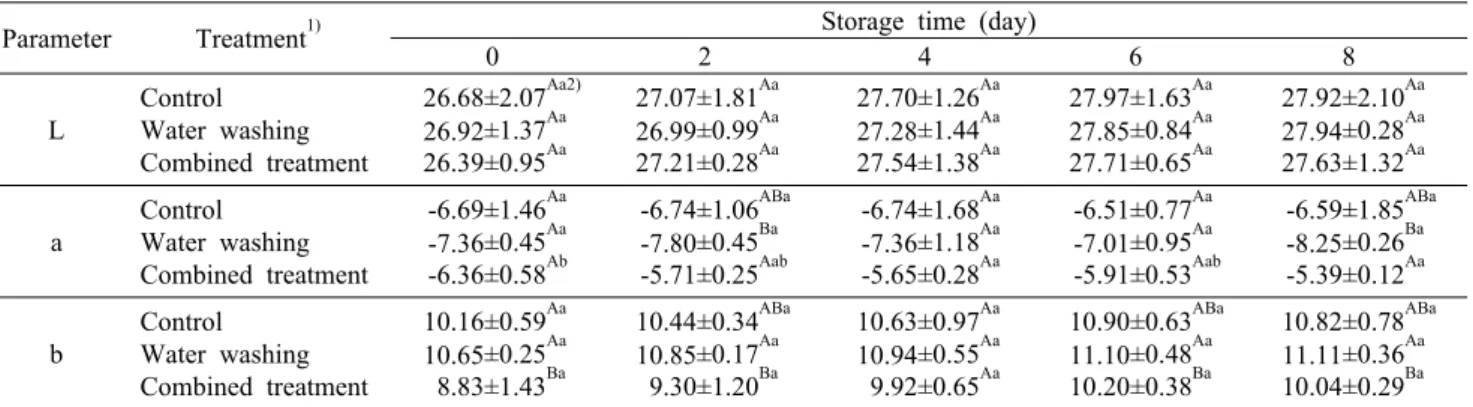
저장 중 병합처리에 의한 색도 변화
병합 세척처리 후 적근대 시료의 외관상 변화와 저장 중 품질 유지 여부를 확인하기 위해 대표적인 품질지표 중의 하나인 색도를 측정하였다(Table 4). 저장 8일간 색도 측정 결과 처리구 간의 큰 차이를 보이지 않았으나, b값에서 병합 처리 시 저장 초기에 대조구와 비교하여 유의적인 차이를 보 였다. 이는 처리 직후 남아 있던 APE 추출물이 색도에 영향 을 주었을 것으로 판단되며, 저장 8일 후에 처리구 간 유의적 인 차이가 없는 것으로 보아 시료에 미치는 영향은 크지 않 다고 판단된다. 유사한 연구 결과로 Poimenidou 등(21)의 연구에서 lactic acid와 차아염소산나트륨을 이용하여 fresh-
cut 시금치와 상추를 2분간 세척한 결과 lactic acid의 경우 에 저장 7일 후의 시료의 L값에 있어서 유의적인 차이가 없었다고 보고한 반면에 차아염소산나트륨으로 동일하게 세척한 결과 시료의 L값이 증가하였는데, 이는 염소계 살균 제가 연약한 잎의 산화에 관여하여 잎채소의 외관에 부정적 인 영향을 끼친 것으로 판단된다. 따라서 본 연구 결과 APE 같은 천연물질을 이용하여 세척하는 경우 저장 중 적근대 같은 잎채소의 색을 유지시켜 염소계 살균세척제에 비해 외 관상 긍정적 효과를 가져다주는 것을 시사한다.
요 약
본 연구에서는 차아염소산 나트륨 같은 염소계 살균세척제 를 대체하기 위한 천연 살균세척제로서 도토리박 추출물 (APE)을 개발하기 위해 적근대에 Listeria monocytogenes 를 접종한 후 APE의 항균 효과를 측정하였다. 그리고 최적 세척처리 조건을 수립하고자 APE, FA, 50°C에서의 mild heat를 병합처리하였다. 모든 처리구 중 0.5% APE/50°C mild heat/0.5% fumaric acid(FA) 병합 세척처리가 가장 효과적이었는데, L. monocytogenes 수를 대조구에 비해 3.36 log CFU/g 감소시켰다. 병합처리된 적근대 시료의 저 장 8일 후 총 호기성균은 대조구와 비교하였을 때 2.89 log CFU/g 감소하였고, 색도 측정 결과 처리구 간 유의적인 차 이가 나타나지 않았다. 따라서 본 연구 결과 APE/mild heat/
FA 병합처리 방법은 수확 후 적근대의 품질에 영향을 미치 지 않고 미생물학적 안전성을 높일 수 있는 효과적인 기술이 라고 판단된다.
REFERENCES
1. Centers for Disease Control and Prevention. 2016. Multistate outbreak of listeriosis linked to packaged salads produced at Springfield, Ohio Dole processing facility. http://www.
cdc.gov/listeria/outbreaks/bagged-salads-01-16 (accessed May 2016).
2. Kim YJ, Kim MH, Song KB. 2009. Combined treatment of fumaric acid with aqueous chlorine dioxide or UV-C irradi- ation to inactivate Escherichia coli O157:H7, Salmonella enterica serovar Typhimurium, and Listeria monocytogenes inoculated on alfalfa and clover sprouts. LWT-Food Sci Technol 42: 1654-1658.
3. Kim YJ, Kim MH, Song KB. 2009. Efficacy of aqueous chlorine dioxide and fumaric acid for inactivating pre-exist- ing microorganisms and Escherichia coli O157:H7, Salmo- nella typhimurium, and Listeria monocytogenes on broccoli sprouts. Food Control 20: 1002-1005.
4. Ganesh V, Hettiarachchy NS, Griffis CL, Martin EM, Ricke SC. 2012. Electrostatic spraying of food-grade organic and inorganic acids and plant extracts to decontaminate Escheri- chia coli O157:H7 on spinach and iceberg lettuce. J Food Sci 77: M391-396.
5. Almasoud A, Hettiarachchy N, Rayaprolu S, Horax R, Eswaranandam S. 2015. Electrostatic spraying of organic acids on biofilms formed by E. coli O157:H7 and Salmonella Typhimurium on fresh produce. Food Res Int 78: 27-33.
6. López-Gálvez F, Gil MI, Truchado P, Selma MV, Allende A. 2010. Cross-contamination of fresh-cut lettuce after a short-term exposure during pre-washing cannot be controlled after subsequent washing with chlorine dioxide or sodium hypochlorite. Food Microbiol 27: 199-204.
7. Mani-López E, García HS, López-Malo A. 2012. Organic acids as antimicrobials to control Salmonella in meat and poultry products. Food Res Int 45: 713-721.
8. Chun HH, Song KB. 2013. The combined effects of aqueous chlorine dioxide, fumaric acid, and ultraviolet-C with modi- fied atmosphere packaging enriched in CO2 for inactivating preexisting microorganisms and Escherichia coli O157:H7 and Salmonella typhimurium inoculated on buckwheat sprouts.
Postharvest Biol Technol 86: 118-124.
9. Son HJ, Kang JH, Oh DH, Min SC, Song KB. 2016. Com- bined treatment of fumaric acid with mild heat to inactivate microorganisms on fresh spinach during storage. J Appl Biol Chem 59: 69-74.
10. Chikthimmah N, Laborde LF, Beelman RB. 2003. Critical factors affecting the destruction of Escherichia coli O157:
H7 in apple cider treated with fumaric acid and sodium benzoate. J Food Sci 68: 1438-1442.
11. Meyers KJ, Swiecki TJ, Mitchell AE. 2006. Understanding the native Californian diet: Identification of condensed and hydrolyzable tannins in tanoak acorns (Lithocarpus densi- florus). J Agric Food Chem 54: 7686-7691.
12. Cantos E, Espín JC, López-Bote C, de la Hoz L, Ordóñez JA, Tomás-Barberán FA. 2003. Phenolic compounds and fatty acids from acorns (Quercus spp.), the main dietary constituent of free-ranged Iberian pigs. J Agric Food Chem 51: 6248-6255.
13. Aguilera-Carbo A, Augur C, Prado-Barragan LA, Favela- Torres E, Aguilar CN. 2008. Microbial production of ellagic acid and biodegradation of ellagitannins. Appl Microbiol Biotechnol 78: 189-199.
14. Sung SH, Kim KH, Jeon BT, Cheong SH, Park JH, Kim DH, Kweon HJ, Moon SH. 2012. Antibacterial and anti- oxidant activities of tannins extracted from agricultural by- products. J Med Plants Res 6: 3072-3079.
15. Delaquis PJ, Fukumoto LR, Toivonen PMA, Cliff MA. 2004.
Implications of wash water chlorination and temperature for the microbiological and sensory properties of fresh-cut ice- berg lettuce. Postharvest Biol Technol 31: 81-91.
16. Li H, Zhao L, Wu J, Zhang Y, Liao X. 2012. Inactivation of natural microorganisms in litchi juice by high-pressure carbon dioxide combined with mild heat and nisin. Food Microbiol 30: 139-145.
17. Akiyama H, Fujii K, Yamasaki O, Oono T, Iwatsuki K. 2001.
Antibacterial action of several tannins against Staphylococ- cus aureus. J Antimicrob Chemother 48: 487-491.
18. Esteban MD, Palop A. 2011. Nisin, carvacrol and their com- binations against the growth of heat-treated Listeria mono- cytogenes cells. Food Technol Biotechnol 49: 89-95.
19. Cotter PD, Hill C. 2003. Surviving the acid test: responses of gram-positive bacteria to low pH. Microbiol Mol Biol Rev 67: 429-453.
20. Ponce AG, Del Valle C, Roura S. 2004. Shelf life of leafy vegetables treated with natural essential oils. J Food Sci 69: fms50-fms56.
21. Poimenidou SV, Bikouli VC, Gardeli C, Mitsi C, Tarantilis PA, Nychas GJ, Skandamis PN. 2016. Effect of single or combined chemical and natural antimicrobial interventions on Escherichia coli O157:H7, total microbiota and color of packaged spinach and lettuce. Int J Food Microbiol 220:
6-18.