A Study on the Impacts of Paste Type Torrefied Wood Flour Coagulants on Water Ecosystem 1 KOR APP
Seung Min YANG 2 ⋅Seok Eon LEE 3 ⋅Hae Keum PARK 2 ⋅Seog Goo KANG 2,†
ABSTRACT
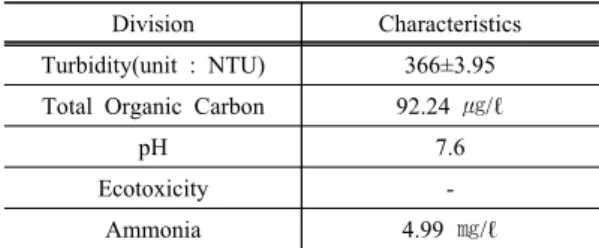
1)Due to global warming and abnormal climate, the incidence and scale of green tracts in rivers and water intake dam are increasing every year. Therefore, in this study, developed eco friendly positively charged Torrefied Wood Flour(TWF) coagulant by reusing wood damaged by blight as a natural material. In order to evaluate the effect of coagulant on water ecosystem, green algae contaminated water was collected and TOC showed high removal rate of 86% ~ 92% under 1% and 5% TWF C-PAM treatment condition. The NH
3-N showed 53% removal efficiency. The average pH of the polluted water was 7.9 in the case of hydrogen ion concentration, and the pH of the treated water was in the range of 6.5 ~ 7.7, It was found to be suitable for water quality standards. In ecotoxicity tests, all the results of the experiment showed that both the number of green algae and that of treated water were not affected by the survival of the daphnia. Therefore, as a result of the analyzing, developed paste type TWF coagulants is considered to be able to remove algae using natural resources.
Keywords: algal bloom, algal bloom remove efficiency, positively charged torrefied wood flour
1. INTRODUCTION
As global warming and climate change led to the spread and increased frequency of green algae in intake sources, swamps, lakes and rivers, it has raised the issue of water pollution management. (Yang et al., 2018).
As intake source water, lake water and river water where green algae sprouts need to undergo a water treatment process before they are supplied to households in tap water, it takes a lot of costs and treatment processes.
Currently, in Korea, Loess holds 80 percent of total spraying coagulants to remove green algae (Yang et al., 2017). Since loess is easy to use and costs much less than other spraying coagulants, it has been widely
used to remove green algae temporarily (WERT, 2012).
Also, flocculants are used to deal with water con- tamination in sewage treatment facilities and the most widely used flocculant is Alum, PAC (Poly aluminum chloride). Alum and PAC, aluminum-based flocculants, may induce central nervous system diseases such as Alzheimer’s and serious environment damages such as the death of flora and fauna, when aluminum ions dissolve in drinking water. To deal with the existing problem of flocculants, there have been several techniques under development to eliminate green algae and pollution materials, such as fine bubble generation and magnetic powder (Ives et al., 1959). Also, other techniques include the development of green algae
1
Date Received April 30, 2019, Date Accepted October 28, 2019
2
Department of Biobased Materials, Chungnam National University, Daejeon 34134, Republic of Korea
3
Industrial & Environment Business Team, FITI Testing & Research Institute, Ochang-eup 28115, Republic of Korea
†