based on vegetative features such as color, size, and branch
ing pattern, as well as reproductive characteristics such as number of carpogonial branches per supporting cell, posi
tion and size of cystocarps and number of ostioles, and whether or not tetrasporangia are produced in sori(Dawson 1954; Norris 1957; Arakaki et al. 2011).
Eleven species are currently recorded in algal flora of Korea(Lee and Kang 2002; Kim et al. 2013; Lee and Kim 2014). During a survey of marine algal flora, a species be
longing to Callophyllis was collected from Jeju in Korea.
This was identified based on morphological and molecular data, and is newly recorded in Korea.
MATERIALS AND METHODS
Specimens for this study were collected from Pyeng
daeri, Gujwa in Jeju, Korea. Taxonomic data were obtained
https://doi.org/10.11626/KJEB.2020.38.4.611
INTRODUCTION
Kallymeniaceae Kylin(Gigartinales, Rhodophyta), which includes approximately 44 genera and 193 species, is char
acterized by a female reproductive structure with one or several 3celled carpogonial branches on the supporting cell and sterile subsidiary cells of similar morphology to the lower two carpogonial branch cells, which are large and often prominently lobed(Womersley 1994). The auxil
iary cell systems in nonprocarpic genera are also distinc
tive, with several 1 or 2celled chains of subsidiary cells (Womer sley 1994). Many taxa in this family have refrac
tive, darkly staining, usually branched stellate or ganglionic cells in the medulla(Womersley 1994).
Callophyllis Kützing is the most diverse genus in the family.
This genus involves approximately 64 species that occur in cold and temperate waters of both hemispheres(Guiry and Guiry 2020). The distinction among Callophyllis species is
Original article
New record of Callophyllis mageshimensis(Gigartinales, Kallymeniaceae) in Korea
Pil Joon Kang, Jae Woo An and Ki Wan Nam*
Department of Marine Biology, Pukyong National University, Busan 48513, Republic of Korea
Korean J. Environ. Biol.
38(4) : 611-615(2020) ISSN 1226-9999(print) ISSN 2287-7851(online)
* Corresponding author Ki Wan Nam
Tel. 051-629-5922
E-mail. [email protected]
Received: 27 November 2020 Revised: 7 December 2020
Revision accepted: 8 December 2020
Abstract: A marine red algal species was collected from Pyengdae-ri, Gujwa in Jeju, Korea during a survey of marine algal flora. This alga shares the generic features of Callophyllis(Gigartinales, Kallymeniaceae), and is characterized by erect and membranous thalli, branches dichotomously or trichotomoulsy divided, margin somewhat undulate or entire and tetrasporangia scattered irregularly in the cortex. In a phylogenetic tree based on rbc L sequences, the Korean alga nests in the same clade as C. mageshimensis originally described from Japan. The genetic distance between both sequences within the clade was 0.0-0.1%. Based on the morphological and molecular data, the alga was identified as Callophyllis mageshimensis. This is the first record of C. mageshimensis in Korean marine algal flora.
Keywords: Callophyllis mageshimensis, red alga, morphological and molecular data, Korea
from fresh, liquidpreserved and herbarium specimens.
Liquidpreserved material was stored in a 10% solution of Formalin/seawater. Blades dissected from the cleared materials were hand sectioned, transferred to a slide with distilled water, and mounted in pure glycerin. Measure
ments are given as width and length. For permanent slides, the glycerin was exchanged with 10-20% corn syrup.
Total genomic DNA was extracted from silicagelpreser
ved sample using the DNeasy Plant Mini Kit(Qiagen, Hilden, Germany) according to the manufacturer’s pro
tocol. Before extraction, dried material was crushed with liquid nitrogen using a mortar and pestle. Extracted DNA was used for amplification of ribulose1, 5bisphosphate carboxylase large subunit(rbcL) regions. For rbcL, the gene was amplified in three overlapping parts with the primer pairs FrbcL start(5′TGTGTTGTCGACATGTCTA
ACTCTGTAGAAG3′) R753(5′GCTCTTTCATA
CATATCTTCC3′), F492(5′CGTATGGATAAATTTG
GTCG3′) R1150(5′GCATTTGTCCGCAGT
GAATACC3′), and F993(5′GGTACTGTTGTAGG
TAAATTAGAAGG3′) RrbcS(5′TGTGTTGCGGC
CGCCCTTGTGTT AGTCTCAC3′)(Freshwater and Rueness 1994). PCR amplifications were performed in a TaKaRa PCR Thermal Cycler Dice(TaKaRa Bio Inc., Otsu, Japan). PCR was performed with an initial denaturation step at 94°C for 4 min, followed by 35 cycles of 1 min at 94°C, 1 min at 50°C, and 2 min at 72°C, with a final 7min extension at 72°C. The PCR products were moved to Macrogen Sequencing Service for sequencing(Macrogen, Seoul, Korea). Sequences for the rbcL region were aligned using BioEdit(Hall 1999). Phylogenetic analyses were per
formed using neighbor joining and maximumlikelihood methods. Bootstrap values were calculated with 1,000 rep
lications. RbcL sequences of other species were obtained from GenBank. Kallymenia reniformis(Turner) J. Agardh was used as an outgroup.
RESULTS AND DISCUSSION Callophyllis mageshimensis Tanaka 1963 Korean name: Jejubulgeunip nom. nov.
(신칭: 제주붉은잎)
Type locality: Mageshima, Tanegashima, Japan(Tanaka 1963).
Specimens examined: NIBRAL0000152471, NIBRRD 0000004777, NIBRRD0000004778(Pyeongdaeri, Jeju:
04.xi.2013).
Habitat: Epilithic or epiphytic on other algae near upper to lower intertidal.
Morphology: Thalli 3-6cm high, erect, compressed, bright to dark red in color, membranous in texture, attached to substratum by rhizoidal pad; main axes issuing branches dichotomously, trichotomously or occasionally palmately and proliferations very rarely on the margin, 5-20mm in width; branches with round apex, somewhat undulate or entire in margin; cortex of small, round to elliptical cells of 2-5×3-5μm in size, one to three cell layers thick; medul
lary cells large, ovoid to elliptical, intermixed with filaments of small cells, 30-100μm in diam.; tetrasporangia scattered irregularly in cortex near the apex of branch, produced from the inner cortical cell, round to elliptical, with cruciate division, 10-15×10-15μm in size. Sexual plants were not observed during the present study.
Callophyllis species have been recognized based on fol
lowing features: thallus size and shape, branching pattern, marginal type, size and location of cystocarps, shape and number of ostioles, and presence or absence of tetraspo
rangial sori(Setchell 1923; Dawson 1954; Norris 1957;
Abbott and Norris 1966; Womersley and Norris 1971; Lee and Kim 2014).
According to the original description(Tanaka 1963), Callo phyllis mageshimensis is characterized by thinly mem
branaceous thalli and di or trichotomously or somewhat palmately divided branches, minutely undulate or entire margin and cystocarps without hornlike protuberances.
Even though cystocarpic plants were not collected in the present study, the vegetative features were confirmed in the Korean alga collected from Jeju(Fig. 1).
It appears that the presence or absence of tetrasporangia sori is an important diagnostic characteristic in Callophyllis except for Chilean species(Arakaki et al. 2011). Unlike in Callophyllis linearis(Abbott and Hollenberg 1976), tetra
sporangia in Callophyllis mageshimensis do not form sori, but are scattered in the cortex(Fig. 1F).
Callophyllis mageshimensis is similar to C. repens in having a creeping habit. However, while the latter species has adherent branches attached to the substratum by discoid and minute radical discs, the former has no such adherent branches. C. mageshimensis is also distinguished from the latter in having a round rather than acute apex in branches.
The Korean alga collected from Jeju is referred to C.
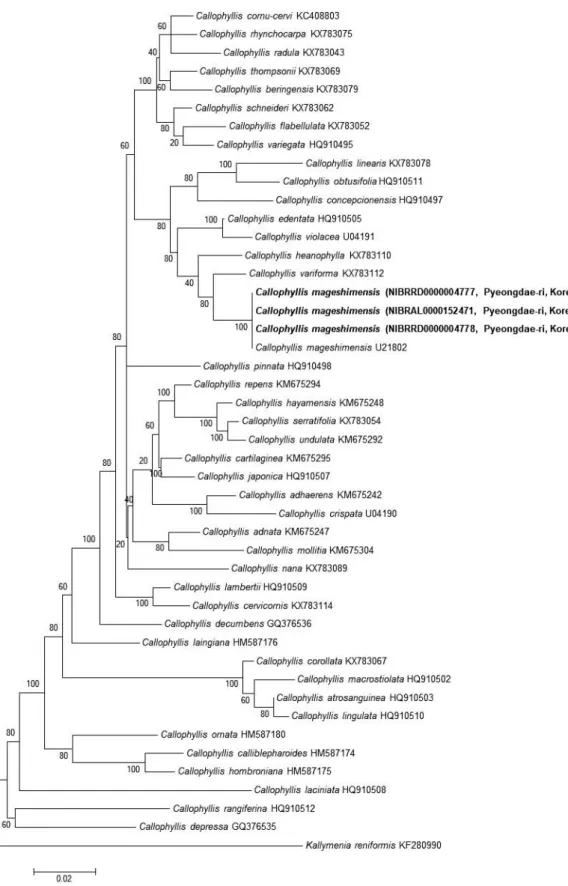
mageshimensis based on the morphological features. This is also supported by molecular analysis(Fig. 2).
In the phylogenetic tree based on rbcL sequence, the sequence of the Korean alga nests in the same clade as that
of C. mageshimensis with a genetic distance of 0.0-0.1%
(Fig. 2). These morphological and molecular data suggest that this Korean species should be identified as C. mageshi-
mensis. This is the first record of Callophyllis mageshimensis in Korea.
Fig. 1. Callophyllis mageshimensis Tanaka. A. Habit of vegetative plant. B. Details of branch with round apex. C. Transverse section of branch with round medullary cells. D. Cortical cell layers. E. Tetrasporangia(arrows) scattered irregularly in cortex in surface view. F. Devel- oping tetrasporangium(arrow) from cortical cell(arrowhead).
A B
C D
E F
3mm
1cm
400µm
40µm
40µm 20µm
Fig. 2. Phylogenetic tree of Callophyllis species obtained from maximum-likelihood method based on rbc L sequences. Bootstrap propor- tion values(1,000 replicates samples) are shown above branches. Scale bar=0.02 substitutions/site.
ACKNOWLEDGEMENTS
This work was supported by a grant from the National Institute of Biological Resources(NIBR) funded by the Ministry of Environment(MOE) of the Republic of Korea (NIBR202002117), and by the Marine Biotechnology Program of the Korea Institute of Marine Science and Tech
no logy Promotion(KIMST) funded by the Ministry of Oceans and Fisheries(MOF)(No. 20170431).
REFERENCES
Abbott IA and RE Norris. 1966. Studies on Callophyllis(Rhodo- phyceae) from the Pacific coast of North America. Nova Hedwigia 10:67-84.
Abbott IA and GJ Hollenberg. 1976. Marine Algae of California.
Stanford University Press, Stanford, California.
Arakaki N, K Alveal, ME Ramírez and S Fredericq. 2011. The ge- nus Callophyllis(Kallymeniaceae, Rhodophyta) from the cen- tral-south Chilean coast(33° to 41° S), with the description of two new species. Rev. Chil. Hist. Nat. 84:481-499.
Dawson EY. 1954. Marine red algae of Pacific Mexico. Part 2.
Cryptonemiales(cont.). Allan Hancock Pac. Exped. 17:241- 398.
Freshwater DW and J Rueness. 1994. Phylogenetic relationships of some European Gelidium(Gelidiales, Rhodophyta) species based upon rbcL nucleotide sequence analysis. Phycologia
33:187-194.
Guiry MD and GM Guiry. 2020. AlgaeBase. World-wide electronic publication, National University of Ireland, Galway. http://
www.algaebase.org. Accessed 08 Nov. 2020.
Hall TA. 1999. BioEdit: a user-friendly biological sequence align- ment editor and analysis program for Windows 95/98/NT.
Nucl. Acids Symp. Ser. 41:95-98.
Kim HS, SM Boo, IK Lee and CH Sohn. 2013. National List of Species of Korea Marine Algae. Jeonghaengsa, Seoul.
Lee HW and MS Kim. 2014. Cryptic species diversity of the red algal genus Callophyllis(Kallymeniaceae, Gigartinales) from Korea. J. Ecol. Environ. 37:395-410.
Lee YP and SY Kang. 2002. A Catalogue of the Seaweeds in Kor- ea. Jeju National University Press, Jeju.
Norris RE. 1957. Morphological studies on the Kallymeniaceae.
Univ. Calif. Publ. Bot. 28:251-333.
Setchell WA. 1923. A revision of the west North American spe- cies of Callophyllis. Univ. Calif. Publ. Bot. 10:397-401.
Tanaka T. 1963. Studies on some marine algae from southern Japan V. Mem. Fac. Fish. Kagoshima Univ. 12:75-91.
Womersley HBS. 1994. The Marine Benthic Flora of Southern Australia - Part IIIA - Bangiophyceae and Florideophyceae (Acrochaetiales, Nemaliales, Gelidiales, Hildenbrandiales and Gigartinales sensu lato). Australian Biological Resources Study, Canberra.
Womersley HBS and RE Norris. 1971. The morphology and taxo- nomy of Australian Kallymeniaceae(Rhodophyta). Aust. J.
Bot. Suppl. 2:1-62.