어린이집에서 이산화탄소와 미세먼지의 장기간 시간적인 변이를 활용한 실내환경수준 평가
김윤지* · 이세원* · 반현경* · 차상민** · 김근배*** · 이기영*
†*서울대학교 보건대학원 환경보건학과
**Kweather
***국립환경과학원
Temporal Variation of Indoor Air Quality in Daycare Centers
Yoonjee Kim *, Sewon Lee*, Hyunkyung Ban*, Sangmin Cha**, Geunbae Kim ***, and Kiyoung Lee*
†*Graduate School of Public Health, Seoul National University, Seoul, Korea
**Kweather, Seoul, Korea
***National Institute of Environmental Research, Incheon, Korea
ABSTRACT
Objectives: The purposes of the study were to analyze the temporal variation of carbon dioxide (CO
2) and particulate matter (PM) in daycare centers and evaluate the appropriateness of the official test method of one- time measurement.
Methods: Indoor air quality in 46 daycare centers in the Seoul Metropolitan Area was measured as specified in the official test method of Indoor Air Quality Management law. In addition, indoor air quality in the 46 daycare centers was measured over 37 days using a real-time monitor (AirGuard K).
Results: The daily means of CO
2and PM in the 46 daycare centers were 1042.74 ± 134.45 ppm and 67.60 ± 18.25 µg/m
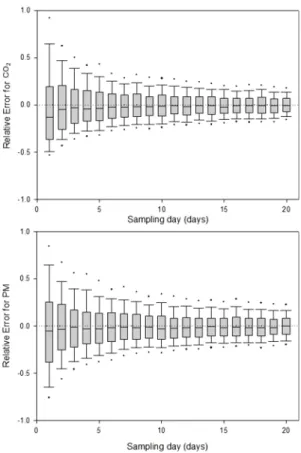
3, respectively. Indoor air quality in the daycare centers showed significant temporal fluctuation. Measurements for single days were significantly different from the 37-day average exposure. Relative error of short term exposure decreased with an increase in the number of sampling days. The noncompliance rate for CO
2using the official testing method was 2.17%, and none exceeded the PM
10standard of 100 µg/m
3. With monitoring over 37 days, the daily noncompliance rate for CO
2was 50.4% and the daily noncompliance rate for PM was 13.8%.
Conclusions: When the official test method evaluates the indoor air at daycare centers one day per year, the results may not represent actual indoor air quality over a longer period of time. Real-time monitoring devices could be an alternative for managing indoor air quality.
Keywords: Indoor, time variation, real-time data, daycare, particulate matter, carbon dioxide
I. 서 론
어린이집의 실내 환경은 어린이의 건강에 중요 한 영향을 미친다. 어린이들은 취약계층 중 한 집
단으로 공기 중 오염물질 등의 환경 오염원의 노 출에 해로운 영향을 받을 수 있다.
1)어린이들은 성 인보다 활동적이기 때문에 호흡량이 많고 입으로 숨을 쉬는 경우가 많다. 구강 호흡을 하게 되면 코
†