소규모 다중이용시설의 실내공기질 실태조사 및 건강위해성평가:
민감군 이용시설을 중심으로
신혜진*
#· 박우상**
#· 김보경* · 지경희*** · 김기태**
†*국립환경과학원 환경건강연구부, **서울과학기술대학교 에너지환경공학과,
***용인대학교 산업환경보건학과
Indoor Air Quality and Human Health Risk Assessment for Un-regulated Small-sized Sensitive Population Facilities
Hyejin Shin*
#, Woosang Park**
#, Bokyung Kim*, Kyunghee Ji***, and Ki-Tae Kim**
†*Environmental Health Research Department, National Institute of Environmental Research
**Department of Environmental Energy Engineering, Seoul National University of Science and Technology
***Department of Occupational and Environmental Health, Yongin University ABSTRACT
Objectives: The purpose of this study is to investigate human health risk assessment of indoor air pollutants at small-sized public-use facilities (e.g., daycare centers, hospital and elderly care facilities) that the susceptible population is mainly used.
Methods: To assess indoor air quality (IAQ), the concentrations of indoor air contaminants such as HCHO, benzene, toluene, ethylbenzene, xylene, styrene, PM-10, CO, NO
2and O
3in air samples were measured according to the Indoor Air Quality Standard Method. By conducting the questionnaire survey, the major factors influencing IAQ were identified. Human health risk assessment was carried out in the consideration of type of use (user and worker) at 75 daycare centers, 34 hospitals and 40 elderly care facilities.
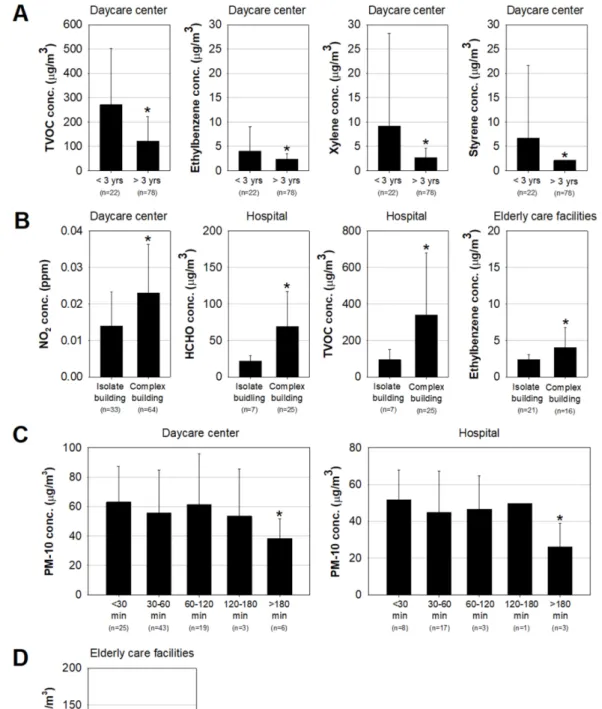
Results: As a result of measurement of indoor air contaminants, the average concentration of HCHO and TVOCs in hospitals was higher than daycare centers and elderly care facilities, about 8.8 and 23.5% of hospitals were exceeded by IAQ standard. In human health risk assessment, for the user of daycare centers and elderly care facilities, the mean carcinogenic risk of HCHO inhalation was higher than acceptable value. Except for HCHO, other values were determined under acceptable risk. Similarly, for the worker of hospitals, the mean carcinogenic risk of HCHO inhalation was higher than acceptable value and other values were evaluated under acceptable risk. In contrast, the risk levels of other contaminants measured in elderly care facilities were acceptable. In the determination of factors influencing IAQ, the construction year, building type, ventilation time, and the use of air cleaner were identified.
Conclusions: This study provides the information for establishing the plans of public health management of IAQ at small-sized public-use facilities that have not yet been placed under the regulation. The findings suggest the consideration of human health risk assessment results for the IAQ standards.
Keywords: Indoor air quality, small-sized public-use facilities, susceptible population, human health risk assessment, indoor air contaminants
#
Hyejin Shin and Woosang Park equally contributed to this manuscript.
†