실내공기 중 생물학적 오염물질에 관한 국내 연구 동향
허은혜·원동환·문경환† 고려대학교 보건과학대학 보건과학과
Trend in Study of Biological Pollutants in Indoor Air Quality in Korea
Eun-Hae Huh, Dong-Hwan Won, and Kyong-Whan Moon†
Department of Public Science, College of Health Science, Korea University, Seoul, Korea
ABSTRACT
Objectives: Indoor air quality problems in public spaces have recently become a very important issue in South Korea, because many spend a long time every day indoors. In this study, an extensive literature review was performed on the subject of suspended bacteria and fungi in public facilities. The objective of this study was to evaluate the extent and types of suspended bacteria and fungi in indoor air in South Korea. This study will provide direction to the research in the field of indoor air.
Methods: Article reviews was conducted using a search engine and the following keywords; ‘bacteria’, ‘total suspended bacteria’, ‘fungi’ and ‘indoor air’ from published articles since 2000.
Results: Most of the places of measurement were schools, kindergartens, childcare centers and general hospitals.
The highest concentrations of total suspended bacteria and fungi were found in schools and kindergartens. Some public facilities exceeded the standard of 800 CFU/m
3. There were few studies on other suspended bacteria:
Gram Negative Bacteria, Staphylococcus and Klebsiella pneumoniae.
Conclusions: It appears that more studies with intensive controls are needed. It was found that schools and kindergartens were most susceptible to microbial indoor air pollution. These results may be able to suggest an indoor standard for suspended bacteria and fungi in South Korea.
Keywords: airborne bacteria, airborne fungi, indoor air, Korea, review paper
I. 서 론
국가의 에너지절약 정책에 따라 건물의 단열과 기 밀성이 강조되고 실내거주시간이 증가하면서 실내공 기오염의 심각성이 부각되고 있다.1) Kim2)의 연구 등에 따르면 대부분의 생물학적 오염물질은 실외보 다 실내에서 높은 농도로 나타나고 있다고 보고하여 실내공기질의 중요성을 뒷받침해 주고 있다. 이에 따
라 환경부는 지속적으로 실내공기 관리상태를 점검 하고 있으며, 최근 환경부 조사에 따르면 다중이용 시설(1만103개소) 및 100가구 이상 신축 공동주택 (389개소) 중 다중이용시설 94곳, 신축 공동주택 2곳이 각각 법령을 위반한 것으로 나타났고, 가정집 의 70%가 총부유세균 유지기준을 초과한 것으로 나 타났으며, 보육시설의 경우 다른 다중이용시설에 비 해 평균 655.9 CFU/m3로 높게 나타났다.3,4)
†
Corresponding author: Department of Environmental Health, College of Health Science, Korea University, Seoul 136- 703, Korea, Tel: +82-2-940-2865, Fax: +82-303-0317-2865, E-mail: [email protected]
Received: 29 March 2012, Revised: 12 April 2012, Accepted: 9 August 2012
일반적으로 실내공기오염 물질은 가스상 오염물질 과 입자상 오염물질로 분류할 수 있다.5)가스상 오 염물질은 이산화탄소, 일산화탄소, 휘발성 유기화합 물, 폼알데하이드 등이고, 입자상 오염물질은 미세먼 지와 꽃가루(pollen), 세균(bacteria), 진균(fungi) 및 일부 원생동물(protozoa)의 포자(spores), 식물 조각, 상피조직(epithelium tissue), 바이러스(viruses) 등의 생물학적 인자가 있다.6)최근 가스상 오염물질은 현 황파악 및 관리가 한계에 이르렀다. 또한, 생물학적 오염물질에 노출시 피부 및 호흡기 계통에 감염성 질환과 과민성질환이 발생한다고 보고되고 있다. 다 른 유해인자와 달리 생물학적 인자는 생물체의 종이 다양하고 돌연변이가 발생하며 생물활성(bioactivity) 을 가지고 있으므로 측정이나 평가방법이 매우 어렵 고 노출기준 설정을 위한 기초자료도 매우 부족하
다.7,8) 이에 따라 실내공기에 대한 관심이 가스상 오
염물질에서 입자상 오염물질 중 생물학적 오염물질 로 이동하고 있다.
환경부는 기존의 지하생활공간 공기질 관리법을 2003년 5월 다중이용시설 등의 실내공기질관리법 (2004년 5월 시행)으로 개정하여 다중이용시설 및 신축공동주택 등을 관리하고 있으며, 고용노동부의 산업안전보건법, 교육과학기술부의 학교보건법, 보건 복지부의 공중위생법 등으로 학교와 사무실 및 공중 위생시설 등을 관리하고 있다. 우리나라 실내공기질 관리항목 및 유지기준에서 총부유세균을 800 CFU/
m3로 정하고 있으나, 일부다중이용시설과 위생시설 은 총부유세균 기준을 정하지 않고 있다. 또한 천 식(asthma), 알레르기(allergy), 아토피(atopy) 등 환 경성 질환의 원인으로 추정되는 부유진균을 관리하 고 있지 않다.9-12) 국외의 경우 홍콩 1,000 CFU/m3, 싱가포르 500 CFU/m3로 비슷한 수준을 보이거나 대부분 기준이 없다.13-15)국내 일부 시설에 대한 기 준의 부재와 필요에 따른 산발적 수행으로 현재까지 국내에서 수행된 연구의 수는 매우 부족하다. 더욱 이 국내 공공시설에서의 실내공기질에 대한 연구를 수집·정리한 논문이 거의 없어 일부 공공시설에 연 구가 치중되는 현상이 지속되고 있으며, 장소별 평 균 오염수준 및 기준 유무를 확인하기 어렵다.
본 연구는 국내에서 기존에 수행된 다중이용시설 등 다양한 공공장소에서 실내공기 중 생물학적 오염 물질을 연구한 것을 수집하고 재분석함으로써 국내
측정동향과 건물이용특성에 따른 분포현황을 파악하 였다. 이를 통해 국내 실내공기 중 세균과 진균에 대한 연구 수행에 자료를 제공하고 향후 국내 부유 미생물에 대한 측정방안 제시 및 실내공기질 기준, 가이드라인 설정 및 관리방안 수립 등으로 활용하는 데 기여하고자 수행하였다.
II. 연구방법 1. 자료수집
최근에 수행된 총부유세균과 진균에 관한 연구자 료 수집은 교육과학기술부 출연기관 한국교육학술정 보원이 제공하는 학술연구정보서비스(http://www.
riss.kr/) 중 국내학술지논문검색 및 학위논문검색, 한 국학술정보(주)가 제공하는 학술데이터베이스(http://
kiss.kstudy.com/) 중 학술지검색, 누리미디어가 제공 하는 국내학술논문 전문 DB(http://www.dbpia.co.kr/) 중 DBPIA 학술논문검색, 그리고 구글 학술검색사 이트(http://scholar.google.co.kr/)를 이용하여 문헌 선 정조건을 설정하고 본 연구 목적에 적합한 연구논문 을 선정하여 기초자료를 수집하였다.
본 연구 수행을 위해 문헌 검색어로 ‘미생물’,
‘생물학적 인자’, ‘세균’, ‘진균’, ‘곰팡이’, ‘총부유 세균’, ‘대장균’, ‘황색포도상 구균’, ‘포도상 구균’
등 총부유세균 및 진균을 나타내는 단어와 측정 장 소를 실내로 제한하기 위해 ‘실내공기’를 조합하였 다. 선별한 문헌들 중 다음과 같은 요건을 가진 것 을 선정하였다. 첫째, 2000년 이후에 국내 학회지 에 발표한 연구논문 및 학위논문, 둘째, 국내에서 수행된 연구논문 및 학위논문, 셋째, 선정된 논문 의 주제가 본 논문 주제와 일치하는 논문, 넷째, 결 과간의 오차를 피하기 위해 측정방법으로 충돌법을 이용한 논문이다.16)
2. 자료취합 및 분석
다양한 연구 설계에 의해 측정된 부유세균과 부유 진균에 대한 자료를 조사연도, 측정 장소, 발표연 도, 측정방법 등으로 구분하여 국내 연구 동향을 파 악하였다. 총부유세균은 측정 장소별로 분류하여 측 정결과에 평균 농도를 나열하고 법정 기준과 비교하 여 초과 정도를 확인함으로써 우선적으로 관리가 필 요한 대상 장소를 선정하는데 활용할 수 있도록 하
였다. 기타부유세균은 연구별로 분류하였으며 부유 진균은 측정 장소별로 분류하여 측정결과에 평균 농 도를 나열하였다. 측정결과는 소수점 이하의 경우 반 올림하여 정수를 사용하였으며 반복 측정한 수치를 제시한 경우는 산술평균으로 기재하였다. 통계학적 분석은 SPSS(Ver. 12.0) 프로그램을 이용하였다. 장 소별 농도수준을 비교하기 위해 빈도분석을 통한 정 규분포성을 확인하고 비정규분포하는 자료에 대해 자료 변환을 통해 정규분포성을 확인한 후 변환된 자료로 독립 t-검정 및 일원분산분석(one-way ANOVA) 등을 수행하였으며, 각 요소들 간의 차이 를 확인하기 위해 Kruskal-Wallis 검정 후 Mann- Whitney 검정을 실시하였다.
III. 연구결과 1. 국내 부유세균 연구 현황
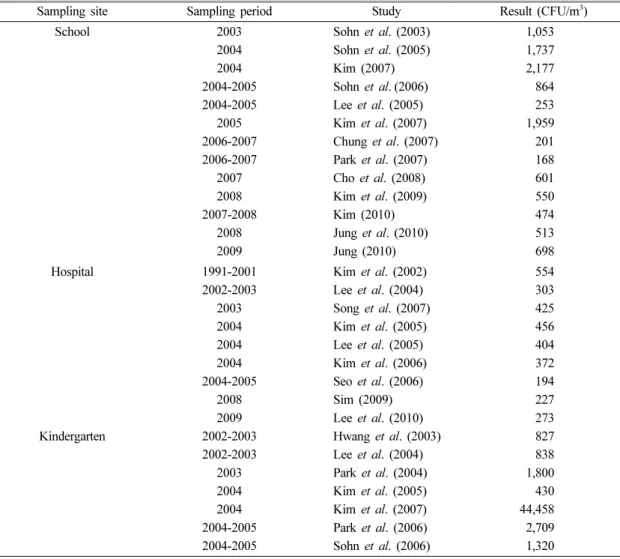
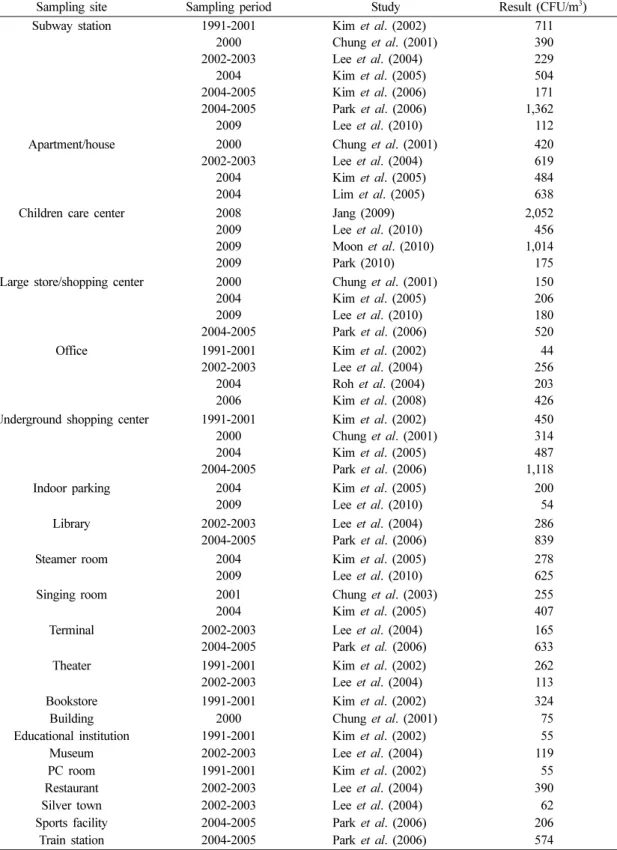
실내공기 중 총부유세균 논문은 총 36개로 주로 학교, 병원, 유치원 등 환자, 청소년, 영유아 등 민 감군이 장시간 생활하는 장소에서 연구가 이루어졌 다. 총부유세균에 대한 연구를 포집 장소별로 분류 하여 Table 1에 나타내었다.17-52)병원과 학교의 결과 는 대표성이 있다고 생각되는 지점의 측정결과를 채 택하였다.
연구별로 측정 지점의 개수가 달라서 비교하기 어 려우나 5% 절삭평균은 508 CFU/m3로 대부분의 다 중이용시설 및 주택, 학교, 사무실, 위생시설 등에서
Table 1. Total suspended bacteria concentration in Public facilities air of South Korea
Sampling site Sampling period Study Result (CFU/m
3)
School 2003 Sohn et al. (2003) 1,053
2004 Sohn et al. (2005) 1,737
2004 Kim (2007) 2,177
2004-2005 Sohn et al. (2006) 864
2004-2005 Lee et al. (2005) 253
2005 Kim et al. (2007) 1,959
2006-2007 Chung et al. (2007) 201
2006-2007 Park et al. (2007) 168
2007 Cho et al. (2008) 601
2008 Kim et al. (2009) 550
2007-2008 Kim (2010) 474
2008 Jung et al. (2010) 513
2009 Jung (2010) 698
Hospital 1991-2001 Kim et al. (2002) 554
2002-2003 Lee et al. (2004) 303
2003 Song et al. (2007) 425
2004 Kim et al. (2005) 456
2004 Lee et al. (2005) 404
2004 Kim et al. (2006) 372
2004-2005 Seo et al. (2006) 194
2008 Sim (2009) 227
2009 Lee et al. (2010) 273
Kindergarten 2002-2003 Hwang et al. (2003) 827
2002-2003 Lee et al. (2004) 838
2003 Park et al. (2004) 1,800
2004 Kim et al. (2005) 430
2004 Kim et al. (2007) 44,458
2004-2005 Park et al. (2006) 2,709
2004-2005 Sohn et al. (2006) 1,320
Table 1. Continued
Sampling site Sampling period Study Result (CFU/m
3)
Subway station 1991-2001 Kim et al. (2002) 711
2000 Chung et al. (2001) 390
2002-2003 Lee et al. (2004) 229
2004 Kim et al. (2005) 504
2004-2005 Kim et al. (2006) 171
2004-2005 Park et al. (2006) 1,362
2009 Lee et al. (2010) 112
Apartment/house 2000 Chung et al. (2001) 420
2002-2003 Lee et al. (2004) 619
2004 Kim et al. (2005) 484
2004 Lim et al. (2005) 638
Children care center 2008 Jang (2009) 2,052
2009 Lee et al. (2010) 456
2009 Moon et al. (2010) 1,014
2009 Park (2010) 175
Large store/shopping center 2000 Chung et al. (2001) 150
2004 Kim et al. (2005) 206
2009 Lee et al. (2010) 180
2004-2005 Park et al. (2006) 520
Office 1991-2001 Kim et al. (2002) 44
2002-2003 Lee et al. (2004) 256
2004 Roh et al. (2004) 203
2006 Kim et al. (2008) 426
Underground shopping center 1991-2001 Kim et al. (2002) 450
2000 Chung et al. (2001) 314
2004 Kim et al. (2005) 487
2004-2005 Park et al. (2006) 1,118
Indoor parking 2004 Kim et al. (2005) 200
2009 Lee et al. (2010) 54
Library 2002-2003 Lee et al. (2004) 286
2004-2005 Park et al. (2006) 839
Steamer room 2004 Kim et al. (2005) 278
2009 Lee et al. (2010) 625
Singing room 2001 Chung et al. (2003) 255
2004 Kim et al. (2005) 407
Terminal 2002-2003 Lee et al. (2004) 165
2004-2005 Park et al. (2006) 633
Theater 1991-2001 Kim et al. (2002) 262
2002-2003 Lee et al. (2004) 113
Bookstore 1991-2001 Kim et al. (2002) 324
Building 2000 Chung et al. (2001) 75
Educational institution 1991-2001 Kim et al. (2002) 55
Museum 2002-2003 Lee et al. (2004) 119
PC room 1991-2001 Kim et al. (2002) 55
Restaurant 2002-2003 Lee et al. (2004) 390
Silver town 2002-2003 Lee et al. (2004) 62
Sports facility 2004-2005 Park et al. (2006) 206
Train station 2004-2005 Park et al. (2006) 574
기준을 초과하지 않았다. 그러나 일부 학교와 유치 원, 보육시설에서 기준치를 초과하였다. 장소에 따라 총부유세균 농도는 차이가 있는 것으로 확인되었다 (p < 0.01). 학교의 경우 14건 중 6건이 유지기준을 초과했으며, 유치원과 보육시설의 경우 12건의 논문 중 2건을 제외한 나머지에서 유지기준을 초과하는 것으로 나타났다. 또한, 일부 학교와 유아원에서는 기준치의 2.5배 이상의 농도를 나타내었다. 이 결과 는 사무실과 비교했을 때 유의한 차이가 있다(p < 0.05).
따라서 학교와 유아원은 다른 시설에 비해 총부유세 균의 농도가 높음을 확인할 수 있다. 또한, 일부 지 하철, 지하상가, 도서관, 거주시설 등에서도 800 CFU/
m3을 초과하였다. 일부 노인복지시설 및 산후조리원 의 경우는 유지기준이 있음에도 연구가 거의 이뤄지 고 있지 않아 현황 및 그 피해를 확인하기 어렵다.
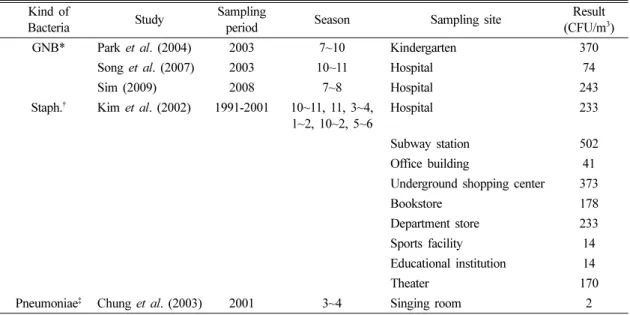
기타부유세균을 가장 많이 측정한 장소는 병원으 로 민감군의 왕래가 많은 장소이나 연구가 부족해 유의성을 파악하기 어렵다. 그람음성균은 Table 2와 같이 유치원과 병원에서 각각 370, 243 CFU/m3로 나타났고 포도상구균은 평균 195 CFU/m3, 폐렴간균 2 CFU/m3로 나타났다.31,33,38,41,52)기타부유세균농도는 지하철과 지하쇼핑센터 등 지하공간에서 대체로 높
게 나타났으나 법적인 규제가 없고 연구의 수가 부 족해 유의성을 파악하는 데 어려움이 있다.
2. 국내 부유진균 연구 현황
부유진균을 측정한 논문은 총 19개로 측정 장 소 및 그 결과에 따라 Table 3과 같이 정리하였
다.23,31-36,40,41,43,44,46,48,51-56)부유진균에 대한 연구는 병
원에서 가장 많고 아파트 및 거주 지역, 지하철, 유 치원 등의 순으로 이루어졌다. 이 장소들은 다른 다 중이용시설에 비해 상대적으로 부유진균농도가 높은 것으로 확인되었다(p < 0.05). 부유진균의 농도가 가 장 높은 곳은 1,100 CFU/m3을 나타낸 유치원으로써 민감군이 장시간 생활하는 공간이다. 그러나 장소와 부유진균간의 상관관계는 유의하지 않은 것으로 나 타났다(p > 0.05).
IV. 고 찰
이번 연구설계에 의해 수집된 국내 총부유세균에 대한 논문은 총 36개로 다른 실내공기오염물질에 비 해 연구가 매우 부족하다. 또한 이 자료 중 대부분 은 가스상 오염물질을 연구할 때 부수적으로 이루어
Table 2. Airborne bacteria concentration in Public facilities air of South Korea Kind of
Bacteria Study Sampling
period Season Sampling site Result
(CFU/m
3)
GNB* Park et al. (2004) 2003 7~10 Kindergarten 370
Song et al. (2007) 2003 10~11 Hospital 74
Sim (2009) 2008 7~8 Hospital 243
Staph.
†Kim et al. (2002) 1991-2001 10~11, 11, 3~4, 1~2, 10~2, 5~6
Hospital 233
Subway station 502
Office building 41
Underground shopping center 373
Bookstore 178
Department store 233
Sports facility 14
Educational institution 14
Theater 170
Pneumoniae
‡Chung et al. (2003) 2001 3~4 Singing room 2
*Gram Negative Bacteria
†
Staphylococcus
‡
Klebsiella pneumoniae
Table 3. Airborne fungi concentration in Public facilities air of South Korea
Sampling site Sampling period Study Result (CFU/m
3)
Hospital 1991-2001 Kim et al. (2002) 252
1998 Cho et al. (2000) 188
2002-2003 Lee et al. (2004) 6
2003 Song et al. (2007) 12
2004 Kim et al. (2005) 64
2004 Lee et al. (2005) 156
2004 Kim et al. (2006) 156
2004 Park et al. (2006) 382
2004 Hwang (2009) 63
Kindergarten 2002-2003 Hwang et al. (2003) 661
2002-2003 Lee et al. (2004) 66
2003 Park et al. (2004) 1,100
2004 Kim et al. (2005) 148
2004 Park et al. (2006) 536
2004-2005 Park et al. (2006) 1,091
Subway 1991-2001 Kim et al. (2002) 122
2000 Chung et al. (2001) 85
2002-2003 Lee et al. (2004) 378
2004 Kim et al. (2005) 89
2004-2005 Park et al. (2006) 350
2004 Hwang (2009) 60
Apartment/house 1999 Kim et al. (2001) 603
2000 Chung et al. (2001) 130
2002-2003 Lee et al. (2004) 51
2004 Kim et al. (2005) 49
2004 Lim et al. (2005) 598
Large store/Shopping center 2000 Chung et al. (2001) 57
2004 Kim et al. (2005) 47
2004-2005 Park et al. (2006) 152
2004 Hwang (2009) 37
Office 1991-2001 Kim et al. (2002) 32
2000 Chung et al. (2001) 38
2002-2003 Lee et al. (2004) 25
2006 Kim et al. (2008) 234
Underground shopping center 1991-2001 Kim et al. (2002) 220
2000 Chung et al. (2001) 117
2004 Kim et al. (2005) 75
2004-2005 Park et al. (2006) 324
Children care center 2004 Hwang (2009) 16
2009 Moon et al. (2010) 144
Day-care center 2004 Park et al. (2006) 334
2004 Hwang (2009) 62
Library 2002-2003 Lee et al. (2004) 238
2004-2005 Park et al. (2006) 132
졌다. 부유진균의 경우 19건의 연구가 이루어졌으며 이 중 15건이 총부유세균과 함께 연구된 것으로 부 유진균 역시 단일 연구가 부족한 것으로 사료된다.
본 연구는 문헌선정조건으로 수집범위를 제한하여 주변 환경에 따라 변화하는 세균 및 진균의 종류와 번식 수준의 차이를 제어하고 세균 포집법 및 세균 배양방법과 다른 균의 증식으로 인한 오차를 감소시 켰다.57) 분석 장비 종류에 의한 오차는 측정방법이 같은 경우 배제할 수 있을 것으로 사료된다. 같은 종류의 배지의 경우 배지 제조사에 따른 유의한 차 이가 없기 때문에 배지에 의한 오차는 제외해도 무 방하며 배지 보관 온도 조건 및 보관 시간대에 의 한 부유세균의 농도 차이 역시 통계적으로 유의하지 않은 것으로 보고되고 있다. 배양기에 투입할 때까 지 소요되는 시간에 의한 오차는 6시간일 때 80%
의 초기 농도 재현율을 보여주므로 미생물 측정시 운반시간을 최소화함으로써 실내공기 중 실제 미생 물 농도를 재현할 수 있을 것으로 판단된다.58)
이번 연구에서 총부유세균 농도가 기준치를 초과 하는 장소는 학교, 유치원, 지하상가 등과 같이 대 부분 체류시간이 긴 장소이다. 특히, 유치원과 어린 이집의 경우 총부유세균의 농도가 다른 다중이용시 설보다 50배까지 높게 나타났다. 이 차이는 유치원
일부 시설의 기계 성능을 초과했던 연구를 제외한 결과로 기계 성능을 초과했던 결과를 고려하면 오염 수준이 굉장히 심각할 것으로 보인다. Kim 등(2007) 의 연구 결과에 의하면 유치원의 실내공기오염은 심 각한 수준을 넘어 당장의 조치가 필요한 것으로 사 료된다. 어린이 및 청소년의 경우 성장 발달 중으로 미성숙한 몸과 조직, 그리고 약한 면역체계로 인해 오염물질에 더욱 민감하며, 체중에 비해 다량의 공 기, 물 및 음식을 섭취하고 성인에 비해 활동량이 많기 때문에 총부유세균 등으로 인한 피해가 더 크 다.59) 2010년 기준으로 유치원생과 초·중·고등학생 은 각각 54만명과 723만명으로 우리나라 총인구 4,941만명의 15.7%를 차지하며, 유치원 8,388개교, 초·중·고등학교 총 11,237개교(분교 제외)가 있
다.60,61) 본 연구에 의하면 학교와 유치원, 어린이집
에서의 논문은 24건으로 인구 규모와 그 피해에 비 해 부족하다.
부유진균은 미국의 경우 법으로 규제하지 않으 나 가이드라인과 대규모의 연구를 통해 관리하고
있다.62,63)미국의 산업안전보건청(OSHA; Occupational
Safety and Health Administration)에서는 오염의 지 표로 1,000 CFU/m3를 제시하고 있으며, 미국 산업 위생사협회(ACGIH; American Conference of
Table 3. Continued
Sampling site Sampling period Study Result (CFU/m
3)
Singing room 2001 Chung et al. (2003) 17
2004 Kim et al. (2005) 77
Terminal 2004 Hwang (2009) 26
2004-2005 Park et al. (2006) 177
Theater 1991-2001 Kim et al. (2002) 139
2002-2003 Lee et al. (2004) 13
Bookstore 1991-2001 Kim et al. (2002) 68
Educational institution 1991-2001 Kim et al. (2002) 43
Indoor parking 2004 Kim et al. (2005) 229
Museum 2002-2003 Lee et al. (2004) 19
PC room 2004-2005 Park et al. (2006) 151
Postpartum nurse center 2004 Park et al. (2006) 371
Restaurant 2004 Kim et al. (2005) 85
School 2005 Kim et al. (2007) 161
Sports facility 1991-2001 Kim et al. (2002) 47
Steamer room 2004 Kim et al. (2005) 67
Train station 2004-2005 Park et al. (2006) 397
Governmental Industrial Hygienists)는 200 CFU/m3, 미국 공중보건서비스청(United States Publice Health Service)은 권고 기준(recommended guideline)으로 200 CFU/m3을 제시하였다.64-66) 그 밖에도 미국 환경 청 홈페이지에 구체적인 제어 방안을 게시함으로써 국민 참여를 유도하여 적극적인 실내공기질관리를 하고 있다.67)캐나다 보건부(Health Canada)는 적절 하지 못한 환기상태를 의미하는 실내 곰팡이 수준으 로 500 CFU/m3을 제시하였으며, WHO와 싱가포르 의 실내 공기질 권고 기준 역시 500 CFU/m3이다.68) Pastuszka 등은 곰팡이가 많은 가정에서의 진균의 농 도를 834 CFU/m3로 건강한 가정과 사무실의 225 CFU/m3, 245 CFU/m3에 비해 3배 이상 높다고 보 고했다.69) 따라서 국내 부유진균의 기준으로 500 CFU/m3을 제시할 수 있다.
이 연구에서 수집한 부유진균 결과 중 주택이나 유치원의 일부 농도가 500 CFU/m3을 초과한다. 이 는 건강한 가정이나 사무실에 비해 상당히 높은 수 치의 결과로 곰팡이가 많은 가정과 유사한 경향성을 보이며 기준으로 제시한 500 CFU/m3을 초과하였다.
특히 일부 유치원의 부유진균 농도는 1,000 CFU/m3 을 초과하는 수치로 유아들이 부유진균에 심각한 수 준으로 노출되고 있는 것으로 사료된다. 유아의 높 은 활동특성과 생체활성특성에 따라 동일한 농도에 노출된 성인에 비해 더 큰 영향이 있을 것으로 예 측되며 노출시간 및 노출빈도가 높은 편이기에 유치 원에 대한 개선대책 마련이 시급하다.
본 연구에 의하면 생물학적 인자에 대한 연구의 대부분이 총부유세균 및 진균의 정량평가에 치중되 어 있고 그 종류를 규명하는 정성평가는 미흡하다.
세균 및 진균의 경우 그 종이 다양하며 종에 따라 유해정도가 다르다. 유해한 균에 노출 시 피부70)나 호흡기 계통에 감염성 질환(infectious disease)과 과 민성 질환(hypersensitivity disease) 등이 야기된다.
본 연구에서 포도상구균은 지하공간에서 주로 발견 되었는데 지하철이나 지하쇼핑센터 등은 불특정 다 수의 사람이 활동하는 공간이고 공기 순환이 어려워 큰 피해로 발전하기 쉽다. 포도상구균은 화농성 질 환과 식중독 등 위생의 지표이며 최근 천식, 아토피 등 면역계 질병과의 상관성에 대한 연구가 보고되고 있어 주의가 필요하다. 또한, 약물 과용, 과도한 위 생 관리 등에 의하여 면역력이 약해짐에 따라 쉽게
감염되기 쉬우며 methicillin-resistant Staphylococcus aureus, vancomycin-resistant Staphylococcus aureus 등 항생제 내성균이 발생하여 문제가 되고 있다. 따 라서 Kim의 연구와 같이 연구설정단계부터 국내에 서 많이 발견되는 종류의 세균 및 진균을 중심으로 배지를 분류하고 선택적으로 포집하여 분리 배양하 고8)콜로니 수를 통해 노출수준을 바로 파악하여 추 후 생물화학적 감별 및 확정시험을 통해 인체 위해 성 평가를 실시함으로써 부유세균 및 부유진균으로 인한 인체 영향을 좀 더 신속하고 정확하게 알 수 있을 것으로 사료된다.
V. 결 론
본 연구는 국내에서 시행된 실내공기 중 생물학적 오염물질에 관한 연구 현황을 파악하기 위해 2000 년 이후 국내에 발표된 부유세균 및 부유진균에 관 한 논문을 수집하여 재분석하였다. 그 결과 국내 연 구는 국부적이거나 제한적으로 시행되는 경향을 보 였다. 대부분 ‘다중이용시설등의 실내공기질관리법’
의 시행규칙에서 제시한 미세먼지, 휘발성유기화합 물, 폼알데하이드 등을 연구할 때 부수적으로 조사 되었으며 총부유세균, 부유진균 등 단일항목에 대한 연구는 미미한 실정이다. 의료기관과 보육시설 등 일 부시설에서 주로 시행되었으며 학교, 유치원, 어린이 집 등에서 기준을 초과하였다.
따라서 장소 특성에 따른 발생원 파악 및 관리가 필요하며 포집방법 및 포집배지 단일화 등 측정방법 표준화를 통해 재현도를 높이고 세균 종류에 따라 배지를 분류·포집하여 신속성을 확보해야 한다. 또 한, 총부유세균 및 진균의 농도가 높게 나타나는 학 교, 유치원, 보육시설, 병원 등에 추가적인 연구 및 대책마련이 시급하며 연구결과가 부족한 노인복지시 설이나 산후조리원 등에 추가적인 연구가 필요하다.
또한, 독성평가와 용량-반응 평가 등의 위해성평가 를 통해 경제·사회·공학적 기술력을 고려한 부처 별 통합 기준을 마련해야 하며 국내 현황과 국외 기 준을 참고하여 부유진균의 기준으로 500 CFU/m3을 제정해야 한다. 이를 위해 국내현황 연구를 축적이 필요하다.
본 연구를 통해 국내 다중이용시설 및 주택, 사무 실, 학교, 위생시설 등의 실내공기 중 생물학적 오
염물질에 대한 연구와 정책수립 및 평가에 기초 자 료를 제공하였으며, 그 필요성을 제시하였다는데 의 의가 있다.
참고문헌