J. Korean Env. Res. Tech. 21(3):27∼45(2018) ISSN 1229-3032
* 본 연구는 2015년도 환경부 사업으로서 한국환경정책·평가연구원(KEI)에서 수행한 “2017년 국가환경지도 구축운영 사업”의 일부 연구내용을 논문 형식으로 변경하였으며, 환경부의 환경정책기반공공기술개발사업(과제번호:E416-00021- 0604-0)에서 지원받았습니다.
First author:Heo, Han-Kyul, Department of Landscape Architecture and Rural System Engineering, Seoul National
University,Tel:+82-2-880-4885, E-mail:[email protected]
Corresponding author:Sung, Hyun-Chan, Environmental GIS/RS center, Korea University,
Tel:+82-2-3290-4720, E-mail:[email protected]Received:27 March, 2018. Revised:19 June, 2018. Accepted:18 June, 2018.
- 27 -
국토계획과 환경계획 통합관리 지표 개발 연구*
허한결1)․성현찬2)․이동근3)․허민주4)․박진한5)
1)서울대학교 협동과정조경학 전공․2)고려대학교 환경GIS/RS센터․
3)서울대학교 농업생명과학대학 조경지역시스템공학부․
4)Department Ecosystem Science and Management․5)Texas A&M University
A Study on Assessment Indicators for Integrated Management on Korea National Planning and Environmental Planning*
Heo, Han-Kyul
1)‧ Sung, Hyun-Chan
2)‧ Lee, Dong-Kun
3)‧ Heo, Min-Ju
4)and Park, Jin-Han
5)1)Interdisciplinary Program in Landscape Architecture, Seoul National University,
2)Environmental GIS/RS center, Korea University,
3)Department of Landscape Architecture and Rural System Engineering, Seoul National University,
4)Department Ecosystem Science and Management,
5)Texas A&M University.
ABSTRACT
Both the national land plan and the environmental plan reflect the need for sustainable land use and
management. However, the linkage between the plans is reduced due to the lack of integrated
management. Therefore, this study developed indicators to achieve integrated management. A total of
59 environmental plans were reviewed for the development of indicators, and a total of 74 integrated
management indicators were derived through a three-stage process. In this process, the relevance of
the integrated management indicators of this study to the UN 's sustainable development goals (SDGs)
is presented in order to derive indicators that meet the level of international consultation. In order to
facilitate the utilization of the indicators, the final indicators are divided into seven areas: natural ecol- ogy, water resource and quality, urban and green space, atmospheric, energy, landscape, resource circu- lation and waste. Furthermore, the indicators were classified into national, regional, and city level.
Accordingly, the final indicator can be adapted to the field of influence of the planned to be estab- lished, and the indicator can be selected and applied to the level of the plan. The final indicators can be used to examine the extent to which the national plan reflects the contents of the environmental plan and can be used as an aid to confirm the contents to be included in the plan when establishing a new national plan.
Key Words : Environmental indicators, Integrated Indicators, Sustainable Development Goals(SDGs), Planning Indicator, Sustainable Land Use
I. 서 론
1992년 리우회의, 2002년 요하네스버그의 지 속가능발전 세계정상회의 이후 지속가능한 국토 이용에 대한 관심이 증가하고 있다. 이에 따라 정부는 지속가능기본법을 제정하였으며, 국토교 통부와 환경부에서는 지속가능한 국토의 관리와 이용을 목표로 하는 계획을 수립하고 있다. 국토 교통부는 제4차 국토종합계획에서 지속가능한 친환경국토를 국토형성의 기본목표 중 하나로 제시하고 있으며(Ministry of Land, Infrastructure and Transport, 2011), 환경부는 제4차 국가환경 종합계획에서는 국격에 걸맞는 지속가능환경을 계획의 목표 중 하나로 제시하고(Ministry of En- vironment, 2016e), 제3차 지속가능발전 기본계 획(Ministry of Environment, 2016c)을 제시하고 있다.
지속가능발전을 위한 국토교통부의 계획은 종합계획으로서의 성격을 가지며, 환경부의 계 획은 부문계획으로서의 성격을 갖는다(Ministry of Land, Infrastructure and Transport, 2013). 세 부 계획내용에서 국토교통부의 계획은 공간적 계획을 주로 다루고 있으며, 환경부의 계획은 환경개선을 위한 정량적 수치가 포함된 지표를 제시하고 있다. 그러므로 지속가능한 국토의 발
전을 위해 국토교통부의 공간적 계획내용에는 환경개선을 위한 환경부의 계획내용이 반영되 어야 한다.
이러한 측면에서 국토기본법 제5조(환경친화 적 국토관리)와 환경정책기본법 제4조(국가 및 지방자치단체의 책무)에 국토계획과 환경계획 연계에 대한 조항을 신설함으로써 국토교통부와 환경부의 계획내용을 연계하는 방안을 마련하고 자 하였다. 그러나 이와 같은 조항은 선언적인 규정으로 실질적 계획의 연계를 달성하기 위한 정책의 개발과 적용이 미흡하였다(Ministry of Environment, 2017). 이에 따라 국토교통부의 계 획과 환경부의 계획의 실질적 연계 달성을 위한 추가적인 노력이 필요하다.
지표는 환경영향과 사회․경제활동의 연계, 정책 목표 달성정도의 측정, 과다한 자료에 대 한 현황파악 효율 증가 등의 역할을 하여(Kang and Kim, 2000) 계획 간 연계 달성을 위한 도구 로서 적합하다. 이와 같은 측면에서 지표를 이 용한 지속가능성, 정책 전반에 대한 평가연구가 지속되고 있다. 환경지표를 이용하여 도시의 현 황, 지속가능성 등을 평가할 수 있으며(Lee and Youn, 1998), 도시평가지표를 이용하여 도시의 지속가능성을 평가할 수 있다(Yun et al., 2015).
또한 환경지표는 거시적인 측면에서 환경정책
전반을 평가할 수 있어 환경정책집행의 우선순 위를 설정할 수 있다(Cho and Bae, 2004). 그러 나 지속가능발전을 위해 국토교통부와 환경부 계획의 통합관리를 평가하기 위한 지표연구는 부족하다.
이러한 측면에서 국토교통부의 계획과 환경 부의 계획의 실질적 통합관리 달성을 위한 지표 개발 연구가 필요하다. 따라서 본 연구에서는 종합적이고 공간적 계획을 제시하는 국토교통 부의 계획이 부문적이고 정량적인 지표를 제시 하고 있는 환경부의 계획내용을 얼마나 반영하 고 있는지 평가할 수 있는 평가지표(이하 ‘국토 계획과 환경계획 통합관리 지표’)를 개발하고자 한다. 본 연구의 결과는 국토계획과 환경계획의 통합관리를 지원할 수 있는 도구를 제시할 것이 며, 이는 지속가능한발전 목표를 달성할 수 있 는 근거를 마련하는데 활용될 수 있을 것이다.
II. 연구방법
1. 계획지표 고찰
지속가능 발전을 위한 평가지표들이 국내․외 에서 연구되었다. 국내에서는 환경상태의 평가를 위한 주민환경지표(Kim et al., 1993), 도시의 환 경성 평가지표(Ministry of Environment, 2007), 녹색성장도시 지표(Choi, 2011), 녹색도시의 건 강성 평가지표(National Institute of Environmen- tal Research, 2013), 지속가능한 도시평가지표 등 이 개발되었다. 또한 국제적으로는 ESI(Environ- mental Sustainabilitiy Index), GCI(Green City Index), LCCDI(Low Carbon Cities Development Index) 등이 개발되었다 (Yun et al., 2015). 이와 같은 지표는 일정한 원칙과 체계를 두고 개발되 었으며, 또한 특정한 접근방식을 이용하여 개발 되었다.
국제기구인 UNCSD(United Naions Conference on Sustainable Development)는 국가 단위 범위 에서 각 국가의 지역적 차원에서 지표가 개발되
어야 하며, 지표와 목표가 연관성이 있어야 하고, 미래에도 적용 가능하고, 다수 국가들과 일치할 수 있는 내용이어야 하며, 정기적으로 만들어진 문서에 근거를 두어야 함을 원칙으로 제시하며 57개 핵심지표를 선정였다(UNCSD, 2001). 또한 OECD(Organisation for Economic Co-operation and Development)는 주요 환경 문제를 다루고 문제의 해결 차원에서 접근하여야 하며, 정책입 안자가 중요한 정보를 얻을 수 있는 지표가 개발 되어야 한다는 원칙을 제시하고 10개 분야 핵심 환경지표를 선정하였다(OECD, 2001). 또한 유 럽연합은 15개 영역에 대해 64개 환경지표를 선 정하였으며, 영국은 6개 분야 147개 지표를 선정 하였다(Ministry of Environment, 2014).
이와 같이 지표를 만드는 목적에 따라 지표를 선정하는 원칙을 두고 있으며, 이에 따라 특정 분류체계로 이루어져 있다. 분류체계는 토양, 건 강, 에너지 폐기물, 자연․생태 등 다양하게 나 타나고 있으나 지표개발 목적에 맞게 취사선택 하여 분류하고 있으며, 이와 같은 지표의 개발 에는 정해진 목표 달성을 위한 항목별 접근 방 식인 top-down 방식과 계획대상의 세부요소를 이용하는 bottom-up 방식이 이용된다(Lee and Youn, 1998).
2. 지표 개발의 틀과 체계
본 연구에서는 지표 개발을 위해 top-down
방식을 사용하였다. Top-down 방식은 목표를
설정하고 목표의 달성을 위해 세부 항목별로 접
근하는 방식이고, bottom-up 방식은 세부항목으
로부터의 접근방식이다. 지속가능한 국토발전이
라는 목표가 설정되어있는 상태에서 이를 달성
하기 위한 지표를 개발하기 위해 top-down 방식
이 적합하였다. 이에 따라, 환경 목표를 가지고
만들어진 전체 환경관련 계획 중 국토계획과 환
경계획의 통합관리에 적합한 지표를 선정하기
위한 계획을 선정하고, 이를 바탕으로 지표를
도출하였다.
Number Goal
6 Ensure availability and sustainable management of water and sanitation for all 7 Ensure access to affordable, reliable, sustainable and modern energy for all 11 Make cities and human settlements inclusive, safe, resilient and sustainable 12 Ensure sustainable consumption and production patterns
13 Take urgent action to combat climate change and its impacts
14 Conserve and sustainably use the oceans, seas and marine resources for sustainable development 15 Protect, restore and promote sustainable use of terrestrial ecosystems, sustainably manage forests,
combat desertification, and halt and reverse land degradation and halt biodiversity loss Table 1. UN Sustainable Development Goals
지표의 도출 과정에서 국제적 협의수준에 맞 는 최종지표를 도출하기 위해 UN의 지속가능발 전목표(SDGs)를 반영하였다. SDGs는 지속가능 발전이라는 목표를 달성하기 위한 17개의 목표 와 169개의 세부목표를 갖는다. SDGs가 갖는 17개의 목표 중 본 연구의 내용과 관련성이 높 은 목표는 7개 목표로 분석되었으며, 이를 지표 개발에 반영하였다 (Table 1).
국토계획과 환경계획 통합관리 지표의 도출 과정에서 총 3단계에 걸친 관계 전문가 의견 수렴을 실시하였다. 첫째 단계로 환경부 공무 원 의견수렴(공무원 3명)을 통한 지표개발의 방향성 설정을 수행하였다. 이를 바탕으로 두 번째 단계에서 대상 환경계획 선정, 최종 지표 의 초안을 도출하여 환경부 공무원과, 국토계 획 및 환경계획 전문가가 참석한 포럼을 개최 하여 2차 의견수렴(공무원 3명, 전문가 8명)을 실시하였다. 마지막 세 번째 단계에서는 2차 의견수렴 과정에서 도출된 지표를 이용하여 환 경부 공무원을 대상으로 3차 의견수렴(공무원 3명)을 실시하였고 이를 반영하여 최종 지표를 도출하였다. 환경부 공무원은 환경부 국토환경 정책과에 있는 공무원으로, 국토계획과 환경계 획 통합관리와 관련된 업무를 수행하고 있어 전문가 의견수렴에 있어 대표성이 있도록 하였 다. 또한 2차 의견수렴 시 참석한 전문가 8명은 환경계획분야 대학 교수 및 국가 연구기관의 박사급 연구원 8명로 이루어져 전문성을 확보
하였다.
3. 대상 환경계획 선정
지표의 도출을 위해 환경적 목표를 반영하고 있는 계획을 선정하였다. 국가환경종합계획과 환경보전중기종합계획 등 분야별 총 54개의 환 경부 계획과 환경적 내용을 포함하는 국토교통 부, 산림청의 5개 계획을 포함하는 총 59개 계 획을 대상으로 실제 국토교통부의 계획내용에 반영 가능한 환경적 내용을 가진 환경계획을 선 정하였다. 전체 59개 환경계획 목록은 환경일반 (5개), 환경보건(4개), 기후대기(8개), 물환경관 리(9개), 상하수도(15개), 자연보전(7개), 자원순 환(5개), 국제협력(1개), 기타(5개) 등 9가지로 분류할 수 있었다.
대상 계획의 선정을 위해 다음과 같은 2가지 기준을 설정하였다. 첫째, 공간적 계획내용을 포 함하는 계획을 선정하였다. 둘째, 내용이 중복되 는 계획을 제외시키고, 통폐합된 계획에 대해 정리를 실시하였다. 최종 선정된 계획을 대상으 로 국토계획과 환경계획의 연동성을 평가하기 위한 지표를 추출하였다.
4. 통합관리 지표 추출
선정된 계획의 내용을 검토하여 국토교통부
계획에 반영할 수 있는 내용을 담은 환경지표를
추출하였다. 총 3단계 과정을 통해 지표를 추출
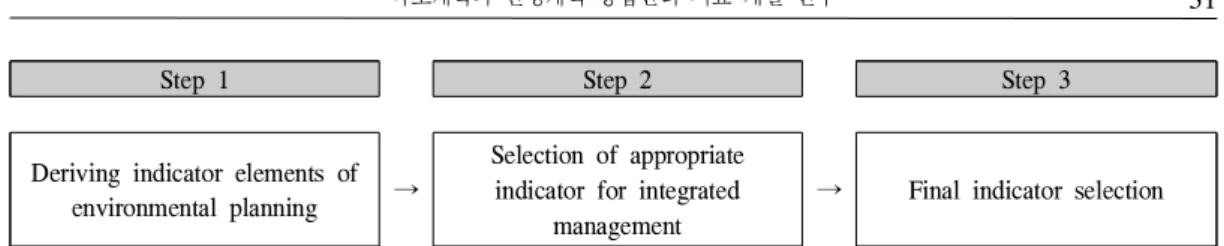
하였다 (Figure 1).
Step 1 Step 2 Step 3
Deriving indicator elements of environmental planning →
Selection of appropriate indicator for integrated
management
→ Final indicator selection
Figure 1. Three-step process for extracting integrated management indicator
1단계에서 환경계획 내에서 지표로서의 성격 을 갖는 지표요소를 모두 도출하였다. 지표요소 란, 국토교통부의 계획을 평가할 수 있는 내용 을 포함하는 것으로 정의하고 연구를 수행하였 다. 지표요소 도출 단계는 계획내, 계획간 중복 성을 고려하지 않고 최대한 많은 지표를 도출해 내는데 중점을 두고 수행하였다. Top-down 방 식으로 환경지표를 설정한 Lee and Youn(1998) 은 OECD의 PSR(Pressure, State, Response) 구 조와 UNCSD의 DSR(Deriving force, State, Responce)구조를 통합하여 구동력 지표, 압력지 표, 상태지표, 대응지표로 지속가능한 도시의 목 표를 구분하고 이를 생물, 환경부하, 자원의 이 용 등 중간지표로 구분하여 지표를 개발하였다.
그러나 본 연구의 지표는 이미 목표를 가지고 수립된 계획내용으로부터 지표요소를 추출하였 기 때문에, 목표에 따라 구분하지 않고 ‘지표의 성격’에 따라 분야의 구분이 없는 통합적 지표 와 세부지표로 나누고, 세부지표는 다시 생태, 수자원, 토양, 대기 등으로 구분하였다. 또한 성 격에 따라 구분된 지표를 지표의 적용 ‘시기적 단계’에 따라 입지단계, 공사단계, 운영단계로 나누어 분류하였다.
2단계에서는 1단계에서 도출된 지표요소 중 국토계획과 환경계획의 통합관리를 평가할 수 있는 지표를 선별하고, 서로 다른 환경계획의 지 표 중 유사한 환경적 목표를 갖는 지표는 동일 그룹으로 분류하였다. 국토계획과 환경계획의 통합관리를 평가할 수 있는 지표는 1단계에서 도출된 지표 중 국토의 이용의 관한 것, 국토의 이용에 의해 영향을 받을 수 있는 것, 국토의 계 획 시 반영되어야 하는 것을 판단하여 선정하였
다. 지표의 그룹화 과정에는 1단계에서 분류한
‘지표의 성격’과 ‘시기적 단계’를 활용하였다. 유 사한 성격과 시기적 단계를 갖는 지표들에 대한 그룹화를 진행하였다. 유사한 성격은 1단계에서 추출된 지표가 같은 목표를 가지고 있는 것을 도출하였고, 시기적 단계는 1단계에서 분류한 입지단계, 공사단계, 운영단계를 이용하였다.
3단계에서는 2단계에서 선정된 지표들에 대 해 중복된 지표를 제거하고, UN의 지속가능발 전목표(SDGs)와 연계가능한 지표들을 최종적으 로 선정하여 통합관리 지표를 도출하였다. 중복 된 지표의 경우 더 높은 목표를 제시하는 것, 목 표가 같다면 지표가 추출된 환경계획이 시기적 으로 최근에 만들어진 것을 선정하고 그렇지 않 은 지표를 삭제하였다. 지속가능발전목표는 국 제적 협의사항인 동시에 환경적 문제를 중점적 으로 다루고 있으며, ‘지속가능한 국토의 관리 와 이용’이라는 본 연구와 동일한 목적을 공유 하고 있다. 이에 따라 UN의 지속가능발전목표 와 연계성을 평가하여 최종 지표를 선정하였다.
최종 선정된 지표에 대해 적용 가능한 계획 수 준을 표시하였다. 계획의 수준은 국가 수준의 계획을 평가할 수 있는 지표, 광역시․도 수준의 계획을 평가할 수 있는 지표, 도시․군 수준의 계획을 평가할 수 있는 지표의 세 가지 위계로 구분하였다.
III. 결과 및 고찰
1. 환경계획 선정
환경계획 선정 과정에서는 총 59개 계획을
대상으로 연구방법에서의 선정 조건에 따라 2단
Environmental Planning Relevant statues
1 제3차 자연환경보전기본계획(2016)
(Basic Plan for Natural Environment)
자연환경보전법
(NATURAL ENVIRONMENT CONSERVATION ACT)
2 제4차 국가환경종합계획(2016)
(Comprehensive Plan for National Environment)
환경정책기본법
(FRAMEWORK ACT ON ENVIRONMENTAL POLICY)
3 제3차 지속가능발전기본계획(2016)
(Basic Plan for Sustainable Development)
저탄소녹색성장기본법
(FRAMEWORK ACT ON LOW CARBON, GREEN GROWTH)
4
제5차 환경보전중기종합계획(2013) (Mid-Term Comprehensive Plan for Environmental
Preservation)
환경정책기본법
(FRAMEWORK ACT ON ENVIRONMENTAL POLICY)
5 환경보건종합계획(2016)
(Comprehensive Plan for Environmental Health)
환경보건법
(ENVIRONMENTAL HEALTH ACT)
6 제2차 국가기후변화적응대책(2016)
(National climate change adaptation measures)
저탄소녹색성장기본법 (Low Carbon Green Growth Basic Law)
7 제2차 대기환경개선종합계획(2016)
(Comprehensive Plans for Clean Air Conservation)
대기환경보전법
(CLEAN AIR CONSERVATION ACT)
8
2차 수도권대기환경관리 기본계획(2015) (Basic Plan for Improvement of Air Quality in
Seoul Metropolitan Area)
수도권대기환경개선에 관한 특별법 (SPECIAL ACT ON THE IMPROVEMENT OF AIR
QUALITY IN SEOUL METROPOLITAN AREA)
9
제2차 물환경관리기본계획(2016) (Basic Plan for Management of Water
Environment)
물환경보전법
(WATER ENVIRONMENT CONSERVATION ACT)
10 물재이용기본계획(2011)
(Basic Plans for Water Reuse)
물의재이용촉진및지원에관한법률 (ACT ON PROMOTION AND SUPPORT OF
WATER REUSE)
11 토양보전기본계획(2010)
(Basic Plan for Soil Conservation)
토양환경보전법
(SOIL ENVIRONMENT CONSERVATION ACT)
12
지하수수질보전종합대책(2005) (Comprehensive measures for water quality
maintenance of groundwater)
지하수법 (GROUNDWATER ACT)
13 제2차 습지보전기본계획(2013)
(Master Plan for Wetland Conservation)
습지보전법
(WETLANDS CONSERVATION ACT)
14 제2차 야생동식물보호기본계획(2011)
(Master Plan for Protection of Wildlife)
야생생물보호및관리에관한법률 (WILDLIFE PROTECTION AND
MANAGEMENT ACT)
15 도심재생사업 경관지침(2009)
(Urban Renewal Business Landscape Guidelines)
자연환경보전법
(the Natural Environment Conservation Act)
16 제1차 자원순환기본계획(2011)
(Resource Circulation Basic Plan)
자원의 절약과 재활용 촉진에 관한 법률 (ACT ON THE PROMOTION OF SAVING AND
RECYCLING OF RESOURCES) Table 2. List of environmental plans selected for indicator selection
계에 걸쳐 계획을 선정하였다. 1차적으로 공간 적 계획내용을 포함하는 제 4차 국가환경종합계 획 등 36개 계획이 선정되었다. 1차 계획 선정 과정에서는 제 2차 환경교육 종합계획과 같은 환경교육 관련 계획, 제 1차 화학물질관리기본
계획, 제 2차 유해화학물질관리기본계획과 같은 특정 물질 관리에 대한 계획, 온실가스 항목 환 경영향평가 등 평가지침과 같은 평가지침 등 총 23개 계획이 제외되었다.
2단계로 내용이 중복되는 계획과 통폐합된
Main category Subdivision Main category Subdivision
Eco
Ecological network
Air
PM2.5
Protected area PM10
Ecological restoration NOx
Ecosystem service SOx
Urban
Ecological resting space VOCs
Urban life
Health Health
Automobile Light pollution
Landscape
Ecological network
Water resource
Water quality
Artificial structure Water supply
Green space Wastewater Reclamation and
Reusing System
Stream Drainage system
Topography Rain water
Building Water reuse
Energy Renewable energy Climate change Green house gas Table 3. Classes of 2
ndstep indicators
계획에 대한 정리를 통해 1단계에서 선정된 총 36개 계획 중 16개 계획이 선정되었다 (Table 2). 이에 따라 전체 59개 계획목록의 9가지 분류 중 환경일반 분류에서 제4차 국가환경종합계획, 제3차 자연환경보전 기본계획, 제3차 지속가능 발전 기본계획 등 4개의 계획이 포함되어 가장 많은 계획이 선정되었으며, 국제협력과 기타 분 류에서는 계획이 선정되지 않았다.
2. 통합관리 지표
1) 환경계획별 지표요소 도출
총 16개 환경계획을 대상으로 지표요소를 도 출한 결과 420개의 지표가 추출되었다. 계획별 로 추출된 지표의 수를 보면, 제 3차 자연환경보 전 기본계획에서 36개 지표, 국가환경종합계획 에서 30개 지표, 제 3차 지속가능발전기본계획 에서 17개 지표, 환경보전중기종합계획에서 28 개 지표, 환경보전 10개년 종합계획에서 4개 지 표, 국가기후변화적응대책에서 9개 지표, 제 2 차 대기환경개선종합계획에서 5개 지표, 수도권 대기환경관리기본계획에서 17개 지표, 제 2차 물환경관리기본계획에서 182개 지표, 물이용기
본계획에서 19개 지표, 지하수수질보전종합대 책에서 6개 지표, 제2차 습지보전기본계획에서 3개 지표, 야생동식물보호기본계획에서 13개 지 표, 도심재생사업경관지침에서 28개 지표, 자원 순환기본계획에서 23개 지표가 도출되었다. 이 중 입지단계에 해당하는 지표가 334개로 가장 많았고, 공사단계의 지표는 33개로 가장 적었으 며, 운영단계의 지표는 53개가 해당되었다.
2) 통합관리 가능한 적정지표 선정
지표도출의 두 번째 단계에서는 1단계에서의 총 420개 지표 중 124개의 지표가 선정되었다.
지표는 9개의 대분류와 33개의 세분류로 나누 어 정리되었다 (Table 3). 생태 분류에 해당하는 지표가 40개로 가장 많았으며, 수자원 관련 지 표는 31개, 도시 관련 지표 9개, 대기 관련 지표 12개, 기후변화관련 지표 6개, 에너지 관련 지표 1개, 보건 관련 지표 3개, 경관 관련 지표 13개, 폐기물 관련 지표 9개로 정리되었다.
3) 최종지표 선정
2단계에서 선정된 124개의 지표 중 50개의
Class Number of indicators Class Number of indicators
Natural ecology 29 Energy 1
Water resource and quality 13 Landscape 4
Urban and green space 5 Resource circulation and waste 6
Air 16
Table 4. Number of indicators included by category
지표가 중복지표로 판단되어 제거되었으며, 최 종적으로 총 74개의 지표가 선정되었다 (부록 1). 74개의 지표는 총 7개의 환경분야로 다시 분 류되었으며, 각 분야별로 도출된 지표의 수는 Table 4와 같다.
최종 지표 중 자연․생태 분야의 지표가 가장 많이 추출되었으며 총 29개 지표가 도출되었다.
이는 자연․생태 분야가 환경부의 주요 정책분 야로서 계획 내용에 많은 부분을 차지하기 때문 일 것으로 보이며, 또한 공간적인 계획내용을 많이 포함하여 국토교통부의 개발입지와 직접 관련되어 있는 것이 원인으로 판단된다. 총 29 개의 지표 중 제3차 자연환경보전기본계획에서 도출된 지표가 12개로 가장 많았고, 두 번째로 는 8개의 지표가 도심재생사업경관지침에서 도 출되었다. 대부분의 자연․생태 분야 지표는 ‘육 상 보호지역 확대 : 국토의 20% 이상’, ‘연안/해 양 보호구역 면적 확대 : 12%’ 등 목표 면적과 관련된 지표가 대부분을 차지하고 있었다. 이는 환경부의 자연․생태 관련 계획 목표가 주로 환 경적으로 가치가 높은 면적의 확대에 있기 때문 인 것으로 판단된다.
반면 에너지 분야의 지표는 1개로 가장 적은 개수의 지표가 도출되었으며, 제3차 지속가능발 전기본계획에서 도출된 지표이다. ‘선택된 지표 는 신재생에너지 보급 비율 : 1차 에너지 대비 11% 이상’으로 에너지와 관련해서는 신재생에 너지 보급을 늘리는 것에 목표가 집중되어 있기 때문으로 판단된다. 지표의 1단계 추출 과정에 서는 ‘가용폐자원 에너지화율 증가’, ‘친환경에 너지 타운 조성 : 10개소’ 등의 지표요소가 있었 으나, 국토계획과 환경계획 통합관리 지표로는
적절치 않아 제거하였기 때문에 최종 선정된 지 표는 1개로 나타났다.
대기와 관련된 지표는 자연․생태 분야에 이 어 두 번째로 많은 16개의 지표를 포함하고 있 었다. 모든 지표는 배출량 및 농도 감축을 목표 로 이루어져 있었다. 이 중 미세먼지와 관련된 지표가 7개로 가장 많았고, 황산화물(SOx), 질 소산화물(NOx), 휘발성물질(VOCs)과 관련된 대기오염물질 관련 지표가 6개였으며, 온실가스 관련 지표가 2개, 기타 지표가 1개로 나타났다.
이는 환경부의 대기관련 계획목표가 최근 미세 먼지 증가에 따른 이슈를 반영하고 있는 것으로 판단된다. 반면 기후변화에 대한 관심에도 불구 하고 온실가스 관련 지표의 내용이 적은 것은 온실가스라는 단어가 다양한 물질들을 포괄하 기 때문인 것으로 판단된다. 대기관련 지표의 내용이 지시하는 공간적 범위는 전국단위가 7 개, 수도권 단위가 7개, 서울이 2개로 계획의 목 표가 다른 지역에 비해 서울 및 수도권 지역에 집중된 것으로 나타났다.
세 번째로 많은 지표를 포함하는 수자원·수질 분야는 8개의 수질 관련 지표와 5개의 수자원 관련 지표로 구성되었다. ‘(한강) 남한강 상류 : 매우좋음 Ⅰa 등, 한강 수계별 수질 달성 목표 기준’과 같은 강, 호소 수질목표 달성 기준 지표 는 1단계 지표 선정시 164개의 지표가 있었으 나, 이는 최종 지표 목록에서 5개로 축약되었다.
수질목표 관련 지표가 많았던 것은 환경부의 계 획이 과거부터 수질관리에 대해 높은 관심을 기 울이고 있기 때문인 것으로 판단된다. 수자원 관련 지표는 ‘상수도 보급률 확대 : 97% 이상’
과 같은 상하수도 보급률과 관련된 지표, ‘중수
도 시설 목표용량 : 5,362,771㎥/일’과 같은 물 재이용과 관련된 지표로 이루어져 있다.
네 번째로 많은 지표를 포함하는 자원순환․
폐기물 분야의 경우 ‘생활폐기물 감량 : BAU 대비 6.1%’와 같은 폐기물의 감량과 관련된 지 표 3개, ‘재활용율 : 90%’와 같은 자원순환 등 재활용 증가와 관련된 지표가 3개로 총 6개의 지표를 포함하고 있다. 이들 지표는 자원순환기 본계획에서 추출된 지표가 5개로 가장 많은 비 중을 차지하고 있었으며, 나머지 하나의 지표는 제3차 지속가능발전기본계획에서 추출되었다.
도시․녹지 분야와 경관 분야의 경우 각각 5 개와 4개의 지표가 도출되었다. 도시․녹지 분 야에 포함된 지표의 내용은 도시 숲 조성 및 연 결성, 휴식공간 확대, 소공원 확대, 바람길 확보 등 다양한 목표를 갖는 지표들이 포함되었다.
경관 분야의 지표도 자연경관 변형의 최소화, 방음벽 주위 녹지 조성, 조명관리 등 다양한 목 표를 갖는 지표가 추출되어 도시․녹지 분야와 유사한 양상을 나타내었다.
최종 선정된 지표는 구체적인 수치가 제시된 지표와 구체적이지 않은 지표로 나눌 수 있었 다. 자연․생태 분야에서는 복원 및 보호 면적과 관련된 지표들이 대부분 구체적인 수치를 제시 하고 있었으며, 생태축, 연결성과 관련된 지표는 구체적이지 않은 것으로 나타났다. 수자원․수 질, 대기, 에너지, 자원순환․폐기물 분야의 지 표는 수질등급, 보급률, 시설 용량, 배출량, 농도 등 모두 구체적인 수치를 제시하고 있었다. 도 시․녹지 분야는 구체적 수치를 제시하는 면적 확보와 관련된 지표와 그렇지 않은 지표로 나눌 수 있었으며, 경관분야는 모두 구체적이지 않은 목표가 설정된 지표로 이루어졌다.
IV. 결 론
지속가능한발전을 위해 환경부의 계획 목표 가 국토교통부의 계획에 반영되어야 하며 이를
위해 국토교통부의 계획이 환경부의 계획내용 을 얼마나 반영하는지 평가할 수 있는 평가지표 를 개발하고자 하였다. 환경부의 계획내의 목표 는 국토교통부의 공간적 계획내용에 반영되지 않을 경우 목표의 달성이 어려운 계획이 많으 며, 이와 같은 환경계획의 목표달성 가능성을 확인할 수 있는 지표들이 도출되었다. 또한 지 표의 중요도를 확인하고 및 국제적 협의수준을 반영할 수 있는 지표를 선정하기 위해 SDGs 지 표와 연계한 지표를 도출하였다.
최종 지표는 실제 계획에 적용성을 높이기 위 해 지표의 분야별로 구분하고, 계획수준별로 정 리하였다. 이에 따라 국토교통부의 계획수준에 따라 지표의 적용이 용이하도록 적용가능한 계 획의 수준에 따라 국가단위지표, 광역단위지표, 도시군단위 지표로 구분하였다. 또한 지표를 자 연․생태, 수자원․수질, 도시․녹지, 대기, 에 너지, 경관, 자원순환․폐기물 등 7개 분야로 구 분하여 지표의 가독성을 높여 하나의 국토교통 부 계획 내에서 지표를 적용하기 용이하도록 하 였다.
환경부의 계획들을 이용하여 지표를 도출한 결과 자연․생태, 대기 분야에 지표가 몰리는 경 향을 나타내는 등 분야별로 상이한 수의 지표가 나타났다. 이는 환경부의 계획이 특정 분야에 집중되어있는 것으로 해석할 수 있으며, 또한 특정 분야의 경우 공간적 계획 내용에 반영 필 요성이 높기 때문인 것으로 판단된다. 즉, 자 연․생태, 대기 분야는 국토교통부 계획의 환경 부 계획 고려 필요성이 높다고 해석할 수 있다.
최종 도출된 지표는 다음과 같은 방법으로 사
용될 수 있을 것이다. 현재 국토교통부의 계획
내용을 검토할 수 있다. 현재 국토교통부의 계
획 내용이 환경부의 계획 목표를 달성할 수 있
는 계획인지, 확인할 수 있다. 또한 새로운 계획
의 수립 시, 계획에 반영해야 하는 내용을 확인
할 수 있는 보조자료로써 사용할 수 있다. 환경
부의 계획 목표는 그 양이 방대하고, 분야가 넓
기 때문에 하나의 표로 정리된 자료를 이용함으 로써 지속가능한발전을 위한 계획수립에 도움 을 줄 수 있다. 이를 위해 최종 선정된 지표를 실제 국토교통부 계획에 적용하여봄으로써 국 토교통부의 계획을 평가할 수 있는지 확인하고, 지표의 활용성에 대해 재검토하여 부족한 부분 을 보완하는 연구가 후속될 필요가 있다.
그러나, 지표의 적용 및 활용에 있어 구체적 인 숫자와 목표 내용을 제시하는 지표의 내용을 국토교통부의 계획이 반영하고 있는지 확인하 고, 새롭게 수립하려는 계획을 통해 지표의 내 용을 달성할 수 있는지는 전문가의 주관적 판단 이 들어간다. 즉, 지표는 객관적 평가를 도울 수 있는 장점을 갖는 도구이나, 최종적으로는 사용 자의 주관적 판단이 필요할 수 있다는 한계점이 있다. 이에 따라 지표를 사용하는 전문가는 최 종적으로 선정된 지표 중 구체적인 목표수치를 제시하고 있는 지표를 중심으로 계획 내용이 지 표의 해당 수치를 달성할 수 있는지 확인함으로 써 주관적인 판단을 최대한 줄이고, 객관적인 계획 검토를 할 수 있을 것이다.
References
Cho, D.H. and Bae, M.K. 2004. A Study on the Decision of Priority Ranking of Environ- mental Policy Implementation Based on Importance-Achievement Analysis. Journal of Korea Planning Association 39(4): 129- 145.(In Korean)
Choi, S.Y. 2011. A study on the development of the model and indicators for green growth city. Ph.D dissertation, Dongguk University, 153-177.(In Korean)
Kang, S.M. and Kim, M. S. 2000. Environmental Indices and Development of Index System.
The Korea Spatial Planning Review 30:
21-49.(In Korean)
Kim, M.J.․Choi, D.I.․Chang, C.K. and Lee, J.W. 1993. Public environment index devel- opment, Journal of Environmental Impact Assessment, 2(1) : 31-38.(In Korean) Lee, D.K. and Youn, S.W. 1998. A study on
Environmental Indicators for Sustainable City Development -The case of Coexistent Indicators between Men and Nature. Journal of environmental impact assessment 7(1) : 93-107.(In Korean)
Ministry of Environment. 2005. Comprehensive measures for water quality maintenance of groundwater.(In Korean)
Ministry of Environment. 2007. Urban Environ- mental Indicators.(In Korean)
Ministry of Environment. 2009. Urban Renewal Business Landscape Guidelines.(In Korean) Ministry of Environment. 2010. Basic Plan for
Soil Conservation.(In Korean)
Ministry of Environment. 2011a. Basic Plans for Water Reuse.(In Korean)
Ministry of Environment. 2011b. Master Plan for Protection of Wildlife.(In Korean)
Ministry of Environment. 2011c. Resource Circu- lation Basic Plan.(In Korean)
Ministry of Environment. 2013a. Master Plan for Wetland Conservation.(In Korean)
Ministry of Environment. 2013b. Mid-Term Comprehensive Plan for Environmental Preservation.(In Korean)
Ministry of Environment. 2014. Environmental performance index management and im- provement plan.(In Korean)
Ministry of Environment. 2015. Basic Plan for Improvement of Air Quality in Seoul Met- ropolitan Area.(In Korean)
Ministry of Environment. 2016a. Basic Plan for
Management of Water Environment.(In
Korean)Ministry of Environment. 2016b.
Basic Plan for Natural Environment.(In Korean)
Ministry of Environment. 2016c. Basic Plan for Sustainable Development.(In Korean) Ministry of Environment. 2016d. Comprehensive
Plan for Environmental Health.(In Korean) Ministry of Environment. 2016e. Comprehensive Plan for National Environment.(In Korean) Ministry of Environment. 2016f. Comprehensive Plans for Clean Air Conservation.(In Korean) Ministry of Environment. 2016g. National climate
change adaptation measures.(In Korean) Ministry of Environment. 2017. A study on de-
velopment of evaluation indicators for the development-environmental plan linkage system.(In Korean)
Ministry of Land, Infrastructure and Transport.
2011. Comprehensive Plan for National Land.(In Korean)
Ministry of Land, Infrastructure and Transport.
2013. A Study on Strengthen Linkage Be- tween Korea National Planning and Envi- ronmental Planning.(In Korean)
National Institute of Environmental Research.
2013. A Study on development and applica- tion of green city index for urban environ- mental management in Korea, National Institute of Environmental Research. 1-35.
(In Korean)
OECD. 2001. OECD environmental indicators.
UNCSD. 2001. United Nations, Indicators of Sustainable Development: Guidelines and Methodologies, Second Edition, UN Sales Publication No. E.01.II.A.6. New York Yun, H.D.․Park, J.Y.․Choi, T.B. Choi․I.T.,
Noh T.H.․Han, B.H. and Kim, M.J. 2015.
A Review on Applicability of Sustainable
City Index - Focusing on GCI, EPI and CBI
-. Journal of environmental impact assess-
ment 24(6) : 593-606.(In Korean)
Category Assessment indicators for Korea national planning
and environmental planning linkage Related SDGs indicator
Application scope
Source National Megalopolis Cities and
coounties
Natural Ecology
4대 핵심 생태축 (DMZ, 백두대간, 도서연안, 5대강 수생태축)을 보전·복원
(Conservation of core ecological area/axis in national and metropolitan city scale)
15.1.2 Proportion of important sites for terrestrial and freshwater biodiversity that are covered by protected areas, by ecosystem type
○
Ministry of Environment, 2016b
5대
광역권역(한강수도권/금강충청권/영산강호남권/
낙동강영남권/태백강원권)별로 4대 핵심 생태축과 연결되는 생태축(정맥), 생태거점 중점 보전·복원
(Restore and protect ecological area and axis connected with 4 major ecological axis for 5 major mega region)
15.1.2 Proportion of important sites for terrestrial and freshwater biodiversity that are covered by protected areas, by ecosystem type
○
Ministry of Environment, 2016b
육상 보호지역 확대 : 국토의 20% 이상 (전체 보호지역 면적 확대 : 국토면적의 15%) (Expansion of protected area : 20% or more of the land area)
15.1.2 Proportion of important sites for terrestrial and freshwater biodiversity that are covered by protected areas, by ecosystem type
○ ○ ○
Ministry of Environment, 2016e Ministry of Environment, 2016c Ministry of Environment, 2011b
연안/해양 보호구역 면적 확대 : 12%
(관할해역대비)
(Expansion of coastal / marine protected area : 12%)
14.5.1 Coverage of protected areas in relation to marine areas
15.1.2 Proportion of important sites for terrestrial and freshwater biodiversity that are covered by protected areas, by ecosystem type
○ ○ ○
Ministry of Environment, 2016e
백두대간보호지역 확대 : 국토의 3.22% 이상 (Expansion of Baekdudaegan protected area : 3.22%
or more)
15.1.1 Forest area as a proportion of total land area 15.1.2 Proportion of important sites for terrestrial and freshwater biodiversity that are covered by protected areas, by ecosystem type
15.4.1 Coverage by protected areas of important sites for mountain biodiversity
○ ○
Ministry of Environment, 2016b
산림지역 비율 확대 : 국토면적의 64% (2020) (Expansion of forest area ration : 64% of the land area(2020))
15.1.1 Forest area as a proportion of total land area 15.1.2 Proportion of important sites for terrestrial and freshwater biodiversity that are covered by protected areas, by ecosystem type
15.2.1 Progress towards sustainable forest management
○ ○
Ministry of Environment.
2016c
산림유전자원보호구역 확대 : 국토의 1.6% 이상 (Expansion of forest genetic resource reserve : 1.6%
or more of the land area)
15.1.1 Forest area as a proportion of total land area 15.1.2 Proportion of important sites for terrestrial and
○ ○
Ministry of Environment.
2016b
Assessment Indicators for Integrated Management on Korea National Planning and Environmental Planning
부 록
Category Assessment indicators for Korea national planning
and environmental planning linkage Related SDGs indicator
Application scope
Source National Megalopolis Cities and
coounties freshwater biodiversity that are
covered by protected areas, by ecosystem type
15.2.1 Progress towards sustainable forest management 15.4.1 Coverage by protected areas of important sites for mountain biodiversity 15.4.2 Mountain Green Cover Index
15.5.1 Red List Index
자연공원 확대 : 국토의 8.09% 이상 (Expansion of natural park : 8.09% or more of the land area)
15.1.1 Forest area as a proportion of total land area 15.1.2 Proportion of important sites for terrestrial and freshwater biodiversity that are covered by protected areas, by ecosystem type
15.2.1 Progress towards sustainable forest management 15.4.1 Coverage by protected areas of important sites for mountain biodiversity 15.4.2 Mountain Green Cover Index
15.5.1 Red List Index
○ ○
Ministry of Environment.
2016b
Natural Ecology
생태경관보전지역 확대 : 국토의 0.5% 이상 (Expansion of ecological and landscape conservation area : 0.5% or more of the land area)
15.1.2 Proportion of important sites for terrestrial and freshwater biodiversity that are covered by protected areas, by ecosystem type
15.4.1 Coverage by protected areas of important sites for mountain biodiversity 15.5.1 Red List Index
○ ○
Ministry of Environment, 2016b
야생동식물보호구역 확대 : 국토면적의 2.8%
이상
(Expansion of wildlife protection area : 2.8% or more of the land area))
15.1.2 Proportion of important sites for terrestrial and freshwater biodiversity that are covered by protected areas, by ecosystem type
15.4.1 Coverage by protected areas of important sites for mountain biodiversity 15.5.1 Red List Index
○ ○ ○
Ministry of Environment, 2011b
습지보호지역(내륙) 확대 : 국토의 0.15% 이상 (Expansion of wetland protected area : 0.15% or more of the land area)
6.6.1 Change in the extent of water-related
ecosystems over time 15.1.2 Proportion of important sites for terrestrial and freshwater biodiversity that are covered by protected areas, by ecosystem type
15.4.1 Coverage by protected areas of important sites for mountain biodiversity 15.5.1 Red List Index
○ ○
Ministry of Environment, 2016b
연안습지의 20%를 연안습지 보호지역으로 지정 (Designation of the 20% of coastal wetland as coastal wetland protection area)
14.5.1 Coverage of protected areas in relation to marine areas
○ ○
Ministry of Environment, 2013a
Category Assessment indicators for Korea national planning
and environmental planning linkage Related SDGs indicator
Application scope
Source National Megalopolis Cities and
coounties 15.1.2 Proportion of important
sites for terrestrial and freshwater biodiversity that are covered by protected areas, by ecosystem type
생태하천 복원율 증가 : 24%
(Expansion of ecological river restoration : 24%)
6.6.1 Change in the extent of water-related
ecosystems over time
○ ○
Ministry of Environment, 2016e 수변구역 등 수변 생태벨트 구축
(Construction of waterside ecological belt including waterfront area)
6.6.1 Change in the extent of water-related
ecosystems over time
○ ○ ○
Ministry of Environment, 2016e
Natural Ecology
권역별로 육상생태축, 수생태축, 생태거점을 지정하고 생태축 조사 및 보전・복원사업 추진 (Designate land ecological axis, water ecological axis, ecological bases by region and promote ecological axis investigation, conservation and restoration projects)
15.2.1 Progress towards sustainable forest management 15.4.2 Mountain Green Cover Index
○ ○
Ministry of Environment, 2016b
친수구역 지정 시, 주변 생태축과 생태적 연결성을 확보
(When designating a waterfront-space, ensure ecological connectivity with surrounding ecological axis)
6.6.1 Change in the extent of water-related
ecosystems over time
○ ○
Ministry of Environment, 2016b
고속도로 공사구간 등 주요 생태축 단절예상 개발사업의 생태축 복원방안 제시 (Propose the restoration plan of ecological axis about development project of major ecological axis cuts such as highway construction section)
15.2.1 Progress towards
sustainable forest management ○ ○
Ministry of Environment, 2011b
국토·도시계획 등 관련계획 수립 및 개발사업 환경영향평가 시 생태축 적용
(Establishment and development of relevant plans such as national land and city planning Business Ecological axis when evaluating environmental impact)
15.9.1 Progress towards national targets established in accordance with Aichi Biodiversity Target 2 of the Strategic Plan for Biodiversity 2011-2020
○ ○
Ministry of Environment, 2016e
지자체별 도시기본(20년)・관리계획(5년) 수립・변경, 환경영향평가, 각종 개발사업과 공간계획 검토 시 도시 생태축 개념 반영 (Reflect the establishment and change of city basic, management plan for each municipality, environmental impact assessment, various development projects)
15.9.1 Progress towards national targets established in accordance with Aichi Biodiversity Target 2 of the Strategic Plan for Biodiversity 2011-2020
○
Ministry of Environment, 2016b
도시내 생태숲, 하천 및 생물서식처 등 생태거점을 보전・복원하여 도시 생태축으로 조성
(Preserving and restoring ecological forests, rivers and habitats in urban areas to make an urban ecological axis)
15.9.1 Progress towards national targets established in accordance with Aichi Biodiversity Target 2 of the Strategic Plan for Biodiversity 2011-2020
○
Ministry of Environment, 2016b
도시공원, 도시숲, 생물서식지, 습지 등 파편화된 생태공간의 연계성 증진을 위해 연결녹지 조성, 건물 입체녹화 추진 (In order to enhance the linkage of fragmented ecological spaces such as city parks, urban forests, biological habitats, and wetlands, make stepping stone green space and three-dimensional planing in buildings)
- ○
Ministry of Environment, 2016b
지형변형율을 최소화
(Minimize terrain strain) - ○
Ministry of Environment, 2009
Category Assessment indicators for Korea national planning
and environmental planning linkage Related SDGs indicator
Application scope
Source National Megalopolis Cities and
coounties 지역의 자연생태계를 원형으로 보전하면서
도시 생태축을 구축
(Construct urban ecological axis while preserving local natural ecosystem as a circle)
- ○
Ministry of Environment, 2009 광역권의 녹지체계와 개발지역의 녹지를
연계시켜 네트워크화
(Networking green area system of mega region by linking green space in development)
- ○
Ministry of Environment, 2009 녹지의 단절부와 생태계를 단절시킬 수 있는
도로 등의 구조물을 건설할 때는 생태통로를 설치
(When constructing structures such as roads, make eco-corridor)
- ○
Ministry of Environment, 2009
하천이 있을 경우 개발지 내의 녹지와 하천을 연결
(If there is a river, connect the green space and river in the development area)
- ○
Ministry of Environment, 2009 재생지역의 녹지공간은 기존 도시지역의
녹지축과 연결
(The green space of the regeneration area is connected with the green space axis of the existing city area)
- ○
Ministry of Environment, 2009
하천이 개발지역에 인접하여 통과할 경우, 해당 지역 내로 생태적 기법으로 조성한 실개천을 연결하여 친수공간을 조성
(If the rivers pass adjacent to the development area, connect the stream creeks created by ecological techniques to the area to create a water front)
- ○
Ministry of Environment, 2009
교각이 하천의 유수 및 생태환경에 최소한의 영향을 주도록 설치
(Install bridge have minimal effect on river runoff and ecological environment)
- ○
Ministry of Environment, 2009
Water resource and quality
(한강) 남한강 상류 : 매우좋음 Ⅰa 등, 한강 수계별 수질 달성 목표 기준
((Han River) Upper stream of South Han River : Very good Ⅰa, etc.,)
6.3.2 Proportion of bodies of water with good ambient water quality
○ ○ ○
Ministry of Environment, 2016a (낙동강) 안동댐 : 매우좋음 Ⅰa 등, 낙동강
수계별 수질 달성 목표 기준
((Nakdong River) Andong dam : Very good Ⅰa, etc.,)
6.3.2 Proportion of bodies of water with good ambient water quality
○ ○ ○
Ministry of Environment, 2016a (금강) 용담댐 : 좋음 Ⅰb 등, 금강 수계별 수질
달성 목표 기준
((Geumgang River) Yongdam dam : Good Ⅰb, etc.,)
6.3.2 Proportion of bodies of water with good ambient water quality
○ ○ ○
Ministry of Environment, 2016a (영상강·섬진강) 섬진강 댐 : 좋 음Ⅰb 등,
영산강·섬진강 수계별 수질 달성 목표 기준 ((Yeongsan River and Seomjin River) Seomsin River dam : Good Ⅰb, etc.,)
6.3.2 Proportion of bodies of water with good ambient water quality
○ ○ ○
Ministry of Environment, 2016a (호소) 파로호 : 매우좋음 Ⅰa 등, 호소별 수질
달성 목표 기준
((Lake) Paro Lake : Very good Ⅰa, etc.,)
6.3.2 Proportion of bodies of water with good ambient water quality
○ ○ ○
Ministry of Environment, 2016a 깨끗한 물 확보 : 도심하천 2등급 이상
(Securing clean water : Urban river grade 2 or more)
6.1.1 Proportion of population using safely managed drinking water services
○
Ministry of Environment, 2016e
Category Assessment indicators for Korea national planning
and environmental planning linkage Related SDGs indicator
Application scope
Source National Megalopolis Cities and
coounties 상수도 보급률 확대 : 97% 이상
(Expansion of waterworks supply rate : 97% or more)
6.1.1 Proportion of population using safely managed drinking water services
○ ○ ○
Ministry of Environment, 2013b 농어촌 상수도 보급률 확대 : 80%
(Expansion of waterworks supply rate in rural areas : 80%)
6.1.1 Proportion of population using safely managed drinking water services
○ ○ ○
Ministry of Environment, 2013b 하수도 보급률 확대 : 93.2% 이상
(Expansion of sewerage penetration rate : 93.2% or more)
6.3.1 Proportion of wastewater
safely treated ○ ○ ○
Ministry of Environment, 2013b 농어촌 하수도 보급률 확대 : 74% 이상
(Expansion of sewerage penetration rate in rural areas : 74% or more)
6.3.1 Proportion of wastewater
safely treated ○ ○ ○
Ministry of Environment, 2013b 공공하수처리 시설 수혜인구 비율 확대 : 97.3% 이상
(Expansion of the ratio of the population receiving public sewage treatment facilities: 97.3% or more)
6.3.1 Proportion of wastewater
safely treated ○ ○ ○
Ministry of Environment, 2016e 중수도 시설 목표용량 : 5,362,771㎥/일 (2008년
대비 2.6배 증가)
(Wastewater facilities target capacity:
5,362,771㎥/day (2.6 times increase from 2008))
- ○ ○ ○
Ministry of Environment, 2011a
Urban and green space
빗물이용 총 목표량 : 48,608천㎥/년
(Total target use of rainwater: 48,608,000 ㎥/year) - ○ ○ ○
Ministry of Environment, 2011a
도시 숲 조성 및 연결성 확대 (Expansion of urban forest creation and connectivity)
11.7.1 Average share of the built-up area of cities that is open space for public use for all, by sex, age and persons with disabilities
○
Ministry of Environment, 2016b
1인당 생활권도시림 면적 : 18.5㎡/인 (Urban forest area per person : 18.5㎡ / person)
11.7.1 Average share of the built-up area of cities that is open space for public use for all, by sex, age and persons with disabilities
○
Ministry of Environment, 2016c
도시 생태휴식공간 조성면적 확대 : 1,034만㎡
(Expansion of urban ecological rest space : 10.34 million ㎡)
11.7.1 Average share of the built-up area of cities that is open space for public use for all, by sex, age and persons with disabilities
○
Ministry of Environment, 2016e Ministry of Environment, 2016c 소공원, 옥상공원(인공지반공원), 수변공원,
농업생명공원 등 비점오염원 저감, local food 등 복합적 기능이 고려된 공원 조성 확대 (Construct parks to reduce non-point pollution source, expansion of park considering complex functions such as local food)
- ○
Ministry of Environment, 2016e
바람길 및 보행녹도를 확보하기 위해 공동주택단지 간에는 10미터 이상 폭을 확보 (To secure wind corridor and walkways, secure a width of more than 10 meters between apartment complexes)
- ○
Ministry of Environment, 2009
Atmosph eric Atmosph eric
PM2.5 환경기준, WHO 목표 3단계까지 강화 : 15㎍/㎥ 이하
(Enhancement of PM2.5 environmental standard to WHO target level 3: 15 ㎍ / ㎥ or less)
11.6.2 Annual mean levels of fine particulate matter (e.g.
PM2.5 and PM10) in cities (population weighted)
○ ○ ○
Ministry of Environment, 2016e PM2.5 2012년 대비 32% 감축 (목표배출 11.6.2 Annual mean levels of ○ ○ ○ Ministry of