Vol. 23, No. 6, pp. 690-698, October 31, 2017, ISSN 1229-3431(Print) / ISSN 2287-3341(Online) https://doi.org/10.7837/kosomes.2017.23.6.690
1
* First Author : [email protected]
Corresponding Author : [email protected], 061-240-7165
The Present State of Marine Oil Spills and the Enhancement Plans of National Oil Spill Response Capability in Vietnam
- Through the Comparison of Statistics and OSR System between Vietnam and Republic of Korea -
Phan Van Hung
*Kwang-Soo Kim
*** Graduate School of Mokpo National Maritime University, Korea & Lecturer, Vietnam Maritime University, Vietnam
** Division of Navigation Science, Mokpo National Maritime University, Mokpo 58628, South Korea
베트남의 해양기름유출 현황과 국가대응역량 증강 방안
통계자료와 유출유 방제시스템에 대한 베트남과 한국 간의 비교를 통하여
- -
판반흥
*김광수
**목포해양대학교 대학원 베트남해양대학교 강사
* / , ** 목포해양대학교 항해학부
Abstract : Vietnam is a marine nation with more than 3,444 of shorelines, thousands of islands, and 2,360 rivers and canals of over 42,000 long. As the frequency and the volume of oil transportation by ships increase, the possibility of oil spill incidents becomes higher than ever. Fuel oil and cargo oil spills at sea have widespread impact and long-term consequences on marine ecosystems, coastal resources and human health as well as socio-economy. This study is to show not only the present state of marine oil spills in Vietnam such as the number and the volume of oil spills for two decades, and an overall about Vietnamese national response system like national framework for Oil Spill Response (OSR), etc. but also to present the recommendations for enhancing national capability in response to oil spill incidents in Vietnam, especially, with a comparison of national OSR systems between Vietnam and South Korea. As the result, the number and the volume of marine oil spills in Vietnam showed an upward trend as opposed to a downward trend in South Korea. This means that Vietnam has the possibility of oil spills in coastal waters. Therefore, three main recommendations for the enhancement of national OSR capability in Vietnam are proposed as follows: the development of alternative plan for reenforcing national OSR system involving legal system for preparedness and response to oil spill pollution such as the acceptance and implementation of OPRC Convention as well as the establishment of national fund compensating for the damage and loss caused by oil pollution;
the enhancement of a consistent reporting, alerting and monitoring system; and the development of training and exercise programs with standard contents of educational courses.
Key Words : Oil spills, National response system, National OSR capability, Legal system, Reporting and monitoring system, Training and exercise programs
요 약 : 베트남은 3,444 가 넘는 해안선 수천 개의 섬 그리고 길이 , 4260 이상인 2,360개의 강과 수로가 있는 해양국이다 선박.
에 의한 유류수송의 빈도와 수송량이 증가하면서 기름유출사고의 가능성이 과거 어느 때보다 높아지고 있다 해상에서의 연료유 및 화.
물유의 유출은 해양생태계 연안자원 및 인간건강은 물론 사회, 경제에 대하여 광범위하고 장기적인 영향을 미친다 본 연구는 . 20년
동안의 기름유출사고 건수와 유출량과 같은 베트남의 해양기름유출 현황 그리고 기름유출대응(OSR)에 대한 국가체제 등과 같은 국가
대응체계에 관한 전반을 보여줄 뿐만 아니라 특히 베트남과 한국 사이의 국가기름유출대응체제를 비교함으로써 기름유출사고에 대응,
하여 베트남의 국가역량을 강화하기 위한 권고안을 제시하고자 한다 그 결과 베트남의 해양기름유출사고 건수와 유출량은 한국의 하. ,
락 추세와는 대조적으로 상승 추세를 보였다 이는 베트남의 연안 해역에서 실제적 기름유출 가능성이 높다는 것을 의미한다 따라서 . .
베트남의 국가기름유출대응역량을 강화하기 위한 가지 주요 권고안을 다음과 같이 제안한다 즉 3 . OPRC협약의 수락 이행 그리고 ·
유류오염으로 인한 피해 및 손실을 보상하는 국가기금의 조성과 같은 기름유출사고에 대비하고 대응하기 위한 법률제도를 포함한 국
가기름유출대응 시스템을 강화하기 위한 방안의 개발; 일관된 보고 경보 및 모니터링 시스템의 강화, ; 표준 교육과정 내용으로
구성된 교육 및 훈련 프로그램의 개발을 제안하고자 한다.
핵심용어 : 기름유출 국가대응시스템, , 국가기름유출대응역량 법률제도, , 보고 및 모니터링 시스템, 교육훈련프로그램
1. Introduction
Marine oil spill incident is a serious environmental pollution problem in Vietnam because it is prevalent in Vietnamese waters and has a wide range of impacts and long-term consequences on marine ecosystems, coastal resources, human health and socio-economy. The improvement of national capacity to combat oil spills at sea is required to minimize the risks to human health, and the damages to the marine environment and coastal resources and to mitigate economic losses due to oil spill incidents. Vietnam is in the process of improving the policy and legislation on marine oil pollution prevention and control. So some ideas and plans of improvement in legislation and amendment of the laws relevant to marine oil spills have been suggested by many researchers in Vietnam (Nguyen, 2008; Nguyen, 2011; Mai, 2013; Luu, 2012). In addition, lots of researches and studies on prevention, preparedness, response and recovery with regard to marine oil spills have been actively conducted in Vietnam (Phung, 2005; Nguyen, 2009;
Nguyen and Nguyen, 2014; Bui, 2009). Numerous and various studies and researches on marine oil spills have also been conducted actively in Korea (Kim, 2013a: 2013b; Choi, 2017; Lee, 2017).
On the other hands, Vietnam has not signed on OPRC Convention 90, OPRC-HNS Protocol 2000, Fund Protocol 1992 and 2003 yet, while the Republic of Korea is a member party to these International Conventions and Protocols (IMO, 2017).
Both Vietnam and Korea are marine nations and peninsular countries. But Vietnam is an oil producer which is located in the subtropical zone, while the Republic of Korea is an oil-consuming country which is located in the temperate zone. Currently, Republic of Korea is supporting Vietnam in the field of the response to marine pollution through the ODA (Official Development Assistance) project of KOICA (Korea International Cooperation Agency) such as the ESI mapping in the Gulf of Thailand project. It is interesting and meaningful to compare the situations of marine oil spills and national Oil Spill Response (OSR) systems between Vietnam and Korea in order to advance and enhance the national capability in response to marine oil spills in Vietnam. However, it is very hard to find any references or research papers comparing Vietnam with Korea on marine oil spills.
In this study, the present states of marine oil spill incidents in Vietnam and Korea such as the number and volume of oil spills of which data were collected from national statistics for recent 20 years as well as the national preparedness and response systems of both countries are reviewed and analyzed, and the recommendations or alternative plans for enhancing national OSR capability in
Vietnam are proposed through the comparison between Vietnam and Korea. The results of this study are expected to be used as the basic data to improve Vietnamese national policy for prevention and response to marine oil spills and to make a significant contribution to the enhancement of national marine OSR capability in Vietnam.
2. The current status of oil spill in Vietnam and Korea
2.1 The number and volume of oil spills in Vietnam The annual numbers and volumes of oil spills at sea occurred from oil tankers, various types of vessels, marine facilities, pipelines and unknown sources in Vietnam for 20 years from 1996 to 2015 are shown in Fig. 1 (VINASARCOM, 2007; MoNRE, 2010; VASI, 2016).
The cases of oil spill appeared at Soc Trang in April 1997, at Khanh Hoa in May 1997 and at Da Nang in June 1997 (Nguyen, 2008) causing huge economic losses and serious pollution and long-term effects in the environment.
Particularly, oil spills from unknown sources in 2007 had effects on the shorelines of many coastal provinces. The oil spill incidents occurred in 2007 can be divided into 4 periods as below: Firstly, from January 28 to February 7, 2007, oil slicks drifted and stranded on shorelines of 6 central provinces involving Ha Tinh, Quang Binh, Thua Thien Hue, Da Nang, Quang Nam, Quang Ngai, peaking 1,867 tonnes of oil spillage. Secondly, from March 1 to 31, 2007, it affected 12 central and southern provinces. Thirdly, from April 11 to 19, 2007, it made an impact on 4 provinces including Hai Phong, Phu Yen, Khanh Hoa and Ninh Thuan.
Finally, oil appeared in Ca Mau province on May 4, 2007 (Nguyen, 2011), and it caused damage to Tien Giang on May 20, 2007.
Fig. 1. The trend of annual number and volume of oil spills in Vietnam from 1996 to 2015.
A few large-scale oil spills have been recorded in Vietnam. In 2009, the incidents of army’s petrol and ocean storages in Da Nang released about 1,821 kL (1,600 tonnes) of fuel oil (A80) and about 1,138 kL (1,000 tonnes) of diesel oil. Hence it showed a tendency to increase in the volume of oil spill, being about 2,385 kL (2,096 tonnes) of oil spills per year on annual average for 5 years from 2006 to 2010, and peaking about 3,800 kL (3,321 tonnes) in 2007. The annual average number of oil spill incidents was approximately 4 cases per year because total number was 79 cases for 20 years. As a result, the total volume of oil spills was about 15,674 kL (13,773 tonnes) for 20 years and the annual average volume of oil spills was about 782 kL (689 tonnes) per year.
There was a tendency to decrease in the volume of oil spilt for 5 years from 2011 to 2015, being around 334 kL (294 tonnes) of oil spills per year on annual average for 5 years. The bar chart, combined with the line chart, offers a glimpse of the trend annual number and volume of oil spilt in Vietnam for 20 years from 1996 to 2015 (Fig. 1). According to the first bar chart, in 2010 the annual number of oil spills reached the highest level, peaking 13 cases because of the established national statistical indicator system (VPM, 2010). It is assumed that before 2010, there was no regulation on statistics, and only large oil spills and big impact on shoreline and citizen were recorded, while from 2010, regulation on statistics was adopted, and both of large spill and very small spill, non-impact on shoreline and citizen were recorded.
Interestingly, there was not any oil spill incident occurred in 2002.
2.2 Comparison of trend in annual number and volume of oil spill between Vietnam and Korea
Vietnam and Korea are marine nations and peninsular countries with thousands of kilometers of shorelines and numerous islands, and with cultural similarities. An absolute majority of exports and imports of Vietnam and Korea have been transported by sea. Nevertheless, marine transport activities around Vietnam and Korea coasts produce continual risks of marine oil pollution by various types of oil such as fuel oil, cargo oil, lubricating oil, etc. from ships.
Total number and total volume of oil spills in Korea for 20 years from 1996 to 2015 were 6,300 cases and about 28,489 kL, respectively, and average annual number and volume of oil spills in Korea were 315 cases and 1,425 kL per year, respectively (Kim, 2013a; MPSS, 2016). Generally, it showed a tendency to decrease in the number of cases and the volume of oil spills in Korea (Kim, 2013a). There was a fluctuation of the annual number of oil spill incidents from year to year in Korea. A few large-scale spills were accountable for the high volume of oil spills that had occurred
since 1996. Particularly, on 7th December 2007, VLCC Hebei Spirit (146,848 GT), was collidede with a crane barge at the coast off Taean, South Korea. Approximately 12,547 kL (10,900 tonnes) of Iranian Heavy, Upper Zakum and Kuwait Export crude oils were released from VLCC Hebei Spirit to the sea (ITOPF, 2007). The oil spill incident impacted significantly on three provinces and several hundred kilometers of coastlines of the mainland and numerous islands along the western coast of South Korea.
Obviously, the number of oil spill incidents in Vietnam is very different from that in Korea. Because oil pollution reporting and monitoring systems in Vietnam are incomplete, it seems that some of the oil spill incidents had not been reported and were not exactly captured in the national statistics of Vietnam.
In Fig. 2, the five-year period average number of oil spill incidents in Korea was shown to be a downward trend, the rate of decrease being around 11.73 % for the period from 2001 to 2005, 20.12 % for the period from 2006 to 2010 and 21.16 % for the period from 2011 to 2015, respectively, while an upward trend was found in Vietnam, and the rate of increase in the 5-year period average number of oil spills was about 300 % for the period from 2006 to 2010, compared with the previous period from 2000 to 2005.
Fig. 2. Five-year period averages number of oil spills in Vietnam (VINASARCOM, 2007; VASI, 2016) and Korea (Kim, 2013a; MPSS, 2016) for 20 years from 1996 to 2015.
Fig. 3 shows the amount of oil spills from incidents in Vietnam and Korea for 20 years from 1996 to 2015. It is notable that a few large-scale spills are accountable for a high percentage of the total volume of oil spills. For instance, in the five-year period from 2006 to 2010, there were 1,413 cases of oil spills, totalling 14,173 kL of oil spilt in Korea, but 12,547 kL was spilt from VLCC Hebei Spirit incident in 2007. Most recently for example, in the year of 2006, total oil spillage was 1,552 tonnes (1,766 kL) in Vietnam, but 1,500 tonnes of oil spill, that occupied 96.65 % of 1,552 tonnes, were spilt from tanker La Palmas.
Fig. 3. Trend of annual volume of oil spill in Vietnam (VINASARCOM, 2007; VASI, 2016) and Korea (Kim, 2013a; MPSS, 2016) for 20 years from 1996 to 2015.
The average volumes of oil spilt in Vietnam and Korea for five-year period from 2006 to 2010 were found to increase significantly in comparison with the previous five-year period from 2001 to 2005, being around 362.4 % and 350 %, respectively (Fig. 4).
Generally, over the two decades the number and the volume of oil spills in Korea showed a downward trend as opposed to a upward trend in Vietnam (Fig. 2, Fig. 3 and Fig. 4). Therefore, the enhancement of national plans to control marine oil spill incidents around Vietnam appears to be necessary, taking into consideration of Korean experiences and case studies in the field of marine oil spill prevention and control.
Fig. 4. The five-year period average volumes of oil spills in Vietnam and Korea for 20 years from 1996 to 2015.
3. National framework of Vietnam
3.1 National framework for oil spill preparedness in Vietnam
Currently, Vietnam’s national policy has been closely related to a vast number of the economy in the world, leading to the fact that national economy has been developing rapidly. On the other hand, it has been exerting the negative impacts on the environment and human health.
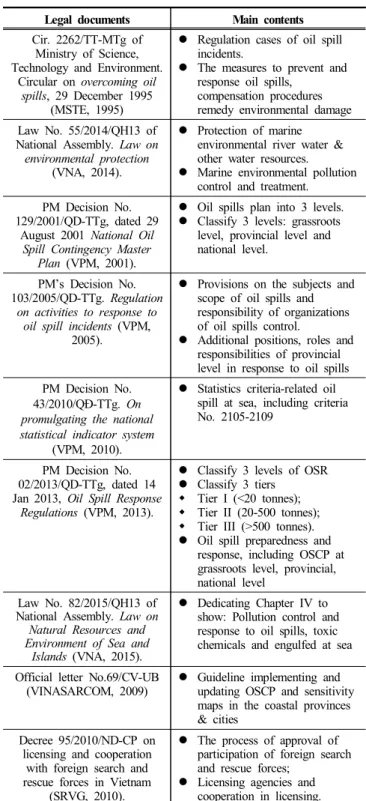
The establishment of laws and regulations on environmental protection has become a key focus on working program of the Government and National Assembly, specifically on marine environment protection and marine OSR that are shown by legal documents in Table 1.
National Contingency Plan (NCP) on OSR for ten-year period from 2001 to 2010 (VPM, 2001) and Prime Minister Decision No.
02 (VPM, 2013) promulgating OSR regulation had divided Vietnam waters into three OSR regions (Fig. 5).
The centers of three OSR regions shall be organized and operated under the statute of public-utility State enterprises with professional response forces acting as core units fully qualified and ready to perform the task of OSR tier 1 and tier 2 for combating oil spills. Three regional OSR centers are under the direction of VINASARCOM (Vietnam National Committee for Search and Rescue) for those tasks related to OSR and are main forces specialized in combating oil spill in designated area and in other areas as assigned by VINASARCOM (Fig. 5), provide assistance to localities in developing provincial Oil Spill Contingency Plan (OSCP), and organize annual training course on OSR.
According to OSR regulations of Vietnam, national OSR system is divided into 3 levels: grassroots (in-house) level, provincial level and national level, corresponding to private, provincial and governmental industry resources.
The provinces have jurisdiction over coastal waters to the limit of 20 km; National OSR Centers and VINASARCOM shall designate the authority for the jurisdiction over the outside of the 20 km limit (Fig. 5).
Fig. 5. Regional oil spill response centers (OSR) in Vietnam (PVM, 2001; 2005; 2013).
Legal documents Main contents Cir. 2262/TT-MTg of
Ministry of Science, Technology and Environment.
Circular on overcoming oil spills, 29 December 1995
(MSTE, 1995)
l Regulation cases of oil spill incidents.
l The measures to prevent and response oil spills,
compensation procedures remedy environmental damage Law No. 55/2014/QH13 of
National Assembly. Law on environmental protection
(VNA, 2014).
l Protection of marine environmental river water &
other water resources.
l Marine environmental pollution control and treatment.
PM Decision No.
129/2001/QD-TTg, dated 29 August 2001 National Oil
Spill Contingency Master Plan (VPM, 2001).
l Oil spills plan into 3 levels.
l Classify 3 levels: grassroots level, provincial level and national level.
PM’s Decision No.
103/2005/QD-TTg. Regulation on activities to response to
oil spill incidents (VPM, 2005).
l Provisions on the subjects and scope of oil spills and responsibility of organizations of oil spills control.
l Additional positions, roles and responsibilities of provincial level in response to oil spills PM Decision No.
43/2010/QĐ-TTg. On promulgating the national statistical indicator system
(VPM, 2010).
l Statistics criteria-related oil spill at sea, including criteria No. 2105-2109
PM Decision No.
02/2013/QD-TTg, dated 14 Jan 2013, Oil Spill Response
Regulations (VPM, 2013).
l Classify 3 levels of OSR l Classify 3 tiers
w Tier I (<20 tonnes);
w Tier II (20-500 tonnes);
w Tier III (>500 tonnes).
l Oil spill preparedness and response, including OSCP at grassroots level, provincial, national level
Law No. 82/2015/QH13 of National Assembly. Law on Natural Resources and Environment of Sea and
Islands (VNA, 2015).
l Dedicating Chapter IV to show: Pollution control and response to oil spills, toxic chemicals and engulfed at sea Official letter No.69/CV-UB
(VINASARCOM, 2009) l Guideline implementing and updating OSCP and sensitivity maps in the coastal provinces
& cities Decree 95/2010/ND-CP on
licensing and cooperation with foreign search and rescue forces in Vietnam
(SRVG, 2010).
l The process of approval of participation of foreign search and rescue forces;
l Licensing agencies and cooperation in licensing.
Table 1. Domestic legal documents relating to oil spill response (OSR) in Vietnam
The polluter is responsible for mobilizing resources to combat oil spills. If the scale of oil spill exceeds the response capacity of the polluter, the provincial People’s Committee is charged with spill response and the mobilization of response resources of
regional OSR center and other organizations based in the province to deal with the spill incident. In case the province is not capable of combating the oil spill, the provincial People’s Committee will report to the VINASARCOM for direction and co-operation with relevant agencies in organizations related to oil spill preparedness and response in Vietnam (Fig. 6). If the oil spill goes beyond the response capability of domestic resources, the VINASARCOM shall propose the Prime Minister to consider and decide on the request for international assistance.
There are 28 coastal provinces with its own oil spill contingency plan (OSCP). Coastal province sets up its leading organization in which Search and Rescue Board or/and Flood, Storm Prevention Steering Board of the province plays a vital role in response to oil spill incidents. This leading organization establishes and implements provincial OSCP that regulates the mobilizing forces, means, facilities and equipments to the spill site.
This province should regularly direct and inspect the relevant organizations and enterprises at risk of oil spill under their respective management. However, there are only several provinces in Vietnam that have OSR equipments because of the lack of finances and experts in using and maintaining the equipments.
Fig. 6. The organizational structure of VINASARCOM for oil spill response.
Admittedly, at the grassroots level, drawing-up of OSCP, investment in facilities or signing of a contract with grassroots’
OSR service supplier or Regional OSR center (Fig. 7) shall be done in tier 1 of OSR. According to the legal requirements, those organizations that can cause oil pollution have to sign a service contract with OSR service providers or to procure adequate equipment and training personnel. However, an OSR center may sign many contracts with various grassroots, but it will not meet the OSR requirements of these grassroots when many incidents occur simultaneously. The command system is limited because most of commanders are part-time cadres who have not been
properly trained. The command system has not been determined in case of OSR tier 1 that involves national OSR center.
Interestingly, law on Natural Resources and Environment of Sea and Islands was established by the National Assembly in Hanoi, June 25, 2015. It was enforced from July 1, 2016. Especially, it has a chapter VI about “Control of pollution, response to oil, chemical toxic spills and engulfing at sea”, involving 22 articles, from Article 42 to Article 63 (VNA, 2015). Moreover, Vietnam has cooperated closely with neighboring countries in the region such as Thailand, Cambodia and Philippines in response to marine oil spill.
Fig. 7. OSR structure of 3 tiers in Vietnam.
3.2 Comparison between Vietnam and Korea in national system for preparedness and response to marine oil spill incidents
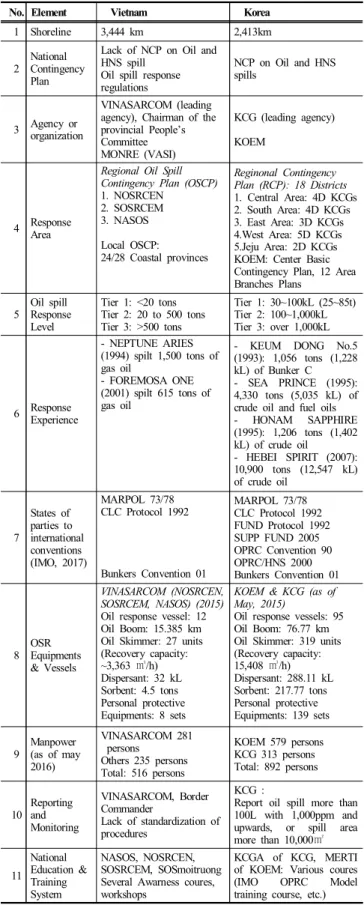
Vietnam and Korea are marine nations with long coastlines (Table 2). Korea is widely known for plenty of experiences regarding the preparedness and response to large-scale oil spills.
Korea has accumulated a lot of lessons through the responses to marine oil spill incidents such as M/T Hebei Spirit incident (Table 2). There is only one leading authority in charge of national response system in Vietnam and in Korea.
As shown in Table 2, there is a big difference between Vietnam and Korea in the states of parties to various international conventions. In Korea, national legal OSR system is relatively complete because most of international conventions and agreements regarding oil spills have been accepted and implemented in Korea, while Vietnam has not signed on some international conventions such as OPRC 90, FUND Protocol 1993, FUND Protocol 2003 and OPRC-HNS Protocol 2000 yet. Furthermore, compared with Korea, Vietnam has weakness in national OSR capacity, specifically with regard to the number of oil response vessel, oil boom, oil
No. Element Vietnam Korea
1 Shoreline 3,444 km 2,413km
2 National Contingency Plan
Lack of NCP on Oil and HNS spill
Oil spill response regulations
NCP on Oil and HNS spills
3 Agency or organization
VINASARCOM (leading agency), Chairman of the provincial People’s Committee MONRE (VASI)
KCG (leading agency) KOEM
4 Response Area
Regional Oil Spill Contingency Plan (OSCP) 1. NOSRCEN
2. SOSRCEM 3. NASOS Local OSCP:
24/28 Coastal provinces
Reginonal Contingency Plan (RCP): 18 Districts 1. Central Area: 4D KCGs 2. South Area: 4D KCGs 3. East Area: 3D KCGs 4.West Area: 5D KCGs 5.Jeju Area: 2D KCGs KOEM: Center Basic Contingency Plan, 12 Area Branches Plans
5 Oil spill Response Level
Tier 1: <20 tons Tier 2: 20 to 500 tons Tier 3: >500 tons
Tier 1: 30~100kL (25~85t) Tier 2: 100~1,000kL Tier 3: over 1,000kL
6 Response Experience
- NEPTUNE ARIES (1994) spilt 1,500 tons of gas oil
- FOREMOSA ONE (2001) spilt 615 tons of gas oil
- KEUM DONG No.5 (1993): 1,056 tons (1,228 kL) of Bunker C - SEA PRINCE (1995):
4,330 tons (5,035 kL) of crude oil and fuel oils - HONAM SAPPHIRE (1995): 1,206 tons (1,402 kL) of crude oil
- HEBEI SPIRIT (2007):
10,900 tons (12,547 kL) of crude oil
7
States of parties to international conventions (IMO, 2017)
MARPOL 73/78 CLC Protocol 1992
Bunkers Convention 01
MARPOL 73/78 CLC Protocol 1992 FUND Protocol 1992 SUPP FUND 2005 OPRC Convention 90 OPRC/HNS 2000 Bunkers Convention 01
8 OSR Equipments
& Vessels
VINASARCOM (NOSRCEN, SOSRCEM, NASOS) (2015) Oil response vessel: 12 Oil Boom: 15.385 km Oil Skimmer: 27 units (Recovery capacity:
~3,363 ㎥/h) Dispersant: 32 kL Sorbent: 4.5 tons Personal protective Equipments: 8 sets
KOEM & KCG (as of May, 2015)
Oil response vessels: 95 Oil Boom: 76.77 km Oil Skimmer: 319 units (Recovery capacity:
15,408 ㎥/h) Dispersant: 288.11 kL Sorbent: 217.77 tons Personal protective Equipments: 139 sets
9 Manpower (as of may 2016)
VINASARCOM 281 persons
Others 235 persons Total: 516 persons
KOEM 579 persons KCG 313 persons Total: 892 persons
10 Reporting and Monitoring
VINASARCOM, Border Commander
Lack of standardization of procedures
KCG :
Report oil spill more than 100L with 1,000ppm and upwards, or spill area more than 10,000㎡
11 National Education &
Training System
NASOS, NOSRCEN, SOSRCEM, SOSmoitruong Several Awarness coures, workshops
KCGA of KCG, MERTI of KOEM: Various coures (IMO OPRC Model training course, etc.) Table 2. Comparison between Vietnam and Korea for national
marine OSR systems
skimmer, dispersant, manpower, etc. (Table 2). Annually, each regional center of Vietnam opens at least one training course for provincial officers in the designated area. The course normally lasts 3 days; 2 days in class and a day of practical training with equipments. A course focuses mainly on overview of OSR and its impact on the environment, and shoreline clean-up activities that VINASARCOM organizes and conducts with military officers who participate in OSR. The authorities of coastal provinces also run OSR training course. However, the structure and major contents of the training program have not been standardized yet in Vietnam, while KCGA (Korea Coast Guard Academy) and MERTI (Marine Environment Research & Training Institute) of KOEM (Korea Marine Environment Management Corporation) have opened and run OSR courses for response personnel under IMO OPRC model training course (Table 2).
Additionally, Vietnam has made important strides in the systems for monitoring and reporting marine oil spill such as the coastal information system including 30 coastal communications, 01 ground communications satellite-HPLES, 01 satellite information station-VNLUT/MCC, 01 long range identification and tracking (LRIT) system; Very-small-aperture-terminal (VSAT) fixed satellite communication network; Vessel traffic services (VTS) systems in Hai Phong and Ho Chi Minh city areas. National remote sensing agency has used radar satellite imagery combined with GIS technology of tracking, monitoring and forecasting position of oil trails. Besides the above achievements, these oil spill monitoring systems have the following limitations: these systems are not closely linked one another; lack of automatic monitoring system in the sea areas; lack of information monitoring oil spill from vessel less than 500 GT and/ or non AIS; lack of standardization of procedures for reporting and monitoring oil spills. As a result, there were many oil spill incidents in Vietnamese water that were not reported. On the other hand, the details of an oil spill incident of which spillage was more than 100L with oil concentration of 1,000 ppm and upwards in water or of which oil spill area was over 10,000 have been reported throughly in Korea (Table 2).
4. Recommendations for enhancing national capability against oil spill incidents in Vietnam
In consideration of the present states of marine oil spills and national OSR system in Vietnam, the challenges that Vietnam faces are presented, and the recommendations or the alternative plans for Vietnam are proposed in comparison with Korea.
4.1 Reinforcement of legal system against oil spill pollution Firstly, in order to reinforce legislation on oil spill response, Vietnam should accept and implement OPRC Convention to which contracting parties are 112 states in the world (IMO, 2017). OPRC convention is a very important legal basis for preparedness, response and co-operation on marine oil spill. To improve national OSR capability and to enhance national system for minimizing the impacts of oil spill incidents that may occur at any time, international supports are necessary through the implementation of OPRC Convention in Vietnam.
According to Vietnamese legislations, only vessels over 1,000 GT are obligatory to have civil liability insurance but the insured amount is not clearly defined.
Besides, Vietnam is a party to Civil Liability Convention 1992 and a party to Bunker Convention 2001, while not a party to 1992 Fund convention and to the Supplementary Fund yet. Hence, the lack of financial guarantee to ensure compensations for damages and loss caused by oil spills as well as for the costs of cleanup and recovery is a real problem in Vietnam.
It is necessary to build a road map to accede to the 1992 Fund as a legal basis for the process of claiming compensation for damages caused by oil pollution in Vietnamese waters. The accession to 1992 Fund convention is expected to contribute to the development of complete compensation regime for the damage to marine environment suitable to the region and the world. In Vietnam, it will also create a legal ground for promoting international cooperation in marine environmental protection. The decisions and judgments in force of the competent Vietnam’s Court in respect of compensation for the damage caused by oil pollution from ships shall be automatically recognized by the other parties.
Secondly, a national fund should be established to support OSR in Vietnamese waters, to which the contributions will be made by ships and marine oil and gas production facilities operating in Vietnamese waters. In many cases of in-house level or provincial level, the national fund is required but there is no fund to pay for OSR center, leading to the delay of response and the impact on the environment and human health. This fund should support the prompt development of NCP for OSR in Vietnam as soon as possible.
In addition, it supports the reenforcement of national OSR capability in terms of securing equipments, survey, research, technology development, education and training of human resources, etc..
4.2 Enhancement of reporting, alerting and monitoring system
Firstly, in Vietnam, a consistent reporting, alerting and monitoring system should be set up at all levels by one organization like KCG of Korea.
Secondly, the monitoring guidelines should be established with specific standards including the definition of a monitoring program (what, when, where, who, why and how to monitor) and the implementation of a monitoring program (survey design, sampling strategies and standard methodologies), combining available monitoring equipments with marine monitoring system. It is noted that small-scale oil spill control and accurate statistics maintenance should be effectively implemented.
4.3 Development of training and exercise programs The standard contents of courses in training programs at different levels for response related personnel should be developed in Vietnam. These OSR training and education programs should be initiated and focused on both quantity and quality of response manpower (Table 2). As a part of the national OSR plan, OSR organizations conduct programs of regular training and exercise for personnel likely to be involved in OSR. These programs should be designed to provide Vietnam with numbers of trained personnel in effective response to oil spill incidents.
In order to raise the national capability of OSR, Vietnam has been providing response personnel with various training programs such as operational level courses for on-scene responders, administrative level courses for on-scene commanders and managers, oversea training courses, etc.. It has been helping to be familiarized with NCP and Local Contingency Plans (LCP) through the joint exercises conducted by civil and authorities, and has been continuously improving or solving problems coming from such exercises. The government should establish regulations on business incentives of private companies which are willing to train OSR experts to meet standard training program and to provide oil spill response services.
5. Conclusion
In this study, the analysis of the current states of oil spills and national OSR system shows that Vietnam has the high potentiality of oil spills in coastal waters, because the number and the volume of marine oil spills for two decades in Vietnam showed an upward trend as opposed to a downward trend in South Korea. Through the comparison of Vietnam with Korea in national OSR system,
three main recommendations for the enhancement of national OSR capability in Vietnam are proposed as follows: the development of alternative plan for reinforcing national OSR system involving legal system for preparedness and response to oil spill pollution such as the acceptance and implementation of OPRC Convention as well as the establishment of national fund compensating for the damage and loss caused by oil pollution; the enhancement of a consistent reporting, alerting and monitoring system; and the development of training and exercise programs with standard contents of educational courses.
Moreover, in the light of the ongoing marine pollution response improvement activities in Vietnam through the ODA (Official Development Assistance) project provided by Republic of Korea, it is expected that ODA project will greatly contribute to strengthening the national oil spill response system of Vietnam.
References
[1] Bui, D. D.(2009), Methods of economic loss valuation on resources and marine systems due to oil spill event: theory, international experiences and appropriate methods for Vietnam. Journal of science of Vietnam National University, Economics and Business, Vol. 25, pp. 239-252.
[2] Choi, H. K.(2017), A Study on the Improvement of Marine Pollution Response Education Program of Korea Coast Guard Academy-Focusing on Comparison between Domestic and Foreign Curriculums, Journal of Korean Society of Marine Environment & Safety, Vol. 23, No. 4, pp 365-375.
[3] IMO(2017), Status of multilateral Conventions and instruments in respect of which the International Maritime Organization or its Secretary-General performs depositary or other functions, 31 July, 2017, pp. 5-9.
[4] ITOPF(2007), http://www.itopf.com/in-action/case-studies/case- study/hebei-spirit-republic-of-korea-2007/.
[5] Kim, K. S.(2013a), Overview of Major Oil Spill at Sea and Details of Various Response Actions 1. Number and Volume of Marine Oil Spills in Korea and in the World, Journal of the Korean Society of Marine Environment & Safety, Vol. 19, No.2, pp. 129-137.
[6] Kim, K. S.(2013b), Overview of Major Oil Spill at Sea and Details of Various Response Actions 2. Analysis of Marine Oil Pollution Incidents in Korea, Journal of the Korean Society of Marine Environment & Safety, Vol. 19, No. 5, pp.
467-475.
[7] Lee, J. H.(2017), Analysis of the Hebei Spirit Oil Spill
Incident and its Aftermath, Journal of the Korean Society of Marine Environment & Safety, Vol. 23, No. 5, pp. 455-461.
[8] Luu, N. T. T.(2012), Legislation to control marine pollution in maritime activities in Vietnam, Dissertation of Dr, Hanoi Law University, http://luanan.nlv.gov.vn/luanan?a=d&d=TTcFlGvQle Ne2012.1.1.#.
[9] Mai, H. D.(2013), International law and foreign law anti oil pollution by vessels. Dissertation of Dr. Major: International Law; Code 38 60 01 62, Vietnam National University, pp.
48-62.
[10] MoNRE(2010), Report of general statistics of National Environment Agency Ministry of Natural Resources &
Environment to General Statistics Office of Vietnam (GSO), 08B/TNMT, pp. 1-3.
[11] MPSS(2016), Statistics annual report of 2016, Ministry of Public Safety and Security, Republic of Korea, p. 435.
[12] MSTE(1995), Cir. 2262/TT-MTg, dated 29 December 1995 of Ministry of Science, Technology and Environment, Circular on overcoming oil spills, http://vanban.chinhphu.vn/portal/page/
portal/chinhphu/hethongvanban?class_id=1&mode=detail&docu ment_id=2940.
[13] Nguyen, B. D.(2008), Overview of Vietnam legal regulations on prevention and protection of oil pollution on the sea.
Journal of science of Vietnam National University, Economics and Legal, Vol. 24. pp. 224-238.
[14] Nguyen, B. D.(2011), Overview of international legal regulations on prevention, protection and compensation of oil pollution on the sea, Journal of science of Vietnam National University, Economics and Legal, Vol. 27, pp. 30-41.
[15] Nguyen, H. T.(2009), Enhancing loacl capacities in oil spill preparedness and response: Vietnam experience, report in Manila Conference. pp. 02-05.
[16] Nguyen, H. N. and K. H. Nguyen(2014), The experiment of the Oilsas Model: an assistant tool, for responding to oil spill incidents in Van Phong bay, Khanh Hoa Province, Collection of marine research, Vol. 20, pp. 19-29.
[17] Phung, C. S.(2005), Report on the subject of scientific: Study and propose prevention and response measures for oil spills level 1 in Da Nang City, Ho Chi Minh City, pp. 10-130.
[18] SRVG(2010), Decree No.95/2010/ND-CP dated September 16, 2010 on licensing of and coordinating with foreign search and rescue forces in Vietnam, by Socialist Republic of Vietnam Government, https://thuvienphapluat.vn/van-ban/Giao-thong-Van -tai/Nghi-dinh-95-2010-ND-CP-cap-phep-phoi-hop-hoat-dong-lu c-luong-tim-kiem-cuu-nan-111744.aspx.
[19] VASI(2016), Vietnam Administration of Sea and Islands, Database oil spills in 2015, pp. 01-18.
[20] VINASARCOM(2007), National Committee for Search and Rescue, General report on the state of oil spills drifted to coast of the central provinces and southern province of Vietnam in 2007, pp. 01-04.
[21] VINASARCOM(2009), Official letter No.69/CV-UB on guiding the formulation and updating of OSRPs, sensitive maps of coastal provinces and cities, pp. 05-09.
[22] VNA(2014), Law No. 55/2014/QH13 on Environmental Protection dated June 23 by the Vietnam’s National Assembly, https://thuvienphapluat.vn/van-ban/Tai-nguyen-Moi-truong/Luat- bao-ve-moi-truong-2014-238636.aspx?tab=1.
[23] VNA(2015), Law No.82/2015/QH13 on Natural Resources and Environment of Sea and Islands, dated June 25 by the Vietnam’s National Assembly, https://thuvienphapluat.vn/van- ban/Tai-nguyen-Moi-truong/Luat-tai-nguyen-moi-truong-bien-va -hai-dao-2015-282375.aspx?tab=1.
[24] VPM(2001), Decision No. 129/2001/QD-TTg, dated 29 August 2001 of Vietnam’s Prime Minister, National Oil Spill Contingency Master Plan., https://thuvienphapluat.vn/van-ban/
Tai-nguyen-Moi-truong/Quyet-dinh-129-2001-QD-TTg-phe-duye t-ke-hoach-quoc-gia-ung-pho-su-co-tran-dau-giai-doan-2001-201 0/48124/noi-dung.aspx.
[25] VPM(2005), Decision No. 103/2005/QD- TTg of Vietnam’s Prime Minister. Regulation on activities to respond to oil spill incidents, Broadcast No. 18, https://thuvienphapluat.vn/van-ban /Tai-nguyen-Moi-truong/Quyet-dinh-103-2005-QD-TTg-Quy-che -hoat-dong-ung-pho-su-co-tran-dau-2454.aspx.
[26] VPM(2010), Decision No 43/2010/QĐ-TTg of the Vietnam’s Prime Minister “On promulgating the national statistical indicator system” was established June 2, 2010 in Hanoi, Broadcast No 359+360, https://thuvienphapluat.vn/van-ban/Ke- toan-Kiem-toan/Quyet-dinh-43-2010-QD-TTg-He-thong-chi-tieu- thong-ke-quoc-gia-106841.aspx.
[27] VPM(2013), Decision No. 02/2013/QD-TTg of Prime Minister, dated 14 January 2013 to Oil Spill Response Regulations.
Broadcast No 50+60, https://thuvienphapluat.vn/van-ban/Tai- nguyen-Moi-truong/Quyet-dinh-02-2012-QD-TTg-Quy-che-hoat- dong-ung-pho-su-co-tran-dau-164456.aspx.
Received : 2017. 09. 20.
Revised : 2017. 10. 25.
Accepted : 2017. 10. 28.