한수지 51(5), 571-578, 2018
571
Copyright © 2018 The Korean Society of Fisheries and Aquatic Science pISSN:0374-8111, eISSN:2287-8815 Korean J Fish Aquat Sci 51(5),571-578,2018
Original Article
서 론
해조류는해양생태계의중요한일차생산자로서상위먹이사 슬단계에있는해양생물의종다양성
,
풍도및어장형성에많 은영향을줄뿐만아니라(Lindstrom, 2009; Janiak and Whit- latch, 2012; Satheesh and Wesley, 2012),
해양에투기되는무 기및유기영양염을흡수하는생물여과자(biofilter)
와생태계 의안정성을유지하고연안의환경을모니터링할수있는생 물학적지시자(biological indicator)
로서 중요한역할을한다(Wells et al., 2007; Scherner et al., 2013).
해조류의종조성및군집구조는수온
,
광량,
초식압및경쟁등 의다양한요인들에영향을받고있으며(Kang, 1968; Graham and Wilcox, 2000; Babitha and Subramanian, 2016),
특히이 러한요인들중수온은해조류의지리적분포를결정짓는중요 한환경요인으로알려져있다(Gessner, 1970; Murray and Lit- tler, 1981; Van den Hoek, 1982a, b; Dawes, 1989; Kim et al.,
1998).
지구온난화의영향으로우리나라연안의수온은점진적으로증가하고있으며
,
이는해양생태계의교란을유발함으로서해양생물의종조성
,
분포범위,
서식량등의변화를가져온다(Choi and Rho, 2010; Kim and Lee, 2010; Kim et al., 2012).
해양환경의변화를예측하고
,
해양생태계의장,
단기적인변동 특성을정밀하게파악하기위해서는해양생물의종조성및분 포조사를통하여기초자료를축적하는것이중요하다.
Kang (1966)
은한국연안해조류의지리적분포를논하면서우리나라연안을
5
개해역(
동해안북부,
동해안남부,
남해안,
서해안및 제주도)
으로구분하였다.
동해안해조류의생태학적연구는
1980
년대부터본격적으로시작되어,
북부에서남부에걸쳐비교적고르게조사되었다
(Boo, 1985; Boo and Lee, 1986; Kim et al., 1997; Choi et al., 2006; Sohn et al., 2007;
Choi et al., 2010).
그결과우리나라동해안에는총414
종(
남 조류33
종,
녹조류51
종,
갈조류99
종,
홍조류231
종)
의해조류 가분포하는것으로나타났으며,
이를한국의전연안에생육하 는해조류와분류군별로비교해볼때,
동해안에는한국산해조 류의약67%
가분포하며,
분류군별로는남조류69%,
녹조류63%,
갈조류73%,
홍조류65%
가생육하는것으로밝혀졌다(Lee and Kang, 1986; Lee and Kim, 1999).
본연구지역인울동해 남부 해역 조하대 해조류 군집구조의 계절적 변화
한수진·황용훈·손민호·최한길 1 ·장재길*
해양생태기술연구소, 1원광대학교 생명과학부/기초자연과학연구소
Seasonal Variation in Seaweed Community Structure in the Subtidal Zone of the Southern Part of the East Coast of Korea
Su Jin Han, Youg Hun Hwang, Min Ho Son, Han Gil Choi
1
and Jae Gil Jang*Marine Eco-technology institute Co., Ltd., Busan 48520, Korea
1Faculty of Biological Science and Institute of Basic Natural Science, Wonkwang University, Iksan 54538, Korea
Seasonal variability in algal community structure of the subtidal zone was examined at four study sites on the south- eastern coast of Korea from February to November 2016. A total of 81 species of algae (8 green, 12 brown, and 61 red) were indentified. During the study period, the greatest number of species was observed at Sinamri (57 species) followed by Daesongri (50 species), Dongbaekri (47 species) and Gangyangri (42 species). Of the six functional seaweed forms, the coarsely-branched form was the most dominant, accounting for about 43% of the total species at Daesongri. The annual average biomass in wet weight varied from 700.59 g/m 2 at Sinamri to 1,712.45 g/m 2 at Dae- songri. The parameters of seaweed community structures were as follows: dominance index (DI), 0.30-0.54; richness index (R), 4.92-7.05; evenness index (J’), 0.54-0.72; and diversity index (H’), 2.05-2.91.
Key words: Algal flora, Biomass, Community, Diversity, Functional form
This is an Open Access article distributed under the terms of the Creative Commons Attribution Non-Commercial Licens (http://creativecommons.org/licenses/by-nc/3.0/) which permits unrestricted non-commercial use, distribution, and reproduction in any medium, provided the original work is properly cited.
https://doi.org/10.5657/KFAS.2018.0571 Korean J Fish Aquat Sci 51(5), 571-578, October 2018
Received 13 August 2018; Revised 4 September 2018; Accepted 10 September 2018
*Corresponding author: Tel: +82. 51. 611. 5423 Fax: +82. 51. 611. 0588
E-mail address: [email protected]
산울주군과부산기장군주변해역은동한난류의영향을강하 게받는곳으로
,
특히동해안남부와남해안의경계구역에위치 하여해조류의지리학적분포를구분하는데매우중요한지형 적특색을가지고있다(Kang et al., 2008; Choi et al., 2010).
연 구지역인근에서보고된해조류연구로는부산동백섬,
용호동,
서암,
영도,
오륙도일대의해조상및군집구조에관한연구(Lee and Kang, 1971; Lee, 1972; Lee, 1974; Nam and Kim, 1999;
Yoo, 2003a, b; Choi, 2007; Choi and Choi, 2014)
와부산기장 군해역의해조상및군집구조변화(Kang et al., 2008; Choi et al., 2010; Yoo et al., 2013)
그리고울산주변해역의해조류군 집구조에관한연구(Choi and Rho, 2010)
등이있다.
그러나대 부분의연구가조간대를대상으로조사가이루어져조하대해 조류군집의구조적특성을파악하는데어려움이있다.
따라서
,
본연구는동해남부연안조하대에분포하는해조류 의군집특성을구명하기위해해조류의종조성,
군집지수,
우 점종및계절별생물량의변화를파악함으로써,
기후변화에따 른해양생태계의변화를모니터링하기위한기초자료로활용하 기위해수행되었다.
재료 및 방법
본연구는동해남부연안
(
울산시울주군-
부산시기장군)
의4
개정점에서2016
년2
월부터11
월까지SCUBA diving
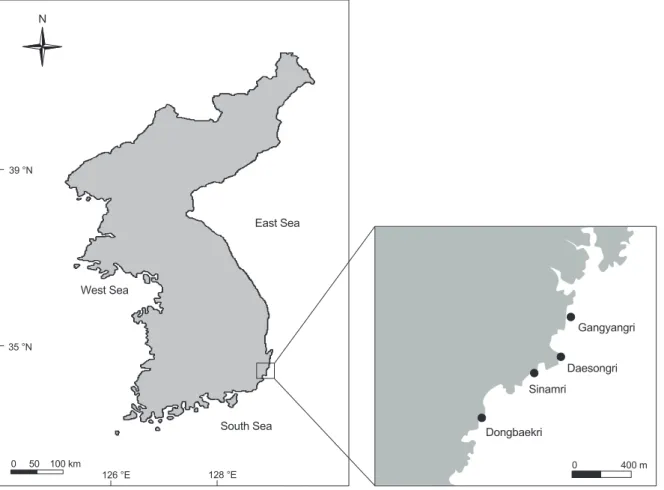
에의해 계절별로수행되었다(Fig. 1).
해조군집분석을위한정량조사 는각조사정점에서해조류식생을대표할수있는곳을선정하여방형구
(50 cm×50 cm)
를설치하고방형구내에서식하는모든해조류를끌칼등으로전량채집하였으며
,
해조상을파악하 기위하여조사정점주변에서식하는모든해조류를정성채집 하였다.
채집된해조류는포르말린-
해수용액(5-10%)
으로현장 에서고정시켜실험실로운반한후해부및광학현미경을이용 하여분류및동정하였고,
출현종의목록및국명은국가생물 종 목록집과AlgaeBase (www.algaebase.ory)
에따랐다(Kim et al., 2013; Guiry and Guiry, 2018).
정량채집된해조류는담수로수회세척하여모래와불순물 을제거한후습중량을측정하였고
,
단위면적당생물량(g/m
2)
으로환산하였다.
해조류종별평균생물량과단위면적당생물량구성비
(%)
를구하여생물량구성비가30%
이상인종은우점종으로
, 10-30%
인 종은준우점종으로 구분하였다(Kim et
Fig. 1. A map of study site and the location at in the southern part of east coast of Korea.
West Sea
East Sea
South Sea N
39 °N
35 °N
0 50 100 km
126 °E 128 °E 0 400 m
Daesongri Gangyangri
Sinamri
Dongbaekri
동해 남부 해역 조하대 해조류 군집구조의 계절적 변화
573
al., 1995; Kim et al., 1997).
또한,
계절별로출현한출현종과 생물량자료를이용하여풍부도지수(richness index, R), Shan- non's
다양도지수(diversity index, H')
와균등도지수(evenness index, J')
를계산하였다(Margalef, 1958; Fowler and Cohen, 1990).
우점도지수(dominance index, DI)
는군집내에서의생 물량순서에따라제1, 2
우점종을선택하고, 2
종의생물량합에 대한총생물량의비율로산출하였고,
군집지수의산출및도식 화에는PRIMER version 6
을이용하였다(McNaughton, 1967;
Lee et al., 1983; Clarke and Gorley, 2006).
해조류의기능형은출현종의외부형태
,
내부구조,
광합성효율 등에따라6
개의그룹(
엽상형,
사상형,
성긴분기형,
다육질형,
유절산호말형,
각상형)
으로구분하고(Littler and Littler, 1984),
6
개의기능형을바탕으로해조류엽상체의체형,
생장속도,
표현형의적응성과엽상체의수명및천이속도를고려하여생태 학적상태그룹
I, II (ecological status group; ESG I, II)
로구분 하였다(Orfandis et al., 2003).
또한,
해조상의특성을파악하 기위해정성채집된해조류를분류및동정한후출현종수로갈조류에대한녹조류의비
(C/P),
갈조류에대한홍조류의비(R/P),
갈조류에대한녹조류와홍조류의비로(R+C)/P
를구하 였다(Feldmann, 1937; Segawa, 1956; Cheney, 1977).
결 과
종조성
본연구기간에동해남부해역
4
개정점에서출현한해조류 는총81
종으로녹조류8
종,
갈조류12
종,
홍조류61
종이었으며
,
홍조류가전체출현종수의75.3%
를차지하여출현율이가장높았다
.
정점별로는42-57
종이출현하였으며,
신암리에서 가장많은종이출현하였다.
계절별출현종수는동계48
종,
춘 계46
종,
하계41
종그리고추계에42
종으로동계에가장많은 종이출현한반면,
하계와추계에는다소낮은출현율을보였 다(Table 1).
정점별해조상을보면
,
강양리에서출현한해조류는총42
종(
녹조4,
갈조7,
홍조31
종)
이었으며,
홍조류가73.8%
로출현율 이가장높았다.
계절별출현종수는10-22
종으로동계에최대 였고추계에최소였다.
대송리에서는총50
종(
녹조6,
갈조7,
홍 조37
종)
이출현하였고,
계절별출현종수는16-29
종으로춘계에최대였다
.
신암리에서는홍조류45
종(78.9%)
을포함하여총57
종이출현하였다.
계절별로는22-30
종이출현하였으며,
하계 와추계에비해동계와춘계에보다많은종이출현하였다.
동백 리에서는총47
종(
녹조4,
갈조6,
홍조37
종)
이출현하였고,
동 계에27
종으로가장많은종이출현한반면,
추계에는17
종이 출현하여가장낮은것으로나타났다.
연구기간중정점별연중출현한해조류종으로는
,
강양리에 서는참가죽그물바탕말(Dictyota coriacea) 1
종,
대송리에서는 잔금분홍잎(Acrosorium polyneurum),
부챗살(Ahnfeltiopsis flabelliformis),
진두발(Chondrus ocellatus),
작은구슬산호말(Corallina pilulifera),
마디잘록이(Fushitsunagia catenata),
참 곱슬이(Plocamium telfairiae)
로6
종,
신암리에서는잔금분홍 잎,
돌가사리(Chondracanthus tenellus),
진두발,
작은구슬산호 말,
마디잘록이,
참곱슬이,
개우무(Pterocladiella capillacea)
로7
종,
동백리에서는잔금분홍잎,
돌가사리,
진두발,
마디잘록이,
참곱슬이,
개우무로총6
종이확인되었다.
모든정점에서출현 한종은총23
종(
녹조류2,
갈조류3,
홍조류18)
이였고,
홍조 류인잔금분홍잎,
진두발,
마디잘록이,
참곱슬이4
종은3
개정 점(
대송리,
신암리,
동백리)
에서연중출현한것으로나타났다. 기능형
동해남부해역
4
개정점에서출현한해조류기능형그룹을보 면,
엽상형은8-13
종으로심암리에서최대,
동백리에서최소를 보였고,
사상형은6-10
종으로대성리에서최대,
강양리에서최 소였다.
성긴분기형은16-21
종으로대성리와신암리에서최대,
강양리에서최소였으며,
다육질형은5-6
종으로정점별큰차이 가없었다.
유절산호말형은2-6
종으로신암리에서최대,
대성리 에서최소였고,
각상형은1-4
종으로신암리에서최대,
대성리에 서최소였다(Fig. 2).
또한, ESG I (
성긴분기형,
다육질형,
유절 산호말형,
각상형)
은전체출현해조류81
종중50
종(61.7%)
으 로우세하였으며, ESG II (
엽상형,
사상형)
는31
종(38.3%)
이었 다. ESG II
그룹의정점별출현종비율은신암리에서35.1%
로 낮았고,
대성리에서40.0%
로높게나타났다.
생물량 및 우점종
연구지역의
4
개정점조하대에서식하는해조류의연평균생 물량은1,081.5 g wet wt./m
2이었으며,
대송리에서1,712.4 g
Table 1. The number of macroalgal species observed at four study sites in the southern part of east coast of Korea
Taxon Gangyangri Daesongri Sinamri Dongbaekri
Wi Sp Su Au To Wi Sp Su Au To Wi Sp Su Au To Wi Sp Su Au To
Chlorophyta 1 1 3 1 4 1 2 2 5 6 2 3 3 0 5 2 1 3 2 4
Phaeophyta 3 5 4 2 7 4 7 1 3 7 2 3 2 0 7 3 3 0 2 6
Rhodophyta 18 14 7 7 31 19 20 13 19 37 25 24 22 22 45 22 20 17 13 37
Total 22 20 14 10 42 24 29 16 27 50 29 30 27 22 57 27 24 20 17 47
Wi, Winter; Sp, Spring; Su, Summer; Au, Autumn; To, Total.
한수진
ㆍ
황용훈ㆍ
손민호ㆍ
최한길ㆍ
장재길574
wet wt./m
2로최대였고,
신암리에서700.6 g wet wt./m
2로최 소였다.
계절별생물량은395.4-2,206.8 g wet wt./m
2로춘계에 최대였고,
추계에최소로확인되었다.
각정점별생물량은강양 리의경우410.8-2,251.3 g wet wt./m
2(
평균1,034.0 g wet wt./
m
2),
대송리에서는417.7-4,308.7 g wet wt./m
2(
평균1,712.5 g wet wt./m
2),
동백리에서는392.9-1,547.6 g wet wt./m
2(
평균879.0 g wet wt./m
2)
로모두춘계에최대생물량을보였으며,
신암리에서만계절별360.2-924.9 g wet wt./m
2(
평균700.6 g wet wt./m
2)
로동계에생물량이높은것으로나타났다(Fig. 3).
분류군별로는강양리에서만갈조류가전체생체량의
58.1%
로 높은생물량비율을보인것에반해그외3
개정점(
대송리,
동 백리,
신암리)
에서는홍조류가85.6-98.9%
로대부분의구성비 율을차지하는것으로나타났다.
해조류의생물량을바탕으로 판정한우점종(30%)
과준우점종(10-30%)
을보면,
강양리에서 는괭생이모자반(Sargassum horneri)
이전체생물량의37.5%
로 우점하였으며
,
참가죽그물바탕말(13.2%)
과 우뭇가사리(Gelidium elegans, 11.5%)
가준우점하였고,
대송리에서는전 체생물량의30%
이상인종은없었으며,
잔금분홍잎(27.9%),
우뭇가사리(26.3%)
와참개도박(Grateloupia elliptica, 10.8%)
이준우점종으로나타났다.
신암리와동백리에서도준우점종 만출현하였는데,
신암리에서는참개도박(15.1%)
과참곱슬이(14.4%),
동백리에서는 돌가사리(20.5%),
참곱슬이(14.6%),
잔금분홍잎
(12.3%)
그리고 개도박(Pachymeniopsis lanceo- lata, 10.4%)
이준우점종으로분포하였다(Table 2).
군집지수
해조류의생물량과출현종수로산출된연평균군집지수를 보면
,
대송리에서제1, 2
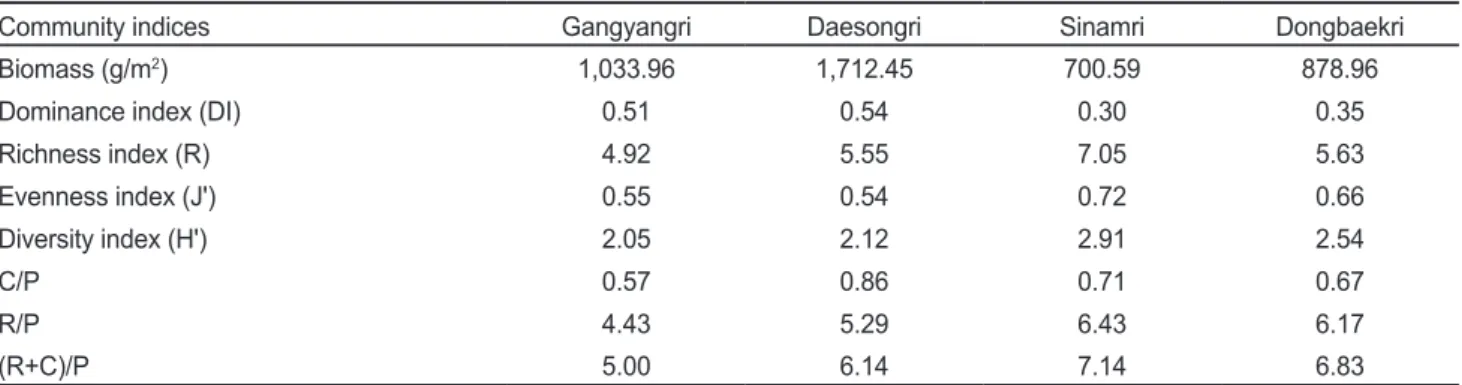
우점종인잔금분홍잎(477.2 g wet wt./
m
2)
과우뭇가사리(451.0 g wet wt./m
2)
가전체생물량(1,712.5 g wet wt./m
2)
의54.2%
를차지하여우점도지수(DI)
가0.54
으 로최대였고,
신암리에서는제1, 2
우점종인참도박(102.0 g wet wt./m
2)
과 참곱슬이(101.1 g wet wt./m
2)
가전체생물량(700.6 g wet wt./m
2)
의29.6%
를차지하여0.30
으로최소로나 타났다.
연구기간에4
계절출현종수와평균생물량을이용한 풍도지수(R)
는57
종이출현한신암리에서최대(7.05)
였고, 42
종이출현한강양리에서4.92
로최소였으며,
균등도지수(J’)
는 해조류의생물량차이가크지않고,
우점도지수가낮았던신암리에서
0.72
로높았다.
풍도와균등도에의해결정되는종다양도지수
(H’)
는신암리에서가장높은값(2.91)
을보였으며,
동백 리(2.54),
대송리(2.12),
강양리(2.05)
의순서로나타났다(Table 3).
해조상의 지역적 특성을 나타내는
C/P
값은 대송리에서0.86
으로최대였고,
강양리에서0.57
으로최소였다. R/P
값과(R+C)/P
값은신암리에서각각6.43, 7.14
로최대로나타났다(Table 3).
Table 2. Dominant (≥ 30%) and subdominant (10-30%) species in terms of average biomass percentage (%) at four study sites in the south- ern part of east coast of Korea
Site Dominant and subdominant species
Gangyangri Sargassum horneri (37.5), Dictyota coriacea (13.2), Gelidium elegans (11.5)
Daesongri Acrosorium polyneurum (27.9), Gelidium elegans (26.3), Pachymeniopsis elliptica (10.8) Sinamri Pachymeniopsis elliptica (15.1), Plocamium telfairiae (14.4)
Dongbaekri Chondracanthus tenellus (20.5), Plocamium telfairiae (14.6), Acrosorium polyneurum (12.3), Pachymeniopsis lanceolata (10.4)
Fig. 2. Number of seaweed species in functional form groups col- lected at four study sites in the southern part of east coast of Korea during the study period.
0 20 40 60 80 100
Gangyangri Daesongri Sinamri Dongbaekri
Sheet Filamentous Coarsely-branched
Thick-leathery Jointed-calcareous Crustose
0 1,000 2,000 3,000 4,000 5,000
Gangyangri Daesongri Sinamri Dongbaekri Winter Spring Summer Autumn No. of species Biomass (g wet wt./m
2)
Site
Site
Fig. 3. Seasonal variations in seaweed biomass (g wet wt./m2) at four study sites in the southern part of east coast of Korea. Bar show standard errors (n=2-3 replicates).
0 20 40 60
Gangyangri Daesongri Sinamri Dongbaekri
0 1,000 2,000 3,000 4,000 5,000
Gangyangri Daesongri Sinamri Dongbaekri Winter Spring Summer Autumn No. of species Biomass (g wet wt./m
2)
Site
Site
동해 남부 해역 조하대 해조류 군집구조의 계절적 변화
575
고 찰
해조류의분류군별종조성과출현종수
(
풍도)
는연안환경의 상태와기후변화를평가하는생물학적인지표자(biological in- dicator)
로활용된다(Wells et al., 2007).
본연구의4
개정점(
강 양리,
대송리,
신암리,
동백리)
에서채집된해조류는총81
종(
녹 조8,
갈조12,
홍조61
종)
이었고정점별로는42-57
종으로다소 차이를보였다.
본연구지역의인근해역에서보고된해조류출 현종수와비교해보면,
울진(Choi et al., 2006),
포항(Shin et al., 2011)
그리고부산일광만(Kang et al., 2008)
에비해서는 적게출현한경향을보인반면,
본연구지역보다남쪽에위치한 부산영도(Choi, 2007),
오륙도(Choi and Choi, 2014),
이기대(Shin et al., 2014),
기장(Yoo et al., 2013)
보다는많이출현한 경향을보였다.
이러한해조류의출현종수차이는조사지역,
조사시기및수심그리고조사방법에따라차이가있으므로조 사해역의해조류종다양성은자료가축적된후논의되어야할 것으로판단된다.
출현종의분류군별구성비를보면,
본연구 에서는녹조류9.9%,
갈조류14.8%,
홍조류75.3%
로홍조류 가가장높은것으로나타났다.
본연구지역의인근지역에서는 녹조류9.1-14.5%,
갈조류10.6-33.3%,
홍조류54.0-80.3%
으 로보고되어(Choi et al., 2006; Choi, 2007; Kang et al., 2008;
Shin et al., 2011; Yoo et al., 2013; Choi and Choi, 2014; Shin
et al., 2014)
녹조류와갈조류의구성비가상대적은낮게나타난반면
,
홍조류는비교적높은것으로나타났다.
해조류는안정된해역에서식하며생장이느린성긴분기형
,
다육질형,
유절산호말형,
각상형해조류(ESG I)
와환경오염이 나교란된해역에서 빠른생장을보이는엽상형과 사상형해조류
(ESG II)
로구분되고 기능형군의 구성비율은해조류서식환경상태와밀접한관련을보인다고알려져있다
(Arévalo et al., 2007; Pinedo et al., 2007, Wells et al., 2007).
본연구에 서ESG II
의 비율은38.3%
로,
조하대의 경우삼척갈남에서41.4% (Kim et al., 2014),
다도해및한려해상국립공원7
개정 점에서30.4% (Oh et al., 2015)
였고,
조간대조사로직접적인 비교는어려우나한려해상국립공원내6
개정점에서36.9% (Oh
et al., 2016),
태안학암포에서34.7% (Heo et al., 2015),
고흥군4
개정점에서34.0% (Song et al., 2011)
로본연구해역의ESG II
비율은다른해역과유사하여아직까지는해조류가서식하기 에안정된환경으로판단된다.
기초생산자인해조류의생물량은군집의특성을나타내는중 요한척도로서 정점별생물량자료를비교및분석하는것은 연안생태계의 안전성과 생산성을 이해하는데중요한자료이 다
(Choi et al., 2006).
본연구에서해조류의연평균생물량은1,081.5 g wet wt./m
2이었으며,
계절별평균생물량은395.4- 2,206.8 g wet wt./m
2로춘계에가장높은생물량을보였다.
본 연구지역인근인일광만(Kang et al., 2008)
에서는계절별평균 생물량이286.1-629.8 g wet wt./m
2으로동계에가장높았으며,
이기대(Shin et al., 2014)
에서는123.6-2,061.6 g wet wt./m
2으 로하계에평균생물량이가장높은것으로보고되어상이한결 과를보였다.
하지만가장인접한기장(Yoo et al., 2013)
의경 우,
연평균생물량은1,249.6 g wet wt./m
2이었으며,
계절별평 균생물량은967.8-1,726.5 g wet wt./m
2으로춘계에가장높은 것으로보고되어본연구와유사한결과를보였지만,
생물량은 다소감소한것으로나타났다.
이는감태(Ecklonia cava),
미역(Undaria pinnatifida),
괭생이모자반,
참개도박등생물량이높 은일부해조류의번무및쇠퇴시기가각해역의특성에따라 다소상이한것에서기인된결과로판단된다(Yoo et al., 2013;
Choi and Choi, 2014).
해조류의분류군별출현종수를기준으로해조류의지리적 분포특성을나타내는
C/P
값은한대에서아열대해역에걸쳐0.4-1.5
범위의값을나타냈고(Segawa, 1956), R/P
값은한대와 극지역에서1.0
이하,
온대지역에서1.0-4.0,
열대해역에서4.0
이상을보였으며(Feldmann, 1937), (R+C)/P
값에따라온대성 내지 한대성(3
이하),
혼합성(3-6),
열대성(6
이상)
해조상으로 구분한다(Cheney, 1977).
본연구지역(
강양리,
대송리,
신암리,
동백리)
에서는C/P
값이0.67, R/P
값이5.08, (R+C)/P
값이5.75
로나타나열대에가까운혼합해조상의특성을보였다.
인근지 역의기존연구들과비교해보면,
일광만(Kang et al., 2008),
기 장(Choi et al., 2010)
과는유사하게나타난반면,
나머지다른Table 3. Average biomass (g wet wt./m2) and various community indices of seaweeds at four sites in the southern part of east coast of Korea
Community indices Gangyangri Daesongri Sinamri Dongbaekri
Biomass (g/m2) 1,033.96 1,712.45 700.59 878.96
Dominance index (DI) 0.51 0.54 0.30 0.35
Richness index (R) 4.92 5.55 7.05 5.63
Evenness index (J') 0.55 0.54 0.72 0.66
Diversity index (H') 2.05 2.12 2.91 2.54
C/P 0.57 0.86 0.71 0.67
R/P 4.43 5.29 6.43 6.17
(R+C)/P 5.00 6.14 7.14 6.83
C, Chlorophyta; P, Phaeophyta; R, Rhodophyta.
지역들보다는높은것으로나타났다
.
해조류의지리적분포와풍도에영향을미치는가장중요한 요인중하나는수온으로 알려져있으며
(Babitha and Subra- manian, 2016),
지난130
년 동안세계적으로 연평균수온은 약0.6℃
증가하였고,
한반도남해와동해(
남부,
중부)
를따라1.6℃
이상의수온상승을보이는것으로나타났다(Kim et al., 2011).
본연구지역동해남부4
개정점에서는이전연구에비 해갈조류의출현비율이낮고홍조류가높게나타났으며,
지리 적분포특성또한열대성및혼합성해조상을보였다.
따라서,
동해안의수온변화를포함한다양한환경변화에따른해조상 의변화가예견되므로지속적인모니터링연구가필요할것으 로판단된다.
References
Arévalo R, Pinedo S and Ballesteros E. 2007. Changes in the composition and structure of Mediterranean rocky-shore communities following a gradient of nutrient enrichment:
Descriptive study and test of proposed methods to assess wa- ter quality regarding macroalgae. Mar Pollut Bull 55, 104- 113. http://dx.doi.org/10.1016/j.marpolbul.2006.08.023.
Babitha D and Subramanian V. 2016. Natural growth and verti- cal distribution of marine red alga Grateloupia filicina (Rho- dophyta/Gigartinales) and its associated fauna. Int J Curr Microbiol App Sci 5, 745-755. http://dx.doi.org/10.20546/
ijcmas.2016.512.085.
Boo SM and Lee IK. 1986. Studies on benthic algal community in the east coast of Korea. I. Floristic composition and peri- odicity of Sokcho rocky shore. Korean J Phycol 1, 107-116.
Boo SM. 1985. Vertical distribution patterns of the intertidal al- gal community on a Kangneung rocky shore, east coast of Korea. Proc Nat Sco Res Inst KANU 1, 46-53.
Cheney DP. 1977. A new and improved ratio for comparing sea- weed floras. Suppl J Phycol 13, 129.
Choi CG and Rho HS. 2010. Marine algal community of Ulsan, on the eastren coast of Korea. Korean J Fish Aquat Sci 43, 246-253. http://dx.doi.org/10.5657/kfas.2010.43.3.246.
Choi CG, Chowdhury MTH, Choi IY and Hong YK. 2010. Ma- rine algal flora and community structure in Kijang on the southern east cost of Korea. J Korean Soc Oceanogr 15, 133-139.
Choi CG, Kwak SN and Sohn CH. 2006. Community struc- ture of subtidal marine algae at Uljin on the east coast of Korea. Algae 21, 463-470. http://dx.doi.org/10.4490/AL- GAE.2006.21.4.463.
Choi CG. 2007. Algal flora and Ecklonia stolonifera Oka- mura (Laminariaceae) population of Youngdo in Busan, Korea. Algae 22, 313-318. http://dx.doi.org/10.4490/AL- GAE.2007.22.4.313.
Choi JH and Choi CG. 2014. Marine algal communities around Oryukdo, Busan, Korea. Korean J Fish Aquat Sci 47, 960-
972. http://dx.doi.org/10.5657/KFAS.2014.0960.
Clarke KR and Gorley RN. 2006. PRIMER V6: User Manual/
Tutorial. PRIMER-E Ltd, Plymouth, U.K.
Dawes CJ. 1989. Temperature acclimation in cultured Eucheu-
ma isiforme from Florida and E. alvarezii from the Philip-
pines. J App Phycol 1, 59-65Feldmann J. 1937. Recherches sur la vegetation marine de la Mediterranee. La cote des Alberes. Rev Algol 10, 1-339.
Fowler J and Cohen C. 1990. Practical Statistics for Field Biol- ogy. John Wiley and Sons, New York, N.Y., U.S.A.
Gessner F. 1970. Temeprature: Plants. In: Kinne O (ed.), Marine ecology. Vol. I. Part 1. Wiley interscience, New York, N.Y., U.S.A.
Graham LE and Wilcox LW. 2000. Algae: Upper Saddle River.
Prentice hall, New Jersey, N.J., U.S.A., 1-640.
Guiry MD and Guiry GM. 2018. AlgaeBase. World-wide elec- tronic publication, National University of Ireland, Galway.
Retrieved from http://www. Algaebase.org’searched on Aug 29, 2018.
Heo JS, Han SJ, Choi HG and Nam KW. 2015. A study on long- term monitoring of seaweed flora and community structure at Hakampo, western coast of Korea. Korean Fish Aquat Sci 48, 969-976. http://dx.doi.org/ 10.5657/ KFAS.2015.0969.
Janiak DS and Whitlatch RB. 2012. Epifaunal and algal assem- blages associated with the native Chondrus crispus (Stack- house) and the non-native Grateloupia turuturu (Yamada) in eastern Long Islands Sound. J Exp Mar Biol Ecol 413, 38-44. https://doi.org/10.1016/j.jembe.2011.11.016.
Kang JW. 1966. On the geographical distribution of marine al- gae in Korea. Bull Pusan Fish Coll 7, 1-125.
Kang JW. 1968. Illustrated Encyclopedia of Fauna & Flora of Korea, Vol. 8, Marine Algae. Samhwa Press, Seoul, Korea.
Kang PJ, Kim YS and Nam KW. 2008. Flora and commu- nity structure of benthic marine algae in Ilkwang Bay, Korea. Algae 23, 317-326. http://dx.doi.org/10.4490/AL- GAE.2008.23.4.317.
Kim JY, Kim JN and Choi JH. 2012. Seasonal variation of spe- cies composition in marine organisms at Oryukdo in the southeastern waters off Korea. J Fish Mar Sci Edu 24, 781- 792. http://dx.doi.org/10.13000/JFMSE.2012.24.6.781.
Kim SJ, Woo SH, Kim BM and Hur SD. 2011. Trends in sea surface temperature (SST) change near the Korean penin- sula for the past 130 years. Ocean Polar Res 33, 281-290.
http://dx.doi.org/10.4217/OPR.2011.33.3.281.
Kim YH, Eum HM and Kang YS. 1998. Qualitative and quan- titative analysis of warm tolerant benthic marine algale in Korea. I. Kori nuclear power plant. Algae 13, 213-226.
Kim YH, Nam KW and Sohn CH. 1997. Intertidal benthic ma- rine algae at Chumunjin on the East coast of Korea: flora, distribution and community structure. Algae 12, 117-130.
Kim YH, Yoon HJ and Yoo JS. 1995. Species composition and biomass of marine algal community on the mid-western
동해 남부 해역 조하대 해조류 군집구조의 계절적 변화
577
coast of Korea. J Plant Biol 38, 389-398.
Kim YT and Lee HJ. 2010. Positive correlation water tempera- ture increase with thermal front retrogression in the southern sea of Korea. J Korean Earth Sci Soc 38, 122-123.
Kim HS, Boo SM, Lee IK and Sohn CH. 2013. National list of species of Korea [Marine Algae]. National Institute of Bio- logical Resources, Inchon, Korea.
Lee KW and Kang JW. 1971. A preliminary survey of the algal flora and comminities of Dongbaiksum, Pusan. Publ Mar Lab Pusan Fish Coll 4, 29-37.
Lee KW. 1972. Annual variation of marine algae flora at Dong- baeksum. Bull Fish Jeju Univ 1, 8-16.
Lee KW. 1974. Observation of algal community near Dong- baeksum, Haeundae. Bull Fish Jeju Univ 5, 319-331.
Lee IK and Kang JW. 1986. A check list of marine algae in Ko- rea. Korean J Phycol 1, 311-325.
Lee IK and Kim YH. 1999. Biodiversity and distribution of marine benthic organisms and uses of algal resources in the coastal zone of Korea and Japan. I. Benthic marine algae in the east coast of Korea. Algae 14, 91-110.
Lee IK, Lee HB and Boo SM. 1983. A summer marine algal flora of islands in Jindo-gun. Rep Sur Natur Environ Korea 3, 293-311.
Lindstrom SC. 2009. The biogeography of seaweeds in south east Alaska. J Biogeogr 36, 401-409. http://dx.doi.
org/10.1111/j.1365-2699.2007.01855.x.
Littler MM and Littler DS. 1984. Relationships between mac- roalgal functional form groups and substrate stability in a subtropical rocky intertidal system. J Exp Mar Biol Ecol 74, 13-34. http://dx.doi.org/10.1016/0022-0981(84)900352.
Margalef R. 1958. Information theory in ecology. General Sys- tematics 3, 36-71.
McNaughoton SJ. 1967. Relationship among functional proper- ties of California Grassland. Nature 216, 168-169. http://dx.
doi.org/10.1038/216168b0.
Murray SN and Littler MM. 1981. Biogeographical analysis of intertidal macrophyte floras of southern California. J Bio- geogr 8, 339-351. http://dx.doi.org/ 10.2307/2844755.
Nam KW and Kim YS. 1999. Benthic marine algal flora and community structure of Yongho-dong area in Pusan, Korea.
J Korean Fish Soc 32, 374-384.
Oh JC, Choi HG, Kim CD and Ahn JK. 2016. Ecological evalu- ation of marine national parks based on seaweed community index. Korean J Fish Aquat Sci 49, 385-392. http://dx.doi.
org/10.5657/KFAS.2016.0385.
Oh JC, Kim HY, Cho HG, Kim CD and Ahn JK. 2015. Varia- tions of macroalgal flora and community structure in areas of Dadohae Hallyeohaesang national park, the southern coast of Korea. J Nat Park Res 6, 132-137.
Orfanidis S, Panayotidis P and Stamatis N. 2003. An insight to the ecological evaluation index (EEI). Ecol Indic 3, 27-33.
http://dx.doi.org/10.1016/S1470-160X(03)00008-6.
Pinedo S, Garcia M, Satta MP, Torres M and Ballesteros E.
2007. Rocky shore communities as indicators of water quality; a case study in the north-western Mediterranean.
Mar Pollut Bull 55, 126-135. http://dx.doi.org/10.1016/
j.marpolbul.2006.08.044.
Satheesh S and Wesley SG. 2012. Diversity and distribution of seaweeds in the Kudankulam coastal waters, south-eastern coast of India. Biodivers J 3, 79-84.
Scherner F, Horta PA, de Oliveira EC, Simonassi JC, Hall- Spencer JM, Chow F, Nunes JMC and Pereira SMB.
2013. Coastal urbanization leads to remarkable seaweed species loss and community shifts along the SW Atlantic.
Mar Pollut Bull 76, 106-115. http://dx.doi.org/10.1016/
j.marpolbul.2013.09.019.
Segawa S. 1956. Colored Illustrations of the Seaweeds of Japan.
Osaka Pub. Co., LTD., Osaka, Japan.
Shin BK, Kwon CJ, Lee SM and Choi CG. 2014. Marine al- gal flora and community structure of Igidea area in Busan, Korea. J Kor Soc Mar Envir Saf 20, 121-129. http://dx.doi.
org/10.7837/kosomes.2014.20.2.121.
Shin JD, Ahn JK and Kim YH. 2011. Structure of the subtidal marine plant community on the east coast of Korea. Ko- rean J Fish Aquat Sci 44, 85-94. http://dx.doi.org/10.5657/
kfas.2011.44.1.085.
Sohn CH, Choi CG and Kim HG. 2007. Algal communities and useful seaweed distribution at Gangnung and it's vicin- ity in east coast of Korea. Algae 22, 45-52. http://dx.doi.
org/10.4490/ALGAE.2007.22.1.045.
Song JN, Park SK, Heo JS, Kim BY, Yoo HI and Choi HG.
2011. Summer seaweed flora and community structure of uninhabited islands in Goheung, Korea. Korean Fish Aquat Sci 44, 524-532. http://dx.doi.org/10.5657/kfas.2011.0524.
Van den Hoek C. 1982a. Phytogeographic distribution groups of benthic marine algae in the North Atlantic Ocean. A re- view of experimental evidence from life history studies.
Helgol Meeres 35, 153-214. http://dx.doi.org/10.1007/
BF01997551.
Van den Hoek C. 1982b. The distribution of benthic marine algae in relation to the temperature regulation of their life histories. Biol J Linn Soc 18, 81-144. https://doi.
org/10.1111/j.1095-8312.1982.tb02035.x.
Wells E, Wilkinson M, Wood P and Scanlan C. 2007. The use of macroalgal species richness and composition on inter tidal rocky seashores in the assessment of ecologi- cal quality under the European water framework directive.
Mar Pollut Bull 55, 151-161. http://dx.doi.org/10.1016/
j.marpolbul.2006.08.031.
Yoo JS, Kim JM and Choi CG. 2013. Changes in marine al- gal communities around Gijang Busan, Korea. Korean J Fish Aquat Sci 46, 303-309. http://dx.doi.org/10.5657/
KFAS.2013.0303.
Yoo JS. 2003a. Biodiversity and community structure of marine
benthic organisms in the rocky shore of Dongbaekseom, Busan. Algae 18, 225-232. http://dx.doi.org/10.4490/AL- GAE.2003.18.3.225.
Yoo JS. 2003b. Dynamics of marine benthic community in in- tertidal zone of Seoam, Busan. J Korean Soc Oceanogr 8, 420-425.