779
Copyright © 2016 The Korean Society of Fisheries and Aquatic Science pISSN:0374-8111, eISSN:2287-8815
서 론
내수면수산물은하천
,
댐,
호수,
저수지,
기타인공으로조성 된담수나기수의수류또는수면에서어획되는수산물로어로 어업으로어획되는가물치,
메기,
뱀장어,
붕어,
잉어와양식어 업으로어획되는메기,
뱀장어,
잉어,
향어,
송어류,
미꾸라지,
다 슬기등이있다(Kim, 2008).
최근양식기술이발전함에따라식 생활에서양식어의중요성이점점커지고있으므로내수면양 식은내수면어업에중요한비중을차지한다.
내수면수산물의소비량을추정하여보았을때뱀장어
,
미꾸 라지,
송어,
메기,
붕어,
잉어,
향어,
쏘가리,
동자개등이다소 비내수면수산물이라보고하였다(Lee, 2009).
내수면수산물 의선호도조사결과에서주요내수면수산물의선호도는뱀장 어가20.8%
로가장높았고미꾸라지가19.0%
로2
위였으며다음으로는메기
,
빙어,
쏘가리,
송어,
붕어,
동자개그리고향어 로나타났으며,
섭취형태는일반적으로탕,
회,
구이,
찜등이다(Lee and Yoo, 2011).
과거내수면수산물은해수면수산물을대신하여지역의중요 한단백질공급원역할만을담당하였으나
,
현재에는현대인의 웰빙식품추구로인해더욱선호도가높아지고있다.
뿐만아니 라여가시간증대로인한레저형식도락으로공급됨으로써다 양한식생활수요에대응하고있다.
특히,
지역특산어종을테마 로 하는양평메기수염축제,
화천산천어축제,
함평뱀장어잡기 축제,
평창송어축제그리고갑천민물고기축제등지역축제를 통한내수면산지어업인들의소득증대를통한지역경제활성 화에도기여하고있다.
내수면수산물에영양성분에관한연구를살펴보면
,
자연산 과양식산메기의미네랄함량평가(Gye et al., 2015),
담수어자연산과 양식산 동자개(Pseudobagrus fulvidraco)의 시기에 따른 영양성분 변화
임치원·김민아·계현진·윤나영·송미영
1·심길보*
국립수산과학원 식품위생가공과, 1국립수산과학원 중앙내수면연구소
Seasonal Variation in the Nutritional Composition of the Muscle of Wild and Cultured Korean Bullhead Pseudobagrus fulvidraco
Chi Woon Lim, Min A Kim, Hyun Jin Gye, Na Young Yoon, Mi Young Song
1
and Kil Bo Shim*Food Safety and Processing Research Division, National Institute of Fisheries Science, Busan 46083, Korea
1
Central Inland Fisheries Research Institute, National Institute of Fisheries Science, Gapyeong 12453, Korea
We evaluated seasonal variations in the proximate, fatty acid and total amino acid compositions and mineral content of the muscles of wild and cultured Korean bullhead Pseudobagrus fulvidraco . The wild and cultured samples showed a significantly higher proportion of crude lipids than other components. Crude lipid content was highest in May in wild fish but lowest in May in cultured fish. We found no significant difference between wild and cultured samples in terms of fatty acid and total amino acid compositions and mineral content. The levels of saturated fatty acids (SFA) and polyunsaturated fatty acids (PUFA) as well as n-6/n-3, were higher in the muscles of wild fish compared with those of cultured fish. However, monounsaturated fatty acids (MUFA) levels were higher in cultured fish. Both wild and cultured fish were good sources of eicosapentaenoic acid (EPA) and docosa hexaenoic acid (DHA). In wild fish, the Mg and Zn contents were highest in August, while the Ca, P, Na, K, Fe, and Cu contents were highest in May.
However, the mineral content of the cultured fish did not exhibit significant seasonal variation.
Key words: Korean bullhead, Proximate composition, Fatty acid, Amino acid, Minerals
This is an Open Access article distributed under the terms of the Creative Commons Attribution Non-Commercial Licens (http://creativecommons.org/licenses/by-nc/3.0/) which permits unrestricted non-commercial use, distribution, and reproduction in any medium, provided the original work is properly cited.
http://dx.doi.org/10.5657/KFAS.2016.0779 Korean J Fish Aquat Sci 49(6) 779-784, December 2016
Received 13 October 2016; Revised 16 November 2016; Accepted 29 November 2016
*Corresponding author: Tel: +82. 51. 720. 2650 Fax: +82. 51. 720. 2669
E-mail address: [email protected]
의정미성분에관한연구
(Yang and Lee, 1983),
담수어의지질 에관한연구(Choi et al., 1984),
천연및양식산담수어의식품 성분(Kim and Lee, 1986),
무지개송어의성숙에따른식품성 분및지질과산화물의변화(Park and Kim, 1996)
가있으나다 소비내수면수산물의영양학적우수성을뒷받침할과학적인 자료가부족하다.
따라서본연구에서는자연산과양식산동자개의시기별에따 른영양성분변화를조사하여영양학적우수성을확보하고수 산식품개발을위한기초자료로활용하고자하였다
.
재료 및 방법
자연산동자개시료는충남예산군소재의예당호에서어획 된시료이며
,
양식산동자개는전북김제소재의양식장에서양 식된시료를봄철(5
월),
여름철(8
월),
겨울철(11
월)
에각각채취 하여사용하였다.
평균체장과평균체중은Table 1
에나타내었 으며시료는깨끗이씻어껍질과내장을제거하고가식부만사 용하였다.
일반성분
일반성분은
AOAC (1995)
방법에따라수분은상압가열건조 법,
단백질은Kjeldahl
질소정량법,
조지방함량은Soxhlet
추출 법,
회분은건식회화법으로분석하였다.
지방산 조성
Bligh and Dyer (1959)
의 방법에 의하여 시료의5
배량의chloroform : methanol (2:1 v/v)
용액으로지질을추출한후, 14% BF
3-methanol
을이용하여지방산의methyl ester
화하여, gas chromatography (GC; Shimazu GC 2010 Plus, Shimazu, Tokyo, Japan)
로써분석하였다.
총아미노산 함량
총아미노산은시료
200 mg
을6 N HCl
로24
시간동안110℃
에서 가열하여 가수분해하였다
.
시료용액을 감압 건조시킨 후, pH 2.2
의구연산완충액으로50 mL
로정용하여0.20 μm membrane filter
로여과한후,
아미노산분석용시료로사용하 였다(White et al., 1986).
총아미노산함량은아미노산분석기(Sykam DE/S-433D, Sykam, Eresing, Germany)
로분석하였 다.
미네랄 함량
동결건조한시료
1 g
을코니컬비커에정밀히칭량한후질산65% (Suprapur grade, Merck, Darmstadt, Gremany) 10 mL
를 가하여180
분이상반응시킨후80℃
에서400
분간가열분해하 였다.
가열분해한시험용액의질산을완전히휘발시키고상온에서냉각후질산
10 mL
를다시가하여위와같은조건으로재가열분해한뒤질산을휘발시켰다
.
잔류물을2%
질산으로충분 히재용해하여여과지(ADVANTEC No.5C, Tokyo, Japan)
로 여과한다음100 mL
로정용하여Inductively coupled plasma spectrometry (ICP; Optima 3300XL, PerkinElmer, Waltham,
MA, USA)
로분석하였다.
무기질함량은원물기준으로환산하여나타내었다
(MFDS, 2015).
통계처리
시료의영양성분변화결과에대한통계처리는시료에대해 평균
±
표준오차로 나타내었으며,
분석은Duncan’s multiple range test
로평균간의유의성(P<0.05)
로검정하였다(Steel and Torrie, 1980).
결과 및 고찰
일반성분 비교
자연산및 양식산동자개에대한 시기에따른일반성분 결
과를
Table 2
에 나타내었다.
봄철의 자연산 동자개의 수분함량은
73±0.42 g/100 g
이었고 양식산 동자개의 수분 함량은
81.6±0.12 g/100 g
이었으며 조지방 함량은 자연산이5.75±0.32 g/100 g
이었으나양식산은1.57±0.21 g/100 g
으 로나타나자연산이양식산보다조지방함량이유의적으로높 았다(P<0.05).
단백질 함량은자연산이17.2±0.41 g/100 g,
양식산이17.0±0.05 g/100 g
이었으며회분함량은자연산이1.02±0.07 g/100 g,
양식산이1.09±0.05 g/100 g
이었다.
자연 산과양식산동자개의수분,
단백질및회분함량은유의적인차 이가없었다(P<0.05).
여름철자연산동자개의수분함량은
77.7±0.30 g/100 g
이 었으며양식산동자개의수분함량은72±0.59 g/100 g
으로유 의적인차이가나타났으며(P<0.05),
봄철과는 다르게자연산 동자개의수분함량이양식산보다높은함량을나타내었다.
조 지방함량은자연산동자개가4.32±0.09 g/100 g
이었으며양 식산동자개는6.57±0.38 g/100 g
으로나타나양식산이자연Table 1. The capture date and biological data of wild and cultured Korean bullhead Pseudobagrus fulvidraco
Body weight (g) Body length (cm)
May Aug. Nov. May Aug. Nov.
Wild 82.5±31.4 125.9±20.0 147.2±51.3 18.6±6.8 22.9±12.1 24.9±32.1
Cultured 80.2±12.7 200.7±45.1 179.8±19.5 21.0±11.5 26.1±19.9 25.3±7.5
산보다유의적으로 높았다
(P<0.05).
단백질함량은자연산이18.3±0.53 g/100 g,
양식산이17±0.36 g/100 g
으로유의적 인차이는없었으나회분함량은자연산이1.18±0.05 g/100 g,
양식산이0.56±0.03 g/100 g
으로나타나유의적인차이가있 었다(P<0.05).
가을철의자연산동자개의수분함량은
77.9±0.37 g/100 g,
양식산동자개의수분함량은74.7±0.32 g/100 g
으로유의적 인차이가나타났으며(P<0.05),
여름철과 마찬가지로자연산 이양식산보다높은함량을나타내었다.
조지방함량은자연 산이3.68±0.11 g/100 g,
양식산이5.25±0.60 g/100 g
으로 조지방함량또한여름철과마찬가지로양식산이자연산보다 높아유의적인차이를보였으며(P<0.05),
봄철과는다른경향 을나타냈다.
단백질함량은자연산이17.7±0.16 g/100 g
이었 으며양식산이17±0.11 g/100 g
이었고회분함량은자연산이1.17±0.21 g/100 g,
양식산이1.92±0.35 g/100 g
으로나타나 유의적인차이가없었다(P<0.05).
자연산과양식산동자개근육의일반성분중조지방함량은 봄철에는자연산이양식산에비하여높았으며
,
여름과가을철 에는양식산이자연산에비하여함량이높았다.
또한단백질함 량은봄철에는비슷한수준이었으나여름과가을철에는자연 산이양식산에비하여다소높았다.
자연산과양식산수산물의 영양성분비교시,
대부분조지방함량은일정한사료공급에의 하여양식산이전반적으로높은경향으로보고하고있다(Ack- man and Takeuchi, 1986; Alasalvar et al., 2002; Fallah et al.,
2011).
그러나본연구결과에서는봄철에자연산이양식산에비하여조지방함량이높았으며
,
이는자연산동자개는여름철산 란을위하여지방이축적되고있는상태이며,
양식산은성장되 어가는단계로인하여봄철에다소지방함량이낮은것으로사 료된다.
또한내수면양식어종의사료는뱀장어,
잉어,
송어,
메 기사료등은국내외에서널리사용되고있어사료의질이나영 양배합이우수하지만기타어종에대한사료의배합은여전히 연구되어야할부분이라고지적되고있어,
사료의품질이영향 을미치는것으로사료된다.
한국수산물성분표
(NFRDI, 2009)
에서양식산동자개근육의 일반성분분석결과,
수분(81.6 g/100 g),
조지방(1.6 g/100 g),
단백질(15.7 g/100 g)
그리고회분(1.1 g/100 g)
함량과비교해 보았을때,
본연구결과는봄철양식산의조지방함량은유사 하였다.
지방산조성 비교
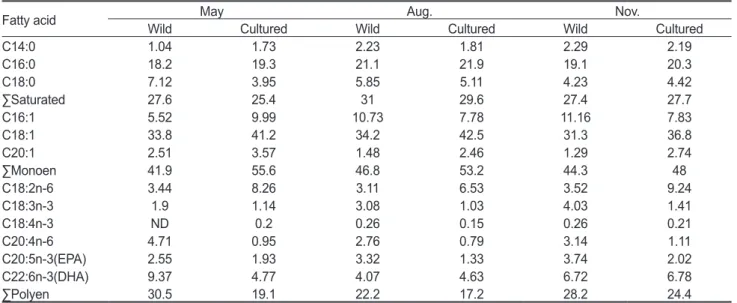
자연산과양식산동자개근육에서추출한지방의지방산조성 은
Table 3
과같다.
포화지방산에서의조성은대부분palmitic
acid (C16:0)
가 주요 성분이었으며단일불포화지방산에서는oleic acid (C18:2n6)
가주였다.
고도불포화지방산에서는lin- oleic acid (C18:2n6), docosahexaenoic acid (C22:6n3)
그리 고eicosapentaenoic acid (C20:5n3)
의조성비가자연산과양 식산차이는있었으나가장높았다.
이는우리나라연근해민어 를포함한14
종어류의주요지방산으로포화지방산은C14:0, C16:0, C18:0,
단일불포화지방산은C18:1,
고도불포화지방 산은DHA, EPA
등이라는연구결과와유사하였다(Lee et al.,
2011).
또한자연산과양식산동자개모두단일불포화지방산이41.9-53.2
로높았으며고도불포화지방산은17.2-30.5%
로낮은 수준이었다.
본 연구의 결과를 뱀장어 주요 구성지방산 함량과비교했 을 때
, palmitic acid (C16:0, 20.73%), oleic acid (C18:1n9, 35.61%), linoleic acid (C18:2n6, 3.40%), DHA (C22:6n3, 6.94%), EPA (C20:5n3, 2.45%)
로전체적으로유사한결과를 나타내고있다(Moon et al., 2012).
자연산과양식산동자개의지방산조성비를비교하여보면
,
봄철C18:0
조성비가자연산과양식산이각각7.12, 3.95%
으로 양식산이낮았으며, C16:1, C18:1
조성비가자연산이5.52%, 33.8%
이었으나 양식산은9.99%, 41.2%
로양식산이높았다. C18:2
조성비는자연산이비하여양식산이C18:3
조성비는자 연산이, C20:4
조성비는자연산이, EPA
조성비는자연산이다 소높았다.
따라서자연산과양식산에따른지방산조성의차이는동자 개의단일불포화지방산이자연산보다양식산에서높은함량을 나타내었으며그중
oleic acid
가뚜렷한차이를보였다.
반면EPA
를포함한고도불포화지방산은자연산이양식산보다 지 방산조성비가높은경향을나타내었다.
총아미노산 함량 비교
자연산과양식산동자개의총아미노산함량은
leucine, lycine, aspartic acid, glutamic acid
의함량이많았으며,
그중glutamic acid
의함량이가장높았다(Table 4).
자연산과양식산동자개 의총아미노산함량은각각14.9-15.4 g/100 g, 14.7-14.9 g/100
g
이었으며,
시기와상관없이자연산이양식산에비하여다소Table 2. The contents of proximate composition content (g/100 g) in muscle of wild and cultured Korean bullhead Pseudobagrus fulvidraco
Season Moisture Crude lipid Crude protein Ash
Wild Cultured Wild Cultured Wild Cultured Wild Cultured
May 79±0.421,a 81.6±0.12a 5.75±0.32a 1.57±0.21b 17.2±0.41a 17.0±0.05a 1.02±0.07a 1.09±0.05ab Aug. 77.7±0.30a2 72±0.59c 4.32±0.09b 6.57±0.38a 18.3±0.53a 17.0±0.36a 1.18±0.05a 0.56±0.03b Nov. 77.9±0.37a 74.7±0.32b 3.68±0.11b 5.25±0.60a 17.7±0.16a 17.0±0.11a 1.17±0.21a 1.92±0.35a
1Mean±standard deviation. 2Different superscripts within a same column are significantly different by Duncan's multiple range at P<0.05.
높았다
.
자연산과양식산동자개의필수아미노산함량도각각6.33-6.52 g/100 g, 6.07-6.33 g/100 g
이었으며,
자연산이양식 산에비하여다소높았다.
각각의아미노산함량은자연산과양 식산,
그리고시기별로차이는미미하였다.
비필수아미노산과 필수아미노산함량비율은0.69-0.75
이며,
일반적으로0.7
이상 이면양질의단백질로구성된것으로판단할수있다(Iwasaki et al., 1985; Kang et al., 2010).
Kim et al. (2014)
의연구에서도무지개송어의총아미노산의 종류는모두17
종이였으며총함량은17.76 g/100 g
으로본연 구와비슷하였다. Glutamic acid
와aspartic acid
함량은각각2.40 g/100 g, 1.63 g/100 g
으로본연구결과보다는다소낮았으 나그외구성아미노산은비슷한함량을나타내었다. 미네랄 함량 비교
자연산및양식산동자개의시기에따른미네랄함량을나타 낸것이다
(Table 5).
가식부100 g
당미네랄함량을분석한결 과,
칼륨296.6-382.3 mg,
인179.3-241.3 mg,
나트륨34-87.1 mg,
마그네슘23.9-33.1 mg,
칼슘16.8-41.5 mg
순으로많았으 며,
아연0.40-0.86 mg,
구리불검출-0.07 mg,
망간불검출-0.03
mg
순이었다.
자연산과양식산그리고시기별로미네랄함량의변화를살펴보면
,
자연산동자개의칼슘함량은13.9-22.5 mg/100 g
이었으며,
양식산은16.9-41.5 mg/100 g
이었다.
시기 별로는봄철에칼슘함량이가장높았으며,
가을철에가장낮 은함량이었다.
자연산동자개의인함량은
177.4-211 mg/100 g
이었으며,
양 식산은181.6-241.3 mg/100 g
이었으며,
자연산은칼슘함량과 마찬가지로봄철이다른시기에비하여다소높았으며,
양식산 은가을철이다른시기보다함량이다소높았다.
나트륨함량은자연산과양식산이각각
49.4-57.4 mg/100 g, 34-87.1 mg/100 g
이었다.
자연산동자개의칼륨함량은296.6- 357.2 mg/100 g,
양식산동자개의 칼륨함량은298.7-382.3 mg/100 g
이었다.
철함량은0.21-0.58 g/100 g
이었으며,
아연,
구리함량은각각0.40-0.62 g/100 g,
불검출-0.07 mg/100 g
이 었으며,
망간함량은불검출-0.03 mg/100 g
이었다.
자연산과양 식산간의함량차이는미미하였으며,
시기에따른함량차이는 뚜렷한경향은보이지않았다.
자연산동자개는마그네슘과아 연은여름철이다른시기에비하여높았으며,
이를제외하고는 봄철에가장높은함량이었다.
반면양식산동자개의미네랄함 량은시기별에따른뚜렷한차이를보이지않았다.
2010
년도 개정된한국인영양섭취기준에따르면19
세이상 남성의1
일미네랄권장섭취량은다량미네랄중칼슘700-750 mg,
인700 mg,
마그네슘340-350 mg,
나트륨1,100-1,500 mg (
충분섭취량),
칼륨3,500 mg (
충분섭취량)
으로설정하였으며 미량미네랄은철9-10 mg,
아연9-10 mg,
구리800 μg,
셀레늄55 μg,
요오드150 μg,
망간4 mg (
충분섭취량),
불소3-3.5 mg (
충분섭취량),
몰리브덴600 μg (
상한섭취량)
으로설정하였다.
그리고19
세이상성인여성의1
일미네랄권장섭취량은다량 미네랄중에칼슘650-700 mg,
인700 mg,
마그네슘280 mg,
나트륨1,100-1,500 mg (
충분섭취량),
칼륨3,500 mg (
충분섭 취량)
이며미량미네랄은철8-14 mg,
아연7-8 mg,
구리800 μg,
셀레늄55 μg,
요오드150 μg,
망간3.5 mg (
충분섭취량),
불소2.5-3 mg (
충분섭취량),
몰리브덴600 μg (
상한섭취량)
으 로설정하였다(MHW, 2016).
내수면수산물의
1
회섭취시미네랄섭취량을19
세이상성 인남성의영양섭취기준(
높은값기준)
에따라칼슘,
인,
마그네 슘,
철,
아연,
구리권장섭취량(Recommended Nutrient Intake:
Table 3. The comparison of fatty acid (%) of the muscle of wild and cultured Korean bullhead Pseudobagrus fulvidraco
Fatty acid May Aug. Nov.
Wild Cultured Wild Cultured Wild Cultured
C14:0 1.04 1.73 2.23 1.81 2.29 2.19
C16:0 18.2 19.3 21.1 21.9 19.1 20.3
C18:0 7.12 3.95 5.85 5.11 4.23 4.42
∑Saturated 27.6 25.4 31 29.6 27.4 27.7
C16:1 5.52 9.99 10.73 7.78 11.16 7.83
C18:1 33.8 41.2 34.2 42.5 31.3 36.8
C20:1 2.51 3.57 1.48 2.46 1.29 2.74
∑Monoen 41.9 55.6 46.8 53.2 44.3 48
C18:2n-6 3.44 8.26 3.11 6.53 3.52 9.24
C18:3n-3 1.9 1.14 3.08 1.03 4.03 1.41
C18:4n-3 ND 0.2 0.26 0.15 0.26 0.21
C20:4n-6 4.71 0.95 2.76 0.79 3.14 1.11
C20:5n-3(EPA) 2.55 1.93 3.32 1.33 3.74 2.02
C22:6n-3(DHA) 9.37 4.77 4.07 4.63 6.72 6.78
∑Polyen 30.5 19.1 22.2 17.2 28.2 24.4
ND, not detected; EPA, eicosapentaenoic acid; DHA, docosa hexaenoic acid.
RNI)
과나트륨,
칼륨,
망간은충분섭취량(Adequate Intake: AI)
과비교하여백분율을계산하여영양섭취비율을살펴보면,
칼 슘6.39%,
인59.2%,
마그네슘17.9%,
철7.92%,
아연11.7%,
구리9.64%,
나트륨7.30%,
칼륨19.1%,
망간1.02%
이었다.
따라서자연산과양식산동자개의영양성분은시기별에지방 함량이가장큰차이를보였으며
,
양식산동자개는봄철에지방함량이매우작았다가이후증가하였으며
,
자연산동자개는봄 철에가장높았다가이후감소하였다.
동자개의산란시기는5
월중순에서6
월까지이며(Kang et al., 2007),
각개체별로산란 여부와매우큰영향이있는것으로사료된다.
반면기타영양 성분은자연산과양식산,
그리고시기별로큰차이가없었으며,
양질의단백질로구성되어있다.
이러한연구결과는동자개의 Table 4. Seasonal variations in total amino acid (g/100 g) of the muscle of wild and cultured Korean bullhead Pseudobagrus fulvidracoAmino acids May Aug. Nov.
Wild Cultured Wild Cultured Wild Cultured
Histidine 0.49 0.42 0.34 0.32 0.41 0.48
Isoleucine 0.72 0.50 0.72 0.65 0.78 0.71
Leucine 1.29 1.28 1.30 1.33 1.34 1.3
Lysine 1.31 1.41 1.43 1.44 1.44 1.39
Methionine 0.48 0.53 0.45 0.37 0.45 0.51
Phenylalanine 0.72 0.61 0.63 0.64 0.58 0.55
Threonine 0.72 0.73 0.78 0.76 0.77 0.78
Valine 0.77 0.58 0.68 0.71 0.75 0.55
Essential amino acids 6.47 6.07 6.33 6.23 6.52 6.27
Aspartic Acid 1.59 1.63 1.55 1.59 1.61 1.41
Serine 0.67 0.74 0.68 0.72 0.68 0.70
Glutamic acid 2.40 2.55 2.45 2.49 2.50 2.4
Proline 0.62 0.55 0.60 0.52 0.60 0.58
Glycine 0.05 0.05 0.03 0.06 0.05 0.06
Alanine 1.04 1.00 0.98 0.92 0.98 1.00
Cystine 1.03 0.79 0.78 0.73 0.76 0.78
Tyrosine 0.54 0.54 0.52 0.57 0.54 0.51
Arginine 1.03 0.99 1.00 0.99 1.00 0.98
Nonessential amino acids 8.96 8.85 8.59 8.59 8.72 8.42
Total AA 15.4 14.9 14.9 14.8 15.2 14.7
TEAA/TENN 0.72 0.69 0.74 0.73 0.75 0.74
Table 5. Seasonal variations in mineral content (mg/100 g) of the muscle of wild and cultured Korean bullhead Pseudobagrus fulvidraco
Mineral May Aug. Nov.
Wild Cultured Wild Cultured Wild Cultured
Ca 22.5±3.39 41.5±26.01 18.8±2.96 18.4±6.48 13.9±5.28 16.9±3.23
P 211±18.4 181.6±20.3 207.7±3.41 179.3±7.03 177.4±0.90 241.3±23.6
Mg 28.9±0.48 23.9±4.02 32.6±0.36 33.1±0.18 21.4±0.19 31.2±7.86
Na 57.4±5.75 34±1.10 46.1±3.60 45.1±2.84 49.4±3.52 87.1±32.4
K 357.2±26.1 308.9±2.29 296.6±5.70 298.7±13.5 315.2±4.84 382.3±87.4
Fe 0.47±0.01 0.30±0.08 0.21±0.00 0.58±0.05 0.36±0.03 0.39±0.33
Zn 0.62±0.01 0.50±0.07 0.86±0.02 0.40±0.02 0.51±0.01 0.50±0.09
Cu 0.06±0.03 0.06±0.01 0.00±0.00 0.00±0.00 0.03±0.00 0.07±0.04
Mn 0.03±0.00 0.03±0.01 0.00±0.00 0.02±0.00 0.01±0.00 0.02±0.01
소비촉진을위한기초자료뿐만아니라가공원료로서의활용가 치를검토하기위한자료로도사용이가능할것으로판단된다
.
사 사
이 논문은
2016
년 국립수산과학원 수산과학연구사업(R2016060)
의지원으로수행된연구이며,
연구비지원에감사 드립니다.
References
Ackman RG and Takeuchi T. 1986. Comparison of fatty acid and lipids of smolting hatchery-fed and wild Atlantic salm- on (Salmo salar). Lipids 21, 117-120.
Alasalvar C, Taylor KDA, Zubcov E, Shahidi F and Alexis M.
2002. Differentiation of cultured and wild sea bass (Dicen
trarchus labrax). Total lipid content, fatty acid and trace
mineral composition. Food Chem 79, 145-150.AOAC. 1995. Official method of analysis of AOAC interna- tional. 16th. Association of Official Analytical Chemistry, Washington DC. U.S.A., 69-74.
Bligh, EG and Dyer WJ. 1959. A rapid method for total lipid extraction and purification. Can J Biochem Physiol 37, 911- Choi JH, Ro JI and Pyeun JH. 1984. Studies on lipids in fresh-917.
water fishes 3. Distribution of lipid components in various tissues of eel, Anguilla japonica. Bull Korean Fish Soc 17, 477-484.
Fallah AA, Saei-Dehkordi SS and Nematollahi A. 2011. Com- parative assessment of proximate composition, physico- chemical parameters, fatty acid profile and mineral con- tent in farmed and wild rainbow trout (Oncorhynchus
mykiss). IFST 46, 767-773. http://dx.doi.org/10.1111/j.1365-
2621.2011.02554.x.Gye HJ, Shim KB, Lim CW, Song MY, Kim DH, Kim BK and Cho YJ. 2015. Nutritional assessment and mineral content of wild and cultured catfish Silurus asotus. J Fish Marine Sci Edu 27, 1364-1368. http://dx.doi.org/10.13000/
JFMSE.2015.27.5.1364.
Iwasaki M and Harada R 1985. Proximate and amino acid com- position of the roe and muscle of selected marine species. J Food Sci 50, 1585-1587.
Kang EJ, Yang H, Lee HH, Cho EO, Lim SG and Bang IC.
2007. Ecology and early life history of endangered fresh- water fish, Pseudobagrus brevicorpus (Pisces: Bagridae).
Korean J Environ Biol 25, 378-384.
Kang HW, Shim KB, Cho YJ, Kang DY, Cho KC. Kim JH and Park GJ. 2010. Biochemical composition of the wild and cultured yellow croaker (Larimichthys polyactis) in Korea.
Kor J Fish Aquat Sci 43, 18-24.
Kim KH, Kang SI, Jeon YJ, Choi BD, Kim MW, Kim DS and Kim JS. 2014. Food quality rainbow trout Oncorhynchus
mykiss domesticated in seawater. Korean J Fish Aquat Sci
47, 114-121. http://dx.doi.org/10.5657/KFAS.2014.0114.Kim KS and Lee EH. 1986. Food components of wild and cul- tured fresh water fishes. Korean J Fish Aquat Sci 19, 195- 211.
Kim TY. 2008. A study on the reinforcement of the competi- tive power of Korean inland fisheries. J Fish Bus Admin 39, 111-137.
Lee DS, Yoon HD, Kim YK, Yoon NY, Moon SK, Kim IS and Jeong BY. 2011. Proximate and fatty acid compositions of 14 species of coastal and offshore fishes in Korea. Korean J Fish Aquat Sci 44, 569-576. http://dx.doi.org/10.5657/
KFAS.2011.0569.
Lee HC and Yoo CG. 2011. A study on the preference and con- sumer behavior for inland water fishes. Korean Food Market Assoc 28, 1-18.
Lee HC. 2009. Estimating volumes and expenditures of inland water fish consumption. J Fish Bus Admin 40, 75-96.
MFDS (Ministry of Food and Drug Safety). 2015. Food Code.
Korea.
Ministry of Health and Welfare (MHW). 2016. Dietary refer- ence intakes for Korean 2015. Ministry of Health and Wel- fare, Sejong, Korea.
Moon SK, Lee DS, Yoon HD, Kim YK, Yoon NY, Kim IS and Jeong, BY. 2012. Proximate and fatty acid composi- tions of three species of imported and domestic freshwater fishes. Korean J Fish Aquat Sci 45, 612-618. http://dx.doi.
org/10.5657/KFAS.2012.0612.
National Fisheries Research and Development Institute (NFR- DI). 2009. Chemical composition of marine products in Ko- rea 2009. NFRDI. Busan. Korea. 38pp.
Park SY and Kim HR. 1996. Changes of food components and lipid peroxides in rainbow trout with growth. J Korean Soc Food Sci Nutr 25, 928-931.
Steel RGD and Torrie JH. 1980. Principle and procedure of statistics; a biometrical approach (2nd ed.). MacGraw-Hill Book Company, New York, U.S.A.
White JA, Hart RJ and Fry JC. 1986. An evaluation of the Wa- ters Pico-Tag system for the amino-acid analysis of food materials. J Autom Chem 8, 170-177.
Yang ST and Lee EH. 1983. Taste compounds of fresh-water fishes-6. Taste compounds of Korean catfish meat. Korean J Fish Aquat Sci 16, 202-210.