Improvement of Boar Semen Quality by Sperm Selection Using Magnetic Nano- particles
KI-Hwa Chung1 and Jung-Ho Son2*
1Dept. of Animal Resources and Technology, Gyeongnam National University of Science and Technology, Jinju 52725, Korea
2Noah Biotech Inc., Cheonan 31035, Korea
Received August 12, 2016 /Revised August 29, 2016 /Accepted August 29, 2016
The objective of this study was to see if fairly simple magnetic nano-particle treatment enhances boar semen qualities. Boar semen samples were prepared from the swine AI center and samples were div- ided by 4 different motility groups (1, >90%; 2. 80~90%; 3. 70~80%; 4. <70%) using computer assisted sperm analysis (CASA) evaluation. Boar semen was extended using BTS extender and same number of magnetic nano-particles as total number of spermatozoa in each sample was treated for 20 min and collected for 5 min at room temperature. Sperm qualities such as motility and viability were evaluated by the CASA before and after treatment. Sperm abnormality and degree of agglutination were also evaluated under the microscopic examination before and after treatment. There were significant changes (p<0.05) on sperm motility from all 4 different groups in the average of 7.11% after treatment.
The enhancement of sperm motility changes was more clear in the groups of lower sperm motile groups (<70% and 70~80%; 19.12±1.08% and 5.67±0.71%, p<0.05). The sperm motility character in terms of curvilinear velocity (VCL), straight line velocity (VSL), average path velocity (VAP) and line- arity (LIN, %) showed also similar pattern but motility enhancement wear more clear in below 70%
motile group. Average sperm viability was increased to 4% by magnetic nano-particles (p<0.05). The percentage of sperm abnormality was also reduced significantly (p<0.05) to the range of 3.7~4.5% be- fore after treatment. The degree of sperm agglutination was also reduced in lower motility groups by the magnetic nano-particle purification.
Key words : Artificial insemination, boar semen, magnetic nano-particles, motility, viability
*Corresponding author
*Tel : +82-41-622-6284, Fax : +82-41-622-6285
*E-mail : [email protected]
This is an Open-Access article distributed under the terms of the Creative Commons Attribution Non-Commercial License (http://creativecommons.org/licenses/by-nc/3.0) which permits unrestricted non-commercial use, distribution, and reproduction in any medium, provided the original work is properly cited.
Journal of Life Science 2016 Vol. 26. No. 8. 943~947 DOI : http://dx.doi.org/10.5352/JLS.2016.26.8.943
Introduction
Assisted reproductive techniques have become the treat- ment of choice in many cases of infertility [; however the current success rates of these procedures in animal especially in pig remain suboptimal due to higher number of spermato- zoa and volume. The ideal protocol for enrichment/selection of sperm cells with high fertilizing ability should be: a) non-toxic for spermatozoa, b) easy to perform and inex- pensive, c) able to support high-throughput sample process- ing, d) capable of selecting the best sperm subpopulation for ART s, leaving behind, seminal plasma, extender (in case of frozen semen) and bioactive substances and cells (leukocytes) that could damage sperm cells [23]. Despite the efforts invested in developing an ideal sperm selection tech-
nique (i.e swim-up; density gradient; electrophoresis, fluo- rescence cell sorting; glass wool filtration) by laboratories around the word, to date no single sperm selection protocol meets all desirable characteristics mentioned above [1] espe- cially, this is true in boar semen.
Magnetic cell separation offers advantages of simplicity of operation, low cost and specificity and sensitivity afforded by use of immunospecific reagents. Typically, this technique employs the use of magnetic particles conjugated to proteins or antibodies to tag cells of interest. To label and to separate cells, many types of magnetic micro beads and nano beads have been developed. The addition of iron oxide compounds (ferromagnetic magnetite γ-Fe2O3 and magnetite Fe3O4) to monodisperse polystyrene spheres or to a sugar based skel- eton is a typical technique of bead production [17].
The consistent production of high quality spermatozoa is crucial for male fertility. Numerous factors associated with the male itself (i.e., age, health, genetic line, nutrition status [5, 12, 13] and the environment (i.e., seasonal changes of tem- peratures, cryopreservation [2, 5, 21] are known to affect se- men quality. Most importantly, the semen itself contains a heterogeneous population of spermatozoa with attributes
that have significant impacts on male fertility potential [3, 20]. For example, semen collected from high fertile males usually result in significant low proportions of abnormal spermatozoa and high proportions of motile spermatozoa, with better viability (i.e., intact acrosome, plasma and mi- tochondrial membranes, low DNA fragmentation index,) than those collected from low fertile males [9, 14].
In many agricultural and clinical laboratories, routine practices of semen quality analyses for artificial insemination purpose are often limited to the evaluation of sperm concen- tration and proportion of motile spermatozoa due to the rap- idity of the tests, but these parameters are still relatively poor predictors of semen fertility [5, 9]. The aforementioned viability factors have tremendous impact on the fertility of spermatozoa during their progression within the female gen- ital tract and their interactions with eggs at the site of fertil- ization [6, 11, 14], but their evaluation can be laborious and results are often available after the preparation of in- semination doses. Although current available tests can be effective at quantifying the proportions of viable spermato- zoa within semen ejaculates or doses for artificial in- semination [8], the removal of damaged spermatozoa would be of great add-on. This procedure may contribute to the elimination of the needless competition between viable and non-viable spermatozoa, leading to higher number of viable spermatozoa reaching the fertilization site for improved fertility. Recently, many progresses on nanotechnology con- tribute the excellent opportunity for a damaged or defective sperm selection. These nano-particles have unique proper- ties (optical, high photo-stability, and magnetic) and their possible attachment to various biomolecules offers a great potential for non-invasive and ultra-sensitive targeting and/or imaging of molecules in living cells and organisms [7, 16].
Numerous studies have reported the potential applica- tions of nano-particles in agricultural and biomedical re- search [7, 16]. In livestock, boar spermatozoa have been shown to harmlessly incorporate self-illuminating quantum dot nano-particles without impairment to their motility and fertilizing potentials [4]. In addition, the use of magnetic iron oxide nanoparticles to target and remove moribund and ab- normal spermatozoa from AI doses has led to improved fer- tility of bulls [18]. In order to see the effect of magnetic iron oxide nano-particles coated with silica on sperm selection, we applied these nano-particles on freshly ejaculated boar semen.
Material and Methods
Semen collection and processing
Semen samples from Duroc boars raised in local AI cen- ters were collected. Before each semen collection, boars are thoroughly cleaned and only sperm rich fractions were col- lected by gloved-hand technique. Beltsville Thawing Solution (BTS) extender was used to dilute the semen and semen samples were transferred to the laboratory immediately us- ing 17℃ semen storage container.
Magnetic nano-bead treatment
Iron oxide (Fe2O3) nano-particles were coated with silica (Noah Biotech Inc., S. Korea) to selectively bind to the outer membrane of dead and moribund spermatozoa. Prepared magnetic nano-particles were obtained in stock of 15.9 mg/ml of PBS buffer and stored at 4oC until use for sperm labeling. Semen samples were mixed with magnetic nano- particles for 20 min and collected for 5 min using 12,000 gauss neodymium magnet at room temperature. Free and sperm-bound magnetic nano-particles were pulled down to the wall and nano-particle-free spermatozoa were collected into 50-mL Falcon centrifuge tubes. Numbers of magnetic beads used for the purification of sperm are the same as total number of spermatozoa in each sample.
Analysis of sperm motility
The sperm movement characteristics were measured us- ing CASA system determined as Zeng et al., [23]. In brief, 1.5 ml semen sample was incubated for 30 min at 37℃ water bath and 10 μl of semen were applied to pre-warmed Makler counting chamber (Sefi-Medical, Israel). Semen samples were analyzed by SAIS II system (Medical Supply Co. Ltd., S. Korea) connected with CCD camera (Veltek, S. Korea) on microscope (Olympus, Japan) connected with a warm plate (37℃).
Analysis of sperm viability and abnormality For sperm viability and abnormality test, fast green FCF (2% v/v) and Eosin B (0.8%, v/v) were solved in PBS and filtered before staining the sperm. Ten micro liters of sperm were applied to the slide and equal volume of dye were added, smeared with cover glass, and dried quickly to avoid live sperm stain as dead. If sperm head stains with dye, it determines as dead. Total of 100 sperm from 25 each of 4 different compartments were counted for both viability and
Table 1. Change of boar sperm motility after treatment of mag- netic nano-particle
Treatment (%)
Sperm motility (%)
Before (%) After (%) Δ (%)
> 90 80~90 70~80
< 70
91.3 ± 1.1Ba 84.7 ± 0.7Bb 76.8 ± 1.0Bc 63.0 ± 0.9Bd
92.8 ± 1.1Aa 88.6 ± 0.5Ab 81.2 ± 0.8Ac 75.0 ± 0.8Ad
1.67 4.63 5.67 19.12 Total/Mean 79.1 ± 1.3B 84.7 ± 1.0A 7.11
a,bWith the same columns, values with different superscripts dif- fer significantly (p<0.05).
A,BWith the same row, values with different superscripts differ significantly (p<0.05).
Data are expressed as Mean ± SEM.
Table 2. Effects of magnetic nano-particle purification on boar sperm motility parameters*
Treatment (%)
VCL (%) VSL (%) VAP (%) LIN (%)
Before After Before After Before After Before After
> 90 80~90 70~80
< 70
31.5±1.1a 27.2±0.7b 24.1±1.1bc
21.5±1.0c
30.7±1.1a 26.4±0.5b 24.9±0.8b 22.1±0.8c
13.0±1.2 12.3±0.8 10.7±1.1 11.9±1.0
13.1±1.2a 11.9±0.6ab 10.7±0.8b 10.3±0.9b
24.9±0.8a 21.8±0.5b 19.2±0.7c 16.6±0.6d
24.6±0.8a 21.3±0.4b 19.7±0.5c 17.1±0.6d
45.8±1.8 46.5±1.1 48.8±1.6 46.1±1.5
47.3±1.8 46.6±0.8 47.0±1.3 49.1±1.3
Total/Mean 25.9±0.6 25.5±0.5 12.0±0.5 11.4±0.4 20.6±0.5 20.5±0.4 46.7±0.7 47.3±0.6
*Curvilinear velocity (VCL), straight line velocity (VSL), average path velocity (VAP) and linearity (LIN).
a,b With the same columns, values with different superscripts differ significantly (p<0.05).
Data are expressed as Mean ± SEM.
abnormality test.
Analysis of sperm agglutination
Under microscopic examination, sperm should be freely swimming and not sticking to one another. Agglutination of sperm occurs when the head or tail of one sperm sticks to another sperm restricting the motility of the sperm. The score of agglutination is graded 1-3 as outlined as below.
Grade 1: Isolated with < 10 sperm per agglutinate Grade 2: Moderate with 10-50 sperm per agglutinate Grade 3: > 50 sperm per agglutinate
Statistical analysis
Data were analyzed using the Generalized Linear Model procedure (PROC-GLM) of the Statistical Analysis System (SAS Institute, Cary, NC, USA, 2000). For statistical analyses, however, percentage values were subjected to arcsine trans- formation before applying Students t-tests to means and standard deviations for each data point. Differences among treatment means were determined by using the Duncan's multiple range tests.
A probability of p<0.05 was considered statistically significant.
Results and Discussion
Effect on sperm motility
Data were analyzed (at least n =4) and summarized. There were significant changes (p<0.05) on sperm motility from all 4 different groups in the average of 7.11% after treatment (Table 1). The enhancement of sperm motility changes was more clear from the groups of lower sperm motile groups (< 70% and 70~80%; 19.12±1.08% and 5.67±0.71%, p<0.05, Table 1). After magnetic nano-particles treatment, it is clear that the proportion of motile spermatozoa moving straight- forward (VCL, progressive) and fast (VSL, rapid) were showed increasing tendency (Table 2, p<0.05). It suggested that the nano-purification procedure using the designed magnetic nano-particles resulted in the selection of sperma- tozoa with higher motility (p<0.05).
The motility character in terms of VCL, VSL, VAP and LIN showed (Table 2) improved more in below 70% motile group indicating moribund sperm were removed by mag- netic nano-particles and it contributed to sperm motility.
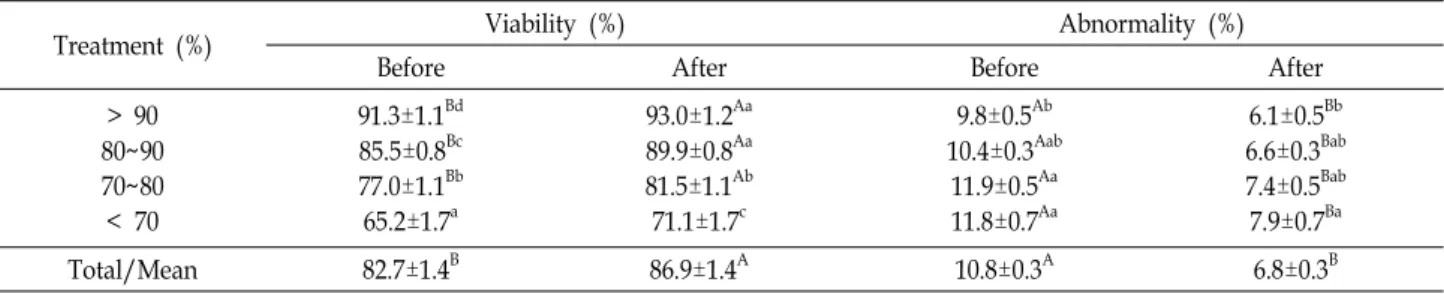
However, no significant effects of the nano-purification were found on other motility parameters such as the Average Path velocities (VAP) and Linearity (LIN). Average sperm via- bility was increased to 4% by magnetic nano-particles (Table 3, p<0.05) indicating dead spermatozoa also removed by magnetic nano-particles. The percentage of sperm abnormal- ity was also reduced significantly (Table 3, p<0.05) to the range of 3.7~4.5% before after treatment. The degree of sperm agglutination was also reduced in lower motility groups by the magnetic nano-particle purification (Table 4) and it is clear that lower motile group with higher agglutina- tion semen needed more number of treatment for the re-
Table 3. Change of boar sperm viability and abnormality after treatment of magnetic nano-particle
Treatment (%) Viability (%) Abnormality (%)
Before After Before After
> 90 80~90 70~80
< 70
91.3±1.1Bd 85.5±0.8Bc 77.0±1.1Bb 65.2±1.7a
93.0±1.2Aa 89.9±0.8Aa 81.5±1.1Ab 71.1±1.7c
9.8±0.5Ab 10.4±0.3Aab
11.9±0.5Aa 11.8±0.7Aa
6.1±0.5Bb 6.6±0.3Bab 7.4±0.5Bab 7.9±0.7Ba
Total/Mean 82.7±1.4B 86.9±1.4A 10.8±0.3A 6.8±0.3B
*a,bWith the same columns, values with different superscripts differ significantly (p<0.05).
A,BWith the same row, values with different superscripts differ significantly (p<0.05).
Data are expressed as Mean ± SEM.
Table 4. Effects of magnetic nano-particle purification on sperm agglutination
No. of magnetic nano- particle treatment*
Agglutination grade
> 90 80~90 70~80 < 70 0
1 2 3
1 1 1 1
2 2 1 1
3 3 2 1
3 3 2 1
*Grade 1: Isolated with < 10 sperm per agglutinate Grade 2: Moderate with 10-50 sperm per agglutinate Grade 3: > 50 sperm per agglutinate
moval of aggregated spermatozoa (Table 4). Because the cur- rently used magnetic nano-particles were designed (Silica- coated) to interact outer membrane of damaged and/or dead spermatozoa, the current findings suggest that such de- fective spermatozoa were present in the semen doses and their removal allowed the enrichment of semen doses with high motile (motile and progressive) and viable spermatozoa.
These observations are in agreement with the findings using fresh and frozen-thawed bovine semen [18]. The application of magnetic-activated cell sorting (MACS) allows for sperm selection based on sperm apoptosis in addition to routine parameters such as motility and morphology. Data gen- erated from previous studies serve as a basis for projects that evaluate magnetic cell sorting safety and efficiency in clinical settings for patients undergoing IVF in various spe- cies [10, 15]. This novel strategy appears as a viable and non-invasive tool for the enrichment of semen doses with high quality spermatozoa to enhance fertility performance.
With this improved motility characteristics and together with the potential viability of spermatozoa as previously de- scribed in bovine [18], it becomes reasonable to expect ex- tended effects on the sow fertility potential of nano-purified spermatozoa in pigs.
Results obtained from this study suggested that sperm selection (purification) by magnetic beads would be a benefi- cial for swine reproductive performance and considered to be an inexpensive method to improve boar sperm quality for AI studs as well as self on-farm collection. Magnetic beads sperm selection procedure takes only 30 min, so it can be done while extending the law semen.
Altogether, this data suggested the possibility of use of magnetic nano-particles for removing the dead, moribund and aggregated boar sperm in fairy short time period.
Further investigations are needed for the sow fertility in- seminated with magnetic nano-particle purified sperm to confirm and expand the present findings.
Acknowledgement
This work was supported by Gyeongnam National University of Science and Technology Grant 2014.
References
1. Barroso, G., Valdespin, C., Vega, E., Kershenovich, R., Avila, R., Avendano, C. and Oehninger, S. 2009. Developmental sperm contributions: fertilization and beyond. Fertil. Steril.
92, 835-848.
2. Claus, R. and Weiler, U.1985. Influence of light and photo- periodicity on pig prolificacy. J. Reprod. Fertil. Suppl. 33, 185-197.
3. Druart, X., Gatti, J. L., Huet. S., Dacheux, J. L. and Humblot, P. 2009. Hypotonic resistance of boar spermatozoa: sperm subpopulations and relationship with epididymal matura- tion and fertility. Reproduction 137, 205-213.
4. Feugang, J. M., Youngblood, R. C., Greene, J. M., Fahad, A. S.. and Monroe, W. A. 2012. Application of quantum dot nanoparticles for potential non-invasive bio-imaging of mammalian spermatozoa. J. Nanobiotechnology 10, 45.
5. Flowers, W. L. 1997. Management of boars for efficient se- men production. J. Reprod. Fertil. Suppl. 52, 67-78.
초록:마그네틱 나노비드를 이용한 돼지 정자 품질의 향상
정기화1․손종호2*
(1경남과학기술대학교 동물소재공학과, 2노아바이오텍)
본 연구는 간단히 활용할 수 있는 나노 크기의 마그네틱 비드를 이용하여 정자의 품질을 향상시킬 수 있는지 여부를 규명하기 위하여 실시하였다. 돼지 정자 시료는 인공수정 센터에서 공급받아 실험실로 2시간 이내로 이송 한 후 CASA 측정을 통하여 4개의 활력을 나타내는 그룹으로(1, > 90%; 2. 80~90%; 3. 70~80%; 4. < 70%) 분류하였 다. 정액은 BTS 희석제를 사용하여 보존하였고, 총 정자수와 동일한 농도의 마그네틱 비드를 정액에 20분간 처리 한 후, 5분간 실온에서 마그네틱 비드에 반응한 정자를 자석을 이용하여 분리하였다. 마그네틱 비드 처리 전 과 후 정자의 생존율 및 활력은 CASA를 이용하여 측정하였고, 기형율과 정자응집의 정도는 현미경으로 검사하였다.
처리 후의 정자 활력은 4개 그룹 모두에서 유의하게(p<0.0.5) 높은 차이를 보였으며 처리 전에 비하여 평균 7.11%
향상되었다. 정자 활력의 변화는 처리 전 낮은 활력을 보인 그룹에서 보다 현저한 차이를 보였다(< 70% and 70~80%; 19.12±1.08% and 5.67±0.71%, p<0.0.5). 정자 활력을 VCL, VSL, VAP 및 LIN (%)로 구분한 성적에서도 유사한 패턴을 나타냈고, 이러한 현상은 활력 70% 이하를 나타낸 그룹에서 개선 효과가 더욱 뚜렷하였다. 마그네 틱 비드 처리 후 정자 생존율은 처리 전에 비하여 평균 4%가 향상 되었고(p<0.0.5), 정자 기형율 또한 3.7~4.5%
(p<0.0.5) 정도 감소하였다. 정자 응집의 정도 또한 마그네틱 비드 처리를 통하여 처리 전 낮은 활력을 나타낸 그룹 에서 감소됨을 알 수 있었다.
6. Gadea, J. 2005. Sperm factors related to in vitro and in vivo porcine fertility. Theriogenology 63, 431-444.
7. Gao, X., Cui, Y., Levenson, R. M., Chung, L. W. K. and Nie, S. 2004. In vivo cancer targeting and imaging with semi- conductor quantum dots. Nat. Biotechnol. 22, 969-976.
8. Graham, J. K. 2001. Assessment of sperm quality: a flow cytometric approach. Anim. Reprod. Sci. 68, 239-247.
9. Guzick, D. S., Overstreet, J. W., Factor-Litvak, P., Brazil, C.
K. and Nakajima, S. T. 2001. Sperm Morphology, Motility, and Concentration in Fertile and Infertile Men. N. Engl. J.
Med. 345, 1388-1393.
10. Herrero, M. B., Delbes, G., Troueng, E., Holzer, H. and Chan, P. T. K. 2012. 28th Annual Meeting of the European Society on Human Reproduction and Embryology (ESHRE) Differential enrichment of sperm with no DNA strand breaks using magnetic activated cell sorting (MACS) in men with various categories of semen parameters. Hum. Reprod.
27, 21-150.
11. Katz, P., Nachtigall, R. and Showstack, J. 2002. The econom- ic impact of the assisted reproductive technologies. Nat. Cell Biol. 4, 29-32.
12. Kidd, S. A., Eskenazi, B. and Wyrobek, A. J. 2001. Effects of male age on semen quality and fertility: a review of the literature. Fertil. Steril. 75, 237-248.
13. Larsson, K. and Einarsson, S. 1976. Influence of boars on the relationship between fertility and post thawing sperm quality of deep frozen boar spermatozoa. Acta Vet. Scand.
17, 74-82.
14. Lee, W. Y., Lee, R., Kim, H. C., Lee, K. H. and Cui, X. S.
2014. Pig spermatozoa defect in acrosome formation caused
poor motion parameters and fertilization failure through artificial insemination and in vitro fertilization.
Asian-Australas J. Anim. Sci. 27, 1417-1425.
15. Losada, C., Ortega, I., Pacheco, A. and Bronet, F. 2012. 28th Annual meeting of the European Society on Human Reproduction and Embryology (ESHRE) Can MACS as a sperm preparation technique improve clinic results in pa- tients with Kartagener syndrome? Hum. Reprod. 27, 162-205.
16. Lu, Y., He, B., Shen, J., Li, J. and Yang, W. 2014. Multifunc- tional magnetic and fluorescent core-shell nanoparticles for bioimaging. Nanoscale 7, 1606-1609.
17. McCloskey, K. E., Chalmers, J. J. and Zborowski, M.
2003.Magnetic cell separation: characterization of magneto- phoretic mobility. Anal. Chem. 75, 6868-6874.
18. Odhiambo, J. F., DeJarnette, J. M., Geary, T. W., Kennedy, C. E. and Suarez, S. S. 2014. Increased conception rates in beef cattle inseminated with nanopurified bull semen. Biol.
Reprod. 91, 97.
19. Robinson, J. A. and Buhr. M. M 2005. Impact of genetic se- lection on management of boar replacement. Theriogenology 63, 668-678.
20. Rodriguez-Martinez, H. 2006. Can we increase the estimated value of semen assessment? Reprod. Domest. Anim. 2, 2-10.
21. Watson, P. F. 2000. The causes of reduced fertility with cry- opreserved semen. Anim. Reprod. Sci. 60-61, 481-492.
22. Wright, V. C., Chang, J., Jeng, G. and Macaluso, M. 2008.
Assisted reproductive technology Surveillance. 57, 1-23.
23. Zeng,, W. X. and Terada, T. 2001. Protection of boar sperma- tozoa from cold shock damage by 2-hydroxypropyl-beta- cyclodextrin. Theriogenology 55, 615-627.