• 검색 결과가 없습니다.

α-Lipoic acid inhibits matrix metalloproteinase-9 expression by inhibiting NF-κB transcriptional activity

N/A
N/A
Protected

Academic year: 2021

Share "α-Lipoic acid inhibits matrix metalloproteinase-9 expression by inhibiting NF-κB transcriptional activity"

Copied!
8
0
0

로드 중.... (전체 텍스트 보기)

전체 글

(1)

Hye-Soon Kim

1

, Hye-Jin Kim

1

, Keun-Gyu Park

1

, Yoon-Nyun Kim

1

, Taeg-Kyu Kwon

2

, Joong-Yeol Park

3

,

Ki-Up Lee

3

, Jung-Guk Kim

4

and In-Kyu Lee

4,5

1

Department of Internal Medicine

2

Department of Immunology

Keimyung University School of Medicine Daegu 700-712, Korea

3

Department of Internal Medicine Ulsan University School of Medicine Seoul 138-736, Korea

4

Department of Internal Medicine

Kyungpook National University School of Medicine Daegu 700-721, Korea

5

Corresponding author: Tel, 82-53-420-5564;

Fax, 82-53-426-2046; E-mail, [email protected]

Accepted 4 January 2007

Abbreviations: ALA, α-lipoic acid; AP-1, activator protein-1; MMP-9, matrix metalloproteinase-9; VSMC, vascular smooth muscle cell

Abstract

The migration of vascular smooth muscle cells (VSMCs) into the intima, an important step in injury-induced neointimal hyperplasia, requires the activation of nuclear factor- κB (NF-κB) and the consequent up-regulation of matrix metallopro - teinase-9 (MMP-9). This study was undertaken to test for a possible effect of α-lipoic acid (ALA), a potent inhibitor of NF- κB, on MMP-9 expression. ALA inhibited high-glucose- and TNF- α-stimulated VSMC migrations in vitro. It also inhibited high-glucose- and TNF- α-induced increases in MMP-9 expression.

The activity of MMP-9-promoter constructs with mutations in the NF- κB binding site was not inhibited by ALA, indicating an involvement of the NF- κB signaling pathway in the ALA-specific inhibition of MMP-9. These data suggest the possibility that ALA may be useful for the prevention of neointimal hyper- plasia after angioplasty, by inhibiting the NF- κB/

MMP-9 pathway, especially with hyperglycemia.

Keywords: hyperplasia; matrix metalloproteinase-9;

muscle, smooth, vascular; NF- κB; thioctic acid; tun- ica intima; vascular smooth muscle cell

Introduction

The long-term success of percutaneous transluminal angioplasty has been limited by neointimal hyper- plasia resulting from vascular injury. After arterial injury, vascular smooth muscle cells (VSMCs) proli- ferate, migrate, and form a neointima that later accu- mulates extracellular matrix. VSMC migration, which depends on an alteration of the proteolytic balance within the arterial wall toward matrix breakdown, is partly mediated by matrix metalloproteinases (MMPs).

MMP-9 is indispensable for the degradation of type IV collagen, a major component of the basement membrane (Zucker et al., 1993; Cho and Reidy, 2002). Recent experimental data have shown that hyperglycemic diabetes can induce altered expres- sion of the genes encoding MMP-9 (Death et al., 2003) and plasma levels and zymographic activities of MMP-9 are increased in diabetics with peripheral arterial disease as compared with non-diabetics (Signorelli et al., 2005).

It has been hypothesized that an increase in oxidative stress plays a key role in the pathogenesis of atherosclerosis and vascular restenosis (Kunsch and Medford, 1999; Griendling and Fitzgerald, 2003), although whether antioxidant supplementation can prevent the development of these processes re- mains controversial (Waters et al., 2002; Salonen et al., 2003). Oxidative stress induces various cyto- kines, including tumor necrosis factor- (TNF- ) (Guha et al., 2000). The stimulation of vascular cells by TNF- initiates a signaling cascade leading to increases in nuclear factor- B (NF- B)-dependent expression of various genes (Bourcier et al., 1997;

Dhawan et al., 1997), which play pivotal roles in the formation of neointimal hyperplasia leading to re- stenosis following angioplasty (Yoshimura et al., 2001). α-Lipoic acid (ALA, 1,2-dithiolane-3-pen- tanoic acid) is a naturally occurring antioxidant which inhibits TNF- -induced NF- B activation and acts as a direct free-radical scavenger (Packer et al., 1995;

Zhang and Frei, 2001). The promoter region of MMP-9 contains binding sites for NF- B (Sato and Seiki, 1993) and MMP-9 expression has been shown to be regulated by NF- B (Rajagopalan et al., 1996;

Bond et al., 2001). Thus, we hypothesized that ALA

α-Lipoic acid inhibits matrix metalloproteinase-9 expression by

inhibiting NF- κB transcriptional activity

(2)

may inhibit MMP-9 expression by inhibiting NF- B activation. In the present study, we examined the effects of ALA on the high-glucose- and TNF- - induced increase in MMP-9 expression and the migration of VSMCs. The underlying mechanism was evaluated by studying the possible involvement of NF- B signaling pathways in the inhibition of MMP-9 by ALA.

Materials and Methods

Cell culture

VSMCs were harvested from the thoracic aorta of adult male Sprague-Dawley (SD) rats using the ex- plant method. All procedures complied with the insti- tutional guidelines for animal research. Cells were cultured in DMEM (Gibco BRL, Grand Island, NY) containing 20% FBS (Gibco BRL). VSMC purity was determined by staining with smooth-muscle-specific

-actin monoclonal antibodies (Sigma, St Louis, MO). Cells from the third to fifth passage were used.

Cell migration assay

Confluent VSMCs were subjected to injury by preincubation in serum-free medium for 24 h and scraping the cell layer with a sterile single-edged razor blade. The dishes were washed twice with PBS and the cells were incubated in conditioned medium for 60 h and fixed. The distance that the cells had migrated across the edge of the wound was measured with a digitizer (WACOM. Co., Ja- pan).

Gelatin substrate gel zymography

Zymography was carried out as described by Overall et al. (1989) with minor modifications. VSMCs were plated at 8 × 10

5

cells/35 mm

2

dish and incubated until they reached 80% confluence. The medium was then aspirated, the cells were serum-starved for 24 h, and fresh serum-free medium was added to each dish with or without ALA. Supernatants were collected after 24 h and proteins were subjected to SDS-PAGE in 8% polyacrylamide gels copoly- merized with 1 mg/ml gelatin. After electrophoresis, the gels were washed in 2.5% Triton X-100 for 1 h at room temperature and then incubated for 24 h at 37

o

C in buffer containing 1 mmol/lCaCl

2

and 50 mmol/l Tris-HCl (pH 7.6). The gels were stained with Coomassie blue (0.25%) and proteolytic activity was detected as a clear zone.

Western blot analysis

VSMCs were plated at 8 × 10

5

cells/35 mm

2

dish and incubated until they reached 80% confluence.

The cells were serum-starved for 24 h and incubated in the conditioned media. Supernatants were collect- ed after 24 h and subjected to SDS-PAGE in 8%

polyacrylamide gels and electrotransferred to PVDF membranes (Millipore Corporation, Bedford, MA).

Detection was performed using an enhanced che- miluminescence Western blotting kit, following the manufacturer’s instructions. Densitometric measure- ment was performed using the digitalized scientific software program UN-SCAN-IT (Silk Scientific Cor- poration, Orem, UT).

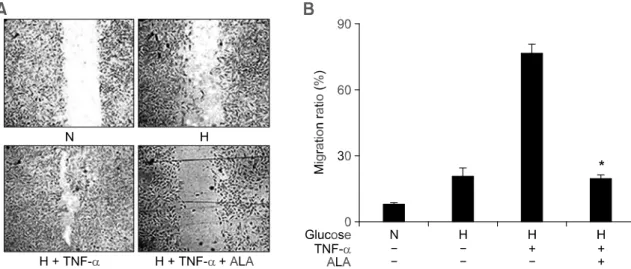
Figure 1. Inhibitory effect of ALA on migration of VSMCs stimulated by high glucose and TNF- (10 ng/ml). (A) The effect of ALA on

cell migration was assessed by the wounding migration assay. (B) The extent of cell migration was determined with a digitizer. N, nor-

mal D-glucose (5 mmol/l); H, high D-glucose (20 mmol/l). Data are expressed as the means ± SEMs of three independent

experiments. * P < 0.01 vs. H+TNF- .

(3)

Luciferase assay

Point mutations in the activator protein-1 (AP-1)- and NF- B-binding sites in the MMP-9 promoter were generated as described previously (Woo et al., 2003). NF- B-luciferase (pNF- B-Luc) and AP-1-lu- ciferase (pAP1(PMA)-TA-Luc) constructs were pur- chased from Clontech (Palo Alto, CA). To analyze luciferase expression, cells were washed twice with PBS and lysed with 100 l 1 × Reporter Lysis Buffer (Promega, Madison, WI). Each lysate (20 l) was assayed for luciferase activity.

Electrophoretic mobility shift assay (EMSA) Preparation of nuclear extracts from VSMCs and EMSA were performed as described previously (Ahn et al., 2001).

Statistical analysis

All results are expressed as means ± SEMs. Sta- tistical comparisons were done with a subsequent Duncan’s test for multiple comparisons. A probability value of < 0.05 was taken as statistically significant.

All experiments were performed at least three times.

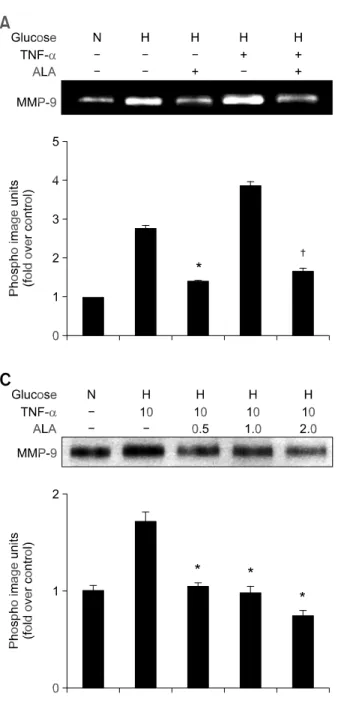
Figure 2. Effects of ALA on MMP-9 expression. (A) VSMCs were treated with or without ALA (2 mmol/l) under conditions of normal glucose, high glucose, and high glucose with TNF- (10 ng/ml).

Conditioned media were collected after 24 h and gelatin zymography was performed. * P < 0.05 vs. H alone,

P < 0.05 vs. H+TNF- . (B) VSMCs were treated with various concentrations of ALA (0.5, 1.0, 2.0 mmol/l) under conditions of high glucose with TNF- . * P < 0.05 vs.

H+TNF- ,

P < 0.01 vs. H+TNF- . (C) MMP-9 was identified by

Western blot analysis using anti-MMP-9 antibody. VSMCs were

treated with various concentrations of ALA (0.5, 1.0, 2.0 mmol/l) under

conditions of high glucose with TNF- . * P < 0.05 compared to

H+TNF- . Data are expressed as the means ± SEMs of three

independent experiments. N, normal D-glucose (5 mmol/l); H, high

D-glucose (20 mmol/l).

(4)

Results

Effect of ALA on VSMC migration and MMP-9 expression in vitro

We first examined whether ALA could affect VSMC migration and MMP-9 expression induced by high- glucose and TNF- stimulation. Figure 1 shows that high glucose (20 mmol/l) stimulated VSMC migration after linear wounding. Simultaneous treatment with high glucose and TNF- (10 ng/ml) exacerbated VSMC migration. ALA (2 mmol/l) effectively inhibited these responses ( P < 0.01). Similarly, high glucose and TNF- significantly increased MMP-9 expre- ssion, especially in co-stimulated cells, and ALA decreased MMP-9 expression effectively (Figure 2A). High glucose- and TNF- -induced MMP-9 ex- pression was inhibited by ALA in a concentra- tion-dependent manner (Figure 2B). Western blot analysis showed that the level of MMP-9 protein decreased after treatment with ALA (Figure 2C).

These results suggest that vascular injury, which can induce TNF- release, especially under high- blood-glucose conditions such as diabetes, may stimulate MMP-9 expression and that ALA can effectively suppress these responses.

Effect of ALA on MMP-9 transcription

MMP-9 promoter activity was examined to determine whether ALA regulates MMP-9 expression at the transcriptional level, using a luciferase reporter gene linked to the MMP-9 promoter sequence. As shown

in Figure 3A, luciferase gene expression was activated by stimulation with high glucose and TNF-

, in a pattern similar to that obtained by zymogra- phy, and decreased in response to ALA. ALA decreased high-glucose- and TNF- -induced promo- ter activity in a concentration-dependent manner (Figure 3B).

To further demonstrate a possible signaling pathway for the inhibition of MMP-9 by ALA, we performed assays using MMP-9-promoter constructs with mutations in the NF- B- and AP-1-binding sites (Figure 4A). MMP-9 promoters with point mutations in the NF- B- and AP-1-binding sites showed a diminished response to treatment with high glucose and TNF- compared with the wild-type MMP-9 promoter (Figure 4B). The ALA-induced inhibition of high-glucose- and TNF- -stimulated MMP-9 promo- ter activity was not observed with the NF- B- mutated MMP-9 promoter (Figure 4B).

Effects of ALA on NF- κB activity

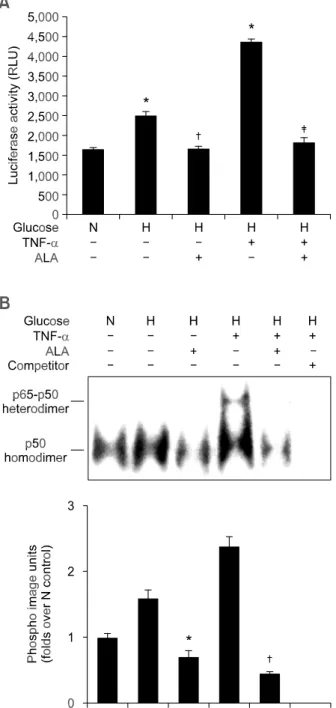
Experiments with reporter-gene constructs contain- ing the NF- B-binding site showed that treatment with ALA markedly attenuated luciferase gene ex- pression activated by high glucose and TNF- (Figure 5A). To determine whether ALA inhibited activation by NF- B by preventing it from binding to DNA, the effect of ALA on NF- B-DNA-binding activity was examined by EMSA. The amount of the NF- B-DNA complex increased in conditioned me- dia containing high glucose and TNF- and ALA

Figure 3. Effect of ALA on MMP-9 promotor activity. (A) Cells were transfected with a MMP-9-promotor-luciferase-reporter vector and treated with ALA (2 mmol/l) under conditions of normal glucose, high glucose, and high glucose with TNF- (10 ng/ml). Luciferase activity was measured in cell lysates. * P < 0.05 vs. N,

P < 0.05 vs. H alone,

P < 0.05 vs. H+TNF- . (B) Cells were transfected with a MMP-9-promotor-reporter vector and treated with various concentrations of ALA (0.5, 1.0, 2.0 mmol/l) in the absence or presence of high glucose and TNF- . Luciferase activity was measured in cell lysates. * P < 0.05 vs. N,

P < 0.05 vs. H+TNF- . Data are expressed as the means ± SEMs of three independent experiments.

N, normal D-glucose (5 mmol/l); H, high D-glucose (20 mmol/l).

(5)

efficiently suppressed the increase in NF- B-binding activity (Figure 5B).

Discussion

The principal findings of this study are: (a) ALA inhibits VSMC migration in the condition of high glucose and TNF- ; (b) ALA inhibits the high-gluco- se- and TNF- -stimulated increases in MMP-9 pro- moter activity and expression; and (c) these effects are mediated by suppression of the NF- B pathway.

Vascular injury causes an early up-regulation of MMP-9 (Bendeck et al., 1994; Wilcox et al., 2001).

Cho and Reidy (2002) have demonstrated in mice lacking the MMP-9 gene that MMP-9 is critical for VSMC migration and the formation of neointima.

Diabetes mellitus has been identified as an inde- pendent risk factor for the development of athero- sclerosis and is considered a coronary-heart-dis-

ease risk equivalent. It is also a recognized inde- pendent risk factor for poor outcome after per- cutaneous transluminal coronary angioplasty for symptomatic coronary disease (Kip et al., 1996;

Holmes et al., 1997; Kastrati et al., 1997; Mathew et al., 2004). TNF- is increased in arterial smooth muscle cells following injury and has multiple bio- logical effects, such as promoting the migration of VSMCs and inflammatory cells by a mechanism dependent on the activation of NF- B (Wang et al., 2001). In this study, we verify that high glucose increases the activities of NF- B and MMP-9 in VSMCs and stimulates their migration. Under con- ditions of combined high glucose and TNF- , these responses are exacerbated. Furthermore, TNF- - and high-glucose-induced increases in luciferase activity are reduced in MMP-9 promoters with point mutations in the NF- B- and AP-1-binding sites, as compared with the wild-type MMP-9 promoter.

These results suggest that NF- B and AP-1 are Figure 4. Effects of ALA on the activities of NF- B and AP-1. (A) Schematic structures of the wild-type and mutant MMP-9-promoter constructs used for the promoter assays. (B) Cells were transfected with WT or mutant MMP-9 promoters and treated with ALA (2 mmol/l) in the presence of high glu- cose and TNF- (10 ng/ml) for 24 h and luciferase activity was measured. Data are expressed as the means ± SEMs of three independent experiments. * P < 0.05 vs. H+TNF- . N, normal D-glucose (5 mmol/l); H, high D-glucose (20 mmol/l); WT-MMP9, wild-type MMP-9 promoter;

mAP1-1, mutant-AP1-1 MMP-9 promoter; mAP1-2, mutant-AP1-2 MMP-9 promoter; mNF B, mutant- NF- B MMP-9 promoter.

(6)

crucial transactivators for the expression of MMP-9 induced by TNF- and high glucose.

ALA is considered an ideal antioxidant since it possesses many beneficial characteristics, including

specific free-radical quenching, metal-chelating acti- vity, interaction with other antioxidants, and suppre- ssive effects on redox-sensitive gene expression (Bast and Haenen, 1988; Ou et al., 1995; Packer, 1998). ALA is widely used in pathological conditions associated with increased oxidative stress, including diabetic neuropathy (Ziegler et al., 1995). In the present study, we have found that ALA inhibits high-glucose- and TNF- -stimulated increases in MMP-9. It has been shown that ALA supplemen- tation prevents angiotensin II-induced renal injury by reducing the activity of NF- B and AP-1 (Mervaala et al., 2003). Therefore, we have focused on the role of the NF- B and AP-1 pathways in the ALA-induced decrease in MMP-9 in VSMCs. We find that ALA suppresses NF- B promoter activity in a concentra- tion-dependent manner, but that it has no effect on AP-1 promoter activity (data not shown). ALA also attenuates the DNA-binding activity of NF- B. More importantly, ALA-mediated inhibition is present with the AP-1-mutated MMP-9 promoters, but not with the NF- B-mutated MMP-9 promoter. These results suggest that ALA reduces MMP-9 expression by inhibiting the NF- B pathway, but not the AP-1 path- way.

Further experiments were performed to clarify the mechanism by which ALA controls NF- B trans- criptional activation. It has been reported that NF- B translocates from the cytoplasm into the nucleus and binds specifically to the NF- B-target DNA sequence (Baldwin, 1996). After specific binding, transcrip- tional activation by NF- B is regulated through phosphorylation of p65 (Wang and Baldwin, 1998).

We have shown by EMSA that ALA attenuates the DNA-binding activity of NF- B. This result indicates that ALA blocks MMP-9 expression, at least in part, by decreasing DNA-binding by NF- B.

In summary, we demonstrate that ALA can su- ppress VSMC migration and inhibits MMP-9 ex- pression by suppressing the NF- B pathway under conditions of elevated TNF- and glucose levels.

The inhibition of MMP-9 may interfere with the ability of VSMCs to cross the endothelial basement mem - brane and therefore ALA may be useful in the prevention of vascular restenosis after angioplasty.

Acknowledgement

This study was supported by the Korea Science and Engineering Foundation through the NRL program (grant M106 00000271-06J000-27110) and by grant No.RTI04- 01-01 from the Regional Technology Innovation Program of Ministry of Commerce, Industry and Energy. K.-M.L. and H.-Y.S. were supported by the Brain Korea 21 project in 2006

Figure 5. Effects of ALA on NF- B activity. (A) Cells were transfected

with a reporter vector containing NF- B binding sites and treated with

ALA (2 mmol/l) under conditions of high glucose and TNF- (10

ng/ml). Luciferase activity was measured. * P < 0.05 vs. N,

P <

0.05 vs. H alone,

P < 0.05 vs. H+TNF- . (B) A typical a gel-shift as-

say for VSMCs stimulated with high glucose and TNF- , followed by

treatment with ALA (2 mmol/l). N, normal D-glucose (5 mmol/l); H, high

D-glucose (20 mmol/l).

(7)

References

Ahn JD, Morishita R, Kaneda Y, Lee KU, Park JY, Jeon YJ, Song HS, Lee IK. Transcription factor decoy for activator protein-1 (AP-1) inhibits high glucose- and angiotensin II-induced type 1 plasminogen activator inhibitor (PAI-1) gene expression in cultured human vascular smooth muscle cells.

Diabetologia 2001;44:713-20

Baldwin AS Jr. The NF-kappa B and I kappa B proteins: new discoveries and insights. Annu Rev Immunol 1996;14:649-83 Bast A, Haenen GR. Interplay between lipoic acid and glutathione in the protection against microsomal lipid peroxidation. Biochim Biophys Acta 1988;963:558-61 Bendeck MP, Zempo N, Clowes AW, Galardy RE, Reidy MA.

Smooth muscle cell migration and matrix metalloproteinase expression after arterial injury in the rat. Circ Res 1994;

75:539-45

Bond M, Chase AJ, Baker AH, Newby AC. Inhibition of transcription factor NF-kappaB reduces matrix metallopro- teinase-1, -3 and -9 production by vascular smooth muscle cells. Cardiovasc Res 2001;50:556-65

Bourcier T, Sukhova G, Libby P. The nuclear factor kappa-B signaling pathway participates in dysregulation of vascular smooth muscle cells in vitro and in human atherosclerosis. J Biol Chem 1997;272:15817-24

Cho A, Reidy MA. Matrix metalloproteinase-9 is necessary for the regulation of smooth muscle cell replication and migration after arterial injury. Circ Res 2002;91:845-51

Death AK, Fisher EJ, McGrath KC, Yue DK. High glucose alters matrix metalloproteinase expression in two key vascular cells: potential impact on atherosclerosis in diabetes.

Atherosclerosis 2003;168:263-9

Dhawan S, Singh S, Aggarwal BB. Induction of endothelial cell surface adhesion molecules by tumor necrosis factor is blocked by protein tyrosine phosphatase inhibitors: role of the nuclear transcription factor NF-kappa B. Eur J Immunol 1997;27:2172-9

Galis ZS, Muszynski M, Sukhova GK, Simon-Morrissey E, Libby P. Enhanced expression of vascular matrix metallo- proteinases induced in vitro by cytokines and in regions of human atherosclerotic lesions. Ann N Y Acad Sci 1995;748:

501-7

Griendling KK, Fitzgerald GA. Oxidative stress and cardio- vascular injury: Part I: basic mechanisms and in vivo moni- toring of ROS. Circulation 2003;108:1912-6

Guha M, Bai W, Nadler JL, Natarajan R. Molecular me- chanisms of tumor necrosis factor alpha gene expression in monocytic cells via hyperglycemia-induced oxidant stress- dependent and -independent pathways. J Biol Chem 2000;

275:17728-39

Holmes DR Jr, Kip KE, Kelsey SF, Detre KM, Rosen AD. Cause of death analysis in the NHLBI PTCA Registry: results and considerations for evaluating long-term survival after coronary interventions. J Am Coll Cardiol 1997;30:881-7

Kastrati A, Sshomig A, Elezi S, Schuhlen H, Dirschinger J, Hadamitzky M, Wehinger A, Hausleiter J, Walter H, Neumann

FJ. Predictive factors of restenosis after coronary stent placement. J Am Coll Cardiol 1997;30:1428-36

Kip KE, Faxon DP, Detre KM, Yeh W, Kelsey SF, Currier JW.

Coronary angioplasty in diabetic patients. The national heart, lung, and blood institute percutaneous transluminal coronary angioplasty registry. Circulation 1996;94:1818-25

Kunsch C, Medford RM. Oxidative stress as a regulator of gene expression in the vasculature. Circ Res 1999;85:753-66 Mathew V, Gersh BJ, Williams BA, Laskey WK, Willerson JT, Tilbury RT, Davis BR, Holmes DR Jr. Outcomes in patients with diabetes mellitus undergoing percutaneous coronary inter- vention in the current era: a report from the Prevention of REStenosis with Tranilast and its Outcomes (PRESTO) trial.

Circulation 2004;109:476-80

Mervaala E, Finckenberg P, Lapatto R, Muller DN, Park JK, Dechend R, Ganten D, Vapaatalo H, Luft FC. Lipoic acid supplementation prevents angiotensin II-induced renal injury.

Kidney Int 2003;64:501-8

Ou P, Tritschler HJ, Wolff SP. Thioctic (lipoic) acid: a thera- peutic metal-chelating antioxidant? Biochem Pharmacol 1995;50:123-6

Overall CM, Wrana JL, Sodek J. Independent regulation of collagenase, 72-kDa progelatinase, and metalloendopro- teinase inhibitor expression in human fibroblasts by trans- forming growth factor-beta. J Biol Chem 1989;264:1860-9 Packer L, Witt EH, Tritschler HJ. Alpha-Lipoic acid as a biological antioxidant. Free Radic Biol Med 1995;19:227-50 Packer L. Alpha-Lipoic acid: a metabolic antioxidant which regulates NF-kappa B signal transduction and protects against oxidative injury. Drug Metab Rev 1998;30:245-75

Rajagopalan S, Meng XP, Ramasamy S, Harrison DG, Galis ZS. Reactive oxygen species produced by macrophage- derived foam cells regulate the activity of vascular matrix metalloproteinases in vitro. Implications for atherosclerotic plaque stability. J Clin Invest 1996;98:2572-9

Salonen RM, Nyyssonen K, Kaikkonen J, Porkkala-Sarataho E, Voutilainen S, Rissanen TH, Tuomainen TP, Valkonen VP, Ristonmaa U, Lakka HM, Vanharanta M, Salonen JT, Poulsen HE. Six-year effect of combined vitamin C and E supple- mentation on atherosclerotic progression: the Antioxidant Supplementation in Atherosclerosis Prevention (ASAP) Study. Circulation 2003;107:947-53

Sato H, Seiki M. Regulatory mechanism of 92 kDa type IV collagenase gene expression which is associated with invasiveness of tumor cells. Oncogene 1993;8:395-405 Signorelli SS, Malaponte G, Libra M, Di Pino L, Celotta G, Bevelacqua V, Petrina M, Nicotra GS, Indelicato M, Navolanic PM, Pennisi G, Mazzarino MC. Plasma levels and zymo- graphic activities of matrix metalloproteinases 2 and 9 in type II diabetics with peripheral arterial disease. Vasc Med 2005;10:1-6

Wang D, Baldwin AS Jr. Activation of nuclear factor-kappaB- dependent transcription by tumor necrosis factor-alpha is mediated through phosphorylation of RelA/p65 on serine 529.

J Biol Chem 1998;273:29411-6

(8)

Wang Z, Castresana MR, Newman WH. NF-kappaB is required for TNF-alpha-directed smooth muscle cell migra- tion. FEBS Lett 2001;508:360-4

Waters DD, Alderman EL, Hsia J, Howard BV, Cobb FR, Rogers WJ, Ouyang P, Thompson P, Rardif JC, Higginson L, Bittner V, Steffes M, Gordon DJ, Proschan M, Younes N, Verter JI. Effects of hormone replacement therapy and antioxidant vitamin supplements on coronary atherosclerosis in post- menopausal women: a randomized controlled trial. JAMA 2002;288:2432-40

Wilcox JN, Okamoto EI, Nakahara KI, Vinten-Johansen J.

Perivascular responses after angioplasty which may contri- bute to postangioplasty restenosis: a role for circulating myofibroblast precursors? Ann N Y Acad Sci 2001;947:68-90 Woo JH, Park JW, Lee SH, Kim YH, Lee IK, Gabrielson E, Lee SH, Lee HJ, Kho YH, Kwon TK. Dykellic acid inhibits phorbol myristate acetate-induced matrix metalloproteinase-9 ex- pression by inhibiting nuclear factor kappa B transcriptional activity. Cancer Res 2003;63:3430-4

Yoshimura S, Morishita R, Hayashi K, Yamamoto K, Nakagami H, Kaneda Y, Sakai N, Ogihara T. Inhibition of intimal hyperplasia after balloon injury in rat carotid artery model using cis-element 'decoy' of nuclear factor-kappaB binding site as a novel molecular strategy. Gene Ther 2001;

8;1635-42

Zhang WJ, Frei B. Alpha-lipoic acid inhibits TNF-alpha- induced NF-kappaB activation and adhesion molecule expression in human aortic endothelial cells. FASEB J 2001;

15:2423-32

Ziegler D, Hanefeld M, Ruhnau KJ, Meissner HP, Lobisch M, Schutte K, Gries FA. Treatment of symptomatic diabetic peripheral neuropathy with the anti-oxidant alpha-lipoic acid.

Diabetologia 1995;38:1425-33

Zucker S, Lysik RM, Zarrabi MH, Moll U. M(r) 92,000 type IV

collagenase is increased in plasma of patients with colon

cancer and breast cancer. Cancer Res 1993;53:140-6

수치

Figure 1. Inhibitory effect of ALA on migration of VSMCs stimulated by high glucose and TNF-  (10 ng/ml)
Figure 2. Effects of ALA on MMP-9 expression. (A) VSMCs were  treated with or without ALA (2 mmol/l) under conditions of normal  glucose, high glucose, and high glucose with TNF-   (10 ng/ml)
Figure 3. Effect of ALA on MMP-9 promotor activity. (A) Cells were transfected with a MMP-9-promotor-luciferase-reporter vector and treated with  ALA (2 mmol/l) under conditions of normal glucose, high glucose, and high glucose with TNF-  (10 ng/ml)
Figure 5. Effects of ALA on NF- B activity. (A) Cells were transfected  with a reporter vector containing NF- B binding sites and treated with  ALA (2 mmol/l) under conditions of high glucose and TNF-   (10  ng/ml)

참조

관련 문서

In this way, it is possible to shorten the time of accident restoration and maintenance by minimizing the expression error of the high-strength facial

This study tried to find out the effect of physical expression activity in the childlcare classroom influencing to the aggressions and the adjusting to school of the

The matrix A show the cost per computer (in thousands of dollars) and B the production figures for the year 2005 (in multiples of 1000 units).. Find a matrix C that

This study suggested diversity in the configuration of expression through expression of abstract images, the style of modern painting, which are expressed

The results of this study are as follows: ⑴ 4 basic directions, 16 themes, and 64 sub-themes of the vocational high school development are established, and

These results suggest that the bilobalide inhibits the cell proliferation and induces the apoptotic cell death in FaDu human pharyngeal squamous cell carcinoma via both

In this study, we tested whether a potent AMP-activated protein kinase (AMPK) activator, nectandrin B inhibits VSMC proliferation and neointiima formation and tried to

Generally urban freeway is the principal arterial corridor that is intended to provide for high levels of safety and efficiency in the movement of