Korean Journal of Microbiology (2018) Vol. 54, No. 3, pp. 305-307 pISSN 0440-2413
DOI https://doi.org/10.7845/kjm.2018.8063 eISSN 2383-9902
Copyright ⓒ 2018, The Microbiological Society of Korea
Complete genome sequence of Pseudoalteromonas donghaensis HJ51 T isolated from seawater
Ji-Sung Oh and Dong-Hyun Roh*
Department of Microbiology, Chungbuk National University, Cheongju 28644, Republic of Korea
해수에서 분리된 Pseudoalteromonas donghaensis HJ51 T 의 유전체 서열분석
오지성 ・ 노동현*
충북대학교 자연과학대학 미생물학과
(Received September 7, 2018; Revised September 17, 2018; Accepted September 17, 2018)
*For correspondence. E-mail: [email protected];
Tel.: +82-43-261-3368; Fax: +82-43-264-9600
The whole genome sequencing using PacBio RS II platform was performed for a marine bacterium Pseudoalteromonas donghaensis HJ51
Tisolated from East Sea of Korea. As a result, three assembled contigs consisting of a chromosome (size of 3,646,857 bp, and G + C content of 41.8%) and two plasmids (size of 842,855 bp and 244,204 bp, and G + C content of 41.3% and 40.4%, respectively) were obtained. The genome included 4,083 protein coding genes and 127 RNA genes. This result could be used for gene sources of biopolymers degradation and the development as a new host with secretion system similar to Escherichia coli.
Keywords: Pseudoalteromonas donghaensis HJ51
T, complete genome sequence, seawater
Marine Gammaproteobacteria of the genus Pseudoalteromonas were reclassified from the genus Alteromonas, based on 16S rRNA gene sequences and phylogenetic analyses (Gauthier et al., 1995). The genus Pseudoalteromonas was known to play important interactions in marine habitats by producing a variety of bioactive compounds with anti-bacterial and anti-fouling activities, extracellular enzymes and polysaccharides, and toxins
(Holmstr ӧm and Kjelleberg, 1999; Bowman, 2007). Especially, extracellular proteases produced from several Pseudoalteromonas spp., have shown high activity under either low temperature or high salts environments and also have been reported to inhibit a marine harmful algae (Lee et al., 2000; He et al., 2004; Yan et al., 2009). Pseudoalteromonas donghaensis HJ51
Tisolated from seawater samples (depth of 200–500 m) of East Sea of Korea was reported as a novel marine bacterium and produced various extracellular enzymes such as protease, DNase, amylase, chitinase, and agarase (Oh et al., 2011). The protease secreted from this strain showed relatively high activity under alkaline pH environment (Oh et al., 2015).
For analysis of the genome sequence, the cells were incu-
bated at 25°C in marine broth 2216 (Difco) and the genomic
DNA was extracted using genomic DNA extraction kit
(Solgent). The genome was sequenced using PacBio RS II
system (Pacific Biosciences). The total 994,261,639 bases
were obtained with 99,225 sequence reads, and the individual
reads were assembled with the Hierarchical Genome Assembly
Process (HGAP version 3.0, Pacific Biosciences). As a result of
the assembly, 3 contigs consisting of a chromosome and two
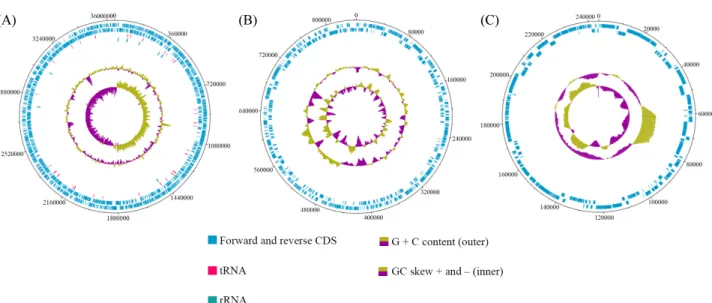
plasmids were generated (Fig. 1). The complete genome size of
P. donghaensis HJ51
Twas 4,733,916 bp with G + C content of
306 ∙ Oh and Roh
미생물학회지 제54권 제3호
(A) (B) (C)
Fig. 1. Circular map of contig 1 (A, chromosome), contig 2 (B, plasmid 1), and contig 3 (C, plasmid 2). Marked characteristics are shown from outside to the center: CDS on forward strand, CDS on reverse strand, tRNA, rRNA, GC content, and GC skew.
Table 1. Genome features of Pseudoalteromonas donghaensis HJ51
TGenome features Value
Contig 1 (Chromosome) 2 (Plasmid 1) 3 (Plasmid 2)
Depth (X) 174 171 211
Genome size (bp) 3,646,857 842,855 244,204
G + C content (%) 41.8 41.3 40.4
CDS 3,150 704 229
tRNA 102 0 0
rRNA 25 0 0
41.6% (Table 1). Total 4,210 coding sequences including 102 tRNAs and 25 rRNAs were identify and annotated by Prokka (Seemann, 2014) and BlastKOALA (Kanehisa et al., 2016).
A variety of extracellular enzyme genes such as protease, DNase, amylase, chitinase, agarase and lipase were identified in the genome. Interestingly, a cold-adapted halophilic extra- cellular serine protease with a catalytic domain (Peptidase S8 family) and two PPC (pre-peptidase C-terminal) domains similar to one of Pseudoalteromonas sp. SM9913 (Yan et al., 2009) was found. The bacterial secretion system of this strain was the same as type II system of Pseudoalteromonas haloplanktis and Pseudoalteromonas atlantica (de Pascale et al., 2010;
Uniprot Consortium, 2017). These secretions are similar to E.
coli BL21 (DE3), which is a widely used host for recombinant protein production (Jeong et al., 2015), except that the leader peptidase (GspO) and Sec-SRP secretion monitor (SecM) are
defective in extracellular secretion system. If these two defective genes were inserted into the genome, it could be used as a host for the production of secretory proteins.
Nucleotide sequence accession numbers
The type strain Pseudoalteromonas donghaensis HJ51
Tis available at KCTC 22219 and LMG 24469. The complete genome sequences for a chromosome and two plasmids are accessible in GenBank under the accession number CP032090, CP032091, and CP032092, respectively.
적 요
이 연구에서는 PacBio RS II 플랫폼을 사용하여 동해에서
분리된 해양 미생물 Pseudoalteromonas donghaensis HJ51
T의 전체 유전체 서열화를 수행하였다. 그 결과, 크기 3,646,857
bp, G + C 함량 41.8%인 염색체와 함께 크기 842,855 bp, G +
C 함량 41.3% 및 크기 244,204 bp, G + C 함량 40.4%인 두 개의
플라스미드로 구성된 3개의 유전체 서열을 획득하였다. 이 유
전체는 4,083개의 단백질 암호화 유전자와 127개의 RNA 유
전자를 포함하고 있다. 다양한 생체 고분자 분해효소의 유전
자원과 대장균과 유사한 세포외 단백질 분비 숙주로서의 개발
에 이용될 수 있을 것으로 생각된다.
Complete genome of P. donghaensis HJ51
T∙ 307
Korean Journal of Microbiology, Vol. 54, No. 3
Acknowledgements
This research was supported by Basic Science Research Program through the National Research Foundation of Korea (NRF) funded by the Ministry of Education (NRF-2017R1D1 A3B04033871).
References