Corresponding Author: Sungsoo Chun
Department of Health Management, Sahmyook University 26-21 Gongreung-dong, Nowon-gu, Seoul 139-742, Korea
Tel: +82-2-3399-1668, Fax: +82-2-3399-1672, E-mail: [email protected]
* The College Alcohol Study (CAS) grant was funded by the Robert Wood Johnson Foundation; the Korean College Alcohol Study (KCAS) grant number 03-30 was funded by the Ministry of Health & Welfare and Sahmyook University, Korea.
Article submitted 07 December 2009, Revised 11 December 2009, Approved 12 December 2009
A Comparison of Alcohol Secondhand Effects among Korean and U.S. College Students
Sungsoo Chun*†, Aeree Sohn*, Easton A. Reid*, Rubelyn Inot***, Mi-Kyung Kim***, Grace Percoheles***, Sang-Sook Lee****, Henry Wechsler**
* Department of Health Management, Sahmyook University, Korea
** Department of Society, Human Development and Health, Harvard School of Public Health
*** Korean Institute on Alcohol Problems, Sahmyook University, Korea
**** Long-term Care Center, Seniors Tower Co.
Ⅰ. Introduction
It has been widely known that harmful use of alcohol is prevalent among youth and is a key public health issue requiring urgent attention (Courtney and Pollach, 2009). Among collegiate Koreans, two out of five students usually drink seven or more alcoholic beverages when they drink, and 15% of students were found to be alcohol dependent (Chun et al., 2001).
Many Koreans believe that drinking alcohol is essential for creating a pleasant atmosphere at gatherings, and nondrinkers are disadvantaged in their work and social experiences (Choi et al., 2001, Park et al., 2004). Drinking at gatherings is visible and often practiced among college students.
Freshmen college students are pressured to join in drinking parties and consume more alcohol (Lee, 1998-99). In this country, cultural and societal norms play a major part in alcohol consumption and
should not be viewed as an individual problem (Han, 1998).
Excessive or binge drinking among college students is associated with a number of adverse health effects including hangovers, poor academic performance, legal trouble (Wechsler et al., 1998;
Wechsler & Isaac, 1992), poor athletic performance (Leichliter et. al., 1998). Social and relational problems (Nezlek et al., 1994), unsafe and unplanned sex (Meilman, 1993), are also common.
A study conducted in the U.S. regarding
morbidity and mortality changes among 18- to 24-
year-old college students from 1998 to 2001, found
that binge drinking and driving while
intoxicated(DWI), increased since 1998. The
number of students who reported DWI increased
from 2.3 million to 2.9 million (Hingson et al.,
2005). In 2001, there was a 6% increase in
unintentional injury deaths, an estimated 1,700
deaths among college students since 1998. (Hingson
et al., 2005). Reports show that there were more
than 696,000 assaults committed by students who had been drinking, and more than 97,000 students who were victims of alcohol-related sexual assaults or date rapes (Hingson et al., 2005). Moreover, Wechsler and others (1995) reported that students who did not drink excessively were affected by secondhand problems from heavy drinkers including vandalism, interrupted sleep, having to take care of other students who were drunk, and experiencing unwanted sexual advances (Wechsler et al., 1995).
Alcohol-related problems on campus do exist and drinkers alone do not suffer the consequences, it extends even to those who drink rarely or not at all.
The aim of this study is to compare Korean and U.S.
college students alcohol secondhand effects.
Ⅱ. Methods
1. U.S College Alcohol Study
The college and students sample
The 2001 Harvard School of Public Health College Alcohol Study (CAS) surveyed students at 120 colleges that had participated in each of the previous three surveys - 1993, 1997, and 1999. The participating schools were located in 38 states and the District of Columbia. From a list of accredited 4-year colleges provided by the American Council on Education, an original sample of 140 colleges was selected in 1993 using probability sampling proportionate to the size of undergraduate enrollment at each institution. Twenty schools were excluded due to the institutions' inability to provide a sample of students and mailing address to meet the time constraints of the survey.
Administrators at each participating school used the same procedure as that in conducting previous
CAS surveys to provide a list of 215 randomly selected students from all full-time undergraduate students enrolled during the 2000-2001 school year.
Details of the previous sampling methods are described elsewhere (Wechsler et al., 1994, 1998, 2000, 2002). In conducting the data analyses, we excluded 1 college with a response rate that was substantially lower than the others, leaving 119 schools. The sample of 119 colleges represented a national cross-section of students enrolled at 4-year colleges. Sixty-nine percent of the respondents attended public colleges and 31% private colleges, which approximates the US national distribution of full-time 4-year college students of 68% and 32%, respectively (Enrollment in postsecondary institutions, 1997). Forty-seven percent of the respondents attended large colleges (> 10,000 students), 23% were at medium-sized colleges (5,000-10,000 students), and 29% were enrolled in small colleges (< 5,000 students), compared to the US national distribution of 37%, 24%, and 40%, respectively (Enrollment in postsecondary institutions, 1997). Sixty-nine percent of respondents attended schools in large or medium-sized cities, compared with 71% of students nationwide (Enrollment in postsecondary institutions, 1997). Thirteen percent of the students attended schools with a religious affiliation, compared with 16% nationwide (Enrollment in postsecondary institutions, 1997), and 5% of the students attended all women's colleges Wechsler et al., 2002).
Procedures and response rate
In each survey year, CAS conducted a mail
survey of students whose names were generated at
random by registrars at participating schools. A
cover letter sent to students instructed them on their rights as human subjects. The survey responses were anonymous and confidential, and on this basis the study was given exempt status by the HSPH Human Subject Committee. The mailings were timed to avoid spring break at each school in order to measure drinking behavior on campus rather than during vacation.
The college response rate was 52% in 2001 (range: 22% to 86%). However, response rates at individual colleges were not associated with binge rates at those schools. The Pearson correlation coefficient of the associations between a colleges' binge rate and its response rate was 0.170 (p= .064) in 2001. In conducting the data analyses, 10,924 cases were used.
2. Korean College Alcohol study
The college and students sample
National Korean samples were selected from the list of accredited 4-year colleges from the Korean Council on University Education using probability proportionate to size of enrollment, college types, and districts. Sixty colleges were selected randomly.
The sampling rates were 29% among colleges and 0.22% of the students. The sampling rates were 0.21% among women college students, 0.26%
among religiously-affiliated college students and 0.22% among education college and general college students. All samples were randomly selected from the each provinces.
Ten of the 60 universities had enrollments of 10,000 or more students, 22 between 5,000 and 10,000 and 28 less than 5,000 students. Two of 60 universities were women's colleges, four were religiously-affiliated colleges, and four were education colleges.
Procedures and response rate
We selected department, current year of matriculation in participating colleges and assigned the number of students to the survey proportionally.
We sent the proportionally assigned questionnaires to the registrars or faculty (Range: 20 cases to 100 cases). For comparison purposes, the Harvard CAS questionnaire was used to prepare the KCAS questionnaires. During the translation, some questions were modified to convey a more clear meaning. A cover letter was sent to students instructing then on their rights as human subjects.
The survey responses were anonymous and confidential.
The mailings were timed to avoid summer vacation at each school in order to measure drinking behavior on campus rather than off campus during vacation. We mailed 2,931 questionnaires on May 12
th2003, and 2,399 questionnaire responses arrived by the cut off date of June 13
th2003. Due to the high response rate of 82%, we didn't examine the selection bias of the non-respondents.
The sample consisted of 52% college men, compared with 52% of men nationwide at the same age in the general population (Korean National Statistical Office, 2003). Twenty-one percent of the respondents attended public colleges and 79%
private colleges, which approximates the Korean
national distribution of full-time 4-year college
students at 25% and 75%, respectively (Korean
Council on University Education, 2003). Twenty-
two percent of the respondents attended large
colleges (>10,000 students), 49% medium- sized
colleges (5,000 - 10,000 students), and 29% small
colleges (> 5,000 students), compared to Korean
national distribution of 26%, 53%, and 21%,
respectively (Korean Council on University
Education, 2003). Among the respondents, 6.5%
attended colleges with religious affiliation or education colleges and 3.1% attended women's colleges, compared with 5.7% and 3.3% nationwide, respectively (Korean Council on University Education, 2003). After 14 cases were excluded with insufficient records in conducting the data analyses, 2,385 cases were used.
3. Measures and Data Analysis
The questionnaire asked the respondents to answer a series of questions about their alcohol use and associated problems, tobacco and other drug use, lifestyles, demographic and background characteristics. The questionnaire instructed participants to define a “drink” in equivalent amounts of alcohol: a 12 oz (360-mL) bottle or can of beer, 4-oz (120mL) glass of wine, a 12 oz (360-mL) bottle or can of wine cooler, a shot (1.25-oz or 37-mL) of liquor either straight or in mixed drink, or a 55ml glass of soju. Soju, a kind of rice wine, and is the most popular alcohol beverage in Korea that contained 25% of alcohol (11g per a glass). The number of students reporting four or more of these alcohol-related problems was examined. All students were asked a series of 9 questions about their experiences of the consequences of other students' drinking (secondhand effect) during the current school year.
The number of students experiencing four or more these secondhand effects was examined.
To evaluate cross-national differences, we pooled the two surveys into a single data file containing 10,904 U.S. students and 2,385 Korean students from 179 colleges. We analyzed the data using SPSS (version 17.0). Odds ratio (OR) was used to compare the likelihood of secondhand
effects between U.S. and Korean students. Multiple logistic regression models were used to control for age, drinking frequency, amount and residence status. The Generalized Estimating Equations (GEE) model (Liang and Zerger, 1992; Han, 1998) was used to make inferences on the estimated coefficients of the multiple logistic regression models using clustered binary outcomes from sampling.
Ⅲ. Results
1. Respondent characteristics
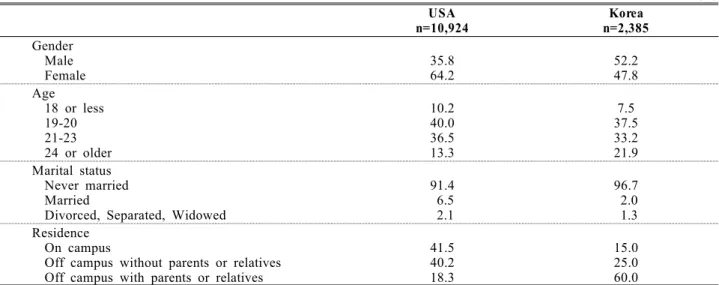
In terms of the demographic characteristics, we found several statistically significant differences between the portion of US and Korea students who were male and female, were age 24 or older, were never married, and were living in campus housing.
In general, the Korean college students tended to be
older, were more likely to be unmarried, and were
much more likely to be male and live off-campus
with their parents or relatives. There were more
male (52.2%) then female (47.8%) students in
Korea, compared to male (35.8%) and female
(64.2%) students in the US. The mean age (21.3) of
the Korean students was slightly older than that of
the US students (20.8) because of two and a half
years of military service for all males in Korea
which is usually completed during their university
studies. More than half of the Korean students
(60.0%) live off-campus with parents or relatives,
compared to just 18.5% of the US students. Two in
five (41.5%) US students lived in a university
residence compared to only one in seven (15.0%)
Korean students (Table1).
USA
n=10,924 Korea
n=2,385 Gender
Male
Female 35.8
64.2 52.2
47.8 Age
18 or less 19-20 21-23 24 or older
10.2 40.0 36.5 13.3
7.5 37.5 33.2 21.9 Marital status
Never married Married
Divorced, Separated, Widowed
91.4 6.5 2.1
96.7 2.0 1.3 Residence
On campus
Off campus without parents or relatives Off campus with parents or relatives
41.5 40.2 18.3
15.0 25.0 60.0
Note. Chi-square comparisons of US vs. Korean college students on each of the variables were significant at p= .001.
Table 1. Sample characteristics
(%)
2. Secondhand effects
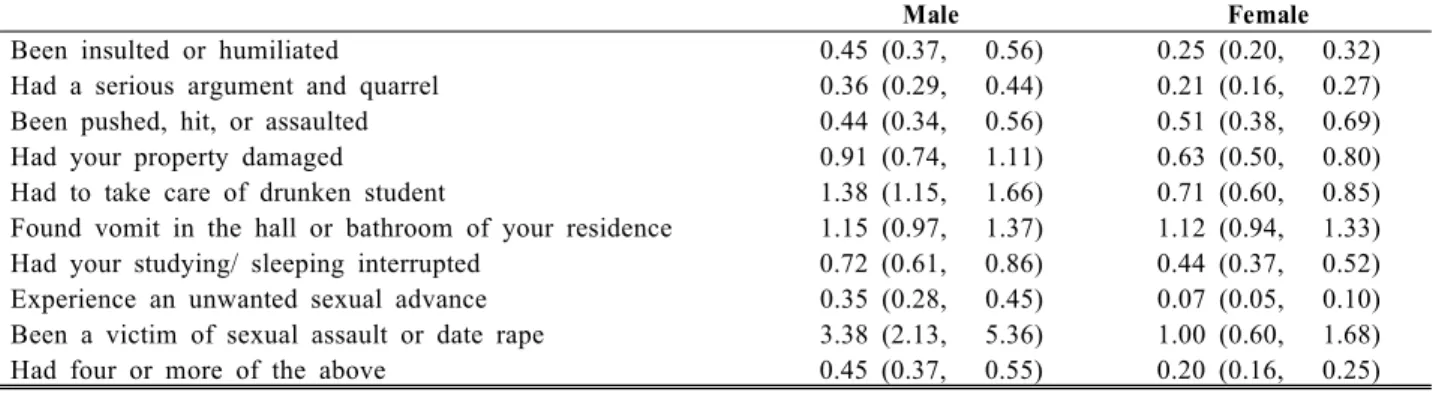
The problems students had experienced as a result of other students' drinking were summarized in Table 2. Korean students were less likely to experience the secondhand effects than US students, except for being a victim of sexual assault or date rape, finding vomit in the hall or bathroom of residence, and having to take care of drunken students. Among Korean students, 7.5% of the male and 3.0% of the female reported being a victim of sexual assault or date rape, while among US students, 1.5% of the male and 1.8% of the female reported being a victim of sexual assault or date rape. After controlling for age, the odds of secondhand effects show us similar results with frequency results. US students were more likely to be insulted or humiliated, have a serious argument and quarrel, be pushed, hit, or assaulted, and have experience an unwanted sexual advance.
After controlling for age, frequency of drinking, and amount of drinking in a row, the odds' differences were grater than the odds controlled by
age only. Korean male students were 0.45 times (95% CI = 0.37, 0.56) less likely to being insulted or humiliated, 0.36 times (95% CI = 0.29, 0.44) less likely to have a serious argument and quarrel, 0.44 times (95% CI = 0.34, 0.56) less likely to be pushed, hit, or assaulted, 0.72 times (95% CI = 0.61, 0.86) to have study/sleep interrupted, 0.35 times (95% CI
= 0.28, 0.45) less likely to experience an unwanted sexual advance, and 0.45 times (95% CI = 0.37, 0.55) less likely to have four or more secondhand effects among the nine secondhand effects in Table 2, while they were 1.38 times (95% CI = 1.15, 1.66) more likely to have to take care of drunken students and 3.38 times (95% CI = 2.13, 5.36) more likely to be a victim of sexual assault or date rape than US male students. Particularly, more US female students were affected by all kinds of second-hand effects than Korean female students after controlling, but vomiting in hall or bathroom of residence and being a victim of sexual assaults or date rape were not shown significance.
Korean female students were 0.25 times (95% CI
= 0.20, 0.32) less likely to being insulted or
humiliated, 0.21 times (95% CI = 0.16, 0.27) less likely to have a serious argument and quarrel, 0.51 times (95% CI = 0.38, 0.68) less likely to be pushed, hit, or assaulted, 0.63 times ((95% CI = 0.50, 0.80) less likely to have property damaged, 0.71 times (95% CI = 0.60, 0.85) less likely to have to take care of drunken student, 0.44 times (95% CI = 0.37,
0.52) less likely to have study/sleep interrupted, 0.07 times (95% CI = 0.05, 0.10) less likely to experience an unwanted sexual advance, and 0.20 times (95% CI = 0.16, 0.25) less likely to have four or more secondhand effects among the nine secondhand effects in Table 2 than US female students.
Male Female
Been insulted or humiliated 0.45 (0.37, 0.56) 0.25 (0.20, 0.32)
Had a serious argument and quarrel 0.36 (0.29, 0.44) 0.21 (0.16, 0.27)
Been pushed, hit, or assaulted 0.44 (0.34, 0.56) 0.51 (0.38, 0.69)
Had your property damaged 0.91 (0.74, 1.11) 0.63 (0.50, 0.80)
Had to take care of drunken student 1.38 (1.15, 1.66) 0.71 (0.60, 0.85) Found vomit in the hall or bathroom of your residence 1.15 (0.97, 1.37) 1.12 (0.94, 1.33) Had your studying/ sleeping interrupted 0.72 (0.61, 0.86) 0.44 (0.37, 0.52) Experience an unwanted sexual advance 0.35 (0.28, 0.45) 0.07 (0.05, 0.10) Been a victim of sexual assault or date rape 3.38 (2.13, 5.36) 1.00 (0.60, 1.68)
Had four or more of the above 0.45 (0.37, 0.55) 0.20 (0.16, 0.25)
Note. Controlled by age, drinking frequency, and drinking amount US is reference at Adj. OR.
Table 2. Odds ratio of alcohol secondhand effect prevalence between Korean and US college students (Adj. OR and 95% CI)
As a results, Korean students were tend to more likely to have the physical secondhand effects, something like being a victim of sexual assault or date rape, having to take care of drunken students and finding vomit in the hall or bathroom of residence, than US students, while US students were tend to more likely to have the psychological or interpersonal secondhand effects, something like being insulted or humiliated, having a serious argument and quarrel, being pushed, hit, or assaulted, having study/sleep interrupted, and experiencing an unwanted sexual advance than Korean students.
Ⅳ. Discussion
In general, US students were more likely to
experience interrelationship problems (e.g., argue with friends, unplanned sexual activities, etc…) after drinking while Korean students were more likely to have individual drinking related problems (e.g., get hurt or injured, require medical treatment, etc…).
Because of the generosity of alcohol use and drunkenness in Korea, most Koreans try to accept drinking behaviors and manners of drunkenness (Han,1998).
The effects of the perception of drinking and related problems in previous studies allow strong predictions to be made in determining alcohol use and abuse of college students and young adults (Perkins & Berkowitz, 1986; Prentice & Miller, 1993; Agostinelli et al., 1995; Agostinelli & Smith, 1999; Perkins, 2002b; Luquis et al., 2003; Lewis &
Neighbors, 2004; Neighbors et al., 2004; Nye et al.,
2006). One theory regarding the widespread use of
alcohol among college students involves misperceptions of peer drinking norms (Lewis &
Neighbors, 2006). A large number of studies have demonstrated that college students misperceive peer drinking norms (Perkins & Berkowitz, 1986;
Prentice & Miller, 1993; Lewis & Neighbors, 2004).
College students specifically tend to overestimate heavy alcohol consumption of their peers (Perkins
& Berkowitz, 1986). Misperception of peer drinking among college students has been suggested as a causal factor of heavy drinking (Agostinelli et al., 1995; Neighbors & Larimer, 2004). Most college student overestimate peer drinking and these misperceptions have the strongest impact on personal alcohol consumption and associated negative consequences. Students' perception of their campus drinking norm is by far the strongest predictor of the amount of personal alcohol consumption (Perkins, 2002b). Students believe that drugs and alcohol are widely used by their peers, that alcohol drinking is a part of the college experience, and that their peers support strong drinking. Students not only agree that a high percentage of their peers are consuming alcohol, but they also suggest that these behaviors are harmless (Luquis et al., 2003; Lee, 2004). Young people who reported that they were exposed to “wet”
environments were more likely to begin binge drinking in college than their peers without similar exposures. Wet environments included friendship networks and affiliations within which binge drinking is common and endorsed, social, residential, and market surroundings in which drinking is prevalent and easily available and cheap alcohol (Weitzman et al., 2003). College students are susceptible to peer influence and the team atmosphere supports social bonds (Nelson &
Wechsler, 2001). We had expected that students
living off-campus with their parents or relatives would be less likely to use alcohol and to be binge drinkers in both countries. A significant interaction between residence and binge drinking showed that the protective effect of living with parents was stronger among US students than among Korean students. The association between students' alcohol consumption and their living arrangements may be the result of peer influence (Wechsler et al., 2001).
Alcohol use in college is a highly social behavior (Wechsler et al., 2001). Students who are heavy episodic drinkers have more friends (Wechsler et al., 1995b), and are more likely to be members of fraternities, sororities (Wechsler et al., 2002) or athletic teams (Nelson and Wechsler, 2001). Living with parents exerted no protective effect against binge drinking in Korea.
Among US Students, 66% had experienced at least one adverse consequence from other students' drinking (Wechsler, et al., 1995c). Students living on campuses with high levels of heavy drinking were more likely to have the adverse effects of other students' drinking, or secondary heavy drinking effects, than their counterparts at campuses where heavy drinking levels were lower (Wechsler, et al., 1995c). Student drinking level is related to the experience of secondary heavy drinking effects at college. The more students themselves drank, the more likely they were to have experienced the adverse consequence from other students' drinking (Wechsler, et al., 1995c). On campuses where more than half the students are binge drinkers, the vast majority of students who live on campus have experienced one or more problems as a result of others' binge drinking (Wechsler, et al., 1995c).
Because more US students are living on campus
than Korean students, US students are more likely
to have interpersonal secondhand effects from other
students' drinking. Even though secondhand effects are problems from “other students' drinking,” the likelihood of experiencing these consequences is greatly affected by the students' own drinking levels.
Ⅴ. Conclusion
The purposes of this study were to compare differences of drinking related problems and second-hand effects among US and Korean college students. The results indicated that secondhand effects are more prevalent among US students than among Korean students. Our findings conclusively implicated that misperception to safe drinks, drunkenness and peer's binge drinking, generosity to drinking behaviors, and Korean parents' generous approval of children's heavy drinking all encourage Korean college students to be more likely to binge drink than US college students are.
The present study concluded that heavy and binge drinking are strongly associated with negative secondhand effects. Social supports like family, particularly parents and friends have a powerful influence on binge-drinking. First, Korean parents must teach their children to be moderate and responsible when drinking. Limited alcohol access and parents' who model temperance in drinking can lower secondhand effects of alcohol consumption.
Second, college administrators need to offer or increase their substance-free housing options as one possible intervention to decrease heavy student drinking and its effects. Alcohol control by way of campus substance-free housing will also have a positive impact by lowering the likelihood of heavy episodic drinking on college campuses and its secondhand effects. In summary, these recommendations will enhance the lives and
academic performance of college students while limiting the negative experiences of students during college.
The results of this study must be viewed within the context of its limitations. Both CAS and KCAS are subject to the limitations of any self-reported survey. However, such surveys have been considered generally valid in examining alcohol responses (Cooper et al., 1981; Midanik, 1988).
Previous findings have indicated that if a self-report bias exists, it is largely limited to the heaviest use group (Room, 1971). Therefore, a possible bias should not affect such a conservative estimate of binge volume as five drinks (Wechsler et al., 1997).
Although our analysis suffered some limitations which are common in cross-national secondary analyses (Kohn, 1987; Kuo et al., 2002), our results nevertheless provide some new data regarding potential cross-national differences which can be used for further research on binge drinking in campuses in both countries. Another study limitation was that CAS and KCAS were not conducted during the same time. However, seasonal differences can be overcome with the four-month duration of the semester.
Furthermore, there may be larger, unmeasured cultural differences that couldn't be included in the questionnaire. Other factors such as legal drinking age, price, alcohol marketing, and alcohol-related policies should also be examined. However, the survey data did not allow us to examine the differences in alcohol prices and related policies in binge alcohol use between the US and Korea.
References
Age specific population. 2002. Korea National
Statistical Office. Available at: http://www.nso.
go.kr/cgi-bin/sws_999.cgi.AccessedMarch15, 2004.
Agostinelli, G., Brown, J.M. & Miller, W.R. 1995.
Effects of normative feedback on consumption among heavy drinking college students. Journal of Drug Education 25:31-40.
Boyle, J.R. & Boekeloo, B.O. 2006. Perceived parental approval of drinking and its impact on problem drinking behaviors among first-year college students. Journal of American College Health 54:238-244.
Choi, S-H., Kim, M. & Kim, K-K. 2001. Drinking behavior and related factors among white collar workers in Seoul. Journal of Korean Society for Health Education and Promotion 18(2): 27-44.
Chun, S. & Sohn, A. 2005. Correlates of problem drinking by the Alcohol Use Disorders Identification Test on Korean College Campus.
Journal of Preventive Medicine and Public Health, 38, 307-314.
Chun, S. 1998. A study on the estimation to the life expectancy lost by drinking. Journal of Korean Public Health Association 24:153-166.
Chun, S. 2002. Analysis of college student binge drinking and alcohol-related problems. Journal of Korean Alcohol Science 3:221-233.
Chun, S., Lee, J., Lee Y. & Park, J. 2001.
Development of prevention programs for problem drinking in the university. Journal of Korean Alcohol Science 2:67-114.
Chun, S., Sohn, A., Song, C. & Park, J. 2006.
Comparison of alcohol use among Korean and U.S. college students. Journal of Korean Alcohol Science 7:1-11.
Chun, S., Sohn, A., Song, C., Lee, J. & Kim, S. 2003.
Health and behavioral consequences of binge drinking in college: A national survey of students at 60 campuses. Journal of Korean Alcohol Science 4:119-135.
Cooper, A.M., Sobell, M.B., Sobell, L.C. & Maisto, S.A. 1981. Validity of alcoholics' self-reports:
duration data. International Journal of Addiction 16:401-406.
Courney, K.E. & Polich, J. 2009. Binge Drinking in
Young Adults: Data, Definitions, and Determinants. Psychol Bull 135(1):142-156.
Dantzer, C., Wardle, J., Fuller, R., Pampalone, S.Z. &
Steptoe, A. 2006. International study of heavy drinking: attitudes and sociodemographic factors in University Students. Journal of American College Health 55:83-89.
Enrollment in postsecondary institutions. 1997. US Dept of Education, Office of Educational Research and Improvement. Available at:
http://nces.ed.gov/pubs2000/2000160.pdf.Access edJanuary25, 2002.
Han, T. 1998. Social and cultural meaning of alcohol consumption: Focusing on community culture.
Seoul, Korea: Korea Institute for Health and Social Affairs.
Higher education bulletin. 2003. Korean Council on University Education. Available at: http://state.
kcue.or.kr/index.jsp.AccessedMarch15, 2004.
Hingson, R., Heeren, T., Winter, M. & Wechsler, H.
2005. Magnitude of alcohol-related mortality and morbidity among U.S. college students ages 18-24: Changes from 1998 to 2001. Annual Review of Public Health 26:259-279, 2005.
PMID: 15760289.
Kohn, M. 1987. Cross-national research as an analytic strategy. American Sociological Review 52:713-731.
Kuo, M., Adlaf, E.M., Lee, H., Gliksman, L., Demers, A. & Wechsler, H. 2002. More Canadian students drink but American students drink more: comparing college alcohol use in two countries. Addiction 97:1583-1592.
Lee, H-C. 1998-99. Transformation of employment practices in Korean businesses. International Studies of Management & Organization 28(4):
26-39.
Lee, W. 2004. Alcohol dependency of college students. Journal of Korean Society for Health Education and Promotion 21:67-86.
Leichliter, J.S., Meilman, P.W., Presley, C.A. and Cashin, J.R., 1998. Alcohol use and related consequences among students with varying levels of involvement in college athletics.
Journal of American College Health pp.
257-262.
Leifman, H. & Ӧsterberg, E. 2002. Alcohol in postwar Europe, ECASⅡ: a discussion of indicators on alcohol consumption and alcohol-related harm.
National Institute of Public Health, Sweden.
Lewis, M.A. & Neighbors, C. 2004. Gender-specific misperceptions of college student drinking norms. Psychology of Addictive Behaviors 18:
334-339.
Liang, K.Y. & Zerger, S.L. 1992. Longitudinal data analysis using generalized linear models.
Biometrika 74:12-22.
Luquis, R.R., Garcia, E. & Ashford, D. 2003. A qualitative assessment of college students' perceptions of health behaviors. American Journal of Health Studies 18:156-164.
Martens, M.P., Page, J.C., Mowry, E. S., Damann, K.M. Taylor, K.K. & Cimini, M.D. 2006.
Differences between actual and perceived students' norms: an examination of alcohol use, drug use, and sexual behavior. Journal of American college health 54:295-300.
Meilman, P.W. 1993. Alcohol induces sexual behavior on campus. Journal of American College Health pp. 27-31.
Midanik, L. 1988. Validity of self report alcohol use:
a literature review and assessment. British Journal of Addiction 83:1019-1030.
Neighbors, C., Larimer, M.E. & Lewis M.A. 2004.
Targeting misperceptions of descriptive drinking norms: efficacy of a computer delivered personalized normative feedback intervention.
Journal of Consulting and Clinical Psychology 72:434-447.
Nelson, T.F. & Wechsler, H. 2001. Alcohol and college athletes. Medicine & Science in Sports
& Exercise 33:43-47.
Nezlek, J.B., Pilkington, C.J. and Bilbro, K.G. 1994.
Moderation in excess: Binge drinking and social interaction among college students. Journal of Studies on Alcohol pp. 342-351.
Norstrὅm, T. 2002. Alcohol in postwar Europe:
consumption, drinking patterns, consequences and policy responses in 15 European countries .National Institute of Public Health, Sweden.
Nye, E.C. Agostinelli, G. & Smith, J.E. 1999.
Enhancing alcohol problem recognition: a self- regulation model for the effects of self-focusing and normative information. Journal of Studies on Alcohol 60:685-693.
O'Malley, P.M. & Johnston, L.D. 2002. Epidemiology of alcohol and other drug use among American college students. Journal of Studies on Alcohol, Supplement No. 14:23-39.
Park. H.S., Kirn, M., Lee. T.S. & Lee. D.W. 2004, November. Drinking with coworkers: The utilities of social gatherings in the Korean civil engineering industry. Paper presented at the annual convention of the National Communication Association, Chicago, IL.
Perkins, H.W. & Berkowitz, A.D. 1986. Perceiving the community norms of alcohol use among students: some research implications for campus alcohol education programming. International Journal of the Addictions 21: 961-976.
Perkins, H.W. 2002. Social norms and the prevention of alcohol misuse in collegiate contexts. Journal of Studies on Alcohol, Supplement No.
14:164-172b.
Perkins, H.W. 2002. Surveying the damage: A view of research on consequences of alcohol misuse in college populations. Journal of Studies on Alcohol, Supplement No. 14:91-100a.
Prentice, D.A. & Miller, D.T. 1993. Pluralistic ignorance and alcohol use on campus: some consequences of misperceiving the social norm.
Journal of Personality and Social Psychology 64:243-256.
Ramstedt, M. 2001. Comparative studies on alcohol-related problems in postwar Western Europe. Centre for Social Research on Alcohol and Drugs, University of Stockholm, Sweden.
Scott, Kathryn D., John Schafer, and Thomas K.
Greenfield. 1999. “The role of alcohol in physical assault perpetration and victimization,”
Journal of Studies of Alcohol 60(4):528-36.
Scribner, R.A., D. MacKinnon, and J. Dwyer. 1995.
“The risk of assaultive violence and alcohol
availability in Los Angeles County,” American
Journal of Public Health 3(85):335-340.
Simpura, J. & Karisson, T. 2001. Trends in drinking patterns in fifteen European countries, 1950 to 2000. National Research and Development Centre for Welfare and Health, Finland.
So, D.W. & Wong, F.Y. 2006. Alcohol, drugs, and substance use among Asian-American College students. Journal of Psychoactive Drugs 38:
35-42.
Sohn, A. & Park, J. 2006. Comparison of sexual behavior between binge drinkers and non-binge drinkers among Korean University students.
Journal of Korean Alcohol Science 7:39-52.
Substance Abuse and Mental Health Services Administration (SAMHSA) 2003. Results from the 2002 national survey on drug use and health: national findings. NHSDA series H-22, DHHS Publication No. (SMA) 03-3836.
Rockville, MD: Office of Applied Studies.
Wechsler, H. & Isaac, N. 1992. ‘Binge’ drinkers at Massachusetts colleges: Prevalence, drinking style, time trends, and associated problems.
JAMA pp. 2929-2931.
Wechsler, H., Davenport, A., Dowdall, G., Moeykens, B. & Castillo, S. 1994. Health and behavioral consequences of binge drinking in college:
anational survey of students at 140 campuses.
Journal of the American Medical Association 272:1672-1677.
Wechsler, H., Dowdall, G.W., Davenport, A. &
Castillo, S. 1995. Correlates of college students binge drinking. American Journal of Public Health 85:921-926b.
Wechsler, H., Dowdall, G., Davenport, A. & Rimm, E.A. 1995. A gender-specific measure of binge drinking among college students. American Journal of Public Health, 85: 982-985a.
Wechsler, H., Dowdall, G.W., Maenner, G., Gledhill- Hoyt, J. and Lee, H., 1998. Changes in drinking and related problems among American college students between 1993 and 1997: Results of the Harvard School of Public Health college alcohol study. Journal of American College Health pp.
57-68.
Wechsler, H., Fulop, M., Padilla, A., Lee, H. &
Patrick, K. 1997. Binge drinking among college students: a comparison of California with other states. Journal of American College Health 45:273-277.
Wechsler, H., Lee, J.E., Kuo, M. & Lee, H. 2000.
College binge drinking in the 1990s: A continuing problems. Results of the Harvard School of Public Health 1999 College Alcohol Study. Journal of American College Health 48:
199-210.
Wechsler, H., Lee, J.E., Kuo, M., Seibring, M., Nelson, T.F. & Lee, H. 2002. Trends in college binge drinking during a period of increased prevention efforts: findings from 4 Harvard School of Public Health College Alcohol Study surveys: 1993-2001. Journal of American College Health 50:203-217.
Wechsler, H., Lee, J.E., Nelson, T.F. & Lee, H. 2001.
Drinking levels, alcohol problems and secondhand effects in substance-free college residences: results of a national study. Journal of Studies on Alcohol 62:23-31.
Wechsler, H., Moeykens, B., Davenport, A., Castillo, S. & Hansen Jeffrey 1995. The adverse impact of heavy episodic drinkers on other college students. Journal of Studies on Alcohol 56:
628-634.
Wechsler, H., Nelson, T., Lee, J.E., Seibring, M., Lewis, C. & Keeling, R.P. 2003. Perception and reality: A national evaluation of social norms marketing interventions to reduce college students' heavy alcohol use. Journal of Studies on Alcohol 64:484-494.
Weitzman, E.R., Nelson, T.F. & Wechsler, H. 2003.
Taking up binge drinking in college: The influences of person, social group, and environment. Journal of Adolescence Health 32:26-35.
Zegar S.L. & Liang, K.Y. 1988. Models for
longitudinal data: a generalized estimating
equation approach. Biometrics 44:1049-60.
ABSTRACT
Objectives: To compare alcohol secondhand effects among US and Korean students.
Methods: Nationally representative 4-year colleges of two countries were involved in this cross-national comparison study. Data from the 2001 U.S. College Alcohol Study and the 2003 Korean College Alcohol Study came from 120 colleges in 38 U.S. states and the District of Columbia and 60 colleges in Korea.
Randomly selected 4-year college students from the U.S. (10,924) and Korea (2,385) participated in the study using self-reports of alcohol use and perceptions of drinking as assessed by College Alcohol Study questionnaires.
Results: Korean students were tend to more likely to have being a victim of sexual assault or date rape, having to take care of drunken students and finding vomit in the hall or bathroom of residence, than US students, while US students were tend to more likely to have being insulted or humiliated, having a serious argument and quarrel, being pushed, hit, or assaulted, having study/sleep interrupted, and experiencing an unwanted sexual advance than Korean students.
Conclusion: In general, US students were more likely to suffer interrelationship problems after drinking while Korean students were more likely to have physical and individual drinking related problems.
Key Words: Alcohol use, College students, Alcohol-related problem, Secondhand effect, Cross-national
<국문초록>