마이크로파로 처리된 목질 바이오매스의 특성 분석
이중명 1†
접수일(2018년 10월 11일), 수정일(2018년 10월 24일), 채택일(2018년 10월 26일)
Characteristics of Bio-based Materials Treated with Microwave Irradiation
Jung Myoung Lee 1†
Received October 11, 2018; Received in revised form October 24, 2018; Accepted October 26, 2018
ABSTRACT
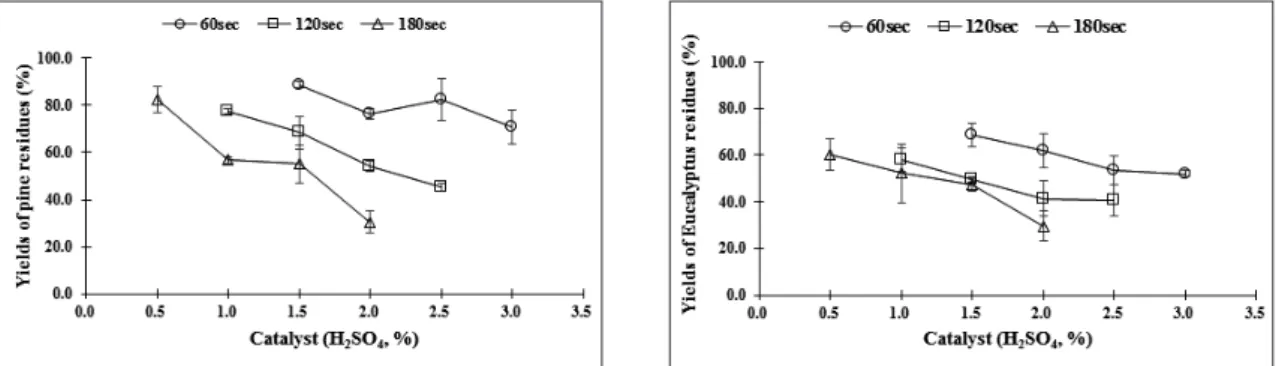
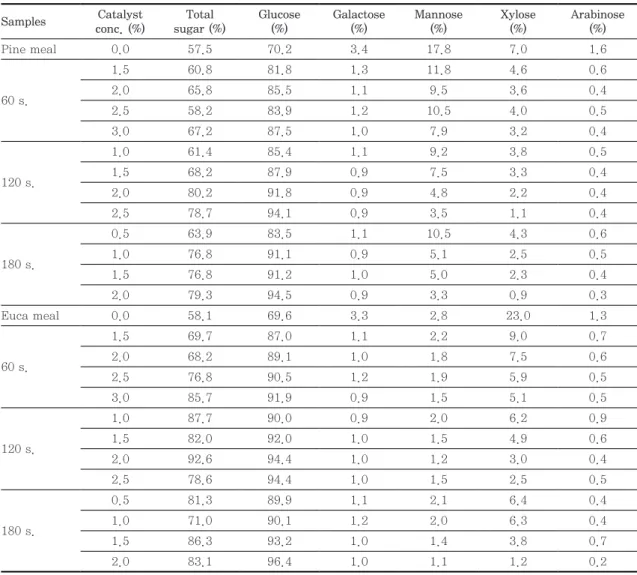
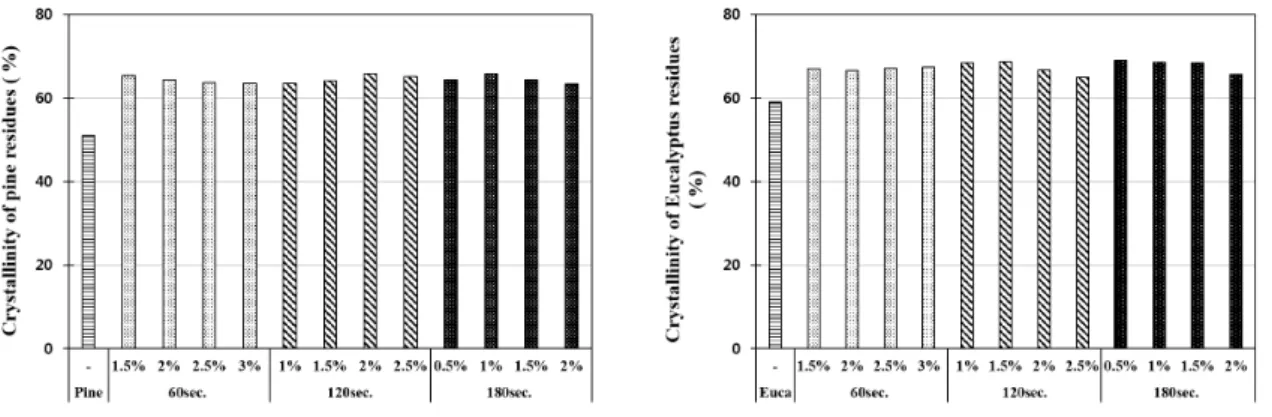
Microwave irradiation is one of pretreatment technologies in the biorefinery area. In this paper, we carried out a comparative study of the two distinct bio-based materials such as pine and eucalyptus as feedstocks subjected to a combination treatment of microwave ir- radiation and chemical micronization at a given reaction severity. The micronized resi- dues were characterized in terms of reaction yields, residual lignin contents, sugar com- positions, crystallinity, and dissolution behaviors on a aqueous Urea/NaOH solution. It was found that hardwood under the combination treatment of microwave and chemical micronization is more sensitive than softwood, resulted to a rapid decrease in yields, and residual lignin contents. The pronounced losses of hemicellulose and lignin in the hard- wood made easily soluble in the aqueous Urea/NaOH solution.
Keywords: Chemical micronization, bio-based materials, biomass, dissolution, microwave irradiation
• 경북대학교 산림과학·조경학부 임산공학전공(Major in Wood Science and Technology, Department of Wood Science and Tech- nology, School of Forestry, Science and Landscape Architecture, Kyungpook National University, 80 Daehakro, Bukgu, Daegu, 41566, Republic of Korea)
1 경북대학교 농업과학기술연구소(Agricultural Science and Technology Research Institute, Kyungpook National University, 80 Daehakro, Bukgu, Daegu, 41566, Republic of Korea)
† 교신저자(Corresponding Author): E-mail: [email protected]
Printed in Korea http://dx.doi.org/10.7584/JKTAPPI.2018.10.50.5.171
1. 서 론
20세기형 ‘대량생산·대량소비’라는 경제 패러다임으로
인류는 지난 세기 동안 풍부한 화석연료를 이용하여 분
리·정제 기술 진보로 인하여 풍족한 경제 소비 활동을 영
위해왔다. 하지만, 이에 따른 부작용으로 지구온난화 및
기후변화라는 극심한 상황에 처해 있다. 이러한 기존의 화석연료를 기반으로 하는 20세기형 경제 개념의 한계를 극복하기 위해, 석유화석자원 대신에 기술 선진국에서는 새로운 경제 개념인 바이오 경제(Bio-based economy) 혹은 나아가 순환바이오경제(Circular BioEconomy) 개 념 도입으로 바이오 자원에서 화학제품, 각종 소재 및 운 송연료, 전력 및 열 생산을 목표로 광범위한 투자가 이루 어지고 있다.
1)4차 산업 패러다임의 전환의 일환으로, 현재 선진국에 서는 목재 및 초본류 등의 바이오 자원을 분리·정제하여 바이오 연료(bio-energy) 혹은 석유화학산업유래의 부 재(bulk)·소재(fine chemicals)를 대체할 수 있는 원료 로 사용하여 그 부가가치성(valorization)을 높이는 데 국가의 역량을 집중하고 있다.
2)세포벽에 존재하고 있는 다양한 형태의 셀룰로오스, 헤 미셀룰로오스 및 리그닌 등의 천연 고분자 물질을 그 쓰 임에 따라 경제적 혹은 산업적으로 용이하게 단량체 (building block) 혹은 전구물질(platform molecular) 로의 재조합(de-construction) 혹은 분리(fraction- ation) 변환하는 기술 개발이 그 핵심이라 볼 수 있다.
3)현재 이용되고 있는 식물세포벽 내의 바이오 고분자(셀 룰로오스, 헤미셀룰로오스, 리그닌) 분리 변환기술은 기 존의 펄프·제지산업에서 사용되고 있는 기술을 변형하여 약산(dilute acid), 알칼리(alkaline), 유기용제(orga- nosolv), 이온성 용매(ionic liquid) 등의 조합으로 다양 한 초본류 및 목재 등의 바이오 자원에 적용되고 있다.
하지만, 초본류 및 목질계 바이오 자원은 1·2차 대사합성 의 산물인 리그닌이 셀룰로오스와 헤미셀룰로오스를 단 단하게 감싸 안은 구조로 형성되어 있어, 선택적인 분리·
제거가 어렵기 때문에 효율적으로 리그닌을 분리·제거하 기 위한 다양한 전처리 기술이 개발되고 있다.
4-7)이러한 전처리 기술 중 글리콜 에테르 용매와 산 촉매를 이용하 여 마이크로파 처리에 의한 목질 바이오 매스 자원의 전 처리 기술로 많은 적용 가능성이 있다고 판단된다.
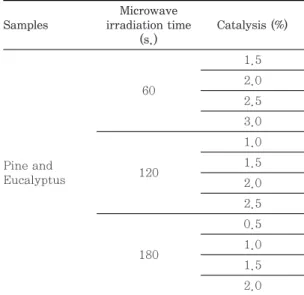
8)본 연구에서는 마이크로파 처리를 통해 침·활엽수 바이 오매스를 제조하고, 처리조건에 따른 바이오매스의 특성 및 이를 통해 얻어진 미세 잔류물의 용해용제에 대한 용 해성 차이를 비교하였다.
2. 재료 및 방법
2.1 공시재료 및 시약
2.1.1 공시재료본 연구에서는 함수율이 9.1%인 국내산 소나무(Pinus densiflora)와 함수율이 5.5%인 유칼립투스(Eucalyptus globulus) 목편을 실험실용 햄머밀을 이용하여 분말화하 여 사용하였다. 분말화한 시료는 40-60 mesh로 분급하 여 에탄올-벤젠 혼합용액(1:2, v/v)으로 24시간 동안 추 출하여 탈지 목분을 제조하였다.
2.1.2 시약