유기성 슬러지 처리 시스템에 관한 융합연구
중소기업기술융합연구소, 청운대학교 교양대학 교수한두희
Convergence Study on Organic Sludge Treatment System
Doo-Hee Han
Professor, ITCRI, College of Liberal Arts Chungwoon University
요 약 천연 광물질, 식물질, 정수장 슬러지를 이용하여 친환경적인 수수질정화제와 이를 활용하는 오폐수복합처리시스 템을 개발하였다. 오폐수복합처리시스템은 오염수 유입, 수질정화제 투입, 가압부상장치 가동, 슬러지 부상, 슬러지 수거 및 처리수 배출의 과정을 거친다. 이 장치를 축분 탈리액, 육계 세척수, 공장 폐수, 하수종말처리장 및 연못의 녹조제거 에 적용하여 우수한 제거율을 얻었다. 유기성 폐기물 정화에 천연 수질정화제를 활용한 예는 조사되지 못했다.
주제어 : 수질정화제, 오폐수복합처리시스템, 돈분, 육계 세척수, 공장 폐수
Abstract An eco-friendly water purifier was developed using natural minerals, plants, and sludge from water purification plants. A wastewater complex treatment system using this water purification agent was developed. The wastewater complex treatment system goes through the process of inflow of contaminated water, input of water purification agent, operation of a pressurized flotation device, sludge flotation, sludge collection and treatment water discharge. This device was applied to the removal of green algae in livestock desorption liquid, broiler washing water, factory wastewater, sewage treatment plant and pond to obtain excellent removal rate. The use of natural water purification agents for organic waste purification has not been investigated.
Key Words : Water purifier, Wastewater complex treatment system, Pig manure, Chicken washing water, Factory wastewater
*This study was carried out by research funds of Chungwoon University in 2020.
*Corresponding Author : Doo-Hee Han([email protected]) Received August 27, 2020
Accepted October 20, 2020 Revised October 5, 2020
Published October 28, 2020
1. 서론
가뭄이 심할 때 강이나 호수에 발생하는 녹조를 효과 적으로 관측하고 예측하는 연구가 필요하게 되었다[1].
그동안 녹조를 억제하기 위한 연구도 많이 이루어 졌고 [2-4], 환경부 통계자료를 할용하여 수질 개선에 관한 효 과적인 연구를 하거나[5]. 융합적인 연구를 통한 유기성 폐기물의 실생활과 밀접한 부분에서 연구한 경우도 있었
다[6]. 그동안 주로 하천 녹조에 관하여 연구되어 오다가 [7-11], 축산폐수 및 염색 폐수를 정화하는데 녹조제거 기술을 활용하는 방안도 연구되어 졌다[12-15]. 기업과 공동으로 수질 정화제를 개발하여 하천 녹조제거에 좋은 결과를 얻은바 있다[16,17].
본 논문에서는 하천 녹조를 정화하기 위한 수질 정화 제를 축분 폐수, 육계 세척수 및 하수종말 처리장 등에 적용한 사례를 보고한다.
2. 천연재료를 이용한 수질정화제
천연 광물질, 식물질, 정수장 슬러지를 이용하여 제조 함으로써 친환경적이고 경제적이며 녹조제거 및 유해세 균의 살균과 기타 오염물질을 흡착, 부상시켜 제거가 용 이할 수 있도록 한 천연재료를 이용한 수질정화제를 개 발하였다. 수질정화제를 제조하는 과정은 다음과 같다.
a. 케이크 상태로 건조된 정수장의 슬러지를 준비한다.
b. 건조된 슬러지를 분쇄하여 분말로 만든다.
c. 정수장 슬러지와 광물재료를 물에 넣고 고압 챔버 내에서 150∼250˚C의 온도로 2∼3시간 동안 가열 및 교반하여 미네랄성분을 녹인다.
d. 융해된 액체 내에 남아있는 광물재료와 정수장 슬 러지의 찌꺼기를 침전시켜 미네랄 성분이 융해된 콜로이 드 상을 만든다.
e. 밤나무, 상수리나무, 녹차, 물푸레나무, 솔잎으로 구성된 각각의 식물재료들을 파쇄하여 작은 입자로 만든 다.
f. 파쇄된 식물재료를 물에 넣어 50∼70˚C에서 1∼
2시간 동안 가열 및 초음파 진동으로 천연 살균성분을 우려낸다.
g. 식물재료의 찌꺼기를 거름망으로 제거하여 천연살 균액을 얻는다.
h. 미네랄 성분이 융해된 콜로이드상의 물과 천연살 균액을 0.8∼1.2 : 0.8∼1.2 체적비율로 혼합하여 수질정 화제를 제조한다.
본 연구는 유기성 폐기물이 녹아 있는 용액을 효율적 인 유기성 폐기물 제거장치를 이용하여 친환경 수질정화 제를 투입하고 응집된 유기성 폐기물을 부상시켜 제거 하는 기술 개발에 초점을 맞춰 진행하였다. 수질정화제의 살포기능과 부상된 유기성 폐기물 슬러지를 효율적으로 회수할 수 있는 기능이 포함된 고효율 오폐수복합후처리 시스템을 연구 개발하였다. 오폐수복합후처리시스템은 이동이 편리하고, 3시간 내에 분해와 조립이 가능한 조립 식 형태로 제작되었다.
친환경 천연 수질정화제 처리기술은 화학약품을 전혀 사용하지 않은 친환경 제거제로 오염된 유기성 슬러지 를 응집-부상시켜 수체 밖으로 제거한다. 이 오폐수복합 후처리시스템은 이동설치가 가능하여 사용이 편리하고, 오염수를 운송할 필요가 없어 경제적이다. 악취를 단시 간에 제거할 수 있으며, 모기유충 등 해충제거 효과는 물 론 유해물질인 질소와 인, 황화수소 등 유기슬러지와 함 께 제거시킬 수 있다. Table 1은 개발된 수질정화제의
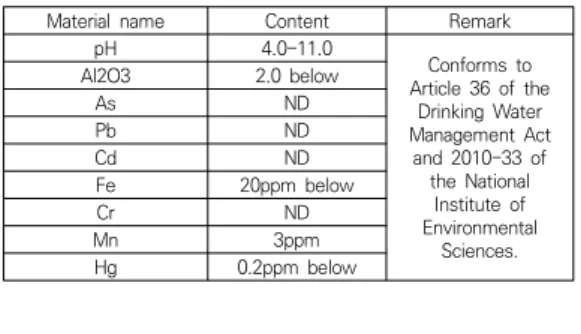
표준 성분 구성을 나타내 주고 있다. Table 2는 수질 정 화제를 사용하여 녹조를 처리한 후 잔류 중금속 함량을 나타내 주고 있다. 이 분석은 국립환경과학원에서 실시하 였다.
Table 1. Component table of the developed water purification agent
Material name Content(%) CAS Number
WATER 95 7732-18-5
Feldspar Porphyry 0.75~1 68476-25-5
Ocher 0.75~1 37338-85-5
Zeolite 0.75~1 68989-22-0
Chestnut Tree 0.35~0.6 92113-25-2
Oak 0.35~0.6 68917-11-3
Tea Tree 0.35~0.6 308064-79-1
Pine needles 0.35~0.6 8000-26-8
Table 2. Table of heavy metals after removing green algae using water purifier
Material name Content Remark
pH 4.0-11.0
Conforms to Article 36 of the
Drinking Water Management Act
and 2010-33 of the National
Institute of Environmental
Sciences.
Al2O3 2.0 below
As ND
Pb ND
Cd ND
Fe 20ppm below
Cr ND
Mn 3ppm
Hg 0.2ppm below
3. 오폐수복합후처리시스템
천연재료를 이용하여 제조된 수질정화제를 활용하기 위한 오폐수복합후처리시스템을 제작하였다. Fig. 1은 제작된 오폐수복합처리시스템을 나타내 주고 있으며 처 리과정은 다음과 같다.
Fig. 1. Sample of wastewater complex treatment system
a. 오염수를 처리장치에 유입시킨다.
b. 오염된 수역의 수면위에 수질정화제를 살포한다.
c. 가압부상장치를 가동시킨다.
d. 수중 및 바닥층의 부유성 슬러지와 함께 부상하며, 응집·부상된 슬러지는 수거용 회수장치로 수거한 후 자 연탈수 처리한다.
e. 응집, 부상, 슬러지 수거의 모든 과정은 오염환경에 따라 1일∼3일 이내에 종료된다.
f. 반복처리를 통해 적정 수질을 유지하고 배출한다.
Fig. 2는 오폐수복합처리시스템의 처리 공정을 나타 내 준다.
Fig. 2. Summary of treatment process
4. 유기성 탈리액 정화 실험 4.1 돈분 탈리액 정화실험
경기도 화성 지방에 위치한 양돈 농가에서 발생하는 돈분을 일차 고액분리하고 남은 탈리액을 물과 희석하여 개발한 장치에 의하여 정화실험을 실시하였다. Table 3 은 ㈜성원엔지니어링에서 측정한 처리 전후의 성분을 비 교한 것인데 돈분 탈리액 정화실험에서 T-N, T-P가 99.7% 이상으로 제거되었다.
Table 3. Comparison table before and after animal manure treatment(Pig manure wastewater) Item Before(mg/L) After(mg/L) Removal rate(%)
BOD 14400.0 30.0 99.8
SS 9633.3 0.2 100
T-N 4515.000 12.972 99.7
T-P 106.560 0.016 100
T- coli 110000 2 100
Ammonia N 4060.00 12.88 99.7
4.2 하림 세척수 정화실험
하림은 육계 농장에서 출발하여 현재는 육계를 가공하 는 공장, 유통까지 육계사업의 모든 범위를 취급하고 있 다. 하림에서 도축할 때 사용하는 세척수는 세척 후 다량 의 유기물 등을 포함한다. Fig. 3은 하림 닭 세척과정을 나타내 준다.
Fig. 3. Harim chicken washing process
이것을 개발된 장치를 이용하여 정화한 결과 ㈜성원엔 지니어링에서 측정한 table 4와 같은 결과를 얻었다.
Table 4. Comparison table before and after animal manure treatment(Chicken washing water) Item Before(mg/L) After(mg/L) Removal
rate(%)
BOD 1271.3 166.0 86.9
COD 350.3 114.3 67.4
SS 1170.3 28.4 99.8
T-N 227.040 24.888 89.0
T-P 28.500 0.126 99.6
T- coli 800000 ND 100
Ammonia
N 156.00 15.88 89.8
4.3 공장 침출수 정화실험
익산에 위치한 기업의 공장폐수를 정화하는 실험을 실 시하였다. 성분분석시험은 ㈜한국환경연구소에서 실시하 였다. Table 5는 공장 폐수의 정화 전 후의 성분분석표 이다.
Table 5. Comparison table before and after animal manure treatment(Factory wastewater) Item Before(mg/L) After(mg/L) Removal rate(%)
BOD 2776.0 76.2 97.3
COD 1085.7 26.0 97.6
SS 98.0 0.2 99.8
T-N 1569.600 30.660 80.4
T-P 0.270 0.006 97.8
4.4 세종시의 하수종말처리장 정화실험
세종시의 하수종말처리장에서 발생되는 원수를 개발 된 정화처리장치를 활용하여 정화처리하였다. Fig. 4는 새종시 공공하수처리시설을 보여준다. Table 6은 ㈜성 원엔지니어링에서 시험분석한 세종시 하수종말처리장의 폐수 정화 전후의 성분분석표이다.
Fig. 4. Sejong City Public Sewage Treatment Facility Table 6. Comparison table before and after animal
manure treatment(Sewage treatment plant) Item Before(mg/L) After(mg/L) Removal
rate(%)
BOD 988.0 1.6 99.8
COD 7000.0 2.8 100
SS 21740.0 0.2 100
T-N 3158.400 5.982 99.8
T-P 138.720 0.008 100
4.5 녹조 제거 정화실험
경복궁 경회루 연못의 녹조제거실험을 실시하였다.
Fig. 4는 경회루이 수질개선 작업 전후의 과정을 나타내 주고 있다. Table 7과 8은 경회루 수질 개선 작업 전후 의 성분변화표를 나타내 준다.
a
b
c
Fig. 4. Gyeonghoeru Pond in Gyeongbokgung Palace (a:
before treatment, b: under treatment, c: after treatment)
Table 7. Comparison table before and after animal manure treatment(Gyeonghoeru Pond) Item Before(mg/L) After(mg/L) Removal
rate(%)
BOD 4.3 1.0 76.7
COD 11.4 5.6 50.9
pH 9.6 7.5 -
T-N 0.7 0.1 84.3
T-P 0.086 0.005 94.2
Chl-a 37.9 5.5 85.5
Dominant
species Staurastrum Staurastrum
Table 8. Comparison table of bacteria before and after animal manure treatment(Gyeonghoeru Pond)
Item Before(m
g/L) After(m
g/L) Removal rate(%) Low temperature general
bacteria(CFU/ml) 712 178 75
Medium temperature
general bacteria(CFU/ml) 436 64 85
Coliform group(CFU/ml) 16 0 100
E. coli(CFU/ml) 0 0 -
5. 결론
식물 10여종에서 추출한 타닌 등 천연물질과 광물질 에서 추출한 제오라이트 등을 주원료로 만든 수질정화제 를 개발하였다. 기존 황토 등 수질개선제가 어류와 수생 식물에 영향을 미치는 것과 달리 천연 원료의 수질정화 제를 사용하기 때문에 생태계까지 보호할 수 있다. 오페 수복합처리시스템의 작동 원리는 수질정화제를 오염된 수면 위에 살포해 수질악화 원인인 조류 및 유기성폐기 물을 응집·부상시킨 후 슬러지를 수거해 자연탈수 처리 하는 방법을 사용한다. 광합성 반응에서 발생하는 산소 기포와 수중에 과포화된 산소가 수온 증가 시 포화용해 도가 낮아지면서 기포가 발생해 응집된 조류 및 유기성 폐기물과 결합하여 물위로 떠오른다.
오폐수복합처리시스템을 제작하여 축분 탈리액에서 T-N, T-P 97% 이상, 육계 세척수에서 BOD 87%, T-N 89%, 공장 폐수에서 T-N 80.4%, T-P 97.8%, 하수종말 처리장에서 T-N 99.8%, T-P 100% 및 연못 녹조제거에 서 T-N 84.3%, T-P 94.2%의 우수한 제거율을 얻었다.
REFERENCES
[1] Y. H. Kwon. (2019). ICT technology-based algal bloom monitoring and prediction research. The Journal of The Korean Institute of Communication Sciences 37(1), 66-71.
[2] M. J. Lee, J. C. Joo, G. Y. Kim, J. R. Park, C. H. Ahn &
S. R. Lee. (2019). Evaluation of the growth inhibition effect of harmful blue-green algae using TiO₂ -embedded Expanded Polystyrene (TiEPS) balls: river and reservoir mesocosms. Journal of Korean Society of Environmental Engineers, 41(11), 647-656.
[3] G. Y. Kim, J. C. Joo, M. J. Lee, J. R. Park, C. H. Ahn &
S. R. Lee. (2019). Evaluation of the growth inhibition effect of harmful blue-green algae using TiO₂-embedded Expanded Polystyrene (TiEPS) balls: laboratory-scale indoor and outdoor experiments. Korean Journal of Environmental Engineering, 41(11), 637-646.
[4] G. Y. Kim, J. C. Joo, B. R. Ahn, D. H. Lee, J. R. Park, C. H. Ahn & J. M. Oh. (2018). Inhibition of the Algal Growth using TiO₂-embedded Expanded Polystyrene (EPS) balls in Lab-scale Outdoor Experiment. Ecology and Resilient Infrastructure, 5(3), 174-179.
[5] Ministry of Environment. (2018). National Waste Statistics Survey. Sejong : Ministry of Environment.
[6] E. H. Jeon & S. H. Yang. (2020). A Study on the User Experience of Food Waste at Home. Journal of the Korea Convergence Society, 11(7), 79-87,
DOI : 10.15207/JKCS.2020.11.7.079
[7] H. S. Lee, K. W. Jung, C. Y. Choi & J. W. Na. (2017).
Aggregation and algal effect of harmful green algae according to the molecular weight of chitosan.
Polymer, 41(3), 561-568.
[8] Y. J. Kim, S. J. Lee & G. G. Ahn. (2019). Analysis of chemical water quality characteristics and empirical model before and after the construction of Geumgang Water System Baekjebo. Environmental organisms, 37(1), 48-59.
[9] K. G. Ahn, J. K. Kim & S. J. Lee. (2008). Nutritional status of artificial lakes using nutrients, transparency and chlorophyll, empirical model analysis, and correlation between variables. Environmental organisms, 26(3), 252-263.
[10] H. J. Lee. (2017). The issues of double-speaking and re-naturalization of the four major rivers “saving”
projects. Environmental Sociology Research ECO, 21(2), 7-43.
[11] Y. G, Lee et al. (2011). Current status and improvement plan of the Gyeongnam Ecological River Restoration Project. Key Policy Research, 1-171.
[12] D. K. Park, S. W Jang & H. N. Choi. (2017). Ecotoxicity assessment for livestock wastewater treated water using pilot scale LID method. Environmental organisms, 35(4), 662-669.
[13] H. J. Jeong, B. H. Koo & H. Cho. (2005). A study on the treatment of livestock wastewater using the electrocoagulation/oxidation method. Environmental Science Journal, 10, 7-16.
[14] H. J. Jeong, J. K. Kim & B. H. Koo. (2003). A study on dyeing wastewater treatment by photocatalytic oxidation. Environmental Science Journal, 8, 37-45.
[15] D. H. Park, H. H. Park, J. H. Kim, J. S. Choi, S. H. Lee
& J. S. Jung. (2007). Development of low-cost, high-efficiency dyeing wastewater treatment technology using a fluid bed biofilm carrier. Journal of Korean Society for Atmospheric Environment, 739-742.
[16] MCE Korea Co., Ltd., Korea Water Resources Corporation.
(2014). Manufacturing method of water purifier using natural materials. Korean Patent No. 10-1373399.
[17] MCE Korea Co., Ltd. (2006). A method of manufacturing a water treatment agent for removing green algae and moss. Korean Patent No. 10-0623993.
한 두 희(Doo-Hee Han) [정회원]
․ 1981년 2월 : 경북대학교 물리교육과 학사
․ 1987년 2월 : 경북대학교 물리학과 석사
․ 1994년 2월 : 경북대학교 물리학과 박사
․ 1996년 3월 ~ 현재 : 청운대학교 교수
․ 관심분야 : 환경, 에너지, 기술융합
․ E-Mail : [email protected]