• 검색 결과가 없습니다.

The Synthesis of Eu<sup>3+</sup> Doped with TiO<sub>2</sub> Nano-Powder and Application as a Pesticide Sensor

N/A
N/A
Protected

Academic year: 2021

Share "The Synthesis of Eu<sup>3+</sup> Doped with TiO<sub>2</sub> Nano-Powder and Application as a Pesticide Sensor"

Copied!
4
0
0

로드 중.... (전체 텍스트 보기)

전체 글

(1)

Journal of the Korean Chemical Society 2011, Vol. 55, No. 6

Printed in the Republic of Korea

http://dx.doi.org/10.5012/jkcs.2011.55.6.932

-932-

The Synthesis of Eu 3+ Doped with TiO 2 Nano-Powder and Application as a Pesticide Sensor

Fei Yao

, Yang Sun

, Chunlei Tan, Song Wei, Xiaojuan Zhang, Xiaoyun Hu

, and Jun Fan*

School of chemical Engineering and Technology, Northwest University, Xi’an, Shannxi, China.

*

E-mail: [email protected]

Department of Physics, Northwest University, Xi’an, Shannxi, China (Received July 4, 2011; Accepted September 22, 2011)

ABSTRACT. Using tetrabutyl titanate as precursor, Eu

3+

doped TiO

2

nano-powder was prepared by sol-gel method, the nature of luminescence of nano-powder was studied. The interaction of chlorpyrifos with Eu

3+

doped TiO

2

was studied by absorption and fluorescence spectroscopy. The results indicated the fluorescence intensity of Eu

3+

doped TiO

2

was quenched by chlorpyrifos and the quenching rate constant (k

q

) was 1.24×10

11

L/mol·s according to the Stern-Volmer equation. The dynamics of photoinduced electron transfer from chlorpyrifos to conduction band of TiO

2

nanoparticle was observed and the mechanism of electron transfer had been confirmed by the calculation of free energy change (∆G

et

) by applying Rehm-Weller equation as well as energy level diagram. A new rapid method for detection of chlorpyrifos was established according to the fluorescence intensity of Eu

3+

doped TiO

2

was proportional to chlorpyrifos concentration. The range of detection was 5.0×10

-10

- 2.5×10

-7

mol/L and the detection limit (3 σ) was 3.2×10

-11

mol/L.

Key words: Eu

3+

doped TiO

2

, Sensor, Chlorpyrifos, Fluorescence, Analysis application

INTRODUCTION

In recent years, there is a growing concern about harm- ful effects of pesticide on human health and enviro- nment. In particular, organophosphorus pesticides (OPs) are described as a group of highly toxic compounds and widely used in agriculture for protecting plants.

1

Chlorpyrifos (CPF) is one of the most frequently used organophosphate pesticides in agriculture.

2

It is a broad- spectrum OP used to control pests in grain storage, water and a variety of leafy crop. Therefore, the detection of chlorpyrifos is significant for agriculture, environment, protection and other aspects. A wide variety of analytical methods such as gas chromatography (GC)

3

and high per- formance liquid chromatography (HPLC)

4

have been commonly used for an efficient determination of chlo- rpyrifos. However, these methods are time consuming and require labourintensive preparation of samples that involve

solvent extraction and clean up of extracts.

With the rapid development of nanotechnology, there are few papers about use of nanotechnology in develop- ment of pesticide sensors. Anyway, no sensor based on the fluorescence of Eu

3+

doped TiO

2

was reported in the lit- erature.

In this paper we developed a rapid and sensitive pes- ticide sensor. To our knowledge, this is the first report of detection of chlorpyrifos by using the fluorescence inten- sity of Eu

3+

doped TiO

2

.

EXPERIMENTAL

The Eu

3+

doped TiO

2

nano-powder was prepared by the Sol-gel method. Two samples were prepared, one of sam- ples placed in vacuum drying at 50

o

C for 24 h, then it was annealed at 700

o

C for 2 h, to get the white powder.

Another liquid sample was diluted and the ratio of dis- tilled water to solution was 3:1. The details of the sample preparation are given in Ref.

5

The collected nanophosphor particles were characterized

by X-ray diraction (XPert-MPD System, PHILIPS) and

transmission electron microscopy (TEM, JEM-2010JEOL,

H-7500 HITACHI). Fluorescence spectra of liquid samples

were measured by F-7000 Hitachi spectrophotometer. UV-

Vis absorption spectra of samples were recorded on UV-

(2)

2011, Vol. 55, No. 6

The Synthesis of Eu

3+

Doped with TiO

2

Nano-Powder and Application as a Pesticide Sensor 933

3600 Shimadzu spectrophotometer.

In a typical uorescence measurement, 3.0 mL liquid samples were added to a quartz cell (1.0 cm×1.0 cm). The CPF solution was then gradually titrated to the cell using a pipette. The concentrations of CPF were ranged from 2.5×10

10

to 25×10

10

mol L

1

and the volume of CPF was 20 µL every time.

The uorescence emission spectra were measured at room temperature. The width of the excitation and emis- sion slits was set at 5.0 nm. An excitation wavelength of 450 nm was chosen and the emission wavelength was recorded from 470 nm to 700 nm.

RESULTS AND DISCUSSION

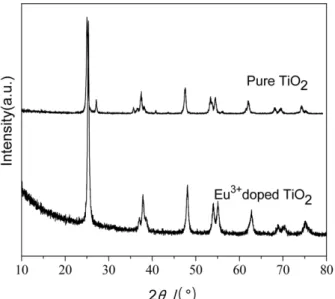
XRD is used to investigate the phase structure of the samples. The characteristic peaks of rutile and anatase are indicated in Fig. 1. Which showed that Eu

3+

doped TiO

2

nano-powder was dominated by anatase TiO

2

, this may be due to the low ion amount of dopants or their high dis- persion in samples.

Fig. 2. showed TEM images of calcined samples after calcination at 700

o

C. The micrographs showed the good electron diraction patterns, which indicated that the nano- particles had crystalline nature with good crystallinity. It was found that the crystalline size of Eu

3+

doped TiO

2

is 25-30 nm.

The absorption spectra of CPF were recorded in the absence and in presence of Eu

3+

doped TiO

2

(Fig. 3).

From Fig. 3. we can see in the region of 200 nm-300 nm, CPF has one characteristic absorption band with absorp-

tion maxima at 220 nm. After addition of different con- centration of Eu

3+

doped TiO

2

to CPF solution, the shape and band maxima of absorption spectra of CPF remain unchanged, but the intensities increased greatly. The flu- orescence spectra of Eu

3+

doped TiO

2

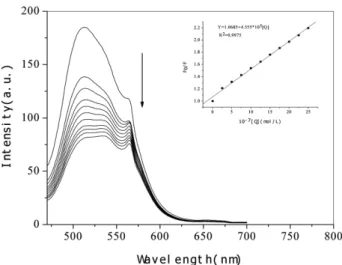
with varying con- centrations of CPF were shown in Fig. 4. it is clear that the fluorescence spectra of Eu

3+

doped TiO

2

remain unchanged.

The fluorescence quenching behaviour is usually described by Stern-Volmer relation:

6

(1)

where, F

0

and F are the fluorescence intensities in the absence and presence of quencher, respectively, K

SV

is the Stern-Volmer constant, [Q] the concentration of the quencher and τ

0

is the fluorescence lifetime of Eu

3+

doped TiO

2

. From the slope of the above plot (Fig. 4), the K

SV

values obtained were 4.56×10

5

L/mol and the fluores-

F

0

/F = 1 K +

SV

[ ] Q = K

q

τ

0

[ ] Q

Fig. 1. XRD of Eu

3+

doped TiO

2

and pure TiO

2

.

Fig. 2. TEM analysis of Eu

3+

doped TiO

2

.

Fig. 3. Absorption spectrum of CPF (2.5×10

-7

mol/L) in the

presence of Eu

3+

doped TiO

2

in theconcentration range of (2-

16)×10

-6

mol/L.

(3)

934 Fei Yao, Yang Sun, Chunlei Tan, Song Wei, Xiaojuan Zhang, Xiaoyun Hu, and Jun Fan

Journal of the Korean Chemical Society

cence lifetime of Eu

3+

doped TiO

2

was 3.67×10

-6

s, the K

q

value calculated was found to be 1.24×10

11

L/mol·s.

The decrease in fluorescence emission may be attrib- uted to the various possibilities such as energy transfer, electron transfer or ground state complex formation between the Eu

3+

doped TiO

2

and CPF.

The band gap energy of Eu

3+

doped TiO

2

(3.0 eV) is greater than the excited state energy (2.88 eV) of CPF and there is no overlap between the fluorescence emission spectrum of Eu

3+

doped TiO

2

with the absorption spectrum of CPF (Fig. 5), so the above two inferences excluded the possibility of energy transfer from Eu

3+

doped TiO

2

to CPF.

The possibility of surface complex formation between Eu

3+

doped TiO

2

and CPF was the result out for quench- ing of Eu

3+

doped TiO

2

by CPF. Nano-TiO

2

had large spe- cific surface area and strong adsorption capacity. With the

increasing concentration of CPF, it formed electric double layer on the surface, and impacted on the relation between surface states and of Eu

3+

doped TiO

2

and Fermi level,

7

it lead to carrier in the form of a non-radiative channels, thereby impacted on the luminescent of Eu

3+

doped TiO

2

. The ability of the excited state CPF to inject its elec- trons into the conduction band of Eu

3+

doped TiO

2

is determined by energy difference between the conduction band of Eu

3+

doped TiO

2

and oxidation potential of excited state CPF. The oxidation potential of excited state CPF is about -1.92 V (NHE),

8

The conduction band poten- tial of Eu

3+

doped TiO

2

is -0.5 V (NHE), it suggested that electron transfer from excited state CPF to the conduction band of Eu

3+

doped TiO

2

is energetically favorable. There- fore, we concluded that the uorescence quenching shown in Fig. 6 was caused by electron transfer.

The thermodynamic feasibility of the excited state elec- tron transfer reactions was calculated by employing the well-known Rehm-Weller expression:

9

(2)

Where, E

(ox)1/2

is the oxidation potential of CPF (0.51 V), E

(red)1/2

is the reduction potential of Eu

3+

doped TiO

2

, E

S

is the singlet state energy of CPF (2.49 eV) and C is the cou- lombic term. Since one of the species is neutral and the solvent used is polar in nature, the coulombic term in the above expression is neglected.

10

The Get value was cal- culated as -1.42 eV and this higher negative Get value indicates electron transfer process which is thermodyna- mically favorable.

The principle based on the fluorescence intensity of Eu

3+

doped TiO

2

change to detect residues of chlorpyrifos.

The standard curve of the detection of chlorpyrifos using Eu

3+

doped TiO

2

was shown in illustration (Fig. 4) . The

∆G

et

= E

1/2(OX)

– E

1/2(red)

– E

S

+ C Fig. 4. Fluorescence Quenching of Eu

3+

doped TiO

2

in the pres-

ence of various concentration of CPF(2.5-25)×10

-10

mol/L. The inset is the dependence of 1/(F

0

/F)on the reciprocal concentration of CPF.

Fig. 5. Absorption spectrum of CPF (A) and emission spectrum

of Eu

3+

doped TiO

2

(B). Fig. 6. Schematic energy level diagram.

(4)

2011, Vol. 55, No. 6

The Synthesis of Eu

3+

Doped with TiO

2

Nano-Powder and Application as a Pesticide Sensor 935

equation is F

0

/F=1.0685+4.555×10

5

[Q], there is a good linear relationship between concentration of CPF (5×10

-10

-2.5×10

-7

mol/L) and the fluorescence intensity of Eu

3+

doped TiO

2

, R=0.9975, the detection limit was 3.2×10

-11

mol/L and the recovery was 97.8%-98.8% (Table 2). This method had a wider range of pesticide concentration measurement compared with other detection methods (Table 1).

CONCLUSION

Based on the above results, the electron transfer mech- anism was proposed for the fluorescence quenching of Eu

3+

doped TiO

2

by CPF. This new rapid, simple and repro- ducible method should proved useful for detecting the res- idues of chlorpyrifos, but it can not determine the exact content of pesticide.

Acknowledgments. This work was supported by the National Natural Science Foundation of China (20876125).

REFERENCES

1. Jeanty, G.; Ghommidh, Ch.; Marty, J. L. Anal. Chim. Acta 2001, 436, 119.

2. Mauriz, E.; Calle, L, A.; Echuga, M.L. Anal. Chim. Acta 2006, 561, 40.

3. Pugliese, P.; Molto, J.C.; Damiani, P.; Marin, R.; Cossig- nani, L.; Manes, J. J. Chromatogr., A 2004, 1050, 185.

4. Reyzer, M. L.; Brodbelt, J. S. Anal. Chim. Acta 2001, 436, 11.

5. Liu, B. S.; He, X.; Zhao, X. J.; Zhao, Q. N. Spectroscopy and Spectral Analysis 2006, 26, 208.

6. Kathiravan, A.; Chandramohan, M.; Renganathan, R.;

Sekar, S. Spectrochim. Acta, Part A 2009, 71, 1783.

7. Liu, Y. G.; Tan, X. W.; Wang, Z.; Yao, J. C.; Xiong, Z. H.

J. Phys. Chem. 2008, 57, 5302.

8. Manisankar, P.; Viswanathan, S.; Mercy, A.; Pusphalatha, C.; Rani. Anal. Chim. Acta 2005, 528, 157.

9. Kavarnos, G. J.; Turro, N. J. Chem. Rev. 1986, 86, 401.

10. Parret, S.; Morlet-Savary, F.; Fouassier, J. P.; Ramamur- thy, P. J. Photochem. Photobiol., A 1994, 3, 205.

11. Chen, Y. P.; Ning, B. A.; Liu N. J. Environ. Sci. Health 2010, 45, 508.

12. Hua, X. D.; Qian, G. L.; Yang, J. F. Biosens. Bioelectron.

2010, 26, 189.

13. Viswanathan, S.; Radecka, H.; Radecki, J. Biosens. Bio- electron. 2009, 24, 2772.

14. Mauriz, E.; Calle, A.; Lechuga, L. M.; Quintana, J.; Mon- toya, A.; Manclus, J. J. Anal. Chim. Acta 2006, 561, 40.

Table 1. The detection method of chlorpyrifos

Detection method Range of detection (ng/mL) Detection limit ( µg/L) Recovery (%) References

Quantum dot 15.2-205.5 - 90.8-108.2 11

Immunochromatographic assay 50-12150 132.91 102.5-107.6 12

Electrochemical biosensor 0.003-350 0.0003 - 13

Resonance immunosensor 45-64 - 80-120 14

This methord 0.875-87.5 0.0112 97.8-98.8

Table 2. Precision and recovery (n=5)

Sample Dosage×10

-10

(mol/L) Recovery of spiked (mol/L) Recovery (%) RSD (%)

2.00 1.975 98.8 0.43

Chlorpyrifos 4.00 3.982 97.8 0.32

6.00 5.963 98.7 0.15

수치

Fig. 2. TEM analysis of Eu 3+  doped TiO 2 .
Fig. 5. Absorption spectrum of CPF (A) and emission spectrum
Table 1. The detection method of chlorpyrifos

참조

관련 문서

L097-1 Fisheries Commission Delegated Regulation (EU) 2016/568 of 29 January 2016 sup plementing Regulation (EU) No 1303/2013 of the European Parliament a nd of the

L019-1 Energy Commission Delegated Regulation (EU) 2016/89 of 18 November 2015 a mending Regulation (EU) No 347/2013 of the European Parliament and o f the Council as

They combine: application of emissions trading to new sectors and a tightening of the existing EU Emissions Trading System; increased use of renewable energy; greater

그러므로 ㉥ ‘김 선생님’은 현재의 담화 상황에 참여하지 않는 인물을 지칭하는 표현이라는 설명은 적절하다.. 그러므로 ㉤이 아버지가 지금까지 은주와 나눈 대화의 화제

*단어 사이의 공통성과

약국은 당초 수집 목적과 합리적으로 관련된 범위에서 정보주체에게 불이익이 발생하는지 여부, 암호화 등 안전성 확보에 필요한 조치를 하였는지 여부 등을

1 John Owen, Justification by Faith Alone, in The Works of John Owen, ed. John Bolt, trans. Scott Clark, &#34;Do This and Live: Christ's Active Obedience as the

(Taekwondo, Weight Lifting Players) (90 min × 6 days/week) Warming