• 검색 결과가 없습니다.

Deposition and Characterization of Electrophoretic Paint on AZ31 Magnesium Alloy

N/A
N/A
Protected

Academic year: 2021

Share "Deposition and Characterization of Electrophoretic Paint on AZ31 Magnesium Alloy"

Copied!
6
0
0

로드 중.... (전체 텍스트 보기)

전체 글

(1)

한국표면공학회지 J. Korean Inst. Surf. Eng.

Vol. 49, No. 2, 2016.

http://dx.doi.org/10.5695/JKISE.2016.49.2.141

<연구논문>

ISSN 1225-8024(Print) ISSN 2288-8403(Online)

Deposition and Characterization of Electrophoretic Paint on AZ31 Magnesium Alloy

Nguyen Van Phuong a , Sungmo Moon a,b,*

a

Surface Technology Division, Korea Institute of Materials Science, Gyeongnam 51508, Korea

b

Advanced Engineering, Korea University of Science and Technology, Daejeon 34113, Korea (Received February 15 , 2016 ; revised March 11, 2016 ; accepted March 14, 2016)

Abstract

In this study, electrophoretic paint (E-paint) was deposited on the knife-abraded surface of AZ31 magnesium alloy (AZ31), and its adhesion and corrosion resistance were examined by tape peel-test and salt spray test, respectively. E-paint started to deposit on AZ31 Mg alloy after an inductance time and pores were found in the E-paint layer which is ascribed to hydrogen bubbles generated on the surface during the painting process. The pores disappeared after curing for 15 min at 160

o

C. The E-paint on AZ31 exhibited good adhesion after immersion in deionized water for 500 h at 40

o

C. The E-paint sample without scratch showed no corrosion after 1500 h of salt spray test. However, on the scratched sample, blisters were visible adjacent to the scratched sites after 500 h of salt spray test.

Keywords : Magnesium alloy, Electrophoretic paint, Adhesion, Corrosion resistance

1. Introduction

Magnesium alloys (Mg alloys) exhibit the attractive combination of low densities and high specific strength, along with good damping capacity, castability, weldability and machinability [1-3]. However, unfortunately, Mg alloys are very susceptible to corrosion due to their high chemically activities ( = –2.356 V vs. SHE at 25

o

C) [4], hence, most commercial Mg alloys require corrosion protective coatings. Organic coatings such as painting, powder coating and electrophoretic paint (E-paint) have been used as the major barrier layer for corrosion protection and decorative purposes. The E- painting is one of the most important organic coating processes in automotive industry due to its excellent corrosion resistance and great covering ability on complex metallic components [5-8]. In the final stage

of the coating process, an organic coating is typically used to enhance the corrosion resistance and decorative purposes. In the E-paint process, charged powder particles, dispersed or suspended in a liquid medium are attracted and deposited onto a substrate with opposite charge on application of electric field.

If the particles are positively charged, the deposition of paint occurs on the cathode, which is called cathodic E-paint. The other case, when the particles are negatively charged, is the deposition on the anode, which is termed as anodic E-paint [5-8]. The cathodic E-paint process is a popular process in the automotive industry and it has been used successfully for many years on steels and aluminum alloys [6].

Although E-painting processes have been widely used in industries of steels and aluminum alloys, however, there is significant difference in electroche- mical corrosion behavior between Mg alloys and steels or Al alloys. Therefore, the deposition and the adhesion of the E-paint on Mg alloys could be also different from those of conventional metals. There are some concerns when E-painting process is applied to bare Mg alloys [9,10]: (1) Mg substrates E Mg 0

2+

/Mg

* Corresponding Author: Sungmo Moon

Surface Technology Division, Korea Institute of Materials Science

Tel: +82-55-280-3549 ; Fax: +82-55-280-3570

E-mail: [email protected]

(2)

and TZ61 Mg alloys in the view of alloying elements [12]. However, still there is lack of information about the deposition behavior and properties of E-paint on AZ31 Mg alloy in view of its adhesion and corrosion resistance.

In this study, E-paint was electrophoretically deposited on the knife-abraded surface of AZ31 Mg alloy and its adhesion was evaluated by tape peel-test with and without immersion in deionized water (DI) for 500 h at 40

o

C, and corrosion resistance was examined by salt spray test (SST) method according to ASTM D3359 standard [16].

2. Experimental

AZ31 Mg alloy (Posco, Korea) with composition (in weight percent) of Al, 2.9; Zn, 0.8; Mn, 0.3; Si

< 0.1; Fe, < 0.005; Cu, < 0.05; Ni, < 0.005; and Mg balance, was used in this study. The samples with a size of 100 × 50 × 1 mm were cut from a rolled AZ31 Mg alloy sheet. The samples were abraded using SiC abrasive papers successively from #220 up to # 2000 grit with ethanol. The SiC paper-abraded specimen surface was finally abraded by pressing and moving of a sharp blade on the Mg alloy surface and then cleaned by compressed air blowing to remove the surface residuals [13]. The samples were masked with a tape to leave an exposure area of 60 cm

2

(6 × 5 cm × 2 sides).

The electrophoretic paint (E-paint) was deposited on AZ31 Mg alloy using a commercial KED#2000P GRAY epoxy type electro-coat paint solution (Noroo, Korea). The E-paints were deposited cathodically on the AZ31 Mg alloy substrate using a stainless steel anode in moderately stirred 2 L of E-painting solution at 28 ± 1

o

C. The E-painting process was performed using a DC power-supply model N5771A (Agilent, United States) controlled by a LabVIEW computer- controlled program (National Instrument, United States). The deposition of paint was carried out at a constant current density of 1.67 mA/cm

2

initially

surface morphologies of uncured and cured E-paints before and after water immersion test at 40

o

C for 500 h.

The adhesion of the E-paint on AZ31 Mg alloy was tested on the samples before and after immersion in DI water for 500 h at 40

o

C using a tape peel-test method according to ASTM D3359 [15]. The surface of cured E-painted sample was scratched both vertically and horizontally, with a tool holding 11 cutting blades, with 1 mm separation from each other; thus leaving 100 small squares of 1 mm

2

E-paint. A strip of adhesive tape was applied to the scratched surface with a constant pressure, and then after about 1 min it was pulled off at an angle 90° to the plate surface.

The corrosion resistance of the E-painted AZ31 Mg alloy was investigated using a SST method according to ASTM B0117 [17]. The sample surface was scribed as “X” pattern by a sharp blade into the underlying metal through the E-paints, and then used for the SST. Changes in the surface appearance were examined with SST time using a Canon S95 digital camera.

3. Results and discussion

Figure 1 presents typical voltage-time and current- time curves of AZ31 Mg alloy during E-painting process. The E-painting was carried out initially by using a constant current mode and then a constant voltage controlled operations. The voltage increased instantaneously to about 5.2 V when a constant current density of 1.67 mA/cm

2

is applied to the sample and remained constant for about 20 seconds, after which it quickly increased to 180 V after about 70 seconds. In the second constant voltage mode at 180 V, the current decreased exponentially with increasing deposition time. The mechanism of the E- painting process by cathodic current was explained by two main reactions [6,7,12]:

(i) electrochemical decomposition of water to

generate OH

ions:

(3)

2H

2

O + 2e

→ H

2

+ 2OH

(1) (ii) electro-coagulation of the cationic resin micelles on the substrate surface through the neutralization reaction of positively charged groups of the resin with electrochemically generated OH

ions:

+ OH

→ + H

2

O (2)

The increase in the voltage to about 5.2 V at the initial stage in Fig. 1 could be attributed to (i) electrochemical decomposition of water on the cathode surface to generate OH

ions by reaction 1 and (ii) electrophoretic migration of the cationic resin micelles together with pigments towards the cathode under influence of the electric field [6,7,12]. After an induction time of about 20 seconds, paint is deposited at the cathode surface by the electro- coagulation process of reaction 2, and the voltage starts to increase fast as shown in Fig. 1. If the voltage reaches a limiting value of 180 V, the current decreases exponentially with time at constant voltage condition (Fig. 1), which indicates an increase in the electrical resistance of the E-paint layer due to its thickening. Finally, the current of the E-painting process tends to reach a constant steady-state value that could be due to the decomposition reaction of water in the E-paint layer and leaking of OH

-

ions through E- paint layer without reaction with the positively charged resins under lowered electric field [7,12].

The electrical resistance of the E-painting system can be calculated from the voltage and current relationship in Fig. 1, according to the Ohm’s law:

R

t

= E

t

/ I

t

(3)

where, R

t

, E

t

and I

t

are electrical resistance, voltage and current at time t, respectively.

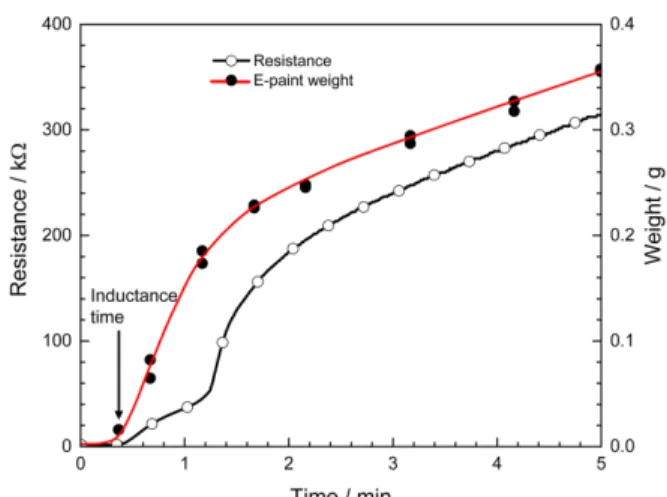
Figure 2 demonstrates the changes in the electrical resistance calculated from the data in Fig. 1 according to Ohm’s law and the amount of paint deposited on AZ31 Mg alloy calculated from the weights of sample measured before and after the E-painting process. During the initial stage, the electrical resistance of the sample was about 1.4 kΩ and the deposited weight was about zero. These indicate that there was not paint deposition but only electro- chemical decomposition of water on the cathode surface to generate OH

ions (Reaction 1) during the induction time. After an inductance time of about 20 seconds, the deposition of E-paint started to occur, as readily inferred from the rapid increases in both the electrical resistance of the sample and proved by a rapid increase of the amount of paint deposited on the surface (Fig. 2).

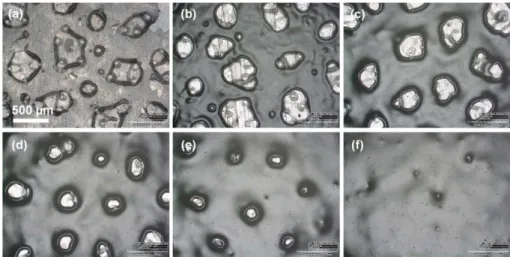
Figure 3 shows optical microscopy images of uncured E-paint on AZ31 Mg alloy with deposition time. The uncured E-paint includes many pores with a size of about 400 μm after 30 seconds, gradually decreasing with deposition time. The formation of pore can be explained by the generation of hydrogen bubbles on the surface during the E-painting process through reaction 1. With increasing deposition time, more paint was deposited on the surface, thereby resulting in thickening of the E-paint layer. The pore size therefore becomes gradually smaller with the growth of the E-paint layer.

Figure 4 shows optical microscopy images of E- paint on AZ31 Mg alloy deposited for 5 min and cured for 15 min at 160

o

C, taken at two different R NH – 3 + R NH – 2

Fig. 1. Typical voltage-time and current-time curves of

AZ31 Mg alloy during E-painting process. Fig. 2. Changes in electrical resistance and weight of

E-paint on AZ31 Mg alloy with electrophoretic

deposition time.

(4)

magnifications, observed before and after immersion test in DI water for 500 h at 40

o

C. The surface of the AZ31 Mg alloy was found to be covered by a continuous paint layer without any pores or cracks. It is noted that the pores disappeared completely after the curing process as shown in Fig. 4. During the curing process, evaporation of any remaining water and solvent occur and the resin is fused into irrever- sibly bound networked structures by polymerization together with binding particles (pigments). Thus, the pores in the E-paint disappear after the curing process.

After water immersion test of cured E-paint, some small blisters were observed on the surface (Figs. 4(c) and 4(d)). The formation of blisters can be explained by the penetration of water through the E-paint layer and reaction with AZ31 Mg alloy substrate to form corrosion products such as Mg(OH)

2

and hydrogen

bubbles. Blisters would grow if the corrosion products led to an increase in volume at the E-paint/

substrate interface.

Blistering after the water immersion test can decrease the adhesion of E-paint layer [12]. The E- paint on AZ31 Mg alloy with and without water immersion test was subjected to tape peel-tests to evaluate its adhesion according to the ASTM D3359 standard [16]. The optical microscopy images of cured E-paint on AZ31 Mg alloy after tape peel-test are shown in Fig. 5. The samples showed no E-paint detached from the surface, even after the long time immersion test in warm DI water, indicating good adhesion of the E-paint on the knife-abraded surface of AZ31 Mg alloy.

It was found that the adhesion of E-paint on Mg alloys depends on the alloying elements, such as Al or Sn [12]. The E-paint on TZ61 exhibited much Fig. 3. Optical microscopy images of uncured E-paints on AZ31 Mg alloy with deposition time of (a) 15 s, (b) 30 s, (c) 1 min, (d) 2 min, (e) 3 min and (f) 5 min.

Fig. 4. Optical microscopy images of cured E-paints on AZ31 Mg alloy taken at two different magnifications (a, b) before and (c, d) after water immersion test for 500 h at 40

o

C.

Fig. 5. Optical microscopy images of cured E-paints

on AZ31 Mg alloy after tape peel-test (a, b) before and

(c, d) after water immersion test.

(5)

better adhesion than that on AZ61 sample after water immersion test. This was attributed to the fact that the bonding between Al

2

O

3

and E-paint becomes weakened faster than that between SnO

2

and E-paint during the water immersion test.

In this study, the E-paint deposited on the knife- abraded surface of AZ31 Mg alloy exhibited good adhesion after water immersion test even though some blisters were formed under the E-paint layer.

These represent that the bonding between the E-paint and air-formed oxide film on AZ31 Mg alloy was not significantly weakened during DI water immer- sion test up to 500 h at 40

o

C. Considering that the E- paint on the knife abraded surface of AZ61 Mg alloy was not good after the water immersion test [12], it is reasonable to infer that the amount of Al in Mg alloy affects the bonding between the E-paint and the alloy surface. The adhesion of E-paint seems to be also related with the composition and porosity of air- formed oxide film on Mg alloy.

Figure 6 depicts surface appearances of non- scratched E-paint on AZ31 Mg alloy after SST for 800 h and 1500 h, according to the ASTM B117 standard [17]. The sample showed no blisters or delamination of paint up to 1500 h of SST time, suggesting that the E-paint can provide very good corrosion resistance on the AZ31 Mg alloy if there are not any scratches on the surface. This also suggests no pores or imperfections remaining in the cured E-paint layer adapted on AZ31 Mg alloy in this work.

However, on the scratched samples, blisters were become visible after 500 h of SST time along the scratched lines, as can be seen in Fig. 7. The blisters of E-painted AZ31 Mg alloy can occur due to corrosion reaction, resulting from the ingress of water and chloride ions through the E-paint/alloy interface during the exposure of the substrate to a corrosive medium. To avoid this problem, better adhesion of E-paint on the alloy surface is needed.

Better adhesion of E-paint can be achieved using an intermediate layer such as chemical conversion coating or plasma electrolytic oxidation coating formed before the E-painting process.

4. Conclusions

Electrophoretic paint (E-paint) was deposited on the knife-abraded surface of AZ31 Mg alloy, and its adhesion and corrosion resistance were examined by tape peel-test before and after immersion in deionized water for 500 h at 40

o

C and salt spray test, respectively.

Following main conclusions can be drawn from this study.

Formation voltage and weight of E-paint on AZ31 Mg alloy showed rapidly increases after an inductance time of about 20 seconds, indicating that E-paint can start to deposit only after an inductance time.

Hydrogen bubbles were observed on the AZ31 Mg alloy surface during the E-painting process, and pores in the E-paint layer were found after electro- phoretic painting. The size of pores in the E-paint layer decreased with increasing deposition time. The pores disappeared after curing for 15 min at 160

o

C.

The E-paints on AZ31 after curing exhibited good adhesions before and after immersion in deionized water for 500 h at 40

o

C.

Non-scratched E-painted AZ31 Mg alloy sample showed no blisters or delamination of the E-paint up to 1500 h of SST time. For the scratched sample, the blisters were not visible after 300 h of SST test time but they appeared after 500 h of SST time along the scratched lines.

Fig. 6. Photographs of non-scratched E-painted AZ31 after salt spray test for (a) 800 h and (b) 1500 h.

Fig. 7. Photographs of scratched E-painted AZ31

after salt spray test for (a) 0 h, (b) 100 h, (c) 300 h

and (d) 500 h.

(6)

Technology: Metallurgy, Design Data, Applications, Springer, Berlin (2006).

[2] Y. Kojima, Platform Science and Technology for Advanced Magnesium Alloys, Mater. Sci. Forum, 350 (2000) 3–18.

[3] Kainer KU. Magnesium Alloys and their Applications, Wiley-VCH Verlag GmbH (2006).

[4] CRC handbook of Chemistry and Physics. 61

st

ed. CRC Press Inc. (1980-81).

[5] J.E. Gray, B. Luan, Protective coatings on magnesium and its alloys – a critical review, J. Alloy Compd., 336 (2002) 88-113.

[6] L. Besra, M. Liu, A review on fundamentals and applications of electrophoretic deposition (EPD), Prog. Mater. Sci., 52 (2007) 1-61.

[7] F. Beck, Fundamental aspects of electrodeposition of paint, Prog. Org. Coat., 4 (1976) 1-60.

[8] N.V. Phuong, K.H. Lee, D. Chang, M. Kim, S.

Lee, S. Moon, Zinc phosphate conversion coatings on magnesium alloys - a review, Met. Mater. Int., 19 (2013) 273-281.

[12] N.V. Phuong, S. Moon, Deposition and characteri- zation of E-paint on magnesium alloys, Prog. Org.

Coat. 89 (2015) 91-99.

[13] S. Moon, A blade-abrading method for surface pretreatment of Mg alloys, J. Kor. Inst. Surf. Eng., 48 (2015) 194-198.

[14] N.M. Aćamović, D.M. Dražić, V.B. Mišković- Stanković, Influence of substrate on the formation and growth kinetics of cathodic electrocoat paint, Prog. Org. Coat., 25 (1995) 293–307.

[15] C.M. Reddy, R.S. Gaston, C.M. Weikart, H.K.

Yasuda, Influence of surface pretreatment and electrocoating parameters on the adhesion of cathodic electrocoat to the Al alloy surfaces, Prog.

Org. Coat., 33 (1998) 225–231.

[16] ASTM standard D3359-02, ASTM International, 06.01 (2004).

[17] ASTM standard B117-03, ASTM International,

03.02 (2004).

수치

Figure 2 demonstrates the changes in the electrical resistance calculated from the data in Fig
Fig. 4. Optical microscopy images of cured E-paints on AZ31 Mg alloy taken at two different magnifications (a, b) before and (c, d) after water immersion test for 500 h at 40 o C
Figure 6 depicts surface appearances of non- non-scratched E-paint on AZ31 Mg alloy after SST for 800 h and 1500 h, according to the ASTM B117 standard [17]

참조

관련 문서

The corrosion behaviors of Al5454 alloy was investigated by potentiodynamic and potentiostatic polarization tests in 5 wt.% NaCl solution.. The pitting potential of the

In this study, surface characterization of Mg-doped hydroxyapatite coatings on Ti-25Ta-xHf alloys after plasma electrolytic oxidation(PEO) for dental implants

The corrosion potential(E corr ), corrosion current density(I corr ), and corrosion rate of Ni-Ti files obtained from anodic polarization curves after electrochemical

In this study, in order to increase corrosion resistance and biocompatibility of Cp-Ti and Ti-6Al-4V alloy that surface of manufactured alloy was coated with TiN

From the results of Micro Vickers hardness test, Ti- 40Hf alloy showed significantly increasing of hardness and tensile strength than others in the case of

These results suggest that, the ZrN coated Ti-Nb alloy is a good corrosion resistance for dental implant compared with non-coated Ti-Nb alloy... The

GDP impact of COVID-19 spread, public health response, and economic policies. Virus spread and public

Micro- and nano-sized pores were formed on the surface of the alloy using PEO and anodization methods, and the pore shape change according to the Zr