․교신저자: 박양춘 충북 청주시 상당구 용담동 173-9번지 대전대학교 청주한방병원 내과
TEL: 043-229-3704 FAX: 043-253-8757 E-mail: [email protected]
만성폐쇄성폐질환의 보완대체의학 임상연구 동향
윤종만, 박양춘
대전대학교 한의과대학 폐계내과학교실
Research Trends for Chronic Obstructive Pulmonary Disease in Complementary and Alternative Medicine
Jong-man Yoon, Yang-chun Park
Division of Respiratory System, Department. of Internal Medicine, College of Oriental Medicine, Dae-Jeon University ABSTRACT
Objectives :
This study analyzed the contents of research papers of complementary and alternative medicine (CAM) concerning chronic obstructive pulmonary disease (COPD) published in PubMed during the last 5 years. This study was conducted to help clinical studies for treating COPD with Oriental medicine.
Materials and Methods :
We inspected 31 theses and scrutinized their objectives, periods, participants, materials and methods, methods of assessment, results and Jadad score.
Results :
The treatments in the studies were supplements, physical training, acupuncture, acu-TENS, Bojungikgi-tang (Buzhongyiqi-tang), counseling, breathing training, osteopathic manipulative treatment, reflexology, and distractive auditory stimuli. The aims of treatment were improvement of exercise capacity, lung function, quality of life, oxidative status, nutrient status, systemic inflammation, and cessation of smoking. The median for treatment period of study was 8 weeks, the median number of participants was 35 and the differences between mean FEV
1from groups were less than 10% in 22 studies. The methods of assessment were lung function test, exercise capacity test, muscle strength test, questionnaire of QoL, laboratory studies, and measurement of nutrient state. The mean of Jadad score was 2.4 ± 1.03, and 24 treatment were assessed as effective.
Conclusion :
Recent CAM studies of COPD have focused on various topics in alternative and complementary medicine, and it is necessary to provide objective studies for treatment of this disease with Oriental medicines.
Key words : Chronic obstructive pulmonary disease, Complementary and alternative medicine, Systemic review
Ⅰ. 서 론
만성폐쇄성폐질환 (Chronic Obstructive Pulmonary Disease: COPD)은 유병률, 사망률, 질병관리비용 의 측면에서 세계적으로 큰 부담이 되는 질환으로
전체 사망원인으로 1990년에는 6위였으나 2020년에
는 3위가 되리라 예측되고 또한 질환으로 인한 장
애의 원인으로는 4위가 될 것으로 예측되고 있다 1 .
우리나라에서도 COPD는 유병률이 7.7%에 이르고
있으며 사망률도 인구 십만 명당 14.5명으로 국내
10대 사망원인에 해당한다 2,3 . 이와 같은 질환의 중
요성에 맞추어 COPD에 대한 연구도 지속적으로
증가하고 있어 이에 대한 간접지표로서 관련 연구
문헌의 발표량을 살펴보면 2000년도에는 1천 여건
이었으나 2007년도에는 2천5백 여건으로 나타났다 4 . COPD는 부분적으로만 가역적인 기류제한이 점 차 진행되는 양상을 보이는 질환으로 현존하는 어 떤 약제도 폐기능이 장기간에 걸쳐 계속 감소되는 것을 완화시키지는 못하는 것으로 알려져 있다 5 . 따라서 COPD에 대한 치료는 증상 발현의 예방과 완화, 악화 횟수와 중증도의 감소, 건강 상태 향상, 운동 감내 능력 증진 등의 목적으로 시행되고 있 으며 보완대체의학 영역의 치료법들에 대한 연구 도 다양하게 시도되고 있다 6 .
한의학에서 COPD는 咳嗽, 痰飮, 肺脹, 喘證의 범주에 해당하는 것으로 보아 만성기관지염의 양 상의 급성기에는 宣肺解表 및 斂肺하고 완해기에 는 補肺健脾益腎하며 폐기종 양상의 肺虛型은 益 氣定喘하고 肺脾兩虛型은 健脾益氣하고 腎虛型은 補腎陰腎陽하는 치법을 제시하고 있다 7 . 그러나 COPD에 대한 문헌논문 8,9 과 증례논문 10 이외에 한 의학 치료를 대상으로 그 효과를 검토하기 위한 본격적인 임상연구는 아직 찾아보기 어려웠다.
따라서 본 연구에서는 PubMed 검색을 통해 COPD의 보완대체의학 치료에 대한 최근 5년간의 세계적인 임상연구 경향과 특성을 살펴봄으로써 한의학에서의 COPD 치료에 대한 임상연구의 기 초자료 마련에 도움이 되고자하였다.
Ⅱ. 대상 및 방법
1. 연구 대상
Pubmed에서 검색어는 “chronic obstructive pulmonary diseased” 또는 “COPD”로, 검색 조건은 Default Tag영역에서는 Title을 선택하였고, 기간영역에서 는 published in the last 5 years, Humans or Animals영역에서는 Humans, Languages영역에서는 English, Topics영역에서는 Complementary Medicine, Type of Article영역에서는 Randomized Controlled Trial을 조건으로 검색하여 총 34편의 논문이 검색 되었으며, 이중 보완대체의학과 무관한 2편과 철회
된 논문 1편을 제외한 총 31편을 살펴보았다.
2. 연구 방법
총 31편의 논문을 발행일 순서로 번호를 부여하 여 각 논문의 연구 대상 치료법과 연구목적에 대 하여 살펴보았고, 참여자 특징 (참여자 수, 최종 분 석 대상자 수, 탈락률 및 1초간 노력성 폐활량)과 개인별 임상시험 참여 기간에 대하여 살펴보았다.
연구목적에 따른 평가방법에 대하여 분석하였고, 각 연구의 intervention이 유의한 효과를 나타내었 는지에 대하여 연구결과를 살펴보았으며, JADAD score에 따라 2명의 저자가 이중평가를 통하여 연 구의 질 평가를 시행하였다.
3. 연구 내용
다음과 같이 검색된 31편의 논문에 대해 살펴보 았다.
1) 만성폐쇄성폐질환의 산화-항산화 상태에 대 한 표준치료에 병행하는 비타민 E 공급의 효과 11
2) 안정상태 COPD에서 식사 상담과 영양강화 식이: 무작위배정 연구 12
3) 만성폐쇄성폐질환의 치료에서 침치료의 효과 13 4) 단회의 Acu-TENS가 만성폐쇄성폐질환 환자 의 FEV 1 을 증가시키고 호흡곤란을 감소시킨다:
무작위 placebo 대조군 연구 14
5) 자발성 pursed lip breathing이 중등증-중증 만성폐쇄성폐질환 환자의 보행지속과 산소포화도 에 미치는 영향 15
6) 고령 만성폐쇄성폐질환 환자에서 정골수기요 법의 즉시 효과 16
7) 만성폐쇄성폐질환에서 신체운동의 추가요법 으로서의 creatine 식이에 대한 무작위배정 대조군 연구 17
8) 만성폐쇄성폐질환 환자에서 zinc picolinate의 항산화 효과 18
9) 만성폐쇄성폐질환 환자에서 비타민 E와 비타
민 C의 공급 19
10) 만성폐쇄성폐질환 환자에서 ventilating-feedback 훈련은 운동 지구력을 증가시킬 수 있는가? 20
11) 만성폐쇄성폐질환 환자에서 Creatine 공급과 신체운동: 이중맹검 위약대조군 연구 21
12) 만성폐쇄성폐질환 환자의 호흡재활프로그램 에서 흡기근 훈련 22
13) 만성폐쇄성폐질환 환자에서 Hochuekti-to (보 중익기탕)은 전신적 염증을 개선시킨다 23
14) 집중적 또는 대략적인 상담 중 COPD 환자 금연의 예상되는 결정요인 24
15) 중등증-중증 만성폐쇄성폐질환 환자에서 간 호사에 의한 추가적 지지는 대략적 금연 중재를 증강시키는가? 25
16) 중환자실에 입원한 만성폐쇄성폐질환 환자 에서 단기적 beta-hydroxy-beta-methylbutyrate 공 급의 항염증 및 항이화 효과 26
17) 중증의 기능이상 및 영양부족 만성폐쇄성폐 질환에서 1개월간 전기 자극 후 대퇴 사두근 근력 과 일상활동 호흡곤란의 개선 27
18) 만성폐쇄성폐질환 환자의 반사학 (reflexology) 효과를 시험하는 무작위배정 대조군 연구 28
19) 전신 및 호흡근 훈련 프로그램에 참가한 만 성폐쇄성폐질환 환자를 위한 운동보조물로서의 L-carnitine 29
20) 중증 COPD 환자의 정신사회적 병적 상태 에 대한 호흡재활의 효과 30
21) 호흡근 지구력 훈련으로 기인하는 COPD 환자의 운동 수행 개선 31
22) COPD 환자에서 1년간의 특별 흡기근 훈련 의 효과 32
23) 비자발성 pursed lip breathing 만성폐쇄성폐 질환 환자의 보행거리에 대한 pursed lip의 즉시효 과 평가 33
24) 만성폐쇄성폐질환에서 Pomegrante juice의 공급: 5주 무작위배정, 이중맹검, 위약대조군 연구 34
25) 호흡 재활훈련을 받는 COPD 환자에서 호
흡근 지구력 훈련의 효과 35
26) 만성폐쇄성폐질환에서 흡기근 훈련은 최대 흡기유속을 증가시킨다 36
27) 만성폐쇄성폐질환의 호흡재활치료 중 Creatine 의 공급 37
28) 만성폐쇄성폐질환의 관리에서 식물기원 처 방: 무작위배정 이중맹검 연구 38
29) 만성폐쇄성폐질환 환자의 상지 훈련에 대한 청각자극 (dustractive auditory stimuli, DAS)의 가능성 39
30) 고령 COPD 환자에서 중량 저항성 훈련은 근육 크기, 근력, 신체적 기능을 증가시킨다: 예비 연구 40
31) 만성폐쇄성폐질환 환자 급성 악화 입원기간 의 영양공급 41
Ⅲ. 결 과
1. 연구 대상 치료법 및 연구 목적
연구 대상 치료법으로는 식이 보충제가 11편
11,17-19,21,26,29,34,37,38,41 , 호흡재활치료를 포함한 신체훈
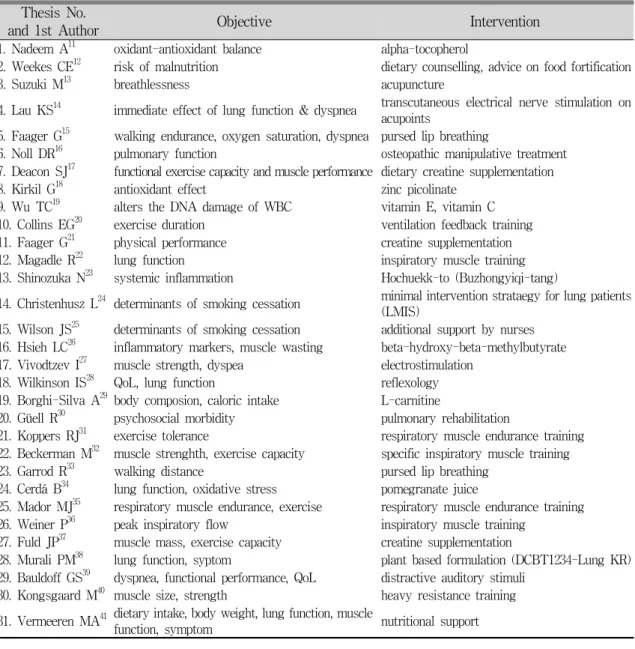
련이 8편 22,27,30-32,35,36,40 , 한의학 치료가 각각 침치료 13 , TENS를 이용한 경혈자극 14 , 보중익기탕 23 을 대상으 로 하여 3편, 상담에 대한 연구가 3편 12,24,25 , 호흡법 에 대한 연구가 3편 15,20,33 , 기타 정골요법 16 , 반사요 법 28 , 청각자극요법 39 에 대한 연구가 각각 1편이었 다(Fig. 1A, Table 1).
연구의 직접 목적으로는 운동능력 향상에 대한 연구가 11편 15,17,20,21,27,31-33,35,37,40 , 폐기능 개선에 대한 연구가 5편 14,16,22,36,38 , 증상 및 삶의 질 개선에 대한 연구가 4편 13,28,30,39 , 항산화효과에 대한 연구가 4편
11,18,19,34 이었고, 이외 영양상태의 개선을 목적으로
하는 연구가 3편 12,29,41 , 전신적 염증상태의 개선에
대한 연구가 2편 23,26 , 금연에 대한 연구가 2편 24,25 이
었다(Fig. 1B, Table 1).
Fig. 1. The Classification of Interventions (A) and Objectives (B) in Each Studies.
Thesis No.
and 1st Author Objective Intervention
1. Nadeem A11 oxidant-antioxidant balance alpha-tocopherol
2. Weekes CE12 risk of malnutrition dietary counselling, advice on food fortification
3. Suzuki M13 breathlessness acupuncture
4. Lau KS14 immediate effect of lung function & dyspnea transcutaneous electrical nerve stimulation on acupoints
5. Faager G15 walking endurance, oxygen saturation, dyspnea pursed lip breathing
6. Noll DR16 pulmonary function osteopathic manipulative treatment 7. Deacon SJ17 functional exercise capacity and muscle performance dietary creatine supplementation
8. Kirkil G18 antioxidant effect zinc picolinate
9. Wu TC19 alters the DNA damage of WBC vitamin E, vitamin C 10. Collins EG20 exercise duration ventilation feedback training 11. Faager G21 physical performance creatine supplementation
12. Magadle R22 lung function inspiratory muscle training
13. Shinozuka N23 systemic inflammation Hochuekk-to (Buzhongyiqi-tang)
14. Christenhusz L24 determinants of smoking cessation minimal intervention strataegy for lung patients (LMIS)
15. Wilson JS25 determinants of smoking cessation additional support by nurses 16. Hsieh LC26 inflammatory markers, muscle wasting beta-hydroxy-beta-methylbutyrate 17. Vivodtzev I27 muscle strength, dyspea electrostimulation
18. Wilkinson IS28 QoL, lung function reflexology
19. Borghi-Silva A29 body composion, caloric intake L-carnitine
20. Güell R30 psychosocial morbidity pulmonary rehabilitation
21. Koppers RJ31 exercise tolerance respiratory muscle endurance training 22. Beckerman M32 muscle strenghth, exercise capacity specific inspiratory muscle training
23. Garrod R33 walking distance pursed lip breathing
24. Cerdá B34 lung function, oxidative stress pomegranate juice
25. Mador MJ35 respiratory muscle endurance, exercise respiratory muscle endurance training 26. Weiner P36 peak inspiratory flow inspiratory muscle training
27. Fuld JP37 muscle mass, exercise capacity creatine supplementation
28. Murali PM38 lung function, syptom plant based formulation (DCBT1234-Lung KR) 29. Bauldoff GS39 dyspnea, functional performance, QoL distractive auditory stimuli
30. Kongsgaard M40 muscle size, strength heavy resistance training 31. Vermeeren MA41 dietary intake, body weight, lung function, muscle
function, symptom nutritional support
Table 1. Summary of Objectives and Interventions in Each Studies
Thesis No.
and 1st Author Period of
Intervention (wk) No. of
Enrollment No. of Data for
Analysis F/U(%) Range of FEV 1
(% pred.)
1. Nadeem A11 8 30 24 80 39.5 - 45.4
2. Weekes CE12 12 66 59 89 31.7 - 31.9
3. Suzuki M13 10 30 30 100 45.5 - 50.2
4. Lau KS14 1 (day) 46 46 100 68 - 74
5. Faager G15 1 50 32 64 22 - 89
6. Noll DR16 1 (day) 35 35 100 1.22 - 1.26 (Litter)
7. Deacon SJ17 8 100 80 80 43.0 - 45.2
8. Kirkil G18 8 NR 30 NA 42.7 - 42.9
9. Wu TC19 12 NR 35 NA 51 - 56
10. Collins EG20 6 64 49 77 41 - 46
11. Faager G21 8 NR 23 NA 42 - 44
12. Magadle R22 9 (month) 34 28 82 45 - 46
13. Shinozuka N23 6 (month) NR 35 NA 40.7 - 45.4
14. Christenhusz L24 12 (month) 234 225 96 64.6 - 65.8
15. Wilson JS25 5 91 78 86 52.1 - 54.6
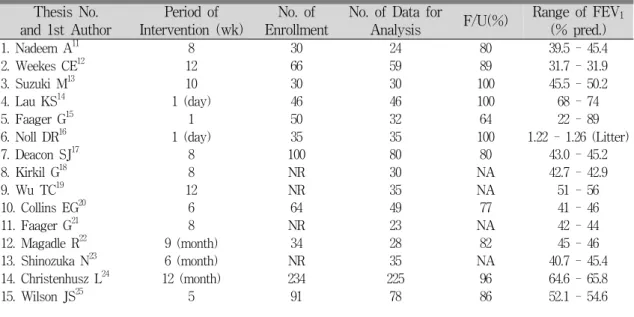
Table 2. Information for Period of Interventions and Participants in Each Studies 2. 참여자 특징 및 참여기간
Intervention이 이루어진 시기인 개인의 임상시 험 참여 기간은 중앙값이 8주, 1사분위수와 3사분 위수는 각각 4.5주와 12주였다. 31편의 연구 중 64.5%에 해당하는 20편 11-13,17-21,25-31,34-36,39,40 의 연구에 서 개인의 시험 참여기간이 4주에서 16주 사이로 나타났다(Fig. 2A, Table 2).
시험 참여 당시 피험자의 1초간 노력성폐활량 (FEV 1 , % 예측치)이 기재된 연구는 27편 11-15,17-25, 27,29-37,39-41 이었고 그 중 8편 11,13-15,18,19,37,41 에서 GOLD (NHLBI/WHO Global Initiative for Chronic
Obstructive Lung Disease) 기준을 사용하였으며,
18편 11,12,20-23,28-30,32-37,39-41 에서 FEV 1 (% 예측치) 평
균의 분포가 30% 이상 50% 미만의 범위에 있었 고, 81.5%에 해당하는 22편 12-15,17-25,27,29-33,35,37,40 의 연 구에서 FEV 1 (% 예측치) 평균의 군간 범주가 10%를 넘지 않았다(Fig 2B, Table 2).
임상시험 참여자수는 시험 개시 당시 중앙값이 35명, 1사분위수와 3사분위수는 각각 30명과 53명 이었고, 탈락여부가 기재된 25편의 연구에서 탈락 률은 13.7%로 나타났다(Table 2).
Fig. 2. The Period of Intervention (A) and Range of FEV 1 (% pred.) (B) in Each sSudies.
16. Hsieh LC26 7 34 34 100 NR
17. Vivodtzev I27 4 17 17 100 27 - 34
18. Wilkinson IS28 4 20 14 70 NR
19. Borghi-Silva A29 6 16 16 100 36 - 38
20. Güell R30 16 40 35 88 32 - 38
21. Koppers RJ31 5 39 36 92 50 - 58
22. Beckerman M32 1 (year) 42 35 83 42 - 43
23. Garrod R33 1 (day) 69 63 91 40.0 - 46.1
24. Cerdá B34 5 NR 30 NA 35.1 - 46.0
25. Mador MJ35 5 38 29 76 43.6 - 45.1
26. Weiner P36 8 28 28 100 38 - 74
27. Fuld JP37 2 36 25 69 45.4
28. Murali PM38 24 135 105 78 1.22 - 1.46 (Litter)
29. Bauldoff GS39 4 NR 30 NA 33.8 - 46.1
30. Kongsgaard M40 12 18 13 72 44 - 48
31. Vermeeren MA41 9 (day) 56 47 84 34 - 45
NR: not reported, NA: not applicable
3. 유효성 평가 방법
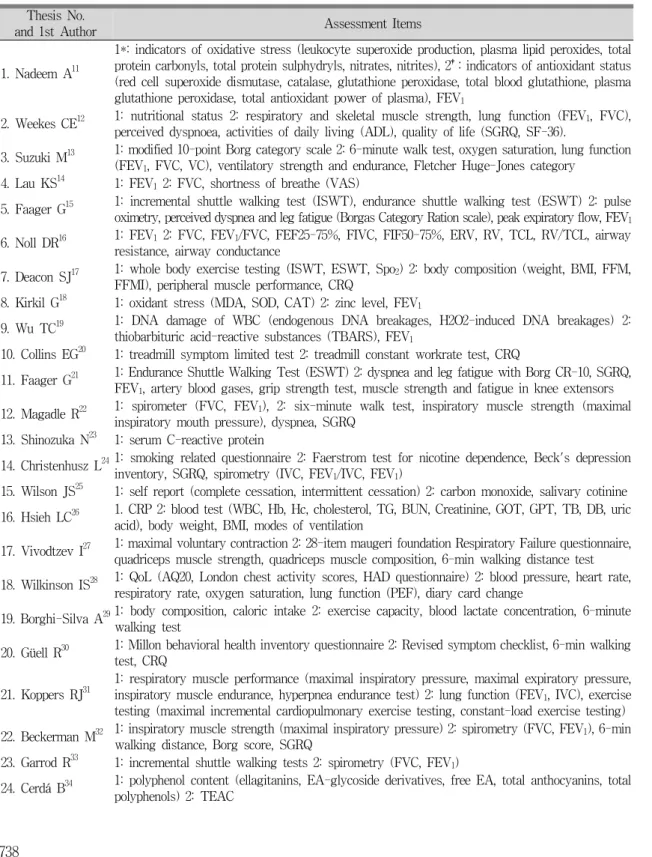
사용된 유효성 평가의 측정항목은 폐기능검사 19편 11-16,18-21,24,26,28,31-33,36,38,41 , 운동능력 및 근력 평가 18편 12,13,15,17,20-22,27,29-33,35,37,39-41 , 증상 및 삶의 질 평가 18편 12-15,17,20-22,24,27,28,30,32,35,37-39,41 , 병리검사 13편 11,13,15,18,
19,21,23,25,26,29,34,38,41 , 체성분 및 영양상태 측정이 6편
12,17,26,29,37,41 이었다(Table 3).
폐기능 관련 평가는 피험자 선정시에는 모든 연 구에서 측정되었으나 평가 항목으로 제시된 연구 는 19편으로 폐쇄성 환기장애의 주요지표인 FEV 1 , FVC, PEF가 주로 측정되었으며 이중 FEV 1 이 가 장 높은 빈도 11-16,18,19,21,22,24,31-33,36,38,41 를 차지하였다.
증상 및 삶의 질 평가는 St. George's Respiratory Questionnaire가 7편 12,21,22,24,32,37,39 으로 가장 많이 사 용되었고, Chronic Respiratory Disease Questionnaire
17,20,30,35 와 Borg Category Scale 13,15,21,32 이 각각 4편에 서 사용되었으며 visual analog scale을 이용한 호 흡곤란 평가가 2편 14,41 , 기타 Activities of Daily Living 12 , Fletcher Huge-Jones Category 13 , Smoking
Related Questionnaire 24 , Beck's Depression Inventory 24 , Respiratory Failure Questionnaire 27 , Airway Questionnaire 20 28 , London Chest Activity Scores 28 , HAD Questionnaire 28 , Millon Behavioral Health Inventory Questionnaire 30 , University of California at San Diego Shortness of Breath Questionnaire 39 등이 사 용되었다.
병리검사는 혈액가스농도분석이 6편 13,15,21,25,38,41 , 항산화 관련 검사가 4편 11,18,19,34 , 일반혈액검사 및 생화학검사가 2편 23,26 , 식이보충제 혈중농도 검사가 1편 18 , 혈액젖산검사가 1편 29 이었다.
운동능력 및 근력평가는 6분 보행검사 6편
13,27,29,30,32,35 , endurance shuttle walking test 15,17,21,37 와 incremental shuttle walking test 15,17,33,37 가 각각 4편 이었고 근력평가는 호흡근 12,13,22,31,32,35 및 이외 근육
12,21,27,37,40,41 의 평가가 각각 6편이었다.
체성분 및 영양상태 평가는 체성분 검사가 5편
17,26,29,37,41 , 섭취량 평가가 2편 12,41 이었다.
Thesis No.
and 1st Author Assessment Items
1. Nadeem A11
1*: indicators of oxidative stress (leukocyte superoxide production, plasma lipid peroxides, total protein carbonyls, total protein sulphydryls, nitrates, nitrites), 2†: indicators of antioxidant status (red cell superoxide dismutase, catalase, glutathione peroxidase, total blood glutathione, plasma glutathione peroxidase, total antioxidant power of plasma), FEV1
2. Weekes CE12 1: nutritional status 2: respiratory and skeletal muscle strength, lung function (FEV1, FVC), perceived dyspnoea, activities of daily living (ADL), quality of life (SGRQ, SF-36).
3. Suzuki M13 1: modified 10-point Borg category scale 2: 6-minute walk test, oxygen saturation, lung function (FEV1, FVC, VC), ventilatory strength and endurance, Fletcher Huge-Jones category
4. Lau KS14 1: FEV12: FVC, shortness of breathe (VAS)
5. Faager G15 1: incremental shuttle walking test (ISWT), endurance shuttle walking test (ESWT) 2: pulse oximetry, perceived dyspnea and leg fatigue (Borgas Category Ration scale), peak expiratory flow, FEV1 6. Noll DR16 1: FEV12: FVC, FEV1/FVC, FEF25-75%, FIVC, FIF50-75%, ERV, RV, TCL, RV/TCL, airway
resistance, airway conductance
7. Deacon SJ17 1: whole body exercise testing (ISWT, ESWT, Spo2) 2: body composition (weight, BMI, FFM, FFMI), peripheral muscle performance, CRQ
8. Kirkil G18 1: oxidant stress (MDA, SOD, CAT) 2: zinc level, FEV1
9. Wu TC19 1: DNA damage of WBC (endogenous DNA breakages, H2O2-induced DNA breakages) 2:
thiobarbituric acid-reactive substances (TBARS), FEV1
10. Collins EG20 1: treadmill symptom limited test 2: treadmill constant workrate test, CRQ
11. Faager G21 1: Endurance Shuttle Walking Test (ESWT) 2: dyspnea and leg fatigue with Borg CR-10, SGRQ, FEV1, artery blood gases, grip strength test, muscle strength and fatigue in knee extensors 12. Magadle R22 1: spirometer (FVC, FEV1), 2: six-minute walk test, inspiratory muscle strength (maximal
inspiratory mouth pressure), dyspnea, SGRQ 13. Shinozuka N23 1: serum C-reactive protein
14. Christenhusz L241: smoking related questionnaire 2: Faerstrom test for nicotine dependence, Beck's depression inventory, SGRQ, spirometry (IVC, FEV1/IVC, FEV1)
15. Wilson JS25 1: self report (complete cessation, intermittent cessation) 2: carbon monoxide, salivary cotinine 16. Hsieh LC26 1. CRP 2: blood test (WBC, Hb, Hc, cholesterol, TG, BUN, Creatinine, GOT, GPT, TB, DB, uric
acid), body weight, BMI, modes of ventilation
17. Vivodtzev I27 1: maximal voluntary contraction 2: 28-item maugeri foundation Respiratory Failure questionnaire, quadriceps muscle strength, quadriceps muscle composition, 6-min walking distance test 18. Wilkinson IS28 1: QoL (AQ20, London chest activity scores, HAD questionnaire) 2: blood pressure, heart rate,
respiratory rate, oxygen saturation, lung function (PEF), diary card change
19. Borghi-Silva A291: body composition, caloric intake 2: exercise capacity, blood lactate concentration, 6-minute walking test
20. Güell R30 1: Millon behavioral health inventory questionnaire 2: Revised symptom checklist, 6-min walking test, CRQ
21. Koppers RJ31 1: respiratory muscle performance (maximal inspiratory pressure, maximal expiratory pressure, inspiratory muscle endurance, hyperpnea endurance test) 2: lung function (FEV1, IVC), exercise testing (maximal incremental cardiopulmonary exercise testing, constant-load exercise testing) 22. Beckerman M32 1: inspiratory muscle strength (maximal inspiratory pressure) 2: spirometry (FVC, FEV1), 6-min
walking distance, Borg score, SGRQ
23. Garrod R33 1: incremental shuttle walking tests 2: spirometry (FVC, FEV1)
24. Cerdá B34 1: polyphenol content (ellagitanins, EA-glycoside derivatives, free EA, total anthocyanins, total polyphenols) 2: TEAC
Table 3. The Methods for Measurement of Outcomes in Each Studies
25. Mador MJ35 1: respiratory muscle strength and endurance (PImax, PEmax, RM endurance time, VE) 2: CRQ, exercise performance (maximal exercise capacity, exercise endurance time, exercise isotime, VE, heart rate, 6-min walk distance)
26. Weiner P36 1: peak inspiratory flow 2: spirometry (FVC, FEV1)
27. Fuld JP37 1: whole body exercise capacity (incremental exercise test; constant work rate exercise test;
incremental shuttle walk test; endurance shuttle walk test; rating of perceived exertion.) 2:SGRQ, body composition (total BM, FFM, FM), muscle function
28. Murali PM38 1: FEV12: PaO2, symptom score (dyspnea, wheezing, cough, expectoration, disability, sleep disturbance) 29. Bauldoff GS39 1: 6-min Peg and Ring board count 2: University of California at San Diego shortness of breath
questionnaire, SGRQ
30. Kongsgaard M40 1: muscle size (cross-sectional area of mid-thigh quadriceps, maximal voluntary contraction, five repetition maximum) 2: muscle strength, power, physical function
31. Vermeeren MA411: energy uptake, protein uptake 2: body composition (body weight, BMI, fat free mass), lung function (FEV1, IVC), disease severity (GOLD guideline), ABGA, handgrip strength, disease symptom (VAS)
* : primary efficacy variables, †: secondary efficacy variables, SGRQ: St George’s Respiratory Questionnaire, VAS:
visual analog scale, CRQ: Chronic Respiratory Disease Questionnaire, AQ20: Airway Questionnaire 20
4. 연구의 질 분석 및 연구 결과
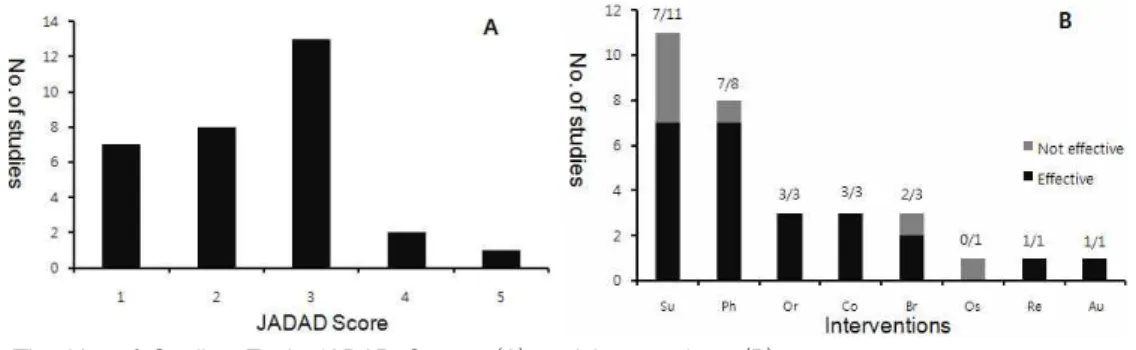
연구의 질을 평가하기 위하여 시행한 JADAD score는 5점이 1편 17 , 4점이 2편 22,37 , 3점이 13편
12,14-16,20,21,25,32-34,36,38,41 , 2점이 8편 11,24,27-30,35,40 , 1점이 7
편 13,18,19,23,26,31,39 으로 전체 평균은 2.4 ± 1.03이었다
(Table 4, Fig. 3A). 유의한 결과를 보인 연구는 24
편 12-15,18,19,22-33,36-41 이었고 유의한 결과를 보이지 않
은 연구는 7편 11,16,17,20,21,34,35 이었다. 치료 수단별로 유의한 결과를 살펴보면 식이 보충제가 11편
11,17-19,21,26,29,34,37,38,41 중 63.6%에 해당하는 7편 18,19,
26,29,37,38,41 에서 유의한 결과를 보였고, 호흡재활치료
를 포함한 신체훈련이 8편 22,27,30-32,35,36,40 중 87.5%에 해당하는 7편 22,27,30-32,36,40 에서 유의한 결과를 보였다.
한의학 치료에 해당하는 침치료 13 , TENS를 이용한 경혈자극 14 및 보중익기탕 23 은 모두 유의한 결과를 보였으며, 상담을 통한 식이조절 12 과 금연 24,25 ,은 모 두 유의한 결과를 보였다. 호흡법에 대한 연구는 3
편 15,20,33 중 2편 15,33 이 유의하게 나타났고, 각각 1편
의 연구가 있는 정골요법 16 은 효과가 없었으며, 반 사요법 28 과 청각자극요법 39 은 유의한 결과를 보였다 (Table 4, Fig. 3B).
Fig. 3. The No. of Studies Each JADAD Scores (A) and Interventions (B).
The numerators of each fractions are No. of effective studies. Su: supplements, Ph: physical training, Or:
oriental medicine, Co: counselling, Br: breathing training, Os: osteopathic manipulative treatment, Re:
reflexology, Au: auditory stimuli.
Thesis No.
and 1st Author JADAD Score Type of Treatment Result
1. Nadeem A11 1-0-1 vitamin E not effective
2. Weekes CE12 2-0-1 dietary counselling, advice on food fortification effective
3. Suzuki M13 0-0-1 acupuncture effective
4. Lau KS14 2-0-1 acu-TENS effective
5. Faager G15 2-0-1 pursed lip breathing effective
6. Noll DR16 2-0-1 osteopathic manipulative treatment not effective
7. Deacon SJ17 2-2-1 dietary creatine supplementation not effective
8. Kirkil G18 0-1-0 zinc picolinate effective
9. Wu TC19 1-0-0 vitamin E, Vitamin C effective
10. Collins EG20 2-0-1 ventilation feedback training not effective
11. Faager G21 1-2-0 creatine supplementation not effective
12. Magadle R22 2-1-1 inspiratory muscle training effective
13. Shinozuka N23 1-0-0 Hochuekk-to (Buzhongyiqi-tang) effective
14. Christenhusz L24 1-0-1 minimal intervention strataegy for lung patients (LMIS) effective
15. Wilson JS25 2-0-1 additional support by nurses effective
16. Hsieh LC26 0-0-1 beta-hydroxy-beta-methylbutyrate effective
17. Vivodtzev I27 1-0-1 electrostimulation effective
18. Wilkinson IS28 1-0-1 reflexology effective
19. Borghi-Silva A29 1-0-1 L-carnitine effective
20. Güell R30 1-0-1 pulmonary rehabilitation effective
21. Koppers RJ31 0-0-1 respiratory muscle endurance training effective 22. Beckerman M32 2-0-1 specific inspiratory muscle training effective
23. Garrod R33 2-0-1 pursed lip breathing effective
24. Cerdá B34 1-2-0 pomegranate juice not effective
25. Mador MJ35 1-0-1 respiratory muscle endurance training not effective
26. Weiner P36 1-1-1 inspiratory muscle training effective
27. Fuld JP37 1-2-1 creatine supplementation effecitve
28. Murali PM38 1-1-1 plant based formulation (DCBT1234-Lung KR) effective
29. Bauldoff GS39 1-0-0 distractive auditory stimuli effective
30. Kongsgaard M40 1-0-1 heavy resistance training effective
31. Vermeeren MA41 1-1-1 nutritional support effective