JESK
http://jesk.or.kr eISSN:2093-8462A Study on Factors Affecting Work Ability in Korean Workers
Yujeong Lee, Seong Rok Chang
Department of Safety Engineering, Pukyong National University, Busan, 48513
Corresponding Author Seong Rok Chang
Department of Safety Engineering, Pukyong National University, Busan, 48513
Mobile : +82-10-2808-6468 Email : [email protected]
Received : May 26, 2015 Revised : May 28, 2015 Accepted : July 11, 2015
Objective:The purpose of this study was to evaluate Korean workers' work ability and to identify its contributing factors.
Background: In order for Korea to overcome the phenomena of becoming an aged society, older adults must participate in the workforce to balance out the population;
workers' work ability must also be maintained. In addition, influential factors in employees' capabilities and degrees of importance thereof should be identified in advance to maintain work ability.
Method: The Work Ability Index (WAI) questionnaire was completed by 5,708 Korean workers. Survey questionnaire consisted items of current work ability, physical and mental demands of the job, numbers of diseases, work impairment due to diseases, sick leaves, work ability in 2 years and mental resources.
Results: Results indicated that work ability and length of service increased with age.
It was also found that employees in administrative positions had greater work ability than site workers, workers directly managed by a supervisor had greater work ability than workers in cooperative firms, and workers who performed intellectual tasks had greater work ability than workers who performed physical labor. Job stress was additionally observed to contribute towards overall work ability. And musculoskeletal disorders (MSDs) were found to negatively affect work ability.
Conclusion: The strongest determining factors in the work ability of Korean workers were stress level and mental state. Therefore, when the WAI is used to assess Korean workers, the weighting of WAI items pertaining to physical and mental abilities should be adjusted accordingly to account for these factors.
Application: The result is expected to suggest that workers maintain work ability in an aged society.
Keywords: Work ability, Korean workers, Work ability index (WAI), Musculoskeletal disorders, Stress level
Copyright@2015 by Ergonomics Society of Korea. All right reserved.
○ccThis is an open-access article distributed under the terms of the Creative Commons Attribution Non-Commercial License (http://
creativecommons.org/licenses/by-nc/3.0/), which permits unrestricted non-commercial use, distribution, and reproduction in any medium, provided the original work is properly cited.
1. Introduction
The proportion of people over 65 years of age is expected to increase steadily in Korea. This age group constituted 10.7% of the population in 2009, designating Korea as an aging society. In addition, the office of statistics Korea also expects that Korea will be an aged society and a post-aged society by 2019 and 2026, respectively (Statistics Korea, 2012a). Demographic data suggests an increase in the age-dependency ratio, a decrease in the number of younger workers, and a decline
in workplace participation of younger workers. Increases in the rate of employment over the past 10 years in Korea were -9.3%, 0.3%, 40%, 47% and 49% for workers in their twenties, thirties, forties, fifties, and sixties, respectively (Statistics Korea, 2012b).
Senescence is associated with inevitable time-dependent decreases in physical capabilities, but the preservation of such capability is essential for maintaining independence in old age.
Ilmarinen et al. (2005) suggested that the balance between human health resources, work demands, and work characteristics partially determines work ability. In addition to health resources, Tuomi et al. (1997) showed that competence, values, attitude, and motivation play an important role in work ability. The Work Ability Index (WAI) was constructed to assess how well workers are able to perform their work (Tuomi et al., 1998). Previous research suggests that individual, psychosocial, and physical factors differentially contribute to work capacity. Individual factors include age, gender, marriage, education, occupation, retirement time, exercise, obesity, disease, physical ability, smoking, and drinking. Psychosocial factors include variables such as relationships and work-related stress. Finally, physical factors comprise job specification, work-related duties, and work environment (Savinainen et al., 2004).
The present study examined the influence of work-related, worker-related and age-related factors on the work ability of Korean workers in typical Korean industries using the WAI questionnaire, the MSDs Symptom Report and Korean Occupational Stress Questionnaire short form.
2. Participants and Methods
2.1 ParticipantsIn this study, a survey was distributed to workers on duty in the industrial fields of Korea. The subject group comprised 2,096 shipbuilding industry workers, 985 machinery industry workers, 734 housing management industry workers, 1,080 construction industry workers, and 813 chemical industry workers. The age distribution of the subjects was as follows: 557 under 29 years of age, 792 between 30 and 34, 931 between 35 and 39, 982 between 40 and 44, 950 between 45 and 49, 690 between 50 and 54, and 526 over 55 years of age. The mean age of the subjects was 41.89 years (S.D. 9.51). Numbers of the workers with white collar and those with blue collar were 676 and 4,799 respectively. Data were collected between 2008 and 2012.
2.2 Methods
The data for this questionnaire study were collected with the WAI questionnaire developed by the Finnish Institute of Occupational Health (Tuomi et al., 1998), the MSDs Symptom Report developed by the National Institute of Occupational Safety & Health (NIOSH, 1997), and the Korean Occupational Stress Questionnaire Short Form developed by the Korean Occupational Safety &
Health Association (KOSHA, 2006). Work ability is designated in the WAI as poor (7~27 points), moderate (28~36 points), good (37~43 points), or excellent (44~49 points). Before the survey, the WAI questionnaire was translated into Korean. Workers' participation was fully voluntary; questionnaires were distributed to workers with the help of safety managers at the participating workplaces. Collected data (questionnaire scores) were entered into a database developed using Microsoft Excel 2010. WAI scores between groups were compared for each category using the Kruskal-Wallis test, and the relationship between WAI score and worker age, job stress and MSDs symptoms were analyzed using a spearman correlation test. Empirical findings may further support the notion that there is redundancy in the seven items. The WAI questionnaire to 5,708 employees and compute all possible correlations between responses to the WAI 7 items. Principal component analysis (PCA) is a mathematical procedure that uses an orthogonal transformation to convert a data set reflecting possibly correlated variables into a set of values representing linearly uncorrelated variables called "principal components". Statistical significance was set at .05. All statistical analyses were performed using SPSS 12.0K (Datasolution Inc.).
3. Results
The work ability index covers seven items, each of which is evaluated with the use of one or more questions. It is calculated by summing the points received for each item. Table 1 shows the mean and standard deviation of WAI score of individual WAI items for 5,708 participants. WAI scores of all workers ranged from 7 to 49 points; the mean WAI score was 40.5 (S.D. 5.05).
Table 2 shows work ability levels. Excellent work ability was observed in 29.0% of workers, good work ability in 48.0% of workers, moderate ability in 17.7% of workers, and poor ability was observed in only 1.2% of workers. This classification is for identifying workers and work environments which need measures of support.
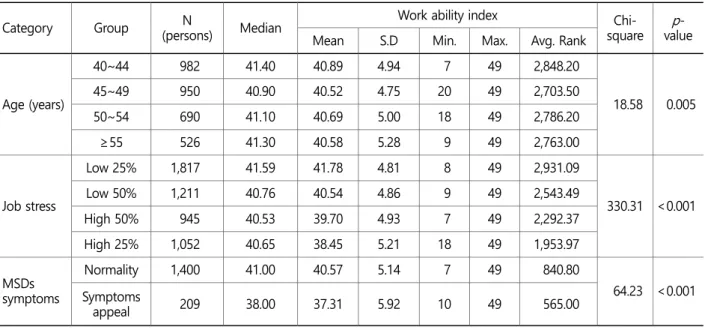
Table 3 shows WAI results categorized according to age, job stress, and symptoms of musculoskeletal disease. Analysis of WAI score by all factors revealed significant differences (p < 0.05). Relative to age, WAI results were as follows: the highest mean WAI score was observed for workers between 40 and 44 years old, and the lowest score was associated with workers under 29 years of age. Regarding job stress level, WAI results were as follows: the highest mean WAI score was found in workers from the "Low 25% stress level", and the lowest score was observed in workers in the "High 25% level". Finally, mean WAI score was higher for workers who did not suffer from musculoskeletal diseases (normality) relative to their counterparts (symptoms appeal).
Table 1. Mean and standard deviation of work ability score WAI
WAI item Current work
ability
Physical and mental demands
of the job
Number of
diseases Work impairment
due to diseases Sick
leave Work ability in
2 years Mental resources
Mean 40.5 7.73 7.47 6.24 5.62 4.69 6.36 2.79
SD 5.05 1.67 1.62 1.39 0.75 0.69 1.38 0.89
Table 2. Distribution of work ability level
Excellent Good Moderate Poor Not classified Total
No. 1,657 2,740 1,009 69 233 5,708
% 29.0 48.0 17.7 1.2 4.1 100.0
Table 3. Kruskal-Wallis test of WAI according to age, job stress and symptoms of MSDs
Category Group N
(persons) Median Work ability index Chi-
square p- value
Mean S.D Min. Max. Avg. Rank
Age (years)
≤29 557 40.40 39.98 5.11 24 49 2,539.00
18.58 0.005
30~34 792 40.70 40.21 5.13 20 49 2,626.70
35~39 931 41.10 40.50 5.14 10 49 2,736.70
Relationships between WAI score and age, WAI score and job stress, and WAI score and MSDs symptoms are shown in Table 4.
A positive correlation was observed between total WAI score and age (p < 0.05). WAI item score and age were significantly correlated with the except item 4 (work impairment due to diseases) and item 6 (work ability in 2 years) (p < 0.05). Items 1 (current work ability), 2 (physical and mental demands of the job), 5 (sick leave) and 7 (mental resources) were positively correlated with WAI items age, while item 3 (number of current disease) was negatively correlated with age. Regarding job stress and symptoms of musculoskeletal disease, WAI scores were negatively correlated with all individual WAI items (p < 0.05).
In this study, we conducted a PCA using the data from WAI item number 7 (see Table 5). Results showed that 34.397% of the variable information from all the items was attributable to component 1. In addition, it was found that 16.365% of the total data was explained by component 2. Approximately 49% of the principle components were analyzed as a sum of up to component Table 3. Kruskal-Wallis test of WAI according to age, job stress and symptoms of MSDs (Continued)
Category Group N
(persons) Median Work ability index Chi-
square p- value
Mean S.D Min. Max. Avg. Rank
Age (years)
40~44 982 41.40 40.89 4.94 7 49 2,848.20
18.58 0.005
45~49 950 40.90 40.52 4.75 20 49 2,703.50
50~54 690 41.10 40.69 5.00 18 49 2,786.20
≥55 526 41.30 40.58 5.28 9 49 2,763.00
Job stress
Low 25% 1,817 41.59 41.78 4.81 8 49 2,931.09
330.31 <0.001
Low 50% 1,211 40.76 40.54 4.86 9 49 2,543.49
High 50% 945 40.53 39.70 4.93 7 49 2,292.37
High 25% 1,052 40.65 38.45 5.21 18 49 1,953.97
MSDs symptoms
Normality 1,400 41.00 40.57 5.14 7 49 840.80
64.23 <0.001 Symptoms
appeal 209 38.00 37.31 5.92 10 49 565.00
Table 4. Correlation analysis of WAI according to age, job stress, and symptoms of MSDs WAI
WAI item Current
work ability
Physical and mental demands
of the job
Number of diseases
Work impairment due to diseases
Sick
leave Work ability
in 2 years Mental resources
Age r 0.037 0.126 0.046 -0.151 0.002 0.05 -0.008 0.051
p-value 0.006 <0.001 <0.001 <0.001 0.897 <0.001 0.544 <0.001
Job stress r -0.273 -0.184 -0.202 -0.141 -0.183 -0.15 -0.173 -0.415
p-value <0.001 <0.001 <0.001 <0.001 <0.001 <0.001 <0.001 <0.001 MSDs
symptoms
r -0.203 -0.135 -0.127 -0.17 -0.266 -0.073 -0.138 -0.149
p-value <0.001 <0.001 <0.001 <0.001 <0.001 0.003 <0.001 <0.001
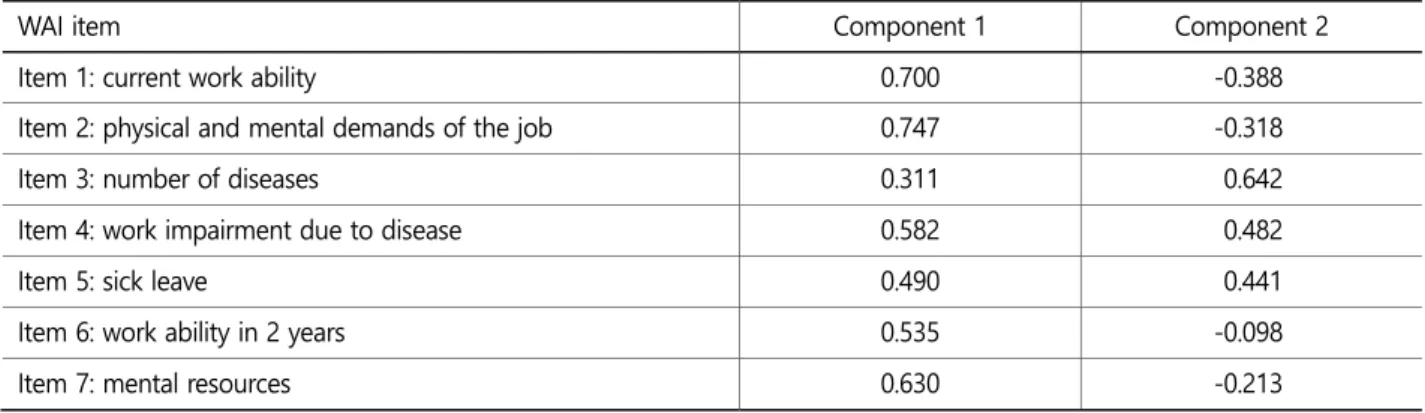
7 from component 3. In other words, these two items were found to be influential in work ability. The finding that components 1 and 2 explained 51% of the WAI suggests that there is connection with detailed items (Table 6). Component 1 was more prevalent in items pertaining to "current work ability", "physical and mental demands of the job", and "mental resources". The main component (component 1) was considered to represent the primary factor affecting WAI score. Component 2 was positively associated with items assessing "number of diseases", "work impairment due to diseases", and "sick leave", and negatively associated with the remaining items. Component 2 was described as an element that distinguishes work ability as a function of mental state and work ability related to physical conditions associated with disease. This result suggests that work ability as assessed by WAI score is dependent on more than simple physical capacity in Korean workers.
4. Discussion and Conclusions
The goal of this study was to assess work ability in Korean workers in typical industries using the WAI questionnaire. The overall WAI score ranged from 7 to 49 points, and the mean WAI score was 40.5. Results of work ability level could show to identify workers and work environments which need measures of support. Measures directed toward restoring work ability or additional evaluations of work ability are needed by those whose work ability is poor. For those whose work ability is moderate, measures to help improving work ability is recommended. Workers with good work ability index should receive instructions how to maintain their work ability (Tuomi et al., 1998).
Table 5. Principal component analysis of WAI items (total variance explained)
Component Total % Variance % Accumulated
1 2.408 34.397 34.397
2 1.146 16.365 50.762
3 0.944 13.487 64.249
4 0.773 11.049 75.299
5 0.688 9.829 85.128
6 0.599 8.556 93.684
7 0.442 6.316 100.000
Table 6. Principal component analysis of WAI items (component matrices)
WAI item Component 1 Component 2
Item 1: current work ability 0.700 -0.388
Item 2: physical and mental demands of the job 0.747 -0.318
Item 3: number of diseases 0.311 0.642
Item 4: work impairment due to disease 0.582 0.482
Item 5: sick leave 0.490 0.441
Item 6: work ability in 2 years 0.535 -0.098
Item 7: mental resources 0.630 -0.213
WAI scores as a function of age were as follows: workers between 40 and 44 years of age had the highest mean score, while the lowest mean score was observed in workers under 29 years of age. A number of previous studies found that WAI score decreased linearly as a function of age (Monteiro et al., 2006; Alavinia et al., 2009; Fischer et al., 2006; Tuomi et al., 1991), and this trend was repeatedly observed in follow-up studies (Martinez et al., 2006; Pohjonen, 2001; Tuulikki et al., 2002; Anne et al., 2004).
Conversely, other studies reported that work capacity was not associated with age (Tuomi et al., 2004; Martinez et al., 2006; Bojana et al., 2009). However, work ability can depend heavily on physical capabilities, which decline with age (Bassey, 1998). The results of the present study are inconsistent with the abovementioned findings. The previous researches showed that WAI score decreased as function of age and work capacity was not associated with age. But this study showed that the high WAI in older Korean workers observed in our study may have been due to the influence of Korean society. An additional factor may have been that all subjects were on duty, rather than retired, at the time of survey completion. Researches in Eastern Asia have shown that the change of WAI score by age were not statistically significant (Kumashiro et al., 2006; Chumchai et al., 2007; Duong et al., 2007).
A number of studies conducted in many different countries have examined the relationship between job stress and work ability.
These studies typically indicated that job stress increases in accordance with job demands, insufficient job control, originality, and human relations (Pohjonen, 2001; KloimuKller et al., 2000; Sjogren-Ronka et al., 2002). In the present study, job stress was found to be a main factor that could significantly impact work ability.
The relationship between work ability and musculoskeletal disorders has also been examined in previous studies. Symptoms of musculoskeletal disease have been shown to be associated with a reduction in work ability (Pohjonen, 2001; Eskelinen et al., 1991; Helena et al., 2010). In this study, musculoskeletal disease was an additional primary factor that could significantly affect work capacity.
The results of the present study may be used as a basis for continuing development of work ability assessments in the future.
Further, our results suggest the need to reevaluate the importance of individual WAI items used in Korea and abroad. The present study suggests the WAI could more accurately assess work capacity in Korean workers if the weighting factors of the individual items of work capacity are calculated.
Acknowledgements
"This work was supported by the Pukyong National University Research Fund in 2012 (PK-2012-0481)".
References
Alavinia, S.M., van den Berg, T.I.J., van Duivenbooden, C., Elders, L.A.M. and Burdorf, A., "Impact of work-related factors, lifestyle, and work ability on sickness absence among Dutch construction workers", Scandinavian Journal of Work, Environment & Health, Vol.35, No.5, pp.325-333, 2009.
Anne, P., Sirpa, L. and Ritva, L., "Functional, postural and perceived balance for predicting the work ability of firefighters", International Archives of Occupational and Environmental Health, Vol.77, No.7, pp.482-490, 2004.
Bassey, E.J., "Longitudinal changes in selected physical capabilities: muscle strength, flexibility and body size". Age and Ageing, Vol.27, No.3, pp.12-16, 1998.
Bojana, K., Milan, M., Rajna, G., Ljiljana, B., Andrea, R. and Jadranka, M., "Work-related stress and work ability among Croatian university hospital midwives", Midwifery, Vol.27, No.2, pp.146-153, 2009.
Chumchai, P., Silpasuwan, P., Viwatwongkasem, C. and Wongsuvan, T., "Work Ability Among Truck Drivers in Thailand", International Commission on Occupational Health, 2007.
Duong, K.V., Nguyen, N.N., Ta, Q.B. and Khuc, X., "Primary Study On Work Ability of Vietnamese Workers", International Commission on Occupational Health, 2007.
Eskelinen, L., Kohvakka, A. and Merisalo, T., "Relationship between the self-assessment and clinical assessment of health status and work ability", Scandinavian Journal of Work, Environment & Health, Vol.17, No.1, pp.40-77, 1991.
Fischer, F.M., Borges, F.N., Rotenberg, L., Latorre, M.R., Soares1, N.S., Rosa1, P.F., Teixeira1, L.R., Nagai1, R., Steluti1, J. and Landsbergis, P., "Work ability of health care shift workers: What matters?", Chronobiology International, Vol.23, No.6, pp.1165-1179, 2006.
Helena, M., Leena, K., Markku, H., Pa¨ivi L.A., Eija, H., Juha, L. and Eira, V.J., "Musculoskeletal pain at multiple sites and its effects on work ability in a general working population", Occupational & Environment Medicine, Vol.67, No.7, pp.449-455, 2010.
Ilmarinen, J., Tuomi, K. and Seitsamo, J., "New dimensions of work ability", International Congress Series, 1280, pp.3-7, 2005.
Korea Occupational Safety and Health Agency (KOSHA), "Guideline for measuring job stressors (KOSHA CODE H-42-2006)", 2006.
KloimuKller, I., Karazman, R. and Geissler, H., Karazman-Morawetz I. and Haupt, H., "The relation of age, work ability index and stress-inducing factors among bus drivers", International Journal of Industrial Ergonomics, Vol.25, No.5, pp.497-502, 2000.
Kumashiro, M., Yamamoto, K. and Shirane, K., "WAI and Job Stress, Five Years of Follow-up Research", International Ergonomics Association, 2006.
Martinez, M.C. and Latorre, M.R., "Health and work ability among office workers", Rev Saude Publica, Vol.40, No.5, pp.851-858, 2006.
Monteiro, M.S., Ilmarinen, J. and Corraa, Filho HR., "Work ability of workers in different age groups in a public health institution in Brazil". International Journal of Occupational Safety Ergonomics, Vol.12, No.4, pp.417-427, 2006.
NIOSH, Elements of Ergonomics Program, U.S. Department of Health and Human Services, 1997.
Pohjonen, T., "Age-related physical fitness and the predictive values of fitness tests for work ability in home care work", Journal of Occupational and Environmental Medicine, Vol.43, No.8, pp.723-730, 2001.
Pohjonen, T., "Perceived work ability of home care workers in relation to individual and work-related factors in different age groups", Occupational Medicine, Vol.51, No.3, pp.209-217, 2001.
Savinainen, M., Nygard, C.H. and Ilmarinen, J., "Workload and physical capacity among ageing municipal employees— 16-year follow-up study", International Journal of Industrial Ergonomics, Vol.34, No.6, pp.519-533, 2004.
Sjogren-Ronka, T., Ojanen, M.T. and Leskinen, E.K., "Physical and psychosocial prerequisites of functioning in relation to work ability and general subjective wellbeing among office workers". Scandinavian Journal of Work, Environment & Health, Vol.28,
No.3, pp.184-190, 2002.
Statistics Korea, Statistics on the Aged, 2012a.
Statistics Korea, Economically Active Population Survey, 2012b.
Tuomi, K., Eskelinen, L. and Toikkanen, J., "Work load and individual factors affecting work ability among aging municipal employees", Scandinavian Journal of Work, Environment & Health, Vol.17, No.1, pp.128-134, 1991.
Tuomi, K., Ilmarinen, J., Jahkola, A., Katajarinne, L. and Tulkki, A., "Work Ability Index. 2nd ed.", Finnish Institute of Occupational Health, Helsinki77, 1998.
Tuomi, K., Ilmarinen, J., Martiainen R. and Klockars M. Aging, work, life style and work ability among Finnish municipal workers in 1981-1992, Scand. J. Work Environ. Health, Vol.23, No.1, 58-65, 1997.
Tuomi, K., Vanhala, S., Nykyri, E. and Janhonen, M., "Organizational practices, work demands and the well-being of employees: a follow-up study in the metal industry and retail trade", Occupational Medicine, Vol.54, No.2, pp.115-121, 2004.
Tuulikki, S.R., Markku, T.O., Esko, K.L., Sirpa, T.M. and Esko, A.M., "Physical and psychosocial prerequisites of functioning in relation to work ability and general subjective well-being among office workers", Scandinavian Journal of Work, Environment & Health, Vol.28, No.3, pp.184-190, 2002.
Author listings
Yujeong Lee: [email protected]
Highest degree: PH.D., Department of Safety Engineering, Pukyong National University Position title: Lecturer, Department of Safety Engineering, Pukyong National University
Areas of interest: Aging, Aesthetic Engineering, Work ability,, Musculoskeletal disorders, Job Stress
Seong Rok Chang: [email protected]
Highest degree: PH.D., Department of Industrial Engineering, Seoul National University Position title: Professor, Department of Safety Engineering, Pukyong National University
Areas of interest: Work Physiology, Musculoskeletal disorders, Work ability, Job Stress, Digital Human Modeling, Human Error Reduction, Risk Management, Safety Management Sysem