• 검색 결과가 없습니다.

A Study on the Screw Loosening Torque According to the Type of Tightening the Implant Fixture and Abutment

N/A
N/A
Protected

Academic year: 2021

Share "A Study on the Screw Loosening Torque According to the Type of Tightening the Implant Fixture and Abutment"

Copied!
7
0
0

로드 중.... (전체 텍스트 보기)

전체 글

(1)

임플란트 고정체와 지대주의 체결방식에 따른 스크류 풀림토크에 관한연구

박 수 철, 김 홍 식, 함 성 원*

김천대학교 치기공학과, 경일대학교 화학공학과

A Study on the Screw Loosening Torque According to the Type of Tightening the Implant Fixture and Abutment

Soo-chul Park, Hong-sik Kim, Sung-won Ham*

Department of Dental Technology, Gimcheon University Department of Chemical Engineering, Kyungil University*

Purpose: In this study, the loosening torque test was conducted with three implant products that are produced, approved and sold in Korea, which are manufactured in different fixture and abutment tightening methods (internal submerged type, internal morse taper type, and external type) to examine the loosening torque of the screw according to the method of tightening the implant fixture and abutment.

Methods: In the loosening torque test, the three types of fixtures and abutments with different tightening methods were tightened by rotating them clockwise with a 30 N force using a driver equipped with an electric torque meter. The results of the test are as follows.

Results: The loosening torque values of the internal submerged type, internal morse taper type and external type implants were 24.10 0.742 N , 29.10 1.710 N , and 26.60 1.636 N , respectively.

Conclusion: The screw loosening torque values of the three fixture and abutment tightening methods were analyzed via Kruskal Wallis test layout, and they were significantly different (p<0.05).

[Abstract]

성 명 함 성 원 전 화 053-600-5369 E-mail [email protected] 교신저자

Key words :

screw loosening torque, fixture, abutment

(2)

Ⅰ. 서 론

과거 치아우식이나 치주질환으로 치아가 결손 되었을 때의 치료방법으로 결손된 양쪽의 건강한 인접 치아를 삭 제하여 고정성 교의치를 이용한 보철수복 방법이 많이 이 용되었다. 이러한 인접 자연치아를 삭제하여 치료하는 방 법은 건강한 치아가 손상되는 부작용과 결손부위의 교합 력까지 인접치아에 전달되는 단점이 있으며 치아의 수명 에도 많은 영향을 미친다. 치과용 임플란트(Implant)는 이러한 치아삭제의 문제를 해결하고 자연치아를 대신하 여 고정체(Fixture)를 골 내에 매식하여 고정체에 지대주 (Abutment)를 지대주 나사(Screw)이용하여 고정하고 인 공 치아를 지대주에 고정시키는 술식이 임상에서 많이 이 용되고 있는 치료방법이다(Kallus et al., 1994).

치과 보철의 재료로 금속재료가 전통적으로 많이 사용 되어져 왔으며, 이러한 금속재료는 니켈(Ni), 크롬(Cr), 코발트(Co), 티타늄(Ti) 등의 비귀금속과 금과 같은 귀금 속이 치과보철재료로 이용되었다. 하지만 니켈, 크롬 등 의 일부 금속은 부식저항성과 생체적합성의 안정성 문제 가 연구보고(Sakong & Park 2013; Park et al., 2012) 되어 임플란트의 소재가 되는 재료는 생체적합성과 부식 저항성이 높은 티타늄이 사용되고 있으며, 그 중 순수 티 타늄 Grade 3와 Grade 4, Ti-6Al-4V 합금이 주로 사용 된다. 순수 티티늄 Grade 3에 비해 기계적 강도가 우수한 순수 티티늄 Grade 4는 임플란트 고정체와 지대주 제조 에 순수 티티늄 Grade 3는 지대주 제조에 주로 사용되고 있으며, 지대주 나사는 티타늄 합금(Ti-6Al-4V)으로 주 로 제작한다.

임플란트 고정체의 지대주 연결부위가 함몰형인 경우 내측형(Internal), 돌출형인 경우 외측형(External)으로 구분되며, 고정체와 지대주의 체결방식에 따라 다양한 형 태가 사용되고 있으며, 현재 임상에서는 Internal submerged type과 Internal morse taper type, External type의 임플란트가 주로 이용되고 있다.

Internal submerged type 임플란트는 고정체의 경계부 위가 치조골의 높이와 동일한 위치에 식립되는 Bone- level type의 내측형이며, Internal morse taper type 임플란트는 표면처리 된 하부의 고정체부위가 치조골의

고정체 부위는 치주조직부에 위치하는 형태인 Tissue- level type의 내측형, External type의 임플란트는 고정 체의 경계부위가 치조골의 높이와 동일한 위치에 식립되 는 Bone-level type의 외측형 임플란트이다.

치주인대의 완충작용으로 적절한 응력분산이 생기는 자 연 치아와는 달리 임플란트는 직접 골에 매식되어 응력분 산이 되지 않으며(Holmes et al., 1992), 임플란트는 고 정체와 지대주를 지대주 나사를 이용해 결합하기 때문에 잘못된 조임회전력, 교합압과 같은 하중의 발생과 상실, 하중으로 의한 진동, 주변의 인위적인 환경에 의해 지대 주 나사 풀림이 발생된다(J orn

¨ ´

eus et al., 1992).

Jemt와 Pattersson(1993)과 Ekfeldt 등(1994)은 한개 의 임플란트 보철치료를 한 환자들을 대상으로 한 연구에 서 많은 환자의 임플란트 풀림현상을 보고하였고, Hemmings 등(1994)과 Carlson & Carlsson(1994)의 임 플란트 보철치료와 합병증의 관련 연구에서 임플란트를 이용한 고정성 보철과 가철성 보철치료 후 많이 발생하는 문제점은 지대주 나사 풀림과 파절이라고 보고하였다. 임 플란트의 지대주 나사 풀림과 파절은 고정체와 지대주에 전달되는 항복강도 이하의 반복적 하중에 의해서 피로파 괴나 소성변형, 과부하에 의해서 발생될 수 있다. 최근에 는 임플란트의 나사풀림, 파절의 문제점에 대한 연구 (Jamiyandorj et al., 2012; Eom et al., 2009)들과 그러 한 문제들을 개선한 제품들이 개발 및 시판되고 있다. 하 지만 임플란트 나사풀림에 대한 연구들은 기성제품의 지 대주와 CAD/CAM을 이용한 지대주를 이용한 연구 (Jamiyandorj et al., 2012; Lee et al., 2012)와 임플란 트 나사의 코팅과 나사 풀림에 대한 연구(Park et al., 2008; Koak et al., 2003)가 대부분으로 임플란트 고정 체와 지대주의 체결방식에 따른 나사 풀림토크의 차이를 비교한 연구는 부족한 실정이다.

이 연구의 목적은 순수 티타늄(CP Ti) Grade 4로 제작

한 임플란트 고정체와 지대주 중 임플란트 고정체와 지대

주의 체결방식 차이에 따른 나사 풀림토크를 비교하여 구

강보건자료로 활용하기 위해 연구를 실시하였다.

(3)

Ⅱ. 연구 방법

1. 시험 재료 규격 및 화학조성

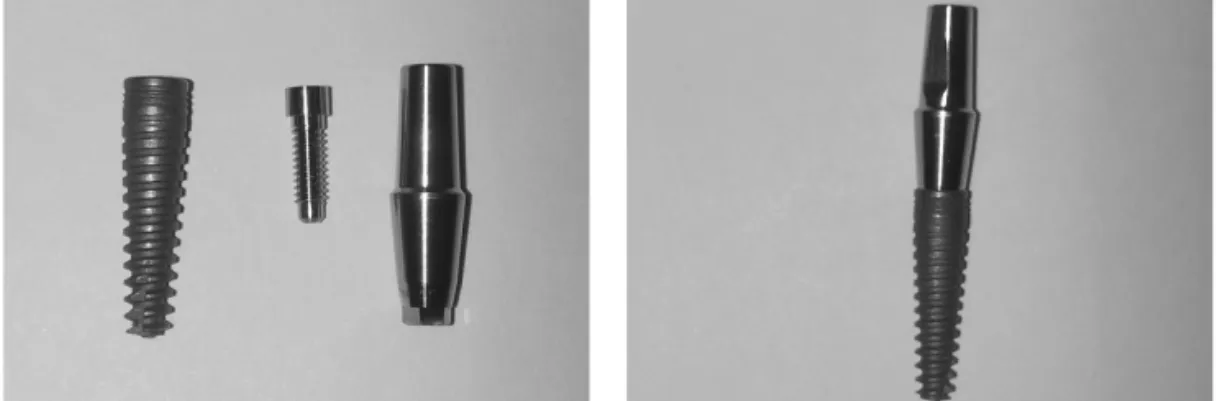
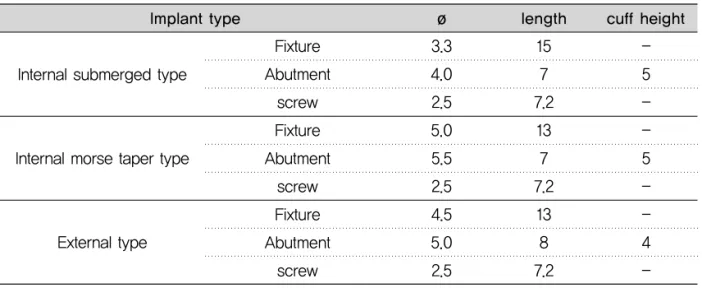
시험에 사용된 임플란트 고정체와 지대주는 2013년 현 재 국내에 제조되어 식약청에 허가되어 판매되는 YES- IMPLANT(한국)의 Internal submerged type implant(Fig 1), Internal morse taper type implant(Fig 2), External type implant(Fig 3), 총 3종

의 고정체와 지대주를 대상으로 하였고 시험대상 임플란 트의 고정체와 지대주의 규격은 다음과 같다(Table 1). 임 플란트 고정체와 지대주의 재료는 국제적 안정성 규격 (ASTM F67, 미국재료시험협회) 시험에 허가된 순수 티 타늄(CP Ti Grade 4, Fort Wayne Metals, 미국)으로,지 대주 나사는 티타늄 합금(Ti-6Al-4V, Fort Wayne Metals, 미국)으로 제작된 기성 나사를 사용하였다.

Fig. 1. Internal submerged type implant

Fig. 2. Internal morse taper type implant

Fig. 3. External type implant

(4)

2. 임플란트 풀림토크 시험

임플란트 풀림토크 시험은 식품의약품안정청(2006)의 치과용 임플란트의 성능 및 안정성 평가시험 해설서의 기 준으로 하였으며, 시험에 사용된 3종의 Internal submerged type, Internal morse taper type, External type의 고정체 부분을 측정기기의 고정부에 고 정하고, 지대주를 연결하고 지대주 나사를 전기식토크측 정기(MGT50E, MARK-10, 미국)가 달린 드라이버를 연 결하여 드라이버를 시계방향으로 회전시켜 30N・㎝의 힘으로 체결하여 고정하였다.

풀림토크시험은 30N・㎝의 힘으로 고정된 3종의 고정 체와 지대주(N=5)를 전기식토크측정기가 달린 드라이버 를 반시계방향으로 회전시켜 최대토크를 0.01N・㎝ 단위 까지 측정하였다.

3. 자료의 분석

이 연구에서 측정된 풀림토크시험 자료의 처리의 분석 은 통계프로그램 SPSS ver. 18.0을 이용하였고, Internal submerged type, Internal morse taper type, External type, 3종의 풀림토크 차이의 검정을 위 해 Kruskal Wallis test를 이용하여 분석하였다.

Ⅲ. 결 과

Internal submerged type 임플란트의 고정체와 지대 주의 풀림토크시험결과 5번 고정체와 지대주의 풀림토크 가 25N・㎝로 가장 높았으며, 3번 고정체와 지대주의 풀 림토크가 23N・㎝로 가장 낮았다(Fig 4). Internal morse taper type 임플란트의 고정체와 지대주의 풀림 토크시험결과 3번 고정체와 지대주의 풀림토크가 32N・

㎝로 가장 높았으며, 5번 고정체와 지대주의 풀림토크가 27.5N・㎝로 가장 낮았다(Fig 5). External type 임플란 트의 고정체와 지대주의 풀림 토크시험결과 3번 고정체 와 지대주의 풀림토크가 29N・㎝로 가장 높았으며, 4번 고정체와 지대주의 풀림토크가 24.5N・㎝로 가장 낮았 다(Fig 6).

Implant type ø length cuff height

Internal submerged type

Internal morse taper type

External type

Fixture Abutment

screw Fixture Abutment

screw Fixture Abutment

screw

- 5 - - 5 - - 4 - 15

7 7.2

13 7 7.2

13 8 7.2 3.3

4.0 2.5 5.0 5.5 2.5 4.5 5.0 2.5

Fig 4. Loosening torque test with the internal

submerged type implant

(5)

Kruskal Wallis test.

3종의 임플란트 체결방식별 고정체와 지대주의 풀림토 크시험결과 Internal morse taper type의 풀림토크가 29.10N・㎝로 가장 높았으며, External type의 풀림토 크가 26.60N・㎝, Internal submerged type의 풀림토

크가 24.10N・㎝로 가장 낮았다. 임플란트 체결방식별 고정체와 지대주의 풀림토크는 통계적으로 유의한 차이 를 보였다(p<0.05)(Table 2).

Fig. 5. Loosening torque test with the internal morse taper type implant

Fig. 6. Loosening torque test with the External type implant

Table 2. Implant fixture and abutment loosening torque test according to the implant tightening type (N・㎝) p-value χ ²

Mean ± SD N

Implant type

0.006 10.258

24.10 ± 0.742 29.10 ± 1.710 26.60 ± 1.636 5

5 5 Internal submerged type

Internal morse taper type External type

Ⅳ. 고 찰

임플란트를 이용한 보철물은 전 세계적으로 증가하고 있으며, 보철물의 종류도 고정성보철뿐만 아니라 노인 인 구의 증가로 가철성보철도 많이 응용되어 임상에서 사용 되고 있다. 하지만 임플란트 보철물의 합병증도 발생되고 있으며, 대표적인 합병증으로 나사풀림, 파절과 같은 문 제점이 보고되고 있다(Ekfeldt et al., 1994; Hemmings et al., 1994; Carlson & Carlsson, 1994; Jemt &

Pattersson, 1993). 이러한 임플란트 나사풀림의 문제와 관련한 연구가 보고되고 있지만, 임플란트 고정체와 지대 주의 유사한 체결방식을 비교한 연구나 기성나사와 맞춤 형나사의 비교가 대부분이었다(Park et al., 2008; Koak et al., 2003; Jamiyandorj et al., 2012; Lee et al.,

2012).

이 연구는 고정체와 지대주를 순수 티타늄(CP Ti)

Grade 4로 제작한 임플란트 중 임플란트 고정체와 지대

주의 체결방식에 따른 나사 풀림토크의 차이를 알아보기

위해 Yes-Implant(한국)의 Internal submerged

type(N=5)의 고정체(3.3ø×15㎜)와 지대주(4.0ø×7㎜),

Internal morse taper type(N=5)의 고정체(5.0ø×13㎜)

와 지대주(5.5ø×7㎜), External type(N=5)의 고정체

(4.5ø×13㎜)와 지대주(5.0ø×8㎜)로, 체결방식이 다른

총 3종의 임플란트 고정체와 지대주를 대상으로 전기식

토크측정기가 달린 드라이버를 연결하여 드라이버를 시

계방향으로 회전시켜 30N・㎝의 힘으로 체결하여 고정

한 후, 전기식토크측정기가 달린 드라이버를 반시계방향

으로 회전시켜 나사 풀림토크를 측정하였다.

(6)

텅스텐 카바이드와 탄소로 표면 처리한 티타늄합금 지대 주 나사의 풀림토크 연구에서 Internal morse taper type(SSⅡ, Osstem, 한국)의 풀림토크가 26.46N・㎝로 External type(USⅡ, Osstem, 한국)의 풀림토크는 25.78N・㎝로 측정된 연구보고는 본 연구의 Internal morse taper type의 풀림토크 29.10N・㎝와 External type의 풀림토크 26.60N・㎝에 비해 풀림토크가 낮았으 나, Park 등의 Internal submerged type(GSⅡ, Osstem, 한국)의 풀림토크가 25.96N・㎝로 측정된 것에 비해 본 연구의 Internal submerged type의 풀림토크는 24.10N・㎝로 약간 낮았다. 하지만 Jamiyandorj 등 (2012)의 임플란트 지대주 나사의 풀림토크 연구에서는 시험 대상군 중 Internal submerged type(GSⅡ, Osstem, 한 국 )와 Internal submerged type (OsseoSpeed, Astra, 스웨덴), 2종류의 풀림토크는 GS

Ⅱ의 기성 지대주 나사의 풀림토크가 24.9N・㎝로 본 연 구의 Internal submerged type과 유사하였으나, OsseoSpeed의 기성 지대주 나사의 풀림토크는 22.4N・㎝

로 낮았다.

이 연구에서 지대주 나사의 풀림토크는 Internal morse taper type, External type, Internal submerged type 순으로 높았다. 이러한 풀림토크 힘의 차이는 Park 등(2008)의 임플란트 풀림토크 연구에서 직 경이 비슷하고 체결방식이 다른 3종의 고정체와 지대주 중 체결되는 면적이 가장 넓고 지대주가 고정체의 내측으 로 결합되는 Internal morse taper type이 풀림토크가 높은 보고를 볼 때 Internal morse taper type의 고정체 와 지대주 풀림토크가 다른 체결방식의 고정체와 지대주 풀림토크에 비해 높은 것으로 판단된다.

본 연구의 3종의 임플란트 고정체와 지대주의 풀림토크 는 체결방식에 따라 차이를 보였으나(p<0.05), 식품의약 품안정청(2006) 기준의 조임토크의 75% 이상인 요구조건 을 모두 충족시켜 임플란트 보철물의 제작에는 문제가 없 을 것으로 보이며, 임플란트 보철제작 시 체결방식을 고려 한 환자의 치료계획과 보철물의 설계가 필요할 것 이다.

Ⅴ. 결 론

이 연구는 국내에서 생산, 허가되어 판매되는 임플란트 제품 중 고정체와 지대주의 체결방식이 다른 YES- IMPLANT(한국)의 Internal submerged type implant, Internal morse taper type implant, External type implant, 3종의 제품을 대상으로 풀림토크시험을 실시하 여 임플란트 고정체와 지대주의 체결방식의 차이에 따른 지대주 나사의 풀림토크를 조사하여 구강보건의 자료로 사용하기 위해 수행하였다.

임플란트 고정체와 지대주의 체결방식이 다른 3종의 고 정체와 지대주를 지대주 나사에 전기식토크측정기가 달 린 드라이버를 시계방향으로 회전시켜 30N・㎝의 힘으 로 체결하여 풀림토크시험을 실시하여 다음과 같은 결과 를 얻었다.

1. 3종의 임플란트 중 Internal morse taper type implant의 풀림토크는 29.10±1.710N・㎝, External type implant의 풀림토크는 26.60±1.636N・㎝, Internal submerged type implant의 풀림토크는 24.10

±0.742N・㎝로 측정되었고, 통계적으로 유의한 차이가 있었다(p<0.05).

2. 체결 방식이 다른 3종의 고정체와 지대주의 풀림 토 크는 체결되는 면적이 넓고, 체결구조가 고정체가 함몰된 형태로 지대주와 결합되는 내측형일때 높았다.

3. 고정체와 지대주의 지대주 나사 풀림토크시험에서 Internal morse taper type implant가 29.10N・㎝의 지대주 나사 풀림 값이 측정되어 체결 고정한 값과 유사 하였으나, 체결 방식이 다른 implant 모두 식품의약품안 정청의 풀림토크 기준을 충족시켰다.

REFERENCES

Carlson B, Carlsson GE. Prosthodontic complications

in osseointegrated dental implant treatment.

(7)

J Implant Dentistry, 3⑷, 264, 1994.

Ekfeldt A. Carlsson GE, B orjesson G. Clinical

¨

evaluation of single-tooth restorations supported by osseointegrated implants: a retrospective study. Int J Oral Maxillofac Implants, 9⑵, 179-183, 1994.

Eom TG, Suh SW, Jeon GR, Shin JW, Jeong CM.

Effect of Tightening Torque on Abutment- Fixture Joint Stability using 3-Dimensional Finite Element Analysis. J Korean Acad Prosthodont, 47⑵, 125-135, 2009.

Hemmings KW, Schmitt A, Zarb GA. Complications and maintenance requirements for fixed prostheses and overdentures in the edentulous mandible: a 5-year report. Int J Oral Maxillofac Implants, 9⑵, 191-196, 1994.

Holmes DC, William RG, Vijay KG, John CK.

Comparison of stress transmission in the IMZ implant system with polyoxymethylene or titanium intramobile element: a finite element stress analysis. Int J Oral Maxillofac Implants, 7⑷, 450-458, 1992.

Jamiyandorj O, Kim JH, Kim MS, Park YB, Shim JS. Comparison of removal torque between prefabricated and customized abutment screw. J Korean Acad Prosthodont, 50⑷, 243-248, 2012.

Jemt T, Pattersson P. A 3-year follow-up study on single implant treatment. J Dent, 21⑷, 203- 208, 1993.

J orn

¨ ´

eus L, Jemt T, Carlsson L. Loads and designs of screw joints for single crowns supported by osseointegrated implants. Int J Oral Maxillofac Implants, 7⑶, 353-359, 1992.

Kallus T, Bressing C, Odont D. Loose gold screws frequently occur in full-arch fixed prostheses supported by osseointegrated implants after 5 years. Int J Oral Maxillofac

Implants, 9⑵, 169-178, 1994.

Koak JY, Heo SJ, Chang IT, Yim SH, Lee JY, Lee KR. The study on the removal torque of the diamond like carbon coated titanium abutment screws. J Korean Acad Prosthodont, 41⑵, 128-135, 2003.

Lee CJ, Yang SE, Kim SG. Evaluation of reverse torque value of abutment screws on CAD/CAM custom-made implant abutments.

J Korean Acad Prosthodont, 50⑵, 128-134, 2012.

Park JK, Jeong CM, Jeon YC, Yoon JH. Influence of tungsten carbide/carbon coating of implant- abutment screw on screw loosening. J Korean Acad Prosthodont, 46⑵, 137-147, 2008.

Park SC, Choi SM, Kang JH. Corrosion Resistance Evaluation in the Co-Cr Alloys for the Full and Removable Partial Denture Metal Frameworks and the Porcelain-fused-to- metal Crown. J Korean Acad dental Technology, 34⑶, 237-245, 2012.

Sakong J, Park SC. Concentration of elemental ions released from non-precious dental casting alloys. J Korean Acad dental Technology, 35

⑴, 1-18, 2013.

The performance and stability of the dental implant assessment tests guidelines. Korea Food &

Drug Administration, 2006.

수치

Fig. 1. Internal submerged type implant
Fig 4. Loosening torque test with the internal submerged type implant
Table 2. Implant fixture and abutment loosening torque test according to the implant tightening type (N・㎝) p-valueχ²Mean ± SDNImplant type 0.00610.25824.10 ± 0.74229.10 ± 1.710 26.60 ± 1.636555Internal submerged type

참조

관련 문서

Conclusion: Within the limits of the current study, we conclude that the incidence of screw loosening differs significantly according to the position of implant placement, the

의 오차 범위내에서 제작된다고 한다. 16) 본 연구결과 기 계적 조임장치인 Torque wrench는 10%, SAE precision torque wrench 7%, Restorative torque

Purpose: The aim of this study was to evaluate the effects of different abutment materials on abutment screw loosening and settling-down effect in conical connection type

Material and methods : This study was carried out to compare domestic and imported implants in aspect of fitness, dental implant fixture and abutment screw using scanning

또한 검 Purpose: This study aims to examine the stress distribution effect of tightening torques of different abutment screws in a custom-abutment implant system on the

The current study intended to investigate the ef- fects of a titanium socket with a zirconia abutment on screw loosening in an internally connected implant under

Materials and Methods: The tightening torque for dental implant in dental laboratory were measured by digital torque gauge.. The length of abutment and analog were

Seven finite element models were constructed in mandible having single screw-type implant fixture connected to the premolar superstructure, in order to evaluate how the