Introduction
Since esthetic demands of patients increase, it has been accepted to attempt to use zirconia for fabricat- ing prosthetics because of the mechanical properties.
However, when choosing abutments for the posterior implant region, zirconia material was not preferred to overcome titanium material.1-3 When especially using internally connected zirconia abutments, connection area between the implant and the abutment might be
weak to fracture.4 Because of the weak link between the zirconia abutment and the titanium implant, es- pecially in internal type systems, dentists have been somewhat afraid of using zirconia abutments in the posterior implant region.
The introduction of zirconia abutments with a sec- ondary component for internally connected implants was one of major breakthrough endeavors to over- come this weak joint in the zirconia abutment and the implant connections. Such an assembly would be
*Correspondence to: Joo-Hee Lee
Associate Professor, Department of Prosthodontics, College of Medicine, University of Ulsan, Asan Medical Center, 88 Olympicro 43 gil, Songpa-gu, Seoul, 05505, Republic of Korea
Tel: +82-2-3010-5803, Fax: +82-2-3010-6967, E-mail: [email protected] Received: April 25, 2017/Last Revision: May 2, 2017/Accepted: May 9, 2017
the effect of a titanium socket with a zirconia abutment on screw loosening after thermocycling in an internally connected implant:
a preliminary study
Kyu-Young Kyung, Hyun-Suk Cha, Joo-Hee Lee*
Department of Prosthodontics, College of Medicine, University of Ulsan, Asan Medical Center, Seoul, Republic of Korea
Purpose: The aim of this study was to investigate the effects of a titanium component for the zirconia abutment in the internal connection implant system on screw loosening under thermocycling conditions. Materials and Methods: Internal connection titanium abutments and external connection zirconia abutments with titanium sockets were connected respectively to screw- shaped internal connection type titanium implants with 30 Ncm tightening. These implant-screw-abutment assemblies were divided into two groups of five specimens each; titanium abutments as control and zirconia abutments with titanium sockets as experimental group. The specimens were subjected to 2,000 thermocycles in water baths at 5°C and 55°C, with 60 seconds of immersion at each temperature. The removal torque values (RTVs) of the abutment screws of the specimen were measured before and after thermocycling. RTVs pre- and post-thermocycling were investigated in statistics. Results: There was not screw loosening identified by tactile and visual inspection in any of the specimens during or after thermocycling. The mean RTV difference for the control group and the experimental group were -1.34 ± 2.53 Ncm and -1.26 ± 2.06 Ncm, respectively. Statistical analysis using an independent t-test revealed that no significant differences were found in the mean RTV difference of the groups (P > 0.05).
Conclusion: Within the limitations of this in vitro study, the titanium socket for the zirconia abutment did not show a significant effect on screw loosening under thermal stress compared to the titanium abutment in the internal connection implant. (J Dent Rehabil Appl Sci 2017;33(2):114-8)
Key words: screw; abutment; implant; thermocycling; removal torque value
Copyright© 2017 The Korean Academy of Stomatognathic Function and Occlusion.
It is identical to Creative Commons Non-Commercial License.
cc
115
J Dent Rehabil Appl Sci 2017;33(2):114-8
an alternative method for avoiding fracture at the weak point of internally connected zirconia abutments. In one study, superior strength was achieved by means of an internal connection via an additional metal com- ponent compared to one-piece zirconia abutment.5 In general a secondary component was placed between the abutment and the implant. The titanium socket used in this study had dual hex design needed to fit both the external connection zirconia abutment and the internal connection titanium implant. The zirco- nia abutment, titanium socket and the implant fixture were all fixated with a single abutment screw without cementation or a friction fitting process.6
Abutment screw loosening is one of the most frequent complications that should be resolved in implant dentistry.7 This mechanical problem is closely related to the forces that occur between the implant and abutment. The joint separating force that is recip- rocal to the clamping force causes screw loosening.
The joint separating force is provoked by occlusal parafunction, interproximal contact between the tooth and prosthesis, non-axial occlusal loading, etc.8-10 The thermal change that routinely occurs in the oral cav- ity is also considered to cause the joint separating force and abutment screw loosening because of the different thermal expansion and shrinkage of each implant component. The length, geometry, and ma- terial compositions of the implant components in- cluding the abutment screw influence the difference in thermal expansion.11
The current study intended to investigate the ef- fects of a titanium socket with a zirconia abutment on screw loosening in an internally connected implant under thermocycling conditions in order to determine the relation between screw loosening and a secondary component due to recurring thermal changes.
Materials and Methods
Two types of implant abutments with the anti- rotational hex were selected for this study, and were divided into the follows; internal connection titanium abutments (Dual Abutment, Dentium Co., Ltd., Seoul, Korea) and titanium abutment screws as con- trol group, external connection zirconia abutments
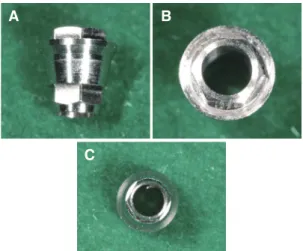
(ZirAce External, Acucera Inc., Seoul, Korea) with titanium inserts (Z socket Regular, Osung MND Co., Ltd., Seoul, Korea) and titanium abutment screws as experimental group (Fig. 1). The titanium abutments were 5.5 mm in width, 5.5 mm in height, and 3.5 mm in collar height. The zirconia abutments were 5.0 mm in width, 5.5 mm in height, and 3.0 mm in collar height. The titanium sockets were 4.1 mm in width and had dual hexes; a hex which went into an internal connection implant fixture, and an opposite hex which connected to the zirconia abutment (Fig.
2). 10 screw-shaped titanium implants (Implantium,
Fig. 1. The implant-abutment assemblies used in the study, (A) Control group: internal connection type titanium implant, titanium abutment, and titanium screw, (B) Experimental group: internal connection type titanium implant, zirconia abutment, titanium socket, and titanium screw.
A B
Fig. 2. The view of a titanium socket used in this study.
(A) Lateral view, (B) Upper view, (C) Lower view.
A B
C
The effect of a titanium socket with a zirconia abutment on screw loosening after thermocycling in an internally connected implant: a preliminary study
Dentium Co., Ltd.), which were 4.5 mm in platform diameter, 4.3 mm in body diameter, and 10.0 mm in length, were used in this study. The sample size of the abutments was five for each group.
The implants, abutments, and abutment screws were assembled with a tightening torque of 30 Ncm, All the specimens were soaked in water in tempera- tures cycling between 5°C and 55°C with 60 seconds of dwell time. There was an interval of 35 seconds between the water changes. The cycle was repeated 2,000 times. The removal torque values (RTV) of the specimens were measured with a digital torque gauge (MTT03-12, Mark-10 Co., Hicksville, USA) before and after thermocycling.
The statistical analyses were performed with SPSS 12.0 for Windows (IBM, New York, USA) and P- values < 0.05 were considered statistically significant.
To compare RTV differences between the groups, an independent t-test was conducted.
Results
For all specimens tested, any screw loosening was not identified by visual and tactile inspection dur- ing or after the thermocycling. Table 1 lists the pre- thermocycling and post-thermocycling mean RTVs and the RTV differences. As shown in Table 1, the negative reverse torque difference indicated that thermocycling made the screws required less loos- ening torque. The control group showed the mean RTV difference value as -1.34 ± 2.53 Ncm and the experimental group showed as -1.26 ± 2.06 Ncm, re- spectively. Statistical analysis using an independent t- test revealed that the RTV differences between both groups were not significantly different (P > 0.05).
Discussion
In this study the data suggested that the use of a
secondary titanium component for the zirconia abut- ment did not significantly influence screw loosening under thermal stress compared to the conventional titanium abutment. Clinically, these results would indicate that there is not a mechanical disadvantage due to screw loosening in using the titanium socket to reinforce the zirconia abutment in internally con- nected implant system.
The titanium socket was mounted on the implant together with the zirconium abutment and fixed by one abutment screw. This titanium socket had dual hexes; a hex which went into an internal connection implant fixture, and an opposite hex which con- nected to the zirconia abutment. It might be assumed that the external structure of the titanium socket had an influence on the decrease in post-thermocycling RT values compared to the internally connected titanium implant. However these two values were not statistically significant in this study. One of the complications associated with two-piece zirconia abutments is the instability of the interface between the zirconia abutment and the titanium component depending on how they are connected. Although zir- conia abutments seem to exhibit sufficient bending moments when the zirconia abutments are bonded with a titanium socket using resin-luting cements, the cementing procedure itself is a complicating proce- dure, which could compromise the fracture resistance of the entire zirconia abutment assembly. Therefore, the current abutment assembly design, where a bond- ing procedure is not necessary, can be a simple and efficient way to reduce future complications.
The zirconia abutments with a titanium socket yielded satisfactory results when compared to tita- nium abutments with respect to static fracture re- sistance.6 The joint clamping force of an abutment screw in the dental implant structure is generally about 75% of the maximum tensional strength.12,13 Thermocycling was used to simulate the humid
Table 1. Pre-thermocycling and post-thermocycling reverse torque values (RTVs), and RTV differences
Group Pre-thermocycling RTV (mean) Post-thermocycling RTV (mean) RTV difference (Ncm)
Control 23.66 22.32 -1.34 ± 2.53
Experimental 22.74 21.48 -1.26 ± 2.06
117
J Dent Rehabil Appl Sci 2017;33(2):114-8
conditions and frequent thermal changes of the oral cavity due to saliva and food intake. This study examined the connection between the screw and the abutment after repeated temperature cycling between 5°C and 55°C. The screws and the implants differed with respect to geometry. The stress caused by ther- mocycling in this study, however, was estimated to be lower than the yielding point since screw loosen- ing was not observed in any specimenrs.14,15 Further studies will be necessary to evaluate the influence of various clinical conditions on screw loosening for the rationale of using the titanium component in the zir- conia abutment while controlling for torque.
Conclusion
This study investigated the effect of a titanium component for the zirconia abutment in the internal connection system on screw loosening under ther- mocycling conditions. The titanium socket for the zirconia abutment did not show a significant effect on screw loosening under thermal stress compared to the titanium abutment in the internal connection implant.
Within the limitations of this study, the use of a tita- nium socket cannot be clinically harmful, particularly if internally connected implant system is chosen.
ORCID
Joo-Hee Lee http://orcid.org/0000-0002-7907-3098
References
1. Yildirim M, Fischer H, Marx R, Edelhoff D. In vivo fracture resistance of implant-supported all- ceramic restorations. J Prosthet Dent 2003;90:325- 31.
2. Apholt W, Bindl A, Lüthy H, Mörmann WH. Flex- ural strength of Cerec 2 machined and jointed In- Ceram-Alumina and InCeram-Zirconia bars. Dent Mater 2001;17:260-7.
3. Garvie RC, Hannink RH, Pascoe RT. Ceramic steel? Nature 1975;258:703-4.
4. Adatia ND, Bayne SC, Cooper LF, Thompson JY.
Fracture resistance of yttria-stabilized zirconia den-
tal implant abutments. J Prosthodont 2009;18:17- 22.
5. Sailer I, Sailer T, Stawarczyk B, Jung RE, Häm- merle CH. In vitro study of the influence of the type of connection on the fracture load of zirconia abutments with internal and external implant-abut- ment connections. Int J Oral Maxillofac Implants 2009;24:850-8.
6. Chun HJ, Yeo IS, Lee JH, Kim SK, Heo SJ, Koak JY, Han JS, Lee SJ. Fracture strength study of inter- nally connected zirconia abutments reinforced with titanium inserts. Int J Oral Maxillofac Implants 2015;30:346-50.
7. Ekelund JA, Lindquist LW, Carlsson GE, Jemt T.
Implant treatment in the edentulous mandible: a prospective study on Brånemark system implants over more than 20 years. Int J Prosthodont 2003;
16:602-8.
8. Eckert SE, Meraw SJ, Cal E, Ow RK. Analysis of incidence and associated factors with fractured im- plants: a retrospective study. Int J Oral Maxillofac Implants 2000;15:662-7.
9. Taylor TD, Agar JR, Vogiatzi T. Implant prosth- odontics: current perspective and future directions.
Int J Oral Maxillofac Implants 2000;15:66-75.
10. Winkler S, Ring K, Ring JD, Boberick KG. Implant screw mechanics and the settling effect: overview. J Oral Implantol 2003;29:242-5.
11. Halliday D, Resnick R, Walker J. Fundamentals of physics extended, 8th ed. Hoboken; Wiley; 2008. p.
586-91.
12. McGlumphy EA, Mendel DA, Holloway JA. Im- plant screw mechanics. Dent Clin North Am 1998;
42:71-89.
13. Burguete RL, Johns RB, King T, Patterson EA.
Tightening characteristics for screwed joints in osseointegrated dental implants. J Prosthet Dent 1994;71:592-9.
14. Traini T, Di Iorio D, Caputi S, Degidi M, Iezzi G, Piattelli A. In vitro evaluation of thermomechanic coupling in conical implant-to-abutment joint. Im- plant Dent 2007;16:379-86.
15. Low D, Sumii T, Swain M. Thermal expansion co- efficient of titanium casting. J Oral Rehabil 2001;
28:239-42.
The effect of a titanium socket with a zirconia abutment on screw loosening after thermocycling in an internally connected implant: a preliminary study
*교신저자: 이주희
(05505)서울 송파구 올림픽로 43길 88 울산대학교 의과대학 서울아산병원 치과보철과 Tel: 02-3010-5803|Fax: 02-3010-6967|E-mail: [email protected] 접수일: 2017년 4월 25일|수정일: 2017년 5월 2일|채택일: 2017년 5월 9일
내부연결 임플란트용 타이타늄 소켓을 이용한 지르코니아 지대주에서 열순환이 나사풀림에 미치는 영향: 예비연구
경규영, 차현석, 이주희*
울산대학교 의과대학 서울아산병원 치과보철과
목적: 이 연구의 목적은 타이타늄 구성요소를 가진 지르코니아 지대주가 내부연결 임플란트에 사용되었을 때 나사 풀림 에 대해 알아보는 것이다. 열순환 후 타이타늄 소켓을 가진 지르코니아 지대주와 타이타늄 지대주의 나사 풀림과 제거력 을 비교 분석하였다.
연구 재료 및 방법: 내측연결 임플란트와 내측연결 타이타늄 지대주, 타이타늄 소켓을 가진 외측연결 지르코니아 지대주 를 준비하였다. 내부연결형 임플란트에 5개의 타이타늄 지대주를(대조군), 타이타늄 소켓을 가진 5개의 지르코니아 지대 주(실험군)를 각각 연결하고 30 Ncm의 토크로 조인 후 열순환 처리 전후의 지대주 나사 제거력을 측정하였다. 각 시편들 은 열순환 장치의 수조에서 5°C와 55°C의 물에 60초씩 교대로 2,000회의 열순환을 시행하였다. 각 시편의 나사 풀림을 조사하고 열순환 전후에 나사 제거력을 통계학적으로 분석하였다.
결과: 두 그룹 모두에서 열순환 후 지대주 나사 풀림을 보이지 않았다. 열순환 전후의 나사 제거력 차이는 대조군에서
-1.34 ± 2.53 Ncm, 실험군에서 -1.26 ± 2.06 Ncm 로 나타났다. 독립표본 T 통계분석 결과 두 군간에 유의한 차이를 보 이지 않았다(P > 0.05).
결론: 이 실험의 결과 내에서 내부연결 임플란트를 위한 지르코니아 지대주 내 타이타늄 소켓이 열순환 후 지대주 나사 풀림에 타이타늄 지대주와 비교하여 유의한 영향을 나타내지 않았다.
(구강회복응용과학지 2017;33(2):114-8)
주요어: 나사; 지대주; 임플란트; 열순환; 제거력