This is an open-access article distributed under the terms of the Creative Commons Attribution Non-Commercial License (http://creativecommons.org/
licenses/by-nc/4.0/), which permits unrestricted non-commercial use, distribution, and reproduction in any medium, provided the original work is properly cited.
CC
Clinical study on screw loosening in dental implant prostheses:
a 6-year retrospective study
Ki-Young Lee
1,*, Kyung Su Shin
2,*, Ji-Hye Jung
1, Hye-Won Cho
1, Kyung-Hwan Kwon
2,†, Yu-Lee Kim
1,†Departments of
1Prosthodontics and
2Oral and Maxillofacial Surgery, Wonkwang University Dental Hospital, College of Dentistry, Wonkwang University, Iksan, Korea
Abstract (J Korean Assoc Oral Maxillofac Surg 2020;46:133-142)
Objectives: In this study, we determined the incidence and pattern of screw loosening in patients who received dental implants.
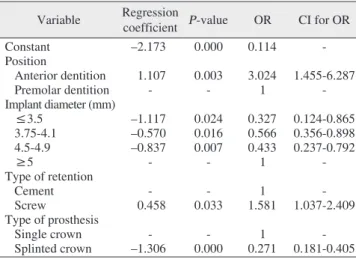
Materials and Methods: Patients who received implants between January 2008 and October 2013 and completed their prosthetic rehabilitation were evaluated for the incidence, frequency, and onset of screw loosening using dental charts and radiographs. The association between each factor and screw loosening was analyzed using the chi-square test and a multivariate analysis with binary logistic regression models ( P <0.05).
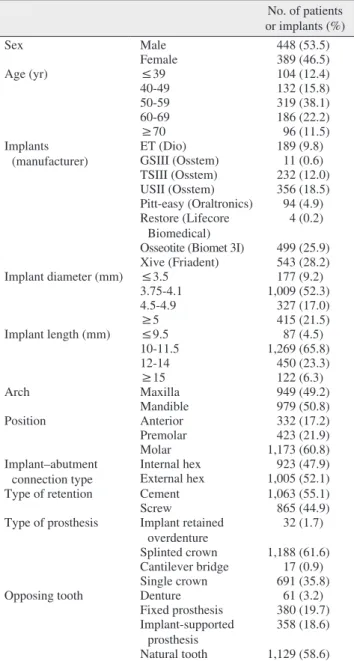
Results: Total 1,928 implants were placed in 837 patients (448 males, 389 females), whose follow-up period after loading varied from 0.25 to 70 months (mean period, 31.5 months). Screw loosening occurred in 7.2% of implants. Most cases occurred less than six months after loading. Among those, 22.3% experienced recurrent screw loosening. Screw loosening was most common in the molar region (8.5%) and frequently associated with an implant diameter of ≥5 mm (14.2%). External implant–abutment connections (8.9%) and screw-retained implant prostheses (10.1%) showed higher incidence of problems than internal implant–abutment connections and cement-retained implants, respectively. Screw loosening was most common in implant prostheses with single crowns (14.0%).
Conclusion: Within the limits of the current study, we conclude that the incidence of screw loosening differs significantly according to the position of implant placement, the type of implant and manufacturer, implant diameter, the type of implant–abutment connection, the type of retention in the implant prosthesis, and the type of implant prosthesis.
Key words: Dental implants, Screw loosening, Regression analysis
[paper submitted 2019. 6. 23 / revised 2019. 10. 21 / accepted 2019. 11. 8]
Copyright © 2020 The Korean Association of Oral and Maxillofacial Surgeons. All rights reserved.
I. Introduction
According to Brånemark
1, since the concept of osseointe- gration was first introduced in dentistry, osseointegrated den- tal implants have been included in the treatment options for patients undergoing prosthodontic treatment. Dental implant treatment is suggested for edentulous patients. It has a high success rate, even after long periods of observation
2,3.
Recently, many studies have reported problems following implant treatment. Goodacre et al.
4reported that potential complications of implant treatment include osseointegra- tion failure, surgical complications, marginal bone loss, peri- implantitis, mechanical complications, and aesthetic, masti- catory, and phonetic problems. Calderon et al.
5stated that the most frequently observed problems after implant treatment were mechanical complications, including screw loosening, screw fractures, implant fractures, porcelain fractures, and retention loss of implant-retained overdentures.
Screw loosening is a commonly observed implant compli- Yu-Lee Kim
Department of Prosthodontics, Wonkwang University Dental Hospital, College of Dentistry, Wonkwang University, 895 Muwang-ro, Iksan 54538, Korea
TEL: +82-63-859-2938 FAX: +82-63-859-4002 E-mail: [email protected]
ORCID: https://orcid.org/0000-0003-1350-5895 Kyung-Hwan Kwon
Department of Oral and Maxillofacial Surgery, Wonkwang University Dental Hospital, College of Dentistry, Wonkwang University, 895 Muwang- ro, Iksan 54538, Korea
TEL: +82-63-850-6486 FAX: +82-63-859-4002 E-mail: [email protected]
ORCID: https://orcid.org/0000-0002-5257-8440
*These authors contributed equally to this work as first authors.
†