Copyright © 2019 Yeungnam University College of Medicine
This is an Open Access article distributed under the terms of the Creative Commons Attribution Non-Commercial License (http://creativecommons.org/licenses/by-nc/4.0/) which permits unrestricted non-commercial use, distribution, and reproduction in any medium, provided the original work is properly cited.
Awareness of occupational hazards and personal protective equipment use among dental hygienists
Hyun-Ju Choi 1 , Tae-Yoon Hwang 2 , Man-Joong Jeon 2
1
Department of Dental Hygiene, Daegu Health College, Daegu, Korea
2
Department of Preventive Medicine & Public Health, Yeungnam University College of Medicine, Daegu, Korea
Background: The aim of this study was to evaluate the awareness of occupational hazards and personal protective equipment use among dental hygienists (DHs).
Methods: A total of 271 self-administered questionnaires were obtained from 280 DHs working at dental hospitals or clinics in Daegu and Gyeongsangbuk-do, Korea.
Results: The occupational hazards included work involving dust (94.1%), volatile substances (86.0%), noise (97.0%), and light-curing units (96.7%). The proportion of dental hygiene tasks that participants perceived as harmful were 42.4%, 51.7%, 9.2%, and 31.4% in the same order as above. The proportion of participants who used dust-proof masks during work involving dust was 1.1%. Those who wore gas-proof masks and gloves for work using volatile substances were 0.7% and 31.2%, respectively. Participants who used goggles for work involving light-curing units were 31.0%. None of the participants used ear plugs for work involving noise. A total of 22.9% of the participants recognized the Material Safety Data Sheet, while 79.7% had never been educat- ed about harmful work environments.
Conclusion: When compared to exposure status and perception of occupational hazards, the level of protective equipment use was very low. Extra measures to increase DHs’ use of personal pro- tective equipment are necessary.
Keywords: Dental hygienists; Occupations; Personal protective equipment Received: May 23, 2018
Revised: October 15, 2018 Accepted: October 26, 2018 Corresponding author:
Tae-Yoon Hwang
Department of Preventive Medicine
& Public Health, Yeungnam University College of Medicine, 170, Hyeonchung-ro, Nam-gu, Deagu 42415, Korea
Tel: +82-53-640-6954 Fax: +82-53-653-2061 E-mail: [email protected]
Introduction
Dental clinics and hospitals are exposed to various harmful substances depending on the nature of treatment. Many medical materials used in dental offices can cause abnormal and hypersensitivity reactions [1]. The risk of damage to hearing and vision is high, owing to harmful physical factors such as loud noises, radiation, and ultraviolet light [1].
Dental hygienists (DHs) in dental clinics and hospitals are exposed to various harmful physical and chemical elements during conservation and reinforcement work, such as calculus removal, diagnostic mouth radiography, impression acquisition,
and production of temporary crowns. Hazardous exposures can lead to musculoskeletal disorders, eye damage, vibration- induced neuropathy, hearing loss, and psychological stress [2-4].
Specifically, there are risks of eye damage due to direct blue light irradiation during resin preparation [5]. Harm may arise when chemicals are inhaled during prosthetic dentistry [6]. In addition, methyl methacrylate, which is used in dental cement, can induce mucous irritation, allergic reactions, hypersensitivity, asthma reactions, nerve symptoms, and skin diseases, among others [7]. Jang [8] reported that 46.5% of respondents complained of coughing due to alginate or stone dust inhalation and 61.1% of experienced respondents complained of coughing. Lee et al. [9]
Yeungnam Univ J Med 2019;36(1):20-25
https://doi.org/10.12701/yujm.2019.00052
reported that noises from ultrasonic scalers, high- and low-speed handpieces, and dental suction affect the hearing of DHs.
Most existing studies have focused their investigations on either exposure to infectious diseases and its awareness, use of protective gear to prevent infection [10-12], or symptoms of musculoskeletal diseases [13-17].
Despite the known physical and chemical hazards of dental care environments, available research on DHs’ awareness about, management of, and protection against these harmful environments is insufficient. DHs’ work, like other hazardous tasks, requires personal protective equipment but the level of awareness of the hazardous work environment in dental offices is still low [18].
This study was conducted to identify DHs’ awareness of the physically and chemically hazardous working conditions associated with dental care and to understand the need for appropriate protective equipment.
Matrials and methods
The study participants were DHs working in 6 dental hospitals and 35 dental clinics in Daegu and Gyeongsangbuk-do provinces.
Those who performed reception duty or pregnant, were excluded.
The dental hospitals and clinics were selected through convenient sampling. We obtained consent after providing an explanation of the study to the DHs and the corresponding dental hospitals and clinics.
Data collection was conducted between April 1, 2017 and April 20, 2017 in the form of self-administered questionnaires. A total of 280 questionnaires were collected. After excluding 9 owing to unreliable responses, 271 were included in the final dataset.
This study was approved by the institutional review board of the institution to which the researcher is affiliated (YU 2017-02-007- 003).
Regarding general characteristics, demographic factors such as gender, age, and educational level, and work-related factors such as the type of working institution, as well as total duration of employment (in years), were investigated.
Work environment-related survey items were constructed based on a study by Choi [19], which adapted the Air Quality and Work Environment Symptom Survey developed by the National Institute for Occupational Safety and Health, to fit the Korean context. Work environment is an item that examines the frequency of work in dental hospitals and clinics that can prove harmful, including tasks that involve dust, volatile substances, noises, and light-curing units.
In order to identify the management characteristics of
hazardous substances during dental work, items from a previous study by Kim and Choi [18] were used. Survey content included whether instructions are read before using dental materials, recognition of Material Safety Data Sheet (MSDS), DHs’
knowledge about the potential harmfulness of dental materials, and awareness regarding the need for education.
The collected data were analyzed using IBM SPSS version 22.0 (IBM Co., Armonk, NY, USA) to compute frequencies and percentages of participants’ general characteristics, awareness of health hazards in dental work, and the use of personal protective equipment.
Results
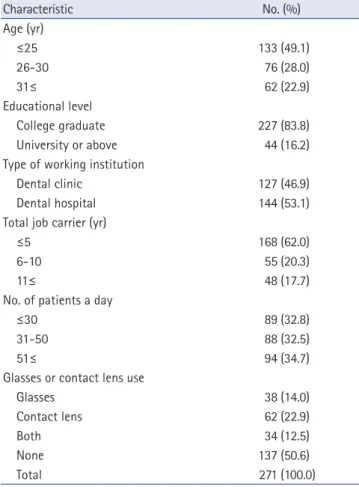
The most common age group was under 25 with 133 participants (49.1%), followed by 26-30 with 76 participants (28.0%) and 31 or older with 62 participants (22.9%). There were 227 college graduates (83.8%) and 44 university graduates or above (16.2%).
A total of 144 participants (53.1%) were from dental hospitals and 127 (46.9%) were from dental clinics. Total career duration was 5 years or less for 168 participants (62.0%), followed by 6 to 10 years for 55 participants (20.3%), and more than 11 years for 48 participants (17.7%).
Regarding the average number of patients seen per day, 94 participants (34.7%) saw more than 51 patients, 89 (32.8%) saw fewer than 30, and 88 (32.5%) saw between 31 and 50. The use of eyewear among participants was considered: 137 participants (50.6%) wore neither, 62 (22.9%) wore contact lenses, 38 (14.0%) wore glasses, and 34 (12.5%) wore both (Table 1).
Among those involved in physically or chemically harmful work, 255 participants (94.1%) performed work involving dust, 233 (86.0%) volatile substances, 263 (97.0%) noises, and 262 (96.7%) light-curing units.
For work involving dust, 234 participants (91.8%) were engaged in alginate mixing, 202 (79.2%) in prosthodontics polishing and restoration, 202 (79.2%) in tooth preparation, and 164 (64.3%) in plaster mixing.
For the types of volatile substances used, 194 participants (83.2%) used disinfectants, 166 (71.2%) resin monomers, 120 (51.5%) formocresol, and 111 (47.6%) zinc oxide eugenol.
For the types of noises, 256 participants (97.3%) used suction and air, 248 (94.3%) operated with dental hand pieces, 119 (45.2%) were exposed to the cries of young patients during treatments, and 62 (23.6%) performed plaster trimming (Table 2).
Based on multiple responses, participants considered the
following as occupational hazards: inhalation of volatile
substances at work (140; 51.7%); work involving dust (115;
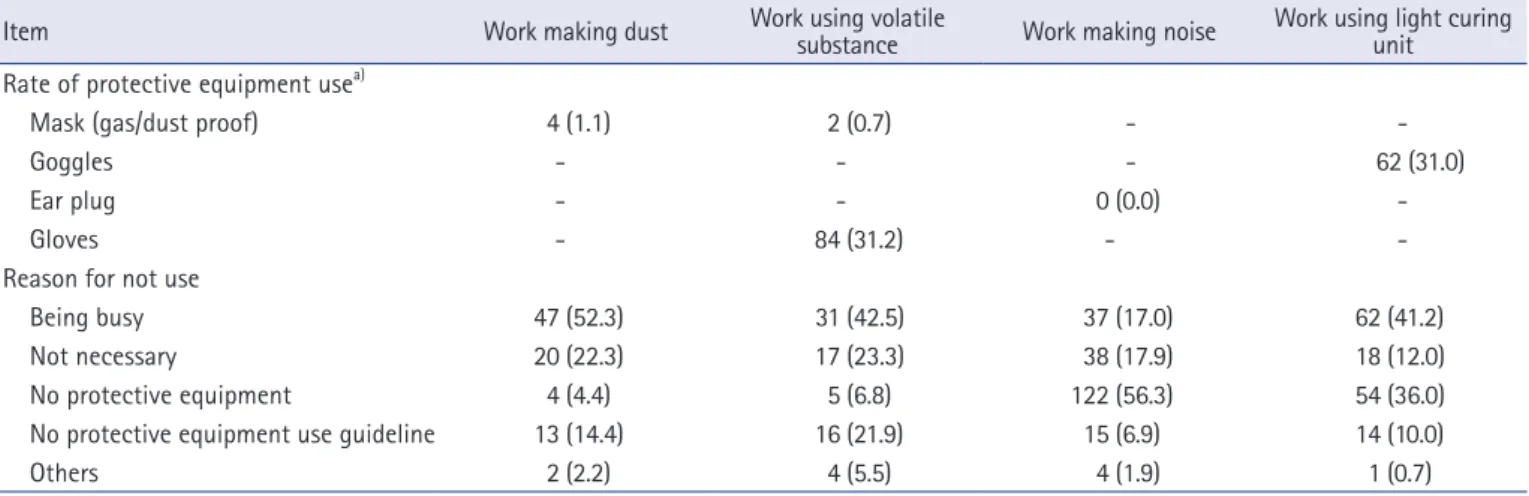
participants (31.0%) responded that they wear protective goggles.
Reasons for not wearing protective goggles included: “being busy” (62; 41.2%), “no protective equipment” (54; 36.0%),
“not necessary” (18; 12.0%), and no protective equipment use guidelines” (14; 10.0%) (Table 4).
One hundred and thirty-eight participants (50.9%) read the instructions before using dental material. The dental MSDS was recognized by 62 (22.9%). Fifty-five participants (20.3%) had some experience of education regarding occupational hazards.
Of those who had not received any education on occupational hazards, 178 participants (82.4%) intended to gain this knowledge if given the opportunity (Table 5).
Table 2. Frequency of hazardous dental works the subjects involved (n=271)
Hazardous dental work No. (%)
Work making dust 255 (94.1)
Type of work making dust
Alginate mixing 234 (91.8)
Prosthodontics polishing and restoration 202 (79.2)
Tooth preparation 202 (79.2)
Plaster mixing 164 (64.3)
Others 17 (6.6)
Work using volatile substance 233 (86.0) Type of volatile substance used
Disinfectant 194 (83.2)
Resin monomer 166 (71.2)
Formocresol 120 (51.5)
Zinc oxide eugenol 111 (47.6)
Others 21 (9.0)
Work making noise 263 (97.0)
Type of noise made
Use of suction and air 256 (97.3)
Use of dental hand piece 248 (94.3)
Cry of younger patient 119 (45.2)
Plaster trimming 62 (23.6)
Others 6 (2.3)
Work using light curing unit 262 (96.7)
Table 3. Dental works perceived to be hazardous by the subjects (n=271)
Dental work No. (%)
Work making dust 115 (42.4)
Work using volatile substance 140 (51.7)
Work making noise 25 (9.2)
Work using light curing unit 85 (31.4) Values are based on multiple responses.
42.4%); working with specialized equipment such as light- curing units (85; 31.4%); and work involving noises (25; 9.2%) (Table 3).
Four participants (1.1%) responded that they wear dust-proof masks when performing work involving dust. Reasons for not wearing dust-proof masks included “being busy” (47; 52.3%), “not necessary” (20; 22.3%), “no protective equipment use guidelines”
(13; 14.4%), and “no protective equipment available” (4; 4.4%).
Two participants (0.7%) responded that they use gas-proof masks and 84 (31.2%) responded that they use gloves when performing work using volatile substances. Reasons for not wearing protective equipment when working with volatile substances included: “being busy” (31; 42.5%), “not necessary”
(17; 23.3%), and “no protective equipment use guidelines” (16;
21.9%).
None of the participants used ear plugs, which should be worn while performing work involving noises. Reasons for not wearing ear plugs included: “no protective equipment” (122; 56.3%),
“not necessary” (38; 17.9%), “being busy” (37; 17.0%), and “no protective equipment use guidelines” (15; 6.9%).
When performing work involving light-curing units, 62 Table 1. General characteristic of the subjects
Characteristic No. (%)
Age (yr)
≤25 133 (49.1)
26-30 76 (28.0)
31≤ 62 (22.9)
Educational level
College graduate 227 (83.8)
University or above 44 (16.2)
Type of working institution
Dental clinic 127 (46.9)
Dental hospital 144 (53.1)
Total job carrier (yr)
≤5 168 (62.0)
6-10 55 (20.3)
11≤ 48 (17.7)
No. of patients a day
≤30 89 (32.8)
31-50 88 (32.5)
51≤ 94 (34.7)
Glasses or contact lens use
Glasses 38 (14.0)
Contact lens 62 (22.9)
Both 34 (12.5)
None 137 (50.6)
Total 271 (100.0)
Discussion
Owing to the diversification and specialization of dental care, DHs must perform various tasks in prosthetics, preservation, corrective care, and preventive care [20]. In the course of their work, DHs are consistently exposed to physically and chemically harmful environments [18]. This study was conducted to identify DHs’ exposure to hazardous work environments and to examine their use of personal protective equipment.
The frequencies of physically and chemically harmful work involving dust, volatile substances, noises, and light-curing units were 94.1%, 86.0%, 97.0%, and 96.7%, respectively. In contrast, the degree of perceived harm were in the following order: work
involving volatile substances that induce inhalation 51.7%; work involving dust 42.4%; work using specialized equipment such as light-curing units 31.4%; and work involving noise 9.2%.
Hazard perception was lower than the hazardous work factors to which DHs are exposed to in the dental setting. In particular, the recognition of noise hazards was very low.
Among the participants, 1.1% responded that they wore dust- proof masks while doing work involving dust. While 0.7% and 31.2% responded that they wore gas-proof masks and protective gloves, respectively, while doing work with volatile substances.
None of the participants wore ear plugs while doing work involving noises. Moreover, only 31.0% wore protective goggles while doing work using light-curing units. Although “being busy”
and “no protective gear” were common reasons for not using appropriate personal protective equipment, the fundamental reason relates to low awareness of work-related hazards.
None of the DHs wore earplugs. This can be attributed to low awareness of the dangers of noises in dental hospitals and clinics. In terms of workplace noises, the working environment standard for DHs is much lower than the 8-hour average of 90 dB prescribed by the Industrial Safety and Health Act. However, Kim et al. [21] reported that noises produced in dental offices may lead to noise-induced deafness. Park and Kim [22] also reported that noises in dental settings, affect the hearing and job performance of DHs.
Our study showed that only 22.9% of the participants were familiar with the MSDS, and only 20.3% were educated about the harmfulness of dental materials. These findings suggest that there is a lack of awareness about occupational hazards in the dental work environment. Contrarily, Jeong et al. [23] reported that while dental workers know about the need for basic protection, the compliance rate is low because of reasons such as increased Table 4. Frequency of the subjects use protective equipment according to hazardous dental works and reasons for not use
Item Work making dust Work using volatile
substance Work making noise Work using light curing unit
Rate of protective equipment use
a)Mask (gas/dust proof) 4 (1.1) 2 (0.7) - -
Goggles - - - 62 (31.0)
Ear plug - - 0 (0.0) -
Gloves - 84 (31.2) - -
Reason for not use
Being busy 47 (52.3) 31 (42.5) 37 (17.0) 62 (41.2)
Not necessary 20 (22.3) 17 (23.3) 38 (17.9) 18 (12.0)
No protective equipment 4 (4.4) 5 (6.8) 122 (56.3) 54 (36.0)
No protective equipment use guideline 13 (14.4) 16 (21.9) 15 (6.9) 14 (10.0)
Others 2 (2.2) 4 (5.5) 4 (1.9) 1 (0.7)
a)
Values are presented as number (%) and only in case of the corresponding harmful dental works.
Table 5. Characteristics related to management of hazardous dental work condition
Item No. (%)
Read the instruction before using dental material
Yes 138 (50.9)
No 133 (49.1)
Recognition of MSDS
Yes 62 (22.9)
No 209 (77.1)
Education experience on harmfulness of dental material
Yes 55 (20.3)
No 216 (79.7)
Intention to get education on harmfulness of dental material
a)Yes 178 (82.4)
No 38 (17.6)
MSDS, material safety data sheet.
a)