Korean J Intern Med 2021;36:313-321 https://doi.org/10.3904/kjim.2019.234
1
Department of Internal Medicine, Inje University Ilsan Paik Hospital, Goyang;
2Department of Internal Medicine, Soonchunhyang University Bucheon Hospital, Bucheon;
3Division of Gastroenterology and Hepatology, Hallym University Kangnam Sacred Heart Hospital, Seoul;
4Department of Internal Medicine, Keimyung University School of Medicine, Daegu;
5
Department of Internal Medicine, Kangwon National University School of Medicine, Chuncheon;
6
Department of Internal Medicine, Seoul National University Bundang Hospital, Seongnam, Korea
Background/Aims: The risk factors for the development of primary biliary chol- angitis (PBC) is unclear. This study aimed to investigate the risk factors associated with PBC in Korea through a questionnaire survey.
Methods: Consecutively enrolled 103 PBC patients from six referral hospitals and 100 age- and sex-matched community controls participated in this study. A stan- dardized questionnaire survey including demographics, lifestyle, individual and familial medical history and reproductive history was prospectively collected and analyzed.
Results: The PBC patients had a mean age of 58.3 years and a female proportion of 86.4%. The age- and sex-matched controls had a similar educational level and economic status to the PBC patients. Among the lifestyle factors, the multivari- able analysis showed smoking including both first-hand and second-hand (odds ratio [OR], 2.03; 95% confidence interval [CI], 1.06 to 3.93), history of autoimmune diseases (OR, 2.46; 95% CI, 1.06 to 6.35), and family history of PBC (OR, 17.76; 95%
CI, 1.77 to 2,418.74) were significantly associated with PBC, whereas alcohol intake was negatively associated with PBC. Among reproductive factors, the number of induced abortions was significantly associated with PBC, while the number of full-term deliveries was negatively associated with PBC.
Conclusions: A family history of PBC, accompanying autoimmune diseases, and smoking were significantly associated with PBC. More induced abortions and less full-term deliveries were associated with PBC in women. In contrast, mild to moderate alcohol intake was negatively associated with PBC. Further studies are warranted to validate the results of this study and to search for clues about the pathogenesis of PBC.
Keywords: Liver cirrhosis, biliary; Risk factors; Smoking; Ethanol; Abortion, induced
Environmental risk factors and comorbidities of primary biliary cholangitis in Korea: a case-control study
Kyung-Ah Kim 1 , Young Seok Kim 2 , Sang Hoon Park 3 , Woo Jin Chung 4 , Dae Hee Choi 5 , Eun Sun Jang 6 , and Sook-Hyang Jeong 6
INTRODUCTION
Primary biliary cholangitis (PBC) is a rare, chronic in- flammatory autoimmune disease that mainly affects
middle-aged women [1]. It is characterized by non-sup- purative inflammation and destruction of the interlob- ular bile ducts leading to cholestasis and cirrhosis and the presence of the anti-mitochondrial antibody (AMA) Received : July 19, 2019
Revised : August 28, 2019 Accepted : September 5, 2019 Correspondence to
Sook-Hyang Jeong, M.D.
Department of Internal Medi-
cine, Seoul National University
Bundang Hospital, 82 Gumi-ro
173 Beon-gil, Bundang-gu,
Seongnam 13620, Korea
Tel: +82-31-787-7034
Fax: +82-31-787-4052
E-mail: [email protected]
https://orcid.org/0000-0002-
4916-7990
in serum [1].
The prevalence of PBC varies widely depending on the geographic location, ranging from 1.91 to 40.2 per 100,000 inhabitants [2], which suggests certain genetic and environmental factors influence the pathogenesis of PBC. Though the pathogenesis of PBC still remains enigmatic, an organ-specific autoimmune reaction trig- gered by exposure to putative environmental factors in genetically susceptible individuals is a convincing ex- planation [3].
Previous studies regarding the environmental risk factors of PBC have been conducted mostly in West- ern countries with a relatively high prevalence of PBC.
Those studies reported that smoking [4-7] and recurrent urinary tract infection (UTI) were frequently associated with PBC. However, the extent of exposure to environ- mental factors such as smoking, alcohol drinking, use of cosmetics, or contraceptive measures is variable de- pending on the countries and regions with different ep- idemiologies and life styles. In this case-control study, we investigated the environmental risk factors and co- morbidities associated with PBC in South Korea.
METHODS Study population
One hundred-three patients with PBC from six refer- ral centers in South Korea were prospectively enrolled from August 2014 to March 2015. The diagnostic crite- ria for PBC were at least two of the following findings present in the patients; chronic cholestasis, presence of AMA and liver histology compatible with PBC. The In- stitutional Review Board (IRB) approved this study (Ilsan Paik Hospital IRB number 2014-08-233) and written in- formed consent was received from all participants. The patients diagnosed as autoimmune hepatitis-PBC over- lap syndrome were excluded.
As a control group, 100 individuals matched to the PBC cases according to a stratified sampling based on age (10-year age groups) and gender were recruited from the commercialized Macromill Embrain research panel (Macromill Embrain, Seoul, Korea; www.embrain.com), which consists of 1,088,408 individuals representative of the Korean national population. The participants were enrolled on a voluntary basis. The survey was conducted
anonymously between August 25 and September 26, 2014.
Questionnaire survey
A standardized questionnaire survey was administered that included 137 questions regarding demographic, anthropometric, life style, medical and familial factors, reproductive (only for female) and socioeconomic fac- tors. Demographics included education and subjective socioeconomic class. Lifestyle factors included first- and second-hand smoke, alcohol consumption (drinks per day, frequency and duration), coffee consumption, and use of cosmetics and hair dye. Medical history includ- ed autoimmune diseases such as autoimmune hepatitis, thyroid illness, rheumatoid arthritis, systemic lupus er- ythematosus, systemic sclerosis, Sjogren’s disease, and inflammatory bowel diseases, infectious disease such as tuberculosis, clonorchiasis and measles, operations and vaccinations. Reproductive factors included age of men- arche and menopause, oral contraceptives, hormone replacement therapy, induced abortion, miscarriage, full-term delivery, and breast feeding. The details of the questionnaire (in Korean) is presented in the Supple- mentary Material.
PBC patients were interviewed face-to-face by a research coordinator or attending physician at each of the centers.
Controls were interviewed face-to-face by trained persons hired by Macromill Embrain.
Statistical analysis
Continuous variables were expressed as the median (in-
terquartile range) or mean ± SD as appropriate. Categor-
ical variables are presented in absolute and percentage
values (%). Continuous variables were compared using
the Student’s t test, or Mann-Whitney U test as appro-
priate, and categorical variables were compared using
the chi-square test or Fisher’s exact test. Multivariable
logistic regression analyses with the Firth method for
rare events were performed for variables with a p < 0.1 in
the univariable analysis and for clinically relevant vari-
ables with p > 0.1, but which were consistently reported
as significant variables in other studies (i.e., smoking
and UTI) to identify the risk factors of PBC for all sub-
jects and a female subgroup, respectively. A p < 0.05 was
considered statistically significant. All statistical analy-
ses were performed with SPSS version 25 (IBM Co., Ar-
monk, NY, USA).
RESULTS
Comparison of the demographic, socioeconomic, lifestyle factors, and medical history between the PBC patients and control group
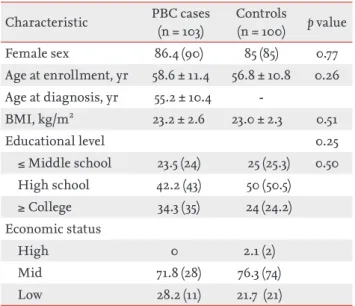
The mean age of the case and control group was 58.6 ± 11.4 and 56.8 ± 10.8 years, respectively. The female pro- portion of the case and control group was 86.4% and 85%, respectively. Educational level and economic status were similar between the two groups (Table 1).
The proportions of ever-smokers including current and ex-smoker (15.5% vs. 11.0%) were low in both groups and not statistically different between the PBC and con- trols groups (Table 2). Although the proportions of those who have experienced first-hand and/or second-hand smoking tended to be higher in the PBC patients (49.5%) than in the control (42.0%) group, it was not significant- ly different (p = 0.16). The proportions of ever-drinkers and persons who have had more than seven drinks per Table 1. Demographic and socioeconomic characteristics of
PBC cases and controls
Characteristic PBC cases (n = 103)
Controls
(n = 100) p value
Female sex 86.4 (90) 85 (85) 0.77
Age at enrollment, yr 58.6 ± 11.4 56.8 ± 10.8 0.26 Age at diagnosis, yr 55.2 ± 10.4 -
BMI, kg/m
223.2 ± 2.6 23.0 ± 2.3 0.51
Educational level 0.25
≤ Middle school 23.5 (24) 25 (25.3) 0.50 High school 42.2 (43) 50 (50.5)
≥ College 34.3 (35) 24 (24.2)
Economic status
High 0 2.1 (2)
Mid 71.8 (28) 76.3 (74)
Low 28.2 (11) 21.7 (21)
Values are presented as % (number) or mean ± SD.
PBC, primary biliary cholangitis; BMI, body mass index.
Table 2. Lifestyle factors of PBC cases and controls
Variable PBC cases (n = 103) Controls (n = 100) p value
First-hand smoking
Ever regularly smoked 16/103 (15.5) 11/100 (11.0) 0.41
Current smoking 5/103 (4.8) 7/100 (7.0) 0.56
Second-hand smoke exposure 42/99 (42.4) 37/99 (37.4) 0.56
Smoking including both first- & second-hand 51/98 (49.5) 42/100 (42.0) 0.16
Female 39/84 (42.6) 33/85 (38.8) 0.32
Male 12/14 (72.4) 9/15 (60.0) 0.12
Alcohol drinking, A/B/C
a9/32/62 (8.7/30.1/61.2) 13/53/34 (13.0/53.0/34.0) < 0.01
Female 5/24/60 (5.6/27.0/67.4) 6/45/34 (7.1/52.9/40.0)
Male 4/8/2 (28.6/57.1/14.3) 7/8/0 (46.7/53.3/0)
Coffee 89/103 (86.4) 92/100 (92.0) 0.20
Hair dye (> 2/yr) 33/101 (32.7) 30/99 (30.3) 0.72
Female 32/87 (36.8) 27/84 (32.1)
Male 1/14 (7.1) 3/15 (20.0)
Nail polish (> 2/yr) 13/102 (12.7) 18/100 (18.0) 0.30
Female 13/88 (14.8) 17/85 (20.0)
Male 0/14 (0.0) 1/15 (6.7)
Hair perm (> 4/yr) 36/102 (35.3) 34/100 (34.0) 0.85
Female 36/88 (40.9) 33/85 (38.8)
Male 0/14 (0.0) 1/15 (6.7)
Values are presented as number (%).
PBC, primary biliary cholangitis.
a
A, ≥ 7 drinks/week for female, ≥ 14 drinks/week for male; B, < 7 drinks/week for female, < 14 drinks/week for male; C, never drinker.
week were significantly lower in the PBC groups than in the controls (p < 0.01). Coffee drinking and exposure to nail polish, cosmetics and hair dye were not significant- ly different between the two groups. The prevalence of PBC in first degree relatives was higher in the PBC cas- es (6.2% vs. 0%, p = 0.02). The prevalence of other auto- immune diseases in first degree relatives did not differ between the relatives of the PBCs cases and those of the control group (Table 3).
History of any autoimmune diseases including au- toimmune thyroiditis, Sjogren’s disease, autoimmune hepatitis, systemic sclerosis and others was more fre- quent in the PBC cases than in the control group (26.2%
vs. 9.1%, p < 0.01). Among the autoimmune diseases, autoimmune thyroiditis (18.5% vs. 7.1%) and Sjogren’s disease (6.3% vs. 1.0%) were significantly more preva- lent in the PBC cases. Diabetes seemed to be more fre- quent in the PBC cases than in the controls (15.5% vs.
7.2%, p = 0.07). Medication for osteoporosis was more frequent in the PBC cases than in the controls. How- ever, history of UTI as a possible risk factor of PBC in previous studies did not differ between the two groups.
History of herbal medication was similarly frequent in both groups (78.6% vs. 77.8%) (Table 3). The frequencies for a positive history of all types of malignancies, acute hepatitis, tuberculosis, clonorchiasis, appendectomy, cholecystectomy, tonsillectomy, and vaccination for
hepatitis and tuberculosis were not different between the two groups.
Comparison of the reproductive and gynecological factors between the PBC patients and the control group among women
Age at menarche and menopause was similar between both groups. The PBC patients (74.2%) had a similar frequency in menopause state as the control group (62.5%). Experience with both pregnancy (91% vs. 100%, p < 0.05) and full-term delivery (91% vs. 100%, p < 0.05) was less frequent in the PBC cases than in the controls.
Moreover, the total number of full-term deliveries was lower in the PBC cases than in the controls (2.1 ± 1.2 vs.
2.5 ± 0.9, p < 0.05). Experience of receiving an induced abortion tended to be higher in the PBC groups than in the controls (51.1% vs. 37.7%, p = 0.07), and number of abortions was significantly higher in the PBC groups (1.2 ± 2.1 vs. 0.5 ± 0.7, p < 0.05). However, spontaneous abortions were not significantly different between the two groups. The frequencies of hormonal replacement therapy for postmenopausal syndrome and past use of oral contraceptives were similar between the two groups (Table 4). Pruritus and abnormal liver biochem- istry during pregnancy were not different between the two groups, either.
Table 3. History on the accompanying disease and family history in PBC cases and controls
Variable PBC cases (n = 103) Controls (n = 100) p value
Sjogren’s disease 27/103 (6.3) 1/97 (1.0) 0.06
Raynaud phenomena 2/100 (2.0) 0/96 (0.0) 0.50
Thyroid disease 19/103 (18.4) 7/99 (7.1) 0.02
Any type of autoimmune disease 27/103 (26.2) 9/90 (9.1) < 0.01
Diabetes mellitus 16/103 (15.5) 7/97 (7.2) 0.07
Osteoporosis 23/103 (22.1) 10/100 (10.0) < 0.05
Urinary tract infection 27/101 (26.7) 19/100 (19.0) 0.19
Acute hepatitis 4/102 (3.9) 0/98 (0.0) 0.12
History of herbal medication 80/103 (77.7) 77/99 (77.8) 0.99
PBC in first degree relatives 6/97 (6.2) 0/97 (0.0) 0.02
Thyroid disease in first degree relatives 9/103 (8.7) 8/100 (8) 0.85
Autoimmune hepatitis in first degree relatives 1/103 (1.0) 0/100 (0.0) 1.00
Sjogren’s disease in first degree relatives 0/103 (0) 0/100 (0) -
Values are presented as number (%).
PBC, primary biliary cholangitis.
Multivariable analysis of the risk factors for PBC Results of the univariable and multivariable analyses among the whole subjects are shown in Table 5. In multivariable analysis, family history of PBC, history of other autoimmune diseases, and smoking including first- and second-hand were significantly associated with PBC, but alcohol drinking was negatively associ- ated with PBC.
As a subgroup analysis including only women, the multivariable analysis showed that the presence of family history of PBC, history of other autoimmune diseases, and induced abortions were significantly as- sociated with PBC, but alcohol dinking less than seven drinks per week and number of full-term deliveries were negatively associated with PBC (Table 6).
Table 4. Reproductive and gynecological factors of female PBC cases and controls
Variable PBC cases (n = 89) Controls (n = 85) p value
Age, yr 58.4 ± 11.1 56.9 ± 10.9 0.35
Age of menarche, yr 15.1 ± 1.9 14.7 ± 1.6 0.14
Menopaused state 74.2 (66/89) 62.5 (53/85) 0.09
Age at menopause, yr 49.8 ± 5.0 50.9 ± 2.1 0.32
Hormone replacement therapy 16.7 (13/66) 7.8 (4/53) 0.18
Pregnancy
Ever 91 (81/89) 100 (85/85) < 0.05
No. of pregnancy 3.8 ± 0.3 3.2 ± 1.2 0.17
Full-term delivery, ever 91 (81/89) 100 (85/85) < 0.05
No. of full-term delivery 2.1 ± 1.2 2.5 ± 0.9 < 0.05
Miscarriage 25.8 (23/89) 23.5 (20/85) 0.72
Artificial abortion
Ever 51.1 (45/88) 37.7 (32/85) 0.07
No. of abortion 1.2 ± 2.1 0.5 ± 0.7 < 0.05
Use of oral contraceptives 25.3 (22/87) 25.9 (22/85) 0.93
Pruritus during pregnancy 4.8 (4/84) 8.3 (7/84) 0.53
Values are presented as mean ± SD or % (number).
PBC, primary biliary cholangitis.
Table 5. Multivariable analysis on the risk factors for PBC in PBC cases and controls
Factor Univariable analysis Multivariable analysis
OR 95% CI OR 95% CI
Smoking (first- & second-hand) 1.50 0.86–2.63 2.03 1.06 –3.98
Alcohol
aA vs. C 0.38 0.15–0.98 0.31 0.10–0.89
B vs. C 0.33 0.18–0.61 0.31 0.15–0.61
Autoimmune disease, any type 3.55 1.57–8.02 2.46 1.06–6.35
Family history of PBC in first degree relatives 13.85 1.60–1,815.30 17.76 1.77–2,418.74
Diabetes 2.37 0.93–6.03 2.64 0.99–7.49
Urinary tract infection 1.56 0.80–3.03 1.52 0.73–3.23
PBC, primary biliary cholangitis; OR, odds ratio; CI, confidence interval.
a