ABSTRACT
Background: Infections caused by carbapenem-resistant Enterobacteriaceae (CRE) are associated with high mortality rates and their treatment is difficult because treatment is limited to certain antibiotics, such as colistin and tigecycline. We aimed to perform active surveillance culture of CRE (ASC-CRE) to monitor the prevalence of CRE acquisition during intensive care unit (ICU) care and to examine the potential risk factors associated with CRE acquisition.
Methods: We conducted ASC-CRE on patients who were admitted to the ICU in the
emergency room at a tertiary hospital. Rectal swabs were analyzed using methods established by the Centers for Disease Control and Prevention. To detect carbapenemase-producing CRE, a polymerase chain reaction assay to detect five carbapenemase genes (blaNDM, blaKPC, blaVIM, blaIMP-1, and blaOXA-48) was performed.
Results: There were 22 CRE acquisition in 21 patients (2.6%, 21/810) and the incidence of CRE acquisition was 4.3/1,000 person-days, respectively. The most common species detected was Klebsiella pneumoniae (72.7%, 16/22), and 9 carbapenemase-producing CREs (7 blaKPC and 2 blaNDM) were detected. Independent risk factors associated with CRE acquisition were men gender (adjusted odds ratio [aOR], 5.3; 95% confidence interval [CI], 1.3–21.3), history of admission within one year (aOR, 3.9; 95% CI, 1.2–12.1), co-colonization with multidrug- resistant Acinetobacter baumannii (aOR, 15.6; 95% CI, 3.6–67.8) and extended-spectrum β-lactamases-producing bacteria (aOR, 4.7; 95% CI, 1.5–14.6), and exposure to glycopeptide antibiotics (aOR, 3.6; 95% CI, 1.3–9.9).
Conclusion: The identification of patients with risk factors for CRE acquisition and early detection of CRE acquisition using ASC-CRE may be useful for CRE control.
Keywords: Carbapenem-Resistant Enterobacteriaceae; Incidence; Risk Factors;
Intensive Care Units
Original Article
Jin Suk Kang ,1*† Jongyoun Yi ,2,3* Mee Kyung Ko ,3 Soon Ok Lee ,1 Jeong Eun Lee ,1 and Kye-Hyung Kim 1,3
1 Division of Infectious Diseases, Department of Internal Medicine, Pusan National University Hospital, Pusan National University School of Medicine, Busan, Korea
2 Department of Laboratory Medicine, Pusan National University Hospital, Pusan National University School of Medicine, Busan, Korea
3Biomedical Research Institute, Pusan National University Hospital, Busan, Korea
Prevalence and Risk Factors of Carbapenem-resistant
Enterobacteriaceae Acquisition in an Emergency Intensive Care Unit in a Tertiary Hospital in Korea:
a Case-Control Study
Received: Feb 1, 2019 Accepted: Apr 23, 2019 Address for Correspondence:
Kye-Hyung Kim, MD, PhD
Division of Infectious Diseases, Department of Internal Medicine, Pusan National University Hospital, Pusan National University School of Medicine, 179 Gudeok-ro, Seo-gu, Busan 49241, Republic of Korea.
E-mail: [email protected]
*Jin Suk Kang and Jongyoun Yi contributed equally to this work.
†Present address: Division of Infectious Diseases, Department of Internal Medicine, Inje University Busan Paik Hospital, Inje University College of Medicine, Busan, Korea
© 2019 The Korean Academy of Medical Sciences.
This is an Open Access article distributed under the terms of the Creative Commons Attribution Non-Commercial License (https://
creativecommons.org/licenses/by-nc/4.0/) which permits unrestricted non-commercial use, distribution, and reproduction in any medium, provided the original work is properly cited.
ORCID iDs Jin Suk Kang
https://orcid.org/0000-0002-4137-5453 Jongyoun Yi
https://orcid.org/0000-0001-9098-3765 Mee Kyung Ko
https://orcid.org/0000-0002-3974-7852
Infectious Diseases,
Microbiology & Parasitology
Soon Ok Lee
https://orcid.org/0000-0002-0399-2135 Jeong Eun Lee
https://orcid.org/0000-0003-3027-1381 Kye-Hyung Kim
https://orcid.org/0000-0001-9682-9654 Funding
This work was supported by Basic Science Research Program through the National Research Foundation of Korea (NRF) funded by the Ministry of Education (grant No. NRF- 2017R1D1A1B03033372).
Disclosure
The authors have no potential conflicts of interest to disclose.
Author Contributions
Conceptualization: Kang JS, Yi J, Kim KH.
Data curation: Kang JS, Yi J, Ko MK, Lee SO, Lee JE, Kim KH. Formal analysis: Kang JS, Yi J, Lee SO, Lee JE, Kim KH. Funding acquisition:
Yi J. Methodology: Kang JS, Yi J, Ko MK, Kim KH. Writing - original draft: Kang JS, Kim KH.
Writing - review & editing: Kang JS, Yi J, Ko MK, Lee SO, Lee JE, Kim KH.
INTRODUCTION
Carbapenem-resistant Enterobacteriaceae (CRE) is an emerging problematic infectious agent, with reports of its prevalence worldwide.1-3 Invasive infections caused by CRE are associated with high mortality rates of about 40%–50%.4-6 Treatment of CRE infection is difficult because treatment is limited to certain antibiotics, such as colistin and tigecycline.7 CRE outbreak in hospitals has become a critical issue. Transmission by patients with CRE, as well as carriers of CRE, contribute significantly to in-hospital CRE transmission.8,9 Patients admitted to the intensive care unit (ICU) are at high-risk of contracting infection caused by multidrug-resistant microorganisms, and often receive empirical broad-spectrum antibiotics, including carbapenem.10 These patients have a high-risk of CRE colonization, and subsequent CRE infection.11,12 Reports have indicated that patients colonized with CRE are at least twice as likely to have a CRE infection.5
The Centers for Disease Control and Prevention (CDC) have emphasized that healthcare facilities must intervene to prevent CRE transmission.9 Active surveillance culture of CRE (ASC-CRE) in high-risk units has been reported to significantly reduce nosocomial transmission of carbapenem-resistant Klebsiella pneumoniae colonization and infection.13 Active surveillance in ICUs is a highly cost-effective means of decreasing CRE infection and mortality in areas with low CRE prevalence.14 Thus, ASC-CRE is recommended in high-risk settings, such as ICUs, to prevent CRE outbreaks or invasive infections.15
In Korea, CRE was reported for the first time in 2010. Sentinel surveillance of CRE in Korea showed that the prevalence of CRE increased sharply in 2015–2016.16-18 CRE infection appears not to be indigenized in Korea yet and has been managed as a nationally notifiable communicable disease since June 2017 in order to prevent its spread. In our hospital, the number of CRE isolates has increased between 2015–2016. Also, there was an outbreak of CRE infection associated with emergency ICU (EICU) use, which occurred in summer 2016.
Thus, we applied preemptive contact precaution immediately after admission to the EICU, and ASC-CRE was performed by collecting rectal swabs in ICUs to identify CRE carriers and to detect CRE acquisition promptly. Whenever CRE was detected, contact precaution was applied immediately. In this study, we performed ASC-CRE to monitor CRE acquisition during ICU care and to examine potential risk factors associated with CRE acquisition.
METHODS
Study population and study design
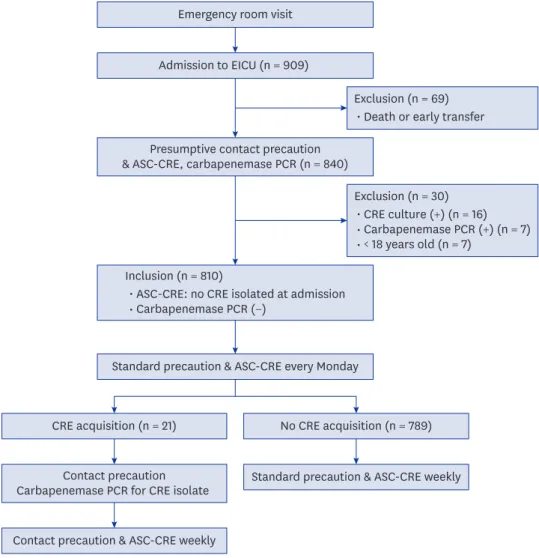
We conducted a retrospective analysis on patients aged ≥ 18 years who were admitted to the EICU between October 15, 2016 and October 31, 2017. The study hospital is an acute care, university-affiliated and tertiary hospital with around 1,400 beds, and 8 different ICUs (emergency, medical, surgical, neurosurgical, cerebrovascular, and 3 traumatic ICUs) in the Southeastern region of Korea. Per the Ministry of Health and Welfare regulations, only patients in the emergency room can be admitted to the EICU; therefore, all patients admitted to the EICU came from home or were transferred from other hospitals or long-term care facilities. Upon admission, empirical contact precautions were applied in all patients, ASC- CRE was performed by collecting rectal swabs for culturing, and real-time polymerase chain reaction (PCR) was performed to detect carbapenemase-producing Enterobacteriaceae (Fig. 1).
Rectal swab samples were collected every Monday until ICU discharge and were tested for CRE. Patients who had CRE detected by culture or by carbapenemase gene expression via
PCR at the time of admission were excluded from this study (Fig. 1). The primary outcome was CRE acquisition in the ICU. The secondary outcome was in-hospital mortality.
Data collection and analysis
Demographic and clinical information was collected from electronic medical records, including age, gender, comorbidities, prior exposure to healthcare facilities within one year (history of admission, regular visit to outpatient clinic or surgery), colonization or infection with multidrug resistant organisms (MDROs) including methicillin-resistant Staphylococcus aureus, multidrug-resistant Acinetobacter baumannii (MRAB), multidrug-resistant Pseudomonas aeruginosa (MRPA), vancomycin-resistant Enterococcus, or extended-spectrum β-lactamases- producing bacteria (ESBL), comorbidities, use of medical devices (central venous catheter, ventilator, indwelling urinary catheter, or nasogastric tube) during the period at risk for CRE, exposure (≥ 1 day) to any antimicrobials in the past 30 days before the admission, ICU length of stay, hospital length of stay, and in-hospital mortality. In addition, the Acute Physiology and Chronic Health Evaluation II (APACHE II) score was calculated from clinical data for adult patients on admission, as a marker of disease severity.
Emergency room visit Admission to EICU (n = 909)
No CRE acquisition (n = 789) Presumptive contact precaution
& ASC-CRE, carbapenemase PCR (n = 840)
Standard precaution & ASC-CRE every Monday
Standard precaution & ASC-CRE weekly
Contact precaution & ASC-CRE weekly CRE acquisition (n = 21)
Contact precaution Carbapenemase PCR for CRE isolate
Exclusion (n = 30)
• CRE culture (+) (n = 16)
• Carbapenemase PCR (+) (n = 7)
• < 18 years old (n = 7) Exclusion (n = 69)
• Death or early transfer
Inclusion (n = 810)
• ASC-CRE: no CRE isolated at admission
• Carbapenemase PCR (−)
Fig. 1. Study design for the ASC-CRE among patients admitted to the EICU in an acute care hospital in non- endemic area.
CRE = carbapenem-resistant Enterobacteriaceae, ASC-CRE = active surveillance culture of carbapenem-resistant Enterobacteriaceae, EICU = emergency intensive care unit, PCR = polymerase chain reaction.
Microbiological methods and definitions
ASC-CRE was performed by collecting rectal swabs according to modified protocols from the CDC.19 Each rectal swab was inoculated in 5 mL trypticase soy broth (Becton Dickinson, Heidelberg, Germany) containing a 10-μg ertapenem or meropenem disk (BIO-RAD, Hercules, CA, USA) and incubated overnight at 35°C in ambient air. The trypticase soy broth was vortexed and 100 μL was subcultured onto a MacConkey agar plate (Asan Pharmaceutical, Seoul, Korea). All lactose-fermenting colonies were identified by matrix assisted laser desorption ionization-time of flight mass spectrometry (Bruker Daltonics, Bremen, Germany). CRE colonization was defined if carbapenem non-susceptible Enterobacteriaceae was identified in rectal swab specimens. Carbapenem nonsusceptibility was confirmed when zone diameter on disk diffusion testing was < 23 mm for meropenem or < 21 mm for ertapenem by the Clinical Laboratory and Standards Institute M100-S26.20 To detect carbapenemase-producing Enterobacteriaceae, a PCR assay was performed to detect five carbapenemase genes (blaNDM, blaKPC, blaVIM, blaIMP-1, and blaOXA-48) using either real-time PCR (Xpert® Carba-R; Cepheid, Sunnyvale, CA, USA), or an in-house conventional multiplex PCR.9,19 Invasive CRE infection was defined as CRE isolated from normally sterile specimens or CRE isolated from any given body site except rectal swab or stool that was associated with clinical infection.
Statistical analysis
All statistical analyses were performed using IBM SPSS Statistics, version 25.0 (IBM Corp., Armonk, NY, USA). All continuous variables were summarized as means and standard deviations, and categorical variables were described using frequencies and percentiles.
Categorical variables were compared using Pearson's χ2 test or Fisher's exact test, whereas non-categorical variables were tested using a t-test. Multivariate analysis was performed for variables with P < 0.1 in univariate analysis. Independent risk factors of CRE acquisition were evaluated using logistic regression. The risk factors of in-hospital mortality were analyzed using Cox proportional hazard regression. All results were considered significant at P < 0.05.
Ethics statement
All patients admitted to the EICU received informed consents for ASC-CRE according to the hospital infection control policy. The present study protocol was reviewed and approved by the Institutional Review Board (IRB) of Pusan National University Hospital (IRB No. 1802- 005-063), and the requirement for obtaining informed consent was waived because of the study's retrospective design.
RESULTS
During the study period of 12.5 months, a total of 909 patients were admitted to the EICU, and 840 patients underwent ASC-CRE testing. Specimens from the other 69 patients could not be collected because of death or early transfer. In total, 810 patients met the inclusion criteria and they contributed 4,838 person-days in EICU (Table 1). Thirty patients were excluded; 23 patients had positive CRE culture or carbapenemase-positive PCR at admission, and 7 patients were aged < 18 years (Fig. 1). The median age of the patients was 66 years (range, 18–105), and 499 (61.6%) patients were men. In total, 131 (16.1%) patients had cardiovascular disease, and 252 (31.1%) had diabetes (Table 2). Overall, the CRE acquisition rate was 2.6% (Table 1). The incidence of CRE acquisition in the ICU was 4.3/1,000 person-days. The median length of ICU stays from ICU admission to the 1st CRE detection in CRE acquisition group was 10 days (range, 3–60) (Fig. 2). There were no cases of invasive CRE infection.
In the 21 CRE-colonized patients, 22 CRE isolates were identified, with one patient colonized with both K. pneumoniae and Escherichia coli (Table 1). The most common CRE isolate was K. pneumoniae (72.7%). Carbapenemase-producing CRE comprised 42.9% (9/22) of CRE isolates and included blaKPC and blaNDM.
Men gender and old age were frequent among those who colonized CRE during ICU
admission “CRE acquisition” (Table 2). They also had a higher APACHE II score at admission, and were frequently co-colonized with MRAB, MRPA, and ESBL. Device usage and previous antibiotic use were more frequent in the CRE acquisition group.
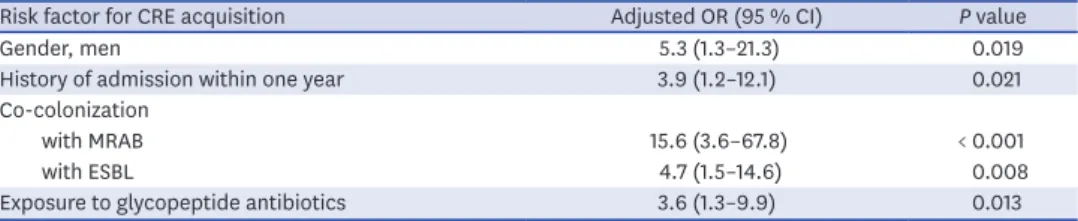
In the multivariate analysis, men gender (adjusted odds ratio [aOR], 5.3; 95% confidence interval [CI], 1.3–21.3), history of admission within one year (aOR, 3.9; 95% CI, 1.2–12.1), co- colonization with MRAB (aOR, 15.6; 95% CI, 3.6–67.8) and ESBL (aOR, 4.7; 95% CI, 1.5–14.6), and exposure to glycopeptide antibiotics (aOR, 3.6; 95% CI, 1.3–9.9) were independent risk factors of CRE acquisition during ICU admission (Table 3).
Of the 810 study subjects, the average hospitalization period was 16.9 ± 20.3; 85 (10.5%) patients died during the admission. Compared to the non-CRE acquisition group, the CRE acquisition group had longer lengths of ICU and hospital stay and a higher proportion in- hospital mortality (Table 2). However, CRE acquisition was not an independent risk factor for in-hospital mortality (P = 0.109) (Supplementary Table 1).
DISCUSSION
The present study investigated the prevalence of and risk factors for CRE acquisition through active CRE surveillance in the EICU at a tertiary hospital in Korea, which is a non- endemic area. Most of the patients admitted to the ICU in the emergency room come from communities that are considered to be at a low risk for MDROs. The prevalence of CRE Table 1. Incidence rate of CRE and microbiologic characteristics of isolates
Characteristics No. (%)
CRE carriage rate on admission in adults 2.8 (23/833)
The acquisition rate of CRE 2.6 (21/810)
Carbapenemase-producing CRE 42.9 (9/21)
Total duration in ICU, person/day 4,838
The incidence of CRE acquisition in ICU, person/day 4.3/1,000
Length of ICU stay from ICU admission to the 1st CRE detection, median (range), day 10 (3–60) Species of CRE isolates
K. pneumoniae 16 (72.7)
E. coli 2 (9.1)
Enterobacter aerogenes 2 (9.1)
Enterobacter cloacae 1 (4.5)
Citrobacter freundii 1 (4.5)
Carbapenemase types
KPC 7 (77.8)
K. pneumoniae 6 (66.7)
E. cloacae 1 (11.1)
NDM 2 (22.2)
E. coli 1 (11.1)
C. freundii 1 (11.1)
CRE = Carbapenem-resistant Enterobacteriaceae, ICU = intensive care unit, KPC = Klebsiella pneumoniae carbapenemases, NDM = New Delhi metallo-β-lactamase.
colonization among adult patients at the time of admission was 2.8% (23/833). The CRE acquisition rate, and incidence in patients admitted to the ICU were 2.6%, and 4.3/1,000 person-days, respectively. In the CRE acquisition group, APACHE II Score was higher, and the proportion of patients who needed additional antibiotic exposure and invasive treatments Table 2. Baseline characteristics and outcomes of 810 patients admitted in ICU with CRE acquisition and without CRE acquisition
Characteristics CRE acquisition (n = 21) No CRE acquisition (n = 789) P value
Baseline characteristics
Age, yr 69.7 ± 10.9 63.6 ± 16.3 0.020
Gender, men 18 (85.7) 481 (61.0) 0.021
Comorbidities
Cardiovascular disease 4 (19.0) 129 (16.3) 0.764
Hypertension 11 (52.4) 336 (42.6) 0.371
Heart failure 4 (19.0) 116 (14.7) 0.536
COPD or chronic lung disease 1 (4.8) 69 (8.7) 1.000
Cerebrovascular accident 6 (28.6) 125 (15.8) 0.131
Dementia 1 (4.8) 51 (6.5) 1.000
Diabetes 7 (33.3) 245 (31.1) 0.824
Liver disease 2 (9.5) 58 (7.4) 0.664
Chronic kidney disease 2 (9.5) 61 (7.7) 0.675
Solid tumor 2 (9.5) 83 (10.5) 1.000
Hematologic malignancy 2 (9.5) 13 (1.6) 0.055
Immunosuppressive treatment 1 (4.8) 22 (2.8) 0.458
HIV/AIDS 0 (0.0) 4 (0.5) 1.000
APACHE II Score 21.4 ± 7.1 16.4 ± 7.5 0.003
Co-colonization with MDROs
MRSA 1 (4.8) 23 (2.9) 0.473
MRAB 5 (23.8) 10 (1.3) < 0.001
MRPA 2 (9.5) 8 (1.0) 0.025
ESBL 7 (33.3) 39 (4.9) < 0.001
VRE 1 (4.8) 7 (0.9) 0.190
Devices during time at risk
Central venous catheter 20 (95.2) 411 (52.1) < 0.001
Ventilator 12 (57.1) 301 (38.1) 0.078
Indwelling urinary catheter 21 (100.0) 670 (84.9) 0.058
Nasogastric tube 13 (61.9) 355 (45.0) 0.125
Antibiotic exposure in the preceding 30 days
Extended spectrum penicillin 10 (47.6) 189 (24.0) 0.013
3rd/4th cephalosporin 10 (47.6) 225 (28.5) 0.057
Carbapenem 11 (52.4) 114 (14.4) < 0.001
Fluoroquinolone 14 (66.7) 237 (30.0) < 0.001
Colistin 3 (14.3) 6 (0.8) 0.001
Tigecycline 1 (4.8) 1 (0.1) 0.051
Aminoglycosides 2 (9.5) 14 (1.8) 0.062
Metronidazole 4 (19.0) 69 (8.7) 0.112
Clindamycin 4 (19.0) 97 (12.3) 0.319
Glycopeptide 11 (52.4) 84 (10.6) < 0.001
Prior exposure to healthcare facilities within one year
Hospital admission 16 (76.2) 277 (35.1) < 0.001
Regular visits to outpatient clinics 6 (28.6) 116 (14.7) 0.112
Surgery 3 (14.3) 109 (13.8) 1.000
Length of stay in ICU and hospital
Length of ICU stay, day 24.5 ± 24.2 5.5 ± 5.7 0.002
Length of hospital stay, day 34.0 ± 22.6 16.5 ± 20.1 < 0.001
In-hospital mortality 7 (33.3) 78 (9.9) 0.004
Data are presented as mean ± standard deviation or number (%).
CRE = carbapenem-resistant Enterobacteriaceae, COPD = chronic obstructive pulmonary disease, HIV/AIDS = human immunodeficiency virus infection and acquired immune deficiency syndrome, APACHE II = acute physiology and chronic health evaluation II, MDROs = multidrug resistant organisms, MRSA = methicillin-resistant Staphylococcus aureus, MRAB = multi-drug resistant Acinetobacter baumannii, MRPA = multidrug-resistant Pseudomonas aeruginosa, VRE
= vancomycin-resistant Enterococcus, ESBL = extended-spectrum beta-lactamase-producing bacteria, ICU = intensive care unit.
was higher. The independent risk factors of CRE acquisition during ICU admission were men gender, history of admission within one year, co-colonization with MRAB and ESBL, and expose to glycopeptide antibiotics. In CRE acquisition group, length of ICU and hospital stay was longer and in-hospital mortality was higher. To our knowledge, this is the first report to assess the risk factors for CRE acquisition during ICU stay by conducting weekly ASC-CRE in a non-endemic region.
Infection with MDROs is increasing worldwide,21 and of the MDROs, CRE infections are a specific threat to public health.1-3,10,16,22 In United States, the reported incidence of CRE infection is 2.93/100,000 people.2 One study in Brazil reported a CRE colonization rate of 6.8% at admission, and a CRE acquisition rate of 18% in patients admitted to the emergency room.23 The carbapenem-resistant K. pneumoniae (CRKP) acquisition rate during the ICU stay ranged from 27%–72.6% in endemic areas.10,24 Asia has been reported to have a low CRE incidence; however, it is increasing. In China, the overall CRE infection incidence was 4/10,000 discharges.3 Furthermore, in Korea, there have been sporadic outbreaks and episodes of CRE.1 In one study, the prevalence of CRE carriers at admission was 0.3% (1/347), and the CRE acquisition rate was 2.9% (4/140) in the ICU of a tertiary university hospital.17 Another study in 2013 showed a CRE prevalence of 7.5% (3/40) in the rectal swab cultures of patients admitted to the ICU of a tertiary university hospital.25 The carbapenem-resistance rate of E. coli and K. pneumoniae blood isolates were reported as around 0.1% and 1.0%–1.3%, respectively, according to Korea-Global AMR Surveillance System.26 Our study showed that the rate of CRE colonization on admission, and the acquisition rate during the ICU stay were 2.8%, and 2.6%, respectively, revealing that Korea is no longer an area with low CRE prevalence.
0 4
No. of patients
Length of ICU stay to the 1st CRE detection, day 3
1 2
7 14 21 28 56 63 70
Fig. 2. Length of ICU stay from ICU admission to the 1st CRE detection (days) in patients with CRE acquisition.
ICU = intensive care unit, CRE = carbapenem-resistant Enterobacteriaceae.
Table 3. Multivariate analysis of risk factors for CRE acquisition in 810 patients admitted in intensive care unit
Risk factor for CRE acquisition Adjusted OR (95 % CI) P value
Gender, men 5.3 (1.3–21.3) 0.019
History of admission within one year 3.9 (1.2–12.1) 0.021
Co-colonization
with MRAB 15.6 (3.6–67.8) < 0.001
with ESBL 4.7 (1.5–14.6) 0.008
Exposure to glycopeptide antibiotics 3.6 (1.3–9.9) 0.013
CRE = Carbapenem-resistant Enterobacteriaceae, OR = odds ratio, CI = confidence interval, MRAB = multi-drug resistant Acinetobacter baumannii, ESBL = extended-spectrum beta-lactamase-producing bacteria.
Previous reported risk factors of CRE colonization include prior exposure to healthcare facilities (an ICU stay, hospitalization, and regular visits to the outpatient department), pulmonary disease, liver disease, immunosuppression, prior antimicrobial exposures, previous use of carbapenem, β-lactams/β-lactamase inhibitors, penicillin and glycopeptide, days of antibiotic therapy, and indwelling devices (vascular catheter, and mechanical ventilation).12,17,23,27-29 In addition, CRKP infections are associated with high mortality rates.12,30 There have been a few studies on the risk factors for CRKP colonization and acquisition in endemic areas. A study in Israel reported that independent risk factors for CRKP acquisition included recent surgery, and Sequential Organ Failure Assessment score.10 In Greece, risk factors for infection with K. pneumoniae carbapenemase-producing KP (KPC- KP) during ICU stay were men gender, previous bed occupant who was colonized with KPC-KP, nearby beds colonized with KPC-KP, tracheotomy, invasive catheterization, and number of antibiotics.24 In our study, 72.7% of the CRE isolates that were acquired comprised K. pneumoniae, and KPC-KP comprised 28.6% (6/21). The presence of invasive devices was not identified as independent risk factors for CRE acquisition. Independent predictors for the acquisition of CRE in ICU patients were men gender, previous admission, co-colonization with MRAB and ESBL, and expose to glycopeptide antibiotics.
Rectal colonization with CRE has been identified as an important risk factor for the development of CRE infection. In a recent meta-analysis, approximately 16.5% of CRE colonization cases were reported to be of an invasive nature.15 CRE-colonized patients had a 10.8-fold higher risk of CRE infection than in non-colonized patients.6 However, active surveillance is limited in terms of cost-effectiveness for all patients, especially in CRE non- endemic areas. Ben-David et al.13 reported that 52% of patients with CRKP infection or
colonization were identified by screening culture, and active surveillance testing was effective in reducing hospital transmission in high-risk patients.13,15 Ho et al.14 revealed that ASC-CRE was highly cost effective in reducing the CRE infection rate and mortality in a non-endemic area.
Hwang et al.31 reported that CRE active surveillance was not effective in patients transferred from long-term care facilities to a tertiary hospital located in Gyeonggi province, a mid- west province in Korea. However, the CRE incidence in Korea varied. In June 2017, CRE was classified as a notifiable infectious disease in Korea. The CRE incidence rate in Busan, Southeastern province, where this study hospital is located, was reported as 24.25/100,000 in 2017.32 The CRE incidence rate in Gyeonggi province was reported as 6.43/100,000 in 2017.
This study had several limitations. First, despite a study period of more than one year, only 21 (2.6%) patients were found to contract CRE. Therefore, there are some limitations to the application of risk factors in the CRE endemic area. Second, we analyzed the association between CRE acquisition and in-hospital mortality rate. However, all-cause mortality and CRE infection from CRE colonization through long-term follow up were not evaluated.
Third, ASC-CRE was performed together with carbapenemase PCR to increase the sensitivity of CRE detection at admission, but the follow-up was only performed by CRE culture. The sensitivity of CRE culture by CDC protocol is about 85% (58%–96%),33 so we cannot exclude the presence of false negative CRE culture. Fourth, patients with CRE colonization can act as reservoirs for transmission of CRE to other patients, resulting in carriage, infection, or outbreak. ASC-CRE is an important measure for early detection of these reservoirs, such that they can be isolated by applying contact precaution.34 However, we did not analyze whether the incidence of CRE outbreak was decreased than the introduction of ASC-CRE.
In conclusion, CRE acquisition rate, and incidence were 2.6%, and 4.3/1,000 person- days, respectively, during ICU stay in the emergency department in a non-endemic area.
Men gender, history of admission within one year, co-colonization with MRAB and ESBL, and expose to glycopeptide antibiotics were risk factors for CRE acquisition during ICU admission. The identification of patients with risk factors for CRE acquisition and early detection of CRE acquisition using ASC-CRE may be useful for CRE control. Further studies on targeted screening strategies based on a risk prediction model for CRE acquisition and its effect on prevention of CRE outbreaks or invasive infections are needed.
ACKNOWLEDGMENTS
We express our gratitude to Infection Control Team in Pusan National University Hospital for their assistance in data collection. The results of this study were presented at ID Week 2018 in San Francisco, CA, USA on 3–7 October 2018 (Abstract No. 1250).
SUPPLEMENTARY MATERIAL
Supplementary Table 1
Risk factors for in-hospital mortality in 810 patients admitted to emergency intensive care unit Click here to view
REFERENCES
1. Logan LK, Weinstein RA. The epidemiology of carbapenem-resistant Enterobacteriaceae: the impact and evolution of a global menace. J Infect Dis 2017;215 (suppl_1):S28-36.
PUBMED | CROSSREF
2. Livorsi DJ, Chorazy ML, Schweizer ML, Balkenende EC, Blevins AE, Nair R, et al. A systematic review of the epidemiology of carbapenem-resistant Enterobacteriaceae in the United States. Antimicrob Resist Infect Control 2018;7(1):55.
PUBMED | CROSSREF
3. Zhang Y, Wang Q, Yin Y, Chen H, Jin L, Gu B, et al. Epidemiology of carbapenem-resistant Enterobacteriaceae infections: report from the China CRE network. Antimicrob Agents Chemother 2018.62(2):e01882-17.
PUBMED
4. Tamma PD, Goodman KE, Harris AD, Tekle T, Roberts A, Taiwo A, et al. Comparing the outcomes of patients with carbapenemase-producing and non-carbapenemase-producing carbapenem-resistant Enterobacteriaceae bacteremia. Clin Infect Dis 2017;64(3):257-64.
PUBMED | CROSSREF
5. Dickstein Y, Edelman R, Dror T, Hussein K, Bar-Lavie Y, Paul M. Carbapenem-resistant Enterobacteriaceae colonization and infection in critically ill patients: a retrospective matched cohort comparison with non- carriers. J Hosp Infect 2016;94(1):54-9.
PUBMED | CROSSREF
6. McConville TH, Sullivan SB, Gomez-Simmonds A, Whittier S, Uhlemann AC. Carbapenem-resistant Enterobacteriaceae colonization (CRE) and subsequent risk of infection and 90-day mortality in critically ill patients, an observational study. PLoS One 2017;12(10):e0186195.
PUBMED | CROSSREF
7. Morrill HJ, Pogue JM, Kaye KS, LaPlante KL. Treatment options for carbapenem-resistant Enterobacteriaceae infections. Open Forum Infect Dis 2015;2(2):ofv050.
PUBMED | CROSSREF
8. Lerner A, Adler A, Abu-Hanna J, Meitus I, Navon-Venezia S, Carmeli Y. Environmental contamination by carbapenem-resistant Enterobacteriaceae. J Clin Microbiol 2013;51(1):177-81.
PUBMED | CROSSREF
9. Centers for Disease Control and Prevention. Facility guidance for control of carbapenem-resistant Enterobacteriaceae (CRE)-November 2015 update CRE toolkit. https://www.cdc.gov/hai/organisms/cre/cre- toolkit. Updated 2015. Accessed July 20, 2018.
10. Debby BD, Ganor O, Yasmin M, David L, Nathan K, Ilana T, et al. Epidemiology of carbapenem resistant Klebsiella pneumoniae colonization in an intensive care unit. Eur J Clin Microbiol Infect Dis 2012;31(8):1811-7.
PUBMED | CROSSREF
11. Chiotos K, Tamma PD, Flett KB, Naumann M, Karandikar MV, Bilker WB, et al. Multicenter study of the risk factors for colonization or infection with carbapenem-resistant Enterobacteriaceae in children.
Antimicrob Agents Chemother 2017;61(12):e01440-17.
PUBMED | CROSSREF
12. Papadimitriou-Olivgeris M, Marangos M, Fligou F, Christofidou M, Bartzavali C, Anastassiou ED, et al.
Risk factors for KPC-producing Klebsiella pneumoniae enteric colonization upon ICU admission. J Antimicrob Chemother 2012;67(12):2976-81.
PUBMED | CROSSREF
13. Ben-David D, Maor Y, Keller N, Regev-Yochay G, Tal I, Shachar D, et al. Potential role of active surveillance in the control of a hospital-wide outbreak of carbapenem-resistant Klebsiella pneumoniae infection. Infect Control Hosp Epidemiol 2010;31(6):620-6.
PUBMED | CROSSREF
14. Ho KW, Ng WT, Ip M, You JH. Active surveillance of carbapenem-resistant Enterobacteriaceae in intensive care units: is it cost-effective in a nonendemic region? Am J Infect Control 2016;44(4):394-9.
PUBMED | CROSSREF
15. Tischendorf J, de Avila RA, Safdar N. Risk of infection following colonization with carbapenem-resistant Enterobacteriaceae: a systematic review. Am J Infect Control 2016;44(5):539-43.
PUBMED | CROSSREF
16. Park JW, Lee E, Lee SJ, Lee H. Status of carbapenemase-producing Enterobacteriaceae incidences in Korea, 2015-2016. Public Health Wkly Rep 2017;10(46):1243-7.
17. Lee HJ, Choi JK, Cho SY, Kim SH, Park SH, Choi SM, et al. Carbapenem-resistant Enterobacteriaceae:
prevalence and risk factors in a single community-based hospital in Korea. Infect Chemother 2016;48(3):166-73.
PUBMED | CROSSREF
18. Kim JO, Song SA, Yoon EJ, Shin JH, Lee H, Jeong SH, et al. Outbreak of KPC-2-producing Enterobacteriaceae caused by clonal dissemination of Klebsiella pneumoniae ST307 carrying an IncX3-type plasmid harboring a truncated Tn4401a. Diagn Microbiol Infect Dis 2017;87(4):343-8.
PUBMED | CROSSREF
19. Centers for Disease Control and Prevention. Laboratory protocol for detection of carbapenem-resistant or carbapenemase-producing, Klebsiella spp. and E. coli from rectal swabs. https://pdfs.semanticscholar.
org/19e7/0fac8709331116cef737b962b976849ac5ac.pdf ?_ga=2.130801487.1593274680.1556868694- 1639565457.1523318026. Updated 2009. Accessed July 30, 2018.
20. Wayne P; Clinical and Laboratory Standards Institute. Performance Standards for Antimicrobial Susceptibility Testing. 26th ed. Wayne, PA: Clinical and Laboratory Standards Institute; 2016.
21. van Duin D, Doi Y. The global epidemiology of carbapenemase-producing Enterobacteriaceae. Virulence 2017;8(4):460-9.
PUBMED | CROSSREF
22. Lee GC, Lawson KA, Burgess DS. Clinical epidemiology of carbapenem-resistant Enterobacteriaceae in community hospitals: a case-case-control study. Ann Pharmacother 2013;47(9):1115-21.
PUBMED | CROSSREF
23. Salomão MC, Guimarães T, Duailibi DF, Perondi MB, Letaif LS, Montal AC, et al. Carbapenem-resistant Enterobacteriaceae in patients admitted to the emergency department: prevalence, risk factors, and acquisition rate. J Hosp Infect 2017;97(3):241-6.
PUBMED | CROSSREF
24. Papadimitriou-Olivgeris M, Marangos M, Fligou F, Christofidou M, Sklavou C, Vamvakopoulou S, et al. KPC- producing Klebsiella pneumoniae enteric colonization acquired during intensive care unit stay: the significance of risk factors for its development and its impact on mortality. Diagn Microbiol Infect Dis 2013;77(2):169-73.
PUBMED | CROSSREF
25. Kim DK, Kim HS, Pinto N, Jeon J, D'Souza R, Kim MS, et al. Xpert CARBA-R assay for the detection of carbapenemase-producing organisms in intensive care unit patients of a Korean tertiary care hospital.
Ann Lab Med 2016;36(2):162-5.
PUBMED | CROSSREF
26. Lee H, Yoon EJ, Kim D, Jeong SH, Won EJ, Shin JH, et al. Antimicrobial resistance of major clinical pathogens in South Korea, May 2016 to April 2017: first one-year report from Kor-GLASS. Euro Surveill 2018;23(42):1800047.
PUBMED | CROSSREF
27. Swaminathan M, Sharma S, Poliansky Blash S, Patel G, Banach DB, Phillips M, et al. Prevalence and risk factors for acquisition of carbapenem-resistant Enterobacteriaceae in the setting of endemicity. Infect Control Hosp Epidemiol 2013;34(8):809-17.
PUBMED | CROSSREF
28. Bhargava A, Hayakawa K, Silverman E, Haider S, Alluri KC, Datla S, et al. Risk factors for colonization due to carbapenem-resistant Enterobacteriaceae among patients exposed to long-term acute care and acute care facilities. Infect Control Hosp Epidemiol 2014;35(4):398-405.
PUBMED | CROSSREF
29. Ling ML, Tee YM, Tan SG, Amin IM, How KB, Tan KY, et al. Risk factors for acquisition of carbapenem resistant Enterobacteriaceae in an acute tertiary care hospital in Singapore. Antimicrob Resist Infect Control 2015;4(1):26.
PUBMED | CROSSREF
30. Patel G, Huprikar S, Factor SH, Jenkins SG, Calfee DP. Outcomes of carbapenem-resistant Klebsiella pneumoniae infection and the impact of antimicrobial and adjunctive therapies. Infect Control Hosp Epidemiol 2008;29(12):1099-106.
PUBMED | CROSSREF
31. Hwang JH, Park JS, Lee E, Bae JY, Song KH, Choe PG, et al. Active surveillance for carbapenem-resistant Enterobacteriaceae, vancomycin-resistant Enterococci and toxigenic Clostridium difficile among patients transferred from long-term care facilities in Korea. J Hosp Infect 2018;99(4):487-91.
PUBMED | CROSSREF
32. Korea Centers for Disease Control & Prevention. Infectious diseases portal. http://www.cdc.go.kr/npt/biz/
npp/nppMain.do. Updated 2018. Accessed October 30, 2018.
33. Viau R, Frank KM, Jacobs MR, Wilson B, Kaye K, Donskey CJ, et al. Intestinal carriage of carbapenemase- producing organisms: current status of surveillance methods. Clin Microbiol Rev 2016;29(1):1-27.
PUBMED | CROSSREF
34. Magiorakos AP, Burns K, Rodríguez Baño J, Borg M, Daikos G, Dumpis U, et al. Infection prevention and control measures and tools for the prevention of entry of carbapenem-resistant Enterobacteriaceae into healthcare settings: guidance from the European Centre for Disease Prevention and Control. Antimicrob Resist Infect Control 2017;6(1):113.
PUBMED | CROSSREF