https://doi.org/10.5468/ogs.2020.63.2.117 pISSN 2287-8572 · eISSN 2287-8580
Introduction
Preterm delivery takes place before the 37th week of preg- nancy [1]. This type of delivery is one of the most important causes of mortality and morbidity in infants around the world [2,3]. Even, in the most developed countries, the preterm delivery rate has increased. For example, in the United States,
Determination of maternal risk factors of preterm delivery: adjusted for sparse data bias; results from a population-based case-control study in Iran
Mehrdad Valipour, PhDc
1,2, Erfan Ayubi, PhD
3, Narges Shiravand, B.S
2, Yousef Moradi, PhDc
4, Abolfazl Abbaszadeh, PhD
5, Firooz Amrai, PhDc
6, Shahin Mokhtari, B.S
2, Kaveh Bahmanpour, PhD
7, Kamyar Mansori, PhD
81Department of Epidemiology, School of Public Health, Iran University of Medical Sciences, Tehran; 2Department of Communicable Disease Control and Prevention, Deputy of Health, Lorestan University of Medical Sciences, Khorramabad; 3Department of Community Medicine, School of Medicine, Zahedan University of Medical Sciences, Zahedan; 4Department of Epidemiology, School of Public Health, Iran University of Medical Sciences, Tehran;
5Lorestan University of Medical Sciences, Khorramabad; 6South Tehran Branch, Islamic Azad University, Tehran; 7Department of Nursing and Midwifery, Sanandaj Branch, Islamic Azad University, Sanandaj; 8Department of Biostatistics and Epidemiology, School of Medicine, Zanjan University of Medical Sciences, Zanjan, Iran
Objective
To determine the maternal risk factors associated with preterm delivery in Iran.
Methods
A population-based case-control study was conducted including 48 women having preterm delivery (case group) and 100 women having term delivery (control group) between March 2007 and March 2012 in the maternity hospitals of the Selseleh County, Lorestan province, Iran. Information regarding maternal risk factors was collected by structured interview and reviewing the medical records. The maternal risk factors associated with preterm delivery were identified using univariate and multivariable logistic regression analysis after adjusting the sparse data bias. The area under the receiver operating characteristic (ROC) curves was estimated to evaluate the discrimination power of the statistical models.
Results
Multivariable analysis demonstrated that multiparty (odds ratio [OR], 14.23; 95% confidence interval [CI], 1.60–127.05), history of gestational diabetes (OR, 0.10; 95% CI, 0.01–0.99), thyroid dysfunction (OR, 97.32; 95% CI, 5.78–1,637.80), urinary tract infection (OR, 16.60; 95% CI, 3.20–85.92), and taking care during pregnancy (OR, 0.12; 95% CI, 0.03–0.50) had significant impact on preterm delivery after adjusting the potential confounders. The area under the ROC curve for the aforementioned maternal risk factors was 0.86 (95% CI, 0.80–0.92).
Conclusion
Our study provides evidence for the associations between multiparty, history of gestational diabetes, thyroid dysfunction, urinary tract infection, as well as taking care during pregnancy, and preterm delivery.
Keywords:
Pregnancy; Risk factors; Premature delivery;
Case-control studies; Iran
Received: 2019.04.25. Revised: 2019.06.16. Accepted: 2019.07.16.
Corresponding author: Kamyar Mansori, PhD
Department of Biostatistics and Epidemiology, School of Medicine, Zanjan University of Medical Sciences, Zanjan, Iran
E-mail: [email protected] https://orcid.org/0000-0003-3527-4741
Articles published in Obstet Gynecol Sci are open-access, distributed under the terms of the Creative Commons Attribution Non-Commercial License (http://creativecommons.
org/licenses/by-nc/3.0/) which permits unrestricted non-commercial use, distribution, and reproduction in any medium, provided the original work is properly cited.
Copyright © 2020 Korean Society of Obstetrics and Gynecology
it has risen from 9.5% in 1981 to 12.7% in 2005 [4]. In Eu- rope and other developed countries, the estimated preterm delivery rate is about 5–9% [5,6]. Preterm delivery is also responsible for 17–34% of deaths in infants in the first year of life in the United States [7]. However, almost 90% of the preterm deliveries occur in the developing countries of which 85% take place in Asia and Africa [8]. In Iran, as a develop- ing country, the preterm delivery rate was estimated between 5.6% and 13.4% based on the geographical regions under study [9]. Preterm birth causes 75% of perinatal deaths and over 50% of the preterm babies have long-term morbidities.
Many preterm infants are at increased risk of death, different diseases, and disabilities, such as developmental disorders of the nervous and respiratory system, defect in sense, learn- ing disability, digestive complications, and many other health problems [10,11].
Given the worrying trend of preterm delivery throughout the world and its related outcomes, it seems that studying the causes and risks of these factors is very important [8,12].
Factors causing preterm birth have not been fully identified yet, however, various studies have considered different fac- tors in the etiology of this outcome [13]. Some studies in this regard have mentioned the following factors as possible causes of preterm birth: genetic factors, rupture of mem- branes, hypertension, diabetes, multiparity, multiple births, techniques of infertility treatment, elective Caesarean section during previous pregnancies, smoking and alcohol consump- tion during pregnancy, mental disorders, and environmental exposures [8]. However, identifying the precise cause of pre- term delivery still requires further studies, especially in devel- oping countries where few studies have been conducted in this area [14].
Hence, given the importance of preterm delivery and its consequences as a major global health problem and the few studies conducted so far in Iran, the present study was designed to determine the maternal risk factors of preterm delivery in Iran. Identifying the risk factors can be an effec- tive step in preventing and controlling the consequences and complications of preterm delivery.
Materials and methods
1. Study design and subjects
This study was a population-based case-control study. Cases
included all pregnant mothers referred to the maternity wards of the Selseleh County hospitals (Lorestan province, Iran) who had preterm delivery between March 21, 2007 and March 21, 2012. The preterm delivery was defined as delivery before 37 weeks of gestation. Preterm delivery cases were identified by daily monitoring of all the new deliveries in all the maternity wards of the County hospitals. On the other hands, the preterm delivery cases were considered as incident cases. Then, for each case, two controls were selected. The controls were a selected by random sampling from all the pregnant mothers referred to the same mater- nity wards of the County hospitals who had term delivery (≥37 weeks of gestation) during the same period (±2 weeks).
In this study, mothers with premature infants due to con- genital or chromosomal anomalies were excluded.
2. Data collection
The data collection tool was a standard questionnaire. How- ever, some information was obtained through interviews with the pregnant mothers and some were gathered from the medical records. The questionnaire included information, such as demographic characteristics of the mother (age, oc- cupation, body mass index, education, etc.), past obstetric history (gestational age at delivery, history of caesarian de- livery, unwanted pregnancy, gravidity, multiparity, childbirth, etc.), complications of pregnancy and delivery (such as histo- ry of gestational diabetes, hypertension, abortion, eclampsia, placenta previa, uterine prolapse, stillbirth and etc.). The data were collected by a trained research doctor.
3. Statistical analysis
For analysis, the relevant data were entered into Stata 14.
Descriptive analyses, such as mean and standard deviation
were used for the continuous variables; and number and
relative frequency were used for the categorical variables. For
determination of the most important risk factors of preterm
delivery, univariate and multivariable logistic regression analy-
ses were performed. Then, the crude and adjusted odds ratio
(OR) with 95% confidence interval (CI) were calculated. A
large number of risk factors were evaluated, and hence, in-
adequate data for the combination of the maternal risk fac-
tors and preterm delivery (2×2 contingency table) are expect-
ed. It is argued that when there are inadequate data for the
combination of the risk factors and outcomes, the estimates,
such as OR and its CI, could be biased [15]. As a result, the
OR tends to be inflated and its CI tends to be inappropriately wide. Such bias is known as sparse data bias and it can exag- gerate the results of the multivariable analysis [15]. Penaliza- tion via data augmentation and firth bias adjustment was performed to offset the impact of sparse data bias on the results. Firth bias adjustment is a common traditional tech- nique for reducing sparse data bias in which ½ is added to each cell of a contingency table. In penalization by data aug- mentation method, a very weakly informative prior [log-F(2, 2)] was considered for the effect of the maternal risk factors (βi in logistic regression model or ORs) on the preterm deliv- ery. It is argued that very weakly informative prior provides a plausible range for the relative estimates with 95% certainty and the OR of the effect of maternal risk factors on preterm delivery falls between 1/40 and 40 [16]. The area under the receiver operating characteristic (ROC) curve was used for as- sessing the discriminative ability of the multivariable logistic regression analysis. A P-value of <0.05 was considered as statistically significant.
Results
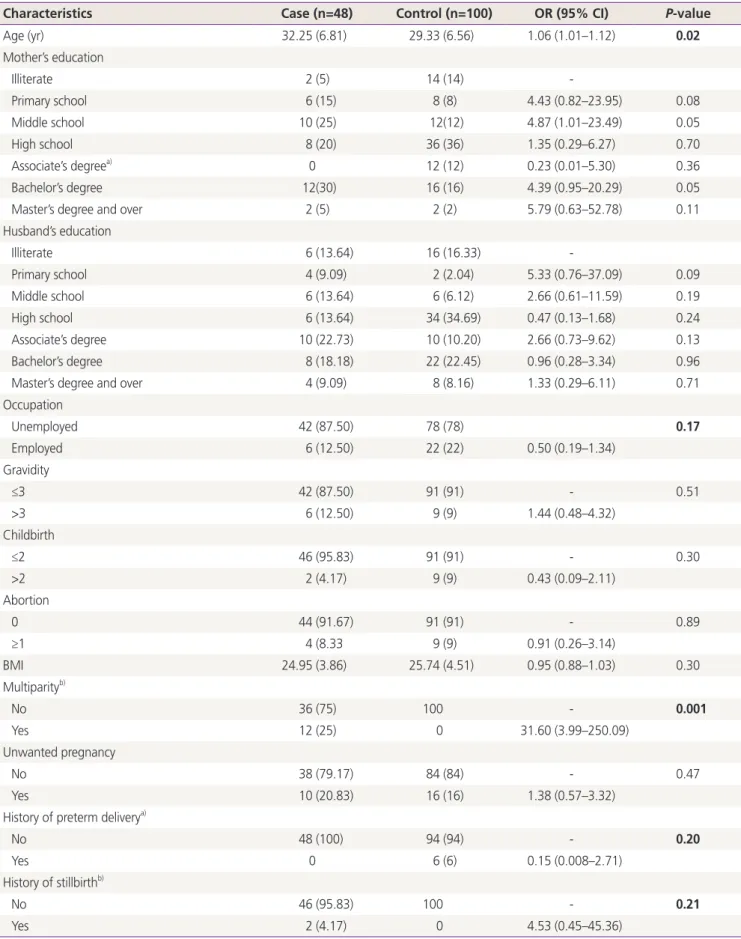
The maternal characteristics of the cases and controls, as well as the results of the univariate logistic regression analy- sis, are shown in Table 1. A total of 48 cases with preterm delivery and 100 controls were enrolled in the study. The mean (standard deviation) age of the cases was 32.25 (6.81) years and that of the controls was 29.33 (6.56) years (P=0.02).
A majority of the cases and controls had a school or lower level of education (65% vs. 70%, respectively). A majority of the cases and controls had a gravida of ≤3, history of ≤2 childbirths, and no history of abortion.
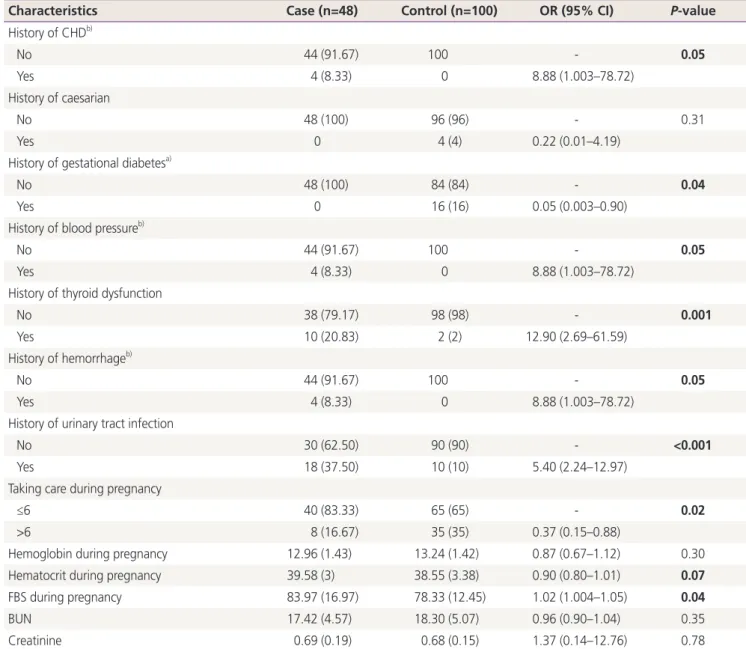
A significant difference was found between the cases and the controls regarding the multiparty, history of coronary heart disease (CHD), gestational diabetes, blood pressure, thyroid dysfunction, hemorrhage, urinary tract infection, taking care during pregnancy, and FBS level (all P≤0.05). The highest significant crude OR was found for multiparity (OR, 31.60; 95% CI, 3.99–250.09). The odds of preterm delivery was 5.40 times higher in those having a history of urinary tract infection than those without (95% CI, 2.24–12.97).
Similarly, the odds of the outcome was 2.73 times lower in the women who received ≥6 care during pregnancy from ru- ral or urban health centers than those who received <6 care
during pregnancy (OR, 0.37; 95% CI, 0.15–0.88).
The results of the multivariable logistic regression analysis are presented in Table 2. After selecting the variables with a
P-value of ≤0.20 in the univariate analysis for the multivari-able analysis, only multiparity, history of gestational diabetes, thyroid dysfunction, urinary tract infection, and taking care during pregnancy were statistically significant (P≤0.05). The highest adjusted OR was determined for a history of thyroid dysfunction (OR, 97.32; 95% CI, 5.78–1,637.80).
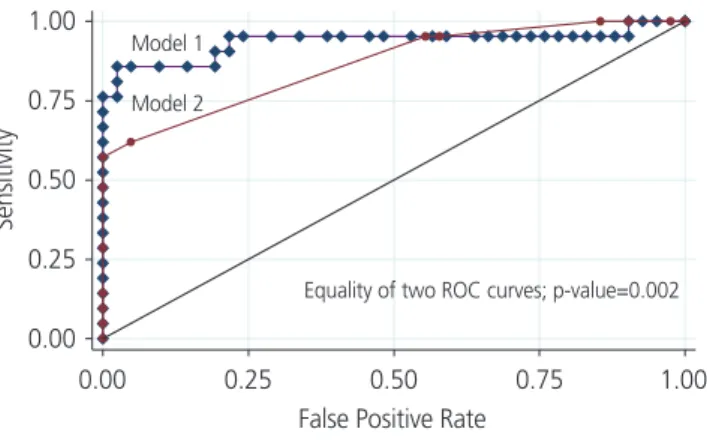
The ROC curves for model 1 with all 13 maternal character- istics included in the multivariable logistic regression analysis and for model 2 with only the significant maternal character- istics included in the multivariable logistic regression analysis are shown in Fig. 1. In analyses that compared the ability of the models to discriminate preterm labor, the ROC for model 1 was significantly greater than that of model 2 (0.93 vs. 0.86,
P=0.002).Discussion
The present study aimed to determine the maternal risk factors for preterm delivery in Iran, which was achieved by a population-based case-control study. The results of the multivariable logistic regression analysis showed that vari- ables, such as multiparity, history of gestational diabetes, thyroid dysfunction, urinary tract infection, and taking care during pregnancy had significant statistical associations with preterm delivery (P<0.05). Besides, the area under the ROC curve for the significant maternal variables in the multivari- able logistic regression analysis was 0.86 (95% CI, 0.80–0.92) In the present study, mothers who received prenatal care for ≥6 times during pregnancy had a lower risk of preterm delivery as compared to those who received care for <6 times (OR, 0.12; 95% CI, 0.03–0.50). This finding has been sup- ported by various other studies in this regard [13,14,17-19].
For example, the study by Jiang et al. [13] showed that lack
of prenatal care is related to an increased risk of preterm
birth, so that the mothers without prenatal care during preg-
nancy had 5.19 times increased risk of preterm birth (OR,
5.19; 95% CI, 3.77, -7.14); and mothers with irregular pre-
natal care had 2.87 times of increased risk of preterm birth
(OR, 2.87; 95% CI, 2.16-3.80). Another study performed in
Iran showed that mothers of premature infants received less
perinatal care; while with more care, the risk of premature
Table 1. Association between preterm delivery and maternal characteristics using univariate logistic regression analysis
Characteristics Case (n=48) Control (n=100) OR (95% CI) P-value
Age (yr) 32.25 (6.81) 29.33 (6.56) 1.06 (1.01–1.12) 0.02
Mother’s education
Illiterate 2 (5) 14 (14) -
Primary school 6 (15) 8 (8) 4.43 (0.82–23.95) 0.08
Middle school 10 (25) 12(12) 4.87 (1.01–23.49) 0.05
High school 8 (20) 36 (36) 1.35 (0.29–6.27) 0.70
Associate’s degreea) 0 12 (12) 0.23 (0.01–5.30) 0.36
Bachelor’s degree 12(30) 16 (16) 4.39 (0.95–20.29) 0.05
Master’s degree and over 2 (5) 2 (2) 5.79 (0.63–52.78) 0.11
Husband’s education
Illiterate 6 (13.64) 16 (16.33) -
Primary school 4 (9.09) 2 (2.04) 5.33 (0.76–37.09) 0.09
Middle school 6 (13.64) 6 (6.12) 2.66 (0.61–11.59) 0.19
High school 6 (13.64) 34 (34.69) 0.47 (0.13–1.68) 0.24
Associate’s degree 10 (22.73) 10 (10.20) 2.66 (0.73–9.62) 0.13
Bachelor’s degree 8 (18.18) 22 (22.45) 0.96 (0.28–3.34) 0.96
Master’s degree and over 4 (9.09) 8 (8.16) 1.33 (0.29–6.11) 0.71
Occupation
Unemployed 42 (87.50) 78 (78) 0.17
Employed 6 (12.50) 22 (22) 0.50 (0.19–1.34)
Gravidity
≤3 42 (87.50) 91 (91) - 0.51
>3 6 (12.50) 9 (9) 1.44 (0.48–4.32)
Childbirth
≤2 46 (95.83) 91 (91) - 0.30
>2 2 (4.17) 9 (9) 0.43 (0.09–2.11)
Abortion
0 44 (91.67) 91 (91) - 0.89
≥1 4 (8.33 9 (9) 0.91 (0.26–3.14)
BMI 24.95 (3.86) 25.74 (4.51) 0.95 (0.88–1.03) 0.30
Multiparityb)
No 36 (75) 100 - 0.001
Yes 12 (25) 0 31.60 (3.99–250.09)
Unwanted pregnancy
No 38 (79.17) 84 (84) - 0.47
Yes 10 (20.83) 16 (16) 1.38 (0.57–3.32)
History of preterm deliverya)
No 48 (100) 94 (94) - 0.20
Yes 0 6 (6) 0.15 (0.008–2.71)
History of stillbirthb)
No 46 (95.83) 100 - 0.21
Yes 2 (4.17) 0 4.53 (0.45–45.36)
delivery was reduced [18]. Perhaps more attention to risk symptoms is paid during prenatal care along with appropri- ate health and treatment advice by the health care person- nel. Hence, improving prenatal care and increasing the num- ber of care can be effective in reducing the risk of premature birth. However, this interpretation about the number of pre- natal care in the present study should be done with caution, because the low number of perinatal care in the mothers
with premature infants might be due to premature birth and consequently shorter gestational age.
In agreement with other previous studies, the results of this study showed that there was a significant statistical associa- tion between multiparity and preterm delivery after adjusting the confounding variables (OR, 14.23; 95% CI, 1.60–127.05) [13,20-23]. The study by Shoja et al. [23] indicated that the odds of preterm delivery in mothers with multiparity preg-
Characteristics Case (n=48) Control (n=100) OR (95% CI) P-value
History of CHDb)
No 44 (91.67) 100 - 0.05
Yes 4 (8.33) 0 8.88 (1.003–78.72)
History of caesarian
No 48 (100) 96 (96) - 0.31
Yes 0 4 (4) 0.22 (0.01–4.19)
History of gestational diabetesa)
No 48 (100) 84 (84) - 0.04
Yes 0 16 (16) 0.05 (0.003–0.90)
History of blood pressureb)
No 44 (91.67) 100 - 0.05
Yes 4 (8.33) 0 8.88 (1.003–78.72)
History of thyroid dysfunction
No 38 (79.17) 98 (98) - 0.001
Yes 10 (20.83) 2 (2) 12.90 (2.69–61.59)
History of hemorrhageb)
No 44 (91.67) 100 - 0.05
Yes 4 (8.33) 0 8.88 (1.003–78.72)
History of urinary tract infection
No 30 (62.50) 90 (90) - <0.001
Yes 18 (37.50) 10 (10) 5.40 (2.24–12.97)
Taking care during pregnancy
≤6 40 (83.33) 65 (65) - 0.02
>6 8 (16.67) 35 (35) 0.37 (0.15–0.88)
Hemoglobin during pregnancy 12.96 (1.43) 13.24 (1.42) 0.87 (0.67–1.12) 0.30
Hematocrit during pregnancy 39.58 (3) 38.55 (3.38) 0.90 (0.80–1.01) 0.07
FBS during pregnancy 83.97 (16.97) 78.33 (12.45) 1.02 (1.004–1.05) 0.04
BUN 17.42 (4.57) 18.30 (5.07) 0.96 (0.90–1.04) 0.35
Creatinine 0.69 (0.19) 0.68 (0.15) 1.37 (0.14–12.76) 0.78
OR, odds ratio; CI, confidence interval; BMI, body mass index; CHD, coronary heart disease; FBS, fasting blood sugar; BUN, blood urea nitro- gen. P-values ≤0.20 are bold.
a)Estimated using firth bias adjustment; b)Estimated using penalization via data augmentation with logf (2, 2).
Table 1. Continued
nancy was more than those without multiparity pregnancy (OR, 3.09; 95% CI, 1.01–9.6). This problem may be because multiparity limits the uterine space for the fetus and also causes secretion of hormones inducing delivery, and there- fore, preterm labor was more in this group.
In this study, we found a significant negative association between preterm delivery and maternal medical disorders, such as gestational diabetes (OR, 0.10; 95% CI, 0.01–1.01) after adjustment of the confounding variables. This find- ing was inconsistent with studies conducted in this field [3,14,18,24-27]. The study by Namakin et al. [18] in Iran showed that mothers with a history of gestational diabetes and hypertension had a higher risk of preterm delivery (OR, 2.99; 95% CI, 1.6–5.5). Zhang et al. [14] in China reported that women with a history of gestational diabetes have 3.44-fold increased risk of preterm birth (OR, 3.44; 95% CI, 1.69–6.99). On the other hand, several studies have shown that there no association between preterm delivery and gestational diabetes [13,28,29]. For example, a case-control study in China showed no relationship between gestational diabetes and preterm delivery [13]. Perhaps one of the rea- sons for the negative relationship in this study was the low sample size involved. However, it can be said that gestational diabetes can affect the growth and development of the fetus
during pregnancy. Particularly, during the second and third trimesters of pregnancy, maternal diabetes can lead to a high level of nutrition and fetal growth. Subsequently, a large fetus with increased bodyweight may also increase the risk of preterm delivery. Therefore, regular monitoring of blood glucose during pregnancy should be given special attention.
In the present study, there was a significant statistical as- sociation between thyroid dysfunction (OR, 97.32; 95% CI, 5.78–1,637.80) and preterm delivery in the multivariable logistic regression analysis, and this is in agreement with other previous studies [3,30-34]. A review by Nazarpour et al. [32] showed that thyroid dysfunction has adverse effects on pregnancy outcomes especially on the preterm delivery.
Another review by Stagnaro-Green [30] also suggested that hypothyroidism and autoimmune thyroid disease are associ- ated with preterm delivery in women. Given the high preva- lence of thyroid disorders in women on one hand and the hormonal changes and multiple metabolic needs occurring during pregnancy affecting the mother’s thyroid function on the other, it is recommended that all pregnant women check their thyroid gland function before trying for pregnancy to prevent adverse consequences of thyroid disorders.
Finally, in agreement with other previous studies [23,35-38], the results of our study indicated that there is a significant statistical association between the history of urinary tract in- fection and preterm delivery after adjusting the confounding variables (OR, 16.60; 95% CI, 3.20–85.92). A study by Shoja et al. [23] demonstrated that there was a significant statisti-
Table 2. Association between preterm delivery and maternal riskfactor using multivariable logistic regression analysis
Characteristics OR (95% CI) P-value
Age (yr) 0.95 (0.87–1.05) 0.37
Occupation 0.18 (0.02–1.52) 0.12
Multiparitya) 14.23 (1.60–127.05) 0.02
History of preterm deliverya) 0.21 (0.02–1.90) 0.17
History of CHDa) 1.17 (0.08–16.21) 0.90
History of gestational diabetesa) 0.10 (0.01–0.99) 0.049 History of blood pressurea) 3.99 (0.38–41.27) 0.24 History of thyroid dysfunctiona) 97.32 (5.78–1,637.80) 0.001 History of hemorrhagea) 4.16 (0.40–42.87) 0.23 History of urinary tract infection 16.60 (3.20–85.92) 0.001 Taking care during pregnancy 0.12 (0.03–0.50) 0.004 Hematocrit during pregnancy 0.90 (0.77–1.06) 0.23 FBS during pregnancy 1.02 (0.98–1.06) 0.21 OR, odds ratio; CI, confidence interval; CHD, coronary heart disease;
FBS, fasting blood sugar. P-values <0.05 are bold.
a)Estimated using penalization via data augmentation with logf (2, 2).
Fig. 1. Receiver operating characteristic (ROC) curves of model 1 (all variables in the multivariable analysis) and model 2 (significant variables in the multivariable analysis). CI, confidence interval.
Sensitivity
1.00 0.75 0.50 0.25
0.00
0.00 0.25 0.50 0.75 1.00 False Positive Rate
ROC area from model 1 (95% CI): 0.93 (0.87, 0.99) ROC area from model 2 (95% CI): 0.86 (0.80, 0.92)
Model 1 Model 2
Equality of two ROC curves; p-value=0.002